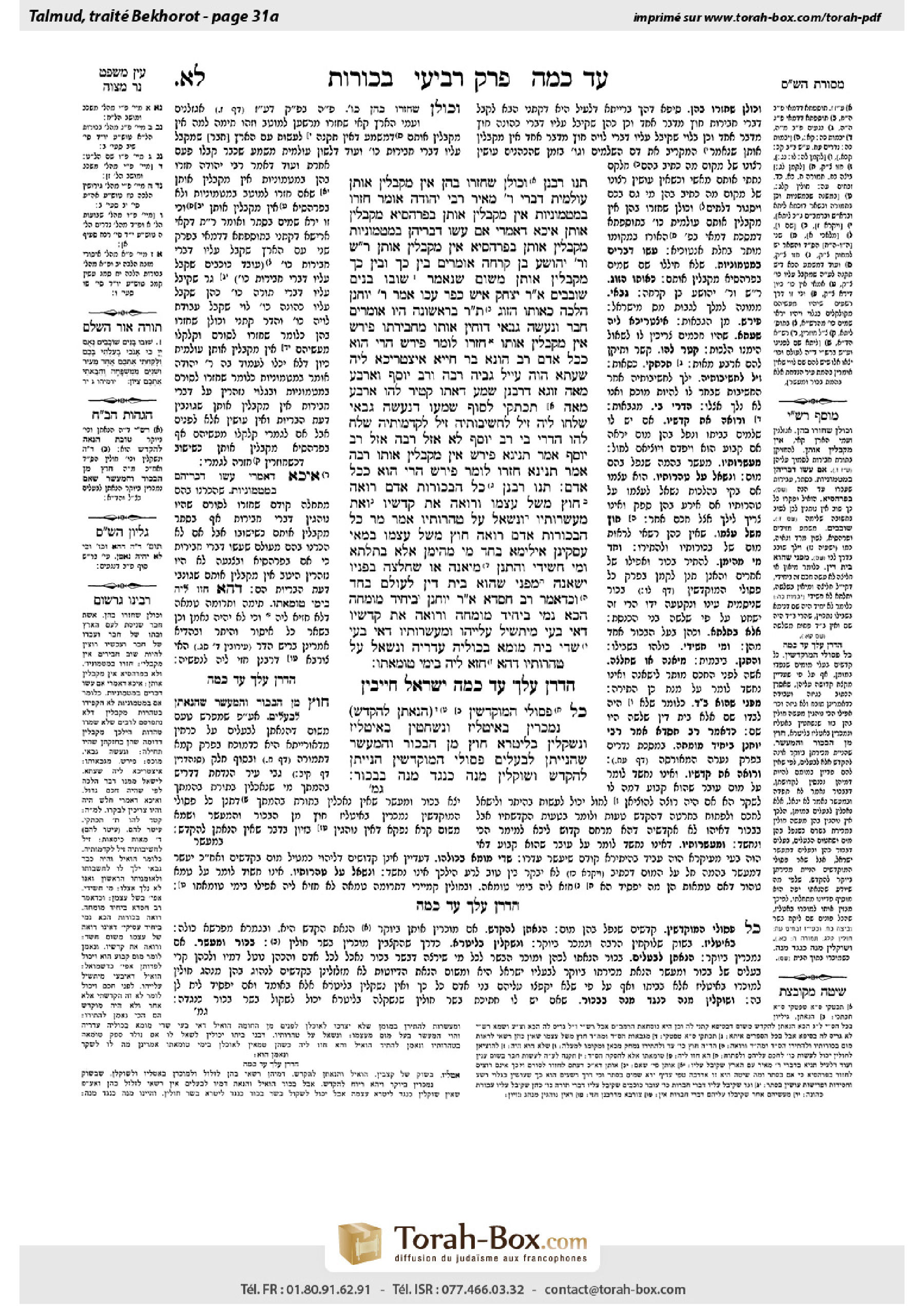
Bekhorot 31a: Talmud study for Daf Yomi
Study the Talmud for Daf Yomi with scanned pages, Hebrew text, English translations from Sefaria and AI-generated French translations.
Passage selection and English or AI-generated French translation are available where the scan has annotations. Daf Study is independent of Torah-Box and Sefaria.
Browse Bekhorot · בכורות · All tractatesBekhorot 31a text and translations
This page of Bekhorot includes the Aramaic text, an English translation and an AI-generated French translation, alongside the scan above.
בכורות ל״א א · Aramaic and Hebrew text
תָּנוּ רַבָּנַן: וְכוּלָּן שֶׁחָזְרוּ בָּהֶן אֵין מְקַבְּלִין אוֹתָן עוֹלָמִית, דִּבְרֵי רַבִּי מֵאִיר. רַבִּי יְהוּדָה אוֹמֵר: חָזְרוּ בְּמַטְמוֹנִיּוֹת — אֵין מְקַבְּלִין אוֹתָן, בְּפַרְהֶסְיָא — מְקַבְּלִין אוֹתָן.
אִיכָּא דְּאָמְרִי: אִם עָשׂוּ דִּבְרֵיהֶן בְּמַטְמוֹנִיּוֹת — מְקַבְּלִין אוֹתָן, בְּפַרְהֶסְיָא — אֵין מְקַבְּלִין אוֹתָן.
רַבִּי שִׁמְעוֹן וְרַבִּי יְהוֹשֻׁעַ בֶּן קׇרְחָה אוֹמְרִים: בֵּין כָּךְ וּבֵין כָּךְ מְקַבְּלִין אוֹתָן, מִשּׁוּם שֶׁנֶּאֱמַר: ״שׁוּבוּ בָּנִים שׁוֹבָבִים״. אָמַר רַבִּי יִצְחָק אִישׁ כְּפַר עַכּוֹ אָמַר רַבִּי יוֹחָנָן: הֲלָכָה כְּאוֹתוֹ הַזּוּג.
תָּנוּ רַבָּנַן, בָּרִאשׁוֹנָה הָיוּ אוֹמְרִים: חָבֵר וְנַעֲשָׂה גַּבַּאי — דּוֹחִין אוֹתוֹ מֵחֲבֵירָתוֹ, פֵּירַשׁ — אֵין מְקַבְּלִין אוֹתוֹ. חָזְרוּ לוֹמַר: פֵּירַשׁ — הֲרֵי הוּא כְּכׇל אָדָם.
רַב הוּנָא בַּר חִיָּיא אִיצְטְרִיכָא לֵיהּ שַׁעְתָּא, הֲוָה עָיֵיל גַּבֵּיהּ רַבָּה וְרַב יוֹסֵף וְאַרְבַּע מְאָה זוּגֵא דְּרַבָּנַן. שְׁמַע דְּאָתוּ, קְטַיר לְהוּ אַרְבַּע מְאָה תַּכְתָּקֵי. לְסוֹף שְׁמַעוּ דְּנַעֲשָׂה גַּבַּאי, שְׁלַחוּ לֵיהּ: זִיל לַחֲשִׁיבוּתֵיהּ, זִיל לְקַדְמוּתֵיהּ. שְׁלַח לְהוּ: הֲדַרִי בִּי. רַב יוֹסֵף לָא אֲזַל, רַבָּה אֲזַל.
רַב יוֹסֵף אָמַר: תְּנֵינָא, פֵּירַשׁ — אֵין מְקַבְּלִין אוֹתוֹ; רַבָּה אָמַר: תְּנֵינָא, חָזְרוּ לוֹמַר: פֵּירַשׁ — הֲרֵי הוּא כְּכׇל אָדָם.
תָּנוּ רַבָּנַן: כׇּל הַבְּכוֹרוֹת אָדָם רוֹאֶה, חוּץ מִשֶּׁל עַצְמוֹ, וְרוֹאֶה אֶת קֳדָשָׁיו, וְאֶת מַעְשְׂרוֹתָיו, וְנִשְׁאָל עַל טׇהֳרוֹתָיו.
אָמַר מָר: כׇּל הַבְּכוֹרוֹת אָדָם רוֹאֶה חוּץ מִשֶּׁל עַצְמוֹ. בְּמַאי עָסְקִינַן? אִילֵימָא בְּחַד — מִי מְהֵימַן? אֶלָּא בִּתְלָתָא, וּמִי חֲשִׁידִי? וְהָתְנַן: מֵיאֲנָה אוֹ שֶׁחָלְצָה בְּפָנָיו — יִשָּׂאֶנָּה, מִפְּנֵי שֶׁהוּא בֵּית דִּין!
לְעוֹלָם בְּחַד, וְכִדְאָמַר רַב חִסְדָּא אָמַר רַבִּי יוֹחָנָן: בְּיָחִיד מוּמְחֶה, הָכָא נָמֵי בְּיָחִיד מוּמְחֶה.
וְרוֹאֶה אֶת קֳדָשָׁיו, דְּאִי בָּעֵי מִיתְּשִׁיל עֲלַיְיהוּ.
וּמַעְשְׂרוֹתָיו, דְּאִי בָּעֵי שָׁדֵי בֵּיהּ מוּמָא בְּכוּלֵּיהּ עֶדְרֵיהּ.
וְנִשְׁאָל עַל טׇהֳרוֹתָיו, דְּהָא חֲזוּ לֵיהּ בִּימֵי טוּמְאָתוֹ.
הֲדַרַן עֲלָךְ עַד כַּמָּה יִשְׂרָאֵל חַיָּיבִין.
מַתְנִי׳ כָּל פְּסוּלֵי הַמּוּקְדָּשִׁין, הֲנָאָתָן לַהֶקְדֵּשׁ, נִמְכָּרִין בָּאִיטְלִיז, וְנִשְׁחָטִין בָּאִיטְלִיז, וְנִשְׁקָלִין בְּלִיטְרָא,
חוּץ מִן הַבְּכוֹר וְהַמַּעֲשֵׂר, שֶׁהֲנָיָיתָן לַבְּעָלִים. פְּסוּלֵי הַמּוּקְדָּשִׁין — הֲנָיָיתָן לַהֶקְדֵּשׁ.
וְשׁוֹקְלִין מָנָה כְּנֶגֶד מָנָה בַּבְּכוֹר.
Bekhorot 31a · English translation
With regard to an am ha’aretz who accepts upon himself the stringent practices of a ḥaver, the Sages taught in a baraita: And with regard to all of them, when they retract and return to being amei ha’aretz, they are never accepted as ḥaverim; this is the statement of Rabbi Meir. Rabbi Yehuda says: If they retracted in private, while in public they continue to act as ḥaverim, they are not accepted, but if they retract in public [befarheseya], they are accepted, as they can be trusted.
There are those who say another version of this discussion: If they performed their actions as ḥaverim even in private, when they initially accepted the status of ḥaverim, then they are accepted when they wish to return to that status. Conversely, if they performed their actions as ḥaverim only in public, they are not accepted.
Rabbi Shimon and Rabbi Yehoshua ben Korḥa say: Both in this case and in that case they are accepted, as it is stated: “Return, you backsliding children; I will heal your backslidings” (Jeremiah 3:22). Rabbi Yitzḥak of the village of Akko says that Rabbi Yoḥanan says: The halakha is in accordance with the opinion of that pair, Rabbi Shimon and Rabbi Yehoshua ben Korḥa, i.e., those who return are accepted in both cases.
§ The Sages taught in a baraita: Initially, the Sages would say with regard to one who is a ḥaver and became a tax collector that he is rejected from his status as a ḥaver. Even if he later resigns from his position as a tax collector, he is not accepted. In later generations they went back to saying that if he resigns from his position as a tax collector he is like any other person and may be accepted once again as a ḥaver.
The Gemara relates that one time the Sages needed Rav Huna bar Ḥiyya for a certain matter. Rabba and Rav Yosef and four hundred pairs of Sages ascended to his home. When he heard that they were coming, he tied for them four hundred chairs [takhtekei] to sit on. Eventually the Sages heard that he had become a tax collector. They sent him the following message: Go to your important position as a tax collector, and go to your former status, as we no longer need you. He sent to them the following message: I have repented and am no longer a tax collector. Rav Yosef did not go to him, but Rabba went to him.
Rav Yosef said in explanation of why he did not go: We learn in a baraita that even if such an individual resigns from his position as a tax collector he is not accepted. Rabba said: We learn in the baraita that in later generations they went back to saying that if he resigns from his position as a tax collector he is like any other person and may be accepted once again as a ḥaver.
§ The Sages taught in a baraita: A person may inspect all firstborns for blemishes except for his own firstborns, as he has a vested interest. And despite his vested interest in these cases, one may inspect his own sanctified animals that he consecrated for the Temple, to determine whether they have blemishes and may be redeemed; and he may inspect his animal tithes to decide whether they are fit for sacrifice in the Temple; and one may ask himself with regard to his ritually pure foods, i.e., he may decide for himself whether or not they have become impure, and he is not suspected of claiming that impure food is actually pure.
The Gemara analyzes the baraita. The Master said: A person may inspect all firstborns except for his own firstborns. What are we dealing with here? If we say that we are dealing with a case of one person examining a blemish, is he trusted by himself to deem any firstborn animal permitted for slaughter? The mishna on 36b states that only three people may permit a firstborn animal to be slaughtered. Rather, it must be dealing with one of three who jointly decide the status of the firstborn animal. And is he suspect in such a case? But didn’t we learn in a mishna (Yevamot 25b): A judge before whom a woman performed refusal when she was a minor, by declaring that she did not desire the husband chosen for her by her family, or before whom she performed ḥalitza, may marry her,because he was only one member of the court, and therefore there is no suspicion of conflict of interest?
The Gemara answers: Actually, we are dealing with a case of a single judge, and this is as Rav Ḥisda says that Rabbi Yoḥanan says with regard to a different matter: Vows may be dissolved even by a single expert, and a three-member court is not always necessary. Here too, we are dealing with a single expert who deems the firstborn animal permitted. A single expert may rule with regard to the firstborn animals belonging to others, but not his own animals, due to his vested interest.
The Gemara analyzes the last section of the baraita. And despite his vested interest, one may inspect his own sanctified animals. Why is it permitted for him to inspect them? The reason is that if he wants to avoid giving the animal to the Temple, he can issue a request from a halakhic authority to annul his oath. Consequently, he does not truly have a vested interest.
The baraita also teaches: And he may rule with regard to his own animal tithes to decide whether they are fit to be sacrificed in the Temple. The Gemara explains that the reason is that if he wants to avoid bringing the animals as offerings, he can inflict a blemish upon his entire herd before separating the tithe, which would render them all unfit for sacrifice in the Temple.
Finally, the baraita states: And one may ask himself with regard to his ritually pure foods, i.e., he may decide for himself whether or not they have become impure, and he is not suspected of claiming that impure food is actually pure. The Gemara explains that his vested interested in this case is not so great, as the food is fit for him to eat in his days of impurity.
MISHNA: With regard to all disqualified consecrated animals that were disqualified for sacrifice due to blemishes and were redeemed, all benefit accrued from their sale belongs to the Temple treasury. In order to ensure that the Temple treasury will not suffer a loss, these animals are sold in the butchers’ market [ba’itliz] and slaughtered in the butchers’ market, where the demand is great and the price is consequently higher. And their meat is weighed and sold by the litra, in the manner that non-sacred meat is sold.
This is the halakha with regard to all consecrated animals except for the firstborn offering and an animal tithe offering. When these become blemished and their slaughter is permitted, they are sold and slaughtered only in the owner’s house and are not weighed; rather, they are sold by estimate. The reason is that all benefit accrued from their sale belongs to the owner, i.e., the priest in the case of the firstborn and the owner in the case of the animal tithe offering. It is not permitted to treat disqualified consecrated animals as one treats non-sacred animals merely to guarantee that the owner will receive the optimal price. This is in contrast to disqualified consecrated animals, where all benefit accrued from their sale belongs to the Temple treasury, and therefore the animal is sold in the market to ensure that the optimal price is received.
And although the meat of the firstborn is not weighed and sold by the litra, nevertheless, if one has non-sacred meat weighing one hundred dinars, one may weigh one portion of non-sacred meat against one portion of the meat of the firstborn, because that is unlike the manner in which non-sacred meat is weighed.
Bekhorot 31a · Traduction française (IA)
Concernant un am ha’aretz qui s’engage à pratiquer les règles strictes d’un ḥaver, les Sages ont enseigné dans une baraïta : Et concernant tous ceux-ci, lorsqu’ils rétractent et retournent à être des amei ha’aretz, ils ne sont jamais acceptés comme ḥaverim ; c’est la déclaration du Rabbi Meir. Le Rabbi Yéhuda dit : Si ils rétractent en privé, tout en continuant à agir comme ḥaverim en public, ils ne sont pas acceptés, mais s’ils rétractent en public [befarheseya], ils sont acceptés, car ils peuvent être considérés comme dignes de confiance.
Il y a ceux qui disent une autre version de cette discussion : Si ils ont accompli leurs actions comme des ḥaverim même en privé, lorsqu'ils ont initialement accepté le statut de ḥaverim, alors ils sont acceptés lorsqu'ils souhaitent revenir à ce statut. À l'inverse, si ils ont accompli leurs actions comme des ḥaverim uniquement en public, ils ne sont pas acceptés.
Rabbi Shimon et Rabbi Yehoshua ben Korḥa disent : Dans ce cas comme dans celui-là, ils sont acceptés, car il est dit : « Retournez, mes enfants déviant, je guérirai vos déviations » (Jérémie 3:22). Rabbi Yitzḥak de la ville d'Akko dit que Rabbi Yoḥanan dit : La halakha suit l'opinion de ce couple, Rabbi Shimon et Rabbi Yehoshua ben Korḥa, c'est-à-dire ceux qui reviennent sont acceptés dans les deux cas.
§ Les Sages ont enseigné dans une baraïta : D'abord, les Sages disaient concernant celui qui est un ḥaver et est devenu un percepteur de taxes qu'il est rejeté de son statut de ḥaver. Même s'il démissionne plus tard de son poste de percepteur de taxes, il n'est pas accepté. Dans les générations ultérieures, ils ont rétabli l'idée que si il démissionne de son poste de percepteur de taxes, il est comme n'importe qui d'autre et peut être accepté à nouveau comme ḥaver.
La Guemara rapporte qu'un jour les Sages avaient besoin de Rav Huna bar Ḥiyya pour une certaine affaire. Rabba et Rav Yosef et quatre cents paires de Sages sont montés chez lui. Lorsqu'il entendit qu'ils venaient, il prépara pour eux quatre cents chaises [takhtekei] pour s'asseoir. Finalement, les Sages apprirent qu'il avait devenu un percepteur de taxes. Ils lui envoyèrent le message suivant : Va à ton poste important de percepteur de taxes, et retourne à ton statut antérieur, car nous n'avons plus besoin de toi. Il leur envoya le message suivant : J'ai repenti et ne suis plus un percepteur de taxes. Rav Yosef ne s'est pas rendu chez lui, mais Rabba est allé chez lui.
Rav Yosef a dit en expliquant pourquoi il ne s'était pas rendu chez lui : Nous apprenons dans une baraïta que même si cet individu démissionne de son poste de percepteur de taxes, il n'est pas accepté. Rabba a dit : Nous apprenons dans la baraïta que dans les générations ultérieures, ils ont rétabli l'idée que si il démissionne de son poste de percepteur de taxes, il est comme n'importe qui d'autre et peut être accepté à nouveau comme ḥaver.
§ Les Sages ont enseigné dans une baraïta : une personne peut examiner tous les premiers-nés pour des défauts, sauf ses propres premiers-nés, car il a un intérêt personnel. Et malgré son intérêt personnel dans ces cas, on peut examiner ses propres animaux sanctifiés qu'il a consacrés pour le Temple afin de déterminer s'ils ont des défauts et peuvent être rachetés ; et il peut examiner ses dîmes animales pour décider s'ils sont dignes d'être sacrifiés dans le Temple ; et on peut lui-même se poser la question concernant ses aliments rituellement purs, c'est-à-dire qu'il peut décider lui-même s'ils sont devenus impurs, et il n'est pas soupçonné d'affirmer que des aliments impurs sont en réalité purs.
La Guemara analyse la baraïta. Le Maître dit : une personne peut examiner tous les premiers-nés, sauf ses propres premiers-nés. De quoi parlons-nous ici ? Si nous disons que nous parlons d'un cas où une personne examine un défaut, est-il considéré comme digne de confiance pour déclarer qu'un animal premier-né est autorisé à être sacrifié ? La Michna du 36b stipule que seulement trois personnes peuvent autoriser la mise à mort d'un premier-né. Plutôt, il doit s'agir d'un des trois qui décident ensemble du statut du premier-né. Et est-il soupçonné dans ce cas ? Mais n'avons-nous pas appris dans une Michna (Yevamot 25b) : un juge devant lequel une femme a accompli la refusance lorsqu'elle était mineure, en déclarant qu'elle ne désirait pas l'époux choisi par sa famille, ou devant lequel elle a accompli la ḥalitza, peut épouser sa femme, car il était seul membre du tribunal, et par conséquent, il n'y a pas de soupçon d'intérêt personnel.
La Guemara répond : En réalité, nous sommes en présence d’un cas d’un seul juge, et cela correspond à ce que Rav Ḥisda dit que Rabbi Yoḥanan a dit concernant une autre question : les vœux peuvent être annulés même par un seul expert, et un tribunal de trois membres n’est pas toujours nécessaire. Ici aussi, nous sommes en présence d’un seul expert qui considère l’animal premier-né comme permis. Un seul expert peut rendre un jugement concernant les animaux premiers-nés appartenant aux autres, mais pas ses propres animaux, en raison de son intérêt personnel.
La Guemara analyse la dernière section de la baraïta. Et malgré son intérêt personnel, on peut inspecter ses propres animaux sanctifiés. Pourquoi est-il permis de les inspecter ? La raison est que s’il veut éviter de donner l’animal au Temple, il peut présenter une demande auprès d’un autorité halakhique pour annuler son serment. Ainsi, il n’a pas véritablement d’intérêt personnel.
La baraïta enseigne également : et il peut rendre un jugement concernant ses propres tithes animales pour décider si elles sont dites propres à être sacrifiées dans le Temple. La Guemara explique que la raison est que s’il veut éviter d’offrir les animaux en sacrifice, il peut infliger une imperfection à toute sa troupe avant de séparer la tithe, ce qui rendrait tous les animaux inpropres au sacrifice dans le Temple.
Enfin, la baraïta affirme : On peut se poser la question concernant ses aliments rituellement purs, c'est-à-dire qu'il peut décider lui-même s'ils sont devenus impurs ou non, et il n'est pas soupçonné de prétendre que des aliments impurs sont en réalité purs. La Guemara explique que son intérêt personnel dans ce cas n'est pas aussi fort, car les aliments sont comestibles durant ses jours d'impureté.
MICHNA : Concernant tous les animaux consacrés déclarés inaptes à l'offrande en raison de taches et qui ont été rachetés, tous les bénéfices issus de leur vente appartiennent au trésor du Temple. Afin d'assurer que le trésor du Temple ne subisse pas de perte, ces animaux sont vendus au marché des bouchers [ba’itliz] et sacrifiés au marché des bouchers, où la demande est forte et le prix est donc plus élevé. Et leur viande est pesée et vendue par litra, de la même manière que la viande non sacrée est vendue.
C'est la halakha concernant tous les animaux consacrés, sauf les offrandes de premier-né et l'offrande de dîme animale. Lorsque ces animaux deviennent tachés et que leur sacrifice est permis, ils sont vendus et sacrifiés uniquement dans la maison du propriétaire et ne sont pas pesés ; ils sont vendus par estimation. La raison en est que tous les bénéfices issus de leur vente appartiennent au propriétaire, c'est-à-dire le prêtre dans le cas du premier-né et le propriétaire dans le cas de l'offrande de dîme animale. Il n'est pas permis de traiter les animaux consacrés inaptes comme on traite la viande non sacrée uniquement pour garantir que le propriétaire obtienne le prix optimal. Cela contraste avec les animaux consacrés inaptes, où tous les bénéfices issus de leur vente appartiennent au trésor du Temple, et par conséquent l'animal est vendu sur le marché pour s'assurer d'obtenir le prix optimal.
Et bien que la viande du premier-né ne soit pas pesée et vendue par litra, néanmoins, si l'on possède une viande non sacrée pesant cent dinars, on peut peser une portion de viande non sacrée contre une portion de la viande du premier-né, car cela diffère de la manière dont la viande non sacrée est pesée.
Traduction française générée par IA à partir de l’édition anglaise de Sefaria. Vérifie toujours un passage avec le texte source.
Text from Sefaria: William Davidson Edition - Vocalized Aramaic (CC BY NC); William Davidson Edition - English (CC BY NC).