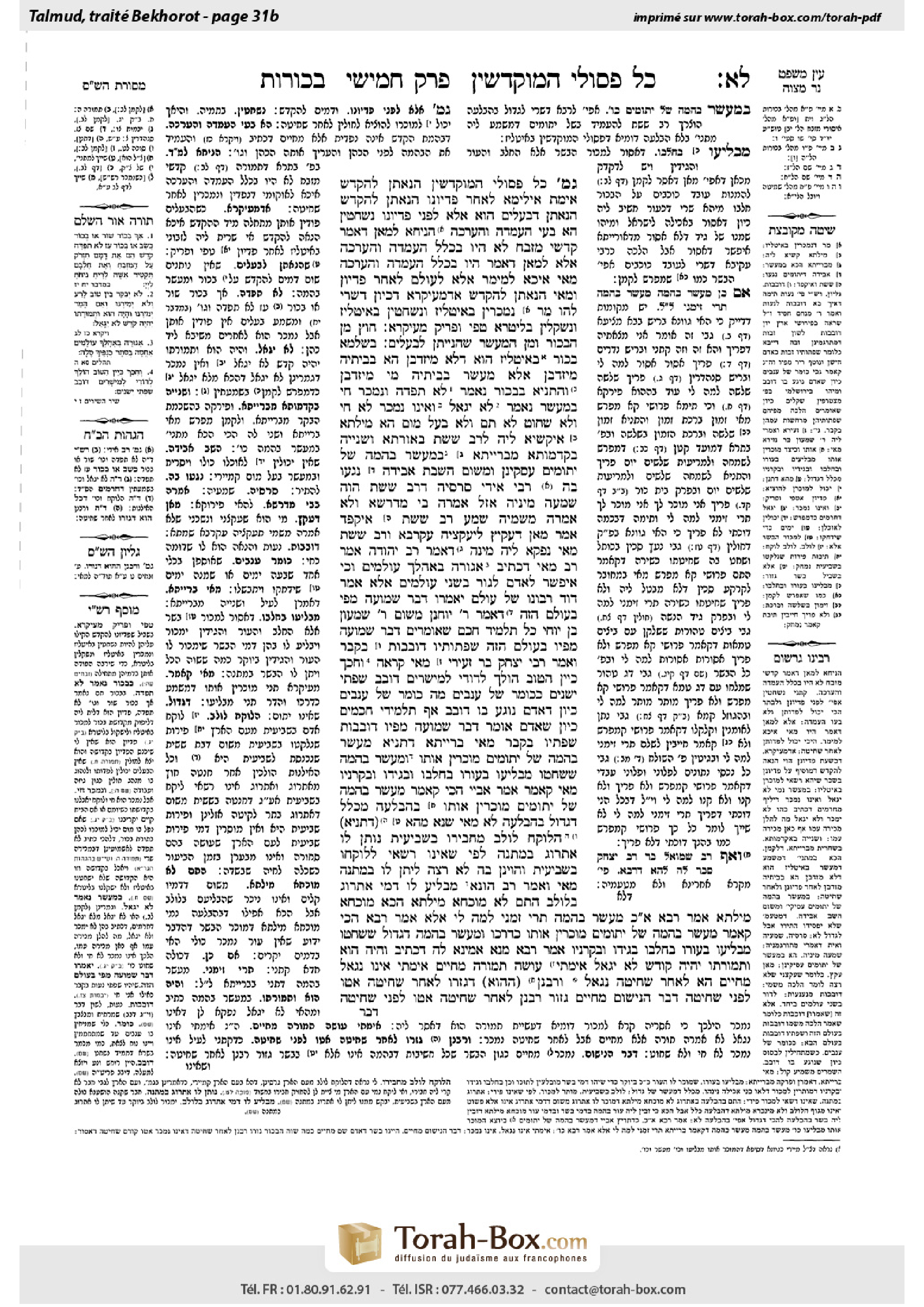
Bekhorot 31b: Talmud study for Daf Yomi
Study the Talmud for Daf Yomi with scanned pages, Hebrew text, English translations from Sefaria and AI-generated French translations.
Passage selection and English or AI-generated French translation are available where the scan has annotations. Daf Study is independent of Torah-Box and Sefaria.
Browse Bekhorot · בכורות · All tractatesBekhorot 31b text and translations
This page of Bekhorot includes the Aramaic text, an English translation and an AI-generated French translation, alongside the scan above.
בכורות ל״א ב · Aramaic and Hebrew text
גְּמָ׳ כָּל פְּסוּלֵי הַמּוּקְדָּשִׁין הֲנָאָתָן לַהֶקְדֵּשׁ. אֵימַת? אִילֵּימָא לְאַחַר פִּדְיוֹנוֹ — הֲנָאָתָן לַהֶקְדֵּשׁ? הֲנָאָתָן דִּבְעָלִים הוּא!
אֶלָּא לִפְנֵי פִּדְיוֹנוֹ. נִשְׁחָטִין? הָא בָּעֵי הַעֲמָדָה וְהַעֲרָכָה!
הָנִיחָא לְמַאן דְּאָמַר, קׇדְשֵׁי מִזְבֵּחַ לֹא הָיוּ בִּכְלַל הַעֲמָדָה וְהַעֲרָכָה, אֶלָּא לְמַאן דְּאָמַר הָיוּ בִּכְלַל הַעֲמָדָה וְהַעֲרָכָה, מַאי אִיכָּא לְמֵימַר?
אֶלָּא לְעוֹלָם לְאַחַר פִּדְיוֹן, וּמַאי הֲנָאָתָן לַהֶקְדֵּשׁ? אַדְּמֵעִיקָּרָא.
דְּכֵיוָן דְּשָׁרֵי לְהוּ מָר, נִמְכָּרִין בָּאִיטְלִיז וְנִשְׁחָטִין בָּאִיטְלִיז וְנִשְׁקָלִין בְּלִיטְרָא, טָפֵי וּפָרֵיק מֵעִיקָּרָא.
חוּץ מִן הַבְּכוֹר וּמִן הַמַּעֲשֵׂר שֶׁהֲנָיָיתָן לַבְּעָלִים. בִּשְׁלָמָא בְּכוֹר — בָּאִיטְלִיז הוּא דְּלָא מִיזְדַּבַּן, הָא בְּבֵיתֵיהּ מִיזְדַּבַּן, אֶלָּא מַעֲשֵׂר — בְּבֵיתֵיהּ מִי מִיזְדַּבַּן?
וְהָתַנְיָא: בִּבְכוֹר נֶאֱמַר ״לֹא תִפְדֶּה״ וְנִמְכָּר חַי, בְּמַעֲשֵׂר נֶאֱמַר ״לֹא יִגָּאֵל״ וְאֵינוֹ נִמְכָּר, לֹא חַי וְלֹא שָׁחוּט, לֹא תָּם וְלֹא בַּעַל מוּם.
הָא מִילְּתָא אִיקַּשְׁיָא לֵיהּ לְרַב שֵׁשֶׁת בְּאוּרְתָּא, וְשַׁנְּיַיהּ בְּקַדְמוּתָא מִבָּרַיְיתָא, בְּמַעְשַׂר בְּהֵמָה שֶׁל יְתוֹמִים עָסְקִינַן, וּמִשּׁוּם הֲשָׁבַת אֲבֵידָה נָגְעוּ בָּהּ.
רַבִּי אִידִי סַרְסְיֵהּ דְּרַב שֵׁשֶׁת הֲוָה שַׁמְעַהּ מִינֵּיהּ, אֲזַל אַמְרַהּ בֵּי מִדְרְשָׁא וְלָא אַמְרַהּ מִשְּׁמֵיהּ, שְׁמַע רַב שֵׁשֶׁת אִיקְּפַד, אֲמַר: מַאן דְּעָקֵיץ לִיעְקְצֵיהּ עַקְרַבָּא, וְרַב שֵׁשֶׁת מַאי נָפְקָא לֵיהּ מִינַּהּ? דְּאָמַר רַב יְהוּדָה אָמַר רַב: מַאי דִּכְתִיב ״אָגוּרָה בְּאׇהׇלְךָ עוֹלָמִים״? וְכִי אִיפְשָׁר לְאָדָם לָגוּר בִּשְׁנֵי עוֹלָמִים?
אֶלָּא אָמַר דָּוִד: רִבּוֹנוֹ שֶׁל עוֹלָם, יֹאמְרוּ דְּבַר שְׁמוּעָה מִפִּי בְּעוֹלָם הַזֶּה. דְּאָמַר רַבִּי יוֹחָנָן מִשּׁוּם רַבִּי שִׁמְעוֹן בֶּן יוֹחַי: כׇּל תַּלְמִיד חָכָם שֶׁאוֹמְרִים דְּבַר שְׁמוּעָה מִפִּיו בְּעוֹלָם הַזֶּה — שִׂפְתוֹתָיו דּוֹבְבוֹת בַּקֶּבֶר.
וְאָמַר רַבִּי יִצְחָק בַּר זְעֵירִי: מַאי קְרָאָה — ״וְחִכֵּךְ כְּיֵין הַטּוֹב הוֹלֵךְ לְדוֹדִי לְמֵישָׁרִים דּוֹבֵב שִׂפְתֵי יְשֵׁנִים״, כְּכוֹמֶר שֶׁל עֲנָבִים, מָה כּוֹמֶר שֶׁל עֲנָבִים כֵּיוָן דְּאָדָם נוֹגֵעַ בּוֹ – דּוֹבֵב, אַף תַּלְמִידֵי חֲכָמִים, כֵּיוָן שֶׁאָדָם אוֹמֵר דְּבַר שְׁמוּעָה מִפִּיו – דּוֹבְבוֹת שְׂפָתָיו בַּקֶּבֶר.
מַאי בָּרַיְיתָא? דְּתַנְיָא: מַעְשַׂר בְּהֵמָה שֶׁל יְתוֹמִים — מוֹכְרִין אוֹתוֹ, וּמַעְשַׂר בְּהֵמָה שֶׁשְּׁחָטוֹ — מַבְלִיעוֹ בְּעוֹרוֹ, בְּחֶלְבּוֹ, וּבְגִידוֹ, וּבְקַרְנָיו.
מַאי קָאָמַר? אָמַר אַבָּיֵי: הָכִי קָאָמַר — מַעְשַׂר בְּהֵמָה שֶׁל יְתוֹמִים מוֹכְרִין אוֹתוֹ בְּהַבְלָעָה.
מִכְּלָל דְּגָדוֹל בְּהַבְלָעָה לָא? מַאי שְׁנָא מֵהָא דְּתַנְיָא: הַלּוֹקֵחַ לוּלָב מֵחֲבֵירוֹ בִּשְׁבִיעִית — נוֹתֵן לוֹ אֶתְרוֹג בְּמַתָּנָה, לְפִי שֶׁאֵינוֹ רַשַּׁאי לְלוֹקְחוֹ בַּשְּׁבִיעִית.
וְהָוֵינַן בָּהּ: לֹא רָצָה לִיתֵּן לוֹ בְּמַתָּנָה מַאי? וְאָמַר רַב הוּנָא: מַבְלִיעַ לוֹ דְּמֵי אֶתְרוֹג בַּלּוּלָב!
הָתָם לָא מוֹכְחָא מִילְּתָא, הָכָא מוֹכְחָא מִילְּתָא.
אָמַר רָבָא: אִם כֵּן, ״מַעְשַׂר בְּהֵמָה״ תְּרֵי זִמְנֵי לְמָה לִי? אֶלָּא אָמַר רָבָא: הָכִי קָאָמַר, מַעְשַׂר בְּהֵמָה שֶׁל יְתוֹמִים מוֹכְרִין אוֹתוֹ כְּדַרְכּוֹ, וּמַעְשַׂר בְּהֵמָה דְּגָדוֹל שֶׁשְּׁחָטוֹ מַבְלִיעוֹ בְּעוֹרוֹ בְּחֶלְבּוֹ בְּגִידוֹ וּבְקַרְנָיו.
אָמַר רָבָא: מְנָא אָמֵינָא לַהּ? דִּכְתִיב: ״וְהָיָה הוּא וּתְמוּרָתוֹ יִהְיֶה קֹדֶשׁ לֹא יִגָּאֵל״.
אֵימָתַי עוֹשֶׂה תְּמוּרָה — מֵחַיִּים, אֵימָתַי אֵינוֹ נִגְאָל — מֵחַיִּים, הָא לְאַחַר שְׁחִיטָה — נִגְאָל, וְרַבָּנַן (ההוא) [הוּא] דִּגְזַרוּ לְאַחַר שְׁחִיטָה, אַטּוּ לִפְנֵי שְׁחִיטָה.
דָּבָר הַנִּישּׁוֹם מֵחַיִּים — גְּזוּר רַבָּנַן לְאַחַר שְׁחִיטָה אַטּוּ לִפְנֵי שְׁחִיטָה,
Bekhorot 31b · English translation
GEMARA: The mishna teaches that with regard to all disqualified consecrated animals that were disqualified for sacrifice due to blemishes and were redeemed, all benefit accrued from their sale belongs to the Temple treasury, and the animals may consequently be sold in the manner of non-sacred meat. The Gemara asks: When does this apply? If we say that it applies to an animal after its redemption, i.e., after the owner redeemed it from the Temple treasury, does the benefit accrued belong to the Temple? Certainly not. Once a consecrated animal is redeemed from the Temple treasury, it is in the possession of its owner, which means that the benefit accrued belongs to the owner.
Rather, it applies to an animal before its redemption, in which case the money accrued from its sale, which renders it non-sacred, belongs to the Temple treasury. But if so, the mishna’s statement that the animals may be slaughtered in the butchers’ market is problematic. The Gemara explains the difficulty: How can the animal be evaluated after having been slaughtered? Redeeming a sanctified animal requires standing and valuation, i.e., it has to be set standing before a priest for him to appraise its monetary value and only then is it redeemed (see Leviticus 27:11–12).
The Gemara adds: This works out well according to the one who says that items consecrated to be sacrificed on the altar that were then disqualified due to a blemish were not included in the requirement of standing and valuation. If so, the animal may be slaughtered and subsequently sold. But according to the one who says that items consecrated to be sacrificed on the altar were included in the requirement of standing and valuation, what is there to say in explanation of the mishna?
The Gemara answers: Rather, the ruling of the mishna actually applies to a case where the animals are sold and slaughtered after their redemption by the owner. And what is the meaning of the mishna’s statement that all benefit accrued from their sale belongs to the Temple treasury? This is not referring to the profit from the sale in the butchers’ market, as was previously assumed. Instead, it is referring to their initial redemption from the Temple treasury.
The Gemara explains: Since the Sage in the mishna deems it permitted for the redeemed animals to be subsequently sold in the butchers’ market and slaughtered in the butchers’ market, and weighed and sold by the litra, there is a higher probability that the owner will redeem the animal for more money initially. The owner’s later ability to sell the redeemed animal for the highest market value is in effect a benefit that eventually accrues to the Temple treasury, as he will be willing to spend more money to redeem the animal.
§ The mishna teaches that the meat of blemished, consecrated animals may be sold in the same manner as non-sacred meat, except for the firstborn animal and animal tithe offering, as all benefit accrued from their sale belongs to the owner. Accordingly, even if it is blemished, the meat may be sold only in the owner’s house. The Gemara asks: Granted, in the case of a firstborn offering, it is in the butchers’ market that it may not be sold, whereas it may be sold in its owner’s house. But with regard to the animal tithe offering, may it be sold in its owner’s house?
But isn’t it taught in a baraita: With regard to a firstborn animal it is stated: “You shall not redeem” (Numbers 18:17), indicating that its sanctity can never be removed from it and transferred to non-sacred objects. But it can be sold after it comes into the possession of the priest, while it is alive. By contrast, with regard to the animal tithe offering, it is stated: “It shall not be redeemed” (Leviticus 27:33), which teaches that its sanctity can never be removed from it, and it cannot be sold either, as the Gemara will explain (32a–b), not when alive and not when slaughtered, not when unblemished and not when blemished. This baraita clearly states that the animal tithe offering may not be sold no matter what its status, which seems to contradict the mishna.
The Gemara notes: At night, Rav Sheshet found this matter difficult, and he resolved it in the morning from a baraita. He explains that in the mishna we are dealing with a case of an animal tithe offering belonging to young orphans that was blemished and slaughtered. Since the orphans are unable to consume the entire animal and would therefore suffer a monetary loss if the meat were to spoil, the Sages permitted its sale, and it is due to the principle of returning a lost item that they touched upon it, i.e., allowed for this.
The Gemara relates: Rav Idi, the attendant [saraseih] of Rav Sheshet, heard this explanation from Rav Sheshet. Rav Idi went and stated the matter in the study hall, but did not say it in his master’s name. Rav Sheshet heard what he had done and was annoyed. Rav Sheshet said: The one who stung me, let him be stung by a scorpion. The Gemara asks: And as for Rav Sheshet, what difference does it make to him whether or not his interpretation was cited in his name? The Gemara answers that this is as Rav Yehuda says that Rav says: What is the meaning of that which is written: “I will dwell in Your tent forever [olamim]” (Psalms 61:5)? Rav asked: But is it possible for a person to live in two worlds [olamim], this world and the next, simultaneously?
Rather, David, who recited this psalm, said to God: Master of the Universe, let people say a matter of halakha in my name in this world after I have passed on to another world. As Rabbi Yoḥanan said in the name of Rabbi Shimon ben Yoḥai: With regard to any Torah scholar in whose name a matter of halakha is stated in this world, his lips mouth the words in the grave, as though he were speaking.
And Rabbi Yitzḥak ben Ze’eiri says: What is the verse from which this is derived? The verse states: “And the roof of your mouth is like the best wine that glides down smoothly for my beloved, moving gently the lips of those who are asleep” (Song of Songs 7:10). Here, words of Torah in the mouths of the Jewish people are likened to a pile [kekhomer] of grapes left to warm before they are pressed, which causes the wine to exude from them easily: Just as with regard to a pile of grapes, when a person places his finger on it and touches it, it moves and issues a sound as the wine bursts forth, so too with regard to Torah scholars, when a matter of halakha is stated in their name, their lips mouth the words in the grave.
The Gemara returns to Rav Sheshet’s explanation: What is the baraita mentioned by Rav Sheshet, upon which he based his resolution? The Gemara explains: As it is taught in a baraita: With regard to an animal tithe offering of young orphans, one may sell it. And with regard to an animal tithe offering that one has slaughtered, whose meat may not be sold, one may include the cost of the meat in the cost of its negligent parts, thereby inflating the cost of those parts, i.e., the animal’s hide, its fat, its sinews, and its horns, which are permitted to be sold.
The Gemara asks: What is the tanna of the baraita saying? Initially, the baraita stated that one may sell the meat of an animal tithe offering belonging to young orphans, which indicates that this may be done in the normal fashion. The baraita then proceeds to state that the sale of the meat must be performed in the indirect manner of inclusion. Abaye said: The baraita is actually referring to only one case, and this is what it is saying: With regard to the meat of an animal tithe offering of young orphans, it may be sold, but only by means of inclusion.
The Gemara states: One can conclude by inference from this baraita that in the case of an animal tithe offering of an adult, i.e., a non-orphan, its meat may not be sold even by means of inclusion. What is different in this case from that which is taught in a mishna (Sukka 3:11): In the case of one who purchases a lulav from another, who is an am ha’aretz, during the Sabbatical Year, the seller gives him an etrog together with the lulav as a gift, as it is not permitted for one to purchase the etrog during the Sabbatical Year, and one may not give the value of Sabbatical-Year produce to an am ha’aretz, lest he engage in commerce with it, which is prohibited.
The Gemara continues: And we discussed this mishna and asked: If the seller did not want to give him the etrog as a gift, what is the halakha? How can the buyer receive the etrog? And Rav Huna said: The seller includes the value of the etrog in the cost of the lulav. The buyer should purchase the lulav at an elevated price to cover the cost of the etrog as well. If inclusion is allowed in the case of the etrog, why would it not be permitted in the case of the meat of an animal tithe offering belonging to an adult?
The Gemara answers: There, in the case of the etrog, the matter is not evident, whereas here, with regard to the meat of an animal tithe offering, the matter is evident. The inclusion of the cost of the etrog in the elevated cost of the lulav is not evident, as it is reasonable that the price of a lulav might fluctuate. By contrast, inflating the cost of the negligible parts of the animal tithe offering to include the cost of its expensive meat is obviously an artifice and is therefore not permitted.
Rava said to Abaye in response: If so, that the baraita is referring to only one case, why do I need it to use the expression: Animal tithe offering, twice? Rather, Rava said that the baraita is discussing two distinct cases, and this is what the tanna is saying: With regard to the meat of an animal tithe offering of young orphans, one may sell it in its usual manner, but in the case of an animal tithe offering belonging to an adult that was slaughtered, one may sell its meat only by means of including its cost in the elevated price of the animal’s hide, its fat, its sinews, and its horns.
Rava said: From where do I say that the meat of an animal tithe offering belonging to an adult may be sold by inclusion? As it is written with regard to the animal tithe offering: “Then both it and that for which it is substituted shall be holy; it shall not be redeemed” (Leviticus 27:33). This indicates that a non-sacred animal designated as a substitute for an animal tithe offering assumes sacred status, while the animal tithe offering retains its sacred status as well. As stated earlier, the phrase “it shall not be redeemed” is interpreted as referring to the prohibition against selling the animal tithe offering. The verse’s juxtaposition of substitution and the prohibition against selling an animal tithe offering indicates a similarity between the two.
Rava explains: When does an animal tithe offering render consecrated as a substitute a non-sacred animal for which it is exchanged? Only when the animal tithe offering is alive, as substitution is invalid after its death. Similarly, when may the animal tithe offering not be redeemed, i.e., sold? When it is alive. It may be inferred from here that it may be redeemed, i.e., sold, after its slaughter. This teaches that by Torah law, the meat of an animal tithe offering may be sold once the animal has been slaughtered. The Sages decreed that an animal tithe offering may not be sold after its slaughter, due to the concern that one might sell it before its slaughter.
Rava continues: It was only with regard to an item that is appraised when the animal is alive, i.e., its meat, which gives the animal its primary value, that the Sages decreed that it may not be sold even after its slaughter, due to the concern that one might sell the animal before its slaughter.
Bekhorot 31b · Traduction française (IA)
GUEMARA : La Michna enseigne que concernant tous les animaux consacrés déclarés inaptes à l'offrande en raison de taches et qui ont été rachetés, tous les bénéfices issus de leur vente appartiennent au trésor du Temple, et les animaux peuvent donc être vendus comme de la viande non sacrée. La Guemara pose la question : Dans quel cas cela s'applique-t-il ? Si l'on dit qu'il s'applique à un animal après son rachat, c'est-à-dire après que l'owner l'ait racheté du trésor du Temple, le bénéfice acquis appartient-il au Temple ? Certainement pas. Une fois qu'un animal consacré est racheté du trésor du Temple, il est en possession de son propriétaire, ce qui signifie que le bénéfice acquis appartient au propriétaire.
Au contraire, cela s'applique à un animal avant son rachat, dans ce cas, les revenus issus de sa vente, qui le rend non sacré, appartiennent au trésor du Temple. Mais si c'est ainsi, l'affirmation de la Michna selon laquelle les animaux peuvent être sacrifiés au marché des bouchers est problématique. La Guemara explique cette difficulté : Comment peut-on évaluer l'animal après qu'il ait été sacrifié ? Le rachat d'un animal consacré exige de le tenir debout et d'en évaluer la valeur monétaire, c'est-à-dire qu'il doit être placé devant un prêtre pour qu'il l'apprécie et seulement alors peut-il être racheté (cf. Lévitique 27 : 11–12).
La Guemara ajoute : Cela s'explique bien selon celui qui dit que les objets consacrés à être sacrifiés sur l'autel, qui ont ensuite été déclarés inaptes en raison d'une tache, n'étaient pas inclus dans la condition de tenir debout et d'être évalué. Si c'est ainsi, l'animal peut être sacrifié et ensuite vendu. Mais selon celui qui dit que les objets consacrés à être sacrifiés sur l'autel étaient inclus dans la condition de tenir debout et d'être évalué, que dire alors pour expliquer la Michna ?
La Guemara répond : Au contraire, la décision de la Michna s'applique en réalité à un cas où les animaux sont vendus et sacrifiés après leur rachat par l'owner. Et que signifie l'affirmation de la Michna selon laquelle tous les bénéfices acquis de leur vente appartiennent au trésor du Temple ? Ce n'est pas en référence au profit de la vente au marché des bouchers, comme on l'avait initialement supposé. Au contraire, cela fait référence à leur rachat initial du trésor du Temple.
La Guemara explique : Puisque le Sage de la Michna considère comme permis que les animaux rachetés puissent être ensuite vendus et sacrifiés au marché des bouchers, et pesés et vendus par litre, il y a une probabilité plus grande que l'owner rachète l'animal pour un montant plus élevé initialement. La capacité de l'owner à vendre l'animal racheté au prix le plus élevé du marché est en effet un bénéfice qui finit par revenir au trésor du Temple, car il sera prêt à dépenser plus d'argent pour racheter l'animal.
§ La Michna enseigne que la viande d'animaux tachés et consacrés peut être vendue de la même manière que de la viande non sacrée, sauf pour l'animal premier-né et l'offrande de dîme d'animal, car tous les bénéfices issus de leur vente appartiennent à l'owner. Ainsi, même s'il est taché, la viande peut être vendue uniquement dans la maison de l'owner. La Guemara pose la question : Cela est évident dans le cas d'une offrande de premier-né, car il ne peut être vendu que dans le marché des bouchers, tandis qu'il peut être vendu dans sa maison. Mais concernant l'offrande de dîme d'animal, peut-elle être vendue dans la maison de l'owner ?
Mais n'est-ce pas enseigné dans une baraïta : concernant l'animal premier-né, il est dit : « Tu ne le rachèteras pas » (Nombres 18 : 17), ce qui indique que sa sanctité ne peut jamais être retirée et transférée à des objets non sacrés. Cependant, il peut être vendu après qu'il ait été en possession du prêtre, alors qu'il est vivant. En revanche, concernant l'offrande de dîme d'animal, il est dit : « Il ne sera pas racheté » (Lévitique 27 : 33), ce qui enseigne que sa sanctité ne peut jamais être retirée et qu'il ne peut être vendu non plus, comme la Guemara le expliquera (32a–b), ni lorsqu'il est vivant, ni lorsqu'il est sacrifié, ni lorsqu'il est intact, ni lorsqu'il est taché. Cette baraïta indique clairement que l'offrande de dîme d'animal ne peut être vendue quels que soient son statut, ce qui semble contredire la Michna.
La Guemara note : la nuit, Rav Sheshet trouva cette question difficile, et il la résolut le matin grâce à une baraïta. Il explique que dans la Michna, nous sommes en présence d'un cas d'offrande de dîme d'animal appartenant à des orphelins jeunes, qui était taché et sacrifié. Puisque les orphelins ne peuvent pas consommer l'ensemble de l'animal et souffriraient d'une perte monétaire si la viande se gâtait, les Sages permirent sa vente, et c'est grâce au principe de rendre un objet perdu que l'on toucha à cela, c'est-à-dire qu'ils permirent cela.
La Guemara rapporte : Rav Idi, le serviteur [saraseih] de Rav Sheshet, a entendu cette explication de Rav Sheshet. Rav Idi est allé et a exposé cette affaire dans la salle de étude, mais ne l'a pas fait en nom de son maître. Rav Sheshet a entendu ce qu'il avait fait et s'est irrité. Rav Sheshet a dit : Celui qui m'a piqué, qu'il soit piqué par un scorpion. La Guemara pose la question : Et concernant Rav Sheshet, quelle différence cela fait-il à lui que son interprétation ait été citée en son nom ? La Guemara répond que cela est comme Rav Yehuda dit que Rav dit : Que signifie ce qui est écrit : « Je demeurerai dans votre tente éternellement [olamim] » (Psaumes 61 : 5) ? Rav a demandé : Mais est-il possible pour une personne de vivre dans deux mondes [olamim], ce monde et l'autre monde, en même temps ?
Au contraire, David, qui a récité ce psaume, a dit à Dieu : Maître du monde, que les gens évoquent une question de halakha en mon nom dans ce monde après que j'aurai passé à l'autre monde. Comme Rabbi Yoḥanan a dit en nom de Rabbi Shimon ben Yoḥai : Concernant tout savant de la Torah dont une question de halakha est évoquée dans ce monde en son nom, ses lèvres murmurent les mots dans la tombe, comme s'il parlait encore.
Et Rabbi Yitzḥak ben Ze’eiri dit : De quel verset cette dérivation est-elle tirée ? Le verset dit : « Et le toit de ta bouche est comme le meilleur vin qui coule doucement pour mon bien-aimé, faisant mouvoir doucement les lèvres de ceux qui dorment » (Cantique des Cantiques 7:10). Ici, les paroles de la Torah dans la bouche du peuple juif sont comparées à un tas de raisins laissés se réchauffer avant d'être pressés, ce qui fait que le vin s'écoule facilement d'eux : Tout comme, concernant un tas de raisins, lorsque l'on place un doigt sur lui et qu'on le touche, il se déplace et émet un son lorsque le vin s'écoule, de même, concernant les savants de la Torah, lorsque l'on énonce une question de halakha en leur nom, leurs lèvres prononcent les mots dans la tombe.
La Guemara revient sur l'explication de Rav Sheshet : De quelle baraïta mentionnée par Rav Sheshet s'agit-il, sur laquelle il s'est basé pour résoudre la question ? La Guemara explique : Il est enseigné dans une baraïta : Concernant une offrande de titres d'animaux de jeunes orphelins, on peut le vendre. Et concernant une offrande de titres d'animaux que l'on a sacrifié, dont la viande ne peut pas être vendue, on peut inclure le prix de la viande dans le prix de ses parties négligées, ce qui permet d'augmenter le prix de ces parties, c'est-à-dire la peau, la graisse, les nerfs et les cornes de l'animal, qui sont permis de vendre.
La Guemara pose la question : De quel tanna provient cette baraïta ? Initialement, la baraïta indiquait que l'on peut vendre la viande d'une offrande de titres d'animaux appartenant à des jeunes orphelins, ce qui suggère qu'on peut le faire de manière normale. La baraïta poursuit ensuite en indiquant que la vente de la viande doit être effectuée de manière indirecte, par inclusion. Abaye dit : La baraïta fait référence en réalité à un seul cas, et c'est ce qu'elle dit : Concernant la viande d'une offrande de titres d'animaux appartenant à des jeunes orphelins, elle peut être vendue, mais uniquement par inclusion.
La Guemara dit : On peut conclure par déduction de cette baraïta que, dans le cas d'une offrande de titres d'animaux d'adulte, c'est-à-dire un non-orphelin, sa viande ne peut pas être vendue même par inclusion. Qu'est-ce qui diffère dans ce cas par rapport à ce qui est enseigné dans une mishna (Sukka 3:11) : Dans le cas d'une personne qui achète un lulav d'une autre personne, qui est un am ha'aretz, pendant l'année sabatique, le vendeur lui donne un etrog avec le lulav en cadeau, car il n'est pas permis d'acheter l'etrog pendant l'année sabatique, et on ne peut pas donner la valeur des produits de l'année sabatique à un am ha'aretz, de peur qu'il ne pratique le commerce avec cela, ce qui est interdit.
La Guemara continue : Et nous avons discuté de cette mishna et nous avons posé la question : Si le vendeur n'avait pas voulu lui donner l'etrog en cadeau, quelle est la halakha ? Comment peut-il recevoir l'etrog ? Et Rav Huna dit : Le vendeur inclut la valeur de l'etrog dans le prix du lulav. L'acheteur devrait acheter le lulav à un prix élevé pour couvrir la valeur de l'etrog également. Si l'inclusion est permise dans le cas de l'etrog, pourquoi ne serait-elle pas permise dans le cas de la viande d'une offrande de titres d'animaux appartenant à un adulte ?
La Guemara répond : Là, dans le cas de l'etrog, la question n'est pas évidente, tandis que ici, concernant la viande d'une offrande de titres d'animaux, la question est évidente. L'inclusion de la valeur de l'etrog dans le prix élevé du lulav n'est pas évidente, car il est raisonnable que le prix d'un lulav puisse fluctuer. En revanche, l'augmentation du prix des parties négligées de l'offrande de titres d'animaux pour inclure la valeur de sa viande chère est clairement un artifice et est donc interdite.
Rava répondit à Abaye : Si c'est ainsi, que la baraïta fait référence à un seul cas, pourquoi dois-je utiliser l'expression « offrande de dîme d'animaux » deux fois ? Plutôt, Rava dit que la baraïta discute de deux cas distincts, et c'est ce que le tanna dit : Concernant la viande d'une offrande de dîme d'animaux appartenant à des jeunes orphelins, on peut la vendre de manière normale, mais dans le cas d'une offrande de dîme d'animaux appartenant à un adulte qui a été sacrifié, on peut vendre sa viande uniquement en incluant son prix dans le prix élevé de la peau, des graisses, des nerfs et des cornes de l'animal.
Rava dit : D'où dis-je que la viande d'une offrande de dîme d'animaux appartenant à un adulte peut être vendue par inclusion ? Comme il est écrit concernant l'offrande de dîme d'animaux : « Alors que l'animal et celui par lequel il est remplacé seront saints ; il ne sera pas racheté » (Lévitique 27:33). Cela indique qu'un animal non sacré désigné comme substitut d'une offrande de dîme d'animaux acquiert un statut sacré, tandis que l'offrande de dîme d'animaux conserve également son statut sacré. Comme mentionné précédemment, la phrase « il ne sera pas racheté » est interprétée comme désignant l'interdiction de vendre l'offrande de dîme d'animaux. La juxtaposition du substitut et de l'interdiction de vendre une offrande de dîme d'animaux indique une similitude entre les deux.
Rava explique : Quand une offrande de dîme d'animaux rend sacré un animal non sacré par lequel elle est échangée ? Seulement quand l'offrande de dîme d'animaux est vivante, car le substitut est invalide après sa mort. De même, quand l'offrande de dîme d'animaux ne peut pas être rachetée, c'est-à-dire vendue ? Quand elle est vivante. On peut en déduire ici qu'elle peut être rachetée, c'est-à-dire vendue, après sa mort. Cela enseigne que selon la loi divine, la viande d'une offrande de dîme d'animaux peut être vendue une fois que l'animal a été sacrifié. Les Sages ont édicté que l'offrande de dîme d'animaux ne peut pas être vendue après sa mort, en raison de la crainte qu'on puisse la vendre avant sa mort.
Rava continue : C'était seulement concernant un objet évalué lorsque l'animal est vivant, c'est-à-dire sa viande, qui donne à l'animal sa valeur principale, que les Sages ont édicté qu'il ne peut pas être vendu même après sa mort, en raison de la crainte qu'on puisse vendre l'animal avant sa mort.
Traduction française générée par IA à partir de l’édition anglaise de Sefaria. Vérifie toujours un passage avec le texte source.
Text from Sefaria: William Davidson Edition - Vocalized Aramaic (CC BY NC); William Davidson Edition - English (CC BY NC).