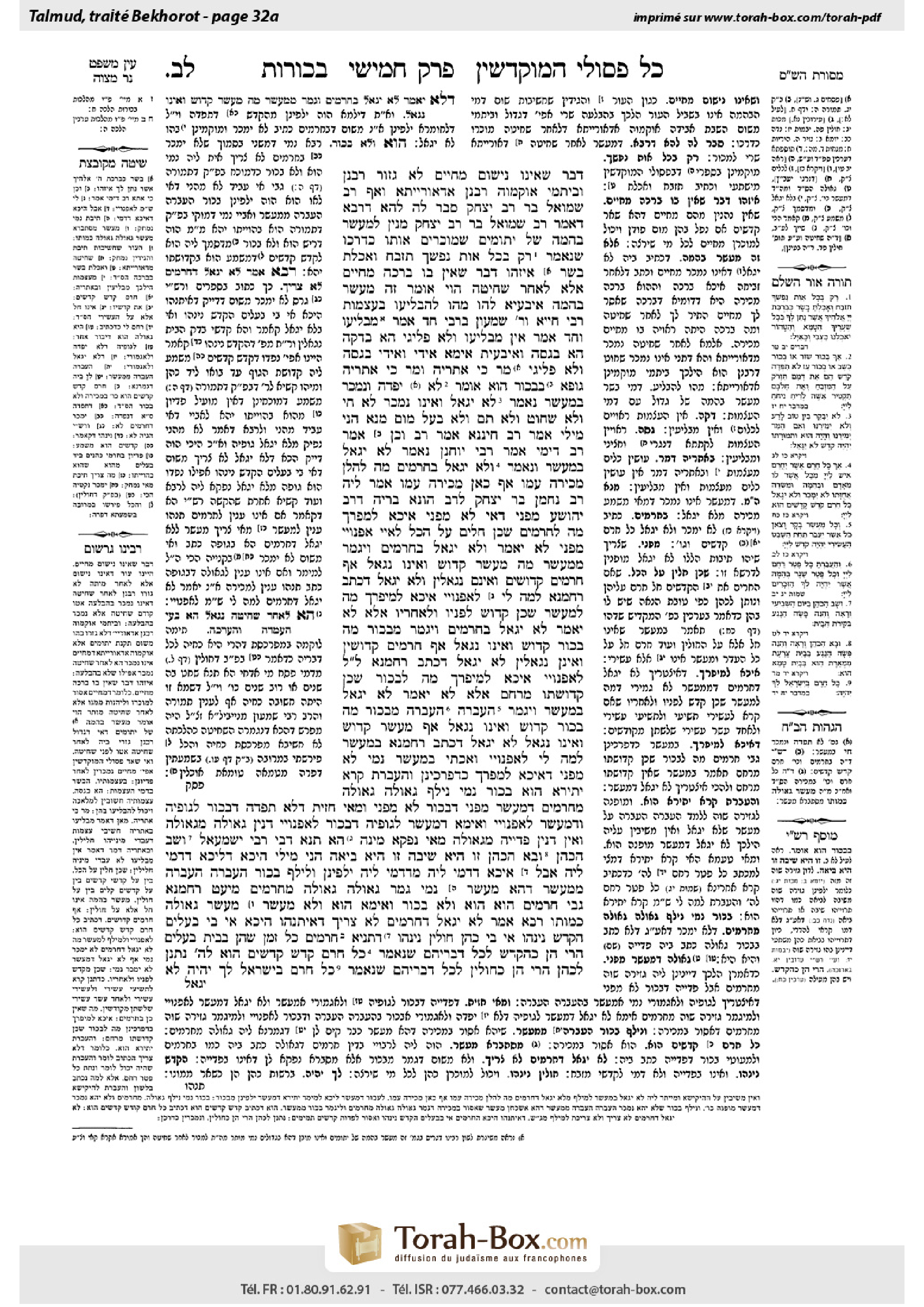
Bekhorot 32a: Talmud study for Daf Yomi
Study the Talmud for Daf Yomi with scanned pages, Hebrew text, English translations from Sefaria and AI-generated French translations.
Passage selection and English or AI-generated French translation are available where the scan has annotations. Daf Study is independent of Torah-Box and Sefaria.
Browse Bekhorot · בכורות · All tractatesBekhorot 32a text and translations
This page of Bekhorot includes the Aramaic text, an English translation and an AI-generated French translation, alongside the scan above.
בכורות ל״ב א · Aramaic and Hebrew text
דָּבָר שֶׁאֵינוֹ נִישּׁוֹם מֵחַיִּים — לָא גְּזוּר רַבָּנַן, וּבְיַתְמֵי אוֹקְמוּהָ רַבָּנַן אַדְּאוֹרָיְיתָא.
וְאַף רַב שְׁמוּאֵל בַּר רַב יִצְחָק סָבַר לַהּ לְהָא דְּרָבָא, דְּאָמַר רַב שְׁמוּאֵל בַּר רַב יִצְחָק: מִנַּיִן לְמַעְשַׂר בְּהֵמָה שֶׁל יְתוֹמִים שֶׁמּוֹכְרִים אוֹתוֹ כְּדַרְכּוֹ?
שֶׁנֶּאֱמַר: ״רַק בְּכׇל אַוַּת נַפְשְׁךָ תִּזְבַּח וְאָכַלְתָּ בָשָׂר״, אֵיזֶהוּ דָּבָר שֶׁאֵין בּוֹ בְּרָכָה מֵחַיִּים אֶלָּא לְאַחַר שְׁחִיטָה? הֱוֵי אוֹמֵר: זֶה מַעְשַׂר בְּהֵמָה.
אִיבַּעְיָא לְהוּ: מַהוּ לְהַבְלִיעוֹ בַּעֲצָמוֹת? רַבִּי חִיָּיא וְרַבִּי שִׁמְעוֹן בְּרַבִּי, חַד אָמַר: מַבְלִיעוֹ, וְחַד אָמַר: אֵין מַבְלִיעוֹ.
וְלָא פְּלִיגִי — הָא בְּדַקָּה, הָא בְּגַסָּה.
וְאִיבָּעֵית אֵימָא: אִידֵּי וְאִידֵּי בְּגַסָּה, וְלָא פְּלִיגִי — מָר כִּי אַתְרֵיהּ, וּמָר כִּי אַתְרֵיהּ.
גּוּפָא: בִּבְכוֹר הוּא אוֹמֵר: ״לֹא יִפְדֶּה״, וְנִמְכָּר; בְּמַעֲשֵׂר נֶאֱמַר: ״לֹא יִגָּאֵל״, וְאֵינוֹ נִמְכָּר, לֹא חַי וְלֹא שָׁחוּט, וְלֹא תָּם וְלֹא בַּעַל מוּם. מְנָא הָנֵי מִילֵּי?
אָמַר רַב חִינָּנָא אָמַר רַב, וְכֵן אָמַר רַב דִּימִי אָמַר רַבִּי יוֹחָנָן: נֶאֱמַר ״לֹא יִגָּאֵל״ בְּמַעֲשֵׂר, וְנֶאֱמַר ״וְלֹא יִגָּאֵל״ בַּחֲרָמִים, מָה לְהַלָּן מְכִירָה עִמּוֹ, אַף כָּאן מְכִירָה עִמּוֹ.
אֲמַר לֵיהּ רַב נַחְמָן בַּר יִצְחָק לְרַב הוּנָא בְּרֵיהּ דְּרַב יְהוֹשֻׁעַ: מַפְנֵי, דְּאִי לָא מַפְנֵי, אִיכָּא לְמִפְרַךְ: מָה לַחֲרָמִים, שֶׁכֵּן חָלִים עַל הַכֹּל!
לָאיֵי אַפְנוֹיֵי מַפְנֵי, לֹא יֵאָמֵר ״וְלֹא יִגָּאֵל״ בַּחֲרָמִים, וְיִגְמַר מִמַּעֲשֵׂר: מָה מַעֲשֵׂר קָדוֹשׁ וְאֵינוֹ נִגְאָל, אַף חֲרָמִים קְדוֹשִׁים וְאֵינָם נִגְאָלִין. ״וְלֹא יִגָּאֵל״ דִּכְתַב רַחֲמָנָא לְמָה לִי? לְאַפְנוֹיֵי.
אִיכָּא לְמִיפְרַךְ: מָה לְמַעֲשֵׂר, שֶׁכֵּן קָדוֹשׁ לְפָנָיו וּלְאַחֲרָיו!
אֶלָּא, לֹא יֵאָמֵר ״לֹא יִגָּאֵל״ בַּחֲרָמִים, וְיִגְמַר מִבְּכוֹר: מָה בְּכוֹר קָדוֹשׁ וְאֵינוֹ נִגְאָל, אַף חֲרָמִים קְדוֹשִׁין וְאֵינָן נִגְאָלִין. ״לֹא יִגָּאֵל״ דִּכְתַב רַחֲמָנָא לְמָה לִי? לְאַפְנוֹיֵי.
אִיכָּא לְמִיפְרַךְ: מָה לִבְכוֹר, שֶׁכֵּן קְדוּשָּׁתוֹ מֵרֶחֶם!
אֶלָּא לֹא יֵאָמֵר ״לֹא יִגָּאֵל״ בְּמַעֲשֵׂר, וְיִגְמַר הַעֲבָרָה הַעֲבָרָה מִבְּכוֹר, מָה בְּכוֹר קָדוֹשׁ וְאֵינוֹ נִגְאָל, אַף מַעֲשֵׂר קָדוֹשׁ וְאֵינוֹ נִגְאָל. ״לֹא יִגָּאֵל״ דִּכְתַב רַחֲמָנָא בְּמַעֲשֵׂר לְמָה לִי? לְאַפְנוֹיֵי.
וְאַכַּתִּי, בְּמַעֲשֵׂר נָמֵי לָא, מַפְנֵי דְּאִיכָּא לְמִיפְרַךְ כִּדְפָרְכִינַן!
״וְהַעֲבַרְתָּ״ קְרָא יַתִּירָא הוּא.
בְּכוֹר נָמֵי נֵילַף ״גְּאוּלָּה״ ״גְּאוּלָּה״ מֵחֲרָמִים! דְּמַעֲשֵׂר מַפְנֵי, דִּבְכוֹר לָא מַפְנֵי.
וּמַאי חָזֵית דְּלֹא תִפְדֶּה דִּבְכוֹר — לְגוּפֵיהּ, וּדְמַעֲשֵׂר — לְאַפְנוֹיֵי? וְאֵימָא: דְּמַעֲשֵׂר — לְגוּפֵיהּ, דִּבְכוֹר — לְאַפְנוֹיֵי!
דָּנִין גְּאוּלָּה מִגְּאוּלָּה, וְאֵין דָּנִין פְּדִיָּיה מִגְּאוּלָּה.
מַאי נָפְקָא מִינַּהּ? הָא תָּנָא דְּבֵי רַבִּי יִשְׁמָעֵאל: ״וְשָׁב הַכֹּהֵן״ ״וּבָא הַכֹּהֵן״ — זוֹ הִיא שִׁיבָה זוֹ הִיא בִּיאָה!
הָנֵי מִילֵּי, הֵיכָא דְּלֵיכָּא דְּדָמֵי לֵיהּ, אֲבָל אִיכָּא דְּדָמֵי לֵיהּ — מִדְּדָמֵי לֵיהּ יָלְפִינַן.
וְלֵילַף בְּכוֹר ״הַעֲבָרָה״ ״הַעֲבָרָה״ מִמַּעֲשֵׂר, דְּהָא מַעֲשֵׂר נָמֵי גָּמַר ״גְּאוּלָּה״ ״גְּאוּלָּה״ מֵחֲרָמִים!
מִיעֵט רַחֲמָנָא גַּבֵּי חֲרָמִים, ״הוּא״ — ״הוּא״ וְלֹא בְּכוֹר. וְאֵימָא ״הוּא״ וְלֹא מַעֲשֵׂר! מַעֲשֵׂר גְּאוּלָּה כְּמוֹתוֹ.
רָבָא אָמַר, ״לֹא יִגָּאֵל״ דַּחֲרָמִים לָא צְרִיךְ, דְּאִיתַנְהוּ הֵיכָא? אִי בֵּי בְעָלִים — הֶקְדֵּשׁ נִינְהוּ, אִי בֵּי כֹהֵן — חוּלִּין נִינְהוּ.
דְּתַנְיָא: חֲרָמִים, כׇּל זְמַן שֶׁהֵן בְּבֵית בְּעָלִים — הֲרֵי הֵן כְּהֶקְדֵּשׁ לְכׇל דִּבְרֵיהֶם, שֶׁנֶּאֱמַר: ״כׇּל חֵרֶם קֹדֶשׁ קָדָשִׁים הוּא לַה׳״. נְתָנָן לְכֹהֵן — הֲרֵי הֵן כְּחוּלִּין לְכׇל דִּבְרֵיהֶם, שֶׁנֶּאֱמַר: ״כׇּל חֵרֶם בְּיִשְׂרָאֵל לְךָ יִהְיֶה״. ״לֹא
Bekhorot 32a · English translation
But with regard to an item that is not appraised when an animal is sold when alive, e.g., the hide and sinews, as these are not primary contributing factors to the animal’s value, the Sages did not decree that one may not sell such items after the animal’s slaughter. Consequently, the meat of an animal tithe offering may be sold by means of inclusion in the animal’s hide, fat, sinews, and horns. And with regard to a case of young orphans, the Sages established the halakha as if by Torah law, and therefore the meat may be sold in its usual manner.
The Gemara notes: And even Rav Shmuel bar Rav Yitzḥak holds in accordance with that opinion of Rava, that by Torah law, the meat of a blemished animal-tithe offering may be sold in the normal manner. As Rav Shmuel bar Rav Yitzḥak says: From where is it derived that one may sell the meat of a blemished animal-tithe offering of young orphans in its usual manner, without having to resort to the method of inclusion?
It is derived from a verse, as it is stated in a verse discussing consecrated animals that became blemished: “Notwithstanding, after all the desire of your soul, you may slaughter and eat flesh, according to the blessing of the Lord your God” (Deuteronomy 12:15). Now which is the item that has no blessing when it is alive, i.e., it is prohibited to derive benefit from it, but it does have a blessing after its slaughter, as indicated by the verse “You may slaughter…according to the blessing of the Lord your God”? You must say that this is the meat of the animal tithe offering.
§ The baraita cited earlier teaches that the Sages permitted the inclusion of the value of a blemished animal-tithe offering’s meat in the cost of its hide, fat, sinews, and horns. In this regard, a dilemma was raised before the Sages: What is the halakha with regard to including the value of the meat in the cost of the animal’s bones? Rabbi Ḥiyya and Rabbi Shimon, son of Rabbi Yehuda HaNasi, disputed this matter. One says that one may include the value in the cost of the bones, and one says one may not include it.
The Gemara notes: And they do not disagree. This one, who maintains that one may not include the value in the cost of the bones, is referring to a small, domesticated animal, whose bones are incapable of being fashioned into utensils and are therefore never sold. That one, who holds that one may include the value in the cost of the bones, is referring to a large, domesticated animal, whose bones can be used and are therefore sold.
And if you wish, say instead that both this one and that one are referring even to a large, domesticated animal, and still they do not disagree. This Sage rules in accordance with the custom of his locale, and that Sage rules in accordance with the custom of his locale. In other words, in certain places the custom is to use the bones and sell them, while elsewhere they do not.
§ The Gemara returns to the matter itself, stated in the baraita: With regard to a firstborn male animal offering the verse states: “You shall not redeem” (Numbers 18:17), but it may be sold while alive, by the priest to whom it belongs. By contrast, with regard to the animal tithe offering, it is stated: “It shall not be redeemed” (Leviticus 27:33), indicating that its sanctity can never be removed from it, and it cannot be sold, not when alive and not when slaughtered, not when unblemished and not when blemished. The Gemara asks: From where is this matter derived, that the phrase “it shall not be redeemed” is referring to the prohibition against selling the animal tithe offering?
Rav Ḥinnana says that Rav says, and similarly, Rav Dimi says that Rabbi Yoḥanan says: It is stated: “It shall not be redeemed,” with regard to the animal tithe offering, and it is stated: “And it shall not be redeemed,” with regard to dedications [baḥaramim], i.e., property that one consecrated by means of the expression: Ḥerem. With regard to dedications, the verse states: “Notwithstanding, any dedicated item…may neither be sold nor redeemed” (Leviticus 27:28). This is a verbal analogy: Just as there, with regard to dedications, the prohibition against selling is mentioned together with the prohibition against redeeming, so too here, with regard to the animal tithe offering, the prohibition against selling is mentioned together with the prohibition against redeeming.
Rav Naḥman bar Yitzḥak said to Rav Huna, son of Rav Yehoshua: It must be that at least one of the phrases “It shall not be redeemed” is free, i.e., at least one of these terms is superfluous in its context, which means that it is included for the specific purpose of the verbal analogy. In such a case the verbal analogy cannot be refuted by logic, whereas if neither phrase is free one can refute the analogy if there is a significant difference between the two cases. As, if these terms are not free, the verbal analogy can be refuted: What is notable about dedications, in contrast to the animal tithe offering? They are notable in that they apply to all items one wishes to dedicate, whereas an animal tithe offering applies only to kosher animals.
The Gemara notes: This is not so [la’ai], as at least one of the phrases: “It shall not be redeemed,” is certainly free. How so? Let the verse not state: “It shall not be redeemed,” with regard to dedications, and instead one could derive the prohibition from an animal tithe offering: Just as an animal tithe offering is sacred and may not be redeemed, so too, dedications are also sacred and may not be redeemed. Why then do I need the phrase “It shall not be redeemed” that the Merciful One writes, in the case of dedications? It is evidently to be considered free to enable the verbal analogy.
The Gemara rejects this suggestion. It is still possible that the phrase “It shall not be redeemed,” written with regard to dedications, is not free, as the suggested derivation stated above can be refuted: What is notable about the animal tithe offering? It is notable in that there is sanctity before it and after it. If, instead of proclaiming as the tithe the tenth animal that one counted, one inadvertently proclaimed either the ninth animal or the eleventh animal as the tithe, the mistakenly proclaimed animal assumes the sacred status of the animal tithe offering. By contrast, one cannot inadvertently dedicate property to the Temple. Since the case of the animal tithe offering includes a stringency not shared by dedications, the phrase “It shall not be redeemed” is required to teach that dedications may not be redeemed, and is therefore not free for the verbal analogy.
The Gemara cites an alternative suggestion. Rather, let the verse not state: “It shall not be redeemed,” with regard to dedications, and instead one can derive the prohibition from the firstborn offering: Just as the firstborn offering is sacred and may not be redeemed, as the verse states: “You shall not redeem it” (Numbers 18:17), so too, dedications are also sacred and may not be redeemed. Why do I need the phrase “It shall not be redeemed” that the Merciful One writes in the case of dedications? It is evidently to be considered free to enable the verbal analogy to the animal tithe.
The Gemara rejects this suggestion as well: It is possible that the phrase “It shall not be redeemed” is not free, as the above derivation can be refuted: What is notable about the firstborn offering? It is notable in that its sanctity is from the womb, whereas dedications require an act of consecration.
Rather, let the verse not say: “It shall not be redeemed,” with regard to the animal tithe offering, and instead one can derive the prohibition from a verbal analogy from the term of passing stated there and the term of passing stated in the case of a firstborn. With regard to an animal tithe offering the verse states: “Whatsoever passes under the rod” (Leviticus 27:32), and in the case of the firstborn offering it is stated: “And you shall cause to pass all that opens the womb, to the Lord” (Exodus 13:12). Just as the firstborn offering is sacred and may not be redeemed, so too, an animal tithe offering is also sacred and may not be redeemed. Why do I need the phrase “It shall not be redeemed” that the Merciful One writes with regard to animal tithe offerings? It is evidently to be considered free to enable the verbal analogy to dedications.
The Gemara asks: But still, the phrase “It shall not be redeemed,” written with regard to the animal tithe offering, is itself not free, as the analogy between the animal tithe offering and the firstborn offering can be refuted as we refuted the analogy between the firstborn offering and dedications, since the firstborn offering is notable in that it is sanctified from the womb.
The Gemara answers: The term “And you shall cause to pass,” written in the context of the firstborn, is a superfluous verse, as it could have simply stated: All that opens the womb is to be for the Lord. Consequently, it is free to enable the verbal analogy. In sum, the Gemara is suggesting that due to the term “And you shall cause to pass,” there is a verbal analogy between the animal tithe offering and the firstborn offering, from which it is derived that the animal tithe offering may not be redeemed. This means that the phrase “It shall not be redeemed,” written with regard to the animal tithe offering, is free to enable the verbal analogy with dedications, from which the prohibition against selling the meat of the animal tithe offering is derived.
The Gemara raises a difficulty: With regard to a firstborn offering as well, let us derive that one may not sell its meat from a verbal analogy between the expression of redemption written there and the expression of redemption written in the context of dedications. This would contradict the ruling of the baraita that a firstborn offering can be sold after it enters the possession of the priest. The Gemara answers: The expression of redemption in the context of the animal tithe offering is free to enable the verbal analogy to dedications, but the expression of redemption in the context of a firstborn offering is not free, as it is required in its own context to teach that the firstborn offering may not be redeemed and as the source for the halakha of the animal tithe offering.
The Gemara asks: And what did you see that you said that the phrase “you shall not redeem” written in the context of a firstborn offering is not free, but is necessary for itself, i.e., to teach that it may not be redeemed, and yet the expression of redemption written with regard to the animal tithe offering is free to enable the verbal analogy, as the halakha of its redemption is derived from the firstborn? But one can say the reverse, that the expression of redemption written in the context of the animal tithe offering is for itself, whereas that written with regard to a firstborn offering is free.
The Gemara answers: We derive the expression of redemption [geula] written in the context of the animal tithe offering from the expression of redemption [geula] written in the context of dedications, but we do not derive the expression of redemption [pediya] written in the context of a firstborn offering from the different expression of redemption [geula] written in the context of the dedications.
The Gemara asks: What difference is there whether or not an identical expression is used for a verbal analogy? Didn’t the school of Rabbi Yishmael teach a verbal analogy with regard to leprosy of houses? The verse states: “And the priest shall return [veshav] on the seventh day” (Leviticus 14:39), and another verse with regard to the priest’s visit seven days later states: “And the priest shall come [uva] and look” (Leviticus 14:44). This returning and this coming have the same meaning and one can therefore derive by verbal analogy that the same halakha that applies if the leprosy had spread at the conclusion of the first week also applies if it had spread again by the end of the following week. Here too, the different terms of pediya and geula should not prevent the application of a verbal analogy.
The Gemara answers: This statement, that the phrases used for a verbal analogy do not have to be identical, applies only where there are no terms that are equivalent to it. But where there are terms that are equivalent to it, we derive the verbal analogy from the terms that are equivalent to it, rather than from the terms that are not equivalent.
The Gemara raises a difficulty: But let one derive that it is prohibited to sell the meat of a blemished firstborn offering from the verbal analogy between the expression of passing and the expression of passing, from the case of the animal tithe offering. This should be possible, as the sale of the meat of a blemished animal-tithe offering is also prohibited, as derived by a verbal analogy between the expression of redemption written in its context and the expression of redemption written with regard to dedications, as explained earlier.
The Gemara answers: The Merciful One limits the extension of the prohibition against selling with regard to dedications by adding the term “it” in the verse: “It is most holy to the Lord” (Leviticus 27:28). The term “it” teaches that the prohibition against selling applies only to it, i.e., dedications, but not to a firstborn offering. The Gemara raises a difficulty: But one can say instead that the term “it” teaches that the prohibition against selling applies to dedications, but not to the animal tithe offering. The Gemara answers: The prohibition against selling applies to the animal tithe offering, with regard to which the expression of redemption is written, just like dedications, while the term “it” limits the prohibition to the firstborn offering.
§ Rava says that there is an alternative explanation for the prohibition against selling the animal tithe. The phrase “It may not be redeemed,” written with regard to dedications, is unnecessary and is therefore free to enable a verbal analogy with the animal tithe offering. Rava explains: As where are the items of dedication, designated for the priests, located? If they are in the owner’s possession, they are considered consecrated and may not be redeemed. And if they are in the priest’s possession, they are considered non-sacred and the priest may sell them.
This is as it is taught in a baraita: Dedications, as long as they are in the owner’s possession, are like consecrated property in all respects, as it is stated: “Every dedicated item is most holy to the Lord” (Leviticus 27:28). Once the owner gave them to the priest, they are like non-sacred property in all respects, as it is stated: “Every dedicated item in Israel shall be for You” (Numbers 18:14). Rava continues: Accordingly, concerning the phrase “It may not
Bekhorot 32a · Traduction française (IA)
Mais concernant un objet qui n’est pas évalué lors de la vente d’un animal vivant, par exemple la peau et les nerfs, car ces éléments ne contribuent pas principalement à la valeur de l’animal, les Sages n’ont pas ordonné qu’on ne puisse pas vendre ces objets après la mise à mort de l’animal. Ainsi, la viande d’un animal offrant de première génération peut être vendue en la comptant dans la valeur de la peau, de la graisse, des nerfs et des cornes de l’animal. Et concernant le cas des orphelins jeunes, les Sages ont établi la halakha comme si c’était selon la loi divine, et par conséquent la viande peut être vendue de la manière habituelle.
Le Guemara note : Et même Rav Shmuel bar Rav Yitzḥak suit l’opinion de Rava, selon laquelle, selon la loi divine, la viande d’un animal offrant de première génération défectueux peut être vendue de la manière habituelle. Comme dit Rav Shmuel bar Rav Yitzḥak : D’où tire-t-on que l’on peut vendre la viande d’un animal offrant de première génération défectueux des orphelins jeunes de la manière habituelle, sans avoir à recourir à la méthode de l’inclusion ?
On tire cela d’un verset, car il est dit dans un verset concernant les animaux consacrés devenus défectueux : « Néanmoins, selon le désir de ton âme, tu tueras et mangeras de la chair, selon la bénédiction du Seigneur ton Dieu » (Deutéronome 12:15). Maintenant, quel est l’objet qui n’a pas de bénédiction lorsqu’il est vivant, c’est-à-dire qu’il est interdit d’en tirer un bénéfice, mais qui a une bénédiction après sa mise à mort, comme indiqué par le verset « Tu tueras… selon la bénédiction du Seigneur ton Dieu » ? Tu dois dire que c’est la viande de l’offrande d’animal.
§ La baraïta citée plus haut enseigne que les Sages ont permis d’inclure la valeur de la viande d’un animal de première génération défectueux dans le prix de sa peau, de sa graisse, de ses nerfs et de ses cornes. À ce sujet, un dilemme a été soulevé devant les Sages : Quelle est la halakha concernant l’inclusion de la valeur de la viande dans le prix des os de l’animal ? Rabbi Ḥiyya et Rabbi Shimon, fils de Rabbi Yehuda HaNasi, ont disputé ce point. L’un dit qu’on peut inclure la valeur dans le prix des os, et l’autre dit qu’on ne peut pas inclure la valeur.
Le Guemara observe : Et ils ne s'entendent pas. Celui qui affirme qu'on ne peut pas inclure la valeur dans le prix des os fait référence à un petit animal domestique, dont les os ne peuvent être façonnés en ustensiles et ne sont donc jamais vendus. Celui qui affirme qu'on peut inclure la valeur dans le prix des os fait référence à un grand animal domestique, dont les os peuvent être utilisés et sont donc vendus.
Et si tu veux, dis plutôt que tous les deux font référence même à un grand animal domestique, et qu'ils ne s'entendent pas. Ce sage règle selon la coutume de son lieu, et cet autre selon la coutume de son lieu. En d'autres termes, dans certains lieux la coutume est d'utiliser les os et de les vendre, tandis que dans d'autres lieux ils ne le font pas.
§ Le Guemara reprend la question elle-même, énoncée dans la baraïta : Concernant un animal de première génération, le verset dit : « Tu ne pourras pas racheter » (Nombres 18:17), mais il peut être vendu vivant par le prêtre à qui il appartient. À l’inverse, concernant l’offrande d’animal, il est dit : « Il ne sera pas racheté » (Lévitique 27:33), indiquant que sa sanctité ne peut jamais être retirée, et qu’il ne peut pas être vendu, ni vivant ni mort, ni intact ni défectueux. Le Guemara demande : D’où tire-t-on cette question, que la phrase « il ne sera pas racheté » fait référence à l’interdiction de vendre l’offrande d’animal ?
Rav Ḥinnana dit que Rav dit, et de même, Rav Dimi dit que Rabbi Yoḥanan dit : Il est dit : « Il ne sera pas racheté », concernant l’offrande d’animal, et il est dit : « Et il ne sera pas racheté », concernant les dédications [baḥaramim], c’est-à-dire les biens que l’on a consacrés par l’expression : Ḥerem. Concernant les dédications, le verset dit : « Néanmoins, tout objet consacré… ne peut ni être vendu ni racheté » (Lévitique 27:28). C’est une analogie verbale : Comme là, concernant les dédications, l’interdiction de vendre est mentionnée ensemble avec l’interdiction de racheter, ainsi ici, concernant l’offrande d’animal, l’interdiction de vendre est mentionnée ensemble avec l’interdiction de racheter.
Rav Naḥman bar Yitzḥak a dit à Rav Huna, fils de Rav Yehoshua : Il faut que l’une des phrases « Il ne sera pas racheté » soit libre, c’est-à-dire que l’une de ces expressions soit superflue dans son contexte, ce qui signifie qu’elle est incluse à des fins spécifiques de l’analogie verbale. Dans ce cas, l’analogie verbale ne peut pas être réfutée par la logique, tandis que si aucune des phrases n’est libre, on peut réfuter l’analogie si il y a une différence significative entre les deux cas. En effet, si ces expressions ne sont pas libres, l’analogie verbale peut être réfutée : Qu’est-ce qui distingue les dédications des offrandes d’animal ? Elles sont notables dans le fait qu’elles s’appliquent à tous les objets que l’on souhaite consacrer, tandis que l’offrande d’animal s’applique uniquement aux animaux kasher.
Le Guemara note : Ce n’est pas ainsi [la’ai], car au moins l’une des phrases : « Il ne sera pas racheté », est certainement libre. Comment ? Supposons que le verset ne dise pas : « Il ne sera pas racheté », concernant les dédications, et qu’on puisse déduire l’interdiction à partir de l’offrande d’animal : Comme l’offrande d’animal est sacrée et ne peut pas être rachetée, ainsi les dédications sont également sacrées et ne peuvent pas être rachetées. Pourquoi alors a-t-on besoin de la phrase « Il ne sera pas racheté » que l’Éternel a inscrite, concernant les dédications ? C’est évidemment pour être libre afin d’assurer l’analogie verbale.
La Guemara rejette cette suggestion. Il est encore possible que la phrase « Il ne sera pas racheté », écrite concernant les dédications, ne soit pas libre, car la dérivation suggérée ci-dessus peut être réfutée : Qu'est-ce qui est notable dans l'offrande de dixième animal ? C'est que la sanctité existe avant et après. Si, au lieu de proclamer comme dixième animal celui que l'on a compté, on proclame par erreur le neuvième ou le onzième animal comme dixième, l'animal ainsi mal proclamé acquiert la sanctité de l'offrande de dixième animal. À l'inverse, on ne peut pas dédier par erreur une propriété au Temple. Puisque le cas de l'offrande de dixième animal inclut une stricteur non partagée par les dédications, la phrase « Il ne sera pas racheté » est nécessaire pour enseigner que les dédications ne peuvent pas être rachetées, et est donc non libre pour l'analogie verbale.
La Guemara cite une autre suggestion. Plutôt, la phrase ne dit pas : « Il ne sera pas racheté », concernant les dédications, et on peut dériver l'interdiction à partir de l'offrande de premier-né : Comme l'offrande de premier-né est sacrée et ne peut pas être rachetée, comme le dit la parole : « Tu ne rachèteras pas » (Nombres 18:17), ainsi aussi les dédications sont sacrées et ne peuvent pas être rachetées. Pourquoi ai-je besoin de la phrase « Il ne sera pas racheté » que l'Éternel a écrite concernant les dédications ? C'est évidemment pour être considérée comme libre afin d'assurer l'analogie verbale.
La Guemara rejette cette suggestion également : Il est possible que la phrase « Il ne sera pas racheté » ne soit pas libre, car la dérivation ci-dessus peut être réfutée : Qu'est-ce qui est notable dans l'offrande de premier-né ? C'est que sa sanctité vient du sein, tandis que les dédications nécessitent une action de consécration.
Plutôt, la phrase ne dit pas : « Il ne sera pas racheté », concernant l'offrande de dixième animal, et on peut dériver l'interdiction à partir d'une analogie verbale entre le terme de passage mentionné là et le terme de passage mentionné dans le cas du premier-né. Concernant l'offrande de dixième animal, la parole dit : « Tout ce qui passe sous le bâton » (Lévitique 27:32), et dans le cas du premier-né, on lit : « Et tu feras passer tout ce qui naît, au Seigneur » (Exode 13:12). Comme l'offrande de premier-né est sacrée et ne peut pas être rachetée, ainsi aussi l'offrande de dixième animal est sacrée et ne peut pas être rachetée. Pourquoi ai-je besoin de la phrase « Il ne sera pas racheté » que l'Éternel a écrite concernant l'offrande de dixième animal ? C'est évidemment pour être considérée comme libre afin d'assurer l'analogie verbale avec les dédications.
La Guemara demande : Mais encore, la phrase « Il ne sera pas racheté », écrite concernant l'offrande de dixième animal, n'est-elle pas libre, car l'analogie entre l'offrande de dixième animal et le premier-né peut être réfutée comme nous avons réfuté l'analogie entre le premier-né et les dédications, puisque le premier-né est notable en ce qu'il est sanctifié dès le sein.
La Guemara répond : Le terme « Et tu feras passer », mentionné dans le contexte du premier-né, est superflu, car on aurait pu simplement dire : Tout ce qui naît est pour le Seigneur. Ainsi, il est libre pour permettre l'analogie verbale. En résumé, la Guemara suggère que grâce au terme « Et tu feras passer », il y a une analogie verbale entre l'offrande de dixième animal et le premier-né, d'où on dérive que l'offrande de dixième animal ne peut pas être rachetée. Cela signifie que la phrase « Il ne sera pas racheté », écrite concernant l'offrande de dixième animal, est libre pour permettre l'analogie verbale avec les dédications, d'où on dérive l'interdiction de vendre la viande de l'offrande de dixième animal.
La Guemara soulève une difficulté : Concernant l'offrande de premier-né également, laissons-nous dériver que l'on ne peut pas vendre sa viande à partir d'une analogie verbale entre l'expression de rachat écrite là et l'expression de rachat écrite dans le contexte des dédications. Cela contredirait la décision du baraïta selon laquelle l'offrande de premier-né peut être vendue après qu'elle entre en possession du prêtre. La Guemara répond : L'expression de rachat dans le contexte de l'offrande de dixième animal est libre pour permettre l'analogie verbale avec les dédications, mais l'expression de rachat dans le contexte de l'offrande de premier-né n'est pas libre, car elle est nécessaire dans son propre contexte pour enseigner que l'offrande de premier-né ne peut pas être rachetée et sert de source pour la halakha de l'offrande de dixième animal.
La Guemara demande : Et qu'as-tu vu pour dire que la phrase « tu ne rachèteras pas » écrite dans le contexte de l'offrande de premier-né n'est pas libre, mais nécessaire en soi, c'est-à-dire pour enseigner qu'elle ne peut pas être rachetée, et pourtant l'expression de rachat écrite concernant l'offrande de dixième animal est libre pour permettre l'analogie verbale, car la halakha de son rachat est dérivée du premier-né ? Mais on peut dire l'inverse, que l'expression de rachat écrite dans le contexte de l'offrande de dixième animal est en soi, tandis que celle écrite concernant l'offrande de premier-né est libre.
La Guemara répond : Nous dérivons l'expression de rachat [geula] écrite dans le contexte de l'offrande de dixième animal à partir de l'expression de rachat [geula] écrite dans le contexte des dédications, mais nous ne dérivons pas l'expression de rachat [pediya] écrite dans le contexte de l'offrande de premier-né à partir de l'autre expression de rachat [geula] écrite dans le contexte des dédications.
La Guemara pose la question : Quelle différence y a-t-il entre l'usage ou non d'une expression identique dans une analogie verbale ? N’a-t-on pas appris de la maison de Rabbi Yishmael une analogie verbale concernant la lèpre des maisons ? La Parashah dit : « Et le prêtre reviendra [veshav] le septième jour » (Lévitique 14:39), et une autre Parashah concernant la visite du prêtre sept jours plus tard dit : « Et le prêtre viendra [uva] et regardera » (Lévitique 14:44). Ce retour et ce venir ont le même sens et l'on peut donc déduire par analogie verbale que la même halakha qui s'applique si la lèpre s'est étendue à la fin de la première semaine s'applique également si elle s'est étendue à nouveau à la fin de la semaine suivante. Ici aussi, les termes différents de pediya et geula ne devraient pas empêcher l'application d'une analogie verbale.
La Guemara répond : Cette affirmation, selon laquelle les expressions utilisées dans une analogie verbale n'ont pas besoin d'être identiques, s'applique uniquement là où il n'y a pas de termes équivalents. Mais là où il y a des termes équivalents, on déduit l'analogie verbale à partir des termes équivalents, et non pas à partir des termes non équivalents.
La Guemara soulève un problème : Mais permettons que l'on déduise que l'interdiction de vendre la viande d'un animal titulaire de première naissance soit interdite à partir de l'analogie verbale entre l'expression de passage et l'expression de passage, à partir du cas de l'offrande d'animal titulaire. Cela devrait être possible, car la vente de la viande d'un animal titulaire de première naissance est également interdite, comme déduit par une analogie verbale entre l'expression de rachat écrite dans son contexte et l'expression de rachat concernant les offrandes, comme expliqué plus tôt.
La Guemara répond : L'Éternel limite l'extension de l'interdiction de vente concernant les offrandes en ajoutant le terme « il » dans la Parashah : « Il est très saint à l'Éternel » (Lévitique 27:28). Le terme « il » enseigne que l'interdiction de vente s'applique uniquement à lui, c'est-à-dire aux offrandes, mais pas à l'offrande de première naissance. La Guemara soulève un problème : Mais on pourrait dire au contraire que le terme « il » enseigne que l'interdiction de vente s'applique aux offrandes, mais pas à l'offrande d'animal titulaire. La Guemara répond : L'interdiction de vente s'applique à l'offrande d'animal titulaire, concernant laquelle l'expression de rachat est écrite, tout comme pour les offrandes, tandis que le terme « il » limite l'interdiction à l'offrande de première naissance.
§ Rava dit qu'il existe une autre explication pour l'interdiction de vendre l'offrande d'animal titulaire. La phrase « Il ne peut être racheté », écrite concernant les offrandes, est inutile et est donc libre de permettre une analogie verbale avec l'offrande d'animal titulaire. Rava explique : Où sont situés les objets dédiés, destinés aux prêtres ? S'ils sont en possession du propriétaire, ils sont considérés comme consacrés et ne peuvent pas être rachetés. Et s'ils sont en possession du prêtre, ils sont considérés comme non sacrés et le prêtre peut les vendre.
C'est ce qui est enseigné dans une baraïta : Les offrandes, tant qu'ils sont en possession du propriétaire, sont comme des biens consacrés en tous points, comme il est dit : « Tout objet dédié est très saint à l'Éternel » (Lévitique 27:28). Une fois que le propriétaire les a donnés au prêtre, ils sont comme des biens non sacrés en tous points, comme il est dit : « Tout objet dédié en Israël sera à toi » (Nb 18:14). Rava continue : Ainsi, concernant la phrase « Il ne peut pas »
Traduction française générée par IA à partir de l’édition anglaise de Sefaria. Vérifie toujours un passage avec le texte source.
Text from Sefaria: William Davidson Edition - Vocalized Aramaic (CC BY NC); William Davidson Edition - English (CC BY NC).