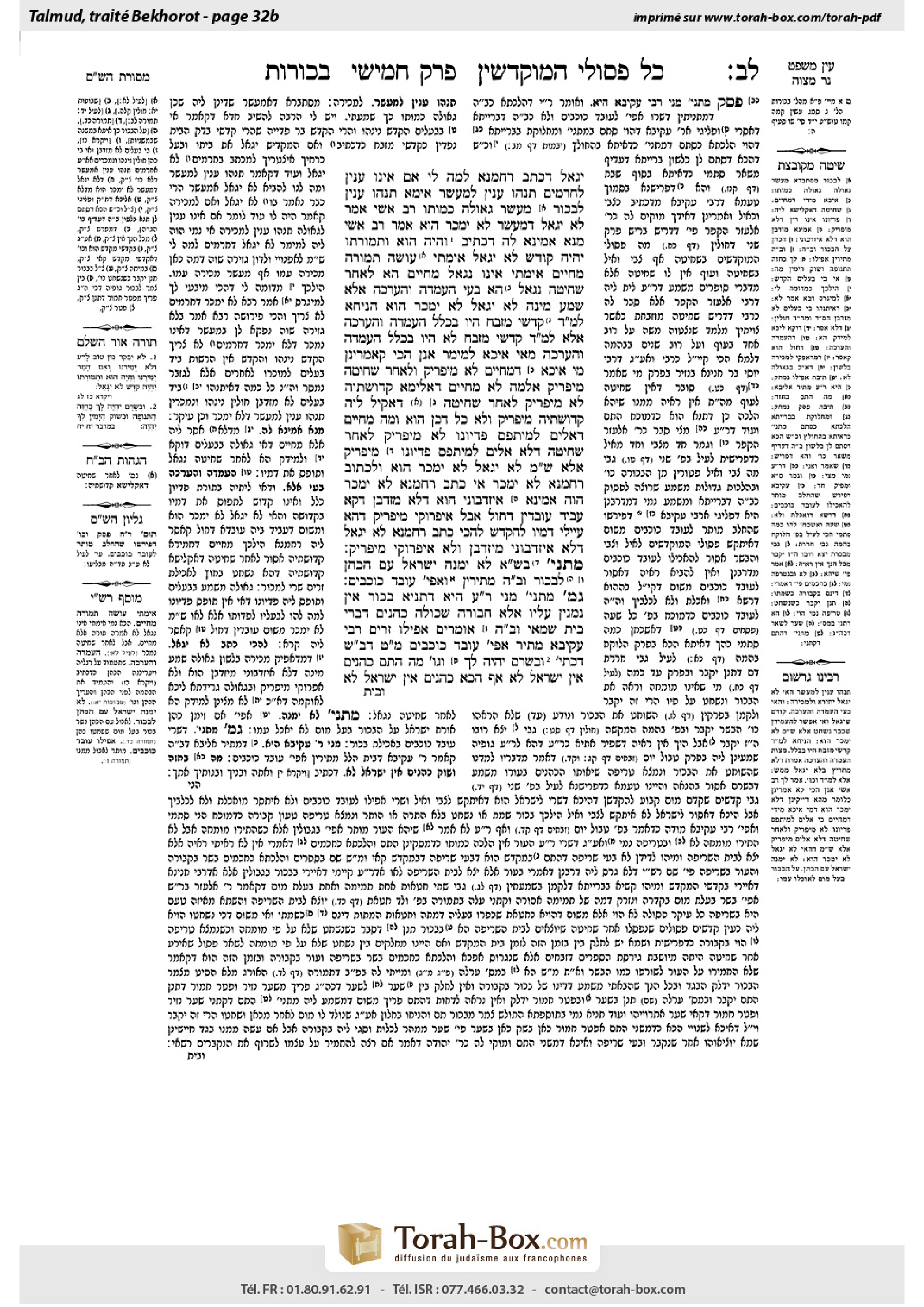
Bekhorot 32b: Talmud study for Daf Yomi
Study the Talmud for Daf Yomi with scanned pages, Hebrew text, English translations from Sefaria and AI-generated French translations.
Passage selection and English or AI-generated French translation are available where the scan has annotations. Daf Study is independent of Torah-Box and Sefaria.
Browse Bekhorot · בכורות · All tractatesBekhorot 32b text and translations
This page of Bekhorot includes the Aramaic text, an English translation and an AI-generated French translation, alongside the scan above.
בכורות ל״ב ב · Aramaic and Hebrew text
יִגָּאֵל״ דִּכְתַב רַחֲמָנָא לְמָה לִי? אִם אֵינוֹ עִנְיָן לַחֲרָמִים — תְּנֵהוּ עִנְיָן לְמַעֲשֵׂר. אֵימָא תְּנֵהוּ עִנְיָן לִבְכוֹר? מַעֲשֵׂר גְּאוּלָּה כְּמוֹתוֹ.
רַב אָשֵׁי אָמַר: ״לֹא יִגָּאֵל״ דְּמַעֲשֵׂר — לֹא יִמָּכֵר הוּא. אָמַר רַב אָשֵׁי: מְנָא אָמֵינָא לַהּ? דִּכְתִיב: ״וְהָיָה הוּא וּתְמוּרָתוֹ יִהְיֶה קֹדֶשׁ לֹא יִגָּאֵל״.
אֵימָתַי עוֹשֶׂה תְּמוּרָה — מֵחַיִּים, אֵימָתַי אֵינוֹ נִגְאָל — מֵחַיִּים, הָא לְאַחַר שְׁחִיטָה — נִגְאָל, הָא בָּעֵי הַעֲמָדָה וְהַעֲרָכָה!
אֶלָּא שְׁמַע מִינַּהּ, ״לֹא יִגָּאֵל״ — לֹא יִמָּכֵר הוּא.
הָנִיחָא לְמַאן דְּאָמַר קׇדְשֵׁי מִזְבֵּחַ הָיוּ בִּכְלַל הַעֲמָדָה וְהַעֲרָכָה, אֶלָּא לְמַאן דְּאָמַר קׇדְשֵׁי מִזְבֵּחַ לֹא הָיוּ בִּכְלַל הַעֲמָדָה וְהַעֲרָכָה, מַאי אִיכָּא לְמֵימַר?
אֲנַן הָכִי קָאָמְרִינַן: מִי אִיכָּא דְּמֵחַיִּים לָא מִיפְּרִיק, וּלְאַחַר שְׁחִיטָה מִיפְּרִיק? אַלְּמָה לָא מֵחַיִּים דְּאַלִּימָא קְדוּשְׁתֵּיהּ — לָא מִיפְּרִיק, לְאַחַר שְׁחִיטָה דְּאַקֵּיל לֵיהּ קְדוּשְׁתֵּיהּ — מִיפְּרִיק!
וְלָא כֹּל דְּכֵן הוּא? וּמָה מֵחַיִּים דְּאַלִּים לְמִיתְפַּס פִּדְיוֹנוֹ — לָא מִיפְּרִיק, לְאַחַר שְׁחִיטָה דְּלָא אַלִּים לְמִיתְפָּס פִּדְיוֹנוֹ — מִיפְּרִיק? אֶלָּא שְׁמַע מִינַּהּ: ״לֹא יִגָּאֵל״ — לֹא יִמָּכֵר הוּא.
וְלִכְתּוֹב רַחֲמָנָא ״לֹא יִמָּכֵר״! אִי כְּתַב רַחֲמָנָא ״לֹא יִמָּכֵר״, הֲוָה אָמֵינָא: אִיזְדַּבּוֹנֵי הוּא דְּלָא מִזְדַּבַּן, דְּקָא עָבֵיד עוֹבָדִין דְּחוֹל, אֲבָל אִיפְּרוֹקֵי — מִיפְּרִיק, דְּהָא עָיְילִי דָּמָיו לְהֶקְדֵּשׁ. לְהָכִי כְּתַב רַחֲמָנָא ״לֹא יִגָּאֵל״, דְּלָא אִיזְדַּבּוֹנֵי מִיזְדַּבַּן וְלָא אִיפְּרוֹקֵי מִיפְּרִיק.
מַתְנִי׳ בֵּית שַׁמַּאי אוֹמְרִים: לֹא יִמָּנֶה יִשְׂרָאֵל עִם הַכֹּהֵן לַבְּכוֹר, וּבֵית הִלֵּל מַתִּירִין, וַאֲפִילּוּ גּוֹי.
גְּמָ׳ מַתְנִיתִין מַנִּי? רַבִּי עֲקִיבָא הִיא, דְּתַנְיָא: בְּכוֹר אֵין נִמְנִין עָלָיו אֶלָּא חֲבוּרָה שֶׁכּוּלָּהּ כֹּהֲנִים, דִּבְרֵי בֵּית שַׁמַּאי. וּבֵית הִלֵּל אוֹמְרִים: אֲפִילּוּ זָרִים. רַבִּי עֲקִיבָא מַתִּיר אֲפִילּוּ גּוֹי.
מַאי טַעְמָא דְּבֵית שַׁמַּאי? דִּכְתִיב ״וּבְשָׂרָם יִהְיֶה לָךְ וְגוֹ׳״, מָה הָתָם כֹּהֲנִים — אִין, יִשְׂרָאֵל — לָא, אַף הָכָא כֹּהֲנִים — אִין, יִשְׂרָאֵל — לָא.
Bekhorot 32b · English translation
be redeemed” that the Merciful One writes, why do I need it? If it is not referring to the matter of dedications, as can be inferred from the baraita, apply it to the matter of the animal tithe offering, teaching that it may not be sold. The Gemara raises a difficulty: One can say that instead of applying it to the animal tithe offering, apply it to the matter of a firstborn offering. The Gemara rejects this possibility: The prohibition against selling extends to the animal tithe offering, concerning which the expression of redemption is written, just like dedications, which is not so concerning the firstborn offering.
§ Rav Ashi says that the prohibition against selling the animal tithe offering is not derived from dedications, but rather from the case of the animal tithe offering itself. The phrase “It may not be redeemed,” written with regard to the animal tithe offering, is to be understood as meaning: It may not be sold. Rav Ashi further says: From where do I say this? As it is written: “Then both it and that for which it is substituted shall be holy; it shall not be redeemed” (Leviticus 27:33).
Rav Ashi elaborates: When does the animal tithe offering render a non-sacred animal for which it is exchanged consecrated as a substitute? Only when the animal tithe offering is alive. Similarly, when may the animal tithe offering not be redeemed by its owner? Only when it is alive, which indicates that it may be redeemed after its slaughter. But when redeeming a sanctified animal, it requires standing and valuation, i.e., it has to be set standing before a priest for him to evaluate it and only then is it redeemed (see Leviticus 27:11–12). How, then, can the animal tithe offering be redeemed after having been slaughtered?
Rav Ashi continues: Rather, conclude from this verse that the phrase “it may not be redeemed” is not referring to redemption. Rather, it is actually to be understood as: It may not be sold. Accordingly, the prohibition against selling the animal tithe offering is in effect only while it is alive, as is the halakha with regard to a substitute; but once it is slaughtered, it may be sold.
The Gemara raises a difficulty: This works out well according to the one who says that animals consecrated to be sacrificed on the altar that were disqualified due to a blemish were included in the requirement of standing and valuation. But according to the one who says that animals consecrated to be sacrificed on the altar that were disqualified due to a blemish were not included in the requirement of standing and valuation, what is there to say? According to this opinion, the phrase “It may not be redeemed” can be interpreted literally, in contrast to Rav Ashi’s claim.
The Gemara explains: This is what we said, i.e., this is what we meant. The phrase “It may not be redeemed” cannot be understood literally, as is there ever an instance where an animal may not be redeemed when alive, and yet it may be redeemed after its slaughter? Since such a scenario is impossible, the verse must be referring to the prohibition against selling. The Gemara asks: But why can it not be said that an animal may be redeemed only after its slaughter? One can claim that when the animal is alive, since its sanctity is strong, it is logical to say that it may not be redeemed. Conversely, after its slaughter, when its sanctity is weak, it is logical to claim that it may be redeemed. If so, the phrase can be understood literally.
The Gemara rejects this contention: But isn’t the opposite claim, that a slaughtered animal tithe offering may not be redeemed, based on an a fortiori inference: If, when the animal tithe offering is alive and its sanctity is strong enough to transfer that sanctity to its redemption money, just as it renders a non-sacred animal consecrated as a substitute, nevertheless it may not be redeemed, then after its slaughter, when its sanctity is not strong enough to transfer that sanctity to its redemption money, as at this stage it cannot render a non-sacred animal consecrated as a substitute, should it be able to be redeemed? In other words, the fact that substitution can be effected only with a living animal indicates that a strong sanctity is more easily transferable to another item than a weak sanctity. Rather, conclude from this that the phrase “It may not be redeemed” is actually to be understood as meaning that it may not be sold.
The Gemara raises a difficulty: But if so, let the Merciful One write explicitly: It may not be sold. The Gemara answers: Had the Merciful One written: It may not be sold, I would say that the animal tithe offering only may not be sold, as one who does so performs an act of a non-sacred item, by treating the consecrated animal in the same manner as a non-sacred animal and transferring its value to non-sacred money. But I would say that it may be redeemed, as in this manner its value becomes consecrated. Therefore, in order to counter this notion, the Merciful One writes: “It may not be redeemed,” which teaches both that the animal tithe offering may not be sold and that it may not be redeemed.
MISHNA: Beit Shammai say: An Israelite cannot be counted with the priest to partake of a blemished firstborn. And Beit Hillel deem it permitted for him to partake of it, and they deem it permitted even for a gentile to partake of a blemished firstborn.
GEMARA: The mishna teaches that Beit Hillel deem it permitted even for a gentile to partake of a blemished firstborn offering. The Gemara says: Whose opinion is expressed in the mishna? It is the opinion of Rabbi Akiva, as it is taught in a baraita: In the case of a blemished firstborn offering, only a group constituted entirely of priests may be counted to partake of it; this is the statement of Beit Shammai. And Beit Hillel say: The group may even be constituted of non-priests. Rabbi Akiva says that Beit Hillel deem it permitted even for a gentile to partake of a blemished firstborn. Evidently, Beit Hillel’s opinion in the mishna is in accordance with Rabbi Akiva’s explanation in this baraita.
The Gemara explains: What is the reason of Beit Shammai? As it is written in a verse discussing the firstborn offering, addressed to Aaron and his sons: “But the firstling of an ox, or the firstling of a sheep, or the firstling of a goat you shall not redeem; they are holy …and their flesh shall be yours, as the wave breast and as the right thigh, it shall be yours” (Numbers 18:17–18). Just as there, with regard to the breast and the thigh, priests may partake of it but an Israelite, i.e., a non-priest, may not, as the verse states: “You shall eat in a pure place; you, and your sons, and your daughters with you” (Leviticus 10:14), so too here, with regard to the firstborn offering, only priests may partake of it, but an Israelite may not.
Bekhorot 32b · Traduction française (IA)
"be redeemed" que l'Éternel écrit, pourquoi ai-je besoin de cela ? Si cela ne se réfère pas à la question des offrandes dédiées, comme on peut en déduire à partir de la baraïta, appliquez-le à la question de l'offrande de dîme animale, enseignant qu'elle ne peut pas être vendue. La Guemara soulève une difficulté : on peut dire qu'au lieu d'appliquer cela à l'offrande de dîme animale, appliquez-le à la question de l'offrande de premier-né. La Guemara rejette cette possibilité : l'interdiction de vendre s'applique à l'offrande de dîme animale, concernant laquelle l'expression de la dédicace est écrite, tout comme pour les offrandes dédiées, ce qui n'est pas le cas pour l'offrande de premier-né.
§ Rav Ashi dit que l'interdiction de vendre l'offrande de dîme animale ne provient pas des offrandes dédiées, mais plutôt du cas de l'offrande de dîme animale elle-même. La phrase "Il ne peut pas être racheté", écrite concernant l'offrande de dîme animale, doit être comprise comme signifiant : Il ne peut pas être vendu. Rav Ashi ajoute encore : d'où dis-je cela ? Comme il est écrit : "Alors, l'animal et celui qui lui est substitué seront saints ; il ne peut pas être racheté" (Lévitique 27:33).
Rav Ashi développe : Quand l'offrande de dîme animale rend un animal non sacré, pour lequel elle est échangée, sacré comme substitut ? Seulement quand l'offrande de dîme animale est vivante. De même, quand l'offrande de dîme animale ne peut pas être rachetée par son propriétaire ? Seulement quand elle est vivante, ce qui indique qu'elle peut être rachetée après sa mort. Mais quand on rachète un animal sacré, il faut qu'il soit debout et évalué, c'est-à-dire qu'il doit être placé debout devant un prêtre pour qu'il l'évalue et seulement alors peut-il être racheté (cf Lévitique 27:11–12). Comment alors l'offrande de dîme animale peut-elle être rachetée après avoir été tuée ?
Rav Ashi continue : Plutôt, tirez-en la conclusion que la phrase « il ne peut pas être racheté » ne se réfère pas au rachat. Plutôt, il faut la comprendre comme : il ne peut pas être vendu. Ainsi, l'interdiction de vendre l'offrande de dîme animale s'applique uniquement pendant qu'elle est vivante, comme c'est le cas pour le substitut ; mais une fois tuée, elle peut être vendue.
La Guemara soulève une difficulté : cela s'aligne bien avec celui qui dit que les animaux sacrés à être sacrifiés sur l'autel, qui étaient disqualifiés en raison d'une tache, étaient inclus dans la nécessité de se tenir et d'être évalué. Mais selon celui qui dit que les animaux sacrés à être sacrifiés sur l'autel, qui étaient disqualifiés en raison d'une tache, n'étaient pas inclus dans la nécessité de se tenir et d'être évalué, que dire alors ? Selon cet avis, la phrase « il ne peut pas être racheté » peut être interprétée littéralement, contrairement à l'affirmation de Rav Ashi.
La Guemara explique : C'est ce que nous avons dit, c'est-à-dire ce que nous voulions dire. La phrase « il ne peut pas être racheté » ne peut pas être comprise littéralement, car il n'y a jamais eu de cas où un animal ne puisse pas être racheté lorsqu'il est vivant, mais puisse être racheté après sa mort ? Puisque ce scénario est impossible, le verset doit se référer à l'interdiction de vente. La Guemara demande : mais pourquoi ne peut-il pas être dit qu'un animal peut être racheté seulement après sa mort ? On peut affirmer que lorsque l'animal est vivant, puisque sa sainteté est forte, il est logique de dire qu'il ne peut pas être racheté. À l'inverse, après sa mort, lorsque sa sainteté est faible, il est logique d'affirmer qu'il peut être racheté. Si tel est le cas, la phrase peut être interprétée littéralement.
La Guemara rejette cette affirmation : Mais n'est-ce pas l'opposition, que l'offrande de dîme animale tuée ne puisse pas être rachetée, basée sur une inférence a fortiori : Si, lorsque l'offrande de dîme animale est vivante et que sa sainteté est suffisante pour transférer cette sainteté à l'argent de rachat, tout comme elle rend un animal non sacré sacré comme substitut, néanmoins elle ne peut pas être rachetée, alors après sa mort, lorsque sa sainteté n'est pas suffisante pour transférer cette sainteté à l'argent de rachat, comme à cette étape elle ne peut pas rendre un animal non sacré sacré comme substitut, devrait-elle pouvoir être rachetée ? En d'autres termes, le fait que le substitut puisse être effectué uniquement avec un animal vivant indique que la sainteté forte est plus facilement transférable à un autre objet qu'une sainteté faible. Plutôt, concluez de cela que la phrase "il ne peut pas être racheté" est en réalité à comprendre comme signifiant qu'il ne peut pas être vendu.
La Guemara soulève une difficulté : mais si c'est ainsi, que l'Éternel écrive explicitement : il ne peut pas être vendu. La Guemara répond : si l'Éternel avait écrit : il ne peut pas être vendu, je dirais que l'offrande de dîme animale ne peut pas être vendue, car celui qui le fait commet un acte d'objet non sacré, en traitant l'animal sacré comme un objet non sacré et en transférant sa valeur à de l'argent non sacré. Mais je dirais qu'il peut être racheté, car ainsi sa valeur devient sacrée. Ainsi, afin de contredire cette idée, l'Éternel écrit : "il ne peut pas être racheté", ce qui enseigne à la fois que l'offrande de dîme animale ne peut pas être vendue et qu'elle ne peut pas être rachetée.
MICHNA : Beit Shammai disent : un Israélite ne peut pas être compté avec le prêtre pour participer à un premier-né blemi. Et Beit Hillel considèrent qu'il est permis qu'il participe à cela, et ils considèrent même qu'il est permis à un non-Israélite de participer à un premier-né blemi.
GUEMARA : La Michna enseigne que Beit Hillel considèrent qu'il est permis même à un non-Israélite de participer à l'offrande de premier-né blemi. La Guemara dit : quel est l'avis exprimé dans la Michna ? C'est l'avis de Rabbi Akiva, comme il est enseigné dans une baraïta : dans le cas d'un premier-né blemi, seul un groupe composé uniquement de prêtres peut être compté pour participer à cela ; c'est l'avis de Beit Shammai. Et Beit Hillel disent : le groupe peut même être composé de non-prêtres. Rabbi Akiva dit que Beit Hillel considèrent qu'il est permis même à un non-Israélite de participer à un premier-né blemi. Évidemment, l'avis de Beit Hillel dans la Michna est en conformité avec l'explication de Rabbi Akiva dans cette baraïta.
La Guemara explique : Quelle est la raison de la Maison de Shammai ? Comme il est écrit dans un verset concernant l'offrande des premiers-nés, adressé à Aaron et à ses fils : « Mais le premier-né d'un bœuf, ou le premier-né d'une brebis, ou le premier-né d'un chèvre, vous ne pouvez pas racheter ; ils sont saints … et leur chair sera la vôtre, comme le sein ondulé et comme le flanc droit, cela sera la vôtre » (Nombres 18 : 17-18). Tout comme là, concernant le sein et le flanc, les prêtres peuvent en manger mais un Israélite, c'est-à-dire un non-prêtre, ne peut pas, comme le verset dit : « Vous mangerez en un lieu pur ; vous, et vos fils, et vos filles avec vous » (Lévitique 10 : 14), ainsi ici, concernant l'offrande des premiers-nés, seul les prêtres peuvent en manger, mais un Israélite ne peut pas.
Traduction française générée par IA à partir de l’édition anglaise de Sefaria. Vérifie toujours un passage avec le texte source.
Text from Sefaria: William Davidson Edition - Vocalized Aramaic (CC BY NC); William Davidson Edition - English (CC BY NC).