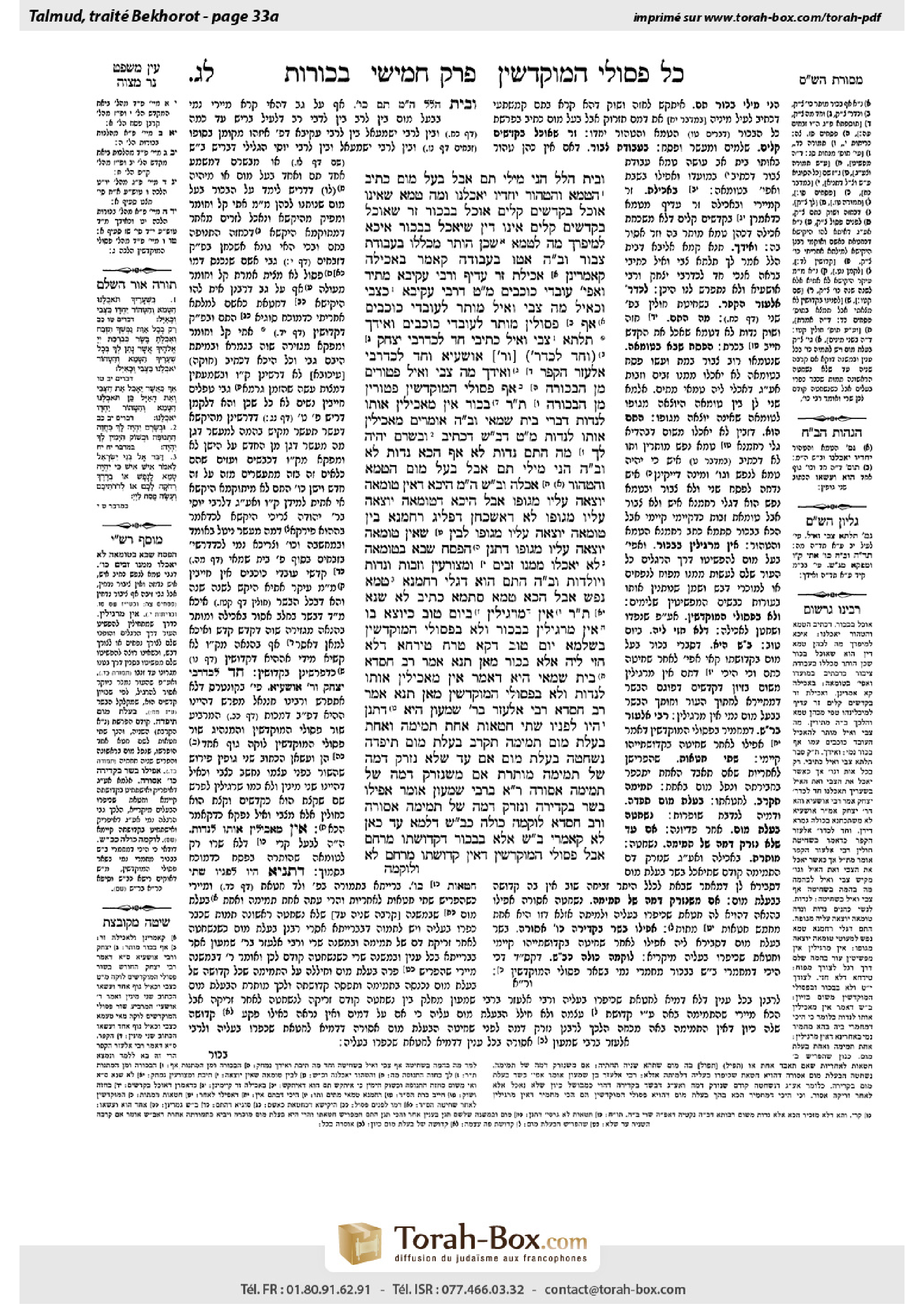
Bekhorot 33a: Talmud study for Daf Yomi
Study the Talmud for Daf Yomi with scanned pages, Hebrew text, English translations from Sefaria and AI-generated French translations.
Passage selection and English or AI-generated French translation are available where the scan has annotations. Daf Study is independent of Torah-Box and Sefaria.
Browse Bekhorot · בכורות · All tractatesBekhorot 33a text and translations
This page of Bekhorot includes the Aramaic text, an English translation and an AI-generated French translation, alongside the scan above.
בכורות ל״ג א · Aramaic and Hebrew text
וּבֵית הִלֵּל: הָנֵי מִילֵּי תָּם, אֲבָל בַּעַל מוּם כְּתִיב ״הַטָּמֵא וְהַטָּהוֹר יַחְדָּיו יֹאכְלֶנּוּ״, וּמָה טָמֵא שֶׁאֵינוֹ אוֹכֵל בְּקָדָשִׁים קַלִּים אוֹכֵל בִּבְכוֹר, זָר שֶׁאוֹכֵל בְּקָדָשִׁים קַלִּים אֵינוֹ דִּין שֶׁיֹּאכַל בִּבְכוֹר.
אִיכָּא לְמִיפְרַךְ: מָה לְטָמֵא, שֶׁכֵּן הוּתַּר מִכְּלָלוֹ בַּעֲבוֹדַת צִבּוּר!
וּבֵית הִלֵּל, אַטּוּ בַּעֲבוֹדָה קָאָמַר? בַּאֲכִילָה קָאָמְרִינַן, אֲכִילַת זָר עֲדִיף.
וְרַבִּי עֲקִיבָא מַתִּיר, וַאֲפִילּוּ גּוֹי. מַאי טַעְמָא דְּרַבִּי עֲקִיבָא? ״כַּצְּבִי וְכָאַיָּל״ — מָה צְבִי וְאַיָּל מוּתָּר לְגוֹי, אַף פְּסוּלִין מוּתָּר לְגוֹי.
וְאִידַּךְ? תְּלָתָא ״צְבִי וְאַיָּל״ כְּתִיבִי, חַד לְכִדְרַבִּי יִצְחָק, וְחַד לְכִדְרַבִּי אוֹשַׁעְיָא, וְחַד לְכִדְרַבִּי אֶלְעָזָר הַקַּפָּר.
וְאִידַּךְ? מָה צְבִי וְאַיָּל פְּטוּרִים מִן הַבְּכוֹרָה, אַף פְּסוּלֵי הַמּוּקְדָּשִׁין פְּטוּרִין מִן הַבְּכוֹרָה.
תָּנוּ רַבָּנַן: בְּכוֹר אֵין מַאֲכִילִין אוֹתוֹ לְנִדּוֹת, דִּבְרֵי בֵּית שַׁמַּאי. וּבֵית הִלֵּל אוֹמְרִים: מַאֲכִילִין אוֹתוֹ לְנִדּוֹת. מַאי טַעְמָא דְּבֵית שַׁמַּאי? דִּכְתִיב: ״וּבְשָׂרָם יִהְיֶה לָךְ״, מָה הָתָם נִדּוֹת לָא, אַף הָכָא נִדּוֹת לָא.
וּבֵית הִלֵּל: הָנֵי מִילֵּי תָּם, אֲבָל בַּעַל מוּם — ״הַטָּמֵא וְהַטָּהוֹר יֹאכְלֶנּוּ״.
וּבֵית שַׁמַּאי, הָנֵי מִילֵּי הֵיכָא דְּאֵין טוּמְאָה יוֹצְאָה עָלָיו מִגּוּפוֹ, אֲבָל הֵיכָא דְּטוּמְאָה יוֹצְאָה עָלָיו מִגּוּפוֹ — לָא.
דְּאַשְׁכְּחַן דְּפַלֵּיג רַחֲמָנָא בֵּין טוּמְאָה יוֹצְאָה עָלָיו מִגּוּפוֹ, לְבֵין שֶׁאֵין טוּמְאָה יוֹצְאָה עָלָיו מִגּוּפוֹ, דִּתְנַן: הַפֶּסַח שֶׁבָּא בְּטוּמְאָה — לֹא יֹאכְלוּ מִמֶּנּוּ זָבִים וּמְצוֹרָעִין וְזָבוֹת וְנִדּוֹת וְיוֹלְדוֹת.
וּבֵית הִלֵּל: הָתָם הוּא דְּגַלִּי רַחֲמָנָא ״טְמֵא נֶפֶשׁ״, אֲבָל הָכָא ״טָמֵא״ סְתָמָא כְּתִיב, לָא שְׁנָא.
תָּנוּ רַבָּנַן: אֵין מַרְגִּילִין בְּיוֹם טוֹב, כַּיּוֹצֵא בּוֹ אֵין מַרְגִּילִין בַּבְּכוֹר, וְלֹא בִּפְסוּלֵי הַמּוּקְדָּשִׁין.
בִּשְׁלָמָא יוֹם טוֹב — דְּקָא טָרַח טִירְחָא דְּלָא חֲזֵי לֵיהּ. אֶלָּא בְּכוֹר — מַאן תַּנָּא? אָמַר רַב חִסְדָּא: בֵּית שַׁמַּאי הִיא, דְּאָמַר אֵין מַאֲכִילִין אוֹתוֹ לְנִדּוֹת.
וְלֹא בִּפְסוּלֵי הַמּוּקְדָּשִׁין. מַאן תַּנָּא? אָמַר רַב חִסְדָּא: רַבִּי אֶלְעָזָר בְּרַבִּי שִׁמְעוֹן הִיא, דִּתְנַן: הָיוּ לְפָנָיו שְׁתֵּי חַטָּאוֹת, אַחַת תְּמִימָה וְאַחַת בַּעֲלַת מוּם — תְּמִימָה תִּקְרַב, בַּעֲלַת מוּם תִּיפָּדֶה.
נִשְׁחֲטָה בַּעֲלַת מוּם, אִם עַד שֶׁלֹּא נִזְרַק דָּמָהּ שֶׁל תְּמִימָה — מוּתֶּרֶת, אִם מִשֶּׁנִּזְרַק דָּמָהּ שֶׁל תְּמִימָה — אֲסוּרָה.
רַבִּי אֶלְעָזָר בְּרַבִּי שִׁמְעוֹן אוֹמֵר: אֲפִילּוּ בָּשָׂר בִּקְדֵירָה, וְנִזְרַק דָּמָהּ שֶׁל תְּמִימָה — אֲסוּרָה.
וְרַב חִסְדָּא, לוֹקְמַהּ כּוּלַּהּ כְּבֵית שַׁמַּאי! דִּלְמָא עַד כָּאן לָא קָאָמְרִי בֵּית שַׁמַּאי אֶלָּא בִּבְכוֹר, דִּקְדוּשָּׁתוֹ מֵרֶחֶם, אֲבָל פְּסוּלֵי הַמּוּקְדָּשִׁין דְּאֵין קְדוּשָּׁתוֹ מֵרֶחֶם — לָא.
Bekhorot 33a · English translation
And Beit Hillel would respond to that claim: This statement applies only to an unblemished firstborn offering, which is sacrificed upon the altar. But concerning a blemished firstborn it is written: “You shall eat it within your gates; the impure and the pure may eat it alike” (Deuteronomy 12:22; see Deuteronomy 15:22). Beit Hillel derive an a fortiori inference: And if a ritually impure priest, who may not eat the meat of offerings of lesser sanctity, nevertheless may eat the meat of a blemished firstborn offering, then with regard to a non-priest, who may eat the meat of offerings of lesser sanctity, e.g., peace offerings and animal tithe offerings, is it not logical that he may eat the meat of a blemished firstborn offering?
The Gemara raises a difficulty: This a fortiori inference can be refuted: What is notable about the case of a ritually impure priest? It is notable in that its general prohibition was permitted in certain circumstances, specifically with regard to the communal service. If there are no ritually pure priests, the sacrificial service may be performed by ritually impure priests. By contrast, it is never permitted for a non-priest to perform the sacrificial service. Accordingly, one cannot derive the halakha concerning a non-priest via an a fortiori inference from an impure priest.
And Beit Hillel would respond: Is that to say that the a fortiori inference was stated with regard to the sacrificial service, which was the subject of that refutation? Not so; rather, we state it with regard to the eating of sacrificial meat, and the eating of a non-priest is superior to that of a ritually impure priest. Accordingly, the refutation of the a fortiori inference is inapplicable.
§ The baraita stated that according to Rabbi Akiva, Beit Hillel deems it permitted for non-priests, and even gentiles, to partake of blemished firstborn offerings. The Gemara asks: What is the reason of Rabbi Akiva? The verse states: “Like the gazelle and like the deer” (Deuteronomy 15:22). Just as a gazelle and a deer are permitted to be eaten by a gentile, so too, disqualified blemished firstborn offerings are permitted to be eaten by a gentile.
The Gemara asks: And the other one, i.e., the tanna who disagrees with Rabbi Akiva’s version of the opinion of Beit Hillel, who does not deem it permitted for a gentile to partake of a blemished firstborn offering, what is his reason? The Gemara answers that the terms “gazelle” and “hart” are written three times in the context of disqualified consecrated animals, in Deuteronomy 12:15, 12:22, and 15:22. One is required for the statement of Rabbi Yitzḥak and Rabbi Oshaya, and one is needed for the statement of Rabbi Elazar HaKappar.
And the other verse teaches that just as a gazelle and a deer are exempt from the first of their offspring being counted a firstborn, as the verse states: “All the firstling males that are born of your herd and of your flock” (Deuteronomy 15:19), referring specifically to domesticated animals but not undomesticated animals such as a gazelle and a deer; so too, disqualified consecrated animals are exempt from the first of their offspring being counted a firstborn (see 14a).
§ The Sages taught in a baraita: One may not give a blemished firstborn offering to menstruating women to eat; this is the statement of Beit Shammai. And Beit Hillel say: One may give it to menstruating women to eat. The Gemara asks: What is the reason of Beit Shammai? It is written with regard to the firstborn offering: “And their flesh shall be yours, as the wave breast and the right thigh” (Numbers 18:18). Just as there, with regard to the wave breast and the right thigh, menstruating women may not eat them, as these consecrated meats may not be eaten by a ritually impure individual, so too here, with regard to the firstborn offering, menstruating women may not eat its meat, as it too is consecrated.
And Beit Hillel would respond: This statement, i.e., this verse, is referring only to the meat of an unblemished firstborn offering. Only such meat is compared to the wave breast and the right thigh. But with regard to a blemished firstborn offering, the verse explicitly states that the impure and the pure may eat it (see Deuteronomy 15:22).
And Beit Shammai would claim: This statement, that the ritually impure may eat the meat of a blemished firstborn offering, applies only where the impurity does not issue upon him from his own body but is contracted from an external source, e.g., from a corpse or the carcass of a creeping animal. But where the impurity issues upon him from his own body, such as in the case of a zav or a menstruating woman, that individual may not eat the meat of a blemished firstborn offering.
Beit Shammai continue: This is a valid distinction, as we find that the Merciful One distinguishes between a case where the impurity issues upon an individual from his own body and between a case where the impurity does not issue upon him from his own body. As we learned in a mishna (Pesaḥim 95b): When the Paschal offering is sacrificed in a state of ritual impurity, due to the fact that the majority of the Jewish people are ritually impure, then zavim and lepers and zavot and menstruating women and women after childbirth may not eat from it. The sacrificing of the Paschal offering overrides only ritual impurity imparted by a corpse; it does not override other forms of ritual impurity.
And Beit Hillel would respond: It is only there, in the case of the Paschal offering, that a difference of that kind applies, as the Merciful One revealed that only an individual whose impurity did not issue from his own body is permitted to eat the Paschal offering, as the verse states: “Impure by reason of a dead body” (Numbers 9:10). But here, with regard to the firstborn offering, the term “impure” is written unspecified: “The impure and the pure may eat it alike.” Therefore, in this case there is no difference between the two types of impurity.
§ The Sages taught in a baraita: One may not skin an animal from its feet [margilin] on a Festival. Although it is permitted to slaughter and skin an animal on a Festival, one may not skin it in such a manner that he will retain the hide intact to function as a vessel. Similarly, one may not skin a firstborn offering from its feet, even on a weekday and even if it is blemished, nor is skinning by way of the feet permitted in the case of disqualified consecrated animals. Such an act is considered degrading to the animal, even if the animal has been redeemed and slaughtered.
The Gemara asks: Granted, one may not skin an animal from its feet on a Festival, as one is thereby performing an effort whose outcome is not needed for use on the Festival. But with regard to a firstborn offering, who is the tanna who taught that skinning it from its feet is prohibited? Rav Ḥisda says: It is the opinion of Beit Shammai, who say that one may not feed the meat of a firstborn offering to menstruating women. According to Beit Shammai, a blemished firstborn retains its sanctity as though it were unblemished, and must be treated in the manner of sacrificial meat. Skinning an animal from its feet is considered an act inappropriate for such meat and is therefore prohibited.
The Gemara analyzes the next clause of the baraita: Nor is skinning by way of the feet permitted in the case of disqualified consecrated animals. The Gemara asks: Who is the tanna who taught this? Rav Ḥisda says: It is Rabbi Elazar, son of Rabbi Shimon, as we learned in a baraita: One had before him two sin offerings that he consecrated to achieve atonement for his sin so that in the event that one of them was lost or died the other would effect atonement. One of them was unblemished and the other one became blemished after having been consecrated. The halakha is that the unblemished offering should be sacrificed, whereas the blemished one should be redeemed.
The baraita continues: If the blemished animal was redeemed and slaughtered before the blood of the unblemished one was sprinkled on the altar to effect the atonement, the blemished animal is permitted to be eaten. But if the blemished one was slaughtered after the blood of the unblemished animal was already sprinkled upon the altar, the blemished animal is prohibited both in consumption and benefit. Since its owner’s atonement is effected by the sprinkling of the blood of the unblemished offering on the altar, at this stage the blemished animal must be put to death, in accordance with the halakha that a sin offering whose owner achieved atonement with another sin offering must die.
Rabbi Elazar, son of Rabbi Shimon, says: Even if the blemished animal was slaughtered and its meat is being cooked in the pot, and only then was the blood of the unblemished animal sprinkled on the altar, the meat of the blemished animal is still prohibited. Rabbi Elazar, son of Rabbi Shimon, maintains that disqualified blemished offerings retain a measure of their sanctity even after being slaughtered. Since the blemished sin offering was not yet eaten when the blood of the unblemished one was sprinkled, it is considered a sin offering whose owner has achieved atonement, and therefore it is prohibited for one to derive benefit from it. The opinion of Rabbi Elazar, son of Rabbi Shimon, accords with the ruling of the baraita with regard to skinning a disqualified consecrated animal from its feet.
The Gemara raises a difficulty: But let Rav Ḥisda establish the entire baraita in accordance with the opinion of Beit Shammai. The Gemara explains: Perhaps Beit Shammai say that the sanctity of a blemished offering is retained only in the case of a firstborn offering, as its sanctity is from the womb. But with regard to a disqualified consecrated animal, whose sanctity is not from the womb, perhaps they do not maintain that its sanctity remains even after it has been slaughtered. It is therefore necessary to attribute the latter clause of the baraita to Rabbi Elazar, son of Rabbi Shimon.
Bekhorot 33a · Traduction française (IA)
Et Beit Hillel répondait à cette affirmation : Cette déclaration s'applique uniquement à un premier-né sans tache, qui est sacrifié sur l'autel. Mais concernant un premier-né taché, il est écrit : « Vous mangerez cela à vos portes ; l'impur et le pur peuvent en manger ensemble » (Deutéronome 12:22 ; voir Deutéronôme 15:22). Beit Hillel tire une déduction par analogie : Et si un prêtre rituellement impur, qui ne peut pas manger la viande des offrandes de moindre sainteté, peut néanmoins manger la viande d'une offrande de premier-né taché, alors concernant un non-prêtre, qui peut manger la viande des offrandes de moindre sainteté, par exemple les offrandes de paix et les offrandes de dîme animale, n'est-il pas logique qu'il puisse manger la viande d'une offrande de premier-né taché ?
La Guemara soulève une difficulté : cette déduction par analogie peut être réfutée : Qu'est-ce qui est notable dans le cas d'un prêtre rituellement impur ? C'est que sa prohibition générale a été permise dans certains cas, spécifiquement en ce qui concerne le service communautaire. Si il n'y a pas de prêtres rituellement purs, le service sacrificiel peut être accompli par des prêtres rituellement impurs. À l'inverse, il n'est jamais permis à un non-prêtre d'accomplir le service sacrificiel. Ainsi, on ne peut pas déduire la halakha concernant un non-prêtre à partir d'une déduction par analogie d'un prêtre impur.
Et Beit Hillel répondait : Est-ce que cela signifie que la déduction par analogie a été émise concernant le service sacrificiel, qui était la matière de cette réfutation ? Non, plutôt, nous l'énonçons concernant la consommation de la viande sacrificiale, et la consommation par un non-prêtre est supérieure à celle d'un prêtre rituellement impur. Ainsi, la réfutation de la déduction par analogie ne s'applique pas.
§ La baraïta a déclaré que selon Rabbi Akiva, Beit Hillel considère comme permis aux non-prêtres et même aux non-juifs de consommer les offrandes de premier-né tachés. La Guemara demande : Quel est le fondement de Rabbi Akiva ? La Parashia dit : « Comme l'antilope et comme le chevreau » (Deutéronome 15:22). Aussi bien l'antilope et le chevreau sont permis d'être mangés par un non-juif, ainsi les offrandes de premier-né tachés sont permises d'être mangées par un non-juif.
La Guemara demande : Et l'autre, c'est-à-dire le tanna qui s'oppose à la version de Rabbi Akiva de l'opinion de Beit Hillel, qui ne considère pas comme permis à un non-juif de consommer une offrande de premier-né tachée, quelle est sa raison ? La Guemara répond que les termes « gazelle » et « cerf » sont écrits trois fois dans le contexte des animaux consacrés déclarés inaptes, dans Deutéronome 12:15, 12:22 et 15:22. Un est requis pour la déclaration de Rabbi Yitzḥak et Rabbi Oshaya, et un est nécessaire pour la déclaration de Rabbi Elazar HaKappar.
Et le verset suivant enseigne que justement la gazelle et le cerf sont exemptés de la première de leurs descendants étant compté comme premier-né, comme le dit la Parashia : « Tous les mâles de premier-né qui naissent de votre troupeau et de votre bétail » (Deutéronome 15:19), se référant spécifiquement aux animaux domestiques mais pas aux animaux sauvages tels que la gazelle et le cerf ; ainsi, les animaux consacrés déclarés inaptes sont exemptés de la première de leurs descendants étant compté comme premier-né (voir 14a).
§ Les Sages ont enseigné dans une baraïta : On ne peut pas donner une offrande de premier-né taché à des femmes en état de ménstruation pour qu'elles en mangent ; c'est la déclaration de Beit Shammai. Et Beit Hillel disent : On peut donner cela aux femmes en état de ménstruation pour qu'elles en mangent. La Guemara demande : Quel est le fondement de Beit Shammai ? Il est écrit concernant l'offrande de premier-né : « Et leur chair sera la vôtre, comme le bœuf ondulé et la cuisse droite » (Nombres 18:18). Aussi bien là, concernant le bœuf ondulé et la cuisse droite, les femmes en état de ménstruation ne peuvent pas en manger, car ces viandes consacrées ne peuvent pas être mangées par un individu rituellement impur, ainsi ici, concernant l'offrande de premier-né, les femmes en état de ménstruation ne peuvent pas manger sa chair, car celle-ci est également consacrée.
Et Beit Hillel répondait : Cette déclaration, c'est-à-dire ce verset, se réfère uniquement à la chair d'un premier-né sans tache. Seule cette chair est comparée au bœuf ondulé et à la cuisse droite. Mais concernant un premier-né taché, le verset stipule explicitement que l'impur et le pur peuvent en manger (voir Deutéronome 15:22).
Et Beit Shammai affirmait : Cette déclaration, que l'impur peut manger la chair d'une offrande de premier-né taché, s'applique uniquement dans le cas où l'impureté ne provient pas de son propre corps mais est contractée d'une source externe, par exemple d'un cadavre ou de la carcasse d'un animal rampant. Mais dans le cas où l'impureté provient de son propre corps, comme dans le cas d'un zav ou d'une femme en état de ménstruation, cette personne ne peut pas manger la chair d'une offrande de premier-né taché.
Beit Shammai continue : C'est une distinction valable, car nous trouvons que le Miséricordieux distingue entre le cas où l'impureté provient d'un individu de son propre corps et entre le cas où l'impureté ne provient pas de son propre corps. Comme nous l'avons appris dans une mitsna (Pesaḥim 95b) : Lorsque l'offrande pascal est sacrifiée dans un état d'impureté rituelle, en raison du fait que la majorité du peuple juif est impure rituellement, alors les zavim, les lépreux, les zavot et les femmes en état de ménstruation et les femmes après accouchement ne peuvent pas en manger. Le sacrifice de l'offrande pascal annule uniquement l'impureté rituelle provenant d'un cadavre ; elle n'annule pas les autres formes d'impureté rituelle.
Et Beit Hillel répondait : C'est uniquement là, dans le cas de l'offrande pascal, que cette distinction s'applique, car le Miséricordieux a révélé que seul un individu dont l'impureté ne provient pas de son propre corps est autorisé à manger l'offrande pascal, comme le dit la Parashia : « Impur à cause d'un cadavre » (Nombres 9:10). Mais ici, concernant l'offrande de premier-né, le terme « impur » est écrit sans précision : « L'impur et le pur peuvent en manger ensemble ». Ainsi, dans ce cas, il n'y a pas de différence entre les deux types d'impureté.
§ Les Sages enseignent dans une baraïta : On ne peut pas dépecer un animal depuis ses pieds [margilin] pendant un festival. Bien qu'il soit permis de sacrifier et de dépecer un animal pendant un festival, on ne peut pas le dépecer de manière à conserver la peau intacte pour en faire un récipient. De même, on ne peut pas dépecer un sacrifice de premier-né depuis ses pieds, même pendant un jour de semaine et même s'il est blemi, ni est-il permis de dépecer un animal consacré non conforme depuis ses pieds. Telle action est considérée comme dégradante pour l'animal, même si l'animal a été racheté et sacrifié.
Le Guemara pose la question : Cela est évident, on ne peut pas dépecer un animal depuis ses pieds pendant un festival, car on y consacre un effort dont le résultat n'est pas nécessaire pour l'usage du festival. Mais concernant un sacrifice de premier-né, qui est le tanna qui a enseigné que dépecer ce dernier depuis ses pieds est interdit ? Rav Ḥisda dit : C'est l'opinion de Beit Shammai, qui disent qu'on ne peut pas nourrir la viande d'un sacrifice de premier-né aux femmes en état de ménstruation. Selon Beit Shammai, un sacrifice de premier-né blemi conserve sa sanctité comme s'il était intact, et doit être traité comme de la viande sacrificielle. Dépecer un animal depuis ses pieds est considéré comme une action inappropriée pour de telle viande et est donc interdit.
Le Guemara analyse la prochaine clause de la baraïta : Ni est-il permis de dépecer un animal depuis ses pieds dans le cas d'animaux consacrés non conformes. Le Guemara pose la question : Qui est le tanna qui a enseigné cela ? Rav Ḥisda dit : C'est Rabbi Elazar, fils de Rabbi Shimon, comme nous l'avons appris dans une baraïta : On avait devant lui deux sacrifices expiatoires qu'il avait consacrés pour obtenir la rédemption de son péché, de sorte que, en cas où l'un d'eux était perdu ou mort, l'autre aurait accompli la rédemption. L'un était intact et l'autre est devenu blemi après avoir été consacré. La halakha est que l'offrande intacte doit être sacrifiée, tandis que l'offrande blemie doit être rachetée.
La baraïta continue : Si l'animal blemmé a été racheté et sacrifié avant que le sang de l'animal sans blemme ne soit aspergé sur l'autel pour obtenir l'atonement, l'animal blemmé est permis à la consommation. Mais si l'animal blemmé a été sacrifié après que le sang de l'animal sans blemme ait déjà été aspergé sur l'autel, l'animal blemmé est interdit à la consommation et à l'usage. Puisque l'atonement de son propriétaire est obtenu par l'aspersion du sang de l'offrande sans blemme sur l'autel, à ce stade l'animal blemmé doit être mis à mort, conformément à la halakha selon laquelle un sacrifice expiatoire dont le propriétaire a obtenu l'atonement grâce à un autre sacrifice expiatoire doit mourir.
Rabbi Elazar, fils de Rabbi Shimon, dit : Même si l'animal blemmé a été sacrifié et que sa viande est en train de cuire dans la marmite, et seulement alors le sang de l'animal sans blemme a été aspergé sur l'autel, la viande de l'animal blemmé reste interdite. Rabbi Elazar, fils de Rabbi Shimon, affirme que les offrandes blemmées déclarées inaptes conservent une mesure de leur sanctité même après avoir été sacrifiées. Puisque le sacrifice expiatoire blemmé n'avait pas encore été mangé lorsqu'on aspergeait le sang de l'offrande sans blemme sur l'autel, il est considéré comme un sacrifice expiatoire dont le propriétaire a obtenu l'atonement, et par conséquent il est interdit d'en tirer un bénéfice. L'opinion de Rabbi Elazar, fils de Rabbi Shimon, correspond à la décision de la baraïta concernant l'arrachage d'un animal consacré inapte à ses pieds.
Le Guemara soulève une difficulté : Mais laissons Rav Ḥisda établir toute la baraïta conformément à l'opinion de Beit Shammai. Le Guemara explique : Peut-être que Beit Shammai affirment que la sanctité d'un sacrifice blemmé est conservée uniquement dans le cas d'un sacrifice de premier-né, car sa sanctité provient du ventre. Mais concernant un animal consacré inapte, dont la sanctité ne provient pas du ventre, peut-être qu'ils ne maintiennent pas que sa sanctité persiste même après qu'il ait été sacrifié. Il est donc nécessaire d'attribuer la seconde partie de la baraïta à Rabbi Elazar, fils de Rabbi Shimon.
Traduction française générée par IA à partir de l’édition anglaise de Sefaria. Vérifie toujours un passage avec le texte source.
Text from Sefaria: William Davidson Edition - Vocalized Aramaic (CC BY NC); William Davidson Edition - English (CC BY NC).