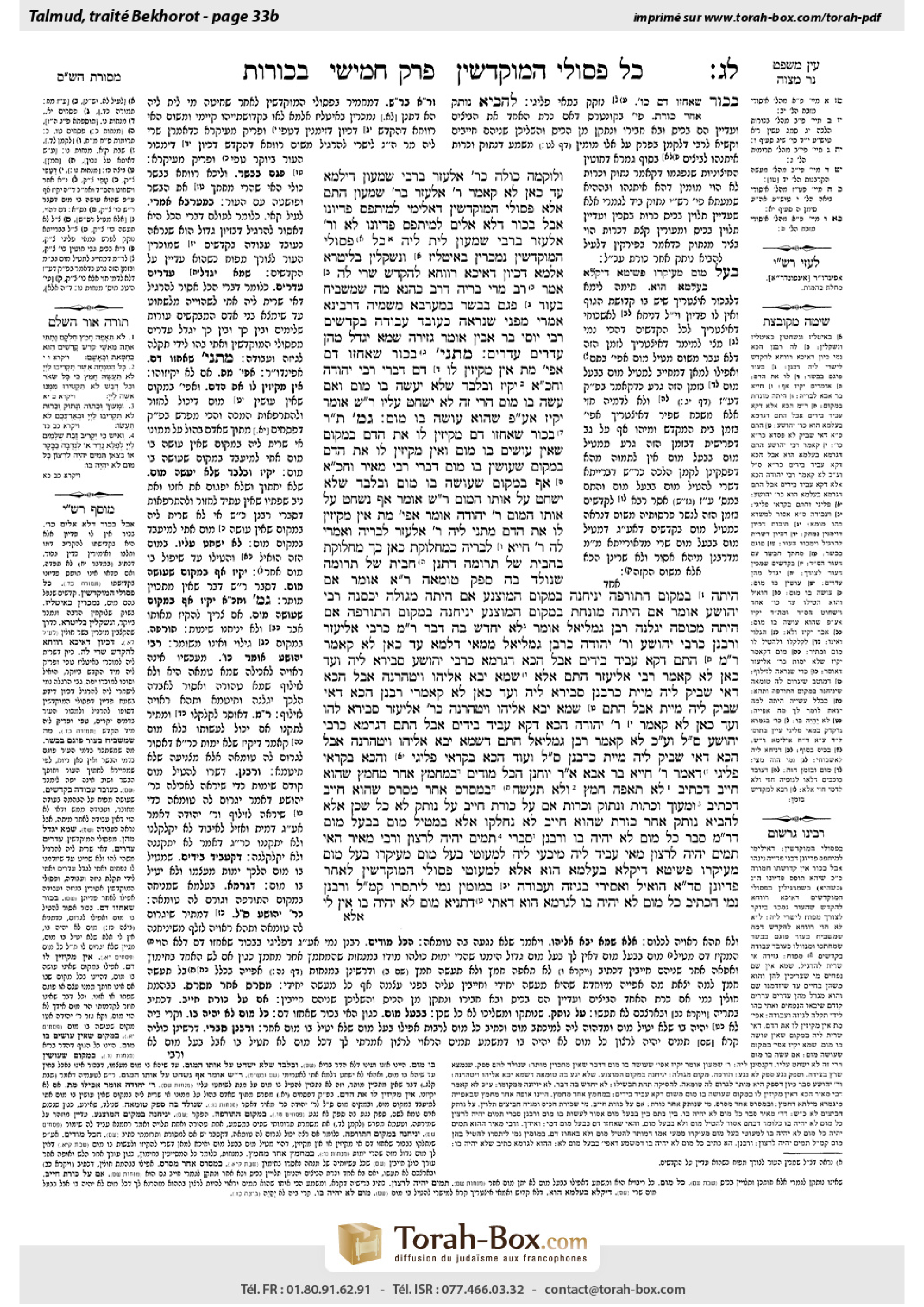
Bekhorot 33b: Talmud study for Daf Yomi
Study the Talmud for Daf Yomi with scanned pages, Hebrew text, English translations from Sefaria and AI-generated French translations.
Passage selection and English or AI-generated French translation are available where the scan has annotations. Daf Study is independent of Torah-Box and Sefaria.
Browse Bekhorot · בכורות · All tractatesBekhorot 33b text and translations
This page of Bekhorot includes the Aramaic text, an English translation and an AI-generated French translation, alongside the scan above.
בכורות ל״ג ב · Aramaic and Hebrew text
וְלוֹקְמַהּ כּוּלַּהּ כְּרַבִּי אֶלְעָזָר בְּרַבִּי שִׁמְעוֹן! דִּילְמָא עַד כָּאן לָא קָאָמַר רַבִּי אֶלְעָזָר בְּרַבִּי שִׁמְעוֹן הָתָם אֶלָּא פְּסוּלֵי הַמּוּקְדָּשִׁין, דְּאַלִּימִי לְמִיתְפַּס פִּדְיוֹנוֹ, אֲבָל בְּכוֹר דְּלָא אַלִּים לְמִיתְפַּס פִּדְיוֹנוֹ — לָא.
וְרַבִּי אֶלְעָזָר בְּרַבִּי שִׁמְעוֹן לֵית לֵיהּ כׇּל פְּסוּלֵי הַמּוּקְדָּשִׁין נִמְכָּרִין בָּאִיטְלִיז וְנִשְׁקָלִין בְּלִיטְרָא? אַלְמָא דְּכֵיוָן דְּאִיכָּא רַוְוחָא לְהֶקְדֵּשׁ שָׁרֵי לֵהּ!
אָמַר רַב מָרִי בְּרֵיהּ דְּרַב כָּהֲנָא: מַה שֶּׁמַּשְׁבִּיחַ בָּעוֹר — פּוֹגֵם בַּבָּשָׂר. בְּמַעְרְבָא מִשְּׁמֵיהּ דְּרָבִינָא אָמְרִי: מִפְּנֵי שֶׁנִּרְאֶה כְּעוֹבֵד עֲבוֹדָה בְּקָדָשִׁים.
רַבִּי יוֹסֵי בַּר אָבִין אוֹמֵר: גְּזֵירָה שֶׁמָּא יְגַדֵּל מֵהֶן עֲדָרִים עֲדָרִים.
מַתְנִי׳ בְּכוֹר שֶׁאֲחָזוֹ דָּם, אֲפִילּוּ מֵת — אֵין מַקִּיזִין לוֹ דָּם, דִּבְרֵי רַבִּי יְהוּדָה. וַחֲכָמִים אוֹמְרִים: יַקִּיז, וּבִלְבַד שֶׁלֹּא יַעֲשֶׂה בּוֹ מוּם, וְאִם עָשָׂה בּוֹ מוּם — הֲרֵי זֶה לֹא יִשְׁחַט עָלָיו. רַבִּי שִׁמְעוֹן אוֹמֵר: יַקִּיז, אַף עַל פִּי שֶׁהוּא עוֹשֶׂה בּוֹ מוּם.
גְּמָ׳ תָּנוּ רַבָּנַן: בְּכוֹר שֶׁאֲחָזוֹ דָּם — מַקִּיזִין לוֹ אֶת הַדָּם בִּמְקוֹם שֶׁאֵין עוֹשִׂים בּוֹ מוּם, וְאֵין מַקִּיזִין לוֹ אֶת הַדָּם בִּמְקוֹם שֶׁעוֹשִׂין בּוֹ מוּם, דִּבְרֵי רַבִּי מֵאִיר.
וַחֲכָמִים אוֹמְרִים: אַף בִּמְקוֹם שֶׁעוֹשֶׂה בּוֹ מוּם, וּבִלְבַד שֶׁלֹּא יִשְׁחַט עַל אוֹתוֹ הַמּוּם. רַבִּי שִׁמְעוֹן אוֹמֵר: אַף נִשְׁחָט עַל אוֹתוֹ הַמּוּם. רַבִּי יְהוּדָה אוֹמֵר: אֲפִילּוּ מֵת — אֵין מַקִּיזִין לוֹ אֶת הַדָּם.
מַתְנֵי לֵיהּ רַבִּי אֶלְעָזָר לִבְרֵיהּ, וְאָמְרִי לַהּ רַבִּי חִיָּיא לִבְרֵיהּ: כַּמַּחְלוֹקֶת כָּאן, כָּךְ מַחְלוֹקֶת בְּחָבִית שֶׁל תְּרוּמָה, דִּתְנַן: חָבִית שֶׁל תְּרוּמָה שֶׁנּוֹלַד בָּהּ סְפֵק טוּמְאָה — רַבִּי אֱלִיעֶזֶר אוֹמֵר: אִם הָיְתָה בִּמְקוֹם הַתּוּרְפָּה — יַנִּיחֶנָּה בְּמָקוֹם הַמּוּצְנָע, אִם הָיְתָה מְגוּלָּה — יְכַסֶּנָּה.
רַבִּי יְהוֹשֻׁעַ אוֹמֵר: אִם הָיְתָה מוּנַּחַת בְּמָקוֹם הַמּוּצְנָע — יַנִּיחֶנָּה בִּמְקוֹם הַתּוּרְפָּה, אִם הָיְתָה מְכוּסָּה — יְגַלֶּנָּה. רַבָּן גַּמְלִיאֵל אוֹמֵר: לֹא יְחַדֵּשׁ בָּהּ דָּבָר.
רַבִּי מֵאִיר כְּרַבִּי אֱלִיעֶזֶר, וְרַבָּנַן כְּרַבִּי יְהוֹשֻׁעַ, וְרַבִּי יְהוּדָה כְּרַבָּן גַּמְלִיאֵל.
מִמַּאי? דִּלְמָא עַד כָּאן לָא קָאָמַר רַבִּי מֵאִיר הָתָם, דְּקָא עָבֵיד בְּיָדַיִם, אֲבָל הָכָא דִּגְרָמָא — כְּרַבִּי יְהוֹשֻׁעַ סְבִירָא לֵיהּ!
וְעַד כָּאן לָא קָאָמַר רַבִּי אֱלִיעֶזֶר הָתָם, אֶלָּא שֶׁמָּא יָבֹא אֵלִיָּהוּ וִיטַהֲרֶנָּה, אֲבָל הָכָא, דְּאִי שָׁבֵיק לֵיהּ מָיֵית — כְּרַבָּנַן סְבִירָא לֵיהּ!
וְעַד כָּאן לָא קָאָמְרִי רַבָּנַן הָכָא, דְּאִי שָׁבֵיק לֵיהּ מָיֵית, אֲבָל הָתָם — שֶׁמָּא יָבֹא אֵלִיָּהוּ וִיטַהֲרֶנָּה, כְּרַבִּי אֱלִיעֶזֶר סְבִירָא לְהוּ! וְעַד כָּאן לָא קָאָמַר רַבִּי יְהוּדָה הָכָא, דְּקָא עָבֵיד בְּיָדַיִם, אֲבָל הָתָם דִּגְרָמָא — כְּרַבִּי יְהוֹשֻׁעַ סְבִירָא לֵיהּ!
וְעַד כָּאן לָא קָאָמַר רַבָּן גַּמְלִיאֵל הָתָם, דְּשֶׁמָּא יָבֹא אֵלִיָּהוּ וִיטַהֲרֶנָּה, אֲבָל הָכָא, דְּאִי שָׁבֵיק לֵיהּ מָיֵית, כְּרַבָּנַן סְבִירָא לֵיהּ!
וְעוֹד, הָכָא בִּקְרָאֵי פְּלִיגִי וְהָכָא בִּקְרָאֵי פְּלִיגִי, דְּאָמַר רַבִּי חִיָּיא בַּר אַבָּא אָמַר רַבִּי יוֹחָנָן: הַכֹּל מוֹדִים בִּמְחַמֵּץ אַחַר מְחַמֵּץ שֶׁהוּא חַיָּיב, דִּכְתִיב ״לֹא תֵאָפֶה חָמֵץ״ וְ״לֹא תֵעָשֶׂה״.
בִּמְסָרֵס אַחֵר מְסָרֵס שֶׁהוּא חַיָּיב, דִּכְתִיב: ״וּמָעוּךְ וְכָתוּת וְנָתוּק וְכָרוּת״, אִם עַל כּוֹרֵת חַיָּיב, עַל נוֹתֵק לֹא כׇּל שֶׁכֵּן? אֶלָּא לְהָבִיא נוֹתֵק אַחַר כּוֹרֵת, שֶׁהוּא חַיָּיב.
לֹא נֶחְלְקוּ אֶלָּא בְּמֵטִיל מוּם בְּבַעַל מוּם, דְּרַבִּי מֵאִיר סָבַר: ״כׇּל מוּם לֹא יִהְיֶה בּוֹ״, וְרַבָּנַן סָבְרִי: ״תָּמִים יִהְיֶה לְרָצוֹן״.
וְרַבִּי מֵאִיר, הַאי ״תָּמִים יִהְיֶה לְרָצוֹן״ מַאי עָבֵיד לֵיהּ? מִיבְּעֵי לֵיהּ לְמַעוֹטֵי בַּעַל מוּם מֵעִיקָּרוֹ.
בַּעַל מוּם מֵעִיקָּרוֹ — פְּשִׁיטָא, דִּיקְלָא בְּעָלְמָא הוּא!
אֶלָּא לְמַעוֹטֵי פְּסוּלֵי הַמּוּקְדָּשִׁין לְאַחַר פִּדְיוֹנָן, סָלְקָא דַּעְתָּךְ אָמֵינָא: הוֹאִיל וַאֲסִירִי בְּגִיזָּה וַעֲבוֹדָה — בְּמוּמִין נָמֵי לִיתַּסְרוּ, קָא מַשְׁמַע לַן.
וְרַבָּנַן נָמֵי, הָכְתִיב ״כׇּל מוּם לֹא יִהְיֶה בּוֹ״! לִגְרָמָא הוּא דְּאָתֵי, דְּתַנְיָא: ״מוּם לֹא יִהְיֶה בּוֹ״ — אֵין לִי
Bekhorot 33b · English translation
The Gemara suggests: But if so, let Rav Ḥisda establish the entire baraita in accordance with the opinion of Rabbi Elazar, son of Rabbi Shimon. The Gemara answers: Perhaps Rabbi Elazar, son of Rabbi Shimon, says that the sanctity of a slaughtered blemished offering is retained only there, with regard to other disqualified consecrated animals, because their level of sanctity is strong enough to transfer their sanctity to their redemption money. But with regard to a blemished firstborn offering, whose level of sanctity is not strong enough to transfer it to its redemption money, perhaps its sanctity is not retained, and therefore one may skin the hide from its feet.
The Gemara asks: But doesn’t Rabbi Elazar, son of Rabbi Shimon, agree with the ruling of the mishna (31a) that all disqualified consecrated animals are sold in the butchers’ market and weighed and sold by the litra, in the manner of non-sacred meat? Certainly he agrees with that halakha. Evidently, since there is a benefit that accrues to the Temple treasury, the tanna of the mishna deems this permitted. As it was taught (31b), the meat of disqualified consecrated animals may be treated in this manner despite the fact that it retains a measure of sanctity. The reason is that if the owner knows that it is permitted for him to perform this more lucrative action, he is likely to spend more money to redeem the animal in the first place, which benefits the Temple treasury. By the same logic, why doesn’t Rabbi Elazar, son of Rabbi Shimon, permit the more lucrative action of skinning the animal from its feet?
The Gemara cites several resolutions. Rav Mari, son of Rav Kahana, said that the benefit gained to the hide by skinning it whole is offset by the detriment caused to the flesh. Part of the animal’s flesh is severed from the carcass during the skinning process, thereby lowering its value. In the West, Eretz Yisrael, they say in the name of Ravina that skinning a disqualified consecrated animal from its feet is prohibited because it appears as though he is performing work with sacrificial animals, which is prohibited.
Rabbi Yosei bar Avin says that this prohibition is a rabbinic decree, lest one retain the disqualified consecrated animals in his possession while waiting for a consumer to purchase the hides, and in the meantime raise many herds of disqualified animals from them. In such a case, he might shear or work the animals in a prohibited manner.
MISHNA: With regard to a firstborn animal that was congested with excess blood, even if the animal will die if one does not let the excess blood, one may not let its blood, as this might cause a blemish, and it is prohibited to cause a blemish on consecrated animals. This is the statement of Rabbi Yehuda. And the Rabbis say: One may let the blood provided that he will not cause a blemish while doing so, and if he caused a blemish, the animal may not be slaughtered on account of that blemish. Since he was the cause of the blemish, he may not slaughter the animal until it develops a different, unrelated blemish. Rabbi Shimon says: One may let the blood even if he thereby causes a blemish in the animal.
GEMARA: The Sages taught in a baraita: With regard to a firstborn animal that was congested with excess blood, and which can be healed only through bloodletting, one may let the animal’s blood by cutting it in a place where the incision does not cause a permanent blemish. But one may not let the animal’s blood by cutting it in a place where the incision causes a permanent blemish, as it is prohibited to intentionally cause a blemish in a firstborn animal; this is the statement of Rabbi Meir.
And the Rabbis say: One may even let the animal’s blood by cutting it in a place where the incision causes a permanent blemish, provided that he does not slaughter the animal on the basis of that blemish, even though in general, a firstborn animal may be slaughtered once it develops any permanent blemish. Rabbi Shimon says: The animal may even be slaughtered on the basis of that blemish. Rabbi Yehuda says: Even if the firstborn would die if its blood is not let, one may not let its blood at all.
The Gemara relates: Rabbi Elazar taught his son, and some say it was Rabbi Ḥiyya who taught his son: Just as there is a dispute here in this baraita with regard to bloodletting, so there is a dispute in a mishna with regard to a barrel of teruma. As we learned (Terumot 8:8): In the case of a barrel of teruma oil with regard to which uncertainty developed concerning its status of ritual impurity, and which therefore may not be eaten, Rabbi Eliezer says that one must nevertheless safeguard the teruma from impurity. Therefore, if the barrel was resting in a vulnerable location, where it might come into contact with impurity, one should place it in a concealed location, and if it was exposed, he should cover it.
Rabbi Yehoshua says: That is not necessary. Rather, if it was placed in a concealed location, one may place it in a vulnerable location. If it was covered he may expose it, as he need no longer safeguard this teruma from impurity. Rabban Gamliel says: One should do nothing new with it, i.e., he should leave the barrel as it is.
The Gemara clarifies: Rabbi Meir, who deems it permitted to let the firstborn offering’s blood provided that one does not cause a blemish, holds in accordance with the opinion of Rabbi Eliezer, who deems it prohibited to place the barrel in an exposed location lest it become ritually impure, which is equivalent to a blemish. And the Rabbis, who deem bloodletting permitted even if it will cause a blemish, hold in accordance with the opinion of Rabbi Yehoshua, who rules that the contents of the barrel may be exposed to ritual impurity. And Rabbi Yehuda, who says that bloodletting is not permitted under any circumstance, holds in accordance with the opinion of Rabban Gamliel, who rules that the barrel should be left as is and not be handled at all.
The Gemara rejects this suggestion: From where can one prove that these comparisons are accurate? Perhaps Rabbi Meir states his opinion, that one may not let blood in a place that will cause a blemish, only there, as the individual is causing the blemish by direct action. But here, in the case of the barrel, where the ritual impurity results from an indirect action, perhaps he holds in accordance with the opinion of Rabbi Yehoshua.
And furthermore, perhaps Rabbi Eliezer states his opinion that the barrel should be protected only here, because perhaps Elijah will come and deem it ritually pure. But there, with regard to the firstborn offering, where if one leaves the animal it will certainly die, perhaps he holds in accordance with the opinion of the Rabbis, that bloodletting is permitted in order to prevent the animal’s death.
And likewise, perhaps the Rabbis state their opinion only here, with regard to the firstborn offering, as if one leaves it, the animal will certainly die. But there, in the case of the barrel of teruma, perhaps they accept the claim that one must safeguard the teruma, because perhaps Elijah will come and deem it ritually pure, which would mean that they hold in accordance with the opinion of Rabbi Eliezer. It can also be suggested that Rabbi Yehuda states his opinion, that bloodletting is prohibited in all circumstances, only here, with regard to the firstborn offering, as the individual is causing the blemish by direct action. But there, in the case of the barrel, where the ritual impurity results from an indirect action, perhaps he holds in accordance with the opinion of Rabbi Yehoshua.
And perhaps Rabban Gamliel states his opinion, that the barrel should not be moved at all, only there, because perhaps Elijah will come and deem it ritually pure. But here, with regard to the firstborn offering, where if one leaves it, it will certainly die, it is possible that he holds in accordance with the opinion of the Rabbis.
And furthermore, one cannot draw parallels between the opinions of the two sources, as here the tanna’im disagree with regard to the exposition of certain verses, and there they disagree with regard to the exposition of certain other verses. As Rabbi Ḥiyya bar Abba says that Rabbi Yoḥanan says: All of the Sages who disagree as to whether one may let the blood of the firstborn animal concede that one who leavens a meal offering after another had already leavened it is liable to receive lashes for the additional leavening, as it is written: “It shall not be baked with leaven” (Leviticus 6:10), and it is also stated: “No meal offering that you sacrifice to God shall be made with leaven” (Leviticus 2:11). This indicates that one is liable for every act of leavening performed on a meal offering.
Similarly, everyone agrees that one who castrates an animal after one who has already castrated it is liable, as it is written: “Those whose testicles are bruised or crushed or detached or cut shall not be offered to the Lord, and you shall not do this in your land” (Leviticus 22:24). If one is liable when the seminal vesicles are cut, then when the testicles are detached altogether, is he not all the more so liable? Rather, this verse serves to include one who detaches the testicles after one who cuts the seminal vesicles, to indicate that he is liable. Apparently, one is liable for castrating an animal that is already sterilized.
These Sages disagree only with regard to one who causes a blemish in an already blemished animal, such as one whose blood circulation is constricted. As Rabbi Meir maintains that as the verse states: “It shall be perfect to be accepted; there shall be no blemish in it” (Leviticus 22:21), this categorical statement includes even the causing of a blemish in an offering that is already blemished. And the Rabbis maintain that the phrase “It shall be perfect to be accepted” indicates that the prohibition against causing a blemish applies only to an animal that is currently perfect, i.e., unblemished, and can therefore be accepted, i.e., it is fit to be sacrificed upon the altar. If the animal is already blemished, there is no prohibition against causing an additional blemish in it.
The Gemara asks: And Rabbi Meir, what does he do with this verse: “It shall be perfect to be accepted”? The Gemara answers: That verse serves to exclude only an animal that was blemished from the outset, i.e., an animal that was born with a blemish. In such a case, there is no prohibition against causing an additional blemish in it. But if the animal was initially unblemished and later developed a blemish, it is prohibited to cause another blemish in it.
The Gemara rejects this suggestion: There is no need to exclude an animal that was blemished from the outset, as it is merely like a palm tree, i.e., it can never attain the status of an animal consecrated as an offering. Therefore, it is obvious that the prohibition against causing a blemish does not apply to this animal.
Rather, Rabbi Meir maintains that the phrase “It shall be perfect to be accepted” serves to exclude disqualified consecrated animals, to teach that after their redemption, when they become non-sacred, the prohibition against causing a blemish does not apply to them any longer. This exclusion is necessary, as it might enter your mind to say that since even after they have been redeemed and are non-sacred, just as it is prohibited to shear these animals or use them for labor, perhaps let it also be prohibited to cause a blemish upon them. Consequently, this verse teaches us that there is no prohibition against causing a blemish in these animals.
The Gemara asks: And as for the Rabbis as well, who derive their opinion from the verse: “It shall be perfect to be accepted,” isn’t it written: “There shall not be any blemish in it,” which indicates an expansion of the prohibition against causing a blemish upon an offering? The Gemara answers: That verse comes to teach that the prohibition against causing a blemish extends also to a blemish caused as the result of an indirect action. As it is taught in a baraita: The verse states: “There shall not be any blemish in it” (Leviticus 22:21); from here I have derived
Bekhorot 33b · Traduction française (IA)
La Guemara suggère : Mais si c’est ainsi, que Rav Ḥisda établisse toute la baraïta conformément à l’opinion de Rabbi Elazar, fils de Rabbi Shimon. La Guemara répond : Peut-être que Rabbi Elazar, fils de Rabbi Shimon, affirme que la sanctité d’un sacrifice blemi est conservée uniquement là, concernant d’autres animaux consacrés inaptes, car leur niveau de sanctité est suffisamment fort pour transférer leur sanctité à leur argent de rachat. Mais concernant un sacrifice blemi de premier-né, dont le niveau de sanctité n’est pas suffisamment fort pour le transférer à son argent de rachat, peut-être sa sanctité n’est pas conservée, et par conséquent on peut dépecer la peau de ses pieds.
La Guemara pose la question : Mais ne serait-ce pas que Rabbi Elazar, fils de Rabbi Shimon, s’accorde avec la décision de la mitsva (31a) selon laquelle tous les animaux consacrés inaptes sont vendus au marché des bouchers et pesés et vendus par la litra, comme la viande non sacrée ? Certes, il s’accorde avec cette halakha. Évidemment, puisque cela procure un bénéfice au trésor du Temple, le tanna de la mitsva considère cela permis. Comme il a été enseigné (31b), la viande d’animaux consacrés inaptes peut être traitée ainsi malgré le fait qu’elle conserve une mesure de sanctité. La raison est que si l’propriétaire sait qu’il est permis à lui de réaliser cette action plus lucrative, il est probable qu’il dépense plus d’argent pour racheter l’animal d’abord, ce qui profite au trésor du Temple. Par le même raisonnement, pourquoi Rabbi Elazar, fils de Rabbi Shimon, ne permettrait-il pas l’action plus lucrative de dépecer l’animal de ses pieds ?
La Guemara cite plusieurs résolutions. Rav Mari, fils de Rav Kahana, a dit que le bénéfice obtenu par la peau en dépecant l’animal entier est compensé par le préjudice causé à la viande. Une partie de la viande de l’animal est séparée du cadavre lors du dépecage, ce qui réduit sa valeur. En Occident, en Terre d’Israël, on dit en nom de Ravina que dépecer un animal consacré inapte de ses pieds est interdit car cela semble comme s’il travaillait avec des animaux sacrés, ce qui est interdit.
Rabbi Yosei bar Avin dit que cette interdiction est un décret rabbinique, afin que l’on ne conserve pas les animaux consacrés inaptes dans sa possession en attendant qu’un acheteur achète les peaux, et pendant ce temps on ne développe pas beaucoup d’herd d’animaux inaptes à partir d’eux. Dans ce cas, il pourrait peloter ou travailler les animaux de manière interdite.
MICHNA : Concernant un animal de premier-né congestionné avec du sang en excès, même si l’animal mourra si l’on ne laisse pas le sang en excès, on ne peut pas laisser son sang, car cela pourrait causer un blemish, et il est interdit de causer un blemish sur des animaux consacrés. C’est l’affirmation de Rabbi Yehuda. Et les Rabbins disent : On peut laisser le sang à condition qu’on ne cause pas un blemish en le faisant, et si on a causé un blemish, l’animal ne peut pas être sacrifié à cause de ce blemish. Puisque c’est lui qui a causé le blemish, il ne peut pas sacrifier l’animal jusqu’à ce qu’il développe un autre blemish indépendant. Rabbi Shimon dit : On peut laisser le sang même si cela cause un blemish à l’animal.
GUEMARA : Les Sages ont enseigné dans une baraïta : En ce qui concerne un animal premier-né congestionné par un excès de sang, et qui ne peut être guéri que par le saignement, on peut saigner l'animal en le coupant dans un endroit où l'incision ne cause pas un défaut permanent. Mais on ne peut pas saigner l'animal en le coupant dans un endroit où l'incision cause un défaut permanent, car il est interdit de provoquer intentionnellement un défaut dans un animal premier-né ; c'est la déclaration du Rabbi Meir.
Et les Rabbins disent : On peut même saigner l'animal en le coupant dans un endroit où l'incision cause un défaut permanent, à condition qu'on ne sacrifie pas l'animal sur la base de ce défaut, même si, en général, un animal premier-né peut être sacrifié dès qu'il développe un défaut permanent. Le Rabbi Shimon dit : L'animal peut même être sacrifié sur la base de ce défaut. Le Rabbi Yéhuda dit : Même si le premier-né mourrait s'il n'était pas saigné, on ne peut pas le saigner du tout.
La Guemara rapporte : Le Rabbi Eléazar a enseigné à son fils, et certains disent que c'était le Rabbi Chija qui a enseigné à son fils : Tout comme il y a un désaccord ici dans cette baraïta concernant le saignement, il y a un désaccord dans une mitsva concernant un tonneau de terouma. Comme nous avons appris (Teroumot 8:8) : Dans le cas d'un tonneau d'huile de terouma concernant lequel il y a eu une incertitude concernant son statut d'impureté rituelle, et qui est donc inedible, le Rabbi Elézer dit qu'on doit néanmoins protéger la terouma contre l'impureté. Ainsi, si le tonneau était placé dans un endroit vulnérable, où il pourrait entrer en contact avec l'impureté, on devrait le placer dans un endroit caché, et si il était exposé, on devrait le couvrir.
Le Rabbi Yéhoshua dit : Ce n'est pas nécessaire. Plutôt, si elle était placée dans un endroit caché, on peut la placer dans un endroit vulnérable. Si elle était couverte, on peut l'exposer, car on n'a plus besoin de protéger cette terouma contre l'impureté. Rabban Gamliel dit : On ne devrait pas faire de changement avec elle, c'est-à-dire qu'on devrait laisser le tonneau tel qu'il est.
La Guemara précise : Le Rabbi Meir, qui considère permis de saigner l'offrande du premier-né à condition qu'on ne cause pas un défaut, adopte l'opinion du Rabbi Elézer, qui considère interdit de placer le tonneau dans un endroit exposé de peur qu'il devienne impur rituellement, ce qui équivaut à un défaut. Et les Rabbins, qui considèrent permis le saignement même s'il provoque un défaut, adoptent l'opinion du Rabbi Yéhoshua, qui décide que le contenu du tonneau peut être exposé à l'impureté rituelle. Et le Rabbi Yéhuda, qui dit que le saignement n'est pas permis sous aucun prétexte, adopte l'opinion de Rabban Gamliel, qui décide que le tonneau devrait être laissé tel qu'il est et ne pas être manipulé du tout.
La Guemara rejette cette suggestion : d'où peut-on prouver que ces comparaisons sont exactes ? Peut-être que Rabbi Meir exprime son opinion selon laquelle on ne doit pas laisser couler le sang dans un lieu qui provoquerait une tache, uniquement là, car l'individu provoque la tache par une action directe. Mais ici, dans le cas du tonneau, où l'impureté rituelle résulte d'une action indirecte, peut-être il adopte l'opinion de Rabbi Yéhoshua.
Et de plus, peut-être que Rabbi Eliezer exprime son opinion selon laquelle le tonneau doit être protégé uniquement ici, car peut-être Eliézer viendra et le déclarera rituellement pur. Mais là, concernant l'offrande du premier-né, où si l'on laisse l'animal, il mourra certainement, peut-être il adopte l'opinion des Rabbins, selon laquelle le sangletage est permis afin d'éviter la mort de l'animal.
Et de même, peut-être que les Rabbins expriment leur opinion uniquement ici, concernant l'offrande du premier-né, comme si l'on laissait l'animal, il mourra certainement. Mais là, dans le cas du tonneau de terouma, peut-être ils acceptent la revendication selon laquelle il faut protéger la terouma, car peut-être Eliézer viendra et le déclarera rituellement pur, ce qui signifierait qu'ils adoptent l'opinion de Rabbi Eliezer. On peut aussi suggérer que Rabbi Yéhuda exprime son opinion selon laquelle le sangletage est interdit dans tous les cas, uniquement ici, concernant l'offrande du premier-né, car l'individu provoque la tache par une action directe. Mais là, dans le cas du tonneau, où l'impureté rituelle résulte d'une action indirecte, peut-être il adopte l'opinion de Rabbi Yéhoshua.
Et peut-être que Rabban Gamliel exprime son opinion selon laquelle le tonneau ne doit pas être déplacé du tout, uniquement là, car peut-être Eliézer viendra et le déclarera rituellement pur. Mais ici, concernant l'offrande du premier-né, où si l'on laisse l'animal, il mourra certainement, il est possible qu'il adopte l'opinion des Rabbins.
Et de plus, on ne peut pas établir de parallèles entre les opinions des deux sources, car ici les tannaïm divergent concernant l'interprétation de certains versets, et là ils divergent concernant l'interprétation de d'autres versets. Comme dit Rabbi Ḥiyya bar Abba, qui rapporte Rabbi Yoḥanan : Tous les Sages qui divergent sur la question de savoir si l'on peut laisser couler le sang de l'animal du premier-né reconnaissent que celui qui fait lever une offrande de farine après que quelqu'un d'autre ait déjà levé la farine est puni de flagellation pour ce deuxième lever, car il est écrit : « Il ne doit pas être cuit avec du levain » (Lévitique 6:10), et il est aussi dit : « Aucune offrande de farine que vous offrirez à l'Éternel ne doit être faite avec du levain » (Lévitique 2:11). Cela indique que l'on est puni pour chaque acte de levain effectué sur une offrande de farine.
De même, tout le monde convient que celui qui castrate un animal après celui qui a déjà castré est puni, car il est écrit : « Ceux dont les testicules sont écrasés, brisés, détachés ou tranchés ne doivent pas être offerts à l'Éternel, et vous ne devez pas faire cela dans votre terre » (Lévitique 22:24). Si l'on est puni lorsqu'on tranche les vésicules séminales, alors lorsqu'on détache les testicules, n'est-on pas encore plus puni ? Plutôt, ce verset sert à inclure celui qui détache les testicules après celui qui a tranché les vésicules séminales, pour indiquer qu'il est puni. Apparemment, l'on est puni pour castrer un animal déjà stérilisé.
Ces Sages divergent uniquement concernant celui qui cause un défaut dans un animal déjà défavorable, tel qu'un animal dont la circulation sanguine est restreinte. Comme Rabbi Meir maintient que, puisque le verset dit : « Il doit être parfait pour être accepté ; il ne doit pas y avoir de défaut en lui » (Lévitique 22:21), cette déclaration catégorique inclut même la cause d'un défaut dans une offrande déjà défavorable. Et les Rabbins maintiennent que la phrase « Il doit être parfait pour être accepté » indique que l'interdiction de causer un défaut s'applique uniquement à un animal qui est actuellement parfait, c'est-à-dire non défavorable, et donc acceptable, c'est-à-dire prêt à être sacrifié sur l'autel. Si l'animal est déjà défavorable, il n'y a pas d'interdiction de causer un autre défaut en lui.
La Guemara demande : Et Rabbi Meir, que fait-il avec ce verset : « Il doit être parfait pour être accepté » ? La Guemara répond : Ce verset sert à exclure uniquement un animal déjà défavorable dès le départ, c'est-à-dire un animal né avec un défaut. Dans ce cas, il n'y a pas d'interdiction de causer un autre défaut en lui. Mais si l'animal était initialement parfait et a ensuite développé un défaut, il est interdit de causer un autre défaut en lui.
La Guemara rejette cette suggestion : il n'y a pas besoin d'exclure un animal déjà défavorable dès le départ, car il est simplement comme un palmier, c'est-à-dire qu'il ne peut jamais atteindre le statut d'un animal consacré. Par conséquent, il est évident que l'interdiction de causer un défaut ne s'applique pas à cet animal.
Plutôt, Rabbi Meir affirme que la phrase « Il doit être parfait pour être accepté » sert à exclure les animaux consacrés inéligibles, pour enseigner que, après leur rachat, lorsqu'ils deviennent non sacrés, l'interdiction de causer une tache ne s'applique plus à eux. Cette exclusion est nécessaire, car il pourrait entrer en vous l'idée que, puisque même après leur rachat et leur statut de non sacré, il est interdit de tailler ces animaux ou de les utiliser pour le travail, peut-être il est également interdit de causer une tache sur eux. Ainsi, ce verset nous enseigne que l'interdiction de causer une tache ne s'applique pas à ces animaux.
La Guemara pose la question : Et quant aux Sages eux-mêmes, qui tirent leur opinion du verset : « Il sera parfait pour être accepté », n’est-il pas écrit : « Il ne doit pas y avoir de tache en lui », ce qui indique une extension de l’interdiction de causer une tache à un sacrifice ? La Guemara répond : Ce verset vient enseigner que l’interdiction de causer une tache s’applique également à une tache causée par une action indirecte. Comme il est enseigné dans une baraïta : Le verset dit : « Il ne doit pas y avoir de tache en lui » (Lévitique 22:21) ; d’ici, j’ai déduit
Traduction française générée par IA à partir de l’édition anglaise de Sefaria. Vérifie toujours un passage avec le texte source.
Text from Sefaria: William Davidson Edition - Vocalized Aramaic (CC BY NC); William Davidson Edition - English (CC BY NC).