Bekhorot 34a: Talmud study for Daf Yomi
Study the Talmud for Daf Yomi with scanned pages, Hebrew text, English translations from Sefaria and AI-generated French translations.
Passage selection and English or AI-generated French translation are available where the scan has annotations. Daf Study is independent of Torah-Box and Sefaria.
Browse Bekhorot · בכורות · All tractatesBekhorot 34a text and translations
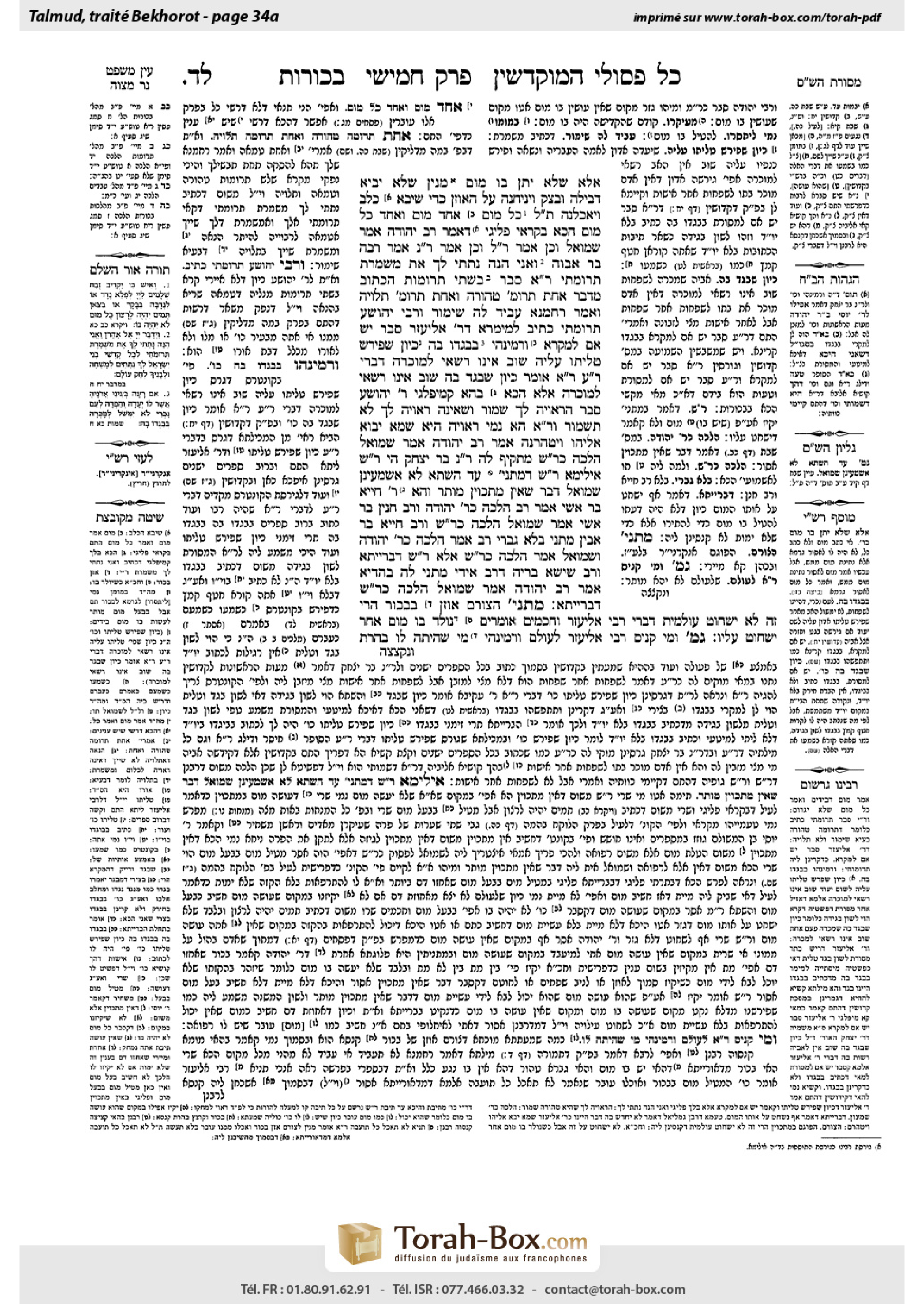
This page of Bekhorot includes the Aramaic text, an English translation and an AI-generated French translation, alongside the scan above.
בכורות ל״ד א · Aramaic and Hebrew text
אֶלָּא שֶׁלֹּא יִתֵּן בּוֹ מוּם, מִנַּיִן שֶׁלֹּא יָבִיא דְּבֵילָה וּבָצֵק וְיַנִּיחֶנָּה עַל הָאוֹזֶן כְּדֵי שֶׁיָּבֹא כֶּלֶב וְיֹאכְלֶנָּה? תַּלְמוּד לוֹמַר ״כׇּל מוּם״ — אֶחָד מוּם וְאֶחָד כׇּל מוּם.
הָכָא בִּקְרָאֵי פְּלִיגִי, דְּאָמַר רַב יְהוּדָה אָמַר שְׁמוּאֵל, וְכֵן אָמַר רֵישׁ לָקִישׁ, וְכֵן אָמַר רַב נַחְמָן אָמַר רַבָּה בַּר אֲבוּהּ: ״וַאֲנִי הִנֵּה נָתַתִּי לְךָ אֶת מִשְׁמֶרֶת תְּרוּמֹתָי״.
רַבִּי אֱלִיעֶזֶר סָבַר: בִּשְׁתֵּי תְּרוּמוֹת הַכָּתוּב מְדַבֵּר, אַחַת תְּרוּמָה טְהוֹרָה וְאַחַת תְּרוּמָה תְּלוּיָה, וְאָמַר רַחֲמָנָא: עֲבֵיד לַהּ שִׁימּוּר. וְרַבִּי יְהוֹשֻׁעַ: ״תְּרוּמָתִי״ כְּתִיב.
לְמֵימְרָא דְּרַבִּי אֱלִיעֶזֶר סָבַר יֵשׁ אֵם לַמִּקְרָא? וּרְמִינְהִי: ״בְּבִגְדוֹ בָּהּ״ — כֵּיוָן שֶׁפֵּירַשׂ טַלִּיתוֹ עָלֶיהָ, שׁוּב אֵינוֹ רַשַּׁאי לְמוֹכְרָהּ, דִּבְרֵי רַבִּי עֲקִיבָא.
רַבִּי אֱלִיעֶזֶר אוֹמֵר: כֵּיוָן שֶׁבָּגַד בָּהּ, שׁוּב אֵינוֹ רַשַּׁאי לְמוֹכְרָהּ!
אֶלָּא, הָכָא בְּהָא קָמִיפַּלְגִי: רַבִּי יְהוֹשֻׁעַ סָבַר: הָרְאוּיָה לָךְ שְׁמוֹר, וְשֶׁאֵינָהּ רְאוּיָה לָךְ לָא תִּשְׁמוֹר, וְרַבִּי אֱלִיעֶזֶר: הָא נָמֵי רְאוּיָה הִיא, שֶׁמָּא יָבוֹא אֵלִיָּהוּ וִיטַהֲרֶנָּה.
אָמַר רַב יְהוּדָה אָמַר שְׁמוּאֵל: הֲלָכָה כְּרַבִּי שִׁמְעוֹן. מַתְקֵיף לַהּ רַב נַחְמָן בַּר יִצְחָק: הֵי רַבִּי שִׁמְעוֹן? אִילֵימָא רַבִּי שִׁמְעוֹן דְּמַתְנִיתִין, עַד הַשְׁתָּא לָא אַשְׁמְעִינַן שְׁמוּאֵל דָּבָר שֶׁאֵין מִתְכַּוֵּין מוּתָּר?
וְהָא רַבִּי חִיָּיא בַּר אָשֵׁי אָמַר רַב: הֲלָכָה כְּרַבִּי יְהוּדָה, וְרַב חָנִין בַּר אָשֵׁי אָמַר שְׁמוּאֵל: הֲלָכָה כְּרַבִּי שִׁמְעוֹן, וְרַב חִיָּיא בַּר אָבִין מַתְנֵי בְּלָא גַּבְרֵי — רַב אָמַר: הֲלָכָה כְּרַבִּי יְהוּדָה, וּשְׁמוּאֵל אָמַר: הֲלָכָה כְּרַבִּי שִׁמְעוֹן!
אֶלָּא רַבִּי שִׁמְעוֹן דְּבָרַיְיתָא, וְרַב שִׁישָׁא בְּרֵיהּ דְּרַב אִידִי מַתְנֵי לַהּ בְּהֶדְיָא: אָמַר רַב יְהוּדָה אָמַר שְׁמוּאֵל: הֲלָכָה כְּרַבִּי שִׁמְעוֹן דְּבָרַיְיתָא.
מַתְנִי׳ הַצּוֹרֵם אוֹזֶן בַּבְּכוֹר — הֲרֵי זֶה לֹא יִשְׁחוֹט עוֹלָמִית, דִּבְרֵי רַבִּי אֱלִיעֶזֶר. וַחֲכָמִים אוֹמְרִים: נוֹלַד בּוֹ מוּם אַחֵר — יִשְׁחוֹט עָלָיו.
גְּמָ׳ וּמִי קָנֵיס רַבִּי אֱלִיעֶזֶר לְעוֹלָם? וּרְמִינְהִי: מִי שֶׁהָיְתָה לוֹ בַּהֶרֶת
Bekhorot 34a · English translation
only the prohibition that one may not directly cause a blemish. From where is it derived that one may not bring pressed figs or dough and place it on the animal’s ear so that a dog will come and eat it, thereby biting off part of the animal’s ear and leaving it blemished? The verse states: “There shall not be any blemish in it” (Leviticus 22:21), indicating that the same prohibition applies both when the blemish is caused directly and when it is any blemish, even one caused indirectly.
After demonstrating that the tanna’im in the baraita discussing the firstborn offering disagree with regard to the exposition of certain verses, the Gemara clarifies that the tanna’im here, in the baraita discussing teruma whose status concerning impurity is uncertain, also disagree with regard to the exposition of verses. As Rav Yehuda says that Shmuel says, and Reish Lakish likewise says, and Rav Naḥman likewise says that Rabba bar Avuh says: It is stated in a verse addressed to Aaron and his sons: “And I, behold, I have given you the charge of My terumot [terumotai]” (Numbers 18:8), with “terumotai” written in plural.
Rabbi Eliezer, who holds that the barrel of teruma must be safeguarded from ritual impurity, holds that the verse is speaking of two terumot: Both teruma that is definitely ritually pure and teruma that is in abeyance, i.e., teruma whose status with regard to impurity is uncertain. And based on the plural “My terumot,” it is understood that the Merciful One states: Make a protection for it, i.e., safeguard even teruma whose status concerning impurity is uncertain. And Rabbi Yehoshua, who holds that one may expose to ritual impurity the teruma contents in the barrel, holds that the term terumotai is written so that it can be read as terumati, meaning: My teruma, in the singular. Therefore, the requirement to safeguard teruma applies only to that teruma whose status is definitely pure.
The Gemara asks: Is this to say that Rabbi Eliezer holds that the vocalization of the Torah is authoritative, i.e., one derives halakhot based on the pronunciation of the words, although it diverges from the spelling? And the Gemara raises a contradiction from a baraita discussing a Hebrew maidservant’s return to her father’s house. The verse states, with regard to her master: “He shall have no power to sell her to a foreign people, seeing that he has dealt deceitfully with her [bevigdo bah]” (Exodus 21:8). The term “bevigdo” shares a root with a word for garment, beged. Therefore, the verse indicates that once the master has spread his garment over her, thereby designating her as his wife, if the maidservant is subsequently divorced or widowed, her father may no longer sell her. This is the statement of Rabbi Akiva, who maintains that the vocalization of the Torah is authoritative, and he interprets bevigdo as related to bigdo, his garment.
Rabbi Eliezer says: The word bevigdo is written without a yod and therefore is written in a manner that it can be read: Bevagdo. Accordingly, bevigdo bah means that since the father dealt deceitfully [bagad] with her by selling her once, he may not sell her again. Evidently, Rabbi Eliezer maintains that the manner in which the verses in the Torah are written is authoritative, and one derives halakhot based on the spelling of the words. This contradicts his derivation with regard to teruma, which is based on the pronunciation of the words.
Rather, here, the tanna’im disagree with regard to this: The verse states: “And I, behold, I have given you the charge of My terumot” (Numbers 18:8). Rabbi Yehoshua holds that the term “you” teaches that only teruma that is fit for you to eat, i.e., teruma that is definitely ritually pure, you must safeguard. But teruma that is not fit for you, i.e., teruma whose status with regard to impurity is uncertain, you do not need to safeguard. And Rabbi Eliezer holds that this teruma, whose status with regard to impurity is uncertain, is also considered fit for you, because perhaps Elijah will come and deem it ritually pure.
§ The Gemara again discusses letting the blood of a firstborn offering. Rav Yehuda says that Shmuel says: The halakha is in accordance with the opinion of Rabbi Shimon. Rav Naḥman bar Yitzḥak objects to this: To which opinion of Rabbi Shimon is Shmuel referring? If we say he is referring to the opinion of Rabbi Shimon in the mishna, that the blood may be let despite the resulting blemish, because the purpose of the treatment is solely medical, that cannot be correct. After all, hasn’t Shmuel taught us until now that an unintentional act, i.e., a permitted action from which a prohibited result inadvertently ensues, is permitted?
But doesn’t Rav Ḥiyya bar Ashi say that Rav says: The halakha is in accordance with the opinion of Rabbi Yehuda, who maintains that an unintentional act is prohibited, and Rav Ḥanin bar Ashi says that Shmuel says: The halakha is in accordance with the opinion of Rabbi Shimon, that an unintentional act is permitted. And Rav Ḥiyya bar Avin teaches these rulings directly, without citing additional men in their transmission. He simply states that Rav says that the halakha is in accordance with the opinion of Rabbi Yehuda, and Shmuel says that the halakha is in accordance with the opinion of Rabbi Shimon. Evidently, Shmuel could not be referring to the opinion of Rabbi Shimon in the mishna, as if so, he would be repeating himself.
The Gemara answers: Rather, Shmuel is referring to the opinion of Rabbi Shimon in the baraita (33b), that not only may one let the blood of the dying firstborn animal despite the resulting blemish, but it is even permitted to eat the animal’s meat on account of the blemish. And the Gemara notes that Rav Sheisha, son of Rav Idi, teaches this explicitly: Rav Yehuda says that Shmuel says: The halakha is in accordance with the opinion of Rabbi Shimon as stated in the baraita.
MISHNA: In the case of one who slits [hatzorem] the ear of a firstborn offering, that person may never slaughter that animal. This is the statement of Rabbi Eliezer. And the Rabbis say: If another blemish later develops in the firstborn, he may slaughter the animal on account of that second blemish.
GEMARA: The Gemara asks: But does Rabbi Eliezer penalize for a transgression forever? And the Gemara raises a contradiction from a mishna (Nega’im 7:5): In the case of one who had a snow-white leprous mark [baheret] on his body,
Bekhorot 34a · Traduction française (IA)
Seulement la prohibition qui interdit de provoquer directement un défaut. D'où vient qu'on ne doit pas apporter des figues pressées ou de la pâte et les placer sur l'oreille de l'animal afin qu'un chien vienne les manger, ce qui mordrait une partie de l'oreille de l'animal et le laisserait blemi ? La Sainte Écriture dit : « Il ne doit pas y avoir de défaut en lui » (Lévitique 22:21), indiquant que cette prohibition s'applique aussi bien lorsque le défaut est causé directement que lorsqu'il est causé indirectement.
Après avoir montré que les tannaïm dans la baraïta discutant de l'offrande des premiers-nés s'entendent sur l'interprétation de certains versets, le Guemara clarifie que les tannaïm ici, dans la baraïta discutant de la terouma dont le statut concernant l'impureté est incertain, s'entendent également sur l'interprétation des versets. Comme Rav Yehuda dit que Shmuel dit, et Reish Lakish ainsi que Rav Naḥman dit que Rabba bar Avuh dit : Il est dit dans un verset adressé à Aaron et à ses fils : « Et voici, je t'ai donné la charge de mes terumot [terumotai] » (Nb 18:8), avec « terumotai » écrit au pluriel.
Rabbi Eliezer, qui considère que le tonneau de terouma doit être protégé contre l'impureté, considère que le verset parle de deux terumot : la terouma certainement pure et la terouma en attente, c'est-à-dire dont le statut concernant l'impureté est incertain. Et à partir du pluriel « mes terumot », on comprend que le Miséricordieux dit : Faites une protection pour elle, c'est-à-dire protégez même la terouma dont le statut est incertain. Rabbi Yehoshua, qui considère que l'on peut exposer à l'impureté les contenants de terouma dans le tonneau, considère que le terme terumotai est écrit de manière à pouvoir être lu comme terumati, c'est-à-dire : ma terouma, au singulier. Ainsi, la nécessité de protéger la terouma s'applique uniquement à celle dont le statut est certainement pur.
Le Guemara demande : Est-ce que cela signifie que Rabbi Eliezer considère que la prononciation de la Torah est autoritaire, c'est-à-dire qu'on dérive des halakhot à partir de la prononciation des mots, même si elle diffère de l'écriture ? Et le Guemara soulève une contradiction à partir d'une baraïta discutant de la réintégration d'une servante hébreuse chez son père. Le verset dit, concernant son maître : « Il n'aura pas le pouvoir de la vendre à un peuple étranger, car il a agi avec duplicité envers elle [bevigdo bah] » (Exode 21:8). Le terme « bevigdo » partage une racine avec un mot pour vêtement, beged. Ainsi, le verset indique que lorsque le maître a étendu son vêtement sur elle, désignant ainsi sa femme, si la servante est ensuite divorcée ou veuve, son père ne peut plus la vendre. C'est la déclaration de Rabbi Akiva, qui maintient que la prononciation de la Torah est autoritaire, et il interprète bevigdo comme étant lié à bigdo, son vêtement.
Rabbi Eliezer dit : Le mot bevigdo est écrit sans un yod et donc est écrit de manière à pouvoir être lu : Bevagdo. Ainsi, bevigdo bah signifie que puisque le père a agi avec duplicité [bagad] envers elle en la vendant une fois, il ne peut pas la vendre à nouveau. Évidemment, Rabbi Eliezer considère que la manière dont les versets de la Torah sont écrits est autoritaire, et qu'on dérive des halakhot à partir de l'écriture des mots. Cela contredit sa dérivation concernant la terouma, qui est basée sur la prononciation des mots.
Plutôt, ici, les tannaïm s'entendent sur ce point : Le verset dit : « Et voici, je t'ai donné la charge de mes terumot » (Nb 18:8). Rabbi Yehoshua considère que le terme « toi » enseigne que seule la terouma qui est propre à toi à manger, c'est-à-dire la terouma certainement pure, tu dois la protéger. Mais la terouma qui n'est pas propre à toi, c'est-à-dire la terouma dont le statut concernant l'impureté est incertain, tu n'as pas besoin de la protéger. Et Rabbi Eliezer considère que cette terouma, dont le statut concernant l'impureté est incertain, est également considérée comme propre à toi, car peut-être Elijah viendra et la déclarera pure.
§ Le Guemara discute à nouveau de l'écoulement du sang d'une offrande des premiers-nés. Rav Yehuda dit que Shmuel dit : La halakha suit l'opinion de Rabbi Shimon. Rav Naḥman bar Yitzḥak s'oppose à cela : À quelle opinion de Rabbi Shimon Shmuel fait-il référence ? Si nous disons qu'il fait référence à l'opinion de Rabbi Shimon dans la mishna, que le sang peut être écoulé malgré le défaut résultant, car le but du traitement est uniquement médical, cela ne peut pas être correct. En effet, n'a-t-il pas enseigné jusqu'à présent que l'acte non intentionnel, c'est-à-dire une action permise dont un résultat interdit arrive accidentellement, est permis ?
Mais n'est-ce pas que Rav Ḥiyya bar Ashi dit que Rav dit : La halakha suit l'opinion de Rabbi Yehuda, qui affirme que l'acte non intentionnel est interdit, et Rav Ḥanin bar Ashi dit que Shmuel dit : La halakha suit l'opinion de Rabbi Shimon, qui considère que l'acte non intentionnel est permis. Et Rav Ḥiyya bar Avin enseigne ces jugements directement, sans citer d'autres personnes dans leur transmission. Il affirme simplement que Rav dit que la halakha suit l'opinion de Rabbi Yehuda, et Shmuel dit que la halakha suit l'opinion de Rabbi Shimon. Évidemment, Shmuel ne peut pas faire référence à l'opinion de Rabbi Shimon dans la mishna, car sinon, il répéterait ce qu'il a déjà dit.
Le Guemara répond : Plutôt, Shmuel fait référence à l'opinion de Rabbi Shimon dans la baraïta (33b), qui affirme que non seulement l'on peut écouler le sang du bête morte des premiers-nés malgré le défaut résultant, mais il est même permis de manger la viande de l'animal à cause du défaut. Et le Guemara note que Rav Sheisha, fils de Rav Idi, enseigne cela explicitement : Rav Yehuda dit que Shmuel dit : La halakha suit l'opinion de Rabbi Shimon telle qu'elle est énoncée dans la baraïta.
MICHNA : Dans le cas d'une personne qui sectionne [hatzorem] l'oreille d'une offrande des premiers-nés, cette personne ne peut jamais sacrifier cet animal. C'est l'opinion de Rabbi Eliezer. Et les Rabbins disent : Si un autre défaut se développe ultérieurement dans le premier-né, il peut sacrifier l'animal à cause de ce deuxième défaut.
GUEMARA : La Guemara pose la question : Mais Rabbi Eliezer punit-il une transgression à jamais ? Et la Guemara évoque une contradiction tirée d'une mitsva (Nega’im 7:5) : Dans le cas d'une personne ayant une tache de leproserie blanche [baheret] sur son corps,
Traduction française générée par IA à partir de l’édition anglaise de Sefaria. Vérifie toujours un passage avec le texte source.
Text from Sefaria: William Davidson Edition - Vocalized Aramaic (CC BY NC); William Davidson Edition - English (CC BY NC).