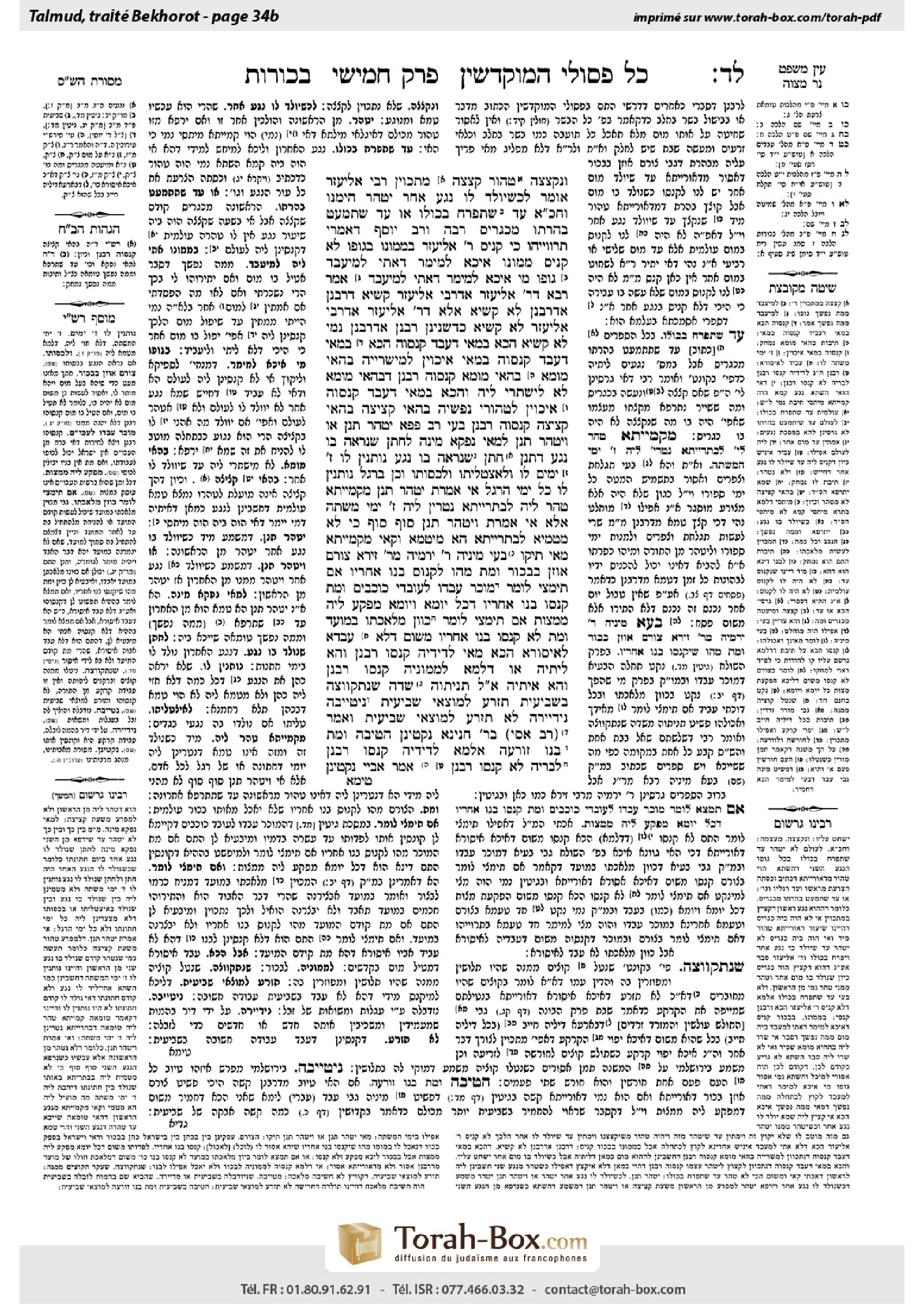
Bekhorot 34b: Talmud study for Daf Yomi
Study the Talmud for Daf Yomi with scanned pages, Hebrew text, English translations from Sefaria and AI-generated French translations.
Passage selection and English or AI-generated French translation are available where the scan has annotations. Daf Study is independent of Torah-Box and Sefaria.
Browse Bekhorot · בכורות · All tractatesBekhorot 34b text and translations
This page of Bekhorot includes the Aramaic text, an English translation and an AI-generated French translation, alongside the scan above.
בכורות ל״ד ב · Aramaic and Hebrew text
וְנִקְצְצָה — טָהוֹר, קְצָצָה מִתְכַּוֵּין — רַבִּי אֱלִיעֶזֶר אוֹמֵר: לִכְשֶׁיִּוָּלֵד לוֹ נֶגַע אַחֵר יִטְהַר הֵימֶנּוּ.
וַחֲכָמִים אוֹמְרִים: עַד שֶׁתִּפְרַח בְּכוּלּוֹ, אוֹ עַד שֶׁתִּמְעַט בַּהַרְתּוֹ מִכִּגְרִיס!
רַבָּה וְרַב יוֹסֵף דְּאָמְרִי תַּרְוַויְיהוּ: כִּי קָנֵיס רַבִּי אֱלִיעֶזֶר בְּמָמוֹנוֹ, בְּגוּפוֹ לָא קָנֵיס.
מָמוֹנוֹ — אִיכָּא לְמֵימַר דְּאָתֵי לְמֶיעְבַּד, גּוּפוֹ — מִי אִיכָּא לְמֵימַר דְּאָתֵי לְמֶיעְבַּד?
אָמַר רָבָא: דְּרַבִּי אֱלִיעֶזֶר אַדְּרַבִּי אֱלִיעֶזֶר קַשְׁיָא, דְּרַבָּנַן אַדְּרַבָּנַן לָא קַשְׁיָא?
אֶלָּא, דְּרַבִּי אֱלִיעֶזֶר אַדְּרַבִּי אֱלִיעֶזֶר לָא קַשְׁיָא, כִּדְשַׁנִּינַן. רַבָּנַן אַדְּרַבָּנַן נָמֵי לָא קַשְׁיָא, הָכָא בְּמַאי דַּעֲבַד קַנְסוּהּ, הָכָא בְּמַאי דַּעֲבַד קַנְסוּהּ.
בְּמַאי אִיכַּוֵּין לְמִישְׁרְיֵיהּ בְּהַאי מוּמָא? בְּהַאי מוּמָא קַנְסוּהּ רַבָּנַן, דִּבְהַאי מוּמָא לָא לִישְׁתְּרֵי לֵיהּ. וְהָכָא, בְּמַאי דַּעֲבַד קַנְסוּהּ — אִיכַּוֵּין לְטַהוֹרֵי נַפְשֵׁיהּ בְּהַאי קְצִיצָה, בְּהַאי קְצִיצָה קַנְסוּהּ רַבָּנַן.
בָּעֵי רַב פָּפָּא: ״יִטְהַר״ תְּנַן, אוֹ ״וְיִטְהָר״ תְּנַן?
לְמַאי נָפְקָא מִינַּהּ? לְחָתָן שֶׁנִּרְאָה בּוֹ נֶגַע.
דִּתְנַן: חָתָן שֶׁנִּרְאָה בּוֹ נֶגַע — נוֹתְנִין לוֹ שִׁבְעָה יָמִים, לוֹ וּלְאִצְטְלִיתוֹ וְלִכְסוּתוֹ, וְכֵן בָּרֶגֶל — נוֹתְנִין לוֹ כׇּל יְמֵי הָרֶגֶל.
אִי אָמְרַתְּ ״יִטְהַר״ תְּנַן — מִקַּמַּיְיתָא טְהַר לֵיהּ, לְבָתְרָיְיתָא נָטְרִין לֵיהּ שִׁבְעָה יְמֵי מִשְׁתֶּה.
אֶלָּא אִי אָמְרַתְּ: ״וְיִטְהַר״ תְּנַן — סוֹף סוֹף, כִּי לָא מְטַמֵּית לְבָתְרָיְיתָא, הָא מִיטַּמֵּא וְקָאֵי מִקַּמַּיְיתָא. מַאי? תֵּיקוּ.
בָּעֵי מִינֵּיהּ רַבִּי יִרְמְיָה מֵרַבִּי זֵירָא: צוֹרֵם אוֹזֶן בַּבְּכוֹר וָמֵת, מַהוּ לִקְנוֹס בְּנוֹ אַחֲרָיו?
אִם תִּימְצֵי לוֹמַר: מוֹכֵר עַבְדּוֹ לַגּוֹיִם וָמֵת — קָנְסוּ בְּנוֹ אַחֲרָיו, דְּכֹל יוֹמָא וְיוֹמָא מַפְקַע לֵיהּ מִמִּצְוֹת.
אִם תִּימְצֵי לוֹמַר: כִּוֵּון מְלַאכְתּוֹ בַּמּוֹעֵד וָמֵת — לֹא קָנְסוּ בְּנוֹ אַחֲרָיו, מִשּׁוּם דְּלָא עַבְדֵהּ לְאִיסּוּרָא.
הָכָא מַאי? לְדִידֵיהּ קְנַסוּ רַבָּנַן, וְהָא לֵיתֵיהּ, אוֹ דִלְמָא לְמָמוֹנֵיהּ קְנַסוּ רַבָּנַן, וְהָא אִיתֵיהּ?
אֲמַר לֵיהּ: תְּנֵיתוּהָ, שָׂדֶה שֶׁנִּתְקַוְּוצָה בִּשְׁבִיעִית — תִּזָּרַע לְמוֹצָאֵי שְׁבִיעִית, נִיטַּיְּיבָה נִידַּיְּירָה — לֹא תִּזָּרַע לְמוֹצָאֵי שְׁבִיעִית. וְאָמַר רַב אַסִּי בְּרַבִּי חֲנִינָא: נָקְטִינַן, הֱטִיבָהּ וָמֵת — בְּנוֹ זוֹרְעָהּ. אַלְמָא לְדִידֵיהּ קְנַסוּ רַבָּנַן, לִבְרֵיהּ לָא קְנַסוּ רַבָּנַן.
אָמַר אַבָּיֵי: נָקְטִינַן
Bekhorot 34b · English translation
and it inadvertently got excised, that individual is ritually pure. If he excised it intentionally, in an attempt to render himself ritually pure, the Sages impose a punitive impurity upon him. The tanna’im disagree with regard to the extent of the penalty: Rabbi Eliezer says: When he will develop another leprous mark, his status of ritual purity is assessed based on this new mark. When that mark is ruled ritually pure, he will become ritually pure from the ritual impurity generated by the mark he excised.
And the Rabbis say: The development of a new leprous mark is insufficient. Rather, he must wait either until the leprosy of the new mark spreads over his entire body, a sign of ritual purity (see Leviticus 13:12), or unless his old baheret had shrunk to a size smaller than that of a split beanbefore he excised it. Otherwise, he remains ritually impure. In any event, it is clear from this mishna that Rabbi Eliezer does not impose an indefinite penalty on one who transgresses. If so, why does he impose an indefinite penalty in the mishna discussing one who causes a blemish on the ear of a firstborn offering?
Rabba and Rav Yosef both say, in answer to this question, that when Rabbi Eliezer penalizes one who transgresses, that is only in a case which involves his property, e.g., a firstborn offering. But in a case which affects his body, e.g., leprosy, he does not penalize him to such an extent.
The Gemara elaborates: With regard to his property, i.e., the firstborn offering, if he would not be penalized indefinitely, there is reason to say that he might come to perform an action which would cause a blemish. Since the firstborn offering is anyway prohibited for personal use until it is blemished, he suffers no risk in blemishing it. A greater deterrent than usual is therefore needed to prevent such action. By contrast, in the case of leprosy on his body, is there a basis to say that he will come to perform an action and remove the white spot? In this case, the limited penalty of having to wait for purification from another leprous mark serves as a sufficient deterrent, as there is no guarantee that another mark will ever appear.
Rava said: Is this to say that the statement of Rabbi Eliezer in the mishna here is difficult in light of the other statement of Rabbi Eliezer in the mishna in Nega’im, whereas the statement of the Rabbis in the mishna is not difficult in light of the other statement of the Rabbis in Nega’im? In the mishna here, the Rabbis impose a limited penalty on the transgressor, whereas in the mishna in Nega’im they impose an indefinite one. This contradiction also requires resolution.
Rather, say: The statement of Rabbi Eliezer in the mishna here is not difficult in light of the statement of Rabbi Eliezer in Nega’im, as we answered. Likewise, the statement of the Rabbis in the mishna is not difficult in light of the statement of the Rabbis in Nega’im, as both rulings follow the same logic. Here, the Rabbis penalized him for what he did, and there, the Rabbis penalized him for what he did.
The Gemara elaborates: In the case of causing a blemish in a firstborn offering, by what means did he intend to permit it? By means of this blemish. Therefore, the Rabbis penalized him only with regard to this blemish, i.e., that the animal will not become permitted to him by means of this blemish that he himself caused. The firstborn offering retains its status as unblemished and will become permitted only if it develops another blemish. And similarly, here, with regard to the removal of the leprous mark, the Rabbis penalize him for what he did. He intended to render himself ritually pure by means of this act of excising the mark. Therefore, the Rabbis penalized him with regard to this act of excision. It is considered as though he did not excise the mark, and as a result, he remains impure permanently.
§ The Gemara analyzes Rabbi Eliezer’s statement: When he will develop another leprous mark, he will become ritually pure [yit’har] from the first. Rav Pappa asks: What is the correct version of Rabbi Eliezer’s statement? Did we learn: Yit’har, or did we learn: Veyit’har, and he will become ritually pure? Yit’har indicates that he will immediately be rendered ritually pure from the first leprous mark upon the appearance of the second mark. Veyit’har, by contrast, indicates that the punitive ritual impurity by rabbinic law imparted by the first mark remains until the second mark is deemed ritually pure.
The Gemara asks: What is the practical difference between the two versions? After all, he is in any case ritually impure due to the second mark until that mark is deemed pure. The Gemara explains that there is a difference in the case of a bridegroom who had removed a leprous mark upon whom a new leprous mark appeared during the seven days of his wedding celebrations.
As we learned in a mishna (Nega’im 3:2): In the case of a bridegroom upon whom a leprous mark appeared, the court grants him seven days of his wedding celebrations before the mark is examined by a priest. This grace period is granted to him whether the mark appeared on him, i.e., his body, or on his cloak, or on any other garment of his. And similarly, with regard to any individual upon whom a leprous mark appeared during a pilgrimage Festival, the court grants him all the days of the pilgrimage Festival as a grace period, during which the mark is not examined by a priest.
The Gemara continues: If you say that we learned that the correct reading of Rabbi Eliezer’s statement is yit’har, i.e., the individual is rendered ritually pure upon the development of the new mark, this means that he is ritually pure during the seven-day period, as he has already become ritually pure of the punitive impurity from the first mark. As for the latter mark, we wait the seven days of feasting for him, before the mark is examined by a priest. He is therefore ritually pure in all regards.
But if you say that we learned that the correct reading of Rabbi Eliezer’s statement is veyit’har, and the punitive impurity of the first mark remains intact until the ritual purity of the second mark has been confirmed, the grace period has no effect. The reason is that ultimately, even if the individual does not yet contract ritual impurity from the latter mark, he remains ritually impure on account of the first mark until the purification of the latter mark. The Gemara asks: What is the resolution to Rav Pappa’s query? Since there is no clear resolution, the Gemara concludes that the dilemma shall stand unresolved.
§ The mishna teaches that one who slits the ear of a firstborn offering is prohibited indefinitely from slaughtering the animal on account of that blemish. Rabbi Yirmeya raises a dilemma before Rabbi Zeira: In the case of one who slits the ear of a firstborn offering and subsequently dies, what is the halakha with regard to penalizing his son after the father’s death? Does the penalty prohibiting consumption of the firstborn offering extend to the son?
The Gemara compares this dilemma to two similar cases. If you say the halakha should be derived from the case of one who sells his Canaanite slave to gentiles and the seller subsequently dies, where the Sages penalized his son after the father’s death and required him to redeem the slave, this is not a direct parallel. The Gemara explains: It is possible that the penalty is extended to the son only there, as each day that the slave is in the servitude of the gentile master, that master prevents the slave from performing mitzvot. A Canaanite slave is obligated to perform the same mitzvot as a Jewish woman, and he is unable to fulfill the mitzvot when in the possession of a gentile. Since this reason does not apply in a case of a firstborn offering, the case of the Canaanite slave cannot be cited as a source to resolve this dilemma.
And if you say the halakha should be derived from the case of one who planned from the outset to perform his labor on the intermediate days of a Festival, by placing himself in a situation in which the labor should in theory be permitted, i.e., that a significant monetary loss would otherwise be incurred, that comparison is also inaccurate. The Gemara elaborates: In such a case the Sages penalized him by deeming it prohibited for him to perform the labor and by removing his rights to any of the finished products, but if he died before the start of the Festival, they did not penalize his son after the father’s death. This case is not a direct parallel either, as it is possible that it is only there that the penalty is not extended to the son, since the father did not yet perform a prohibited act, as he did not carry out any action on the Festival before he died.
If so, here, in the case of mutilating the ear of a firstborn offering, what is the halakha? Should one say that the Sages penalized only him, i.e., the father, and he is no longer alive? Or perhaps the Sages imposed the penalty upon his property, i.e., that no benefit may be derived from the animal, and that animal still exists in the possession of his heirs.
Rabbi Zeira said to Rabbi Yirmeya: You learned the resolution to your dilemma in a mishna (Shevi’it 4:2). A field whose thorns were removed during the Sabbatical Year may be sown at the conclusion of the Sabbatical Year, as removing thorns is not full-fledged labor that renders the field prohibited. But if it had been improved with fertilizer, or if it had been enclosed so that the animals inside would fertilize it with their manure, it may not be sown at the conclusion of the Sabbatical Year, as both these acts cause significant improvements to the field. The Sages imposed a penalty that one may not derive benefit from prohibited labor. And Rav Asi, son of Rabbi Ḥanina, says: We have a tradition that if one improved his field in a prohibited manner and then died, his son may sow it. Apparently, the Sages penalized only him, i.e., the father, but the Sages did not penalize his son.
Abaye says: We have a tradition
Bekhorot 34b · Traduction française (IA)
et s'il l'a excisé accidentellement, il est rituellement pur. Si, en revanche, il l'a excisé intentionnellement, dans l'intention de devenir rituellement pur, les Sages imposent à cet individu une impureté pénale. Les tannaïm s'entendent sur l'étendue de la sanction : Rabbi Eliezer dit : Lorsqu'il développera une autre marque de lépreuse, son statut de pureté rituelle sera évalué en fonction de cette nouvelle marque. Lorsque cette marque sera jugée pure rituellement, il deviendra pur de l'impureté rituelle générée par la marque qu'il a excisée.
Et les Rabbins disent : Le développement d'une nouvelle marque de lépreuse n'est pas suffisant. Il doit attendre soit que la lépreuse de la nouvelle marque s'étende sur tout son corps, signe de pureté rituelle (cf. Lévitique 13:12), soit que sa vieille marque ait diminué en taille jusqu'à ce qu'elle soit plus petite qu'une fissure de haricot avant qu'il ne l'excise. Sinon, il demeure impur rituellement. En tout cas, il est clair à partir de cette mitsva que Rabbi Eliezer ne sanctionne pas de manière indéfinie celui qui transgresse. Si tel est le cas, pourquoi imposent-ils une sanction indéfinie dans la mitsva concernant celui qui blesse l'oreille d'une offrande première ?
Rabba et Rav Yosef disent tous deux, en réponse à cette question, que lorsque Rabbi Eliezer sanctionne celui qui transgresse, cela n'est que dans le cas où cela concerne sa propriété, par exemple une offrande première. Mais dans le cas où cela affecte son corps, par exemple la lépreuse, il ne sanctionne pas à ce point.
La Guemara développe : En ce qui concerne sa propriété, c'est-à-dire l'offrande du premier-né, si l'on ne sanctionne pas indéfiniment, il y a lieu de dire qu'il pourrait venir à effectuer une action qui causerait une tache. Puisque l'offrande du premier-né est tout de même interdite à usage personnel jusqu'à ce qu'elle soit tachée, il ne subit aucun risque en la tachant. Un déterrent plus fort que d'habitude est donc nécessaire pour empêcher une telle action. À l'inverse, dans le cas de la lépreuse sur son corps, y a-t-il une base pour dire qu'il viendra à effectuer une action et à enlever la tache blanche ? Dans ce cas, la sanction limitée de devoir attendre la purification d'une autre marque de lépreuse suffit à en faire un déterrent, car il n'y a pas de garantie que cette autre marque apparaîtra jamais.
Rava dit : Est-ce que cela signifie que la déclaration de Rabbi Eliezer dans cette mitsva n'est pas difficile en raison de la déclaration de Rabbi Eliezer dans la mitsva de Nega'im, alors que la déclaration des Rabbins dans cette mitsva n'est pas difficile en raison de la déclaration des Rabbins dans la mitsva de Nega'im ? Dans cette mitsva, les Rabbins imposent une sanction limitée au transgresseur, alors qu'ils imposent une sanction indéfinie dans la mitsva de Nega'im. Cette contradiction nécessite également une résolution.
Plutôt, disent-ils : La déclaration de Rabbi Eliezer dans cette mitsva n'est pas difficile en raison de la déclaration de Rabbi Eliezer dans la mitsva de Nega'im, comme nous l'avons répondu. De même, la déclaration des Rabbins dans cette mitsva n'est pas difficile en raison de la déclaration des Rabbins dans la mitsva de Nega'im, comme les deux décisions suivent la même logique. Ici, les Rabbins sanctionnent pour ce qu'il a fait, là, les Rabbins sanctionnent pour ce qu'il a fait.
La Guemara développe : Dans le cas de la création d'une tache dans une offrande première, par quel moyen avait-il l'intention de permettre cela ? Par cette tache. Ainsi, les Rabbins sanctionnent uniquement concernant cette tache, c'est-à-dire que l'animal ne deviendra pas permis à lui par cette tache qu'il a lui-même causée. L'offrande première conserve son statut d'innocent et ne deviendra permise que si elle développe une autre tache. De même, ici, concernant la suppression de la marque de lépreuse, les Rabbins sanctionnent pour ce qu'il a fait. Il avait l'intention de devenir rituellement pur grâce à cet acte d'excision de la marque. Ainsi, les Rabbins sanctionnent concernant cet acte d'excision. On considère qu'il n'a pas excisé la marque, et en conséquence, il demeure impur de manière permanente.
§ La Guemara analyse la déclaration de Rabbi Eliezer : Lorsqu'il développera une autre marque de lépreuse, il sera rendu rituellement pur [yit’har] du premier. Rav Pappa demande : Quelle est la version correcte de la déclaration de Rabbi Eliezer ? A-t-on appris : Yit’har, ou a-t-on appris : Veyit’har, et il sera rendu rituellement pur ? Yit’har indique qu'il sera immédiatement rendu rituellement pur du premier marque de lépreuse à l'apparition du second marque. Veyit’har, en revanche, indique que l'impureté rituelle pénale imposée par la loi rabbinique du premier marque reste jusqu'à ce que le second marque soit jugé pure rituellement.
La Guemara demande : Quelle est la différence pratique entre les deux versions ? En effet, il est en tout cas rituellement impur en raison de la deuxième marque jusqu'à ce qu'elle soit jugée pure. La Guemara explique que la différence réside dans le cas d'un mari qui avait supprimé une marque de lépreuse, sur lequel une nouvelle marque de lépreuse est apparue pendant les sept jours de ses célébrations de mariage.
Comme nous l'avons appris dans une mitsva (Nega’im 3:2) : Dans le cas d'un mari sur lequel une marque de lépreuse est apparue, le tribunal lui accorde sept jours de ses célébrations de mariage avant que la marque ne soit examinée par un prêtre. Ce délai de grâce est accordé à lui, que la marque soit apparue sur lui, c'est-à-dire son corps, ou sur son manteau, ou sur tout autre vêtement à son usage. De même, concernant tout individu sur lequel une marque de lépreuse est apparue pendant un festival de pèlerinage, le tribunal lui accorde tous les jours du festival de pèlerinage comme délai de grâce, pendant lequel la marque n'est pas examinée par un prêtre.
La Guemara continue : Si vous dites que nous avons appris que la lecture correcte de la déclaration de Rabbi Eliezer est yit’har, c'est-à-dire que l'individu est rendu rituellement pur avec l'apparition de la nouvelle marque, cela signifie qu'il est rituellement pur pendant les sept jours, car il est déjà devenu pur de l'impureté pénale du premier marque. En ce qui concerne la marque ultérieure, nous attendons les sept jours de festivités pour lui, avant que la marque ne soit examinée par un prêtre. Il est donc rituellement pur en tous points.
Mais si vous dites que nous avons appris que la lecture correcte de la déclaration du Rabbi Eliezer est veyit’har, et que l’impureté punitive de la première marque demeure intacte jusqu’à ce que la pureté rituelle de la deuxième marque soit confirmée, la période de grâce n’a aucun effet. La raison est que finalement, même si la personne ne contracte pas encore d’impureté rituelle à cause de la deuxième marque, elle reste impure rituellement à cause de la première marque jusqu’à la purification de la deuxième marque. La Guemara pose la question : quelle est la résolution à la question de Rav Pappa ? Puisque il n’y a pas de solution claire, la Guemara conclut que ce dilemme restera sans solution.
§ La Michna enseigne que celui qui perce l’oreille d’un holocauste de premier-né est interdit à l’éternité de sacrifier l’animal à cause de cette imperfection. Le Rabbi Yirmeya pose un dilemme devant le Rabbi Zeira : dans le cas d’un homme qui a percé l’oreille d’un holocauste de premier-né et est ensuite mort, quelle est la halakha concernant la punition de son fils après la mort du père ? La punition interdisant la consommation du holocauste de premier-né s’étend-elle au fils ?
La Guemara compare ce dilemme à deux cas similaires. Si vous dites que la halakha devrait être tirée du cas d’un homme qui vend son esclave cananéen aux non-juifs et que le vendeur meurt ensuite, où les Sages ont puni son fils après la mort du père et exigé qu’il rachète l’esclave, cela n’est pas un parallèle direct. La Guemara explique : il est possible que la punition s’étende au fils uniquement dans ce cas, car chaque jour que l’esclave est en servitude du maître non-juif, ce dernier empêche l’esclave de pratiquer des mitsvot. Un esclave cananéen est tenu de pratiquer les mêmes mitsvot qu’une femme juive, et il ne peut les accomplir lorsqu’il est en possession d’un non-juif. Puisque cette raison ne s’applique pas dans le cas d’un holocauste de premier-né, le cas de l’esclave cananéen ne peut pas être cité comme source pour résoudre ce dilemme.
Et si vous dites que la halakha devrait être tirée du cas d’un homme qui avait l’intention dès le début de travailler pendant les jours intermédiaires d’un festival, en se mettant dans une situation où le travail devrait, en théorie, être permis, c’est-à-dire que l’homme subirait une perte financière considérable autrement, cette comparaison est également inexacte. La Guemara explique : dans ce cas, les Sages ont puni l’homme en considérant que le travail était interdit et en retirant ses droits sur les produits finis, mais si l’homme est mort avant le début du festival, ils n’ont pas puni son fils après la mort du père. Ce cas n’est pas non plus un parallèle direct, car il est possible que la punition ne s’étende pas au fils uniquement là, car le père n’a pas encore commis un acte interdit, car il n’a pas accompli d’action pendant le festival avant sa mort.
Si c’est ainsi, ici, dans le cas de la mutilation de l’oreille d’un holocauste de premier-né, quelle est la halakha ? Doit-on dire que les Sages ont puni uniquement lui, c’est-à-dire le père, et qu’il n’est plus vivant ? Ou peut-être les Sages ont-ils imposé la punition sur ses biens, c’est-à-dire que aucun bénéfice ne peut être tiré de l’animal, et que l’animal existe encore en possession de ses héritiers.
Le Rabbi Zeira a dit au Rabbi Yirmeya : vous avez appris la résolution à votre dilemme dans une Michna (Shevi’it 4:2). Un champ dont les épines ont été retirées pendant l’année sabbatique peut être semé à la fin de l’année sabbatique, car le retrait des épines n’est pas un travail complet qui rend le champ interdit. Mais si le champ avait été amélioré avec un engrais, ou s’il avait été entouré de sorte que les animaux à l’intérieur fertilisent le champ avec leurs déjections, il ne peut pas être semé à la fin de l’année sabbatique, car ces deux actes causent des améliorations significatives au champ. Les Sages ont imposé une punition selon laquelle on ne peut pas tirer un bénéfice du travail interdit. Et Rav Asi, fils du Rabbi Ḥanina, dit : nous avons une tradition selon laquelle si l’homme a amélioré son champ de manière interdite et est ensuite mort, son fils peut le semer. Apparemment, les Sages ont puni uniquement lui, c’est-à-dire le père, mais les Sages n’ont pas puni son fils.
Abaye dit : nous avons une tradition
Traduction française générée par IA à partir de l’édition anglaise de Sefaria. Vérifie toujours un passage avec le texte source.
Text from Sefaria: William Davidson Edition - Vocalized Aramaic (CC BY NC); William Davidson Edition - English (CC BY NC).