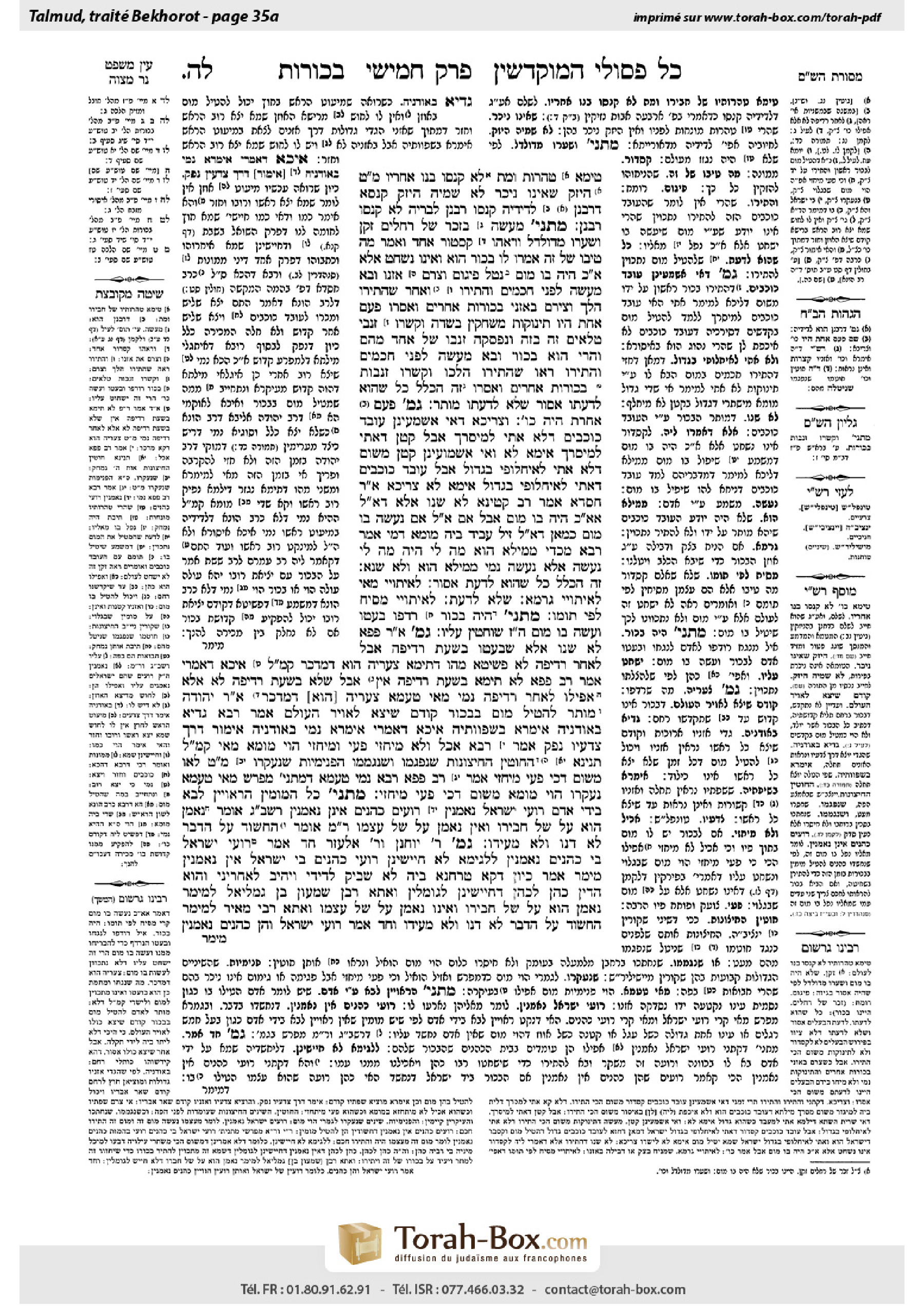
Bekhorot 35a: Talmud study for Daf Yomi
Study the Talmud for Daf Yomi with scanned pages, Hebrew text, English translations from Sefaria and AI-generated French translations.
Passage selection and English or AI-generated French translation are available where the scan has annotations. Daf Study is independent of Torah-Box and Sefaria.
Browse Bekhorot · בכורות · All tractatesBekhorot 35a text and translations
This page of Bekhorot includes the Aramaic text, an English translation and an AI-generated French translation, alongside the scan above.
בכורות ל״ה א · Aramaic and Hebrew text
טִימֵּא טְהָרוֹת וָמֵת — לֹא קָנְסוּ בְּנוֹ אַחֲרָיו. מַאי טַעְמָא? הֶיזֵּק שֶׁאֵינוֹ נִיכָּר לָא שְׁמֵיהּ הֶיזֵּק, קְנָסָא דְּרַבָּנַן — לְדִידֵיהּ קְנַסוּ רַבָּנַן, לִבְרֵיהּ לָא קְנַסוּ רַבָּנַן.
מַתְנִי׳ מַעֲשֶׂה בְּזָכָר שֶׁל רְחֵלִים זָקֵן, וּשְׂעָרוֹ מְדוּלְדָּל, וְרָאָהוּ קַסְטוֹר אֶחָד וְאָמַר: מָה טִיבוֹ שֶׁל זֶה? אָמְרוּ לוֹ: בְּכוֹר הוּא, וְאֵינוֹ נִשְׁחָט אֶלָּא אִם כֵּן הָיָה בּוֹ מוּם. נָטַל (פיגום) [פִּיגְיוֹם] וְצָרַם אׇזְנוֹ, וּבָא מַעֲשֶׂה לִפְנֵי חֲכָמִים וְהִתִּירוּ, וְאַחַר שֶׁהִתִּירוּ הָלַךְ וְצֵירֵם בְּאׇזְנֵי בְכוֹרוֹת אֲחֵרִים וְאָסְרוּ.
פַּעַם אַחַת הָיוּ תִּינוֹקוֹת מְשַׂחֲקִין בַּשָּׂדֶה, וְקָשְׁרוּ זַנְבֵי טְלָאִים זֶה בָּזֶה, וְנִפְסְקָה זְנָבוֹ שֶׁל אֶחָד מֵהֶם, וַהֲרֵי הוּא בְּכוֹר, וּבָא מַעֲשֶׂה לִפְנֵי חֲכָמִים וְהִתִּירוּ. רָאוּ שֶׁהִתִּירוּ, הָלְכוּ וְקָשְׁרוּ זַנְבוֹת בְּכוֹרוֹת אֲחֵרִים, וְאָסְרוּ. זֶה הַכְּלָל: כֹּל שֶׁהוּא לְדַעְתּוֹ — אָסוּר, שֶׁלֹּא לְדַעְתּוֹ — מוּתָּר.
גְּמָ׳ פַּעַם אַחֶרֶת הָיָה כּוּ׳. וּצְרִיכָא, דְּאִי אַשְׁמְעִינַן גּוֹי — דְּלָא אָתֵי לְמִיסְרַךְ, אֲבָל קָטָן דְּאָתֵי לְמִיסְרַךְ — אֵימָא לָא.
וְאִי אַשְׁמוֹעִינַן קָטָן, מִשּׁוּם דְּלָא אָתֵי לְאִיחַלּוֹפֵי בְּגָדוֹל, אֲבָל גּוֹי דְּאָתֵי לְאִיחַלּוֹפֵי בְּגָדוֹל — אֵימָא לָא. צְרִיכָא.
אָמַר רַב חִסְדָּא אָמַר רַב קַטִּינָא: לֹא שָׁנוּ אֶלָּא דַּאֲמַרוּ לֵיהּ ״אֶלָּא אִם כֵּן הָיָה בּוֹ מוּם״, אֲבָל אִם אֲמַרוּ לֵיהּ ״אִם נַעֲשָׂה בּוֹ מוּם״ — כְּמַאן דַּאֲמַרוּ לֵיהּ ״זִיל עֲבֵיד בֵּיהּ מוּמָא״ דָּמֵי.
אָמַר רָבָא: מִכְּדֵי מִמֵּילָא הוּא, מָה לִי ״הָיָה״, מָה לִי ״נַעֲשָׂה״? אֶלָּא ״נַעֲשָׂה״ נָמֵי מִמֵּילָא הוּא, וְלָא שְׁנָא.
זֶה הַכְּלָל: כֹּל שֶׁהוּא לְדַעַת — אָסוּר. לְאֵיתוֹיֵי מַאי? לְאֵיתוֹיֵי גְּרָמָא.
שֶׁלֹּא לְדַעַת — לְאֵיתוֹיֵי מֵסִיחַ לְפִי תוּמּוֹ.
מַתְנִי׳ הָיָה בְּכוֹר רֹדְפוֹ, בְּעָטוֹ, וְעָשָׂה בּוֹ מוּם — הֲרֵי זֶה שׁוֹחֲטִין עָלָיו.
גְּמָ׳ אָמַר רַב פָּפָּא: לֹא שָׁנוּ אֶלָּא שֶׁבְּעָטוֹ בִּשְׁעַת רְדִיפָה, אֲבָל לְאַחַר רְדִיפָה — לָא. פְּשִׁיטָא!
מַהוּ דְּתֵימָא: צַעְרֵיהּ הוּא דְּמִדְּכַר, קָא מַשְׁמַע לַן.
אִיכָּא דְּאָמְרִי, אָמַר רַב פָּפָּא: לָא תֵּימָא בִּשְׁעַת רְדִיפָה — אִין, אֲבָל שֶׁלֹּא בִּשְׁעַת רְדִיפָה — לָא, אֶלָּא אֲפִילּוּ לְאַחַר רְדִיפָה נָמֵי. מַאי טַעְמָא? צַעֲרֵיהּ [הוּא] דְּמִדְּכַר.
אָמַר רַב יְהוּדָה: מוּתָּר לְהַטִּיל מוּם בִּבְכוֹר קוֹדֶם שֶׁיָּצָא לַאֲוִיר הָעוֹלָם. אָמַר רָבָא: גַּדְיָא בְּאוּדְנֵיהּ, אִימְּרָא בְּשִׂפְוָותֵיהּ. אִיכָּא דְּאָמְרִי: אִימְּרָא נָמֵי בְּאוּדְנֵיהּ, אֵימוֹר דֶּרֶךְ צְדָעָיו נְפַק.
אָמַר רָבָא: אָכֵל וְלָא מִיחֲזֵי, פָּעֵי וּמִיחֲזֵי — הָוֵי מוּמָא. מַאי קָא מַשְׁמַע לַן? תְּנֵינָא: הַחוּטִין הַחִיצוֹנוֹת — שֶׁנִּפְגְּמוּ וְשֶׁנִּגְמְמוּ, הַפְּנִימִיּוֹת — שֶׁנֶּעֶקְרוּ. מַאי טַעְמָא? לָאו מִשּׁוּם דְּכִי פָּעֵי מִיחְזֵי?!
אָמַר רַב פָּפָּא: רָבָא נָמֵי טַעְמָא דְמַתְנִיתִין מְפָרֵשׁ, מַאי טַעְמָא נֶעְקְרוּ הָוֵי מוּמָא — מִשּׁוּם דְּכִי פָּעֵי מִיחְזֵי.
מַתְנִי׳ כׇּל הַמּוּמִין הָרְאוּיִין לָבֹא בִּידֵי אָדָם, רוֹעֵי יִשְׂרָאֵל נֶאֱמָנִין, רוֹעִים כֹּהֲנִים אֵינָן נֶאֱמָנִין. רַבָּן שִׁמְעוֹן בֶּן גַּמְלִיאֵל אוֹמֵר: נֶאֱמָן הוּא עַל שֶׁל חֲבֵירוֹ, וְאֵין נֶאֱמָן עַל שֶׁל עַצְמוֹ. רַבִּי מֵאִיר אוֹמֵר: הֶחָשׁוּד עַל הַדֶּבֶר, לֹא דָּנוֹ וְלֹא מְעִידוֹ.
גְּמָ׳ רַבִּי יוֹחָנָן וְרַבִּי אֶלְעָזָר, חַד אָמַר: ״רוֹעֵי יִשְׂרָאֵל״ בֵּי כֹהֲנִים — נֶאֱמָנִין, לִלְגִימָא לָא חָיְישִׁינַן.
רוֹעֵי כֹּהֲנִים בֵּי יִשְׂרָאֵל — אֵין נֶאֱמָנִין, מֵימָר אָמַר: כֵּיוָן דְּקָא טָרַחְנָא בֵּיהּ, לָא שָׁבֵיק לְדִידִי וְיָהֵיב לְאַחֲרִינֵי.
וְהוּא הַדִּין כֹּהֵן לְכֹהֵן, דְּחָיְישִׁינַן לְגוֹמְלִין.
וַאֲתָא רַבָּן שִׁמְעוֹן בֶּן גַּמְלִיאֵל לְמֵימַר: נֶאֱמָן הוּא עַל שֶׁל חֲבֵירוֹ, וְאֵינוֹ נֶאֱמָן עַל שֶׁל עַצְמוֹ. וַאֲתָא רַבִּי מֵאִיר לְמֵימַר: הֶחָשׁוּד עַל הַדֶּבֶר לֹא דָּנוֹ וְלֹא מְעִידוֹ.
וְחַד אָמַר: ״רוֹעֵי יִשְׂרָאֵל״ וְהֵן כֹּהֲנִים — נֶאֱמָנִין,
Bekhorot 35a · English translation
that if one rendered impure the ritually pure items of another and died before paying, the Sages did not penalize his son after his death and require him to pay for the damage. What is the reason for this? The reason is that damage that is not evident, i.e., which does not involve any visible change, is not considered damage by Torah law. There is a penalty imposed by rabbinic law, as the injured party suffered a loss, but the Sages penalized only him; the Sages did not penalize his son.
MISHNA: There was an incident involving an old ram whose hair was long and dangling, because it was a firstborn offering. And one Roman quaestor [kastor] saw it and said to its owner: What is the status [tivo] of this animal that you allowed it to grow old and you did not slaughter it? They said to him: It is a firstborn offering, and therefore it may be slaughtered only if it has a blemish. The quaestor took a dagger [pigom] and slit its ear. And the incident came before the Sages for a ruling, and they deemed its slaughter permitted. And after the Sages deemed its slaughter permitted, the quaestor went and slit the ears of other firstborn offerings, but in these cases the Sages deemed their slaughter prohibited, despite the fact that they were now blemished.
One time children were playing in the field and they tied the tails of lambs to each other, and the tail of one of them was severed, and it was a firstborn offering. And the incident came before the Sages for a ruling and they deemed its slaughter permitted. The people who saw that they deemed its slaughter permitted went and tied the tails of other firstborn offerings, and the Sages deemed their slaughter prohibited. This is the principle: With regard to any blemish that is caused intentionally, the animal’s slaughter is prohibited; if the blemish is caused unintentionally, the animal’s slaughter is permitted.
GEMARA: The mishna mentions that one time children were involved in a case in which they unintentionally blemished a firstborn offering whose subsequent slaughter the Sages deemed permitted. The Gemara notes: And although the first clause of the mishna mentions a similar occurrence, the incident involving the children is necessary. As, had the tanna taught us only the incident involving the gentile, it might have been thought that the Sages permitted the slaughter of the firstborn offering only there, as it is not a problem if the gentile will acquire the habit of causing blemishes, because that prohibition does not apply to gentiles. But with regard to a Jewish minor, it is a concern that he is likely to acquire the habit of causing blemishes in firstborn offerings, and therefore one might say that even the first, unintentional time should not be permitted.
And had the tanna taught us only the incident involving a minor, it might have been thought that the Sages deemed the firstborn offering permitted only there, since there is no concern that people will come to confuse a minor with an adult. People would not erroneously conclude that it is permitted to cause a blemish on a firstborn offering intentionally merely due to an incident involving a minor. But in the case of a gentile adult, where this is a concern that people would come to confuse him with a Jewish adult, one might say that even the first, unintentional time should not be permitted. It is therefore necessary for the mishna to teach both cases.
§ The Gemara analyzes the incident involving the Roman quaestor. Rav Ḥisda says that Rav Ketina says: They taught that the firstborn offering is permitted only in a case where the bystanders said to the quaestor: A firstborn offering may not be slaughtered unless it has a blemish, as this is referring to a blemish that develops naturally. But if they said to him that a firstborn offering may be slaughtered only if a blemish was caused to form upon it, which indicates human intervention, it is considered as though they explicitly told him: Go and cause a blemish on it, in which case the animal is prohibited.
The Gemara cites a dissenting opinion. Rava said: Now consider, both expressions in fact indicate that the blemish occurred by itself, as both statements are in the passive. Accordingly, what difference is it to me whether the bystanders used the expression: If it had a blemish, or the expression: A blemish was caused in it? Rather, the expression: Was caused, also indicates that it occurred by itself, and there is no difference between the expressions. In both instances the firstborn offering would be permitted.
The mishna teaches that this is the principle: In the case of any blemish that is caused with his intent, the animal’s slaughter is prohibited. The Gemara explains: What does this principle serve to add? It serves to add an indirect action, i.e., a blemish caused in this manner is also considered an intentional act and the animal may not be slaughtered on its account.
The Gemara further inquires: What is added by the phrase in the second part of the principle: If the blemish was caused without his intent, the animal’s slaughter is permitted? This serves to add an instance where a gentile did not inquire about the nature of the firstborn offering, but rather discovered it from one who speaks offhandedly. Although the gentile intentionally caused a blemish in the animal, since the Jew did not intentionally prompt him to cause it, the animal is permitted.
MISHNA: If one’s firstborn offering was pursuing him, and he kicked the animal and caused a blemish in it, he may slaughter the animal on account of that blemish.
GEMARA: Rav Pappa says: They taught that the firstborn offering may be slaughtered only in an instance where he kicked it at the time of its pursuit. But if the individual kicked the animal after its pursuit, it may not be slaughtered, as he intended to cause a blemish in order to render it permitted to be slaughtered. The Gemara raises a difficulty: It is obvious that it is not permitted to slaughter the animal in such a case.
The Gemara explains: Rav Pappa’s statement is necessary, lest you say that it is in fact permitted to slaughter the firstborn offering since he kicked it after its pursuit only out of anger, as he recalls his distress caused by its pursuit of him, and not in order to render the animal permitted to be slaughtered. Rav Pappa therefore teaches us that it is assumed that he kicked the animal with the express intention of causing a blemish in it, not merely out of anger, and therefore it may not be slaughtered.
There are those who say the opposite version of this discussion. Rav Pappa says: Do not say that if the individual kicked the firstborn offering at the time of the pursuit, then yes, it is permitted to slaughter it, but if he kicked it not at the time of the pursuit, it is not permitted to slaughter it. Rather, even if he kicked it after its pursuit of him, it is also permitted. What is the reason? It is assumed that he kicked it after the pursuit not with the intention of causing a blemish, but because he recalls his distress caused by its pursuit of him.
§ Rav Yehuda says: It is permitted to cause a blemish in a firstborn fetus before it emerges into the air of the world, as it obtains its sacred status only when it is born. Applying this ruling, Rava said: In the case of a kid, it is practical to cause a blemish on its ear. Since a kid’s ears are long they emerge from the birth canal prior to the head. With regard to a lamb, whose ears are short and do not appear before the head, it is practical to cause a blemish only on its lip. There are those who say that there is a different version of this statement: In the case of a lamb as well, it is practical to cause a blemish on its ear, as one can say that it emerges from the birth canal through its temples, in which case its ears are visible first.
Rava says: In a case where a firstborn has a blemish in its mouth, if, when it eats, the blemish is not visible, but when it opens its mouth wide and cries out, it is visible, this is considered a blemish, rendering the animal fit for slaughter. The Gemara asks: What is this teaching us? We learn this in the mishna (39a) with regard to blemishes that render a firstborn offering fit for slaughter: The external gums that were damaged and lacking or that were scratched, and likewise, the internal gums that were entirely extracted, are considered blemished. What is the reason that if the internal gums were extracted it is considered a blemish? Is it not because when the animal opens its mouth wide and cries out, it is visible? If so, what is the novelty of Rava’s statement?
Rav Pappa says in response: Rava is not in fact teaching a novel halakha. Rather, he is explaining the reason for the ruling of the mishna: What is the reason that if the internal gums were extracted it is considered a blemish? It is that when the animal opens its mouth wide and cries out, the blemish is visible.
MISHNA: With regard to all the blemishes that are capable of being brought about by a person, Israelite shepherds are deemed credible to testify that the blemishes were not caused intentionally. But priest-shepherds are not deemed credible, as they are the beneficiaries if the firstborn is blemished. Rabban Shimon ben Gamliel says: A priest is deemed credible to testify about the firstborn of another, but is not deemed credible to testify about the firstborn belonging to him. Rabbi Meir says: A priest who is suspect about the matter of causing a blemish may neither adjudicate nor testify in cases involving that matter, even on behalf of another.
GEMARA: Rabbi Yoḥanan and Rabbi Elazar disagree with regard to the meaning of the mishna. One of them says that the case of Israelite shepherds is where the shepherds are in the house of priests, i.e., in the employ of a priest. These shepherds are deemed credible to testify that the blemishes were not caused intentionally, as we are not concerned they are lying for a swallow [lilegima] of the firstborn that their priest employer might give them in exchange.
And the case of priest-shepherds is where the shepherds are in the house of an Israelite, i.e., in the latter’s employ. In such a case, the priest-shepherds are not deemed credible to testify that the blemishes were not caused intentionally, as the priest-shepherd can say: Since I have toiled with this firstborn offering, my Israelite employer will not forsake me and give it to another priest. The priest is assumed to be lying, as he has a motive to cause a blemish in the animal.
And the same is true in the case of a priest who testifies for the sake of another priest. Although the first priest would not derive benefit from his testimony immediately, he is nevertheless not deemed credible to testify, as we are concerned about reciprocal behavior, i.e., the other priest might later repay the favor and lie on his behalf.
And Rabban Shimon ben Gamliel comes to say that the testimony of a priest in such a case, when he testifies about the firstborn of another priest, is deemed credible, as there is no concern about reciprocal behavior. But he is not deemed credible with regard to his own firstborn. And Rabbi Meir comes to say that a priest, who is suspect about the matter of causing a blemish, may neither adjudicate nor testify in cases involving that matter, even on behalf of another. The difference between the opinion of Rabbi Meir and that of the first tanna will be discussed further on.
The Gemara cites the other explanation of the mishna: And the other one of the two amora’im says: The case of Israelite shepherds is where the shepherds are priests in the employ of an Israelite. The mishna is teaching that these shepherds are deemed credible to testify that the blemishes on their employer’s firstborn offering were not caused intentionally, as they are not suspected of lying in order to obtain its meat.
Bekhorot 35a · Traduction française (IA)
que si l'on avait rendu impur les objets rituellement purs d'autrui et était mort avant de payer, les Sages n'ont pas puni son fils après sa mort et n'ont pas exigé qu'il paie le préjudice. Pourquoi ? Parce que le préjudice qui n'est pas évident, c'est-à-dire celui qui ne comporte aucun changement visible, n'est pas considéré comme un préjudice selon la loi divine. Il y a une sanction imposée par la loi rabbinique, car la partie blessée a subi une perte, mais les Sages ont sanctionné uniquement lui ; les Sages n'ont pas sanctionné son fils.
MICHNA : Il y avait un cas concernant un bouc âgé dont la barbe était longue et pendante, car il s'agissait d'un offrande de premier-né. Et un questeur romain [kastor] l'a vu et a dit à son propriétaire : Quel est l'état [tivo] de cet animal que vous avez laissé vieillir et que vous n'avez pas sacrifié ? Ils lui ont répondu : C'est un offrande de premier-né, et donc il peut être sacrifié uniquement s'il présente une tache. Le questeur a pris un couteau [pigom] et a entaillé son oreille. Et l'incident est venu devant les Sages pour une décision, et ils ont jugé que son sacrifice était permis. Et après que les Sages avaient jugé que son sacrifice était permis, le questeur est allé entailler les oreilles d'autres offrandes de premier-né, mais dans ces cas les Sages ont jugé leur sacrifice interdit, malgré le fait qu'ils étaient maintenant blemis.
Un jour, des enfants jouaient dans le champ et ils avaient lié les queues des agneaux les uns aux autres, et la queue d'un d'eux avait été tranchée, et c'était un offrande de premier-né. Et l'incident est venu devant les Sages pour une décision, et ils ont jugé que son sacrifice était permis. Les gens qui avaient vu qu'ils avaient jugé que son sacrifice était permis sont allés lier les queues d'autres offrandes de premier-né, et les Sages ont jugé leur sacrifice interdit. C'est le principe : En ce qui concerne toute tache causée intentionnellement, le sacrifice de l'animal est interdit ; si la tache est causée de manière accidentelle, le sacrifice de l'animal est permis.
GUEMARA : La Michna mentionne qu'il y avait un cas impliquant des enfants dans lequel ils avaient accidentellement blemi un offrande de premier-né dont le sacrifice avait été jugé permis par les Sages. La Guemara note : Et bien que la première clause de la Michna mentionne un cas similaire, l'incident impliquant les enfants est nécessaire. Car, si le tanna nous avait appris uniquement l'incident impliquant le non-Juif, on aurait pu penser que les Sages avaient permis le sacrifice de l'offrande de premier-né uniquement là, car il n'est pas un problème si le non-Juif développe l'habitude de causer des taches, car cette interdiction ne s'applique pas aux non-Juifs. Mais concernant un mineur juif, c'est une préoccupation qu'il puisse développer l'habitude de causer des taches aux offrandes de premier-né, et donc on pourrait dire que même la première fois, accidentelle, ne devrait pas être permise.
Et si le tanna nous avait appris uniquement l'incident impliquant un mineur, on aurait pu penser que les Sages avaient jugé l'offrande de premier-né permise uniquement là, car il n'y a pas de préoccupation que les gens puissent confondre un mineur avec un adulte. Les gens ne concluraient pas erroneusement que c'est permis de causer une tache sur un offrande de premier-né intentionnellement simplement à cause d'un incident impliquant un mineur. Mais dans le cas d'un non-Juif adulte, où c'est une préoccupation que les gens puissent le confondre avec un adulte juif, on pourrait dire que même la première fois, accidentelle, ne devrait pas être permise. Il est donc nécessaire que la Michna enseigne les deux cas.
§ La Guemara examine l'incident concernant le questeur romain. Rav Ḥisda dit que Rav Ketina dit : Ils ont enseigné que l'offrande de premier-né est permise uniquement dans le cas où les spectateurs dirent au questeur : Une offrande de premier-né ne peut être sacrifiée qu'à condition qu'elle présente une tache, car cela fait référence à une tache qui se développe naturellement. Mais si ils avaient dit au questeur : Une offrande de premier-né peut être sacrifiée uniquement si une tache a été causée sur elle, ce qui indique une intervention humaine, on considère cela comme s'ils lui avaient dit explicitement : Allez-y et causez une tache sur elle, dans ce cas l'animal est interdit.
La Guemara cite un avis divergent. Rava a dit : Considérez maintenant, les deux expressions indiquent en fait que la tache s'est produite d'elle-même, car les deux déclarations sont à la voix passive. Ainsi, quelle différence y a-t-il entre les deux expressions ? Plutôt, l'expression : a été causée, indique également qu'elle s'est produite d'elle-même, et il n'y a pas de différence entre les expressions. Dans les deux cas, l'offrande de premier-né serait permise.
La mishna enseigne que c'est le principe : En ce qui concerne toute tache causée avec son intention, la mise à mort de l'animal est interdite. La Guemara explique : Quel est l'usage de ce principe ? Il sert à ajouter une action indirecte, c'est-à-dire une tache causée ainsi est également considérée comme une action intentionnelle et l'animal ne peut pas être sacrifié à cause de cela.
La Guemara pose une question supplémentaire : Quel est l'ajout de la phrase dans la deuxième partie du principe : Si la tache a été causée sans son intention, la mise à mort de l'animal est permise ? Cela sert à ajouter un cas où un non-Juif n'a pas interrogé sur la nature de l'offrande du premier-né, mais plutôt l'a découvert d'une personne qui parlait à la légère. Bien que le non-Juif ait intentionnellement causé une tache sur l'animal, puisque le Juif n'a pas intentionnellement encouragé cette action, l'animal est permis.
MICHNA : Si l'offrande du premier-né de quelqu'un le poursuivait et qu'il avait frappé l'animal et causé une tache sur lui, il peut sacrifier l'animal à cause de cette tache.
GUEMARA : Rav Pappa dit : Ils ont enseigné que l'offrande du premier-né peut être sacrifiée uniquement dans un cas où il l'avait frappé à l'époque de sa poursuite. Mais si l'individu avait frappé l'animal après sa poursuite, il ne peut pas être sacrifié, car il avait l'intention de causer une tache afin de le rendre permis à sacrifier. La Guemara soulève une difficulté : Il est évident qu'il n'est pas permis de sacrifier l'animal dans un tel cas.
La Guemara explique : La déclaration de Rav Pappa est nécessaire, afin que l'on ne dise pas que l'offrande de premier-né peut effectivement être sacrifiée, car il a frappé l'animal après sa poursuite uniquement par colère, car il se rappelle sa détresse causée par sa poursuite, et non pas pour le rendre permis à être sacrifié. Rav Pappa enseigne donc que l'on suppose qu'il a frappé l'animal avec l'intention explicite de lui causer un défaut, et non simplement par colère, et par conséquent, il ne peut pas être sacrifié.
Certains disent l'inverse de cette discussion. Rav Pappa dit : Ne dis pas que si l'individu a frappé l'offrande de premier-né pendant la poursuite, alors oui, il est permis de le sacrifier, mais si l'individu a frappé l'offrande de premier-né en dehors de la poursuite, il n'est pas permis de le sacrifier. En réalité, même s'il a frappé l'offrande après la poursuite, il est également permis. Quelle est la raison ? On suppose qu'il a frappé l'animal après la poursuite sans l'intention de lui causer un défaut, mais parce qu'il se rappelle sa détresse causée par sa poursuite.
§ Rav Yehuda dit : Il est permis de causer un défaut dans un fœtus de premier-né avant qu'il ne sorte dans l'air du monde, car il ne prend sa sainteté qu'après sa naissance. En appliquant cette décision, Rava dit : Dans le cas d'un petit agneau, il est pratique de causer un défaut sur son oreille. Les oreilles d'un petit agneau sont longues et sortent du canal de naissance avant la tête. En ce qui concerne un agneau, dont les oreilles sont courtes et ne sortent pas avant la tête, il est pratique de causer un défaut sur ses lèvres. Certains disent qu'il existe une autre version de cette déclaration : Dans le cas d'un agneau également, il est pratique de causer un défaut sur son oreille, car l'on peut dire qu'il sort du canal de naissance par ses tempes, ce qui rend ses oreilles visibles en premier.
Rava dit : Dans le cas où un premier-né a un défaut dans sa bouche, si, lorsqu'il mange, le défaut n'est pas visible, mais lorsqu'il ouvre la bouche et crie, il est visible, cela est considéré comme un défaut, rendant l'animal digne de sacrifice. La Guemara pose la question : Qu'est-ce que cette enseignement nous apprend ? Nous apprenons cela dans la mitsna (39a) concernant les défauts qui rendent un offrande de premier-né digne de sacrifice : les gencives externes endommagées, manquantes ou griffées, ainsi que les gencives internes entièrement extraites, sont considérés comme des défauts. Quelle est la raison pour laquelle si les gencives internes ont été extraites, cela est considéré comme un défaut ? N'est-ce pas parce que lorsque l'animal ouvre la bouche et crie, le défaut est visible ? Si c'est le cas, quelle est la nouveauté de l'enseignement de Rava ?
Rav Pappa répond : Rava ne nous enseigne pas en réalité une halakha nouvelle. Il explique plutôt la raison de la décision de la mitsva : Quelle est la raison pour laquelle si les gencives internes ont été extraites, cela est considéré comme un défaut ? C'est que lorsque l'animal ouvre la bouche et crie, le défout est visible.
MITSVA : Concernant tous les défauts pouvant être causés par une personne, les bergers israélites sont considérés comme crédibles pour témoigner que les défauts n'ont pas été causés intentionnellement. Les bergers sacrés ne sont pas considérés comme crédibles, car ils en bénéficient si le premier-né est déficient. Rabban Shimon ben Gamliel dit : Un prêtre est considéré comme crédible pour témoigner sur le premier-né d'un autre, mais pas sur le premier-né qui lui appartient. Rabbi Meir dit : Un prêtre suspect concernant la question de causer un défaut ne peut ni arbitrer ni témoigner dans les cas concernant cette question, même en faveur d'un autre.
GUEMARA : Rabbi Yoḥanan et Rabbi Elazar divergent sur la signification de la Michna. L'un d'eux dit que le cas des bergers israélites est celui où les bergers sont dans la maison des prêtres, c'est-à-dire employés par un prêtre. Ces bergers sont considérés comme crédibles pour témoigner que les défauts n'ont pas été causés intentionnellement, car nous ne craignons pas qu'ils mentent pour obtenir un premier-né que leur prêtre employeur pourrait leur donner en échange.
Et le cas des bergers sacrés est celui où les bergers sont dans la maison d'un Israélite, c'est-à-dire employés par lui. Dans ce cas, les bergers sacrés ne sont pas considérés comme crédibles pour témoigner que les défauts n'ont pas été causés intentionnellement, car le berger sacré peut dire : Puisque j'ai travaillé avec ce premier-né, mon employeur israélite ne me laissera pas tomber et me donnera un autre prêtre. Le prêtre est supposé mentir, car il a un motif de causer un défaut dans l'animal.
C'est également le cas d'un prêtre qui témoigne en faveur d'un autre prêtre. Bien que le premier prêtre ne puisse pas bénéficier immédiatement de son témoignage, il n'est pas considéré comme crédible pour témoigner, car nous craignons le comportement mutuel, c'est-à-dire que le prêtre pourrait plus tard récompenser le favor et mentir en son nom.
Et Rabban Shimon ben Gamliel vient dire que le témoignage d'un prêtre dans ce cas, lorsqu'il témoigne sur le premier-né d'un autre prêtre, est considéré comme crédible, car il n'y a pas de crainte concernant le comportement mutuel. Mais il n'est pas considéré comme crédible concernant son propre premier-né. Et Rabbi Meir vient dire qu'un prêtre, suspect concernant la question de causer un défaut, ne peut ni arbitrer ni témoigner dans les cas concernant cette question, même en faveur d'un autre. La différence entre l'opinion de Rabbi Meir et celle du premier tanna sera discutée plus tard.
La Guemara cite l'autre explication de la mitsna : Et l'autre des deux amoraïm dit : Le cas des bergers israélites est celui où les bergers sont des prêtres employés par un Israélite. La mitsna enseigne que ces bergers sont considérés comme crédibles pour témoigner que les défauts sur le premier-né de leur employeur n'ont pas été causés intentionnellement, car ils ne sont pas soupçonnés de mentir pour obtenir sa viande.
Traduction française générée par IA à partir de l’édition anglaise de Sefaria. Vérifie toujours un passage avec le texte source.
Text from Sefaria: William Davidson Edition - Vocalized Aramaic (CC BY NC); William Davidson Edition - English (CC BY NC).