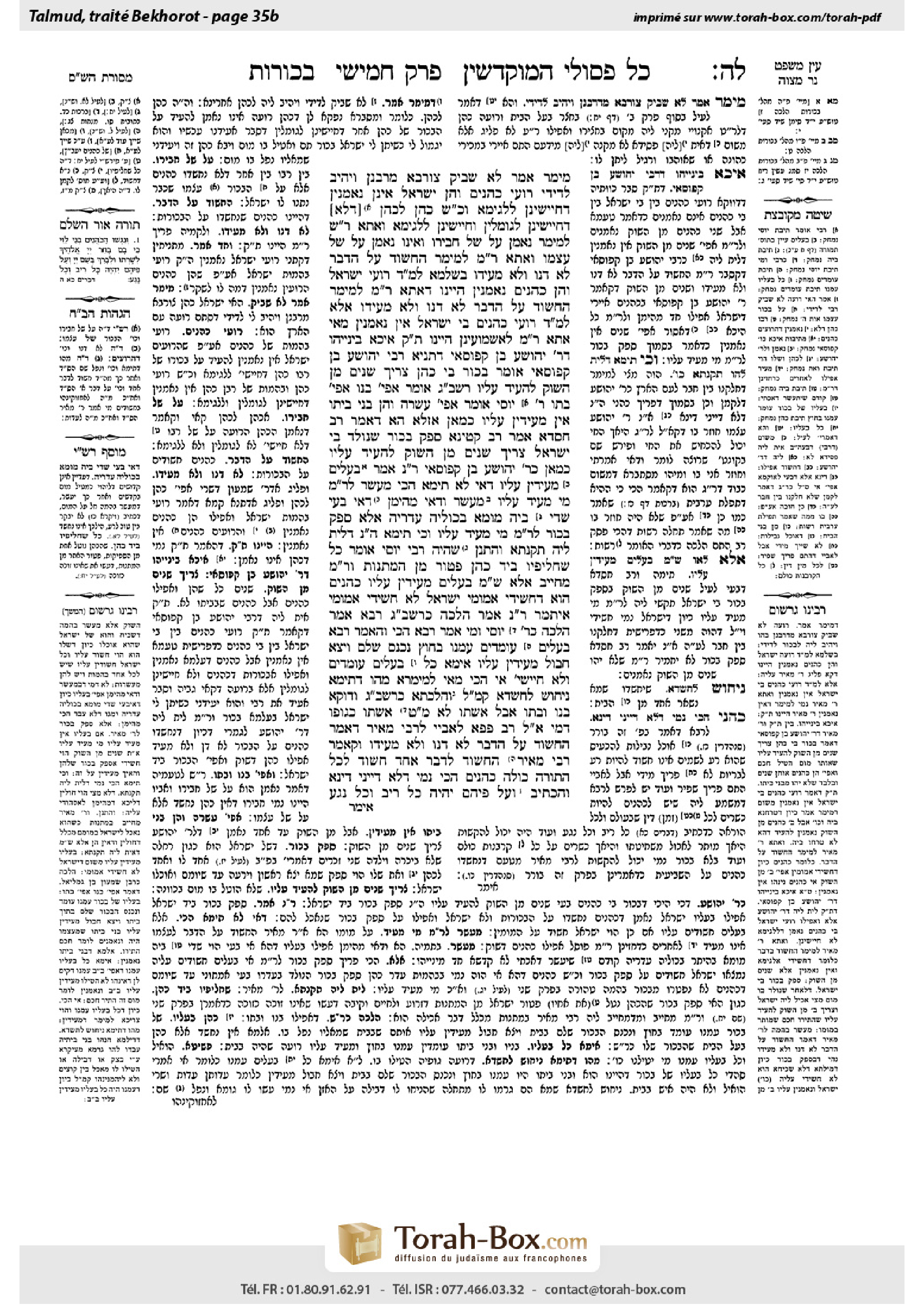
Bekhorot 35b: Talmud study for Daf Yomi
Study the Talmud for Daf Yomi with scanned pages, Hebrew text, English translations from Sefaria and AI-generated French translations.
Passage selection and English or AI-generated French translation are available where the scan has annotations. Daf Study is independent of Torah-Box and Sefaria.
Browse Bekhorot · בכורות · All tractatesBekhorot 35b text and translations
This page of Bekhorot includes the Aramaic text, an English translation and an AI-generated French translation, alongside the scan above.
בכורות ל״ה ב · Aramaic and Hebrew text
מֵימָר אָמַר: לָא שָׁבֵיק צוּרְבָּא מֵרַבָּנַן וְיָהֵיב לְדִידִי. ״רוֹעֵי כֹהֲנִים״ וְהֵן יִשְׂרָאֵל — אֵינָן נֶאֱמָנִין, דְּחָיְישִׁינַן לִלְגִימָא.
וְכׇל שֶׁכֵּן כֹּהֵן לְכֹהֵן, דְּחָיְישִׁינַן לְגוֹמְלִין, וְחָיְישִׁינַן לִלְגִימָא. וַאֲתָא רַבָּן שִׁמְעוֹן לְמֵימַר: נֶאֱמָן עַל שֶׁל חֲבֵירוֹ, וְאֵינוֹ נֶאֱמָן עַל שֶׁל עַצְמוֹ. וַאֲתָא רַבִּי מֵאִיר לְמֵימַר: הֶחָשׁוּד עַל הַדָּבָר, לֹא דָּנוֹ וְלֹא מְעִידוֹ.
בִּשְׁלָמָא לְמַאן דְּאָמַר: רוֹעֵי יִשְׂרָאֵל וְהֵן כֹּהֲנִים נֶאֱמָנִין — הַיְינוּ דַּאֲתָא רַבִּי מֵאִיר לְמֵימַר: הֶחָשׁוּד עַל הַדָּבָר לֹא דָּנוֹ וְלֹא מְעִידוֹ.
אֶלָּא לְמַאן דְּאָמַר: רוֹעֵי כֹהֲנִים בֵּי יִשְׂרָאֵל אֵין נֶאֱמָנִין — מַאי אֲתָא רַבִּי מֵאִיר לְאַשְׁמוֹעִינַן? הַיְינוּ תַּנָּא קַמָּא!
אִיכָּא בֵּינַיְיהוּ דְּרַבִּי יְהוֹשֻׁעַ בֶּן קַפּוֹסַאי, דְּתַנְיָא: רַבִּי יְהוֹשֻׁעַ בֶּן קַפּוֹסַאי אוֹמֵר: בְּכוֹר בֵּי כֹהֵן צָרִיךְ שְׁנַיִם מִן הַשּׁוּק לְהָעִיד עָלָיו.
רַבָּן שִׁמְעוֹן בֶּן גַּמְלִיאֵל אוֹמֵר: אֲפִילּוּ בְּנוֹ, אֲפִילּוּ בִּתּוֹ. רַבִּי יוֹסֵי אוֹמֵר: אֲפִילּוּ עֲשָׂרָה וְהֵן בְּנֵי בֵיתוֹ אֵין מְעִידִין עָלָיו.
כְּמַאן אָזְלָא הָא דְּאָמַר רַב חִסְדָּא אָמַר רַב קַטִּינָא: סְפֵק בְּכוֹר שֶׁנּוֹלַד בֵּי יִשְׂרָאֵל, צָרִיךְ שְׁנַיִם מִן הַשּׁוּק לְהָעִיד עָלָיו?
כְּמַאן? כְּרַבִּי יְהוֹשֻׁעַ בֶּן קַפּוֹסַאי.
רַב נַחְמָן אָמַר: בְּעָלִים מְעִידִין עָלָיו, דְּאִי לָא תֵּימָא הָכִי, מַעֲשֵׂר לְרַבִּי מֵאִיר מִי מֵעִיד עָלָיו?
מַעֲשֵׂר וַדַּאי מְהֵימַן, דְּאִי בָּעֵי שָׁדֵי בֵּיהּ מוּמָא בְּכוּלֵּיהּ עֶדְרֵיהּ. אֶלָּא סְפֵק בְּכוֹר, לְרַבִּי מֵאִיר מִי מֵעִיד עָלָיו?
וְכִי תֵּימָא, הָכִי נָמֵי דְּלֵית לֵיהּ תַּקַּנְתָּא, וְהָתְנַן, שֶׁהָיָה רַבִּי יוֹסֵי אוֹמֵר: כֹּל שֶׁחֲלִיפָיו בְּיַד כֹּהֵן פָּטוּר מִן הַמַּתָּנוֹת, וְרַבִּי מֵאִיר מְחַיֵּיב!
אֶלָּא שְׁמַע מִינַּהּ: בְּעָלִים מְעִידִין עָלָיו, כֹּהֲנִים הוּא דַּחֲשִׁידִי אַמּוּמֵי, יִשְׂרָאֵל לָא חֲשִׁידִי אַמּוּמֵי.
אִיתְּמַר: רַב נַחְמָן אָמַר: הֲלָכָה כְּרַבָּן שִׁמְעוֹן בֶּן גַּמְלִיאֵל, רָבָא אָמַר: הֲלָכָה כְּרַבִּי יוֹסֵי.
וּמִי אָמַר רָבָא הָכִי? וְהָאָמַר רָבָא: בְּעָלִים עוֹמְדִים עִמָּנוּ בַּחוּץ, נִכְנַס שָׁלֵם וְיָצָא חָבוּל — מְעִידִין עָלָיו! אֵימָא: כׇּל בְּעָלִים עוֹמְדִים, וְלָא חָיְישִׁינַן.
אִי הָכִי מַאי לְמֵימְרָא? מַהוּ דְּתֵימָא: נֵיחוּשׁ לַחֲשָׁדָא, קָא מַשְׁמַע לַן. וְהִלְכְתָא כְּרַבָּן שִׁמְעוֹן בֶּן גַּמְלִיאֵל, וְדַוְקָא בְּנוֹ וּבִתּוֹ, אֲבָל אִשְׁתּוֹ לָא. מַאי טַעְמָא? אִשְׁתּוֹ כְּגוּפוֹ דָּמֵי.
אֲמַר לֵיהּ רַב פָּפָּא לְאַבָּיֵי: לְרַבִּי מֵאִיר דְּאָמַר הֶחָשׁוּד עַל הַדָּבָר לֹא דָּנוֹ וְלֹא מְעִידוֹ, וְקָאָמַר רַבִּי מֵאִיר הֶחָשׁוּד לְדָבָר אֶחָד חָשׁוּד לְכׇל הַתּוֹרָה כּוּלָּהּ, כֹּהֲנִים הָכִי נָמֵי דְּלָא דָּיְינִי דִּינָא? וְהָכְתִיב ״וְעַל פִּיהֶם יִהְיֶה כׇּל רִיב וְכׇל נָגַע״!
Bekhorot 35b · English translation
The reason is that it is assumed that the priest-shepherd would say: My Israelite employer will not forsake a priest who is a Torah scholar and give the blemished animal to me, an unlearned shepherd. The case of priest-shepherds is where the shepherds are Israelites in the employ of a priest. These shepherds are not deemed credible to testify, as we are concerned that they might be lying for a swallow of the firstborn that their priest employer would give them in exchange.
And all the more so the testimony of a priest for the sake of another priest is not deemed credible, as we are concerned that the two might engage in reciprocal behavior, and we are concerned that the priest-shepherd might be lying for a swallow of the firstborn offering. And Rabban Shimon ben Gamliel comes to say that the priest-shepherd is deemed credible to testify with regard to the firstborn offering of another priest, but is not deemed credible to testify with regard to a firstborn belonging to himself. And Rabbi Meir comes to say that a priest who is suspect about the matter of causing a blemish may neither adjudicate nor testify in cases involving that matter, even on behalf of another.
The Gemara raises a difficulty: Granted, according to the second opinion, i.e., the one who says the first tanna maintains that the case of Israelite shepherds is where the shepherds are priests in the employ of an Israelite, and they are deemed credible to testify, this is the reason that Rabbi Meir comes to disagree and say that a priest who is suspect about the matter of causing a blemish may neither adjudicate nor testify even for the sake of an Israelite employer.
But according to the first opinion, i.e., the one who says that the first tanna maintains that the case of priest-shepherds is where the shepherds are in an Israelite’s house, and they are not deemed credible to testify, what is Rabbi Meir coming to teach us? This is the same opinion as that of the first tanna himself.
The Gemara answers: There is a difference between the opinions of the first tanna and Rabbi Meir with regard to a statement of Rabbi Yehoshua ben Kefusai. As it is taught in a baraita that Rabbi Yehoshua ben Kefusai says: If a firstborn animal in the house of a priest developed a blemish, two people from the marketplace, i.e., not from the priest’s household, are required to testify about it that the blemish was not caused deliberately. This unqualified statement indicates that the two people can even be priests, provided that they are not household members.
The baraita continues: Rabban Shimon ben Gamliel says: Even the priest’s son and even his daughter may testify about it. Rabbi Yosei says: Even in a case where there are ten people, if they are members of his household, they may not testify about it. The first tanna of the mishna maintains that only a priest who is a shepherd of the animal in question is not deemed credible to testify, but the testimony of an independent priest is credible. This accords with the opinion of Rabbi Yehoshua ben Kefusai, who allows the testimony of any two independent people, including a priest. Conversely, Rabbi Meir does not deem credible even the testimony of an independent priest, as indicated by his general statement about suspect priests.
The Gemara discusses a related statement: In accordance with whose opinion is that which Rav Ḥisda says that Rav Ketina says: In the case of an animal whose status as a firstborn is uncertain that was born in the house, i.e., in the possession, of an Israelite, e.g., it was uncertain whether the mother had previously given birth, in which case the animal remains in the possession of the Israelite and may be eaten upon developing a blemish, two people from the marketplace are required to testify about it?
In accordance with whose opinion is this statement? It is in accordance with the opinion of Rabbi Yehoshua ben Kefusai. Just as he requires two independent people to testify about a firstborn offering in the possession of a priest, as he is suspected of intentionally causing the blemish, so too, he requires two independent people to testify in the case of an uncertain status of a firstborn offering born in the possession of an Israelite.
Rav Naḥman disagrees and says: The Israelite owners themselves may testify about it. As, if you do not say so, but instead maintain that any involved person is suspected of deliberately causing a blemish in his firstborn animal, this poses a difficulty with regard to the halakha of an animal tithe offering, which may also be eaten if it developed a blemish. According to Rabbi Meir, who can testify about it? Rabbi Meir maintains that anyone who is suspect about the matter of causing a blemish on his own behalf may neither adjudicate nor testify in cases involving that matter even on behalf of another. If so, how can anyone, even an Israelite, testify about any blemished animal-tithe offering? It must be that an Israelite is not suspected of deliberately causing blemishes.
The Gemara rejects this claim: With regard to the animal tithe offering, the owner is certainly deemed credible to testify that its blemish occurred naturally, because if he wants, he could legitimately cause a blemish in his entire flock before the obligation to separate tithes came into effect. Rather, this is what Rav Naḥman stated: If an Israelite is not deemed credible to testify about a blemish found on an animal whose status as a firstborn is uncertain, then according to Rabbi Meir, who can testify about it? Both Israelites and priests stand to gain if their animal whose status as a firstborn is uncertain develops a blemish, and therefore no one should be deemed credible to testify about it.
And if you would say that indeed, according to Rabbi Meir, an animal whose status as a firstborn is uncertain has no remedy that can render it fit for slaughter, as no one is deemed credible to testify about its blemish, this cannot be correct. But didn’t we learn in a mishna (18b) that Rabbi Yosei would say: Any animal whose replacements are in the possession of a priest is exempt from, i.e., not subject to, the mitzva of giving the priestly gifts, and Rabbi Meir deems him obligated to give the gifts? Since Rabbi Meir permits the consumption of an animal whose status as a firstborn is uncertain, evidently he allows testimony about its blemish in such a case.
Rather, learn from this that the Israelite owners may testify about their animals whose status as a firstborn are uncertain, despite the fact that priests may not. The reason is that it is only priests who are suspected of causing blemishes; Israelites are not suspected of causing blemishes.
§ It was stated: Rav Naḥman says that the halakha is in accordance with the opinion of Rabban Shimon ben Gamliel, that a priest is deemed credible to testify about the blemished firstborn animal of another priest, even if he is a household member. Rava says: The halakha is in accordance with the opinion of Rabbi Yosei, that one’s household members are not deemed credible to testify.
The Gemara asks: And does Rava actually say this? But doesn’t Rava say: If the priestly owner of a firstborn animal was standing outside with us, and the animal entered the house whole and emerged injured, the household members may testify about it that the blemish was not caused by a person. Evidently, Rava maintains that the members of the priest’s household are deemed credible to testify about the priest’s firstborn. The Gemara answers: One can say that Rava is referring to a case where all the owners, i.e., the household members, are standing outside, while the shepherd alone remains inside. When the firstborn animal emerges injured, the shepherd is deemed credible to testify about the blemish and we are not concerned that he is lying.
The Gemara asks: If so, that all of the household members were outside, what is the purpose of stating that the shepherd is deemed credible? This ruling is obvious. The Gemara answers: This ruling is necessary lest you say that we should entertain a suspicion that the shepherd himself caused the blemish. Rava therefore teaches us that this is not so, and the shepherd is deemed credible. The Gemara concludes: And the halakha is in accordance with the opinion of Rabban Shimon ben Gamliel, that a priest’s household members may testify about his blemished firstborn offering. And this applies specifically to his son and daughter, but his wife may not testify. What is the reason? One’s wife is as oneself.
§ Rav Pappa said to Abaye: According to Rabbi Meir, who says that a priest who is suspect about the matter of causing a blemish may neither adjudicate nor testify in cases involving that matter even on behalf of another, and in addition Rabbi Meir says that one who is suspected of transgressing one matter, i.e., who is known to have committed one transgression, is suspected of transgressing the entire Torah, it should follow that priests should also not be allowed to administer judgment at all. But isn’t it written with regard to the priests: “And according to their word shall every controversy and every stroke be” (Deuteronomy 21:5)?
Bekhorot 35b · Traduction française (IA)
La raison est que l'on suppose que le prêtre-berger dirait : Mon employeur israélite ne laissera pas partir un prêtre savant en Torah et lui donnerait un animal blemi, moi, un berger ignoré. Le cas des prêtres-bergers est celui où les bergers sont des Israélites employés par un prêtre. Ces bergers ne sont pas considérés comme crédibles pour témoigner, car on craint qu'ils puissent mentir pour un petit morceau de premier-né que leur prêtre employeur leur donnerait en échange.
Et encore plus encore, le témoignage d'un prêtre au bénéfice d'un autre prêtre n'est pas considéré comme crédible, car on craint que les deux puissent avoir un comportement mutuel, et on craint que le prêtre-berger mente pour un petit morceau de premier-né. Et Rabban Shimon ben Gamliel vient dire que le prêtre-berger est considéré comme crédible pour témoigner concernant le premier-né d'un autre prêtre, mais n'est pas considéré comme crédible pour témoigner concernant un premier-né qui lui appartient. Et Rabbi Meïr vient dire qu'un prêtre suspect concernant la question de provoquer un blemissement ne peut ni arbitrer ni témoigner dans les cas concernant cette question, même au bénéfice d'un autre.
La Guemara soulève une difficulté : Cela est admis, selon l'opinion secondaire, c'est-à-dire celle qui dit que le premier tanna maintient que le cas des bergers israélites est celui où les bergers sont des prêtres employés par un Israélite, et ils sont considérés comme crédibles pour témoigner, c'est la raison pour laquelle Rabbi Meïr vient contester et dire qu'un prêtre suspect concernant la question de provoquer un blemissement ne peut ni arbitrer ni témoigner même au bénéfice d'un employeur israélite.
Mais selon l'opinion première, c'est-à-dire celle qui affirme que le premier tanna soutient que le cas des prêtres-bergers est celui où les bergers sont dans la maison d'un Israélite, et qu'ils ne sont pas considérés comme crédibles pour témoigner, de quoi Rabbi Meïr vient-il nous apprendre ? C'est la même opinion que celle du premier tanna lui-même.
La Guemara répond : Il y a une différence entre les opinions du premier tanna et de Rabbi Meïr concernant une déclaration de Rabbi Yéhoshua ben Kéfusai. Comme il est enseigné dans une baraïta que Rabbi Yéhoshua ben Kéfusai dit : Si un animal premier-né dans la maison d'un prêtre a développé un blemissement, deux personnes du marché, c'est-à-dire qui ne sont pas de la famille du prêtre, doivent témoigner qu'il n'a pas été causé intentionnellement. Cette déclaration sans restriction indique que ces deux personnes peuvent même être des prêtres, à condition qu'ils ne soient pas membres de la famille.
La baraïta continue : Rabban Shimon ben Gamliel dit : Même le fils et la fille du prêtre peuvent témoigner à ce sujet. Rabbi Yosei dit : Même dans un cas où il y a dix personnes, si elles sont membres de sa famille, elles ne peuvent pas témoigner à ce sujet. Le premier tanna de la mishna maintient que seul un prêtre qui est berger de l'animal en question n'est pas considéré comme crédible pour témoigner, mais le témoignage d'un prêtre indépendant est crédible. Cela correspond à l'opinion de Rabbi Yéhoshua ben Kéfusai, qui permet le témoignage de toute personne indépendante, y compris un prêtre. À l'inverse, Rabbi Meïr ne considère pas même le témoignage d'un prêtre indépendant comme crédible, comme indiqué par son déclaration générale concernant les prêtres suspects.
La Guemara discute d'une déclaration connexe : Selon l'opinion de qui est-ce que Rav Ḥisda dit que Rav Kétina dit : Dans le cas d'un animal dont le statut de premier-né est incertain, qui a été né dans la maison, c'est-à-dire en possession d'un Israélite, par exemple, il était incertain si la mère avait déjà donné naissance, dans ce cas l'animal reste en possession de l'Israélite et peut être mangé s'il développe un blemissement, deux personnes du marché sont nécessaires pour témoigner à ce sujet ?
Selon l'opinion de qui est-ce que cette déclaration ? C'est selon l'opinion de Rabbi Yéhoshua ben Kéfusai. Tout comme il exige deux personnes indépendantes pour témoigner concernant un premier-né dans la possession d'un prêtre, car il est suspect de provoquer intentionnellement un blemissement, de même il exige deux personnes indépendantes pour témoigner dans le cas d'un statut incertain d'un premier-né né dans la possession d'un Israélite.
Rav Naḥman conteste et dit : Les propriétaires israélites eux-mêmes peuvent témoigner à ce sujet. Car, si vous ne dites pas cela, mais au contraire maintenez que toute personne impliquée est suspecte de provoquer intentionnellement un blemissement dans son animal premier-né, cela pose une difficulté concernant la halakha de l'offrande de dîme d'animal, qui peut également être mangée si elle a développé un blemissement. Selon Rabbi Meïr, qui peut témoigner à ce sujet ? Rabbi Meïr maintient que toute personne suspecte concernant la question de provoquer un blemissement sur son propre compte ne peut ni arbitrer ni témoigner dans les cas concernant cette question, même au bénéfice d'autrui. Si c'est ainsi, comment peut-on être témoin de toute offrande de dîme d'animal blemie ? Il doit être que l'Israélite n'est pas suspect de provoquer intentionnellement des blemissements.
La Guemara rejette cette affirmation : Concernant l'offrande de dîme d'animal, le propriétaire est certainement considéré comme crédible pour témoigner que le blemissement s'est produit naturellement, car s'il le voulait, il pouvait légitimement provoquer un blemissement dans toute sa troupe avant que l'obligation de séparer les dîmes ne soit entrée en vigueur. Au contraire, c'est ce que Rav Naḥman a dit : Si un Israélite n'est pas considéré comme crédible pour témoigner concernant un blemissement trouvé sur un animal dont le statut de premier-né est incertain, alors selon Rabbi Meïr, qui peut témoigner à ce sujet ? Les Israélites et les prêtres ont tous deux un intérêt si leur animal dont le statut de premier-né est incertain développe un blemissement, et par conséquent, personne ne devrait être considéré comme crédible pour témoigner à ce sujet.
Et si l'on disait que, selon Rabbi Meïr, un animal dont le statut de premier-né est incertain n'a pas de remède qui puisse le rendre propre à l'abattage, car personne n'est considéré comme crédible pour témoigner sur son défaut, cela ne peut pas être correct. Mais n'avons-nous pas appris dans une mitsna (18b) que Rabbi Yosei disait : Tout animal dont les remplaçants sont en possession d'un prêtre est exempt, c'est-à-dire ne soumis pas, à la mitsva de donner les présents pour le prêtre, et Rabbi Meïr considère qu'il est tenu de donner les présents ? Puisque Rabbi Meïr permet la consommation d'un animal dont le statut de premier-né est incertain, il semble qu'il autorise le témoignage sur son défaut dans ce cas-là.
Plutôt, apprendre de cela que les propriétaires israélites peuvent témoigner sur leurs animaux dont le statut de premier-né est incertain, malgré le fait que les prêtres ne peuvent pas. La raison est que seul les prêtres sont soupçonnés de causer des défauts ; les Israélites ne le sont pas.
§ Il a été dit : Rav Naḥman dit que la halakha suit l'opinion de Rabban Shimon ben Gamliel, que le prêtre est considéré comme crédible pour témoigner sur l'animal premier-né blemi d'un autre prêtre, même s'il est un membre de la famille. Rava dit : la halakha suit l'opinion de Rabbi Yosei, que les membres de la famille ne sont pas considérés comme crédibles pour témoigner.
La Guemara demande : Et Rava dit vraiment cela ? Mais n'a-t-il pas dit : Si le propriétaire prêtre d'un animal premier-né était debout en dehors avec nous, et l'animal est entré dans la maison intact et est sorti blessé, les membres de la famille peuvent témoigner sur cela que le défaut n'a pas été causé par une personne. Il semble que Rava considère que les membres de la famille du prêtre sont crédibles pour témoigner sur son animal premier-né. La Guemara répond : On peut dire que Rava parle d'un cas où tous les propriétaires, c'est-à-dire les membres de la famille, sont debout en dehors, tandis que le berger seul reste à l'intérieur. Lorsque l'animal premier-né sort blessé, le berger est considéré comme crédible pour témoigner sur le défaut et nous ne sommes pas inquiets qu'il mente.
La Guemara demande : Si c'est ainsi, que tous les membres de la famille étaient en dehors, à quoi sert-il de dire que le berger est crédible ? Cette décision est évidente. La Guemara répond : Cette décision est nécessaire afin que l'on ne dise pas que nous devons soupçonner que le berger lui-même a causé le défaut. Rava enseigne donc que cela n'est pas le cas, et le berger est considéré comme crédible. La Guemara conclut : Et la halakha suit l'opinion de Rabban Shimon ben Gamliel, que les membres de la famille du prêtre peuvent témoigner sur son animal premier-né blemi. Et cela s'applique spécifiquement à son fils et sa fille, mais sa femme ne peut pas témoigner. Quelle est la raison ? La femme est comme soi-même.
§ Rav Pappa a dit à Abaye : Selon Rabbi Meïr, qui affirme qu'un prêtre soupçonné concernant la question de causer un défaut ne peut ni juger ni témoigner dans les cas concernant cette question, même en faveur d'autrui, et en outre Rabbi Meïr affirme qu'une personne soupçonnée de transgresser une seule matière, c'est-à-dire connue pour avoir commis une seule transgression, est soupçonnée de transgresser toute la Torah, il en résulterait que les prêtres ne devraient pas non plus être autorisés à administrer la justice du tout. Mais n'est-il pas écrit concernant les prêtres : « Et selon leur parole sera toute contestation et toute sentence » (Deutéronome 21:5) ?
Traduction française générée par IA à partir de l’édition anglaise de Sefaria. Vérifie toujours un passage avec le texte source.
Text from Sefaria: William Davidson Edition - Vocalized Aramaic (CC BY NC); William Davidson Edition - English (CC BY NC).