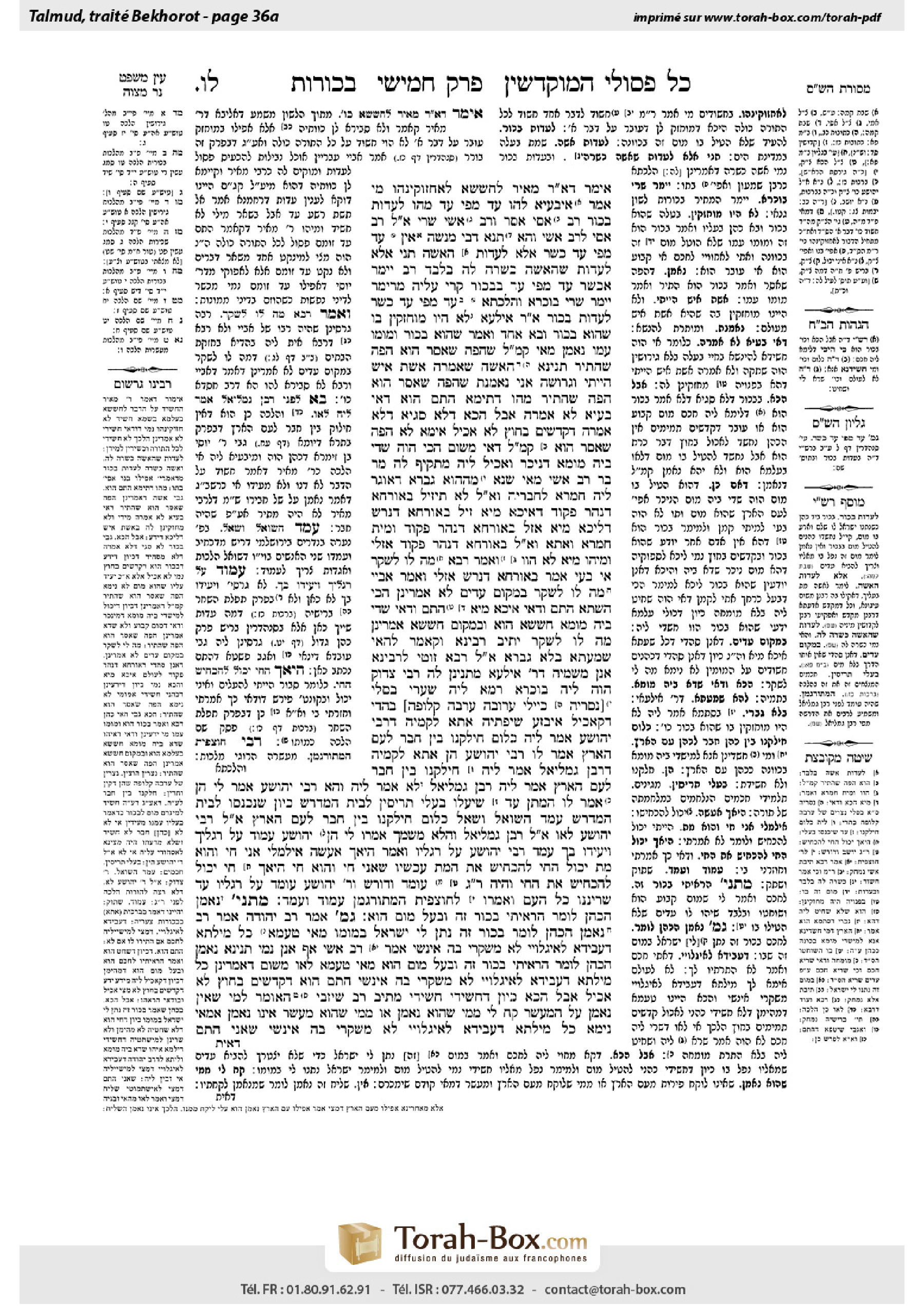
Bekhorot 36a: Talmud study for Daf Yomi
Study the Talmud for Daf Yomi with scanned pages, Hebrew text, English translations from Sefaria and AI-generated French translations.
Passage selection and English or AI-generated French translation are available where the scan has annotations. Daf Study is independent of Torah-Box and Sefaria.
Browse Bekhorot · בכורות · All tractatesBekhorot 36a text and translations
This page of Bekhorot includes the Aramaic text, an English translation and an AI-generated French translation, alongside the scan above.
בכורות ל״ו א · Aramaic and Hebrew text
אֵימַר דְּאָמַר רַבִּי מֵאִיר לַחֲשָׁשָׁא, לְאַחְזוֹקִינְהוּ מִי אָמַר?
אִיבַּעְיָא לְהוּ: עֵד מִפִּי עֵד, מַהוּ לְעֵדוּת בְּכוֹר? רַב אַסִּי אָסַר, וְרַב אָשֵׁי שָׁרֵי. אֲמַר לֵיהּ רַב אַסִּי לְרַב אָשֵׁי: וְהָא תָּנָא דְבֵי מְנַשֶּׁה: אֵין עֵד מִפִּי עֵד כָּשֵׁר אֶלָּא לְעֵדוּת הָאִשָּׁה!
תְּנִי: אֶלָּא לְעֵדוּת שֶׁהָאִשָּׁה כְּשֵׁרָה לָהּ בִּלְבָד.
רַב יֵימַר אַכְשַׁר עֵד מִפִּי עֵד בִּבְכוֹר, קָרֵי עֲלֵיהּ מָרִימָר: ״יֵימַר שָׁרֵי בּוּכְרָא״. וְהִלְכְתָא: עֵד מִפִּי עֵד כָּשֵׁר לְעֵדוּת בְּכוֹר.
אָמַר רַבִּי אִילְעָא: לֹא הָיוּ מוּחְזָקִין בּוֹ שֶׁהוּא בְּכוֹר, וּבָא אֶחָד וְאָמַר שֶׁהוּא בְּכוֹר וּמוּמוֹ עִמּוֹ — נֶאֱמָן.
מַאי קָא מַשְׁמַע לַן, שֶׁהַפֶּה שֶׁאָסַר הוּא הַפֶּה שֶׁהִתִּיר? תְּנֵינָא: הָאִשָּׁה שֶׁאָמְרָה ״אֵשֶׁת אִישׁ הָיִיתִי וּגְרוּשָׁה אֲנִי״ נֶאֱמֶנֶת, שֶׁהַפֶּה שֶׁאָסַר הוּא הַפֶּה שֶׁהִתִּיר!
מַהוּ דְּתֵימָא: הָתָם הוּא דְּאִי בָּעֲיָא לָא אָמְרָה. אֲבָל הָכָא, דְּלָא סַגִּיא דְּלָא אָמְרָה, דְּקָדָשִׁים בְּחוּץ לָא אָכֵיל,
אֵימָא: לָא הַפֶּה שֶׁאָסַר הוּא, קָא מַשְׁמַע לַן, דְּאִי מִשּׁוּם הָכִי — הֲוָה שָׁדֵי בֵּיהּ מוּמָא דְּנִיכָּר וְאָכֵיל לֵיהּ.
מַתְקֵיף לַהּ מָר בַּר רַב אָשֵׁי: מַאי שְׁנָא מֵהָהוּא גַּבְרָא דְּאוֹגַר לֵיהּ חֲמָרָא לְחַבְרֵיהּ, וַאֲמַר לֵיהּ: לָא תֵּיזִיל בְּאוֹרְחָא דִּנְהַר פְּקוֹד דְּאִיכָּא מַיָּא, זִיל בְּאוֹרְחָא דְּנַרֶשׁ דְּלֵיכָּא מַיָּא. אֲזַל בְּאוֹרְחָא דִּנְהַר פְּקוֹד וּמִית חֲמָרָא, וַאֲתָא וַאֲמַר לֵיהּ: בְּאוֹרְחָא דִּנְהַר פְּקוֹד אָזְלִי, וּמִיהוּ מַיָּא לָא הֲווֹ.
וַאֲמַר רָבָא: מָה לוֹ לְשַׁקֵּר, אִי בָּעֵי אָמַר: בְּאוֹרְחָא דְּנַרֶשׁ אֲזַלִי. וַאֲמַר אַבָּיֵי: ״מָה לוֹ לְשַׁקֵּר״ בִּמְקוֹם עֵדִים לָא אָמְרִינַן.
הָכִי הַשְׁתָּא?! הָתָם וַדַּאי אִיכָּא מַיָּא, הָכָא וַדַּאי שָׁדֵי בֵּיהּ מוּמָא — חֲשָׁשָׁא הוּא, וּבִמְקוֹם חֲשָׁשָׁא אָמְרִינַן ״מָה לוֹ לְשַׁקֵּר״. יָתֵיב רָבִינָא וְקָאָמַר לְהַאי שְׁמַעְתָּא בְּלָא גַּבְרָא, אֲמַר לֵיהּ רָבָא זוּטֵי לְרָבִינָא: אֲנַן מִשְּׁמֵיהּ דְּרַבִּי אִילְעָא מַתְנִינַן לַהּ.
רַבִּי צָדוֹק הֲוָה לֵיהּ בּוּכְרָא, רְמָא לֵיהּ שְׂעָרֵי בְּסַלֵּי, בַּהֲדֵי דְּקָאָכֵיל אִיבְּזַע שִׂיפְתֵּיהּ. אֲתָא לְקַמֵּיהּ דְּרַבִּי יְהוֹשֻׁעַ, אָמַר לוֹ: כְּלוּם חִילַּקְנוּ בֵּין חָבֵר לְעַם הָאָרֶץ? אָמַר לוֹ רַבִּי יְהוֹשֻׁעַ: הֵן.
אֲתָא לְקַמֵּיהּ דְּרַבָּן גַּמְלִיאֵל, אָמַר לוֹ: חִילַּקְנוּ בֵּין חָבֵר לְעַם הָאָרֶץ? אָמַר לוֹ רַבָּן גַּמְלִיאֵל: לָא. אָמַר לוֹ: (והא) [וַהֲלֹא] רַבִּי יְהוֹשֻׁעַ אָמַר לִי הֵן! אָמַר לוֹ: הַמְתֵּן עַד שֶׁיַּעֲלוּ בַּעֲלֵי תְרִיסִין לְבֵית הַמִּדְרָשׁ.
כֵּיוָן שֶׁנִּכְנְסוּ לְבֵית הַמִּדְרָשׁ, עָמַד הַשּׁוֹאֵל וְשָׁאַל: כְּלוּם חִילַּקְנוּ בֵּין חָבֵר לְעַם הָאָרֶץ? אָמַר לוֹ רַבִּי יְהוֹשֻׁעַ: לָאו. אָמַר לוֹ רַבָּן גַּמְלִיאֵל: וַהֲלֹא מִשִּׁמְךָ אָמְרוּ לִי הֵן!
יְהוֹשֻׁעַ, עֲמוֹד עַל רַגְלֶיךָ, וְיָעִידוּ בְּךָ. עָמַד רַבִּי יְהוֹשֻׁעַ עַל רַגְלָיו וְאָמַר: הֵיאַךְ אֶעֱשֶׂה? אִילְמָלֵי אֲנִי חַי וְהוּא מֵת — יָכוֹל הַחַי לְהַכְחִישׁ אֶת הַמֵּת, עַכְשָׁיו שֶׁאֲנִי חַי וְהוּא חַי — הֵיאַךְ חַי יָכוֹל לְהַכְחִישׁ אֶת הַחַי?
וְהָיָה רַבָּן גַּמְלִיאֵל עוֹמֵד וְדוֹרֵשׁ, וְרַבִּי יְהוֹשֻׁעַ עוֹמֵד עַל רַגְלָיו, עַד שֶׁרִינְּנוּ כׇּל הָעָם וְאָמְרוּ לְחוּצְפִּית הַמְתוּרְגְּמָן: עֲמוֹד! וְעָמַד.
מַתְנִי׳ נֶאֱמָן הַכֹּהֵן לוֹמַר: הֶרְאֵיתִי בְּכוֹר זֶה וּבַעַל מוּם הוּא.
גְּמָ׳ אָמַר רַב יְהוּדָה אָמַר רַב: נֶאֱמָן הַכֹּהֵן לוֹמַר ״בְּכוֹר זֶה נָתַן לִי יִשְׂרָאֵל בְּמוּמוֹ״. מַאי טַעְמָא? כֹּל מִילְּתָא דַּעֲבִידָא לְאִיגַּלּוֹיֵי לָא מְשַׁקְּרִי בַּהּ אִינָשֵׁי. אָמַר רַב אָשֵׁי: אַף אֲנַן נָמֵי תְּנֵינָא, נֶאֱמָן הַכֹּהֵן לוֹמַר ״הֶרְאֵיתִי בְּכוֹר זֶה וּבַעַל מוּם הוּא״. מַאי טַעְמָא? לָאו מִשּׁוּם דְּאָמְרִינַן כֹּל מִילְּתָא דַּעֲבִידָא לְאִיגַּלּוֹיֵי לָא מְשַׁקְּרִי בַּהּ אִינָשֵׁי?
הָתָם הוּא דְּקָדָשִׁים בְּחוּץ לָא אָכֵיל, אֲבָל הָכָא, כֵּיוָן דַּחֲשִׁידִי — חֲשִׁידִי.
מֵתִיב רַב שֵׁיזְבִי: הָאוֹמֵר לְמִי שֶׁאֵין נֶאֱמָן עַל הַמַּעֲשֵׂר ״קַח לִי מִמִּי שֶׁהוּא נֶאֱמָן״ אוֹ ״מִמִּי שֶׁהוּא מְעַשֵּׂר״ — אֵינוֹ נֶאֱמָן. אַמַּאי? נֵימָא: כֹּל מִילְּתָא דַּעֲבִידָא לְאִיגַּלּוֹיֵי לָא מְשַׁקְּרִי בַּהּ אִינָשֵׁי!
שָׁאנֵי הָתָם,
Bekhorot 36a · English translation
The Gemara answers: One can say that Rabbi Meir says that priests are suspect with regard to causing blemishes only to the extent that there is a concern that they might have caused a blemish. But did he say this ruling to establish them as those who definitely cause blemishes? Certainly not.
§ A dilemma was raised before the Sages: With regard to testimony based on hearsay, where one repeats the testimony of another witness, what is the halakha in a case of such testimony about a blemished firstborn animal? Rav Asi deems prohibited the slaughter of the animal based on such testimony, and Rav Ashi deems it permitted. Rav Asi said to Rav Ashi: But isn’t it taught in a baraita in the school of Menashe that hearsay testimony is valid only for the testimony of a woman, where one testifies that her husband is dead? This indicates that such testimony is not accepted in all other instances.
Rav Ashi responded: Emend the baraita and teach it like this: Testimony based on hearsay is valid only for that testimony for which the testimony of a woman is valid. According to Rav Ashi, the baraita is teaching that any case where the testimony of a woman is valid, hearsay testimony is valid as well, and this includes testimony concerning a blemished firstborn animal.
The Gemara relates that Rav Yeimar deemed fit testimony based on hearsay with regard to a blemished firstborn animal. Mareimar condescendingly called him: Yeimar who permits firstborn animals. The Gemara concludes: And the halakha is that testimony based on hearsay is valid in the case of a firstborn animal.
§ The Gemara discusses a related matter. Rabbi Ile’a says: In a case where a blemished animal was not established as being a firstborn, and one priest came to an expert and said that it is a firstborn animal and yet its blemish is with it, i.e., it was unintentionally blemished, he is deemed credible, and the expert may deem the animal fit for slaughter based on the priest’s testimony.
The Gemara asks: What is Rabbi Ile’a teaching us? Is he teaching us the principle that the mouth that prohibited it is the mouth that permitted it, i.e., when the only source that an item was prohibited is the statement of one who says that it is now permitted, his claim is accepted? But we learn this in a mishna (Ketubot 22a): With regard to a woman who said: I was a married woman and now I am a divorcée, she is deemed credible and permitted to remarry, as the mouth that prohibited her by establishing that she was married is the mouth that permitted her by establishing that she was divorced.
The Gemara answers: Rabbi Ile’a’s statement is necessary, lest you say it is only there, in the case of the mishna, that the woman’s testimony is accepted, as, if she wants to remarry illegally, she does not need to say anything at all about previously being married. But here, with regard to the firstborn animal, it is different, as, if the priest wishes to eat the meat of the animal, it not sufficient for him not to bring the animal to an expert, i.e., he has no recourse other than to say that it is a firstborn animal which has a blemish requiring examination, as he cannot determine on his own whether this blemish permanently disqualifies the firstborn animal from sacrifice, and he would not eat sacrificial meat outside the Temple courtyard, which is punishable by karet.
Since the priest must admit that this is a firstborn animal, I might say that this is not a case of: The mouth that prohibited it is the mouth that permitted it, and therefore the priest is not deemed credible. To dispel this possibility, Rabbi Ile’a teaches us that he is deemed credible, because if it due to that reason, that the priest is suspected of causing the blemish, he would have caused a blemish that is obvious to all. In such a case, he would violate a mere prohibition, not one that is punishable by karet, since he would not be eating sacrificial meat outside the Temple courtyard, as the animal is blemished.
Mar bar Rav Ashi objects to this: What is different between this case and that incident involving a certain man who rented a donkey to another? The owner said to the renter: Look, do not go on the path of Nehar Pekod, where there is water and the donkey is likely to drown. Instead, go on the path of Neresh, where there is no water. The renter went on the path of Nehar Pekod and the donkey died. When he came back, he said: Yes, I went on the path of Nehar Pekod, but there was no water there, and therefore the donkey’s death was caused by other factors.
And Rava said: The renter’s claim is accepted, due to the reasoning of: Why would he lie and state this claim? In other words, if this man wanted to lie, he could have told the donkey’s owner: I went on the path of Neresh, as the owner instructed. And Abaye said to Rava: We do not say the principle of: Why would he lie, in a place where there are witnesses. Since witnesses can be summoned to establish conclusively whether there was water along the path of Nehar Pekod, the reasoning that the renter could have stated a different claim is not employed. Similarly, the priest’s contention that the blemish occurred inadvertently should not be deemed credible, as it is known that priests are suspected of causing blemishes.
The Gemara rejects this suggestion: How can these cases be compared? There, with regard to the path of Nehar Pekod, there is certainly water there, but here, the possibility that the priest caused a blemish in the firstborn animal is only a concern, and in a place of mere concern we do say the reasoning of: Why would he lie? The Gemara relates that Ravina was sitting and saying this halakha of Rabbi Ile’a anonymously. Rava Zuti said to Ravina: We learned this halakha in the name of Rabbi Ile’a.
§ The Gemara relates: Rabbi Tzadok, an erudite priest, had a firstborn animal. He placed barley in wicker baskets for it, and while it was eating, its lip split, rendering the animal blemished. Rabbi Tzadok came before Rabbi Yehoshua, to ask whether or not he is suspected of intentionally causing a blemish in his firstborn animal offering. Rabbi Tzadok said to him: Didn’t we differentiate between a priest who is a ḥaver, i.e., learned, and a priest who is an ignoramus, with regard to their credibility about blemishes found on a firstborn animal? Rabbi Yehoshua said to him: Yes, we did. Since you are a learned priest, you are deemed credible to testify that this blemish was caused inadvertently.
Rabbi Tzadok then came before Rabban Gamliel, the Nasi and head of the academy of Yavne at the time. Rabbi Tzadok said to him: Didn’t we differentiate between a priest who is a ḥaver and a priest who is an ignoramus with regard to credibility about blemishes found on a firstborn animal? Rabban Gamliel said to him: No, we did not. Rabbi Tzadok said to him: But Rabbi Yehoshua said to me that yes, we did differentiate in this manner. Rabban Gamliel said to Rabbi Tzadok: Wait until the masters of the shields [ba’alei terisin], a reference to the Torah scholars who battle in the war of Torah, enter the study hall, at which point we will discuss this issue.
When the Torah scholars entered the study hall, the questioner stood before everyone present and asked: With regard to blemishes found on a firstborn animal, didn’t we differentiate between a priest who is a ḥaver and a priest who is an ignoramus? Rabbi Yehoshua said to him: No, we did not. Rabban Gamliel said to him: But they said to me in your name that yes, we did differentiate.
Rabban Gamliel continued: Yehoshua, stand on your feet and they will testify against you that you did, in fact, say that we differentiated in such a case. Rabbi Yehoshua stood on his feet and said: How should I act in this situation? If I were alive and Rabbi Tzadok were dead, the living can contradict the dead, and I could deny issuing that ruling. Now that I am alive and he is alive, how can the living contradict the living? I have no choice but to admit that I said it.
In the meantime, Rabban Gamliel was standing and lecturing, and Rabbi Yehoshua all the while was standing on his feet, as Rabban Gamliel did not instruct him to sit. He remained standing in deference to the Nasi. This continued for some time, until it aroused great resentment against Rabban Gamliel, and all of the people assembled began murmuring and said to Ḥutzpit the disseminator: Stop conveying Rabban Gamliel’s lecture, and he stopped.
MISHNA: A priest is deemed credible to say: I showed this firstborn animal to an expert and he ruled that it is blemished.
GEMARA: Rav Yehuda says that Rav says: A priest is deemed credible to say: An Israelite gave me this firstborn animal with its blemish already inflicted upon it. What is the reason? With regard to any matter that is likely to be revealed, people do not lie about it. Since the Israelite can be questioned with regard to the veracity of the priest’s claim, it is assumed that the priest will not risk lying. Rav Ashi said: We learn a similar principle in the mishna as well: A priest is deemed credible to say: I showed this firstborn animal to an expert and he ruled that it is blemished. What is the reason the priest’s claim is deemed credible? Is it not because we say that with regard to any matter that is likely to be revealed, people do not lie about it?
The Gemara rejects the claim that the mishna’s ruling is based on the principle that people do not lie about a matter that is likely to be revealed: Perhaps there, in the case of the mishna, the reason the priest’s claim is accepted is that he would not eat sacrificial meat outside the Temple courtyard. If an expert had not permitted the meat, the priest would not eat it. But here, in Rav’s case, where the priest claims an Israelite gave him an already blemished animal, since priests are suspected of causing blemishes and claiming that it was inadvertent, they are also suspected of causing a blemish and claiming it was given to them in that state by an Israelite.
Rav Sheizevi raises an objection to Rav’s ruling from a mishna (Demai 4:5): In the case of one who says to someone who is not trusted with regard to tithe: Purchase produce for me from someone who is trusted with regard to tithes, i.e., one who does not purchase produce from an ignoramus, who generally does not separate tithes; or if he says: Purchase produce for me from someone who tithes, i.e., even from one who purchases produce from an ignoramus but is careful to set aside tithes upon purchasing the produce, the agent is not deemed credible to claim that he fulfilled the condition of the one who appointed him. According to Rav, why isn’t the agent deemed credible? Say the principle that with regard to any matter that is likely to be revealed, people do not lie about it.
The Gemara answers: It is different there,
Bekhorot 36a · Traduction française (IA)
La Guemara répond : On peut dire que le maître Méri dit que les prêtres sont suspects concernant la cause de défauts uniquement dans la mesure où il y a une crainte qu'ils aient causé un défaut. Mais a-t-il dit cette décision pour établir qu'ils sont ceux qui causent certainement des défauts ? Certainement pas.
§ Un dilemme a été soulevé devant les Sages : En ce qui concerne le témoignage basé sur une information secondaire, où l'on répète le témoignage d'un autre témoin, quelle est la halakha dans le cas d'un tel témoignage concernant un animal premier blemi ? Rav Asi considère comme interdit la mise à mort de l'animal sur la base de ce témoignage, et Rav Ashi considère cela comme permis. Rav Asi a dit à Rav Ashi : Mais n'est-ce pas enseigné dans une baraïta de la maison de Menashe que le témoignage basé sur une information secondaire est valide uniquement pour le témoignage d'une femme, où l'on témoigne que son mari est mort ? Cela indique que ce genre de témoignage n'est pas accepté dans tous les autres cas.
Rav Ashi a répondu : Corrigez la baraïta et enseignez-la ainsi : Le témoignage basé sur une information secondaire est valide uniquement pour celui dont le témoignage d'une femme est valide. Selon Rav Ashi, la baraïta enseigne que tout cas où le témoignage d'une femme est valide, le témoignage basé sur une information secondaire est également valide, et cela inclut le témoignage concernant un animal premier blemi.
La Guemara rapporte que Rav Yeimar considérait comme valable le témoignage basé sur une information secondaire concernant un animal premier blemi. Mareimar l'a appelé méprisamment : Yeimar qui permet les animaux premiers. La Guemara conclut : Et la halakha est que le témoignage basé sur une information secondaire est valide dans le cas d'un animal premier.
§ La Guemara discute d'une question liée. Rabbi Ile’a dit : Dans le cas où un animal blemi n'a pas été établi comme étant un animal premier, et qu'un prêtre est venu chez un expert et a dit qu'il s'agit d'un animal premier et pourtant son blemish est avec lui, c'est-à-dire qu'il a été blemi accidentellement, il est considéré comme crédible, et l'expert peut considérer l'animal comme propre à la mise à mort sur la base du témoignage du prêtre.
La Guemara pose la question : Qu'enseigne Rabbi Ile’a ? Est-ce qu'il enseigne le principe que la bouche qui l'a interdit est la bouche qui l'a permis, c'est-à-dire que lorsque la seule source qui établit qu'un objet est interdit est la déclaration d'une personne qui dit qu'il est maintenant permis, sa déclaration est acceptée ? Mais nous apprenons cela dans une mitsna (Ketubot 22a) : En ce qui concerne une femme qui a dit : J'étais une femme mariée et maintenant je suis une divorcée, elle est considérée comme crédible et permise à remettre mariage, car la bouche qui l'a interdite en établissant qu'elle était mariée est la bouche qui l'a permise en établissant qu'elle était divorcée.
La Guemara répond : L'affirmation de Rabbi Ile’a est nécessaire, afin que l'on ne dise pas qu'il est seulement dans le cas de la mitsva que le témoignage de la femme est accepté, car, si elle veut remettre mariage illégalement, elle n'a pas besoin de dire quoi que ce soit à propos d'être mariée auparavant. Mais ici, concernant l'animal premier, c'est différent, car, si le prêtre veut manger la viande de l'animal, il n'est pas suffisant pour lui de ne pas apporter l'animal à un expert, c'est-à-dire qu'il n'a pas d'autre recours que de dire qu'il s'agit d'un animal premier qui a un blemish nécessitant une expertise, car il ne peut pas déterminer seul si ce blemish disqualifie définitivement l'animal premier du sacrifice, et il ne mangerait pas de viande sacrée en dehors du cour de l'Autel, ce qui est puni par karet.
Puisque le prêtre doit admettre que c'est un animal premier, je pourrais dire que ce n'est pas un cas de : La bouche qui l'a interdit est la bouche qui l'a permis, et donc le prêtre n'est pas considéré comme crédible. Pour éliminer cette possibilité, Rabbi Ile’a enseigne que le prêtre est considéré comme crédible, car si c'était pour cette raison, à savoir que le prêtre est suspect de causer le blemish, il aurait causé un blemish visible à tous. Dans ce cas, il aurait violé une simple interdiction, pas une qui est punie par karet, car il ne mangerait pas de viande sacrée en dehors du cour de l'Autel, l'animal étant blemi.
Mar bar Rav Ashi s'oppose à cela : Quelle est la différence entre ce cas et l'incident concernant un certain homme qui a loué un âne à un autre ? L'propriétaire a dit au locataire : Regarde, ne va pas sur le chemin de Nehar Pekod, où il y a de l'eau et l'âne est susceptible de se noyer. Au contraire, va sur le chemin de Neresh, où il n'y a pas d'eau. Le locataire est allé sur le chemin de Nehar Pekod et l'âne est mort. Lorsqu'il est revenu, il a dit : Oui, j'ai suivi le chemin de Nehar Pekod, mais il n'y avait pas d'eau là, et donc la mort de l'âne était due à d'autres facteurs.
Et Rava a dit : La déclaration du locataire est acceptée, en raison du raisonnement suivant : Pourquoi ment-il et affirme-t-il cela ? En d'autres termes, si cet homme voulait mentir, il aurait pu dire à l'propriétaire de l'âne : J'ai suivi le chemin de Neresh, comme l'propriétaire l'avait ordonné. Et Abaye a dit à Rava : Nous ne disons pas le principe de : Pourquoi ment-il, dans un lieu où il y a des témoins. Puisque des témoins peuvent être convoqués pour établir de manière certaine s'il y avait de l'eau sur le chemin de Nehar Pekod, le raisonnement selon lequel le locataire aurait pu affirmer une autre déclaration n'est pas utilisé. De même, la déclaration du prêtre selon laquelle le blemish s'est produit accidentellement ne devrait pas être considérée comme crédible, car il est connu que les prêtres sont suspects de causer des blemishes.
La Guemara rejette cette suggestion : Comment peuvent ces cas être comparés ? Là, concernant le chemin de Nehar Pekod, il y a certainement de l'eau là, mais ici, la possibilité que le prêtre ait causé un blemish dans l'animal premier est seulement une préoccupation, et dans un lieu de préoccupation seule, nous disons le raisonnement de : Pourquoi ment-il ? La Guemara rapporte que Ravina était assis et disait cette halakha de Rabbi Ile’a anonymement. Rava Zuti a dit à Ravina : Nous avons appris cette halakha en nom de Rabbi Ile’a.
§ La Guemara rapporte : Rabbi Tzadok, un prêtre savant, possédait un animal premier-né. Il mit du blé dans des paniers de paille pour l'alimenter, et pendant qu'il mangeait, sa lèvre se déchira, le rendant blemi. Rabbi Tzadok alla devant Rabbi Yehoshua pour demander s'il était soupçonné d'avoir intentionnellement causé une blemie à son animal premier-né. Rabbi Tzadok dit à lui : N'avons-nous pas distingué entre un prêtre qui est un ḥaver, c'est-à-dire un savant, et un prêtre qui est un ignorant, en ce qui concerne leur crédibilité concernant les blemies trouvées sur un animal premier-né ? Rabbi Yehoshua dit à lui : Oui, nous l'avons fait. Puisque vous êtes un prêtre savant, vous êtes considéré comme crédible pour témoigner que cette blemie a été causée accidentellement.
Rabbi Tzadok alla ensuite devant Rabban Gamliel, le Nasi et chef de l'académie de Yavne à l'époque. Rabbi Tzadok dit à lui : N'avons-nous pas distingué entre un prêtre qui est un ḥaver et un prêtre qui est un ignorant en ce qui concerne leur crédibilité concernant les blemies trouvées sur un animal premier-né ? Rabban Gamliel dit à lui : Non, nous n'avons pas fait cela. Rabbi Tzadok dit à lui : Mais Rabbi Yehoshua m'a dit que oui, nous avions distingué ainsi. Rabban Gamliel dit à Rabbi Tzadok : Attendez que les maîtres des boucliers [ba’alei terisin], une référence aux savants de la Torah qui combattent dans la guerre de la Torah, entrent dans la salle de étude, à ce moment-là nous discuterons de cette question.
Quand les savants de la Torah entrèrent dans la salle de étude, le questionneur s'adressa à tous ceux présents et demanda : En ce qui concerne les blemies trouvées sur un animal premier-né, n'avons-nous pas distingué entre un prêtre qui est un ḥaver et un prêtre qui est un ignorant ? Rabbi Yehoshua dit à lui : Non, nous n'avons pas fait cela. Rabban Gamliel dit à lui : Mais ils m'ont dit en votre nom que oui, nous avions distingué ainsi.
Rabban Gamliel continua : Yehoshua, debout, ils témoigneront contre toi que tu as, en effet, dit que nous avions distingué dans ce cas. Rabbi Yehoshua se leva et dit : Comment dois-je agir dans cette situation ? Si j'étais vivant et Rabbi Tzadok mort, les vivants peuvent contredire les morts, et je pourrais nier avoir rendu cette décision. Maintenant que je suis vivant et lui aussi, comment les vivants peuvent-ils contredire les vivants ? Je n'ai pas d'autre choix que d'admettre que j'ai dit cela.
En même temps, Rabban Gamliel était debout et donnait une leçon, et Rabbi Yehoshua était toujours debout, car Rabban Gamliel ne l'avait pas ordonné de s'asseoir. Il restait debout en signe de respect envers le Nasi. Cela continua pendant un certain temps, jusqu'à ce qu'il provoque une grande colère contre Rabban Gamliel, et tous les gens présents commencèrent à murmurer et dirent à Ḥutzpit, le diffuseur : Arrête de transmettre la leçon de Rabban Gamliel, et il s'arrêta.
MICHNA : Un prêtre est considéré comme crédible pour dire : J'ai montré cet animal premier-né à un expert et il a décidé qu'il était blemi.
GUEMARA : Rav Yehuda dit que Rav dit : Un prêtre est considéré comme crédible pour dire : Un Israélite m'a donné cet animal premier-né avec sa blemish déjà causée. Quelle est la raison ? En ce qui concerne toute affaire susceptible d'être révélée, les gens ne mentent pas à ce sujet. Puisque l'Israélite peut être questionné concernant la véracité de la déclaration du prêtre, on suppose que le prêtre ne risque pas de mentir. Rav Ashi dit : Nous apprenons une similitude de ce principe dans la mishna aussi : Un prêtre est considéré comme crédible pour dire : J'ai montré cet animal premier-né à un expert et il a décidé qu'il est blemi. Quelle est la raison pour laquelle la déclaration du prêtre est considérée comme crédible ? N'est-ce pas parce que nous disons que, en ce qui concerne toute affaire susceptible d'être révélée, les gens ne mentent pas à ce sujet ?
La Guemara rejette l'argument selon lequel la décision de la mishna est basée sur le principe que les gens ne mentent pas à propos d'une affaire susceptible d'être révélée : Peut-être que, dans le cas de la mishna, la raison pour laquelle la déclaration du prêtre est acceptée est qu'il ne mangerait pas de viande sacrée en dehors du cour de l'Autel. Si un expert n'avait pas permis la viande, le prêtre ne la mangerait pas. Mais ici, dans le cas de Rav, où le prêtre affirme que l'Israélite lui a donné un animal déjà blemi, puisque les prêtres sont soupçonnés de causer des blemies et d'affirmer qu'elles sont accidentelles, ils sont également soupçonnés de causer une blemie et d'affirmer qu'elle a été donnée par un Israélite dans cet état.
Rav Sheizevi émet une objection contre la décision de Rav à partir d'une mishna (Demai 4:5) : Dans le cas d'une personne qui dit à quelqu'un non crédible concernant les dîmes : Achète des produits pour moi auprès de quelqu'un crédible concernant les dîmes, c'est-à-dire quelqu'un qui ne achète pas des produits auprès d'un ignorant, qui ne sépare généralement pas les dîmes ; ou si elle dit : Achète des produits pour moi auprès de quelqu'un qui sépare les dîmes, c'est-à-dire même auprès de celui qui achète des produits auprès d'un ignorant mais qui est soigneux de séparer les dîmes lors de l'achat des produits, l'agent n'est pas considéré comme crédible pour affirmer qu'il a rempli la condition de celui qui l'a désigné. Selon Rav, pourquoi n'est-il pas considéré comme crédible ? Disons le principe que, en ce qui concerne toute affaire susceptible d'être révélée, les gens ne mentent pas à ce sujet.
La Guemara répond : C'est différent là-bas,
Traduction française générée par IA à partir de l’édition anglaise de Sefaria. Vérifie toujours un passage avec le texte source.
Text from Sefaria: William Davidson Edition - Vocalized Aramaic (CC BY NC); William Davidson Edition - English (CC BY NC).