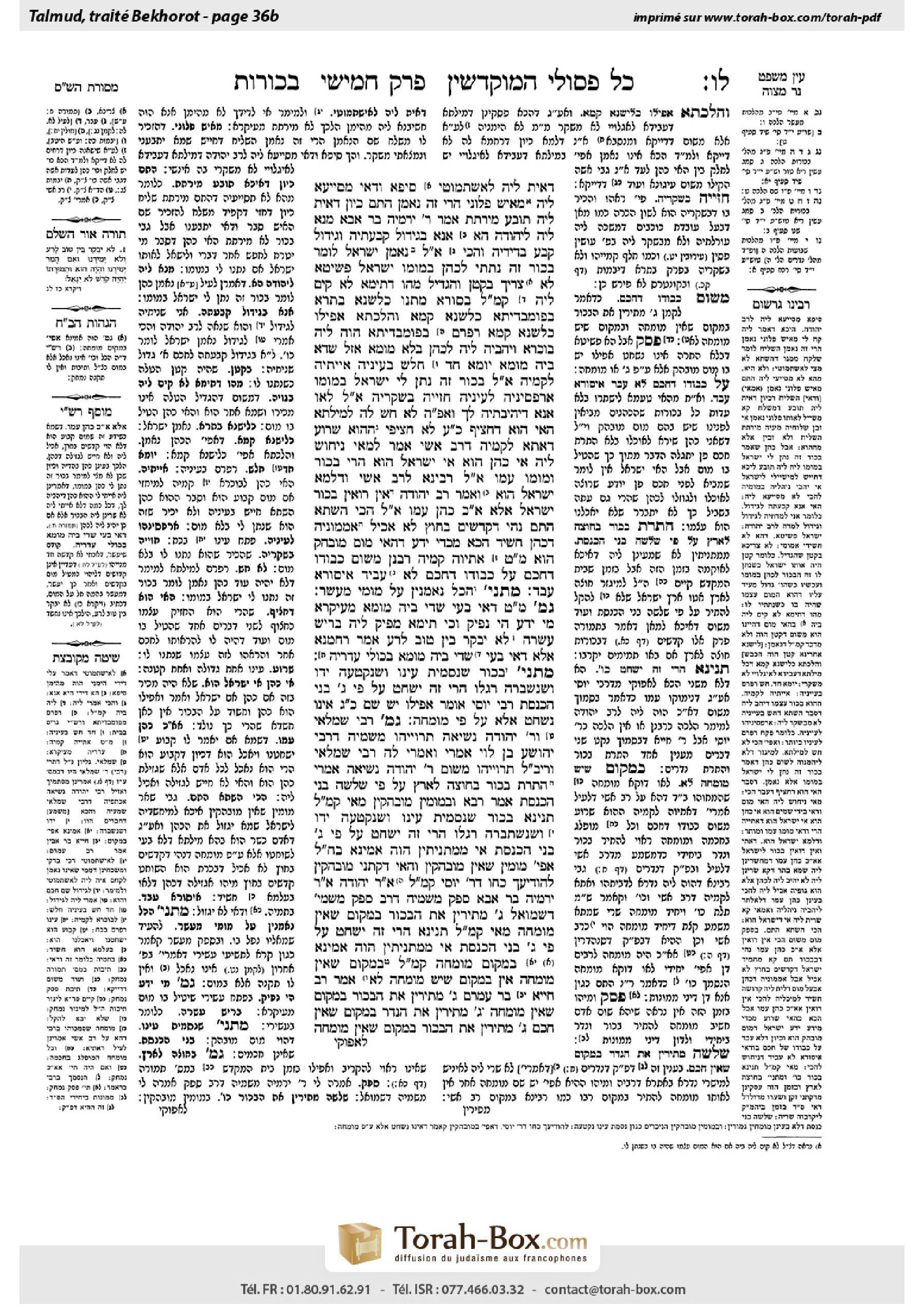
Bekhorot 36b: Talmud study for Daf Yomi
Study the Talmud for Daf Yomi with scanned pages, Hebrew text, English translations from Sefaria and AI-generated French translations.
Passage selection and English or AI-generated French translation are available where the scan has annotations. Daf Study is independent of Torah-Box and Sefaria.
Browse Bekhorot · בכורות · All tractatesBekhorot 36b text and translations
This page of Bekhorot includes the Aramaic text, an English translation and an AI-generated French translation, alongside the scan above.
בכורות ל״ו ב · Aramaic and Hebrew text
דְּאִית לֵיהּ לְאִשְׁתְּמוֹטֵי.
סֵיפָא וַדַּאי מְסַיְּיעָא לֵיהּ: מֵאִישׁ פְּלוֹנִי — הֲרֵי זֶה נֶאֱמָן.
הָתָם, כֵּיוָן דְּאִית לֵיהּ תּוֹבֵעַ, מִירְתַת.
אָמַר רַבִּי יִרְמְיָה בַּר אַבָּא: מְנָא לֵיהּ לִיהוּדָה הָא? אֲנָא בְּגִידּוּל קְבַעְתָּיהּ, וְגִידּוּל קְבַע בְּדִידֵיהּ. וְהָכִי אָמְרִי לֵיהּ: נֶאֱמָן יִשְׂרָאֵל לוֹמַר ״בְּכוֹר זֶה נָתַתִּי לְכֹהֵן בְּמוּמוֹ״.
יִשְׂרָאֵל? פְּשִׁיטָא! לָא צְרִיכָא בְּקָטָן וְהִגְדִּיל, מַהוּ דְּתֵימָא: לָא קִים לֵיהּ? קָא מַשְׁמַע לַן.
בְּסוּרָא מַתְנוּ כְּלִשָּׁנָא בָתְרָא, בְּפוּמְבְּדִיתָא כְּלִשָּׁנָא קַמָּא, וְהִלְכְתָא אֲפִילּוּ כְּלִשָּׁנָא קַמָּא.
רַפְרָם בְּפוּמְבְּדִיתָא הֲוָה לֵיהּ בּוּכְרָא, וְיַהֲבֵיהּ לֵיהּ לְכֹהֵן בְּלָא מוּמָא. אֲזַל שְׁדָא בֵּיהּ מוּמָא. יוֹמָא חַד חֲלַשׁ בְּעֵינֵיהּ, אַיְיתְיֵהּ לְקַמֵּיהּ. אֲמַר לֵיהּ: בְּכוֹר זֶה נָתַן לִי יִשְׂרָאֵל בְּמוּמוֹ. אַרְפְּסִינֵיהּ לְעֵינֵיהּ, חַזְיֵיהּ בְּשִׁקְרֵיהּ. אֲמַר לֵיהּ: לָאו אֲנָא דִּיהֵיבְתֵּיהּ לָךְ?
וַאֲפִילּוּ הָכִי לָא חַשׁ לַהּ לְמִילְּתָא, הַאי הוּא דַּחֲצִיף, כּוּלֵּי עָלְמָא לָא חֲצִיפִי.
הָהוּא שָׂרוּעַ דַּאֲתָא לְקַמֵּיהּ דְּרַב אָשֵׁי, אָמַר: לְמַאי נֵיחוּשׁ לֵיהּ? אִי כֹּהֵן הוּא, אִי יִשְׂרָאֵל הוּא — הֲרֵי בְּכוֹר וּמוּמוֹ עִמּוֹ.
אֲמַר לֵיהּ רָבִינָא לְרַב אָשֵׁי: וְדִלְמָא יִשְׂרָאֵל הוּא, וְאָמַר רַב יְהוּדָה: אֵין רוֹאִין בְּכוֹר יִשְׂרָאֵל אֶלָּא אִם כֵּן כֹּהֵן עִמּוֹ!
אֲמַר לֵיהּ: הָכִי הַשְׁתָּא?! הָתָם, נְהִי דְּקָדָשִׁים בְּחוּץ לָא אָכֵיל, אַמָּמוֹנֵיהּ דְּכֹהֵן חֲשִׁיד.
הָכָא, מִכְּדֵי יָדַע דְּהַאי מוּם מוּבְהָק הוּא, מַאי טַעְמָא אַתְיוּהּ קַמֵּיהּ רַבָּנַן? מִשּׁוּם כְּבוֹדוֹ דְּחָכָם; עַל כְּבוֹדוֹ דְּחָכָם לָא עָבֵיד, אִיסּוּרָא עָבֵד?!
מַתְנִי׳ הַכֹּל נֶאֱמָנִין עַל מוּמֵי מַעֲשֵׂר.
גְּמָ׳ מַאי טַעְמָא? דְּאִי בָּעֵי שָׁדֵי בֵּיהּ מוּמָא מֵעִיקָּרָא! מִי יָדַע הֵי נָפֵיק?
וְכִי תֵּימָא מַפֵּיק לֵיהּ בְּרֵישׁ עַשְׂרָה, ״לֹא יְבַקֵּר בֵּין טוֹב לָרַע״ אָמַר רַחֲמָנָא! אֶלָּא דְּאִי בָּעֵי שָׁדֵי בֵּיהּ מוּמָא (בכולי) [בְּכוּלֵּיהּ] עֶדְרֵיהּ.
מַתְנִי׳ בְּכוֹר שֶׁנִּסְמֵית עֵינוֹ, וְשֶׁנִּקְטְעָה יָדוֹ, וְשֶׁנִּשְׁבְּרָה רַגְלוֹ — הֲרֵי זֶה יִשָּׁחֵט עַל פִּי שְׁלֹשָׁה בְּנֵי הַכְּנֶסֶת. רַבִּי יוֹסֵי אוֹמֵר: אֲפִילּוּ יֵשׁ שָׁם עֶשְׂרִים וּשְׁלֹשָׁה, אֵינוֹ נִשְׁחָט אֶלָּא עַל פִּי מוּמְחֶה.
גְּמָ׳ רַבִּי שִׂמְלַאי וְרַבִּי יְהוּדָה נְשִׂיאָה תַּרְוַיְיהוּ מִשְּׁמֵיהּ דְּרַבִּי יְהוֹשֻׁעַ בֶּן לֵוִי אָמְרִי, וְאָמְרִי לַהּ: רַבִּי שִׂמְלַאי וְרַבִּי יְהוֹשֻׁעַ בֶּן לֵוִי תַּרְוַיְיהוּ מִשּׁוּם רַבִּי יְהוּדָה נְשִׂיאָה אָמְרִי: הַתָּרַת בְּכוֹר בְּחוּצָה לָאָרֶץ עַל פִּי שְׁלֹשָׁה בְּנֵי הַכְּנֶסֶת. אָמַר רָבָא: וּבְמוּמִין מוּבְהָקִין.
מַאי קָא מַשְׁמַע לַן? תְּנֵינָא: בְּכוֹר שֶׁנִּסְמֵית עֵינוֹ, וְשֶׁנִּקְטְעָה יָדוֹ, וְשֶׁנִּשְׁתַּבְּרָה רַגְלוֹ — הֲרֵי זֶה יִשָּׁחֵט עַל פִּי שְׁלֹשָׁה בְּנֵי הַכְּנֶסֶת!
אִי מִמַּתְנִיתִין הֲוָה אָמֵינָא: בְּחוּצָה לָאָרֶץ אֲפִילּוּ מוּמִין שֶׁאֵין מוּבְהָקִין, וְהַאי דְּקָתָנֵי מוּבְהָקִין — לְהוֹדִיעֲךָ כֹּחוֹ דְּרַבִּי יוֹסֵי, קָא מַשְׁמַע לַן.
אָמַר רַב יְהוּדָה אָמַר רַבִּי יִרְמְיָה בַּר אַבָּא, סָפֵק מִשְּׁמֵיהּ דְּרַב, סָפֵק מִשְּׁמֵיהּ דִּשְׁמוּאֵל: שְׁלֹשָׁה מַתִּירִין אֶת הַבְּכוֹר בִּמְקוֹם שֶׁאֵין מוּמְחֶה. מַאי קָא מַשְׁמַע לַן? תְּנֵינָא: הֲרֵי זֶה יִשָּׁחֵט עַל פִּי שְׁלֹשָׁה בְּנֵי הַכְּנֶסֶת!
אִי מִמַּתְנִיתִין הֲוָה אָמֵינָא: בִּמְקוֹם מוּמְחֶה, קָא מַשְׁמַע לַן: בִּמְקוֹם שֶׁאֵין מוּמְחֶה — אִין, בִּמְקוֹם שֶׁיֵּשׁ מוּמְחֶה — לָא.
אָמַר רַב חִיָּיא בַּר עַמְרָם: שְׁלֹשָׁה מַתִּירִין אֶת הַבְּכוֹר בִּמְקוֹם שֶׁאֵין מוּמְחֶה, שְׁלֹשָׁה מַתִּירִין אֶת הַנֶּדֶר בִּמְקוֹם שֶׁאֵין חָכָם. שְׁלֹשָׁה מַתִּירִין אֶת הַבְּכוֹר בִּמְקוֹם שֶׁאֵין מוּמְחֶה
Bekhorot 36b · English translation
as he has the easy option of extricating himself from the accusation that he did not fulfill the condition of the one who appointed him, by claiming that in his opinion the individual from whom he purchased the produce was to be trusted. Since the issue of the third party’s trustworthiness is subjective, the agent is not afraid to lie.
The Gemara suggests: The latter clause of this mishna certainly supports the ruling of Rav, that people do not lie with regard to any matter that will be revealed. How so? The latter clause states that if the one instructed the agent to purchase produce specifically from so-and-so, who is reliable with regard to tithes, then this agent is deemed credible to claim that he adhered to the instructions. Since the one who appointed him mentioned a specific individual, the agent is not suspected of lying, as that individual can be subsequently questioned.
The Gemara rejects this proof: There, in the mishna, since the agent has a claimant, he is afraid to lie. In other words, since the one who appointed him specified an individual, the agent presumes that he intends to verify the matter, and therefore he will not risk lying. By contrast, in Rav’s case, since it was the priest who volunteered the information that a specific Israelite gave him an already blemished firstborn animal, he is not concerned that the examiner might seek out the Israelite to confirm the actual facts.
Upon hearing Rav Yehuda’s statement in the name of Rav, Rabbi Yirmeya bar Abba said: From where does Yehuda know this halakha? Actually, I taught this halakha to Giddul in Rav’s name and Giddul, in turn, taught it to Rabbi Yehuda. But Giddul corrupted my statement, as this is how I said it to him: An Israelite is deemed credible to say: I gave this firstborn animal to a priest with its blemish already inflicted upon it, and it may be slaughtered and eaten.
The Gemara asks: An Israelite? It is obvious that he is deemed credible to issue this claim, as he has no use for the firstborn animal. The Gemara answers: No, this ruling is necessary, as it is referring to an animal that was young when the Israelite gave it to the priest and it grew older by the time of his testimony. This ruling is necessary, lest you say that as the animal grew older in the interim, perhaps the Israelite does not recognize it and mistakenly assumes that it was the animal he gave the priest, when in fact it is a different firstborn animal upon which the priest intentionally caused a blemish. Rabbi Yirmeya bar Abba therefore teaches us that the Israelite is trusted to recognize the animal he gave the priest.
The Gemara notes: In Sura, they teach the halakha in accordance with the latter version, as stated by Rabbi Yirmeya bar Abba, that an Israelite is deemed credible to testify. In Pumbedita, they teach the halakha in accordance with the first version, as taught by Rav Yehuda, citing Rav, that even a priest is deemed credible if he claims that an Israelite gave him an already blemished firstborn animal. The Gemara concludes: And the halakha is in accordance with even the first version.
In this regard, the Gemara relates that Rafram, who resided in Pumbedita, had a firstborn animal and he gave it to a priest in an unblemished state. The priest went and caused a blemish in it. One day, Rafram had an affliction in his eyes, which rendered it difficult for him to open them. The priest to whom Rafram had given the firstborn animal brought it before him, as an expert examiner, for him to deem the animal permitted. The priest said to him: An Israelite gave me this firstborn animal with its blemish upon it. Rafram forced his eyes open and saw the animal and recognized it [bashkerei] as the one he himself had given the priest. Rafram said to the priest: Is it not I who gave this firstborn animal to you?
The Gemara notes: And even so, Rafram was unconcerned by the matter of the priest’s attempted chicanery, as he maintained that it is only this priest who is impudent, but all other priests are not impudent. This scenario did not cause Rafram to discredit any other priest’s claim that he received a blemished firstborn animal from an Israelite, as this was an exceptional case. This priest demonstrated extreme impudence by bringing it to be examined by Rafram himself, and therefore one cannot draw conclusions about the behavior of other priests from this incident.
§ The Gemara relates that there was a certain firstborn animal, one of whose eyes was larger than the other, whose owner came before Rav Ashi to have it deemed fit for slaughter on account of its blemish. Uncertain as to who brought the animal for examination, Rav Ashi said: For what should we be concerned with regard to this animal? In a case of such a blemish, whether it is a priest who brought it for examination, or whether it is an Israelite, there is no concern that the blemish might have been intentionally caused, as this is clearly a firstborn animal whose blemish was already with it naturally.
Ravina said to Rav Ashi: But perhaps it is an Israelite who brought the firstborn animal, and Rav Yehuda says that one may not examine the firstborn animal of an Israelite unless a priest is present with him in order to receive the animal if it is established as fit for slaughter. Rav Yehuda is concerned that if the Israelite’s firstborn animal is deemed fit for slaughter when no priest is present, the Israelite might improperly use the animal for his own purposes. If so, how can you, Rav Ashi, say that there is no problem if this animal was brought by an Israelite?
Rav Ashi said to Ravina in response: How can these cases be compared? There, where the presence of a priest is required, it is referring to a case where the halakhic status of the blemish has yet to be determined. Now, granted an Israelite will not risk eating sacrificial meat outside the Temple courtyard, as that incurs a penalty of karet, and he therefore would have the blemish’s status determined by an expert. But he is suspected with regard to the property of a priest. Although the Israelite will have the status of the animal confirmed before risking a prohibition that entails karet, he might steal the firstborn offering if it is established as fit for consumption.
Conversely, here, in the case of the animal that had one eye larger than the other, since even an Israelite knows that this is a clear-cut blemish and the animal is clearly fit for slaughter, what is the reason he brought the animal before the Sages for examination? He brought it out of respect for the Sage. Now, if this Israelite does not neglect the respect due a Sage, would he commit a transgression and steal the possession of the priest? Certainly not. Therefore, in our case an Israelite would be trustworthy, and the presence of a priest is unnecessary.
MISHNA: Everyone is deemed credible to testify about the blemishes of an animal tithe offering, even the owner who is the beneficiary of a ruling that it is blemished.
GEMARA: What is the reason that even the owner is deemed credible to testify? The reason is that had he wanted, he could have caused a blemish in it initially, in a permitted manner, before tithing his animals. The Gemara raises a difficulty: But when he leads his animals out of the gate in order to tithe them, does he know which of them will emerge as the tenth, that you say he could have initially blemished that specific animal before it assumed the tithe status?
And if you would say that he intentionally leads an animal out as the head of the ten, i.e., so that it is the last of ten to emerge, one may not do so, as the Merciful One states: “He shall not search whether it be good or bad” (Leviticus 27:33), which teaches that the animal tithe may not be led out intentionally but must exit of its own accord. Rather, this is the meaning of the Gemara’s initial answer: The reason is that had he wanted, he could have caused a blemish in his entire flock, in a permitted manner, before leading them through the gate in order to tithe them.
MISHNA: With regard to a firstborn animal whose eye was blinded or whose foreleg was severed or whose hind leg was broken, all of which obviously render the animal permanently blemished, that animal may be slaughtered on the basis of the ruling of three regular Jews who attend the synagogue, and it does not require a ruling by one of the Sages. Rabbi Yosei disagrees and says: Even if there is a court of twenty-three Sages there, it may be slaughtered only on the basis of the ruling of an expert in judging blemishes.
GEMARA: The Gemara relates that Rabbi Simlai and Rabbi Yehuda Nesia both say in the name of Rabbi Yehoshua ben Levi, and some say that Rabbi Simlai and Rabbi Yehoshua ben Levi both say in the name of Rabbi Yehuda Nesia: The permitting of the slaughter of a firstborn animal outside of Eretz Yisrael, where a firstborn offering is unfit for sacrifice even when the Temple is standing, may be performed on the basis of the ruling of three regular Jews who attend the synagogue. Rava said: And this ruling applies specifically in a case of clear-cut blemishes, i.e., those blemishes which clearly permit the slaughter of the firstborn animal.
The Gemara asks: What is Rava teaching us by this statement? We already learn this in the mishna: With regard to a firstborn animal whose eye was blinded or whose foreleg was severed or whose hind leg was broken, that animal may be slaughtered on the basis of the ruling of three regular Jews who attend the synagogue. The mishna is referring to clear-cut blemishes in contemporary times, in the absence of the Temple, when a firstborn animal is unfit to be brought as an offering. What, then, is the novelty of Rava’s statement?
The Gemara answers: If the halakha that three regular Jews may permit the slaughter of a firstborn animal is learned from the mishna alone, I would say that according to the mishna, the power invested in three regular Jews to permit the slaughter of a firstborn animal in the absence of the Temple nowadays, or outside of Eretz Yisrael during Temple times, applies even to a firstborn animal that has blemishes that are not clear-cut. And the reason that the mishna specifically teaches a case of clear-cut blemishes is to convey the far-reaching nature of the opinion of Rabbi Yosei, who requires the examination of an expert even in such a case. Rava therefore teaches us that this is not so; rather, the mishna’s ruling is referring specifically to a case of clear-cut blemishes.
§ Rav Yehuda says that Rabbi Yirmeya bar Abba says the following halakha, but he was uncertain whether Rabbi Yirmeya bar Abba said it in the name of Rav and uncertain whether he said it in the name of Shmuel: Three regular Jews may permit a firstborn animal with clear-cut blemishes in a place where there is no expert. The Gemara asks: What is Rav Yehuda teaching us by this statement? We already learn this in the mishna: That animal may be slaughtered on the basis of the ruling of three regular Jews who attend the synagogue.
The Gemara answers: If the halakha is learned from the mishna alone, I would say that three laymen may permit a firstborn animal with clear-cut blemishes even in a place where there is an expert. Rav Yehuda therefore teaches us that in a place where there is no expert, yes, three laymen may permit it. But in a place where there is an expert, three laymen are not invested with this power.
Rav Ḥiyya bar Amram says: A group of three laymen may permit a blemished firstborn animal in a place where there is no expert to consult, and likewise a group of three laymen may dissolve a vow in a place where there is no Sage. The Gemara explains: The ruling that a group of three laymen may permit a blemished firstborn animal in a place where there is no expert to consult
Bekhorot 36b · Traduction française (IA)
puisque il a l'option facile de se disculper de l'accusation qu'il n'a pas rempli la condition de celui qui l'a chargé, en affirmant que, selon son avis, la personne à qui il a acheté les produits était digne de confiance. Puisque la question de la crédibilité du tiers est subjective, l'agent n'a pas peur de mentir.
La Guemara suggère : la dernière partie de cette mitsna soutient certainement la décision de Rav, selon laquelle les gens ne mentent pas concernant toute affaire qui sera révélée. Comment ? La dernière partie indique que si celui qui a chargé l'agent d'acheter des produits spécifiquement auprès de tel ou tel, qui est digne de confiance concernant les dîmes, alors cet agent est considéré comme crédible pour affirmer qu'il a suivi les instructions. Puisque celui qui l'a chargé a mentionné un individu spécifique, l'agent n'est pas soupçonné de mentir, car cet individu peut être interrogé ultérieurement.
La Guemara rejette cette preuve : là, dans la mitsna, puisque l'agent a un plaignant, il a peur de mentir. En d'autres termes, puisque celui qui l'a chargé a spécifié un individu, l'agent suppose qu'il veut vérifier la question, et donc il ne risque pas de mentir. À l'inverse, dans le cas de Rav, puisque c'était le prêtre qui a donné l'information que tel Israélite lui avait donné un premier-né blemi, il n'avait pas à crainre que l'examinateur cherche à vérifier auprès de l'Israélite les faits réels.
En entendant la déclaration de Rav Yehuda en nom de Rav, Rabbi Yirmeya bar Abba dit : d'où Yehuda connaît-il cette halakha ? En réalité, je lui ai enseigné cette halakha à Giddul en nom de Rav, et Giddul, à son tour, l'a enseignée à Rabbi Yehuda. Mais Giddul a corrompu ma déclaration, car c'est ainsi que je lui l'ai dit : un Israélite est considéré comme crédible pour affirmer : j'ai donné cet animal premier-né à un prêtre avec sa blemish déjà existante, et il peut être sacrifié et mangé.
La Guemara pose la question : un Israélite ? Il est évident qu'il est considéré comme crédible pour émettre cette déclaration, car il n'a pas besoin de l'animal premier-né. La Guemara répond : non, cette décision est nécessaire, car elle fait référence à un animal jeune lorsque l'Israélite l'a donné au prêtre et qui a vieilli jusqu'au moment de son témoignage. Cette décision est nécessaire, afin que l'on ne dise pas que, comme l'animal a vieilli entre-temps, peut-être l'Israélite ne le reconnaît pas et suppose par erreur que c'est l'animal qu'il a donné au prêtre, alors qu'en réalité c'est un autre animal premier-né sur lequel le prêtre a intentionnellement causé une blemish. Rabbi Yirmeya bar Abba enseigne donc que l'Israélite est considéré comme crédible pour reconnaître l'animal qu'il a donné au prêtre.
La Guemara note : à Sura, ils enseignent la halakha selon la version ultérieure, comme l'a dit Rabbi Yirmeya bar Abba, selon laquelle un Israélite est considéré comme crédible pour témoigner. À Pumbedita, ils enseignent la halakha selon la première version, comme l'a enseigné Rav Yehuda en nom de Rav, selon laquelle même un prêtre est considéré comme crédible s'il affirme qu'un Israélite lui a donné un animal premier-né déjà blemi. La Guemara conclut : et la halakha suit même la première version.
À cet égard, la Guemara rapporte que Rafram, qui résidait à Pumbedita, avait un animal premier-né et il le donna à un prêtre dans un état intact. Le prêtre alla et causa un défaut dans l'animal. Un jour, Rafram souffrit d'une maladie aux yeux, ce qui rendait difficile l'ouverture de ses yeux. Le prêtre à qui Rafram avait donné l'animal premier-né l'amena devant lui, comme un expert, pour qu'il le déclare permis. Le prêtre dit à Rafram : Un Israélite m'a donné cet animal premier-né avec un défaut. Rafram força ses yeux à s'ouvrir et vit l'animal et le reconnut comme celui qu'il avait lui-même donné au prêtre. Rafram dit au prêtre : N'est-ce pas moi qui ai donné cet animal premier-né à vous ?
La Guemara note : Et même ainsi, Rafram ne s'inquiétait pas de la machination du prêtre, car il affirmait que c'est seulement ce prêtre qui est impudique, mais tous les autres prêtres ne le sont pas. Ce scénario n'a pas causé à Rafram de discréditer les déclarations d'autres prêtres affirmant avoir reçu un animal premier-né déficient d'un Israélite, car c'était un cas exceptionnel. Ce prêtre montra une extrême impudeur en amenant l'animal devant Rafram lui-même, et donc on ne peut pas tirer de conclusions sur le comportement des autres prêtres à partir de cet incident.
§ La Guemara rapporte que certains avaient un animal premier-né, dont un des yeux était plus grand que l'autre, et son propriétaire vint devant Rav Ashi pour qu'il soit déclaré propre à la boucherie en raison de ce défaut. Incertain quant à celui qui avait amené l'animal pour l'examen, Rav Ashi dit : À quoi devons-nous nous préoccuper concernant cet animal ? Dans le cas d'un tel défaut, que ce soit un prêtre qui l'ait amené pour l'examen ou un Israélite, il n'y a pas de préoccupation que le défaut ait été intentionnellement causé, car c'est clairement un animal premier-né dont le défaut était déjà naturel.
Ravina a dit à Rav Ashi : mais peut-être s'agit-il d'un Israélite qui a amené l'animal premier-né, et Rav Yehuda dit que l'on ne peut pas examiner l'animal premier-né d'un Israélite sans qu'un prêtre ne soit présent avec lui afin de le recevoir s'il est déclaré propre à la boucherie. Rav Yehuda craint que si l'animal premier-né d'un Israélite est déclaré propre à la boucherie sans prêtre présent, l'Israélite pourrait utiliser l'animal à des fins personnelles. Si c'est le cas, comment pouvez-vous, Rav Ashi, dire qu'il n'y a pas de problème si cet animal a été amené par un Israélite ?
Rav Ashi a dit à Ravina en réponse : Comment peuvent ces cas être comparés ? Là, où la présence d'un prêtre est requise, il s'agit d'un cas où le statut halakhique de la tache n'a pas encore été déterminé. Maintenant, bien que l'Israelite ne risque pas de manger de viande sacrée en dehors du cour de l'Autel, car cela entraîne une peine de karet, et qu'il a donc le statut de la tache déterminé par un expert, il est soupçonné concernant la propriété d'un prêtre. Bien que l'Israelite ait le statut de l'animal confirmé avant de risquer une interdiction entraînant karet, il pourrait voler l'offrande des premiers-nés si elle est établie comme comestible.
Inversement, ici, dans le cas de l'animal ayant un œil plus grand que l'autre, puisque même un Israelite sait que c'est une tache évidente et que l'animal est clairement apte à la boucherie, pourquoi l'a-t-il amené devant les Sages pour examen ? Il l'a fait par respect pour le Sage. Maintenant, si cet Israelite ne néglige pas le respect dû aux Sages, commet-il un péché et vole-t-il la propriété du prêtre ? Certainement pas. Par conséquent, dans notre cas, l'Israelite est considéré comme digne de confiance, et la présence d'un prêtre n'est pas nécessaire.
MICHNA : Tout le monde est considéré comme crédible pour témoigner sur les taches d'un animal d'offrande des premiers-nés, même l'propriétaire qui bénéficie d'une décision selon laquelle l'animal est taché.
GUEMARA : Quelle est la raison pour laquelle même l'owner est considéré comme crédible ? La raison est que s'il l'avait voulu, il aurait pu causer une tache à l'animal d'une manière permise avant de titrer ses bêtes. La Guemara soulève un problème : Mais quand il conduit ses bêtes à la porte pour les titrer, sait-il quelle d'entre elles sortira comme la dixième, que tu dis qu'il aurait pu causer une tache à cet animal spécifique avant qu'il ne prenne le statut de titre ?
Et si tu dis qu'il a intentionnellement conduit une bête comme tête des dix, c'est-à-dire pour qu'elle soit la dernière à sortir, on ne peut pas le faire, car l'Éternel dit : « Il ne doit pas chercher s'il est bon ou mauvais » (Lévitique 27:33), ce qui enseigne que l'offrande des titres ne peut être conduite intentionnellement mais doit sortir d'elle-même. C'est donc la signification de la réponse initiale de la Guemara : La raison est que s'il l'avait voulu, il aurait pu causer une tache à toute sa troupe, d'une manière permise, avant de les conduire à la porte pour les titrer.
MICHNA : Concernant un animal des premiers-nés dont l'œil était aveugle ou dont la jambe avant était tranchée ou dont la jambe arrière était brisée, toutes ces taches évidentes rendant l'animal taché de manière permanente, cet animal peut être sacrifié sur la décision de trois Juifs ordinaires qui assistent à la synagogue, et cela ne nécessite pas la décision d'un Sage. Rabbi Yosei désaccorde et dit : Même s'il y a un tribunal de vingt-trois Sages là, il peut être sacrifié uniquement sur la décision d'un expert dans l'évaluation des taches.
GUEMARA : La Guemara rapporte que Rabbi Simlai et Rabbi Yehuda Nesia disent tous deux en nom de Rabbi Yehoshua ben Levi, et certains disent que Rabbi Simlai et Rabbi Yehoshua ben Levi disent tous deux en nom de Rabbi Yehuda Nesia : La permission de sacrifier un animal des premiers-nés en dehors d'Israël, où une offrande des premiers-nés n'est pas comestible même quand le Temple est debout, peut être faite sur la décision de trois Juifs ordinaires qui assistent à la synagogue. Rava a dit : Et cette décision s'applique spécifiquement dans le cas de taches évidentes, c'est-à-dire celles qui permettent clairement de sacrifier l'animal des premiers-nés.
La Guemara demande : Quel enseignement Rava nous apporte-t-il par cette déclaration ? Nous avons déjà appris cela dans la mishna : Concernant un animal des premiers-nés dont l'œil était aveugle ou dont la jambe avant était tranchée ou dont la jambe arrière était brisée, cet animal peut être sacrifié sur la décision de trois Juifs ordinaires qui assistent à la synagogue. La mishna fait référence à des taches évidentes dans les temps modernes, en l'absence du Temple, où un animal des premiers-nés n'est pas comestible. Quel est donc le nouveauté de la déclaration de Rava ?
La Guemara répond : Si la halakha que trois Juifs ordinaires peuvent permettre le sacrifice d'un animal des premiers-nés est apprise uniquement à partir de la mishna, je dirais que selon la mishna, le pouvoir conféré aux trois Juifs ordinaires pour permettre le sacrifice d'un animal des premiers-nés en l'absence du Temple aujourd'hui, ou en dehors d'Israël pendant les temps du Temple, s'applique même à un animal des premiers-nés ayant des taches non évidentes. Et la raison pour laquelle la mishna enseigne spécifiquement un cas de taches évidentes est pour transmettre la portée de l'opinion de Rabbi Yosei, qui exige l'examen d'un expert même dans un tel cas. Rava enseigne donc que cela n'est pas ainsi ; plutôt, la décision de la mishna fait référence spécifiquement à un cas de taches évidentes.
§ Rav Yehuda dit que Rabbi Yirmeya bar Abba enseigne la suivante halakha, mais il était incertain si Rabbi Yirmeya bar Abba l'enseignait en nom de Rav et incertain si l'enseignait en nom de Shmuel : Trois Juifs ordinaires peuvent permettre un animal des premiers-nés ayant des taches évidentes dans un lieu où il n'y a pas d'expert. La Guemara demande : Quel enseignement Rav Yehuda nous apporte-t-il par cette déclaration ? Nous avons déjà appris cela dans la mishna : Cet animal peut être sacrifié sur la décision de trois Juifs ordinaires qui assistent à la synagogue.
La Guemara répond : Si la halakha est apprise uniquement à partir de la mishna, je dirais que trois laïcs peuvent permettre un animal des premiers-nés ayant des taches évidentes même dans un lieu où il y a un expert. Rav Yehuda enseigne donc que dans un lieu où il n'y a pas d'expert, oui, trois laïcs peuvent le permettre. Mais dans un lieu où il y a un expert, trois laïcs ne sont pas investis de ce pouvoir.
Rav Ḥiyya bar Amram dit : Un groupe de trois laïcs peut autoriser un animal premier blemi dans un lieu où il n'y a pas d'expert à consulter, et de même un groupe de trois laïcs peut annuler une promesse dans un lieu où il n'y a pas de Sage. La Guemara explique : La décision selon laquelle un groupe de trois laïcs peut autoriser un animal premier blemi dans un lieu où il n'y a pas d'expert à consulter
Traduction française générée par IA à partir de l’édition anglaise de Sefaria. Vérifie toujours un passage avec le texte source.
Text from Sefaria: William Davidson Edition - Vocalized Aramaic (CC BY NC); William Davidson Edition - English (CC BY NC).