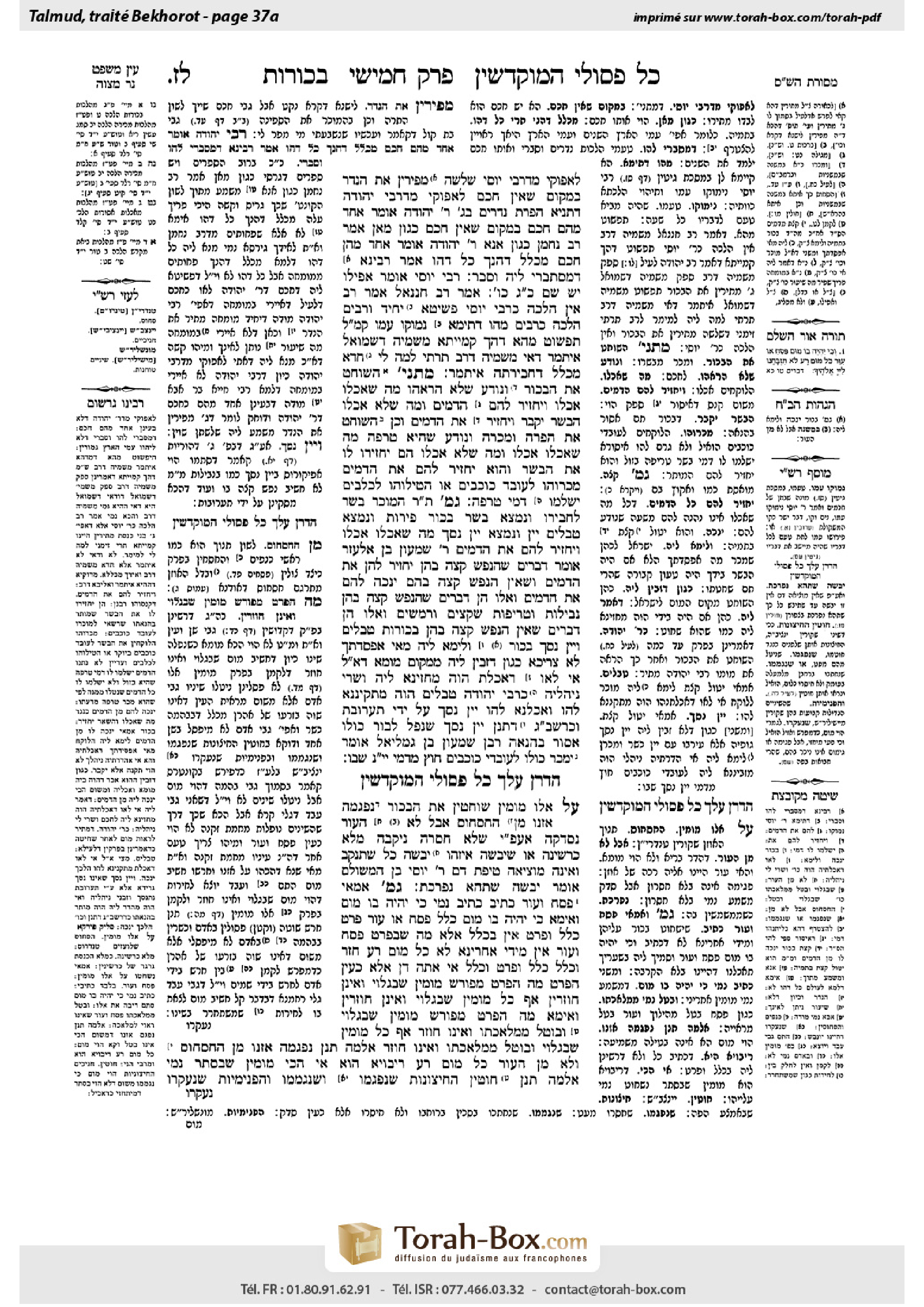
Bekhorot 37a: Talmud study for Daf Yomi
Study the Talmud for Daf Yomi with scanned pages, Hebrew text, English translations from Sefaria and AI-generated French translations.
Passage selection and English or AI-generated French translation are available where the scan has annotations. Daf Study is independent of Torah-Box and Sefaria.
Browse Bekhorot · בכורות · All tractatesBekhorot 37a text and translations
This page of Bekhorot includes the Aramaic text, an English translation and an AI-generated French translation, alongside the scan above.
בכורות ל״ז א · Aramaic and Hebrew text
לְאַפּוֹקֵי מִדְּרַבִּי יוֹסֵי, שְׁלֹשָׁה מְפִירִין אֶת הַנֶּדֶר בִּמְקוֹם שֶׁאֵין חָכָם לְאַפּוֹקֵי מִדְּרַבִּי יְהוּדָה, דְּתַנְיָא: הֲפָרַת נְדָרִים בִּשְׁלֹשָׁה, רַבִּי יְהוּדָה אוֹמֵר: אֶחָד מֵהֶם חָכָם.
בִּמְקוֹם שֶׁאֵין חָכָם. כְּגוֹן מַאן? אָמַר רַב נַחְמָן: כְּגוֹן אֲנָא. רַבִּי יְהוּדָה אוֹמֵר: אֶחָד מֵהֶן חָכָם, מִכְּלָל דְּהָנָךְ כֹּל דְּהוּ? אָמַר רָבִינָא: דְּמַסְבְּרִי לֵיהּ וְסָבַר.
רַבִּי יוֹסֵי אוֹמֵר: אֲפִילּוּ יֵשׁ שָׁם עֶשְׂרִים וּשְׁלֹשָׁה כּוּ׳. אָמַר רַב חֲנַנְאֵל אָמַר רַב: אֵין הֲלָכָה כְּרַבִּי יוֹסֵי. פְּשִׁיטָא, יָחִיד וְרַבִּים הֲלָכָה כְּרַבִּים! מַהוּ דְּתֵימָא נִמּוּקוֹ עִמּוֹ? קָא מַשְׁמַע לַן.
תִּפְשׁוֹט מֵהָא, דְּהָךְ קַמַּיְיתָא מִשְּׁמֵיהּ דִּשְׁמוּאֵל אִיתְּמַר, דְּאִי מִשְּׁמֵיהּ דְּרַב — תַּרְתֵּי לְמָה לִי?
חֲדָא (מכלל) [מִכְּלָלָא] דַּחֲבִירְתַּהּ אִיתְּמַר.
מַתְנִי׳ הַשּׁוֹחֵט אֶת הַבְּכוֹר, וְנוֹדַע שֶׁלֹּא הֶרְאָהוּ — מַה שֶּׁאָכְלוּ אָכְלוּ, וְיַחְזִיר לָהֶם הַדָּמִים, וּמַה שֶּׁלֹּא אָכְלוּ — הַבָּשָׂר יִקָּבֵר, וְיַחְזִיר אֶת הַדָּמִים.
וְכֵן הַשּׁוֹחֵט אֶת הַפָּרָה וּמְכָרָהּ, וְנוֹדַע שֶׁהִיא טְרֵפָה — מַה שֶּׁאָכְלוּ אָכְלוּ, וּמַה שֶּׁלֹּא אָכְלוּ — הֵם יַחֲזִירוּ לוֹ אֶת הַבָּשָׂר, וְהוּא יַחֲזִיר לָהֶם אֶת הַדָּמִים. מְכָרוּהוּ לְגוֹיִם, אוֹ הִטִּילוּהוּ לִכְלָבִים — יְשַׁלְּמוּ דְּמֵי טְרֵפָה.
גְּמָ׳ תָּנוּ רַבָּנַן: הַמּוֹכֵר בָּשָׂר לַחֲבֵירוֹ וְנִמְצָא בְּשַׂר בְּכוֹר, פֵּירוֹת וְנִמְצָא טְבָלִים, יַיִן וְנִמְצָא יֵין נֶסֶךְ — מַה שֶּׁאָכְלוּ אָכְלוּ, וְיַחְזִיר לָהֶם אֶת הַדָּמִים.
רַבִּי שִׁמְעוֹן בֶּן אֶלְעָזָר אוֹמֵר: דְּבָרִים שֶׁהַנֶּפֶשׁ קָצָה בָּהֶן — יַחֲזִיר לָהֶן אֶת הַדָּמִים, וְשֶׁאֵין הַנֶּפֶשׁ קָצָה בָּהֶם — יְנַכֶּה לָהֶם אֶת הַדָּמִים. וְאֵלּוּ הֵן דְּבָרִים שֶׁהַנֶּפֶשׁ קָצָה בָּהֶן: נְבֵילוֹת וּטְרֵיפוֹת, שְׁקָצִים וּרְמָשִׂים. וְאֵלּוּ הֵן דְּבָרִים שֶׁאֵין הַנֶּפֶשׁ קָצָה בָּהֶן: בְּכוֹרוֹת, טְבָלִים וְיֵין נֶסֶךְ.
בְּכוֹר — וְלֵימָא לֵיהּ: מַאי אַפְסֵדְתָּךְ?
לָא צְרִיכָא, כְּגוֹן דְּזַבֵּין לֵיהּ מִמְּקוֹם מוּמָא, דַּאֲמַר לֵיהּ: אִי לָאו דְּאָכְלַתְּ הֲוָה מַחְזֵינָא לֵיהּ וְשָׁרֵי נִיהֲלֵיהּ, כְּרַבִּי יְהוּדָה.
טְבָלִים — הֲוָה מַתְקֵינְנָא לְהוּ וְאָכֵלְנָא לְהוּ, יֵין נֶסֶךְ — עַל יְדֵי תַּעֲרוֹבֶת, וּכְרַבָּן שִׁמְעוֹן בֶּן גַּמְלִיאֵל.
דִּתְנַן: יֵין נֶסֶךְ שֶׁנָּפַל לַבּוֹר — כּוּלּוֹ אָסוּר בַּהֲנָאָה. רַבָּן שִׁמְעוֹן בֶּן גַּמְלִיאֵל אוֹמֵר: יִמָּכֵר כּוּלּוֹ לְגוֹיִם, חוּץ מִדְּמֵי יֵין נֶסֶךְ שֶׁבּוֹ.
הֲדַרַן עֲלָךְ כׇּל פְּסוּלֵי הַמּוּקְדָּשִׁין.
מַתְנִי׳ עַל אֵלּוּ מוּמִין שׁוֹחֲטִין אֶת הַבְּכוֹר: נִפְגְּמָה אׇזְנוֹ מִן הַחַסְחוּס, אֲבָל לֹא הָעוֹר, נִסְדְּקָה אַף עַל פִּי שֶׁלֹּא חָסְרָה, נִיקְּבָה מְלֹא כַרְשִׁינָה, אוֹ שֶׁיָּבְשָׁה. אֵיזֶהוּ יְבֵשָׁה? כֹּל שֶׁתִּנָּקֵב וְאֵינָהּ מוֹצִיאָה טִיפַּת דָּם. רַבִּי יוֹסֵי בֶּן הַמְשׁוּלָּם אוֹמֵר: יְבֵשָׁה שֶׁתְּהֵא נִפְרֶכֶת.
גְּמָ׳ אַמַּאי? פִּסֵּחַ וְעִוֵּר כְּתִיב!
כְּתִיב נָמֵי ״כִּי יִהְיֶה בוֹ מוּם״, וְאֵימָא: ״כִּי יִהְיֶה בּוֹ מוּם״ — כָּלַל, ״פִּסֵּחַ אוֹ עִוֵּר״ — פָּרַט, כְּלָל וּפְרָט אֵין בַּכְּלָל אֶלָּא מָה שֶׁבַּפְּרָט; פִּסֵּחַ וְעִוֵּר — אִין, מִידֵּי אַחֲרִינָא — לָא!
״כֹּל מוּם רָע״ — חָזַר וְכָלַל, כְּלָל וּפְרָט וּכְלָל — אִי אַתָּה דָן אֶלָּא כְּעֵין הַפְּרָט; מָה הַפְּרָט מְפוֹרָשׁ — מוּמִין שֶׁבַּגָּלוּי וְאֵינָן חוֹזְרִין, אַף כֹּל מוּמִין שֶׁבַּגָּלוּי וְאֵינָן חוֹזְרִין.
וְאֵימָא: מָה הַפְּרָט מְפוֹרָשׁ — מוּמִין שֶׁבַּגָּלוּי, וּבוֹטֵל מִמְּלַאכְתּוֹ, וְאֵינוֹ חוֹזֵר, אַף כֹּל — מוּמִין שֶׁבַּגָּלוּי, וּבוֹטֵל מִמְּלַאכְתּוֹ, וְאֵינוֹ חוֹזֵר. אַלְּמָה תְּנַן: נִפְגְּמָה אׇזְנוֹ מִן הַחַסְחוּס וְלֹא מִן הָעוֹר?
כֹּל מוּם רָע רִיבּוּיָא הוּא, אִי הָכִי, מוּמִין שֶׁבַּסֵּתֶר נָמֵי? אַלְּמָה תְּנַן: חוּטִין הַחִיצוֹנוֹת שֶׁנִּפְגְּמוּ וְשֶׁנִּגְמְמוּ, וְהַפְּנִימִיּוֹת שֶׁנֶּעֶקְרוּ —
Bekhorot 37a · English translation
is to the exclusion of the opinion of Rabbi Yosei in the mishna, who prohibits any number of laymen to deem a firstborn animal permitted. The ruling that a group of three laymen may dissolve a vow in a place where there is no Sage is to the exclusion of the opinion of Rabbi Yehuda, as it is taught in a baraita: Dissolution of vows requires a court of three. Rabbi Yehuda says: This is the halakha only if at least one of them is a Sage. If no Sage is available, laymen may not dissolve a vow.
Rav Ḥiyya bar Amram stated above that a group of three may dissolve a vow in a place where there is no Sage. This indicates that if there is a Sage, he alone may dissolve a vow. The Gemara asks: Who, for example, is considered such a Sage? Rav Naḥman said: For example, one such as me. The baraita further stated that Rabbi Yehuda says: At least one of the three laymen must be a Sage. The Gemara asks: Should one conclude by inference that those other two members can be anyone, even complete ignoramuses? Ravina said in explanation: Each member of the group must be one to whom the halakhot of vows is explained and he is able to comprehend them.
§ The mishna teaches that Rabbi Yosei says: Even if there is a court of twenty-three Sages there, it may be slaughtered only on the basis of the ruling of an expert. Rav Ḥananel says that Rav says: The halakha is not in accordance with the opinion of Rabbi Yosei. The Gemara challenges: This is obvious, as there is a principle that in a dispute between an individual Sage and many Sages, the halakha is in accordance with the opinion of the many Sages. The Gemara answers: Rav’s statement is necessary, lest you say that Rabbi Yosei is an exception to the principle, as his reasoning [nimmuko] is with him, i.e., his logic is sound. Rav Ḥananel therefore teaches us that this is not so, and the halakha does not follow his opinion.
Earlier (36b), the Gemara cited a ruling, which was issued either by Rav or Shmuel, that three regular Jews may deem a firstborn animal permitted in a place where there is no expert, in contrast to the opinion of Rabbi Yosei. The Gemara suggests: Resolve that dilemma from this statement in the name of Rav, that the halakha is not in accordance with the opinion of Rabbi Yosei. It can be inferred from here that that first, uncertain ruling was stated in the name of Shmuel. As, if it was stated in the name of Rav, why do I need two identical rulings?
The Gemara answers: This is insufficient proof, as it is possible that Rav did not issue two identical rulings. Rather, one ruling was stated from the other, by inference. Rav issued only one of these statements explicitly; the other was reported by his students in his name based on an inference from what he had said.
MISHNA: In the case of one who slaughters a firstborn animal and sells its meat, and it was discovered that he did not initially show it to one of the Sages, the halakha is that it was actually prohibited to derive any benefit from the meat. In that case, what the buyers ate, they ate, and the Sages penalized the seller in that he must return the money to them, which they paid for the meat that they ate. And with regard to that which they did not eat, that meat must be buried, and he must return the money that they paid for the meat that they did not eat.
And likewise, in the case of one who slaughters a cow and sells it, and it was discovered that it is a tereifa, what the buyers ate, they ate, and what they did not eat, they must return the meat to the seller, who may sell it to a gentile or feed it to the dogs, and he must return the money to the buyers. If the buyers sold it to gentiles or cast it to the dogs, they pay the seller the value of a tereifa, which is less than the value of kosher meat, and the seller refunds the balance to the buyers.
GEMARA: The Sages taught in a baraita: In a case where one sells meat to another and it was discovered that it is the meat of a firstborn animal, which was not deemed permitted for consumption by an expert, or if one sells produce to another and it was discovered that it is untithed produce, or if one sells wine to another and it turns out that it is wine that was used for a libation in idol worship, the halakha is that what the purchasers ate, they ate, and the seller reimburses them all their money.
Rabbi Shimon ben Elazar says, qualifying this ruling: If he sold them items from which one is generally repulsed, he must reimburse them all their money, as they are presumed to not have derived benefit from the consumption of such items. But if he sold them items from which one is not generally repulsed, he deducts for them the value of the benefit from those items and reimburses them the balance. And the following are items from which one is generally repulsed: Carcasses and tereifot, repugnant creatures, and creeping animals. And the following are items from which one is generally not repulsed: Firstborn animals, untithed produce, and wine used for a libation in idol worship.
The Gemara asks: Why does the seller deduct the value of the meat of a firstborn animal eaten by the purchaser and reimburse him the difference? Let the purchaser say to the seller: What loss have I caused you by eating the meat? Had you not sold it to me, you would have had no rights to partake of it, as this is an unblemished firstborn animal from which deriving benefit is prohibited.
The Gemara answers: No, this ruling is necessary in a case where he sold him a cut of meat from an area on the animal that contained a blemish, but the seller had not yet brought the animal to be examined and deemed permitted by a Sage. In that instance, the seller can say to the purchaser: Had you not eaten the meat, I would have shown the animal to a Sage and he would have deemed it permitted to me. The Gemara notes that this is in accordance with the opinion of Rabbi Yehuda (28a), who permits a firstborn animal to be examined and deemed permitted even after it has been slaughtered.
The Gemara adds that with regard to untithed produce, although one could claim that the purchaser did not cause a loss to the seller, as untithed produce is prohibited for consumption, the seller can say to the purchaser: Had you not eaten my produce, I would have remedied it, i.e., separated its tithes, and eaten it. Similarly, with regard to wine used for a libation in idol worship, which is also prohibited to be consumed, this is referring to a seller who sold it in a mixture of permitted wine. In this case, had the purchaser not consumed the wine mixture, the seller could have derived benefit from it, in accordance with the opinion of Rabban Shimon ben Gamliel.
As we learned in a mishna (Avoda Zara 74a): In the case of wine used for a libation in idol worship that fell into a wine cistern, it is prohibited to derive benefit from all the wine in the cistern, even if the volume of the wine used for a libation was small in comparison to the volume of the rest of the wine in the cistern. Rabban Shimon ben Gamliel says: All of the wine in the cistern may be sold to a gentile, and the money paid for it is permitted, except for the value of the wine used for a libation that is in it.
MISHNA: For these blemishes, one may slaughter the firstborn animal outside the Temple: If the firstborn’s ear was damaged and lacking from the cartilage [haḥasḥus], but not if the skin was damaged; and likewise, if the ear was split, although it is not lacking; or if the ear was pierced with a hole the size of a bitter vetch, which is a type of legume; or if it was an ear that is desiccated. What is a desiccated ear that is considered a blemish? It is any ear that if it is pierced it does not discharge a drop of blood. Rabbi Yosei ben HaMeshullam says: Desiccated means that the ear is so dry that it will crumble if one touches it.
GEMARA: With regard to the blemishes mentioned in this mishna and in the subsequent mishnayot, the Gemara asks: Why is it permitted to slaughter and eat a firstborn that sustained these blemishes? Only a lame animal and a blind animal are written in the verse that discusses this halakha. That verse states: “And if there be any blemish therein, lameness, or blindness, any ill blemish whatsoever, you shall not sacrifice it to the Lord your God. You shall eat it within your gates” (Deuteronomy 15:21–22).
The Gemara answers: It is also written in the beginning of the verse: “If there be any blemish therein,” which indicates that other blemishes are also included. The Gemara asks: But why not say that the phrase “if there be any blemish therein” is a generalization, while “lameness, or blindness” is a detail. According to the principles of midrashic exegesis, if a generalization and a detail are mentioned, the generalization includes only that which is specified in the detail. Therefore, it should be concluded that in the event of lameness and blindness, yes, one may slaughter the firstborn, but in the event of another matter, one may not slaughter it.
The Gemara answers: By subsequently stating: “Any ill blemish,” it then generalized again. Consequently, it is a generalization and a detail and a generalization, represented in the phrases “any blemish,” “lameness or blindness,” and “any ill blemish,” and according to the principles of midrashic exegesis, you may deduce that the verse is referring only to items similar to the detail. Just as the items mentioned in the detail, i.e., in the phrase “lameness or blindness,” are clearly defined as blemishes that are exposed and do not regenerate, so too, all blemishes that are exposed and do not regenerate are considered blemishes with regard to a firstborn.
The Gemara suggests: But say instead that just as the items mentioned in the detail, i.e., in the phrase “lameness or blindness,” are clearly defined as blemishes that are exposed and that cause an animal to desist from its normal labor, and they are blemishes that do not regenerate, so too, all blemishes that are exposed and that cause an animal to desist from its labor and do not regenerate are included in this halakha. If so, a blemish that does not fit these criteria would not render the firstborn permitted to be slaughtered. Why then did we learn in the mishna that if the firstborn’s ear was damaged and lacking from the cartilage, but not if it is lacking from the skin, it is considered a blemish, despite the fact that this does not cause the animal to desist from its labor?
The Gemara answers: The word “any” in “any ill blemish” is an amplification, and it includes even blemishes that are different from those defined by the detail. The Gemara challenges: If so, blemishes that are hidden should also be included. Why then did we learn in the mishna (39a) that animals with external gums that were damaged and lacking or that were scratched [veshenigmemu] and likewise animals with internal gums that were entirely extracted are considered blemished?
Bekhorot 37a · Traduction française (IA)
il s'agit d'exclure l'opinion du Rabbi Yosei dans la Michna, qui interdit à tout nombre de laïcs de considérer un animal premier comme permis. La décision selon laquelle un groupe de trois laïcs peut annuler un vœu dans un lieu où il n'y a pas de Sage s'oppose à l'opinion du Rabbi Yehuda, comme il est enseigné dans une baraïta : L'annulation des vœux nécessite un tribunal de trois. Le Rabbi Yehuda dit : C'est la halakha uniquement si au moins l'un d'eux est un Sage. Si aucun Sage n'est disponible, les laïcs ne peuvent pas annuler un vœu.
Rav Ḥiyya bar Amram a déclaré ci-dessus que trois personnes peuvent annuler un vœu dans un lieu où il n'y a pas de Sage. Cela indique que si un Sage est présent, seul lui peut annuler un vœu. La Guemara pose la question : Qui, par exemple, est considéré comme un Sage ? Rav Naḥman a dit : Par exemple, quelqu'un tel que moi. La baraïta ajoute que Rabbi Yehuda dit : Au moins l'un des trois laïcs doit être un Sage. La Guemara pose la question : Doit-on conclure par déduction que les deux autres membres peuvent être n'importe qui, même des ignorants complets ? Ravina a expliqué : Chacun des membres du groupe doit être une personne à qui les halakhot des vœux sont expliqués et qui est capable de les comprendre.
§ La mitsna enseigne que Rabbi Yosei dit : Même s'il y a un tribunal de vingt-trois Sages, il peut être sacrifié uniquement sur la base du jugement d'un expert. Rav Ḥananel dit que Rav dit : La halakha ne suit pas l'opinion de Rabbi Yosei. La Guemara conteste : Cela est évident, car il y a un principe selon lequel, en cas de désaccord entre un Sage individuel et de nombreux Sages, la halakha suit l'opinion des nombreux Sages. La Guemara répond : L'affirmation de Rav est nécessaire, afin que l'on ne dise pas que Rabbi Yosei est une exception à ce principe, car sa raison [nimmuko] est avec lui, c'est-à-dire que sa logique est solide. Rav Ḥananel enseigne donc que cela n'est pas vrai, et la halakha ne suit pas son opinion.
Plus tôt (36b), la Guemara a cité un jugement, émis soit par Rav soit par Shmuel, selon lequel trois Juifs ordinaires peuvent considérer un animal premier comme permis dans un lieu où il n'y a pas d'expert, contrairement à l'opinion du Rabbi Yosei. La Guemara suggère : Résolvez ce dilemme à partir de cette déclaration en nom de Rav, selon laquelle la halakha ne suit pas l'opinion du Rabbi Yosei. On peut en déduire ici que ce premier jugement incertain a été émis en nom de Shmuel. En effet, si c'était en nom de Rav, pourquoi aurait-on besoin de deux jugements identiques ?
La Guemara répond : Cela n'est pas une preuve suffisante, car il est possible que Rav n'ait pas émis deux jugements identiques. Plutôt, un jugement a été émis par l'autre par déduction. Rav a émis seulement un de ces jugements explicitement ; l'autre a été rapporté par ses élèves en son nom, basé sur une déduction à partir de ce qu'il avait dit.
MICHNA : Dans le cas d'une personne qui sacrifie un animal premier et vend sa viande, et il est découvert qu'il n'a pas montré cet animal à l'un des Sages au départ, la halakha est que la viande était effectivement interdite à l'usage. Dans ce cas, ce que les acheteurs ont mangé, ils l'ont mangé, et les Sages sanctionnent le vendeur en exigeant qu'il leur rende l'argent qu'ils ont payé pour la viande qu'ils ont mangée. Et concernant ce qu'ils n'ont pas mangé, cette viande doit être enterrée, et il doit rendre l'argent qu'ils ont payé pour la viande qu'ils n'ont pas mangée.
Et de même, dans le cas d'une personne qui tue une vache et la vend, et il est découvert qu'il s'agit d'une tereifa, ce que les acheteurs ont mangé, ils l'ont mangé, et ce qu'ils n'ont pas mangé, ils doivent rendre la viande au vendeur, qui peut la vendre à un non-Juif ou la nourrir aux chiens, et il doit rendre l'argent aux acheteurs. Si les acheteurs ont vendu cette viande aux non-Juifs ou l'ont jetée aux chiens, ils paient au vendeur la valeur d'une tereifa, qui est inférieure à la valeur de la viande kasher, et le vendeur rembourse la différence aux acheteurs.
GUEMARA : Les Sages ont enseigné dans une baraïta : Dans le cas où l'on vend de la viande à un autre et il est découvert qu'il s'agit de la viande d'un animal premier, qui n'a pas été considérée comme permise à l'usage par un expert, ou si l'on vend des produits et il est découvert qu'ils sont des produits non titrés, ou si l'on vend du vin et il se révèle qu'il s'agit de vin utilisé pour une libation dans l'idolâtrie, la halakha est que ce que les acheteurs ont mangé, ils l'ont mangé, et le vendeur rembourse à tous leur argent.
Le Rabbi Shimon ben Elazar dit, en qualifiant ce jugement : Si l'on a vendu des choses dont on est généralement répugné, il doit rembourser à tous leur argent, car ils sont supposés n'avoir pas tiré de bénéfice de la consommation de ces choses. Mais si l'on a vendu des choses dont on n'est pas généralement répugné, il déduit pour eux la valeur du bénéfice tiré de ces choses et rembourse la différence. Et les choses dont on est généralement répugné sont : les cadavres et les tereifot, les créatures repoussantes et les animaux rampants. Et les choses dont on n'est pas généralement répugné sont : les animaux premiers, les produits non titrés et le vin utilisé pour une libation dans l'idolâtrie.
La Guemara pose la question : Pourquoi le vendeur déduit-il la valeur de la viande d'un animal premier mangée par l'acheteur et rembourse-t-il la différence ? L'acheteur peut dire au vendeur : Quel préjudice ai-je causé en mangeant la viande ? Si tu ne m'avais pas vendu la viande, tu n'aurais pas eu le droit de t'en servir, car c'est un animal premier intact dont l'usage est interdit.
La Guemara répond : Non, ce jugement est nécessaire dans le cas où il a vendu une portion de viande provenant d'une partie de l'animal contenant une tare, mais le vendeur n'avait pas encore amené l'animal à être examiné et déclaré permis par un Sage. Dans ce cas, le vendeur peut dire à l'acheteur : Si tu n'avais pas mangé la viande, j'aurais montré l'animal à un Sage et il aurait déclaré qu'il était permis à moi. La Guemara note que cela correspond à l'opinion du Rabbi Yehuda (28a), qui permet à un animal premier d'être examiné et déclaré permis même après avoir été sacrifié.
La Guemara ajoute que concernant les produits non titrés, bien qu'on puisse affirmer que l'acheteur n'a pas causé de préjudice au vendeur, car les produits non titrés sont interdits à la consommation, le vendeur peut dire à l'acheteur : Si vous n'aviez pas mangé mes produits, je les aurais réparés, c'est-à-dire séparé leurs dixièmes et les aurais mangés. De même, concernant le vin utilisé pour un libation dans l'idolâtrie, qui est également interdit à la consommation, cela fait référence à un vendeur qui a vendu ce vin mélangé à du vin permis. Dans ce cas, si l'acheteur n'avait pas consommé ce mélange de vin, le vendeur aurait pu en tirer un bénéfice, conformément à l'opinion de Rabban Shimon ben Gamliel.
Comme nous l'avons appris dans une mitsva (Avoda Zara 74a) : Dans le cas de vin utilisé pour un libation dans l'idolâtrie qui est tombé dans un réservoir de vin, il est interdit de tirer un bénéfice de tout le vin du réservoir, même si la quantité de vin utilisé pour un libation est petite par rapport à la quantité du reste du vin dans le réservoir. Rabban Shimon ben Gamliel dit : Tout le vin du réservoir peut être vendu à un non-Juif, et l'argent reçu est permis, sauf la valeur du vin utilisé pour un libation qui est dedans.
MITSVA : Pour ces défauts, on peut sacrifier l'animal premier en dehors du Temple : Si l'oreille du premier-né était endommagée et manquante dans la cartilagine [haḥasḥus], mais pas si la peau était endommagée ; et de même, si l'oreille était fendue, même si elle n'est pas manquante ; ou si l'oreille était percée d'un trou de la taille d'une légumineuse amère ; ou si c'était une oreille sèche. Qu'est-ce qu'une oreille sèche qui est considérée comme un défaut ? C'est toute oreille qui, si elle est percée, ne saigne pas une goutte. Rabbi Yosei ben HaMeshullam dit : Sèche signifie que l'oreille est si sèche qu'elle se désintègre si on la touche.
GUEMARA : Concernant les défauts mentionnés dans cette mitsna et dans les mitsvot suivantes, la Guemara demande : Pourquoi est-il permis de sacrifier et de manger un premier-né qui a subi ces défauts ? Seul un animal boiteux et un animal aveugle sont mentionnés dans la parabole qui discute de cette halakha. Cette parabole stipule : « Et si il y a quelque défaut en lui, boiterie, ou aveuglement, quelque défaut maladif que ce soit, vous ne le sacrifierez pas à l'Éternel votre Dieu. Vous le mangerez dans vos villes » (Deutéronome 15:21–22).
La Guemara répond : Il est également écrit au début de la parabole : « Si il y a quelque défaut en lui », ce qui indique que d'autres défauts sont également inclus. La Guemara demande : Mais pourquoi ne pas dire que la phrase « si il y a quelque défaut en lui » est une généralisation, tandis que « boiterie, ou aveuglement » est un détail. Selon les principes d'exégèse midrashique, si une généralisation et un détail sont mentionnés, la généralisation inclut uniquement ce qui est spécifié dans le détail. Ainsi, il devrait être conclu que, en cas de boiterie et d'aveuglement, oui, on peut sacrifier le premier-né, mais en cas d'autre chose, on ne peut pas sacrifier.
La Guemara répond : Ensuite, en disant : « Quelque défaut maladif que ce soit », il généralise à nouveau. Ainsi, c'est une généralisation et un détail et une généralisation, représentés dans les phrases « quelque défaut », « boiterie ou aveuglement », et « quelque défaut maladif que ce soit », et selon les principes d'exégèse midrashique, on peut déduire que la parabole fait référence uniquement aux choses similaires au détail. Tout comme les choses mentionnées dans le détail, c'est-à-dire dans la phrase « boiterie ou aveuglement », sont clairement définies comme des défauts visibles et qui ne régénèrent pas, de même, tous les défauts visibles et qui ne régénèrent pas sont considérés comme des défauts concernant un premier-né.
La Guemara suggère : Mais disons plutôt que tout comme les choses mentionnées dans le détail, c'est-à-dire dans la phrase « boiterie ou aveuglement », sont clairement définies comme des défauts visibles qui font que l'animal cesse de travailler normalement, et qui ne régénèrent pas, de même, tous les défauts visibles qui font que l'animal cesse de travailler et ne régénèrent pas sont inclus dans cette halakha. Si c'est ainsi, un défaut qui ne correspond pas à ces critères ne rendrait pas le premier-né permis à être sacrifié. Pourquoi alors avons-nous appris dans la mitsna que si l'oreille du premier-né était endommagée et manquante dans la cartilagine, mais pas si elle était manquante dans la peau, cela est considéré comme un défaut, malgré le fait que cela ne fait pas cesser l'animal de travailler ?
La Guemara répond : Le mot « quelque » dans « quelque défaut maladif » est une amplification, et il inclut même des défauts différents de ceux définis par le détail. La Guemara conteste : Si c'est ainsi, les défauts cachés devraient également être inclus. Pourquoi alors avons-nous appris dans la mitsna (39a) que les animaux avec des gencives externes endommagées ou manquantes ou grattées [veshenigmemu] et de même les animaux avec des gencives internes entièrement extraites sont considérés comme défectueux ?
Traduction française générée par IA à partir de l’édition anglaise de Sefaria. Vérifie toujours un passage avec le texte source.
Text from Sefaria: William Davidson Edition - Vocalized Aramaic (CC BY NC); William Davidson Edition - English (CC BY NC).