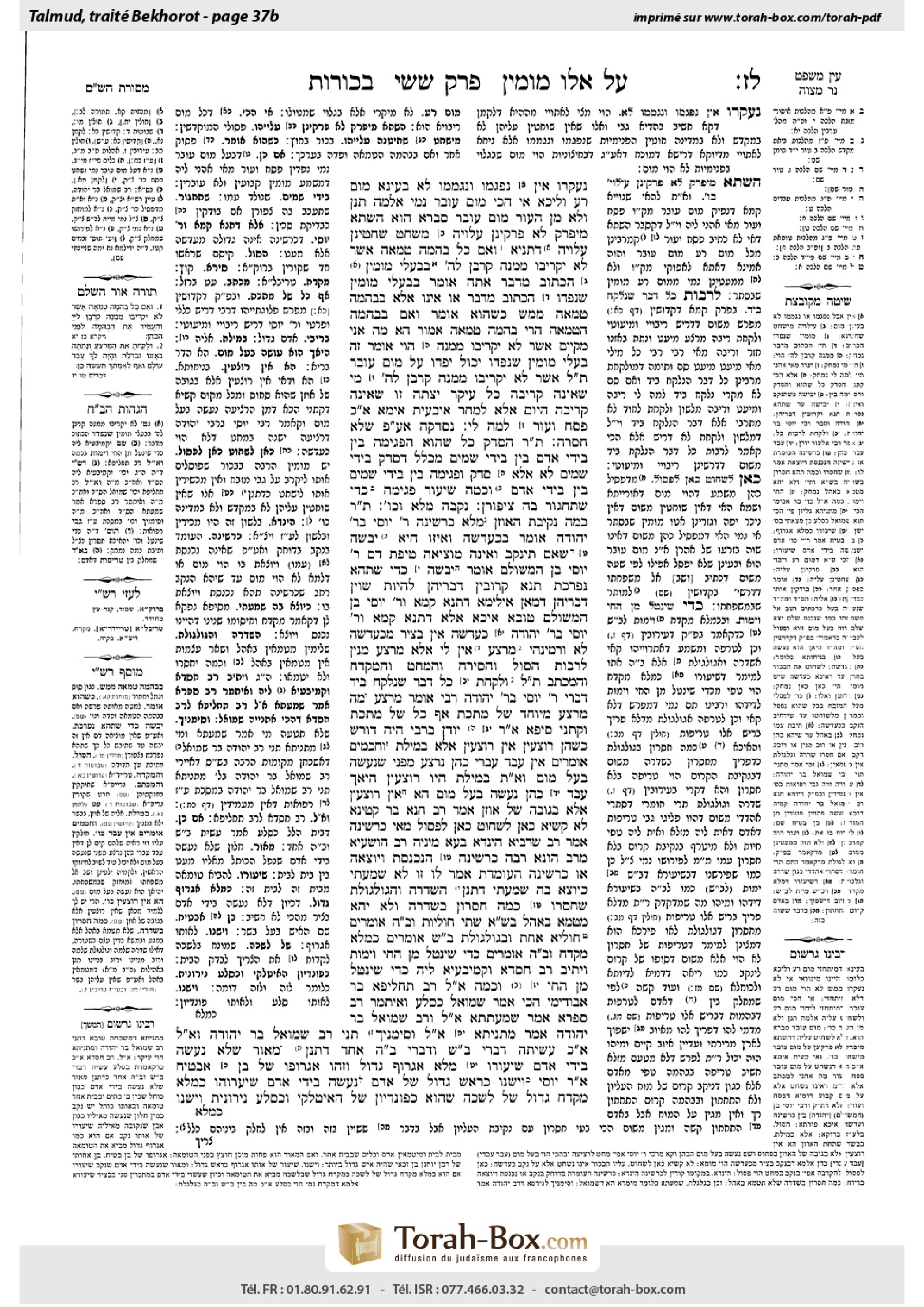
Bekhorot 37b: Talmud study for Daf Yomi
Study the Talmud for Daf Yomi with scanned pages, Hebrew text, English translations from Sefaria and AI-generated French translations.
Passage selection and English or AI-generated French translation are available where the scan has annotations. Daf Study is independent of Torah-Box and Sefaria.
Browse Bekhorot · בכורות · All tractatesBekhorot 37b text and translations
This page of Bekhorot includes the Aramaic text, an English translation and an AI-generated French translation, alongside the scan above.
בכורות ל״ז ב · Aramaic and Hebrew text
נֶעְקְרוּ אִין, נִפְגְּמוּ וְנִגְמְמוּ לָא? בָּעֵינָא ״מוּם רָע״, וְלֵיכָּא! אִי הָכִי, מוּם עוֹבֵר נָמֵי! אַלְּמָה תְּנַן: וְלֹא מִן הָעוֹר?
מוּם עוֹבֵר סְבָרָא הוּא, הַשְׁתָּא מִיפְרָק לָא פָּרְקִינַן עִלָּוֵיהּ, מִשְׁחָט שָׁחֲטִינַן עִלָּוֵיהּ? דְּתַנְיָא: ״וְאִם כׇּל בְּהֵמָה טְמֵאָה אֲשֶׁר לֹא יַקְרִיבוּ מִמֶּנָּה קׇרְבָּן לַה׳״ — בְּבַעֲלֵי מוּמִין הַכָּתוּב מְדַבֵּר.
אַתָּה אוֹמֵר בְּבַעֲלֵי מוּמִין שֶׁנִּפְדּוּ הַכָּתוּב מְדַבֵּר, אוֹ אֵינוֹ אֶלָּא בִּבְהֵמָה טְמֵאָה מַמָּשׁ? כְּשֶׁהוּא אוֹמֵר ״וְאִם בִּבְהֵמָה הַטְּמֵאָה״, הֲרֵי בְּהֵמָה טְמֵאָה אָמוּר, הָא מָה אֲנִי מְקַיֵּים ״אֲשֶׁר לֹא יַקְרִיבוּ מִמֶּנָּה״? הֱוֵי אוֹמֵר: זֶה בַּעֲלֵי מוּמִין שֶׁנִּפְדּוּ.
יָכוֹל יִפָּדוּ עַל מוּם עוֹבֵר? תַּלְמוּד לוֹמַר: ״אֲשֶׁר לֹא יַקְרִיבוּ מִמֶּנָּה קׇרְבָּן לַה׳״ — מִי שֶׁאֵינָהּ קְרֵיבָה כׇּל עִיקָּר, יָצְתָה זוֹ שֶׁאֵינָהּ קְרֵיבָה הַיּוֹם אֶלָּא לְמָחָר.
אִיבָּעֵית אֵימָא: אִם כֵּן פִּסֵּחַ וְעִוֵּר לְמָה לִי?
נִסְדְּקָה אַף עַל פִּי שֶׁלֹּא חָסְרָה. תָּנוּ רַבָּנַן: הַסֶּדֶק — כׇּל שֶׁהוּא, הַפְּגִימָה — בֵּין בִּידֵי אָדָם בֵּין בִּידֵי שָׁמַיִם. מִכְּלָל דְּסֶדֶק בִּידֵי שָׁמַיִם לָא?
אֶלָּא, סֶדֶק וּפְגִימָה — בֵּין בִּידֵי שָׁמַיִם בֵּין בִּידֵי אָדָם. וְכַמָּה שִׁיעוּר פְּגִימָה? כְּדֵי שֶׁתַּחְגּוֹר בָּהּ צִיפּוֹרֶן.
נִקְּבָה מְלֹא וְכוּ׳. תָּנוּ רַבָּנַן: כַּמָּה נְקִיבַת הָאוֹזֶן? מְלֹא כַרְשִׁינָה. רַבִּי יוֹסֵי בְּרַבִּי יְהוּדָה אוֹמֵר: בְּכַעֲדָשָׁה. וְאֵיזוֹ הִיא יְבֵשָׁה? שֶׁאִם תִּינָּקֵב וְאֵינָהּ מוֹצִיאָה טִיפַּת דָּם. רַבִּי יוֹסֵי בֶּן הַמְשׁוּלָּם אוֹמֵר: יְבֵשָׁה כְּדֵי שֶׁתְּהֵא נִפְרֶכֶת.
תָּנָא: קְרוֹבִין דִּבְרֵיהֶן לִהְיוֹת שָׁוִין. דִּבְרֵיהֶן דְּמַאן? אִילֵימָא דְּתַנָּא קַמָּא וְרַבִּי יוֹסֵי בֶּן הַמְשׁוּלָּם — טוּבָא אִיכָּא! אֶלָּא דְּתַנָּא קַמָּא וְרַבִּי יוֹסֵי בְּרַבִּי יְהוּדָה.
כַּעֲדָשָׁה — אִין, בְּצִיר מִכַּעֲדָשָׁה — לָא? וּרְמִינְהִי: ״מַרְצֵעַ״ — אֵין לִי אֶלָּא מַרְצֵעַ, מִנַּיִן לְרַבּוֹת הַסּוֹל, וְהַסִּירָה, וְהַמַּחַט, וְהַמַּקְדֵּחַ, וְהַמַּכְתֵּב?
תַּלְמוּד לוֹמַר: ״וְלָקַחְתָּ״ — כׇּל דָּבָר שֶׁנִּלְקָח בַּיָּד, דִּבְרֵי רַבִּי יוֹסֵי בְּרַבִּי יְהוּדָה. רַבִּי אוֹמֵר: ״מַרְצֵעַ״ — מָה מַרְצֵעַ מְיוּחָד שֶׁל מַתֶּכֶת, אַף כֹּל שֶׁל מַתֶּכֶת.
וְקָתָנֵי סֵיפָא: אָמַר רַבִּי, יוּדָן בְּרִבִּי הָיָה דּוֹרֵשׁ: כְּשֶׁהֵן רוֹצְעִין, אֵין רוֹצְעִין אֶלָּא בַּמִּילָת.
וַחֲכָמִים אוֹמְרִים: אֵין עֶבֶד עִבְרִי כֹּהֵן נִרְצָע, מִפְּנֵי שֶׁנַּעֲשָׂה בַּעַל מוּם. וְאִם תֹּאמַר: בַּמִּילָת הָיוּ רוֹצְעִין, הֵיאַךְ עֶבֶד כֹּהֵן נַעֲשֶׂה בַּעַל מוּם? הָא אֵין רוֹצְעִין אֶלָּא בְּגוֹבַהּ שֶׁל אוֹזֶן.
אָמַר רַב חָנָא בַּר קַטִּינָא: לָא קַשְׁיָא — כָּאן לִשְׁחוֹט, כָּאן לִפְסוֹל.
מַאי כַּרְשִׁינָה? אָמַר רַב שֵׁרֵבְיָא: הִינְדָּא.
בְּעָא מִינֵּיהּ רַב הוֹשַׁעְיָא מֵרַב הוּנָא רַבָּה: כַּרְשִׁינָה הַנִּכְנֶסֶת וְיוֹצְאָה, אוֹ כַרְשִׁינָה הָעוֹמֶדֶת? אָמַר לוֹ: זוֹ לֹא שָׁמַעְתִּי, כַּיּוֹצֵא בָּהּ שָׁמַעְתִּי.
דִּתְנַן: הַשִּׁדְרָה וְהַגּוּלְגּוֹלֶת שֶׁחָסְרוּ, כַּמָּה חֶסְרוֹן בַּשִּׁדְרָה וְלֹא יְהֵא מְטַמֵּא בְּאֹהֶל? בֵּית שַׁמַּאי אוֹמְרִים: שְׁתֵּי חוּלְיוֹת, וּבֵית הִלֵּל אוֹמְרִים: חוּלְיָא אַחַת. וּבַגּוּלְגּוֹלֶת, בֵּית שַׁמַּאי אוֹמְרִים: כִּמְלֹא מַקְדֵּחַ, וּבֵית הִלֵּל אוֹמְרִים: כְּדֵי שֶׁיִּנָּטֵל מִן הַחַי וְיָמוּת.
וְיָתֵיב רַב חִסְדָּא וְקָמִיבַּעְיָא לֵיהּ: ״כְּדֵי שֶׁיִּנָּטֵל מִן הַחַי״ — וְכַמָּה? אֲמַר לֵיהּ רַב תַּחְלִיפָא בַּר אֲבוּדִימִי: הָכִי אָמַר שְׁמוּאֵל — כְּסֶלַע.
וְאִיתְּמַר: רַב סָפְרָא אָמַר: שְׁמַעְתְּתָא אֲמַר לֵיהּ, וְרַב שְׁמוּאֵל בַּר יְהוּדָה אָמַר: מַתְנִיתָא אֲמַר לֵיהּ, וְסִימָנָיךְ: תָּנֵי רַב שְׁמוּאֵל בַּר יְהוּדָה.
וַאֲמַר לֵיהּ: אִם כֵּן, עָשִׂיתָה דִּבְרֵי בֵּית שַׁמַּאי וְדִבְרֵי בֵּית הִלֵּל אֶחָד! דִּתְנַן: מָאוֹר שֶׁלֹּא נַעֲשָׂה בִּידֵי אָדָם, שִׁיעוּרוֹ מְלֹא אֶגְרוֹף גָּדוֹל, וְזֶהוּ אֶגְרוֹפוֹ שֶׁל בֶּן אֲבַטִּיחַ. אָמַר רַבִּי יוֹסֵי: וְיֶשְׁנוֹ כְּרֹאשׁ גָּדוֹל שֶׁל אָדָם.
נַעֲשָׂה בִּידֵי אָדָם, שִׁיעֲרוּהוּ כִּמְלֹא מַקְדֵּחַ גָּדוֹל שֶׁל לִשְׁכָּה, שֶׁהוּא כְּפוּנְדְּיוֹן (שֶׁל) הָאִיטַלְקִי, וּכְסֶלַע נִירוֹנִית, וְיֶשְׁנוֹ
Bekhorot 37b · English translation
It can be inferred that if the internal gums were extracted then yes, one may slaughter the firstborn, but if they were merely damaged or they were scratched, one may not, since it is a hidden blemish. The Gemara answers: I require that it be an “ill blemish,” which must be exposed and degrading, and a hidden blemish is not considered such an “ill blemish.” The Gemara asks: If so, that all blemishes are included by the words: “Any ill blemish,” aside from hidden blemishes, a temporary blemish should also render it permitted for the firstborn to be slaughtered. Why then did we learn in the mishna: If the firstborn’s ear was damaged and lacking from the cartilage it may be slaughtered, but not if it is damaged and lacking from the skin, since it is a temporary blemish?
The Gemara answers: A temporary blemish is not excluded by the exegesis but is based on logical reasoning: Now, if we do not even redeem an offering due to a temporary blemish, will we slaughter a firstborn outside the Temple, for which redemption is not performed, due to a temporary blemish? The Gemara explains the source for this assertion that an offering is not redeemed because of a temporary blemish. As it is taught in a baraita: “And if it be any impure animal, of which they may not bring an offering to the Lord” (Leviticus 27:11). The verse is speaking of ritually pure animals with blemishes.
The baraita continues: Do you say that the verse is speaking of animals with blemishes that were redeemed, or is it referring only to an actual impure animal, such as a donkey or a horse that was consecrated; but with regard to a kosher animal, perhaps its consecrated status cannot be removed by redemption even if it was blemished? When the verse states: “And if it be of an impure animal” (Leviticus 27:27), a non-kosher animal is mentioned. So how do I realize the meaning of: “Of which they may not bring an offering”? You must say that this is referring to blemished animals that were redeemed, indicating that redemption is permitted.
The baraita concludes: One might have thought that offerings may be redeemed due to a temporary blemish that they sustained. Therefore, the verse states: “Of which they may not bring an offering to the Lord” (Leviticus 27:11). This teaches that an animal that is not sacrificed at all is redeemed, which excludes this animal that has a temporary blemish, which is not sacrificed today, but rather may be sacrificed tomorrow.
The Gemara comments: If you wish, say a different explanation as to why a temporary blemish is not included in the amplification of the verse: “Any ill blemish”: If so, that even a temporary blemish permits its slaughter, why do I need the verse to mention a lame animal and a blind animal? It would have sufficed to state: “Any ill blemish.” Rather, the verse excludes a temporary blemish that is unlike these two blemishes, which are permanent.
§ The mishna teaches: If the ear of the firstborn animal was split, although it is not lacking, one may slaughter the animal outside the Temple. With regard to this, the Sages taught in a baraita: The split that permits the animal to be slaughtered is one of any size. With regard to the damage, whether it was done by the hand of a person or by the hand of God, it may be slaughtered. The Gemara asks: Should it be derived by inference that with regard to a split, if it was caused by the hand of God it is not considered a blemish? That also should be considered an obvious blemish and render the animal permitted for slaughter.
The Gemara answers: Rather, the baraita should be interpreted as follows: The animal may be slaughtered for a split of any size, and with regard to a split and damage, whether it was done by the hand of God or by the hand of a person, the animal may be slaughtered. And what is the measure of the damage that is considered a blemish? It must be large enough that a fingernail will be retained [shetaḥgor] on it, i.e., if one passes his fingernail over the ear of the animal it can enter the area of the damage.
§ The mishna stated that if the ear of a firstborn animal was pierced with a hole the size of a bitter vetch, the animal is slaughtered because of it. With regard to this, the Sages taught in a baraita: How large must the piercing of the ear be? It must be the size of a karshina. Rabbi Yosei, son of Rabbi Yehuda, says: Like the size of a lentil, which is slightly smaller. And what is a desiccated ear that is considered a blemish? It is an ear that if it is pierced, it does not discharge a drop of blood. Rabbi Yosei ben HaMeshullam says: Desiccated means that the ear is so dry that it will crumble if one touches it.
A Sage taught: Their statements are close to being identical in practice. The Gemara asks: The statements of whom are close to being identical? If we say that he is referring to the statements of the first tanna and Rabbi Yosei ben HaMeshullam with regard to a desiccated ear, there is a significant difference between these two opinions. One says it is determined by whether blood emerges, while the other holds it is based on whether it crumbles. Rather, he is referring to the statement of the first tanna and the statement of Rabbi Yosei, son of Rabbi Yehuda, as a karshina and a lentil are almost identical in size.
The Gemara asks with regard to the statement of Rabbi Yosei, son of Rabbi Yehuda: If the ear was pierced with a hole like the size of a lentil, then yes, it is considered a blemish, but if it was pierced with a hole less than the size of a lentil, then is it not considered a blemish? And one can raise a contradiction from a baraita: The Torah provides a description of the process by which a Hebrew slave who has already completed his six years of servitude may continue on as a slave of his master: “And you shall take the awl and put it through his ear and in the door” (Deuteronomy 15:17). From this verse, I have derived only that an awl can be used. From where do I know to include the palm thorn [hassol], a thorn, a needle, and a gimlet, and a stylus for writing on wax as valid tools for piercing his ear?
Therefore, the verse states: “And you shall take,” which indicates that anything that can be taken by hand is a valid tool. This is the statement of Rabbi Yosei, son of Rabbi Yehuda. Rabbi Yehuda HaNasi says: Not all these items can be used. Rather, since the verse specifies an “awl,” only items similar to an awl can be used; just as an awl is distinct in that it is fashioned of metal, so too, anything fashioned of metal can be used.
And the latter clause of the baraita teaches: Rabbi Elazar said that Yudan the Distinguished would teach as follows: When they pierce the ear of the slave, they pierce only in the earlobe.
And the Rabbis say: The piercing is not performed on that part of the ear, since there is a tradition that the ear of a Hebrew slave who is a priest is not pierced, because the piercing renders him blemished and unfit to serve in the Temple. And if you say that they pierced the slave in the earlobe, how does a Hebrew slave who is a priest become blemished through piercing? A wound on this part of the ear heals. This indicates that they pierce only on the upper part of the ear, through the cartilage.
In any event, it is clear from the statement of Rabbi Yosei, son of Rabbi Yehuda, that the piercing of a needle is considered a blemish, despite the fact that it is definitely smaller than the size of a lentil. The Gemara answers: Rav Ḥana bar Ketina said: It is not difficult, as here, Rabbi Yosei, son of Rabbi Yehuda, said that the hole must be the size of a lentil with regard to slaughtering an animal outside the Temple due to the blemish. There, with regard to disqualifying the animal from being sacrificed, even a tiny hole is considered a blemish, just as it renders the priest blemished.
§ According to the first opinion cited in the baraita, the size of the hole that is considered a blemish in the ear of the firstborn animal is like that of a karshina. The Gemara asks: What is a karshina? Rav Sherevya says: It is a bitter vetch, called hinda in Aramaic.
With regard to this halakha, Rav Hoshaya asked Rav Huna the Great: Is this measure referring to a bitter vetch that can enter and exit the hole in the ear, which means that the hole is slightly larger than the bitter vetch? Or is it referring to a bitter vetch that is stationary in the hole, meaning that the hole is precisely the size of a bitter vetch? Rav Huna the Great said to him: I did not hear this halakha specifically, but I heard a similar halakha to it, that the expression: The size of a bitter vetch [melo karshina], means that the bitter vetch can enter and exit the hole.
As we learned in a mishna (Oholot 2:3): The spine and the skull of a corpse that are incomplete do not impart ritual impurity in a tent. This halakha was unanimously accepted, but the details were subject to dispute: How much is considered a deficiency in the spine so that it will not impart impurity in a tent? Beit Shammai say: If it is missing two vertebrae, and Beit Hillel say: Even if it is missing only one vertebra, it will not impart impurity. And likewise, they disagree concerning the deficiency in the skull: Beit Shammai say that it must be missing a piece like the size of a drilled hole, and Beit Hillel say: It must be missing an amount that if removed from a living person, he would die.
The Gemara relates: And Rav Ḥisda was sitting, and he raised a dilemma: That which was stated: An amount that if removed from a living person, how much is that? Rav Taḥlifa bar Avudimi said to him: This is what Shmuel says: It is like the size of a sela coin.
The Gemara notes: And it was stated that the amora’im disagreed with regard to whom Rabbi Taḥlifa cited when relating this halakha to Rav Ḥisda. Rav Safra says that he told him a halakha of the amora’im citing Shmuel. And Rav Shmuel bar Yehuda says that he told him a baraita that stipulated that the measure is like the size of a sela coin. And your mnemonic to remember what each one said is the common talmudic phrase: Rav Shmuel bar Yehuda teaches [tanei], generally indicating a source from a tanna, which hints that according to Rav Shmuel bar Yehuda, Rav Taḥlifa cited a baraita to Rav Ḥisda, while according to Rav Safra, he related a tradition from Shmuel.
And Rav Ḥisda said to Rav Taḥlifa: If so, that the measure of the deficiency according to the opinion of Beit Hillel is the size of a sela coin, you have made the statement of Beit Shammai and the statement of Beit Hillel one and the same, since the size of a sela coin and a drilled hole is identical. As we learned in a mishna (Kelim 17:12): With regard to a window that was not fashioned by the hands of a person, such as where a stone fell out of the wall by itself, its measure for which ritual impurity is transmitted from room to room is like the size of a large fist. And this is the size of the fist of Ben Avatiaḥ, who was known to be an exceptionally large man. Rabbi Yosei said: And the size of this fist is like the size of a large human head.
The mishna continues: But if the window was made by the hand of a person, its measure for which ritual impurity is transmitted is like the size of the drilled hole of the large drill of the chamber in the Temple, which is like the size of the Italian pundeyon and like the size of a sela of the emperor Nero. And its size is
Bekhorot 37b · Traduction française (IA)
On peut en déduire que si les gencives internes avaient été extraites, alors oui, on peut sacrifier le premier-né, mais si elles avaient simplement été endommagées ou simplement griffées, on ne peut pas, car c'est un défaut caché. La Guemara répond : Je demande qu'il s'agisse d'un « défaut maladif », qui doit être visible et dégradant, et un défaut caché n'est pas considéré comme tel « défaut maladif ». La Guemara pose la question : Si tel est le cas, tous les défauts sont inclus dans les mots : « Tout défaut maladif », à l'exception des défauts cachés, un défaut temporaire devrait aussi rendre le premier-né permis à la sacrifice. Pourquoi alors avons-nous appris dans la mitsna : Si l'oreille du premier-né était endommagée et manquait de cartilage, on peut le sacrifier, mais pas si elle était endommagée et manquait de peau, car c'est un défaut temporaire ?
La Guemara répond : Un défaut temporaire n'est pas exclu par l'exégèse, mais est basé sur un raisonnement logique : Maintenant, si nous ne rachetons même pas un sacrifice en raison d'un défaut temporaire, allons-nous sacrifier un premier-né en dehors du Temple, pour lequel la rachat n'est pas effectué, en raison d'un défaut temporaire ? La Guemara explique la source de cette affirmation selon laquelle un sacrifice n'est pas racheté en raison d'un défaut temporaire. Comme il est enseigné dans une baraïta : « Et si c'est un animal impur, dont ils ne peuvent pas apporter un sacrifice à l'Éternel » (Lévitique 27:11). La verset parle d'animaux purement rituellement avec des défauts.
La baraïta continue : Vous dites que le verset parle d'animaux présentant des défauts qui ont été rachetés, ou s'agit-il uniquement d'un animal impur, tel qu'un âne ou un cheval qui a été consacré ; mais concernant un animal kasher, peut-être son statut de consécration ne peut pas être retiré par le rachat même s'il présentait des défauts ? Lorsque le verset dit : « Et si c'est un animal impur » (Lévitique 27:27), un animal non-kasher est mentionné. Donc comment puis-je comprendre : « Deux dont ils ne peuvent pas apporter un sacrifice » ? Vous devez dire que cela fait référence aux animaux présentant des défauts qui ont été rachetés, indiquant que le rachat est permis.
La baraïta conclut : On pouvait penser que les sacrifices peuvent être rachetés en raison d'un défaut temporaire qu'ils ont subi. Par conséquent, le verset dit : « Deux dont ils ne peuvent pas apporter un sacrifice à l'Éternel » (Lévitique 27:11). Cela enseigne que l'animal qui n'est pas sacrifié du tout est racheté, ce qui exclut cet animal qui a un défaut temporaire, qui n'est pas sacrifié aujourd'hui, mais plutôt peut être sacrifié demain.
La Guemara commente : Si vous le souhaitez, proposez une autre explication pour expliquer pourquoi un défaut temporaire n'est pas inclus dans l'élargissement du verset : « Tout défaut maladif » : Si tel est le cas, que même un défaut temporaire permette son sacrifice, pourquoi ai-je besoin du verset pour mentionner un animal boiteux et un animal aveugle ? Il aurait suffi de dire : « Tout défaut maladif ». Plutôt, le verset exclut un défaut temporaire qui est différent de ces deux défauts, qui sont permanents.
§ La mitsva enseigne : Si l'oreille de l'animal premier-né était fendue, bien qu'elle ne manque pas, on peut sacrifier l'animal en dehors du Temple. Concernant cela, les Sages ont enseigné dans une baraïta : La fendure qui permet de sacrifier l'animal est celle d'une taille quelconque. Concernant le dommage, qu'il ait été causé par la main d'un homme ou par la main de Dieu, il peut être sacrifié. La Guemara pose la question : Doit-on en déduire par inférence que concernant une fendure, si elle a été causée par la main de Dieu, elle n'est pas considérée comme un défaut ? Cela devrait aussi être considéré comme un défaut évident et rendre l'animal permis à la sacrifice.
La Guemara répond : Plutôt, la baraïta doit être interprétée comme suit : L'animal peut être sacrifié pour une fendure de toute taille, et concernant une fendure et un dommage, qu'il ait été causé par la main de Dieu ou par la main d'un homme, l'animal peut être sacrifié. Et quelle est la mesure du dommage qui est considéré comme un défaut ? Il doit être suffisamment grand pour que l'ongle de l'homme puisse être conservé [shetaḥgor], c'est-à-dire si l'on passe son ongle sur l'oreille de l'animal, il peut entrer dans la zone du dommage.
§ La mitsva a déclaré que si l'oreille d'un animal premier-né avait été percée d'un trou de la taille d'une bète amère, l'animal est sacrifié à cause de cela. Concernant cela, les Sages ont enseigné dans une baraïta : Quelle taille doit être la perforation de l'oreille ? Elle doit être la taille d'une karshina. Rabbi Yosei, fils de Rabbi Yehuda, dit : Comme la taille d'une lentille, qui est légèrement plus petite. Et qu'est-ce qu'une oreille sèche qui est considérée comme un défaut ? C'est une oreille qui, si elle est percée, ne saigne pas une goutte. Rabbi Yosei ben HaMeshullam dit : Sèche signifie que l'oreille est si sèche qu'elle se cassera si l'on touche à elle.
Un Sage a enseigné : Leurs déclarations sont proches d'être identiques en pratique. La Guemara pose la question : Les déclarations de qui sont proches d'être identiques ? Si nous disons qu'il s'agit des déclarations du premier tanna et de Rabbi Yosei ben HaMeshullam concernant une oreille sèche, il y a une différence significative entre ces deux opinions. L'un dit qu'il est déterminé par si du sang sort, tandis que l'autre considère qu'il est basé sur si elle se casse. Plutôt, il s'agit de la déclaration du premier tanna et de celle de Rabbi Yosei, fils de Rabbi Yehuda, comme une karshina et une lentille sont presque identiques en taille.
La Guemara pose la question concernant la déclaration de Rabbi Yosei, fils de Rabbi Yehuda : Si l'oreille avait été percée d'un trou comme la taille d'une lentille, alors oui, elle est considérée comme un défaut, mais si elle avait été percée d'un trou plus petit que la taille d'une lentille, alors elle n'est pas considérée comme un défaut ? Et l'on peut élever une contradiction à partir d'une baraïta : La Torah décrit le processus par lequel un serviteur hébreu qui a déjà accompli ses six années de servitude peut continuer à être un serveur de son maître : « Et tu prendras l'ail et le passeras par son oreille et dans la porte » (Dn 15:17). À partir de ce verset, j'ai déduit seulement que l'ail peut être utilisé. D'où sais-je inclure le buis, une épine, une aiguille, un foret et un stylet pour écrire sur la cire comme des outils valides pour percer son oreille ?
Par conséquent, la Sainte Écriture dit : « Et tu prendras », ce qui indique que tout ce qui peut être pris à la main est un outil valide. C'est la déclaration du Rabbi Yosei, fils du Rabbi Yéhuda. Le Rabbi Yéhuda HaNasi dit : Ce n'est pas tous ces objets qui peuvent être utilisés. En réalité, puisque la Sainte Écriture précise un « perçoir », seul les objets semblables à un perçoir peuvent être utilisés ; tout comme le perçoir est distinct en ce qu'il est en métal, de même tout ce qui est en métal peut être utilisé.
Et la seconde partie de la baraïta enseigne : Le Rabbi Eléazar dit que Yudan le Distingué enseignait ainsi : Lorsqu'ils perçaient l'oreille de l'esclave, ils perçaient seulement dans la lobe de l'oreille.
Et les Rabbins disent : Le perçage n'est pas effectué sur cette partie de l'oreille, car il y a une tradition selon laquelle l'oreille d'un esclave juif qui est un prêtre n'est pas perçée, car le perçage le rend blemique et inadapté à servir dans le Temple. Et si vous dites qu'ils perçaient l'esclave dans la lobe de l'oreille, comment un esclave juif qui est un prêtre devient-il blemique par le perçage ? Une plaie à cette partie de l'oreille guérit. Cela indique qu'ils perçaient seulement sur la partie supérieure de l'oreille, à travers la cartilagine.
En tout cas, il est clair, à partir de la déclaration du Rabbi Yosei, fils du Rabbi Yéhuda, que le perçage d'une aiguille est considéré comme un blemissement, malgré le fait qu'il soit certainement plus petit que la taille d'une lentille. La Guemara répond : Rav Hana bar Ketina dit : Ce n'est pas difficile, car ici, le Rabbi Yosei, fils du Rabbi Yéhuda, dit que le trou doit être de la taille d'une lentille concernant l'abattage d'un animal en dehors du Temple en raison du blemissement. Là, concernant l'invalidation de l'animal pour la sacrifice, même un petit trou est considéré comme un blemissement, tout comme il rend le prêtre blemique.
§ Selon le premier avis cité dans la baraïta, la taille du trou qui est considéré comme un blemissement dans l'oreille de l'animal premier-né est comme celle d'une karshina. La Guemara pose la question : Qu'est-ce qu'une karshina ? Rav Sherevya dit : C'est une vigne amère, appelée hinda en araméen.
Concernant cette halakha, Rav Hoshaya a demandé à Rav Huna le Grand : Cette mesure fait-elle référence à une vigne amère qui peut entrer et sortir du trou, ce qui signifie que le trou est légèrement plus grand que la vigne amère ? Ou fait-elle référence à une vigne amère qui est stationnaire dans le trou, ce qui signifie que le trou est exactement de la taille d'une vigne amère ? Rav Huna le Grand a dit à lui : Je n'ai pas entendu cette halakha spécifiquement, mais j'ai entendu une halakha similaire, que l'expression : « la taille d'une vigne amère [melo karshina] », signifie que la vigne amère peut entrer et sortir du trou.
Comme nous avons appris dans une mitsna (Oholot 2:3) : La colonne vertébrale et la tête d'un cadavre incomplets ne transmettent pas la souillure rituelle dans une tente. Cette halakha a été unanime, mais les détails étaient sujets à débat : Quelle est la quantité considérée comme un défaut dans la colonne vertébrale pour qu'elle ne transmette pas la souillure dans une tente ? Beit Shammai disent : Si elle manque deux vertèbres, et Beit Hillel disent : Même si elle manque une seule vertèbre, elle ne transmet pas la souillure. Et de même, ils divergent concernant le défaut dans la tête : Beit Shammai disent qu'il faut qu'elle manque une pièce de la taille d'un trou percé, et Beit Hillel disent : Il faut qu'elle manque une quantité telle que si elle était retirée d'une personne vivante, il mourrait.
La Guemara rapporte : Et Rav Ḥisda était assis, et il posa un dilemme : Ce qui a été dit : Une quantité telle que si elle était retirée d'une personne vivante, combien est-ce ? Rav Taḥlifa bar Avudimi dit à lui : C'est ce que Shmuel dit : C'est la taille d'une pièce de sela.
La Guemara note : Et il a été dit que les tannaïm divergeaient concernant celui à qui Rav Taḥlifa a cité lorsqu'il rapportait cette halakha à Rav Ḥisda. Rav Safra dit qu'il lui a dit une halakha des tannaïm citant Shmuel. Et Rav Shmuel bar Yehuda dit qu'il lui a dit une baraïta qui stipulait que la mesure est comme la taille d'une pièce de sela. Et votre mnémotechnique pour se souvenir de ce que chacun a dit est la phrase talmudique commune : Rav Shmuel bar Yéhuda enseigne [tanei], généralement indiquant une source d'un tanna, ce qui suggère que selon Rav Shmuel bar Yéhuda, Rav Taḥlifa a cité une baraïta à Rav Ḥisda, tandis que selon Rav Safra, il a rapporté une tradition de Shmuel.
Et Rav Hischda a dit à Rav Taḥlifa : Si tel est le cas, que la mesure du défaut selon l'avis de Beit Hillel est la taille d'une pièce de sela, vous avez rendu l'avis de Beit Shammai et celui de Beit Hillel identiques, car la taille d'une pièce de sela et d'un trou percé est identique. Comme nous avons appris dans une mitsva (Kelim 17:12) : Concernant une fenêtre qui n'a pas été façonnée par la main d'une personne, comme celle où une pierre est tombée d'un mur par elle-même, sa mesure pour laquelle la souillure rituelle est transmise d'une pièce à l'autre est comme la taille d'une main de grande taille. Et c'est la taille de la main de Ben Avatiaḥ, qui était connu pour être un homme extrêmement grand. Rabbi Yosei dit : Et la taille de cette main est comme la taille d'une tête humaine grande.
La mitsva continue : Mais si la fenêtre a été faite par la main d'une personne, sa mesure pour laquelle la souillure rituelle est transmise est comme la taille du trou percé de la grande perceuse de la chambre du Temple, qui est comme la taille d'un pundeyon italien et comme la taille d'une pièce de sela de l'empereur Néron. Et sa taille est
Traduction française générée par IA à partir de l’édition anglaise de Sefaria. Vérifie toujours un passage avec le texte source.
Text from Sefaria: William Davidson Edition - Vocalized Aramaic (CC BY NC); William Davidson Edition - English (CC BY NC).