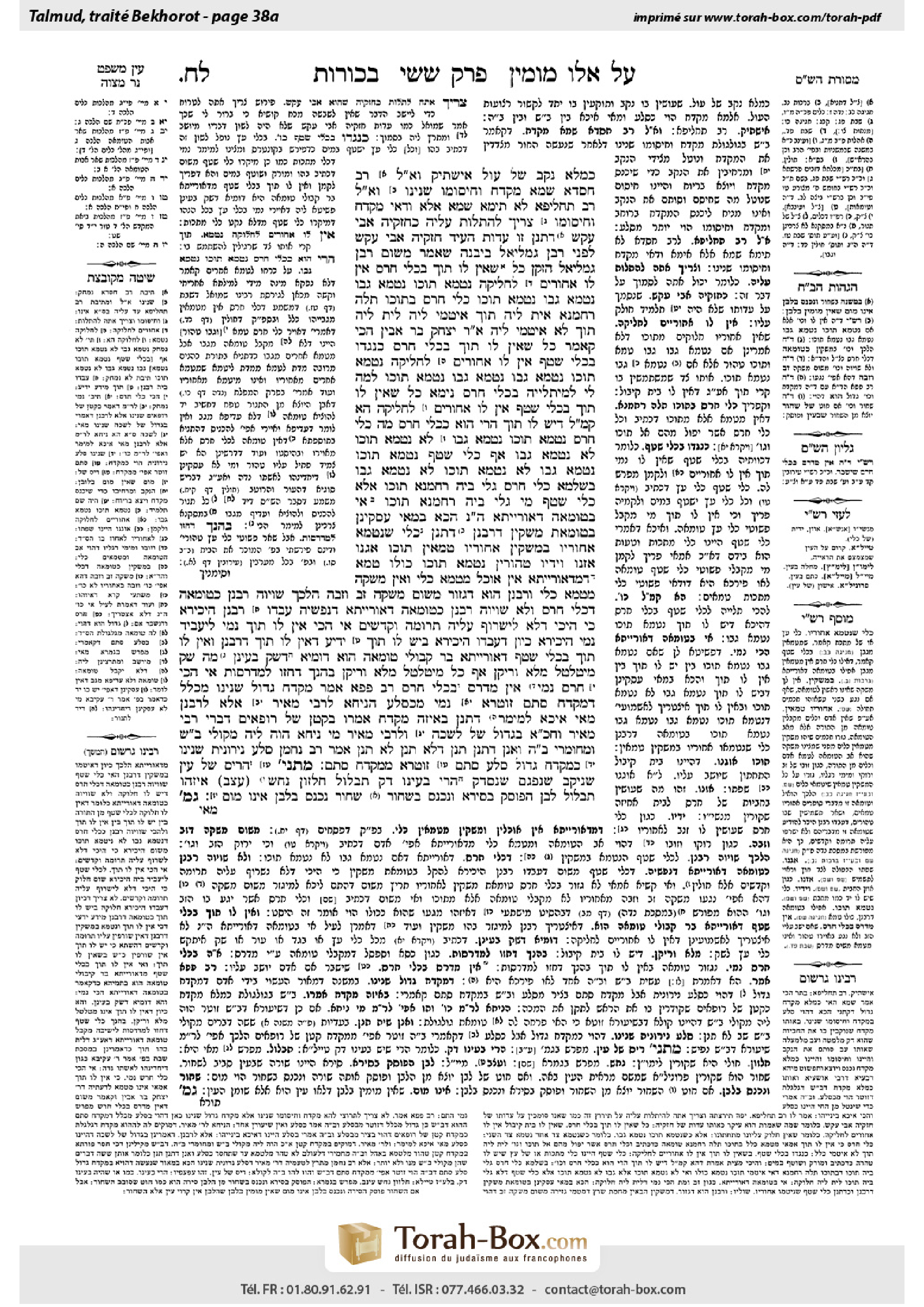
Bekhorot 38a: Talmud study for Daf Yomi
Study the Talmud for Daf Yomi with scanned pages, Hebrew text, English translations from Sefaria and AI-generated French translations.
Passage selection and English or AI-generated French translation are available where the scan has annotations. Daf Study is independent of Torah-Box and Sefaria.
Browse Bekhorot · בכורות · All tractatesBekhorot 38a text and translations
This page of Bekhorot includes the Aramaic text, an English translation and an AI-generated French translation, alongside the scan above.
בכורות ל״ח א · Aramaic and Hebrew text
כִּמְלֹא נֶקֶב שֶׁל עוֹל! אִישְׁתִּיק, וְאָמַר לֵיהּ רַב חִסְדָּא: שֶׁמָּא מַקְדֵּחַ וְחִיסּוּמוֹ שָׁנִינוּ.
וַאֲמַר לֵיהּ רַב תַּחְלִיפָא: לָא תֵּימָא שֶׁמָּא, אֶלָּא וַדַּאי מַקְדֵּחַ וְחִיסּוּמוֹ, צָרִיךְ לְהִתָּלוֹת עָלֶיהָ כְּחִזְקִיָּה אֲבִי עִקֵּשׁ.
דִּתְנַן: זוֹ עֵדוּת הֵעִיד חִזְקִיָּה אֲבִי עִקֵּשׁ לִפְנֵי רַבָּן גַּמְלִיאֵל בְּיַבְנֶה, שֶׁאָמַר מִשּׁוּם רַבָּן גַּמְלִיאֵל הַזָּקֵן: כֹּל שֶׁאֵין לוֹ תּוֹךְ בִּכְלִי חֶרֶס — אֵין לוֹ אֲחוֹרַיִם לַחֲלִיקָה. נִטְמָא תּוֹכוֹ — נִטְמָא גַּבּוֹ, נִטְמָא גַּבּוֹ — נִטְמָא תּוֹכוֹ.
כְּלִי חֶרֶס, בְּתוֹכוֹ תְּלָה רַחֲמָנָא — אִית לֵיהּ תּוֹךְ — אִיטַּמִּי לֵיהּ, לֵית לֵיהּ תּוֹךְ — לָא אִיטַּמִּי לֵיהּ!
אָמַר רַבִּי יִצְחָק בַּר אָבִין: הָכִי קָאָמַר, כֹּל שֶׁאֵין לוֹ תּוֹךְ בִּכְלִי חֶרֶס — כְּנֶגְדּוֹ בִּכְלִי שֶׁטֶף אֵין לוֹ אֲחוֹרַיִם לַחֲלִיקָה, נִטְמָא תּוֹכוֹ — נִטְמָא גַּבּוֹ, נִטְמָא גַּבּוֹ — נִטְמָא תּוֹכוֹ.
לְמָה לִי לְמִיתְלְיֵיהּ בִּכְלִי חֶרֶס? נֵימָא: כֹּל שֶׁאֵין לוֹ תּוֹךְ בִּכְלִי שֶׁטֶף — אֵין לוֹ אֲחוֹרַיִם לַחֲלִיקָה!
הָא קָא מַשְׁמַע לַן, דְּיֵשׁ לוֹ תּוֹךְ — הֲרֵי הוּא כִּכְלִי חֶרֶס; מָה כְּלִי חֶרֶס, נִטְמָא תּוֹכוֹ — נִטְמָא גַּבּוֹ, לֹא נִטְמָא תּוֹכוֹ — לֹא נִטְמָא גַּבּוֹ; אַף כְּלִי שֶׁטֶף, נִטְמָא תּוֹכוֹ — נִטְמָא גַּבּוֹ, לֹא נִטְמָא תּוֹכוֹ — לֹא נִטְמָא גַּבּוֹ.
בִּשְׁלָמָא כְּלִי חֶרֶס, גַּלִּי בֵּיהּ רַחֲמָנָא ״תּוֹכוֹ״, אֶלָּא כְּלִי שֶׁטֶף, מִי גַּלִּי בֵּיהּ רַחֲמָנָא תּוֹכוֹ?
אִי בְּטוּמְאָה דְּאוֹרָיְיתָא — הָכִי נָמֵי, הָכָא בְּמַאי עָסְקִינַן? בְּטוּמְאַת מַשְׁקִין דְּרַבָּנַן, דִּתְנַן: כְּלִי שֶׁנִּטְמָא אֲחוֹרָיו בְּמַשְׁקִין — אֲחוֹרָיו טְמֵאִין, תּוֹכוֹ אׇגְנוֹ אׇזְנוֹ וְיָדָיו טְהוֹרִין, נִטְמָא תּוֹכוֹ — כּוּלּוֹ טָמֵא.
מִדְּאוֹרָיְיתָא, אֵין אוֹכֶל מְטַמֵּא כְּלִי, וְאֵין מַשְׁקֶה מְטַמֵּא כְּלִי, וְרַבָּנַן הוּא דִּגְזוּר מִשּׁוּם מַשְׁקֵה זָב וְזָבָה.
הִלְכָּךְ, שַׁוְּיוּהּ רַבָּנַן כְּטוּמְאָה דִּכְלִי חֶרֶס, וְלָא שַׁוְּיוּהּ רַבָּנַן כְּטוּמְאָה דְּאוֹרָיְיתָא דְּנַפְשֵׁיהּ.
עֲבַדוּ רַבָּנַן הֶיכֵּירָא, כִּי הֵיכִי דְּלָא לִישְׂרוֹף עֲלֵיהּ תְּרוּמָה וְקָדָשִׁים. אִי הָכִי, אֵין לוֹ תּוֹךְ נָמֵי, לֶיעְבֵּיד נָמֵי הֶיכֵּירָא!
כֵּיוָן דַּעֲבַדוּ הֶיכֵּירָא בְּיֵשׁ לוֹ תּוֹךְ, יְדִיעַ דְּאֵין לוֹ תּוֹךְ דְּרַבָּנַן.
וְאֵין לוֹ תּוֹךְ בִּכְלִי שֶׁטֶף, דְּאוֹרָיְיתָא בַּר קַבּוֹלֵי טוּמְאָה הוּא? דּוּמְיָא דְּשַׂק בָּעֵינַן, מָה שַׂק מִיטַּלְטֵל מָלֵא וְרֵיקָן, אַף כֹּל מִיטַּלְטֵל מָלֵא וְרֵיקָן.
בְּהָנָךְ דַּחֲזוּ לְמִדְרָסוֹת. אִי הָכִי, חֶרֶס נָמֵי! אֵין מִדְרָס בִּכְלִי חֶרֶס.
רַב פָּפָּא אָמַר: מַקְדֵּחַ גָּדוֹל שָׁנִינוּ.
מִכְּלָל דְּמַקְדֵּחַ סְתָם זוּטַרא נָמֵי מִכְּסֶלַע. הָנִיחָא לְרַבִּי מֵאִיר, אֶלָּא לְרַבָּנַן מַאי אִיכָּא לְמֵימַר?
דִּתְנַן: בְּאֵיזֶה מַקְדֵּחַ אָמְרוּ? בְּקָטָן שֶׁל רוֹפְאִים, דִּבְרֵי רַבִּי מֵאִיר. וַחֲכָמִים אוֹמְרִים: בְּגָדוֹל שֶׁל לִשְׁכָּה.
וּלְרַבִּי מֵאִיר, מִי נִיחָא? הָוֵה לֵיהּ מִקּוּלֵּי בֵּית שַׁמַּאי וּמֵחוּמְרֵי בֵּית הִלֵּל. וַאֲנַן דִּתְנַן — תְּנַן, דְּלָא תְּנַן — לָא תְּנַן!
אָמַר רַב נַחְמָן: סֶלַע נִירוֹנִית שָׁנִינוּ, כְּמַקְדֵּחַ גָּדוֹל, סֶלַע סְתָם זוּטַרא מִמַּקְדֵּחַ סְתָם.
מַתְנִי׳ הָרִיס שֶׁל עַיִן שֶׁנִּיקַּב, שֶׁנִּפְגַּם, שֶׁנִּסְדַּק, הֲרֵי בְּעֵינוֹ דַּק, תְּבַלּוּל, חִלָּזוֹן, נָחָשׁ, עָצָב. אֵיזֶהוּ תְּבַלּוּל? לָבָן הַפּוֹסֵק בַּסִּירָא וְנִכְנָס בַּשָּׁחוֹר. שָׁחוֹר נִכְנַס בַּלָּבָן — אֵינוֹ מוּם.
Bekhorot 38a · English translation
like the size of the hole of a yoke of an animal. Evidently, the measure of the drilled hole stipulated by Beit Shammai with regard to a deficient skull equals the size of a sela coin stipulated by Beit Hillel according to the statement of Rav Taḥlifa. The Gemara relates: Rav Taḥlifa was silent. And Rav Ḥisda said to him: Perhaps we learned that Beit Shammai did not mean the size of a drilled hole alone, but rather the size of a drilled hole and its obstruction, i.e., a hole that allows for the drill to be inserted and removed. This is slightly larger than the sela mentioned by Beit Hillel.
And Rav Taḥlifa said to him: Do not say: Perhaps. Rather, say: Beit Shammai definitely was referring to the size of a drilled hole and its obstruction, and you can rely on this explanation since it is certainly correct, as certain as the testimony of Ḥizkiyya, the father of Ikkesh, which is uncontested. It can be derived from here that just as the phrase: Size of a drilled hole, is referring to the size of a hole into which the drill can be inserted and removed, so too, the size of a bitter vetch mentioned in the mishna is referring to a hole into which the bitter vetch can be inserted and removed.
§ The Gemara explains the reference to the testimony of Ḥizkiyya the father of Ikkesh. As we learned in a baraita that Ḥizkiyya, the father of Ikkesh, testified this testimony before Rabban Gamliel in Yavne, which he said in the name of Rabban Gamliel the Elder: With regard to earthenware vessels, any vessel that does not have a receptacle has no distinction with regard to the halakhic status of its sides. This is in contrast to the earthenware vessels mentioned in the Torah, where only the inside, and not the outside, is susceptible to ritual impurity. Rather, if its inside, i.e., the sides that are used, became impure, its outside also becomes impure. Likewise, if its outside became impure, its inside also becomes impure.
The Gemara challenges: With regard to an earthenware vessel, the Merciful One rendered its susceptibility to impurity dependent on the presence of a receptacle, as it states: “And every earthen vessel into whose interior any of them falls” (Leviticus 11:33). Consequently, if there is a receptacle, it will become impure, but if there is no receptacle, it should not become impure.
Rabbi Yitzḥak bar Avin said in response: The testimony is not referring to earthenware vessels, but to vessels that are purified through immersion in a ritual bath, such as wooden vessels, which are susceptible to ritual impurity even if they lack a receptacle. Accordingly, this is what the tanna is saying: With regard to earthenware vessels, any vessel that does not have a receptacle never becomes impure. The halakha in the corresponding case with regard to a vessel that is purified though rinsing, i.e., immersion in a ritual bath, where it lacks a receptacle, is that there is no distinction with regard to the halakhic status of its sides. Therefore, if its inside, i.e., the side that is used, became impure, its outside also becomes impure. Likewise, if its outside became impure, its inside also becomes impure.
The Gemara asks: Why do I need to render this halakha dependent on an earthenware vessel? Let us simply say: With regard to a vessel that is purified though rinsing, any vessel that does not have a receptacle has no distinction with regard to the halakhic status of its sides.
The Gemara answers: This association teaches us that if the vessel that is purified through rinsing has a receptacle, it is like an earthenware vessel. Therefore, just as in the case of an earthenware vessel, if its inside became impure, its outside also becomes impure, but if its inside did not become impure, its outside does not become impure, so too, with regard to a vessel that is purified through rinsing, if its inside became impure, its outside becomes impure. But if its inside did not become impure, its outside does not become impure.
The Gemara asks: Granted that with regard to an earthenware vessel, the Merciful One revealed that it is rendered ritually impure only if the impure item fell into its “inside” (see Leviticus 11:33). But with regard to a vessel that is purified though rinsing, did the Merciful One reveal with regard to it that it becomes impure only through its inside? Therefore, even if the impure item touched the outside, it should become entirely impure.
The Gemara answers: If it is referring to ritual impurity that is by Torah law, then indeed a vessel that is purified through rinsing can be become impure even through its outside. But here we are dealing with the ritual impurity of liquids, i.e., liquids that became impure and subsequently touched the vessel, which becomes impure only by rabbinic law. As we learned in a mishna (Kelim 25:6): With regard to a vessel whose outside became ritually impure by contact with impure liquids, only its outside is impure, but its inside, its rim, its ear-shaped handle, and its straight handle are pure. If its inside became impure, it becomes impure in its entirety.
The Gemara explains the reason: By Torah law, food does not transmit impurity to a vessel, and a liquid does not transmit impurity to a vessel. And it was the Sages who decreed that an impure liquid transmits impurity to a vessel, because of the concern that people will be lenient with regard to the liquid of a zav and a zava, such as their urine or saliva, which are a primary source of impurity and impart impurity to vessels.
Therefore, the Sages deemed the impurity of a vessel that is purified though rinsing whose outside became impure through liquid to be like the impurity of an earthenware vessel, and if its exterior became impure, its interior remains pure. But the Sages did not deem its impurity like the impurity of itself, i.e., a vessel that is purified through rinsing, by Torah law, that if its exterior became impure, the vessel becomes impure in its entirety.
The reason for this is that through this ruling the Sages employed an indicator that it is impure only by rabbinic law so that people will not burn teruma and consecrated items due to having come into contact with those vessels, as by Torah law they are ritually pure and it is prohibited to burn them. The Gemara asks: If so, that this is the case under discussion, then with regard to a vessel that is purified through rinsing that has no receptacle as well, the Sages should employ an indicator. They should rule that the inside remains pure so that teruma and consecrated items will not be burned after coming in contact with it. Why then did Ḥizkiyya, the father of Ikkesh, testify that if its outside became impure, its inside becomes impure as well?
The Gemara answers: Since the Sages employed an indicator with regard to vessels that are purified through rinsing that have a receptacle, it is thereby known that the impurity of a vessel that does not have a receptacle that comes in contact with an impure liquid is by rabbinic law. Therefore, no one will burn teruma and consecrated items that came in contact with it.
The Gemara asks: And with regard to a vessel that is purified through rinsing, is it susceptible to ritual impurity by Torah law, so that the Sages found it necessary to decree that the exterior is susceptible to impurity of liquids? After all, in order for a vessel to be susceptible to impurity it is required to be similar to a sack, which is mentioned with regard to ritual impurity (see Leviticus 11:32): Just as a sack is carried both full and empty, so too, any object must be capable of being carried both full and empty in order to become ritually impure. This excludes a vessel that has no receptacle and cannot be carried full.
The Gemara answers that it is referring to these vessels that are suited for sitting and are susceptible to ritual impurity imparted by treading, i.e., the ritual impurity imparted by a zav, zava, or a menstruating woman who sits or lies down on an item, even though it lacks a receptacle. The Gemara challenges: If so, with regard to an earthenware vessel that has no inside, the Rabbis should also decree that it is susceptible to the impurity of liquids if it is fit for sitting. The Gemara answers: There is no ritual impurity imparted by treading with regard to earthenware vessels.
§ The Gemara returns to the matter of an incomplete skull. According to the opinion of Beit Shammai, if the skull is missing a piece of bone the size of a drilled hole, it does not impart impurity. According to Shmuel, Beit Hillel holds that it must be missing a piece the size of a sela coin. If so, there would be no disagreement between Beit Shammai and Beit Hillel, as it was taught with regard to a window that imparts ritual impurity that a drilled hole is the same size as a sela coin. The Gemara now offers an additional answer: Rav Pappa says that it was with regard to a large drill that we learned that the minimum size of a window that imparts impurity equals the size of a sela coin.
The Gemara comments that by inference, the unspecified drill mentioned in the statement of Beit Shammai with regard to an incomplete skull is also smaller than the size of a sela coin mentioned by Beit Hillel. The Gemara asks: This works out well according to the explanation of Rabbi Meir for the opinion of Beit Shammai. But according to the opinion of the Rabbis, what is there to say?
As we learned in a mishna (Oholot 2:3): With regard to which drill did Beit Shammai state their opinion concerning an incomplete skull? It was with regard to a small drill of doctors, used for drilling bones. This is the statement of Rabbi Meir. And the Rabbis say: It was with regard to a large drill, such as that used in the Temple chamber. According to the mishna concerning a window that imparts impurity, the size of this drill is like that of a sela coin, and the opinions of Beit Shammai and Beit Hillel would still be identical.
The Gemara asks further: And even according to the opinion of Rabbi Meir, does it work out well? If the unspecified drill mentioned by Beit Shammai is smaller than a sela coin, then this is an instance of the leniencies of Beit Shammai and of the stringencies of Beit Hillel, as with regard to a skull that was missing a piece only the size of a drilled hole, Beit Shammai are lenient and hold that it does not impart impurity in a tent, while Beit Hillel do consider it impure. And we have a principle: That which we learned in the mishna in tractate Eduyyot pertaining to the leniencies of Beit Shammai and the stringencies of Beit Hillel, we learned, and that which we did not learn there, we did not learn. Therefore, in all other cases, Beit Shammai are stringent and Beit Hillel are lenient.
Rav Naḥman says: It is specifically with regard to a sela of the emperor Nero that we learned in the mishna concerning a window that imparts impurity that it is like the size of a large drilled hole. But with regard to the unspecified sela coin mentioned by Beit Hillel as the measure, it is even smaller than an unspecified drilled hole. Therefore, Beit Shammai are stringent even according to the opinion of Rabbi Meir.
MISHNA: For these blemishes of the eye, one may slaughter the firstborn animal outside the Temple: The eyelid that was pierced, an eyelid that was damaged and is lacking, or an eyelid that was split; and likewise, one may slaughter a firstborn animal outside the Temple if there was in his eye a cataract, a tevallul, or a growth in the shape of a snail, a snake, or a berry that covers the pupil. What is a tevallul? It is a white thread that bisects the iris and enters the black pupil. If it is a black thread that bisects the iris and enters the white of the eye it is not a blemish.
Bekhorot 38a · Traduction française (IA)
comme la taille du trou d'un joug d'animaux. Évidemment, la mesure du trou percé prescrite par Beit Shammai concernant un crâne déficient est égale à la taille d'une pièce de monnaie sela prescrite par Beit Hillel selon la déclaration de Rav Taḥlifa. La Guemara rapporte : Rav Taḥlifa était muet. Et Rav Ḥisda a dit à lui : Peut-être avons-nous appris que Beit Shammai n'entendait pas la taille du trou percé seul, mais plutôt la taille du trou percé et de son obstruation, c'est-à-dire un trou permettant d'insérer et de retirer le foret. Cela est légèrement plus grand que la sela mentionnée par Beit Hillel.
Et Rav Taḥlifa a dit à lui : N'exprime pas : Peut-être. Plutôt, dis : Beit Shammai faisait certainement référence à la taille du trou percé et de son obstruation, et tu peux compter sur cette explication, car elle est certainement correcte, aussi certain que le témoignage de Ḥizkiyya, le père d'Ikkesh, qui est incontesté. On peut en déduire ici que justement, la phrase : taille du trou percé, fait référence à la taille d'un trou dans lequel on peut insérer et retirer le foret, de même, la taille du bétail amarant mentionné dans la Michna fait référence à un trou dans lequel on peut insérer et retirer le bétail amarant.
§ La Guemara explique la référence au témoignage de Ḥizkiyya, le père d'Ikkesh. Comme nous avons appris dans une baraïta que Ḥizkiyya, le père d'Ikkesh, a témoigné ce témoignage devant Rabban Gamliel à Yavne, que celui-ci a dit en nom de Rabban Gamliel le Vieux : Concernant les récipients en terre, tout récipient qui n'a pas un récipient n'a pas de distinction concernant le statut halakhique de ses côtés. Cela est contraire aux récipients en terre mentionnés dans la Torah, où seul l'intérieur, et non l'extérieur, est susceptible de souillure rituelle. Plutôt, si son intérieur, c'est-à-dire les côtés utilisés, est devenu souillé, son extérieur devient également souillé. De même, si son extérieur est devenu souillé, son intérieur devient également souillé.
La Guemara soulève un défi : Concernant un récipient en terre, le Merciieux a rendu sa susceptibilité à la souillure dépendante de la présence d'un récipient, comme il est dit : « Et tout récipient en terre dans lequel tombe l'un d'eux » (Lévitique 11:33). Ainsi, s'il y a un récipient, il devient souillé, mais s'il n'y a pas de récipient, il ne devrait pas devenir souillé.
Rabbi Yitzḥak bar Avin a répondu : Le témoignage ne fait pas référence aux récipients en terre, mais aux récipients purifiés par l'immersion, tels que les récipients en bois, qui sont susceptibles de souillure rituelle même s'ils n'ont pas de récipient. Ainsi, c'est ce que le tanna dit : Concernant les récipients en terre, tout récipient qui n'a pas de récipient ne devient jamais souillé. La halakha concernant un récipient purifié par l'immersion, c'est-à-dire un récipient qui n'a pas de récipient, est que l'on ne fait pas de distinction concernant le statut halakhique de ses côtés. Ainsi, si son intérieur, c'est-à-dire le côté utilisé, est devenu souillé, son extérieur devient également souillé. De même, si son extérieur est devenu souillé, son intérieur devient également souillé.
La Guemara pose une question : Pourquoi ai-je besoin de rendre cette halakha dépendante d'un récipient en terre ? Laissons-nous simplement dire : Concernant un récipient purifié par l'immersion, tout récipient qui n'a pas de récipient n'a pas de distinction concernant le statut halakhique de ses côtés.
La Guemara répond : Cette association nous apprend que si le récipient purifié par l'immersion possède un récipient, il est considéré comme un récipient en terre. Ainsi, justement, dans le cas d'un récipient en terre, si son intérieur est devenu souillé, son extérieur devient également souillé, mais si son intérieur n'est pas devenu souillé, son extérieur ne devient pas non plus souillé. De même, concernant un récipient purifié par l'immersion, si son intérieur est devenu souillé, son extérieur devient souillé. Mais si son intérieur n'est pas devenu souillé, son extérieur ne devient pas non plus souillé.
La Guemara pose une question : Cela étant dit, concernant un récipient en terre, l'Éternel a révélé que la souillure dépend de l'entrée dans son « intérieur » (cf. Lévitique 11:33). Mais concernant un récipient purifié par l'immersion, l'Éternel a-t-il révélé qu'il devient souillé uniquement par son intérieur ? Ainsi, même si l'objet souillé a touché l'extérieur, il devrait devenir entièrement souillé.
La Guemara répond : Si cela fait référence à la souillure rituelle selon la Loi, alors effectivement un récipient purifié par l'immersion peut devenir souillé même par son extérieur. Mais ici nous traitons de la souillure des liquides, c'est-à-dire des liquides devenus souillés et qui ont touché le récipient, qui devient souillé uniquement selon la loi rabbinique. Comme nous avons appris dans une Michna (Kelim 25:6) : Concernant un récipient dont l'extérieur est devenu souillé par contact avec des liquides souillés, seul l'extérieur est souillé, mais l'intérieur, son bord, son manche en forme d'oreille et son manche droit sont purs. Si son intérieur est devenu souillé, il devient entièrement souillé.
La Guemara explique la raison : Selon la Loi halakhique, la nourriture ne transmet pas la souillure à un récipient, et le liquide ne transmet pas la souillure à un récipient. Et c'est les Sages qui ont décrété que le liquide souillé transmet la souillure à un récipient, en raison de la crainte que les gens soient indulgents concernant le liquide d'un zav et d'une zava, tels que leur urine ou leur salive, qui sont une source principale de souillure et transmettent la souillure aux récipients.
Ainsi, les Sages ont jugé que la souillure d'un récipient purifié par l'immersion dont l'extérieur est devenu souillé par un liquide est comme la souillure d'un récipient en terre, et si son extérieur est devenu souillé, son intérieur reste pur. Mais les Sages n'ont pas jugé sa souillure comme la souillure de lui-même, c'est-à-dire un récipient purifié par l'immersion, selon la Loi, que si son extérieur est devenu souillé, le récipient devient entièrement souillé.
La raison en est que par cette décision, les Sages ont utilisé un indicateur selon lequel il est impur uniquement selon la loi rabbinique, afin que les gens ne brûlent pas la terouma et les objets consacrés en raison de leur contact avec ces vases, car selon la loi de la Torah, ils sont rituellement purs et il est interdit de les brûler. La Guemara pose la question : Si c’est le cas, alors concernant un vase qui est purifié par le rinçage et qui n’a pas de récipient, les Sages devraient utiliser un indicateur. Ils devraient décider que l’intérieur reste pur afin que la terouma et les objets consacrés ne soient pas brûlés après avoir été en contact avec lui. Pourquoi alors témoignait Ḥizkiyya, le père d’Ikkesh, que si son extérieur devient impur, son intérieur devient impur également ?
La Guemara répond : Puisque les Sages ont utilisé un indicateur concernant les vases qui sont purifiés par le rinçage et qui ont un récipient, il est ainsi connu que l’impureté d’un vase qui n’a pas de récipient et qui entre en contact avec un liquide impur est selon la loi rabbinique. Par conséquent, personne ne brûlera la terouma et les objets consacrés qui ont été en contact avec lui.
La Guemara pose la question : Et concernant un vase qui est purifié par le rinçage, est-il susceptible d’impureté rituelle selon la loi de la Torah, de sorte que les Sages ont jugé nécessaire de décréter que l’extérieur est susceptible d’impureté des liquides ? En effet, afin qu’un vase soit susceptible d’impureté, il faut qu’il soit semblable à une sac, mentionné concernant l’impureté rituelle (voir Lévitique 11:32) : Comme on transporte une sac vide ou plein, ainsi aussi tout objet doit être capable d’être transporté vide ou plein afin d’être rituellement impur. Cela exclut un vase qui n’a pas de récipient et ne peut être transporté plein.
La Guemara répond qu’il s’agit de ces vases adaptés à la pose et susceptibles d’être souillés par la marche, c’est-à-dire l’impureté rituelle transmise par un zav, une zava ou une femme en menstruation qui s’assoit ou se couche sur un objet, même s’il manque un récipient. La Guemara conteste : Si c’est le cas, concernant un vase en terre qui n’a pas d’intérieur, les Rabbins devraient aussi décréter qu’il est susceptible d’impureté des liquides s’il est adapté à la pose. La Guemara répond : Il n’y a pas d’impureté rituelle transmise par la marche concernant les vases en terre.
§ La Guemara revient à la question du crâne incomplet. Selon l’opinion de Beit Shammai, si le crâne manque une pièce de os de la taille d’un trou percé, il ne transmet pas l’impureté. Selon Shmuel, Beit Hillel considère qu’il doit manquer une pièce de la taille d’une monnaie de sela. Si c’est le cas, il n’y aurait pas de désaccord entre Beit Shammai et Beit Hillel, car il a été enseigné concernant une fenêtre qui transmet l’impureté que le trou percé est de la taille d’une monnaie de sela. La Guemara propose maintenant une autre réponse : Rav Pappa dit que c’était concernant un perceur grand que nous avons appris que la taille minimale d’une fenêtre qui transmet l’impureté est égale à la taille d’une monnaie de sela.
La Guemara commente que par déduction, le perceur indéterminé mentionné dans l’affirmation de Beit Shammai concernant un crâne incomplet est aussi plus petit que la taille d’une monnaie de sela mentionné par Beit Hillel. La Guemara pose la question : Cela s’aligne bien selon l’explication de Rabbi Meir pour l’opinion de Beit Shammai. Mais selon l’opinion des Rabbins, que dire ?
Comme nous avons appris dans une mitsva (Oholot 2:3) : Concernant quel perceur Beit Shammai a-t-il exprimé son opinion concernant un crâne incomplet ? C’était concernant un perceur utilisé par les médecins, petit, pour percer les os. C’est l’affirmation de Rabbi Meir. Et les Rabbins disent : C’était concernant un perceur grand, tel que celui utilisé dans la chambre du Temple. Selon la mitsva concernant une fenêtre qui transmet l’impureté, la taille de ce perceur est comme celle d’une monnaie de sela, et les opinions de Beit Shammai et de Beit Hillel restent identiques.
La Guemara pose une question supplémentaire : Et même selon l’opinion de Rabbi Meir, cela s’aligne-t-il bien ? Si le perceur indéterminé mentionné par Beit Shammai est plus petit qu’une monnaie de sela, alors c’est un cas des leniencies de Beit Shammai et des stringences de Beit Hillel, car concernant un crâne qui manque une pièce seulement de la taille d’un trou percé, Beit Shammai sont leniants et considèrent qu’il ne transmet pas l’impureté dans une tente, tandis que Beit Hillel le considèrent comme impur. Et nous avons un principe : Ce que nous avons appris dans la mitsva du traité Eduyyot concernant les leniencies de Beit Shammai et les stringences de Beit Hillel, nous l’avons appris, et ce que nous n’avons pas appris là, nous ne l’avons pas appris. Par conséquent, dans tous les autres cas, Beit Shammai sont stricts et Beit Hillel sont leniants.
Rav Naḥman dit : C’est spécifiquement concernant une monnaie de l’empereur Nero que nous avons appris dans la mitsva concernant une fenêtre qui transmet l’impureté qu’elle est comme la taille d’un trou percé grand. Mais concernant la monnaie indéterminée mentionnée par Beit Hillel comme mesure, elle est même plus petite qu’un trou percé indéterminé. Par conséquent, Beit Shammai sont stricts même selon l’opinion de Rabbi Meir.
MICHNA : Concernant ces défauts des yeux, on peut sacrifier l’animal premier en dehors du Temple : le paupier percé, un paupier endommagé et manquant, ou un paupier fendu ; et de même, on peut sacrifier un animal premier en dehors du Temple si dans son œil il y avait un cataracte, un tevallul, ou une croissance en forme de limace, de serpent ou de baie qui recouvre le pupille. Qu’est-ce qu’un tevallul ? C’est un fil blanc qui traverse l’iris et entre dans le pupille noir. Si c’est un fil noir qui traverse l’iris et entre dans la partie blanche de l’œil, ce n’est pas un défaut.
Traduction française générée par IA à partir de l’édition anglaise de Sefaria. Vérifie toujours un passage avec le texte source.
Text from Sefaria: William Davidson Edition - Vocalized Aramaic (CC BY NC); William Davidson Edition - English (CC BY NC).