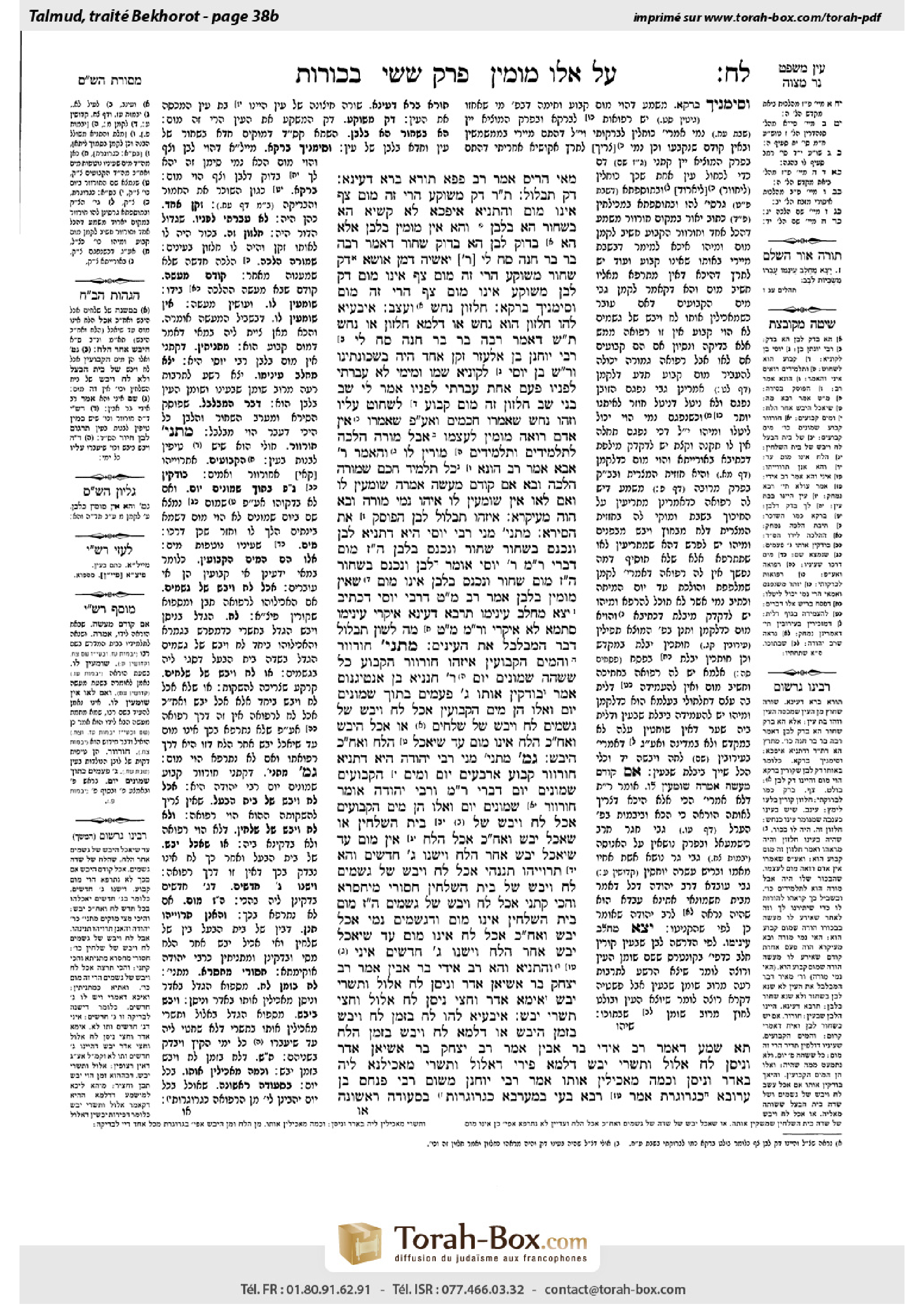
Bekhorot 38b: Talmud study for Daf Yomi
Study the Talmud for Daf Yomi with scanned pages, Hebrew text, English translations from Sefaria and AI-generated French translations.
Passage selection and English or AI-generated French translation are available where the scan has annotations. Daf Study is independent of Torah-Box and Sefaria.
Browse Bekhorot · בכורות · All tractatesBekhorot 38b text and translations
This page of Bekhorot includes the Aramaic text, an English translation and an AI-generated French translation, alongside the scan above.
בכורות ל״ח ב · Aramaic and Hebrew text
גְּמָ׳ מַאי הָרִיס? אָמַר רַב פָּפָּא: תּוֹרָא בָּרָא דְּעֵינָא. דַּק תְּבַלּוּל, תָּנוּ רַבָּנַן: דַּק מְשׁוּקָּע — הֲרֵי זֶה מוּם, צָף — אֵינוֹ מוּם.
וְהָתַנְיָא אִיפְּכָא! לָא קַשְׁיָא, הָא בַּשָּׁחוֹר הָא בַּלָּבָן. וְהָא: אֵין מוּמִין בַּלָּבָן! אֶלָּא, הָא בְּדוּק לָבָן, הָא בְּדוּק שָׁחוֹר.
דְּאָמַר רַבָּה בַּר בַּר חָנָה: סָח לִי יֹאשִׁיָּה דְּמִן אוּשָׁא: דַּק שָׁחוֹר מְשׁוּקָּע — הֲרֵי זֶה מוּם, צָף — אֵינוֹ מוּם. דַּק לָבָן מְשׁוּקָּע — אֵינוֹ מוּם, צָף — הֲרֵי זֶה מוּם, וְסִימָנָיךְ: בַּרְקָא.
חִלָּזוֹן נָחָשׁ וְעָצָב. אִיבַּעְיָא לְהוּ: חִלָּזוֹן הוּא נָחָשׁ, אוֹ דִלְמָא חִלָּזוֹן אוֹ נָחָשׁ?
תָּא שְׁמַע, דְּאָמַר רַבָּה בַּר בַּר חָנָה: סָח לִי רַבִּי יוֹחָנָן בֶּן אֶלְעָזָר, זָקֵן אֶחָד הָיָה בִּשְׁכוּנָתֵינוּ, וְרַבִּי שִׁמְעוֹן בֶּן יוֹסֵי לָקוֹנְיָא שְׁמוֹ, וּמִיָּמַי לֹא עָבַרְתִּי לְפָנָיו. פַּעַם אַחַת עָבַרְתִּי לְפָנָיו, אָמַר לִי: שֵׁב בְּנִי, שֵׁב. חִלָּזוֹן זֶה מוּם קָבוּעַ לִשְׁחוֹט עָלָיו, וְזֶהוּ נָחָשׁ שֶׁאָמְרוּ חֲכָמִים.
וְאַף עַל פִּי שֶׁאָמְרוּ: אֵין אָדָם רוֹאֶה מוּמִין לְעַצְמוֹ, אֲבָל מוֹרֶה הֲלָכָה לַתַּלְמִידִים, וְתַלְמִידִים מוֹרִין לוֹ.
וְהָאָמַר רַבִּי אַבָּא אָמַר רַב הוּנָא: כׇּל תַּלְמִיד חָכָם שֶׁמּוֹרֶה הֲלָכָה וּבָא, אִם קוֹדֶם מַעֲשֶׂה אֲמָרָהּ — שׁוֹמְעִין לוֹ, וְאִם לָאו — אֵין שׁוֹמְעִין לוֹ! אִיהוּ נָמֵי מוֹרֶה וּבָא הֲוָה מֵעִיקָּרָא.
אֵיזֶהוּ תְּבַלּוּל? לָבָן הַפּוֹסֵק אֶת הַסִּירָא. מַתְנִיתִין מַנִּי? רַבִּי יוֹסֵי הִיא, דְּתַנְיָא: לָבָן וְנִכְנָס בַּשָּׁחוֹר, שָׁחוֹר וְנִכְנָס בַּלָּבָן — הֲרֵי זֶה מוּם, דִּבְרֵי רַבִּי מֵאִיר. רַבִּי יוֹסֵי אוֹמֵר: לָבָן וְנִכְנָס בַּשָּׁחוֹר — הֲרֵי זֶה מוּם, שָׁחוֹר וְנִכְנָס בַּלָּבָן — אֵינוֹ מוּם, שֶׁאֵין מוּמִין בַּלָּבָן.
אָמַר רַב: מַאי טַעְמָא דְּרַבִּי יוֹסֵי? דִּכְתִיב: ״יָצָא מֵחֵלֶב עֵינֵימוֹ״, תַּרְבָּא דְּעֵינָא — אִיקְּרִי, ״עֵינֵימוֹ״ סְתָמָא — לָא אִיקְּרִי. וְרַבִּי מֵאִיר מַאי טַעְמֵיהּ? מָה לְשׁוֹן ״תְּבַלּוּל״? דָּבָר הַמְבַלְבֵּל אֶת הָעֵינַיִם.
מַתְנִי׳ חֲוַרְוָור וְהַמַּיִם הַקְּבוּעִין. אֵיזֶהוּ חֲוַרְוָור הַקָּבוּעַ? כֹּל שֶׁשָּׁהָה שְׁמוֹנִים יוֹם. רַבִּי חֲנַנְיָא בֶּן אַנְטִיגְנוֹס אֹמֵר: בּוֹדְקִין אוֹתוֹ שָׁלֹשׁ פְּעָמִים בְּתוֹךְ שְׁמוֹנִים יוֹם.
וְאֵלּוּ הֵן מַיִם הַקְּבוּעִין: אָכַל לַח וְיָבֵשׁ שֶׁל גְּשָׁמִים, לַח וְיָבֵשׁ שֶׁל שְׁלָחִים, אוֹ אָכַל הַיָּבֵשׁ וְאַחַר כָּךְ הַלַּח — אֵינוֹ מוּם, עַד שֶׁיֹּאכַל הַלַּח וְאַחַר כָּךְ הַיָּבֵשׁ.
גְּמָ׳ מַתְנִיתִין מַנִּי? רַבִּי יְהוּדָה הִיא, דְּתַנְיָא: חֲוַרְוָור קָבוּעַ — אַרְבָּעִים יוֹם, וּמַיִם הַקְּבוּעִים — שְׁמוֹנִים יוֹם, דִּבְרֵי רַבִּי מֵאִיר. וְרַבִּי יְהוּדָה אוֹמֵר: חֲוַרְוָור — שְׁמוֹנִים יוֹם.
וְאֵלּוּ הֵן מַיִם הַקְּבוּעִים: אָכַל לַח וְיָבֵשׁ שֶׁל בֵּית הַשְּׁלָחִין, אוֹ שֶׁאָכַל יָבֵשׁ וְאַחַר כָּךְ אָכַל הַלַּח — אֵין מוּם עַד שֶׁיֹּאכַל יָבֵשׁ אַחַר הַלַּח, וְיֶשְׁנוֹ שְׁלֹשָׁה חֳדָשִׁים.
וְהָא תַּרְוַיְיהוּ תְּנַנְהִי: אָכַל לַח וְיָבֵשׁ שֶׁל גְּשָׁמִים, לַח וְיָבֵשׁ שֶׁל בֵּית הַשְּׁלָחִין!
חַסּוֹרֵי מִיחַסְּרָא וְהָכִי קָתָנֵי: אָכַל לַח וְיָבֵשׁ שֶׁל גְּשָׁמִים — הֲרֵי זֶה מוּם, בֵּית הַשְּׁלָחִין — אֵינוֹ מוּם, וְהַגְּשָׁמִים נָמֵי, אָכַל יָבֵשׁ וְאַחַר כָּךְ אָכַל לַח — אֵינוֹ מוּם, עַד שֶׁיֹּאכַל יָבֵשׁ אַחַר הַלַּח.
וְיֶשְׁנוֹ שְׁלֹשָׁה חֳדָשִׁים. אִינִי? וְהָתַנְיָא — וְהָא רַב אִידִי בַּר אָבִין אָמַר רַב יִצְחָק בַּר אַשְׁיָאן: אֲדָר וְנִיסָן — לַח, אֱלוּל וְתִשְׁרִי — יָבֵשׁ! אֵימָא: אֲדָר וַחֲצִי נִיסָן — לַח, אֱלוּל וַחֲצִי תִשְׁרֵי — יָבֵשׁ.
אִיבַּעְיָא לְהוּ: לַח בִּזְמַן לַח, וְיָבֵשׁ בִּזְמַן הַיָּבֵשׁ, אוֹ דִלְמָא: לַח וְיָבֵשׁ בִּזְמַן הַלַּח?
תָּא שְׁמַע, דְּאָמַר רַב אִידִי בַּר אָבִין אָמַר רַב יִצְחָק בַּר אַשְׁיָאן: אֲדָר וְנִיסָן — לַח, אֱלוּל וְתִשְׁרִי — יָבֵשׁ. דִּלְמָא פֵּירֵי דֶּאֱלוּל וְתִשְׁרִי מַאֲכִילִנַן לֵיהּ בַּאֲדָר וְנִיסָן!
וְכַמָּה מַאֲכִילִין אוֹתוֹ? אָמַר רַבִּי יוֹחָנָן מִשּׁוּם רַבִּי פִּנְחָס בֶּן עָרוֹבָא: כִּגְרוֹגֶרֶת. אָמַר רָבָא: (בָּעֵי) [בָּעַן] בְּמַעְרְבָא: כִּגְרוֹגְרוֹת בִּסְעוּדָה רִאשׁוֹנָה,
Bekhorot 38b · English translation
GEMARA: The mishna’s list of blemishes of the eye included an eyelid [ris] that was pierced, damaged, or split. The Gemara asks: What is the meaning of: The ris? Rav Pappa says: It means the outer line, or barrier, of the eye, i.e., the eyelid. The mishna further stated: A cataract, a tevallul. With regard to a cataract, the Sages taught: A sunken cataract, i.e., one that is in the eye itself, is a blemish, but a floating cataract, i.e., one that is floating above the eye, is not a blemish.
The Gemara asks: But isn’t the opposite taught in a baraita, that a sunken cataract is not a blemish whereas a floating one is a blemish? The Gemara answers: That is not difficult, as this first baraita is referring to a cataract in the black portion of the eye, whereas that second baraita is referring to one in the white portion of the eye. The Gemara challenges: But it was taught that there are no blemishes in the white portion of the eye. Rather, both baraitot are referring to the black portion of the eye, and this second baraita is referring to a white cataract, whereas that first baraita is referring to a black cataract.
This is as Rabba bar bar Ḥana says: Yoshiya from Usha told me that with regard to a black cataract, if it is sunken it is a blemish, but if it is floating it is not a blemish. Conversely, with regard to a white cataract, if it is sunken it is not a blemish, whereas if it is floating it is a blemish. And your mnemonic to remember this is barka, which is a disease in which white patches float above the eye, and it is considered a blemish.
§ The mishna included in its list of blemishes of the eye a growth in the shape of a snail, a snake, or a berry that covers the pupil. A dilemma was raised before the Sages: Is the snail mentioned in the mishna the same as the snake, or perhaps they are two distinct blemishes, and the mishna means a snail or a snake?
The Gemara answers: Come and hear, as Rabba bar bar Ḥana says: Rabbi Yoḥanan ben Elazar told me: There was a certain elder in our neighborhood, and Rabbi Shimon ben Yosei Lakonya was his name, and in all my days I did not pass before him. But once I did pass before him, and he said to me: Sit, my son, sit, and I will teach you one matter: This snail that you see in the eye of a firstborn is a permanent blemish, and it is permitted to slaughter the animal on its account. And this is also the snake mentioned by the Sages as a blemish.
Rabbi Shimon ben Yosei Lakonya adds: And even though the Sages said that a person cannot see blemishes for himself, and therefore I cannot permit this firstborn to myself, even so a halakhic authority may issue a halakhic ruling to his students, and the students may then issue a halakhic ruling for him based on what he taught them. Consequently, once I have taught you this halakha, you may permit my firstborn to me due to this blemish.
The Gemara asks: How could Rabbi Yoḥanan ben Elazar permit the firstborn in this manner? But doesn’t Rabbi Abba say that Rav Huna says: With regard to any Torah scholar who is engaged in issuing a ruling of halakha in a situation relevant to himself, if he already stated the ruling before the incident, i.e., before it was relevant to him, one listens to him; and if not, i.e., the ruling followed the incident, one does not listen to him? The Gemara answers that he too, Rabbi Shimon ben Yosei Lakonya, was engaged in issuing this ruling of halakha at the outset, before it became relevant to him.
§ The mishna further stated: What is a tevallul? It is a white thread that bisects the iris and enters the black pupil. The Gemara asks: Whose opinion is expressed in the mishna? It is the opinion of Rabbi Yosei, as it is taught in a baraita: If there is either a white thread that enters the black, or a black thread that enters the white, it is a blemish; this is the statement of Rabbi Meir. Rabbi Yosei says: If it is a white thread that enters the black, it is a blemish, but if it is a black thread that enters the white, it is not a blemish, as there are no blemishes in the white of the eye.
Rav says: What is the reason of Rabbi Yosei? As it is written: “Their eyes stand forth from fatness” (Psalms 73:7), which is interpreted to mean that the wicked embark on an evil path due to the fatness in the eyes, which is in the white portion. This indicates that the white portion is called the fat of the eye, but it is not called simply: Their eyes. Conversely, a tevallul is considered a blemish only if it is in the eye itself, as it states: “Or tevallul in his eye” (Leviticus 21:20). The Gemara further asks: And with regard to Rabbi Meir, what is his reason? The Gemara answers that Rabbi Meir would explain as follows: What is the meaning of the expression tevallul? It is a substance that mixes [hamevalbel] within the eyes, i.e., which passes through the white and the black in any fashion.
MISHNA: Pale spots on the eye and tears streaming from the eye that are constant are blemishes that enable the slaughter of the firstborn. Which are the pale spots that are constant? They are any spots that persisted for eighty days. Rabbi Ḥananya ben Antigonus said: One examines it three times within eighty days. Only if the spots are found during all three examinations are they considered constant.
And these are the constant tears, i.e., this is how it is known whether the blemish is temporary or permanent: In a case where the animal ate, for medicinal purposes, moist fodder and dry fodder from a field watered exclusively with rain, or if the animal ate moist fodder and dry fodder from an irrigated field, or even if the animal did not eat them together but ate the dry fodder and thereafter ate the moist fodder, and the condition of constant tears was not healed, it is not a blemish. It is not a blemish unless the animal eats the moist fodder and thereafter eats the dry fodder and is not thereby healed.
GEMARA: The Gemara asks: Whose opinion is expressed in the mishna? It is the opinion of Rabbi Yehuda, as it is taught in a baraita: A blemish of constant pale spots is a condition that persisted for forty days, and constant tears is a condition that persisted for eighty days; this is the statement of Rabbi Meir. And Rabbi Yehuda says: A blemish of constant pale spots is a condition that persisted for eighty days.
The baraita continues: And these are the constant tears, according to the opinion of Rabbi Yehuda: In a case where the animal ate moist fodder and dry fodder from an irrigated field, or ate the dry fodder and thereafter ate the moist fodder, and the animal was not healed, its status as a blemish is not certain. It is not a blemish unless the animal eats the dry fodder after eating the moist fodder and is not thereby healed. And the duration of this period of eating moist and then dry fodder extends for three months.
The Gemara asks: But how can the mishna be in accordance with the opinion of Rabbi Yehuda? We learned about two types of fields in the mishna: A case where the animal ate moist fodder and dry fodder from a field watered exclusively with rain and a case where the animal ate moist fodder and dry fodder from an irrigated field and was not healed. In either case, it is not a blemish. By contrast, Rabbi Yehuda mentioned only moist fodder and dry fodder from a field that requires irrigation, from which it can be inferred that if the animal was fed moist fodder and dry fodder from a field watered exclusively with rain and it was not healed, its condition is a blemish.
The Gemara answers that the mishna is incomplete and this is what it is teaching, in accordance with the ruling of Rabbi Yehuda in the baraita: If the animal ate moist fodder and dry fodder from a field watered exclusively with rain, it is a blemish. If it ate moist fodder and dry fodder from an irrigated field, it is not a blemish. And with regard to a field watered exclusively with rain as well, if it ate the dry fodder and thereafter ate the moist fodder it is not a blemish. It is a not blemish until the animal eats the dry fodder after the moist fodder.
With regard to the statement of the baraita: And the duration of this period of eating moist and then dry fodder lasts for three months, the Gemara asks: Is that so? But isn’t it taught that Rav Idi bar Avin says that Rav Yitzḥak bar Ashiyan says: The months of Adar and Nisan are the moist period mentioned in the mishna, as the fodder is still moist at that time of year; and the months of Elul and Tishrei are the dry period, as this is the end of summer? In total, there are four months, not three. The Gemara answers that one should say as follows: The months of Adar and half of Nisan are the moist period, and the months of Elul and half of Tishrei are the dry period, for a total of three months.
With regard to the ruling of the mishna that the animal must be given moist fodder and then dry fodder, a dilemma was raised before the Sages: Does this mean it must be fed moist fodder at the time of moist fodder, i.e., at the end of the rainy season, and dry fodder at the time of dry fodder, at the conclusion of summer? Or perhaps it is fed moist fodder and then dry fodder leftover from the previous summer, both at the time of moist fodder.
The Gemara suggests: Come and hear, as Rav Idi bar Avin says that Rav Yitzḥak bar Ashiyan said: The months of Adar and Nisan are the period of moist fodder; Elul and Tishrei are the period of dry fodder. This indicates that the animal is given the fodder that is available at that time. The Gemara refutes this proof: That statement is not necessarily referring to the time when it is fed, as perhaps one feeds it the produce of Elul and Tishrei in Adar and Nisan.
The Gemara asks: And how much does one feed it? Rabbi Yoḥanan says in the name of Rabbi Pineḥas ben Arova: One feeds it the amount of a fig-bulk. Rava says: They raise a dilemma in the West, Eretz Yisrael: Does this mean that it is fed the amount of a fig-bulk at its first meal each day,
Bekhorot 38b · Traduction française (IA)
GUEMARA : La Michna liste les défauts de l'œil, y compris une paupière [ris] percée, endommagée ou fendue. La Guemara demande : Quelle est la signification de : le ris ? Rav Pappa dit : Cela signifie la ligne externe ou la barrière de l'œil, c'est-à-dire la paupière. La Michna précise également : une cataracte, un tevallul. Concernant la cataracte, les Sages enseignent : une cataracte enfoncée, c'est-à-dire celle qui est dans l'œil lui-même, est un défaut, mais une cataracte flottante, c'est-à-dire celle qui flotte au-dessus de l'œil, n'est pas un défaut.
La Guemara demande : Mais n'est-ce pas enseigné dans une baraïta contraire que la cataracte enfoncée n'est pas un défaut, tandis que la cataracte flottante est un défaut ? La Guemara répond : Ce n'est pas difficile, car cette première baraïta fait référence à une cataracte dans la partie noire de l'œil, tandis que cette seconde baraïta fait référence à une cataracte dans la partie blanche de l'œil. La Guemara conteste : Mais on a enseigné que les défauts ne sont pas présents dans la partie blanche de l'œil. Plutôt, les deux baraitot font référence à la partie noire de l'œil, et cette seconde baraïta fait référence à une cataracte blanche, tandis que cette première baraïta fait référence à une cataracte noire.
C'est ce que Rabba bar bar Ḥana dit : Yoshiya d'Usha m'a dit que concernant une cataracte noire, si elle est enfoncée, c'est un défaut, mais si elle flotte, ce n'en est pas un. À l'inverse, concernant une cataracte blanche, si elle est enfoncée, ce n'en est pas un, tandis que si elle flotte, c'est un défaut. Et votre mnémotechnique pour se souvenir de cela est barka, qui est une maladie où des taches blanches flottent au-dessus de l'œil, et qui est considérée comme un défaut.
§ La Michna inclut dans sa liste des défauts de l'œil une croissance en forme de limace, de serpent ou de baie qui recouvre la pupille. Un dilemme a été soulevé devant les Sages : La limace mentionnée dans la Michna est-elle la même que le serpent, ou peut-être sont-elles deux défauts distincts, et la Michna signifie une limace ou un serpent ?
La Guemara répond : Viens écouter, car Rabba bar bar Ḥana dit : Rabbi Yoḥanan ben Elazar m'a dit : Il y avait un vieillard dans notre quartier, et son nom était Rabbi Shimon ben Yosei Lakonya, et en tout mon temps je ne suis pas passé devant lui. Mais une fois, je suis passé devant lui, et il m'a dit : Assieds-toi, mon fils, assieds-toi, et je t'enseignerai une seule chose : Cette limace que tu vois dans l'œil d'un premier-né est un défaut permanent, et on peut sacrifier l'animal à cause d'elle. Et c'est aussi le serpent mentionné par les Sages comme un défaut.
Rabbi Shimon ben Yosei Lakonya ajoute : Et même si les Sages disent qu'une personne ne peut pas voir les défauts par elle-même, et donc je ne peux pas permettre ce premier-né à moi-même, même ainsi une autorité halakhique peut émettre un jugement halakhique à l'égard de ses élèves, et les élèves peuvent alors émettre un jugement halakhique à son sujet en se basant sur ce qu'il leur a enseigné. Ainsi, une fois que j'ai enseigné cette halakha à toi, tu peux permettre mon premier-né à moi-même à cause de ce défaut.
La Guemara demande : Comment Rabbi Yoḥanan ben Elazar a-t-il pu permettre le premier-né ainsi ? Mais n'est-ce pas Rabbi Abba qui dit que Rav Huna dit : Concernant tout savant de la Torah qui est engagé dans l'émission d'un jugement halakhique dans une situation pertinente à lui-même, si il a déjà énoncé le jugement avant l'incident, c'est-à-dire avant qu'il ne soit pertinent à lui, on l'écoute ; et si non, c'est-à-dire si le jugement est venu après l'incident, on ne l'écoute pas ? La Guemara répond que lui aussi, Rabbi Shimon ben Yosei Lakonya, était engagé dans l'émission de ce jugement halakhique dès le début, avant qu'il ne devienne pertinent à lui.
§ La Michna précise également : Qu'est-ce qu'un tevallul ? C'est un fil blanc qui traverse la pupille et entre dans la partie noire. La Guemara demande : Quel est l'avis exprimé dans la Michna ? C'est l'avis de Rabbi Yosei, car il est enseigné dans une baraïta : Si c'est un fil blanc qui entre dans la partie noire, ou un fil noir qui entre dans la partie blanche, c'est un défaut ; c'est l'opinion de Rabbi Meir. Rabbi Yosei dit : Si c'est un fil blanc qui entre dans la partie noire, c'est un défaut, mais si c'est un fil noir qui entre dans la partie blanche, ce n'est pas un défaut, car il n'y a pas de défaut dans la partie blanche de l'œil.
Rav dit : Quelle est la raison de Rabbi Yosei ? Comme il est écrit : « Leur regard s'élève en raison de leur graisse » (Psaumes 73:7), ce qui est interprété pour signifier que les méchants entreprennent un chemin mauvais en raison de la graisse dans les yeux, qui est dans la partie blanche. Cela indique que la partie blanche est appelée la graisse des yeux, mais elle n'est pas simplement appelée : leurs yeux. À l'inverse, un tevallul est considéré comme un défaut uniquement s'il est dans l'œil lui-même, car il est dit : « Ou tevallul dans son œil » (Lvïtique 21:20). La Guemara demande encore : Et concernant Rabbi Meir, quelle est sa raison ? La Guemara répond que Rabbi Meir expliquerait ainsi : Quelle est la signification de l'expression tevallul ? C'est une substance qui se mélange [hamevalbel] dans les yeux, c'est-à-dire qui passe à travers la partie blanche et la partie noire de toute façon.
MICHNA : Les taches pâles sur l'œil et les larmes qui coulent constamment sont des défauts qui permettent de sacrifier le premier-né. Quelles sont les taches pâles constantes ? Ce sont toutes les taches qui ont persisté pendant soixante-dix jours. Rabbi Ḥananya ben Antigonus dit : On examine cela trois fois en soixante-dix jours. Seulement si les taches sont trouvées lors des trois examens, elles sont considérées comme constantes.
Et ces sont les larmes constantes, c'est-à-dire c'est ainsi qu'on sait si le défaut est temporaire ou permanent : Dans le cas où l'animal a mangé, à des fins médicales, des foin humide et sec provenant d'un champ arrosé exclusivement par la pluie, ou si l'animal a mangé du foin humide et sec provenant d'un champ irrigué, ou même si l'animal n'a pas mangé les deux ensemble mais a mangé le foin sec et ensuite le foin humide, et la condition des larmes constantes n'a pas été guérie, ce n'est pas un défaut. Ce n'est pas un défaut à moins que l'animal mange le foin humide et ensuite le foin sec et ne soit pas guéri à cause de cela.
GUEMARA : La Guemara pose la question : Quelle est l'opinion exprimée dans la mitsva ? C'est l'opinion du Rabbi Yéhuda, comme il est enseigné dans une baraïta : Une tache constante de taches pâles est une condition persistant quarante jours, et des larmes constantes sont une condition persistant quatre-vingts jours ; c'est la déclaration du Rabbi Méïr. Et le Rabbi Yéhuda dit : Une tache constante de taches pâles est une condition persistant quatre-vingts jours.
La baraïta continue : Et ces sont les larmes constantes, selon l'opinion du Rabbi Yéhuda : Dans un cas où l'animal a mangé du foin humide et du foin sec provenant d'un champ arrosé exclusivement par la pluie, ou a mangé du foin sec et ensuite du foin humide, et l'animal n'a pas guéri, son statut de tache n'est pas certain. Ce n'est pas une tache à moins que l'animal ne mange d'abord le foin sec et ensuite le foin humide et ne soit ainsi guéri. Et la durée de cette période de consommation du foin humide puis du foin sec s'étend sur trois mois.
La Guemara pose la question : Mais comment la mitsva peut-elle être en conformité avec l'opinion du Rabbi Yéhuda ? Nous avons appris à propos de deux types de champs dans la mitsva : un cas où l'animal a mangé du foin humide et du foin sec provenant d'un champ arrosé exclusivement par la pluie et un cas où l'animal a mangé du foin humide et du foin sec provenant d'un champ irrigué et n'a pas guéri. Dans aucun cas, ce n'est pas une tache. À l'inverse, le Rabbi Yéhuda mentionne uniquement du foin humide et du foin sec provenant d'un champ nécessitant une irrigation, d'où il peut être inféré que si l'animal a été nourri du foin humide et du foin sec provenant d'un champ arrosé exclusivement par la pluie et n'a pas guéri, son état est une tache.
La Guemara répond que la mitsva est incomplète et c'est ce qu'elle enseigne, conformément à la décision du Rabbi Yéhuda dans la baraïta : Si l'animal a mangé du foin humide et du foin sec provenant d'un champ arrosé exclusivement par la pluie, c'est une tache. Si l'animal a mangé du foin humide et du foin sec provenant d'un champ irrigué, ce n'est pas une tache. Et concernant un champ arrosé exclusivement par la pluie également, si l'animal a mangé d'abord le foin sec et ensuite le foin humide, ce n'est pas une tache. C'est une tache seulement après que l'animal ait mangé d'abord le foin sec et ensuite le foin humide.
Concernant la déclaration de la baraïta : Et la durée de cette période de consommation du foin humide puis du foin sec dure trois mois, la Guemara pose la question : Est-ce ainsi ? Mais n'est-il pas enseigné que Rav Idi bar Avin dit que Rav Yitzhak bar Ashiyan dit : Les mois d'Adar et de Nisan sont la période de foin humide mentionnée dans la mitsva, car le foin est encore humide à cette époque de l'année ; et les mois d'Eloul et de Tishri sont la période de foin sec, car c'est la fin de l'été ? En total, il y a quatre mois, pas trois. La Guemara répond que l'on doit dire comme suit : Les mois d'Adar et la moitié de Nisan sont la période de foin humide, et les mois d'Eloul et la moitié de Tishri sont la période de foin sec, pour un total de trois mois.
Concernant la décision de la mitsva que l'animal doit être nourri du foin humide puis du foin sec, un dilemme a été soulevé devant les Sages : cela signifie-t-il qu'il doit être nourri du foin humide à l'époque du foin humide, c'est-à-dire à la fin de la saison des pluies, et du foin sec à l'époque du foin sec, à la fin de l'été ? Ou peut-être est-il nourri du foin humide et du foin sec restant de l'été précédent, tous deux à l'époque du foin humide.
La Guemara suggère : Viens écouter, comme Rav Idi bar Avin dit que Rav Yitzḥak bar Ashiyan a dit : Les mois d'Adar et de Nisan sont la période du foin humide ; Eloul et Tishri sont la période du foin sec. Cela indique que l'animal est nourri du foin disponible à cette époque. La Guemara réfute cette preuve : cette déclaration ne fait pas nécessairement référence à l'époque où il est nourri, car peut-être on nourrit l'animal avec les produits d'Eloul et de Tishri en Adar et en Nisan.
La Guemara pose la question : Et combien nourrit-on l'animal ? Le Rabbi Yochanan dit au nom du Rabbi Pinḥas ben Arova : On nourrit l'animal la quantité d'une figue. Rava dit : Ils soulevent un dilemme dans l'Ouest, Eretz Yisraël : cela signifie-t-il qu'on nourrit l'animal la quantité d'une figue à son premier repas de la journée,
Traduction française générée par IA à partir de l’édition anglaise de Sefaria. Vérifie toujours un passage avec le texte source.
Text from Sefaria: William Davidson Edition - Vocalized Aramaic (CC BY NC); William Davidson Edition - English (CC BY NC).