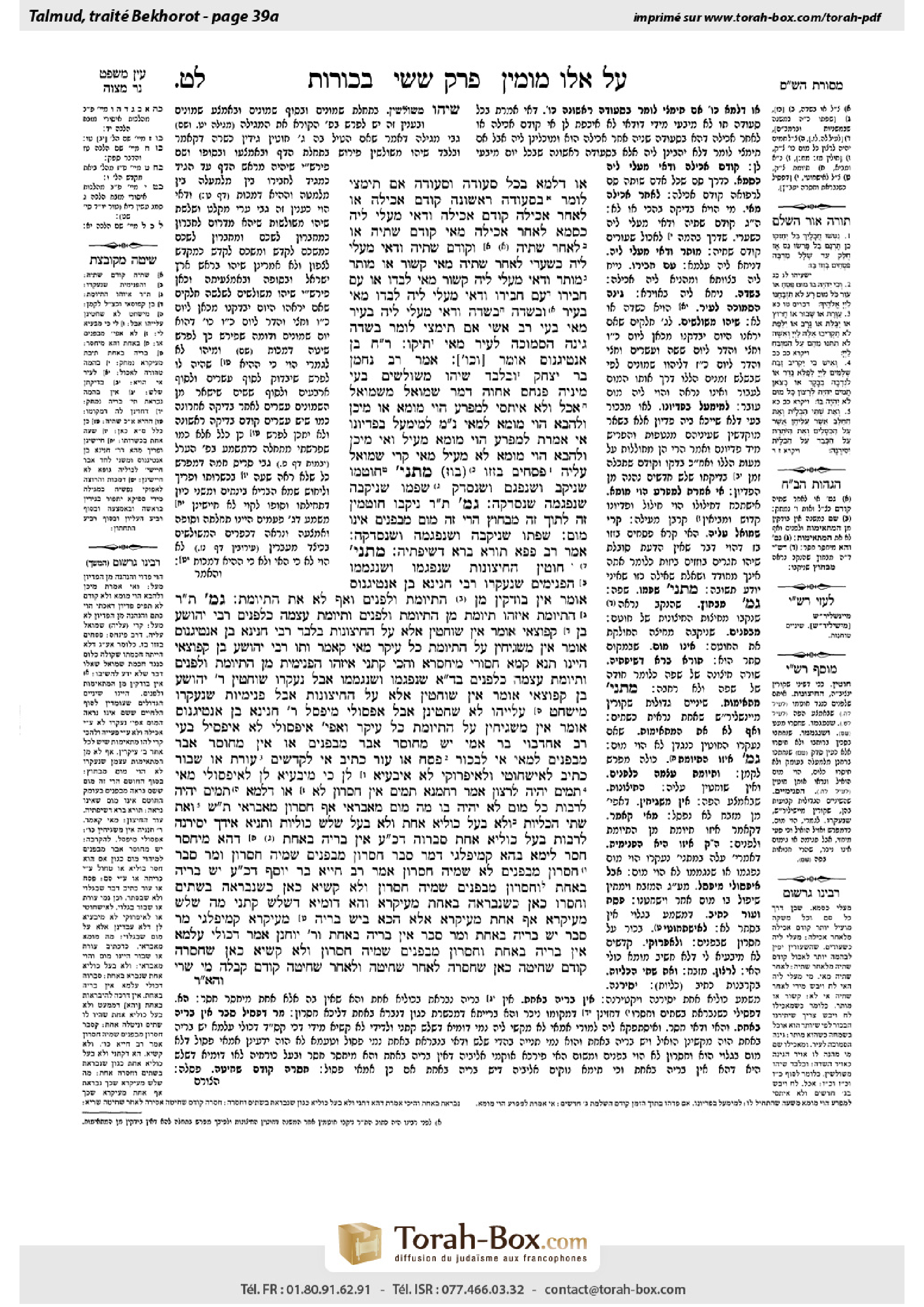
Bekhorot 39a: Talmud study for Daf Yomi
Study the Talmud for Daf Yomi with scanned pages, Hebrew text, English translations from Sefaria and AI-generated French translations.
Passage selection and English or AI-generated French translation are available where the scan has annotations. Daf Study is independent of Torah-Box and Sefaria.
Browse Bekhorot · בכורות · All tractatesBekhorot 39a text and translations
This page of Bekhorot includes the Aramaic text, an English translation and an AI-generated French translation, alongside the scan above.
בכורות ל״ט א · Aramaic and Hebrew text
אוֹ דִלְמָא בְּכׇל סְעוּדָה וּסְעוּדָה? אִם תִּימְצֵי לוֹמַר בִּסְעוּדָה רִאשׁוֹנָה — קוֹדֶם אֲכִילָה אוֹ לְאַחַר אֲכִילָה? קוֹדֶם אֲכִילָה וַדַּאי מְעַלֵּי לֵיהּ כְּסַמָּא, לְאַחַר אֲכִילָה מַאי? קוֹדֶם שְׁתִיָּה אוֹ לְאַחַר שְׁתִיָּה? וְקוֹדֶם שְׁתִיָּה וַדַּאי מְעַלֵּי לֵיהּ כִּשְׂעָרֵי, לְאַחַר שְׁתִיָּה מַאי?
קָשׁוּר אוֹ מוּתָּר? מוּתָּר — וַדַּאי מְעַלֵּי לֵיהּ, קָשׁוּר מַאי? לְבַדּוֹ אוֹ עִם חֲבֵירוֹ? עִם חֲבֵירוֹ — וַדַּאי מְעַלֵּי לֵיהּ, לְבַדּוֹ מַאי?
בָּעִיר (וּבַשָּׂדֶה) [אוֹ בַּשָּׂדֶה]? בַּשָּׂדֶה — וַדַּאי מְעַלֵּי לֵיהּ, בָּעִיר — מַאי? בָּעֵי רַב אָשֵׁי: אִם תִּימְצֵי לוֹמַר בַּשָּׂדֶה — גִּינָּה הַסְּמוּכָה לָעִיר מַאי? תֵּיקוּ.
רַבִּי חֲנַנְיָא בֶּן אַנְטִיגְנוֹס אוֹמֵר. אָמַר רַב נַחְמָן בַּר יִצְחָק: וּבִלְבַד שֶׁיְּהוּ מְשׁוּלָּשִׁים.
בָּעֵי מִינֵּיהּ פִּנְחָס, אֲחוּהּ דְּמָר שְׁמוּאֵל, מִשְּׁמוּאֵל: אֲכַל וְלָא אִיתַּסִּי — לְמַפְרֵעַ הָוֵי מוּמָא, אוֹ מִיכָּן וּלְהַבָּא הָוֵי מוּמָא?
לְמַאי נָפְקָא מִינַּהּ? לְמִימְעַל בְּפִדְיוֹנוֹ. אִי אָמְרַתְּ לְמַפְרֵעַ הָוֵי מוּמָא — מָעֵיל,
וְאִי מִיכָּן וּלְהַבָּא הָוֵי מוּמָא — לָא מָעֵיל, מַאי? קָרֵי שְׁמוּאֵל עֲלֵיהּ: ״פִּסְחִים בָּזְזוּ בַז״.
מַתְנִי׳ חוֹטְמוֹ שֶׁנִּיקַּב, וְשֶׁנִּפְגַּם, וְשֶׁנִּסְדַּק. שְׂפָמוֹ שֶׁנִּיקְּבָה, שֶׁנִּפְגְּמָה, שֶׁנִּסְדְּקָה.
גְּמָ׳ תָּנוּ רַבָּנַן: נִיקְּבוּ חֳוטָמִין זֶה לְתוֹךְ זֶה — מִבַּחוּץ הֲרֵי זֶה מוּם, מִבִּפְנִים אֵינוֹ מוּם. שְׂפָתוֹ שֶׁנִּיקְּבָה וְשֶׁנִּפְגְּמָה וְשֶׁנִּסְדְּקָה, אָמַר רַב פָּפָּא: תּוֹרָא בָּרָא דְּשִׂיפְתֵּיהּ.
מַתְנִי׳ חוּטִין הַחִיצוֹנוֹת שֶׁנִּפְגְּמוּ, וְשֶׁנִּגְמְמוּ, הַפְּנִימִיִּם שֶׁנֶּעֶקְרוּ. רַבִּי חֲנִינָא בֶּן אַנְטִיגְנוֹס אוֹמֵר: אֵין בּוֹדְקִין מִן הַתְּיוֹמֶת וְלִפְנִים, וְאַף לֹא אֶת הַתְּיוֹמֶת.
גְּמָ׳ תָּנוּ רַבָּנַן: הַתְּיוֹמֶת, אֵיזֶהוּ תְּיוֹמֶת? מִן הַתְּיוֹמֶת וְלִפְנִים, וּתְיוֹמֶת עַצְמָהּ כְּלִפְנִים. רַבִּי יְהוֹשֻׁעַ בֶּן קַפּוֹצַאי אוֹמֵר: אֵין שׁוֹחֲטִין אֶלָּא עַל הַחִיצוֹנוֹת בִּלְבַד. רַבִּי חֲנִינָא בֶּן אַנְטִיגְנוֹס אוֹמֵר: אֵין מַשְׁגִּיחִין עַל הַתְּיוֹמֶת כׇּל עִיקָּר.
מַאי קָאָמַר? וְתוּ, רַבִּי יְהוֹשֻׁעַ בֶּן קַפּוֹצַאי הַיְינוּ תַּנָּא קַמָּא!
חַסּוֹרֵי מִיחַסְּרָא וְהָכִי קָתָנֵי: אֵיזֶהוּ הַפְּנִימִית? מִן הַתְּיוֹמֶת וְלִפְנִים, וּתְיוֹמֶת עַצְמָהּ כְּלִפְנִים. בַּמֶּה דְּבָרִים אֲמוּרִים? שֶׁנִּפְגְּמוּ וְשֶׁנִּגְמְמוּ, אֲבָל נֶעְקְרוּ — שׁוֹחֲטִין.
רַבִּי יְהוֹשֻׁעַ בֶּן קַפּוֹצַאי אוֹמֵר: אֵין שׁוֹחֲטִין אֶלָּא עַל הַחִיצוֹנוֹת, אֲבָל פְּנִימִיּוֹת שֶׁנֶּעֶקְרוּ — מִישְׁחָט עֲלַיְיהוּ לָא שָׁחֲטִינַן, אֲבָל אִפְּסוֹלֵי מִיפְּסֵל. רַבִּי חֲנִינָא בֶּן אַנְטִיגְנוֹס אוֹמֵר: אֵין מַשְׁגִּיחִין עַל הַתְּיוֹמֶת כׇּל עִיקָּר, וַאֲפִילּוּ אִיפְּסוֹלֵי לָא אִיפְּסִיל.
בָּעֵי רַב אַחָדְבוּי בַּר אַמֵּי: יֵשׁ מְחוּסַּר אֵבֶר מִבִּפְנִים, אוֹ אֵין מְחוּסַּר אֵבֶר מִבִּפְנִים? לְמַאי? אִי לִבְכוֹר — ״פִּסֵּחַ אוֹ עִוֵּר״ כְּתִיב,
אִי לְקָדָשִׁים, ״עַוֶּרֶת אוֹ שָׁבוּר״ כְּתִיב! לְאִישְּׁחוֹטֵי וּלְאִיפְּרוֹקֵי לָא אִיבַּעְיָא לַן, כִּי מִיבַּעְיָא לַן לְאִיפְּסוֹלֵי — מַאי?
״תָּמִים יִהְיֶה לְרָצוֹן״ אָמַר רַחֲמָנָא, תָּמִים — אִין, חֶסְרוֹן — לֹא. אוֹ דִלְמָא ״תָּמִים יִהְיֶה לְרָצוֹן״, ״כׇּל מוּם לֹא יִהְיֶה בּוֹ״ — מָה מוּם מֵאַבָּרַאי, אַף חֶסְרוֹן מֵאַבָּרַאי.
תָּא שְׁמַע: ״וְאֶת שְׁתֵּי הַכְּלָיוֹת״ — וְלֹא בַּעַל כּוּלְיָא אַחַת, וְלֹא בַּעַל שָׁלֹשׁ כּוּלְיוֹת. וְתַנְיָא אִידַּךְ: ״יְסִירֶנָּה״ — לְרַבּוֹת בַּעַל כּוּלְיָא אַחַת.
סַבְרוּהָ, דְּכוּלֵּי עָלְמָא אֵין בְּרִיָּה בְּאַחַת, דְּהָא מִיחְסָר חָסַר. לֵימָא בְּהָא קָמִיפַּלְגִי: דְּמָר סָבַר, חֶסְרוֹן מִבִּפְנִים שְׁמֵיהּ חֶסְרוֹן, וּמָר סָבַר, חֶסְרוֹן מִבִּפְנִים לָא שְׁמֵיהּ חֶסְרוֹן.
אָמַר רַב חִיָּיא בַּר יוֹסֵף: דְּכוּלֵּי עָלְמָא יֵשׁ בְּרִיָּה בְּאַחַת, וְחֶסְרוֹן מִבִּפְנִים שְׁמֵיהּ חֶסְרוֹן, וְלָא קַשְׁיָא: כָּאן — כְּשֶׁנִּבְרְאָה בִּשְׁתַּיִם וְחָסְרוּ, כָּאן — כְּשֶׁנִּבְרְאָה בְּאַחַת מֵעִיקָּרָא.
וְהָא דּוּמְיָא דְּשָׁלֹשׁ קָתָנֵי, מָה שָׁלֹשׁ מֵעִיקָּרָא, אַף אַחַת מֵעִיקָּרָא!
אֶלָּא, הָכָא בְּיֵשׁ בְּרִיָּה מֵעִיקָּרָא קָמִיפַּלְגִי, מָר סָבַר: יֵשׁ בְּרִיָּה בְּאַחַת, וּמַר סָבַר: אֵין בְּרִיָּה בְּאַחַת.
וְרַבִּי יוֹחָנָן אֲמַר: דְּכוּלֵּי עָלְמָא אֵין בְּרִיָּה בְּאַחַת, וְחֶסְרוֹן מִבִּפְנִים שְׁמֵיהּ חֶסְרוֹן. וְלָא קַשְׁיָא: כָּאן שֶׁחָסְרָה קוֹדֶם שְׁחִיטָה, כָּאן שֶׁחָסְרָה לְאַחַר שְׁחִיטָה. וּלְאַחַר שְׁחִיטָה קוֹדֶם קַבָּלָה מִי שְׁרֵי?
Bekhorot 39a · English translation
or perhaps does it mean it is fed the amount of a fig-bulk at each and every meal? If you say that it is fed a fig-bulk only at the first meal, is it fed this fodder before its regularly scheduled eating or after eating? The Gemara elaborates: Before eating, it is certainly effective for it like a medicine, which people imbibe before their meals. With regard to after eating, what is the halakha? Is this an effective manner of examining the animal? The Gemara further inquires: Is the animal fed this fodder as a medicine before drinking or after drinking? Before drinking it is certainly effective for it, like barley, which is fed to an animal before it drinks. With regard to after drinking, what is the halakha?
The Gemara continues to inquire: Is the animal given the fodder when it is tied or untied? The Gemara explains: When it is untied, the fodder is certainly effective for this animal. When it is tied, what is the halakha? Furthermore, is it fed the fodder when it is by itself, or with another animal? When it is with another animal, the fodder is certainly effective for this animal, as it is comfortable. When it is by itself, what is the halakha?
Likewise, is the animal fed it in the city or in the field? When it is in the field, the fodder is certainly effective for this animal, as it is calm. When it is in the city, what is the halakha? Rav Ashi raises a further dilemma: If you say that this treatment is effective only when it is in the field, not when it is the city, what is the halakha with regard to a garden adjacent to the city? No resolution is found for any of these inquiries, and with regard to each of them the Gemara states that the dilemma shall stand unresolved.
§ The mishna teaches with regard to constant pale spots that Rabbi Ḥananya ben Antigonus says: One examines the animal three times within eighty days. Rav Naḥman bar Yitzḥak says: And this is the halakha provided that they are divided into equal thirds, i.e., there must be an even gap between each of these examinations.
With regard to the statement of the mishna that constant tears are examined by feeding the animal moist and then dry fodder for a period of three months, Pineḥas, the brother of Mar Shmuel, raises a dilemma before Shmuel: If the animal ate the fodder in the required manner and was not healed, which means that it is blemished, is it a retroactive blemish from the day it was discovered, or is it a blemish from that point forward?
The Gemara asks: What is the practical difference? The Gemara answers: It is with regard to whether one has violated the prohibition of misuse of consecrated property concerning its redemption money in a case where a consecrated animal was redeemed before the end of the three months of examination and someone derived benefit from the money paid for its redemption. If you say that it is a retroactive blemish, he thereby misuses consecrated property, as the redemption was effective and the money belongs to the Temple treasury.
But if it is a blemish from that point forward, then one who derived benefit from money paid before that point has not misused consecrated property, as an unblemished animal cannot be redeemed, and the money remains non-sacred. What, then, is the halakha? Shmuel read this verse with regard to his brother: “The lame take the prey” (Isaiah 33:23), i.e., one who is not learned in Torah has managed to ask a question for which I have no answer.
MISHNA: For these additional blemishes, one may slaughter a firstborn animal outside the Temple: Its nose that was pierced, or that was damaged and is lacking, or that was split. Likewise, its lip that was pierced, or that was damaged, or that was split is considered a blemish.
GEMARA: With regard to the case of the nose that was pierced, the Sages taught in a baraita: In a case where its nostrils were pierced one into the other, if the perforation is visible on the outside of the nostril, this is a blemish; if it is visible only on the inside of the nostril, it is not a blemish. With regard to the case of: Its lip that was pierced or that was damaged or that was split, Rav Pappa says: This is referring to the outer row, i.e., the front, protruding part of its lip.
MISHNA: The mishna lists additional blemishes that permit the slaughter of the firstborn: The external gums that were damaged and lacking or that were scratched, and likewise, the internal gums that were extracted. Rabbi Ḥanina ben Antigonus says: One does not examine from the double teeth, i.e., the large molars that appear like two teeth, and inward, and one does not examine even the place of the double teeth themselves. This is because even if they were extracted, it is a concealed blemish, and it does not permit the slaughter of the firstborn.
GEMARA: The Sages taught in a baraita: When the mishna is referring to the double teeth, what are the double teeth? The area from the double teeth and inward, and the double teeth themselves, are considered like the inward part, i.e., the location of a concealed blemish, for which one may not slaughter the animal. Rabbi Yehoshua ben Kefutzai says: One slaughters the firstborn only for a blemish of the outer teeth alone. Rabbi Ḥanina ben Antigonus says: One does not consider the double teeth at all.
The Gemara notes that the baraita asks about the double teeth but does not answer the question: What is the tanna saying? And furthermore, the opinion of Rabbi Yehoshua ben Kefutzai is the same as that of the first tanna, as they both maintain that a blemish to the double teeth is considered a concealed blemish.
The Gemara answers that the baraita is incomplete and this is what it is teaching: What are the inner gums, for which a firstborn is not slaughtered if a blemish was found there? The inner gums are located from the place of the double teeth and inward, and the double teeth themselves are considered like the inward part. In what case is this statement, that one does not slaughter the animal, said? It is said in a case where the inner gums were damaged or were scratched. But if they were extracted, one does slaughter the firstborn for this blemish.
The Gemara continues its interpretation of the baraita. Rabbi Yehoshua ben Kefutzai says: One slaughters the firstborn only for a blemish of the outer teeth. But with regard to the inner gums that were extracted, one does not slaughter the animal for them, but it is disqualified as an offering. Rabbi Ḥanina ben Antigonus says: One does not pay attention to the double teeth at all, and a blemish there does not even disqualify the firstborn from sacrifice.
§ Rav Aḥadvoi bar Ami raises a dilemma: Is there halakhic significance to the lack of a limb that is internal, or is there no halakhic significance to the lack of a limb that is internal? The Gemara inquires: With regard to what issue did he raise this dilemma? If it was with regard to whether such a blemish renders permitted the slaughter of a firstborn outside the Temple, it is written: “Lameness or blindness” (Deuteronomy 15:21), which indicates that the blemish must be exposed.
If the dilemma was raised with regard to whether other sacrificial animals with such a blemish are thereby disqualified from being sacrificed and may be redeemed, it is written: “Blind or broken” (Leviticus 22:22), which are also types of exposed blemishes. The Gemara explains that we do not raise this dilemma with regard to slaughtering the firstborn or redeeming other sacrificial animals, as it is clearly not considered a blemish to that extent. Rather, we raise the dilemma with regard to disqualifying the animal from sacrifice. What is the halakha?
The Gemara clarifies the dilemma. The Merciful One states: “It shall be complete to be accepted” (Leviticus 22:21), which indicates that a complete animal, yes, is fit as a sacrifice, but if it is lacking in any manner, even on the inside, it is not fit. Or perhaps one should interpret this phrase: “It shall be complete to be accepted,” in light of what is stated immediately afterward: “There shall be no blemish therein.” Just as a blemish is on the outside, as taught by the next verse, which says: “Blind or broken,” so too, the status of lacking a limb applies only if it is lacking on the outside.
The Gemara suggests: Come and hear that this matter is subject to a dispute. It is taught in one baraita: When it states with regard to the burning of the sacrificial portions of a peace offering: “And the two kidneys” (Leviticus 3:4), this teaches that one sacrifices only an animal that has two kidneys, but not an animal that has one kidney, nor one that has three kidneys. And it is taught in another baraita that when that verse states: “And the two kidneys…he shall take it away,” the singular form serves to include an animal that has one kidney, which may be sacrificed. Evidently, these tanna’im disagree as to whether an animal lacking a kidney is fit to be sacrificed.
The Sages initially assumed that everyone agrees that there is no entity born with one kidney, and only one kidney is found because this offering became lacking a kidney only after birth. If so, let us say that they disagree about this: That one Sage, the tanna of the first baraita, holds that a lack of an internal limb is considered a lack, and one Sage, the tanna of the second baraita, holds that a lack of an internal limb is not considered a lack.
Rav Ḥiyya bar Yosef says: There is no dispute here, as everyone agrees that there is such an entity born with one kidney, and everyone also agrees that the lack of an internal limb is considered a lack that disqualifies the animal. And the contradiction between the two baraitot is not difficult: Here, in the first baraita, where it was created with two kidneys and one is lacking, the animal is disqualified. Whereas there, where it was created with one kidney from the outset, it is not lacking and therefore it is fit.
The Gemara asks: But the first baraita teaches the case of an animal that has one kidney as similar to that of an animal that has three kidneys. One can therefore infer: Just as these three kidneys were present from the outset, as an animal does not grow new limbs, so too, the animal with one kidney alone was like that from the outset.
Rather, everyone agrees that a lack of an internal limb is considered a lack, and here the tanna’im disagree with regard to the matter of whether there is an entity created with one kidney from the outset. One Sage, the tanna of the second baraita, holds that there is an entity created with one kidney, and it may be assumed that this is such an animal, and it is not lacking a limb. And one Sage, the tanna of the first baraita, holds that there is no entity created with one kidney, and this animal is lacking a limb and is disqualified for sacrifice.
And Rabbi Yoḥanan says: Everyone agrees that there is no entity born with one kidney, and that a lack of an internal limb is considered a lack, and yet it is not difficult. Here, in the first baraita, it is referring to a case where it lacked a kidney before its slaughter. Whereas there, the second baraita is dealing with a case where it lacked a kidney only after its slaughter, and therefore it is fit. The Gemara asks: And if the animal lacked a kidney after its slaughter but before the collection of the blood in a vessel for sprinkling, is it permitted to sacrifice it?
Bekhorot 39a · Traduction française (IA)
ou peut-être signifie-t-il qu'on lui donne la quantité d'une figue à chaque repas ? Si vous dites qu'on lui donne la quantité d'une figue uniquement au premier repas, est-ce qu'on lui donne ce fourrage avant ou après son repas habituel ? La Guemara développe : Avant de manger, cela est certainement efficace pour lui comme un médicament, que les gens prennent avant leurs repas. En ce qui concerne après avoir mangé, quelle est la halakha ? Est-ce une manière efficace d'examiner l'animal ? La Guemara pose ensuite une autre question : L'animal est-il nourri ce fourrage comme un médicament avant ou après avoir bu ? Avant de boire, cela est certainement efficace pour lui, comme le blé, qui est donné à un animal avant qu'il ne boive. En ce qui concerne après avoir bu, quelle est la halakha ?
La Guemara continue à poser une question : L'animal est-il nourri avec ce fourrage lorsqu'il est attaché ou lorsqu'il est libre ? La Guemara explique : Lorsqu'il est libre, ce fourrage est certainement efficace pour cet animal. Lorsqu'il est attaché, quelle est la halakha ? De plus, est-ce qu'on lui donne ce fourrage lorsqu'il est seul ou avec un autre animal ? Lorsqu'il est avec un autre animal, ce fourrage est certainement efficace pour cet animal, car il est confortable. Lorsqu'il est seul, quelle est la halakha ?
De même, est-ce qu'on nourrit l'animal là-bas ou dans le champ ? Lorsqu'il est dans le champ, ce fourrage est certainement efficace pour cet animal, car il est calme. Lorsqu'il est dans la ville, quelle est la halakha ? Rav Ashi soulève une autre difficulté : Si vous dites que ce traitement est efficace uniquement lorsqu'il est dans le champ, pas lorsqu'il est dans la ville, quelle est la halakha concernant un jardin adjacent à la ville ? Aucune résolution n'est trouvée pour aucune de ces questions, et concernant chacune d'entre elles, la Guemara indique que la difficulté restera sans réponse.
§ La mitsva enseigne concernant les taches constantes que Rabbi Ḥananya ben Antigonus dit : On examine l'animal trois fois dans les soixante-dix jours. Rav Naḥman bar Yitzḥak dit : Et c'est la halakha à condition qu'ils soient divisés en tiers égaux, c'est-à-dire qu'il doit y avoir une distance égale entre chaque examen.
Concernant l'affirmation de la mitsva que les larmes constantes sont examinées en nourrissant l'animal avec un fourrage humide puis sec pendant trois mois, Pineḥas, le frère de Mar Shmuel, soulève une difficulté devant Shmuel : Si l'animal a mangé ce fourrage de la manière requise et n'a pas guéri, ce qui signifie qu'il est blemi, est-ce une blemie rétroactive depuis le jour où elle a été découverte, ou est-ce une blemie à partir de ce point-là ?
La Guemara demande : Quelle est la différence pratique ? La Guemara répond : Cela concerne si l'on a violé la prohibition de mauvais usage des biens consacrés concernant l'argent de rachat dans un cas où un animal consacré a été racheté avant la fin des trois mois d'examen et quelqu'un a tiré profit de l'argent payé pour son rachat. Si vous dites que c'est une blemie rétroactive, il a ainsi mauvais usage des biens consacrés, car le rachat a été efficace et l'argent appartient au trésor du Temple.
Mais si c'est une imperfection à partir de ce point-là, alors celui qui a tiré profit de l'argent payé avant ce point n'a pas abusé des biens consacrés, car un animal parfait ne peut être racheté, et l'argent reste profane. Quelle est donc la halakha ? Shmuel a interprété cette parole concernant son frère : « Les boiteux prennent la proie » (Yachin 33:23), c'est-à-dire celui qui n'est pas savant en Torah a réussi à poser une question pour laquelle je n'ai pas de réponse.
MICHNA : Concernant ces imperfections supplémentaires, on peut sacrifier un animal premier en dehors du Temple : Son nez percé, ou endommagé et manquant, ou fendu. De même, sa lèvre percée, ou endommagée, ou fendue est considérée comme une imperfection.
GUEMARA : Concernant le cas du nez percé, les Sages ont enseigné dans une baraïta : Dans le cas où ses narines étaient percées l'une dans l'autre, si la perforation est visible à l'extérieur de la narine, c'est une imperfection ; si elle est visible uniquement à l'intérieur de la narine, ce n'est pas une imperfection. Concernant le cas de : Sa lèvre percée ou endommagée ou fendue, Rav Pappa dit : Cela fait référence à la rangée externe, c'est-à-dire la partie avant et saillante de sa lèvre.
MICHNA : La mitsva liste des blemishes supplémentaires qui permettent de sacrifier le premier-né : Les gencives externes endommagées, manquantes ou rayées, et de même, les gencives internes extraites. Rabbi Ḥanina ben Antigonus dit : On ne examine pas les dents doubles, c'est-à-dire les grandes molaires qui apparaissent comme deux dents, ni à l'intérieur, et on ne examine même pas la place des dents doubles elles-mêmes. Cela est ainsi car même si elles étaient extraites, c'est une blemish cachée, et cela ne permet pas de sacrifier le premier-né.
GUEMARA : Les Sages ont enseigné dans une baraïta : Lorsque la mitsva fait référence aux dents doubles, quels sont les dents doubles ? La zone des dents doubles et à l'intérieur, ainsi que les dents doubles elles-mêmes, sont considérées comme la partie intérieure, c'est-à-dire la localisation d'une blemish cachée, pour laquelle on ne peut pas sacrifier l'animal. Rabbi Yehoshua ben Kefutzai dit : On sacrifie le premier-né uniquement pour une blemish des dents externes. Rabbi Ḥanina ben Antigonus dit : On ne considère pas les dents doubles du tout.
La Guemara note que la baraïta pose une question sur les dents doubles mais ne répond pas à la question : Quel est l'opinion du tanna ? De plus, l'opinion de Rabbi Yehoshua ben Kefutzai est la même que celle du premier tanna, car ils maintiennent tous les deux qu'une blemish des dents doubles est considérée comme une blemish cachée.
La Guemara répond que la baraïta est incomplète et c'est cela qu'elle enseigne : Quels sont les gencives internes, pour lesquels un premier-né n'est pas sacrifié si on y trouve une tache ? Les gencives internes sont situées à partir du lieu des dents doubles et vers l'intérieur, et les dents doubles elles-mêmes sont considérées comme la partie intérieure. Dans quel cas cette déclaration, selon laquelle on ne sacrifie pas l'animal, est-elle dite ? Elle est dite dans le cas où les gencives internes étaient endommagées ou griffées. Mais si elles avaient été extraites, on sacrifie tout de même le premier-né pour cette tache.
La Guemara continue l'interprétation de la baraïta. Rabbi Yéhoshua ben Kéfutzai dit : On sacrifie le premier-né uniquement pour une tache des dents externes. Mais concernant les gencives internes qui ont été extraites, on ne sacrifie pas l'animal pour elles, mais l'animal est disqualifié comme offrande. Rabbi Ḥanina ben Antigonus dit : On ne tient pas compte des dents doubles du tout, et une tache là ne disqualifie pas le premier-né de la sacrifice.
§ Rav Aḥadvoï bar Ami soulève un dilemme : Y a-t-il une importance halakhique dans le manque d'un membre interne, ou n'y a-t-il pas d'importance halakhique dans le manque d'un membre interne ? La Guemara demande : À propos de quelle question a-t-il soulevé ce dilemme ? Si c'était à propos de savoir si une tache ainsi rendait permis de sacrifier un premier-né en dehors du Temple, il est écrit : « Lame ou aveugle » (Deutéronome 15:21), ce qui indique que la tache doit être visible.
Si le dilemme a été soulevé à propos de savoir si d'autres animaux sacrifiés avec une tache ainsi sont ainsi disqualifiés et peuvent être rachetés, il est écrit : « Aveugle ou brisé » (Lévitique 22:22), ce qui sont aussi des types de taches visibles. La Guemara explique que nous ne soulevons pas ce dilemme à propos de la sacrifice du premier-né ou de la rachat d'autres animaux sacrifiés, car il est clairement considéré comme une tache de moindre importance. Plutôt, nous soulevons ce dilemme à propos de la disqualification de l'animal de la sacrifice. Quelle est la halakha ?
La Guemara clarifie le dilemme. L'Éternel dit : « Il doit être complet pour être accepté » (Lévitique 22:21), ce qui indique qu'un animal complet, oui, est digne d'être offert, mais si il manque de quelque manière, même à l'intérieur, il n'est pas digne. Ou peut-être devons-nous interpréter cette phrase : « Il doit être complet pour être accepté », en lumière de ce qui est dit immédiatement après : « Il ne doit pas y avoir de tache en lui. » Comme une tache est à l'extérieur, comme enseigné par la prochaine verset, qui dit : « Aveugle ou brisé », ainsi, le statut de manque d'un membre s'applique uniquement si le manque est à l'extérieur.
La Guemara suggère : Viens écouter que cette question est sujette à un débat. Il est enseigné dans une baraïta : Lorsqu'il dit concernant la brûlaison des parties sacrées d'une offrande de paix : « Et les deux reins » (Lévitique 3:4), cela enseigne qu'on sacrifie uniquement un animal qui a deux reins, mais pas un animal qui a un rein, ni un qui a trois reins. Et il est enseigné dans une autre baraïta que lorsqu'il dit : « Et les deux reins... il doit le prendre », la forme singulier sert à inclure un animal qui a un seul rein, qui peut être sacrifié. Évidemment, ces tannaïm sont en désaccord sur le fait qu'un animal manquant de rein est digne de sacrifice.
Les Sages ont d'abord supposé que tout le monde est d'accord sur le fait qu'il n'existe pas d'entité née avec un seul rein, et que seul un rein est trouvé car cette offrande a manqué de rein seulement après la naissance. Si c'est le cas, disons que leur désaccord est sur cela : Un Sage, le tanna de la première baraïta, considère que le manque d'un membre interne est considéré comme un manque, et un Sage, le tanna de la deuxième baraïta, considère que le manque d'un membre interne n'est pas considéré comme un manque.
Rav Ḥiyya bar Yosef dit : Il n'y a pas de débat ici, car tout le monde est d'accord sur le fait qu'il existe une entité née avec un seul rein, et tout le monde est d'accord sur le fait que le manque d'un membre interne est considéré comme un manque qui disqualifie l'animal. Et la contradiction entre les deux baraïtes n'est pas difficile : Ici, dans la première baraïta, où il a été créé avec deux reins et un est manquant, l'animal est disqualifié. Alors que là, où il a été créé avec un seul rein dès le départ, il n'est pas manquant et donc il est propre.
La Guemara demande : Mais la première baraïta enseigne le cas d'un animal qui a un seul rein comme semblable à celui d'un animal qui a trois reins. On peut donc en déduire : Comme ces trois reins étaient présents dès le départ, car un animal ne grandit pas de nouveaux membres, ainsi, l'animal avec un seul rein seul était comme tel dès le départ.
Plutôt, tout le monde est d'accord sur le fait que le manque d'un membre interne est considéré comme un manque, et ici les tannaïm sont en désaccord concernant la question de savoir s'il existe une entité créée avec un seul rein dès le départ. Un Sage, le tanna de la deuxième baraïta, considère qu'il existe une entité créée avec un seul rein, et on peut supposer que c'est un tel animal, et il n'est pas manquant de membre. Et un Sage, le tanna de la première baraïta, considère qu'il n'existe pas d'entité créée avec un seul rein, et cet animal est manquant de membre et est disqualifié pour la sacrifice.
Et Rabbi Yoḥanan dit : Tout le monde est d'accord sur le fait qu'il n'existe pas d'entité née avec un seul rein, et que le manque d'un membre interne est considéré comme un manque, et pourtant ce n'est pas difficile. Ici, dans la première baraïta, il s'agit d'un cas où il manquait un rein avant sa sacrifice. Alors que là, la deuxième baraïta traite d'un cas où il manquait un rein seulement après sa sacrifice, et donc il est digne. La Guemara demande : Et si l'animal manquait un rein après sa sacrifice mais avant la collecte du sang dans un récipient pour l'aspersion, est-il permis de le sacrifier ?
Traduction française générée par IA à partir de l’édition anglaise de Sefaria. Vérifie toujours un passage avec le texte source.
Text from Sefaria: William Davidson Edition - Vocalized Aramaic (CC BY NC); William Davidson Edition - English (CC BY NC).