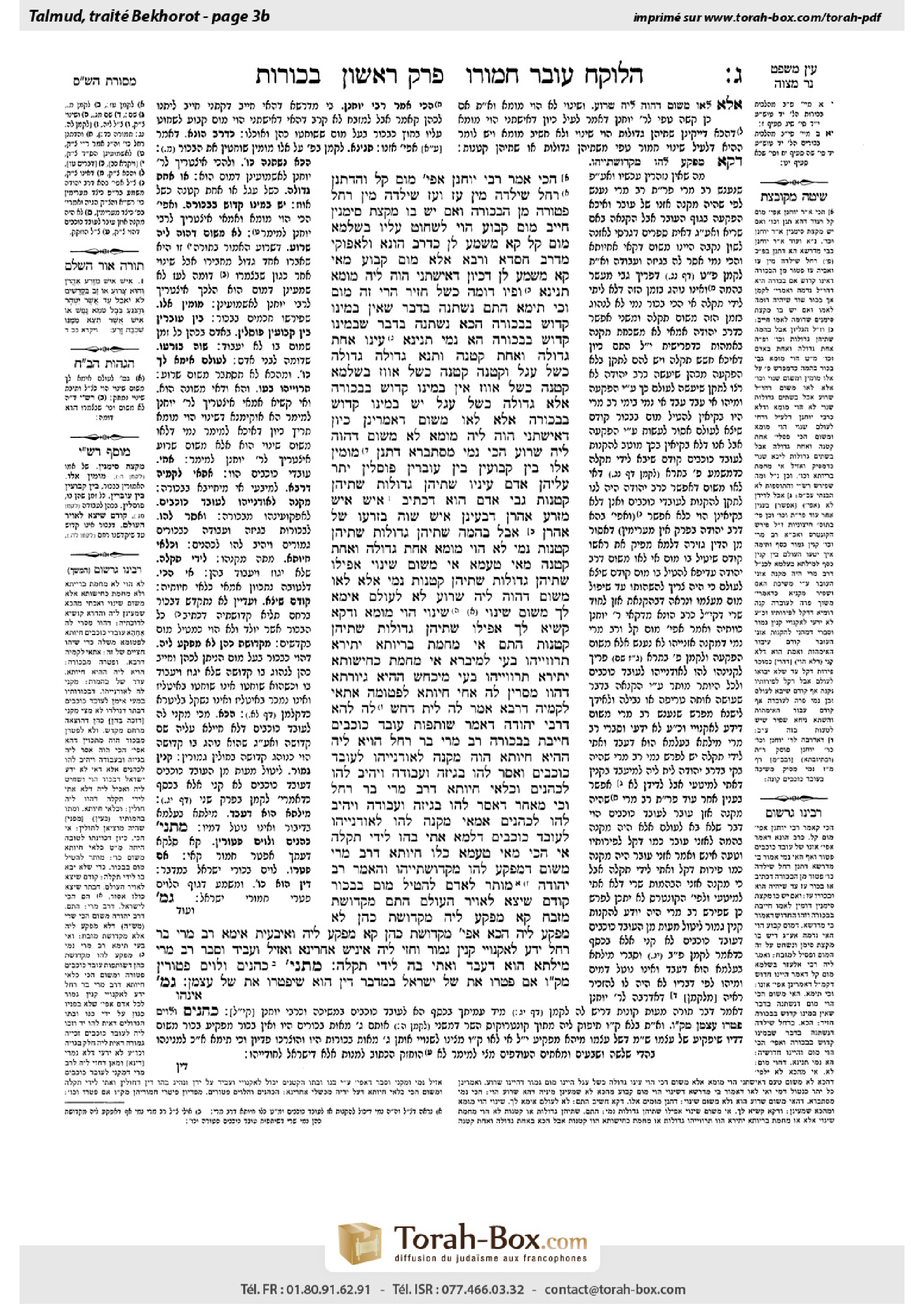
Bekhorot 3b: Talmud study for Daf Yomi
Study the Talmud for Daf Yomi with scanned pages, Hebrew text, English translations from Sefaria and AI-generated French translations.
Passage selection and English or AI-generated French translation are available where the scan has annotations. Daf Study is independent of Torah-Box and Sefaria.
Browse Bekhorot · בכורות · All tractatesBekhorot 3b text and translations
This page of Bekhorot includes the Aramaic text, an English translation and an AI-generated French translation, alongside the scan above.
בכורות ג׳ ב · Aramaic and Hebrew text
הָכִי אָמַר רַבִּי יוֹחָנָן: אֲפִילּוּ מוּם קַל. וְהָדִתְנַן: רָחֵל שֶׁיָּלְדָה מִין עֵז וְעֵז שֶׁיָּלְדָה מִין רָחֵל — פְּטוּרָה מִן הַבְּכוֹרָה, וְאִם יֵשׁ בּוֹ מִקְצָת סִימָנִין — חַיָּיב. מוּם קָבוּעַ הָוֵי לִשְׁחוֹט עָלָיו.
בִּשְׁלָמָא מוּם קַל — קָא מַשְׁמַע לַן כִּדְרַב הוּנָא, וּלְאַפּוֹקֵי מִדְּרַב חִסְדָּא וְרָבָא.
אֶלָּא מוּם קָבוּעַ — מַאי קָא מַשְׁמַע לַן? דְּכֵיוָן דְּאִישְׁתַּנִּי הָוֵה לֵיהּ מוּמָא? תְּנֵינָא: וּפִיו דּוֹמֶה כְּשֶׁל חֲזִיר — הֲרֵי זֶה מוּם!
וְכִי תֵּימָא, הָתָם נִשְׁתַּנָּה בְּדָבָר שֶׁאֵין בְּמִינוֹ קָדוֹשׁ בִּבְכוֹרָה, הָכָא נִשְׁתַּנָּה בְּדָבָר שֶׁבְּמִינוֹ קָדוֹשׁ בִּבְכוֹרָה, הָא נָמֵי תְּנֵינָא: עֵינוֹ אַחַת גְּדוֹלָה וְאַחַת קְטַנָּה.
וְתַנָּא גְּדוֹלָה — גְּדוֹלָה כְּשֶׁל עֵגֶל, וּקְטַנָּה — קְטַנָּה כְּשֶׁל אַוָּוז. בִּשְׁלָמָא קְטַנָּה כְּשֶׁל אַוָּוז, אֵין בְּמִינוֹ קָדוֹשׁ בִּבְכוֹרָה, אֶלָּא גְּדוֹלָה כְּשֶׁל עֵגֶל — יֵשׁ בְּמִינוֹ קָדוֹשׁ בִּבְכוֹרָה! אֶלָּא לָאו מִשּׁוּם דְּאָמְרִינַן: כֵּיוָן דְּאִישְׁתַּנִּי הָוֵה לֵיהּ מוּמָא?
לָא, מִשּׁוּם דְּהָוֵה לֵיהּ ״שָׂרוּעַ״. הָכִי נָמֵי מִסְתַּבְּרָא, דִּתְנַן: מוּמִין אֵלּוּ, בֵּין קְבוּעִין בֵּין עוֹבְרִין — פּוֹסְלִין. יָתֵר עֲלֵיהֶן אָדָם: עֵינָיו שְׁתֵּיהֶן גְּדוֹלוֹת, שְׁתֵּיהֶן קְטַנּוֹת.
גַּבֵּי אָדָם הוּא דִּכְתִיב: ״אִישׁ אִישׁ מִזֶּרַע אַהֲרֹן״, דְּבָעֵינַן אִישׁ שָׁוֶה בְּזַרְעוֹ שֶׁל אַהֲרֹן, אֲבָל בְּהֵמָה, שְׁתֵּיהֶן גְּדוֹלוֹת שְׁתֵּיהֶן קְטַנּוֹת — נָמֵי לָא הָוֵי מוּמָא.
אַחַת גְּדוֹלָה וְאַחַת קְטַנָּה, מַאי טַעְמָא? אִי מִשּׁוּם שִׁינּוּי — אֲפִילּוּ שְׁתֵּיהֶן גְּדוֹלוֹת, שְׁתֵּיהֶן קְטַנּוֹת נָמֵי! אֶלָּא לָאו מִשּׁוּם דְּהָוֵה לֵיהּ ״שָׂרוּעַ״?
לָא, לְעוֹלָם אֵימָא לָךְ מִשּׁוּם שִׁינּוּי, שִׁינּוּי הָוֵי מוּמָא. וּדְקָא קַשְׁיָא לָךְ: אֲפִילּוּ שְׁתֵּיהֶן גְּדוֹלוֹת, שְׁתֵּיהֶן קְטַנּוֹת? הָתָם, אִי מֵחֲמַת בְּרִיּוּתָא יַתִּירָא — תַּרְוַויְיהוּ בָּעֵי לְמִיבְרָא, אִי מֵחֲמַת כְּחִישׁוּתָא יַתִּירָא — תַּרְוַויְיהוּ בָּעֵי מִיכְחַשׁ.
הָהִיא גִּיּוֹרְתָּא דַּהֲווֹ מָסְרִין לַהּ אַחֵי חֵיוְתָא לְפַטּוֹמַהּ, אֲתַאי לְקַמֵּיהּ דְּרָבָא, אֲמַר לַהּ: לֵית דְּחַשׁ לַהּ לְהָא דְּרַבִּי יְהוּדָה, דְּאָמַר: שׁוּתָּפוּת גּוֹי חַיֶּיבֶת בִּבְכוֹרָה.
רַב מָרִי בַּר רָחֵל הַוְיָא לֵיהּ הָהִיא חֵיוָתָא, הֲוָה מַקְנֶה לְאוּדְנַיְיהוּ לְגוֹי, וְאָסַר לְהוּ בְּגִיזָּה וַעֲבוֹדָה, וְיָהֵיב לְהוּ לְכֹהֲנִים, וּכְלַאי חֵיוָתָא דְּרַב מָרִי בַּר רָחֵל.
וְכִי מֵאַחַר דְּאָסַר לְהוּ בְּגִיזָה וַעֲבוֹדָה, וְיָהֵיב לְהוּ לְכֹהֲנִים, אַמַּאי מַקְנֶה לְהוּ לְאוּדְנַיְיהוּ לְגוֹי, דִּלְמָא אָתֵי בְּהוּ לִידֵי תַקָּלָה? אִי הָכִי, מַאי טַעְמָא כְּלוֹ חֵיוָתָא דְּרַב מָרִי? מִשּׁוּם דְּמַפְקַע לְהוּ מִקְּדוּשְׁתַּיְיהוּ.
וְהָאָמַר רַב יְהוּדָה: מוּתָּר לָאָדָם לְהַטִּיל מוּם בִּבְכוֹר קוֹדֶם שֶׁיָּצָא לַאֲוִיר הָעוֹלָם! הָתָם מִקְּדוּשַּׁת מִזְבֵּחַ קָא מַפְקַע לֵיהּ, מִקְּדוּשַּׁת כֹּהֵן לָא מַפְקַע לֵיהּ. הָכָא אֲפִילּוּ מִקְּדוּשַּׁת כֹּהֵן קָא מַפְקַע לֵיהּ.
וְאִיבָּעֵית אֵימָא: רַב מָרִי בַּר רָחֵל יָדַע לְאַקְנוֹיֵי קִנְיַן גָּמוּר, וְחָזֵי לֵיהּ אִינִישׁ אַחֲרִינָא, וְאָזֵיל וְעָבֵיד, וְסָבַר רַב מָרִי מִילְּתָא הוּא דַּעֲבַד, וְאָתֵי בָּהּ לִידֵי תַקָּלָה.
מַתְנִי׳ כֹּהֲנִים וּלְוִיִּם פְּטוּרִין, מִקַּל וָחוֹמֶר: אִם פָּטְרוּ אֶת שֶׁל יִשְׂרָאֵל בַּמִּדְבָּר, דִּין הוּא שֶׁיִּפְטְרוּ אֶת שֶׁל עַצְמָן.
Bekhorot 3b · English translation
This is what Rabbi Yoḥanan said: Even if only a slight blemish would result from the removal of the portion of the animal owned by the gentile, the animal still does not have firstborn status. And in addition, Rabbi Yoḥanan also commented on that which we learned in a mishna (16b): A ewe that gave birth to a goat of sorts and a goat that gave birth to a ewe of sorts are exempt from the mitzva of the firstborn. And if the offspring has some of the characteristics of its mother, it is obligated, i.e., subject to the obligations of firstborn status. Rabbi Yoḥanan commented: Nevertheless, it may not be sacrificed on the altar because this is a permanent blemish. Therefore, a priest is permitted to slaughter it outside of the Temple.
The Gemara asks: Granted that Rabbi Yoḥanan’s first statement that the animal does not have firstborn status even if it has a slight blemish is necessary, as he teaches us that he holds in accordance with the opinion of Rav Huna, who said previously (2b) that even if the gentile owns only the ear of the firstborn it does not have firstborn status, and his statement is to the exclusion of the opinions of Rav Ḥisda and Rava, who said the gentile must own a portion of the fetus that would render it a carcass or a tereifa if it were removed.
But with regard to Rabbi Yoḥanan’s second statement that a goat of sorts that was born to a ewe but has some characteristics of the mother is considered to have a permanent blemish, what is it teaching us? Is it teaching that since it looks different from the normal appearance of a sheep this appearance is considered a blemish? We already learned this in the mishna (40a): Or with regard to a lamb whose mouth is similar to that of a pig, that is a blemish that enables slaughter of the firstborn.
And if you would say that there, where the animal’s mouth is similar to that of a pig, its appearance was altered into a being in whose species there is no sanctity of the firstborn, while here, where it looks like a goat, its appearance was altered into a being in whose species there is sanctity of the firstborn, and Rabbi Yoḥanan teaches that this animal too is considered to be blemished, we already learned this, too, in the subsequent mishna (40b): An animal with one of its eyes large and one small is also considered blemished.
And a tanna taught in explanation of the mishna: A large eye is referring to one as large as that of a calf, and a small eye is referring to one as small as that of a goose. Granted, in the case of an eye as small as that of a goose the reason it is considered a blemish is that there is no sanctity of the firstborn among its species, i.e., that of a bird. But in the case of an eye that is as large as that of a calf there is sanctity of a firstborn among its species. Rather, is it not considered blemished because we say that since it has changed from the appearance of a sheep it is considered a blemish? Therefore, Rabbi Yoḥanan’s statement has still not introduced any novelty.
The Gemara responds: No, an eye as large as that of a calf is considered a blemish because the animal is one that has a limb that is too large [sarua], which is listed in the Torah as one of the blemished animals (see Leviticus 22:23). The Gemara comments: This, too, stands to reason, as we learned in a mishna (43a): Concerning these blemishes that were taught with regard to an animal, whether they are permanent or transient, they also disqualify a priest from performing the Temple service. And the subsequent mishna (44a) adds: Beyond those are additional blemishes that apply exclusively to a person, i.e., a priest: If both of his eyes are large, or both of them are small.
The reason for the latter halakha is that it is with regard to a person that it is written: “Any man from the offspring of Aaron” (Leviticus 22:4), which indicates that we require a man who is equal to the seed of Aaron, i.e., he has an ordinary appearance like other priests; but with regard to an animal, if both eyes are big or both eyes are small, it is also not a blemish.
Accordingly, if one of the animal’s eyes is big or one is small, what is the reason that it is considered a blemish? If it is due to the deviation in appearance, meaning it does not look like a sheep, then even if both eyes are big or both are small it should be considered a blemish. Rather, is it not because it is an animal with a limb that is too large?
The Gemara responds: No, actually I will say to you that the reason an animal with one big eye and one small eye is considered blemished is because of its deviation, as a deviation is considered a blemish. And as for that which is difficult for you, that if it is due to an anomalous appearance then even if both are big or both are small it should be considered a blemish, there it is not considered a deviation. This is because a particularly healthy animal has large eyes, while a particularly weak animal has small eyes. Therefore, only an animal with one large eye and with one small eye is considered to be blemished, as if the large eye is due to extreme health both should have been healthy, and if the small eye is due to extreme weakness both should have been weak.
§ In connection with the dispute between Rabbi Yehuda and the Rabbis whether an animal owned in partnership with a gentile has firstborn status, the Gemara relates the following incident: There was a certain female convert whose gentile brothers would give her animals to fatten and would then divide the profits with her. She came before Rava to ask whether firstborn status applies to the firstborn of these animals. Rava said to her: There is no one who is concerned with this ruling of Rabbi Yehuda, who says an animal owned in partnership with a gentile is obligated, i.e., subject to counting its first offspring a firstborn.
The Gemara relates another incident: Rav Mari bar Raḥel had a certain flock of animals. He would transfer ownership of the ears of the firstborn fetuses to a gentile in order to exempt them from the obligations of firstborn status. But nevertheless he prohibited them from being sheared and used for labor, and gave them to the priests, halakhot that apply to a standard firstborn animal. And ultimately, the animals of Rav Mari bar Raḥel died.
The Gemara asks: But since he prohibited them from being sheared and used for labor and also gave them to the priests, why did he initially transfer ownership of their ears to the gentile, abrogating their firstborn status? The Gemara answers that he did so lest the priests come to experience a mishap with them, improperly shearing them or using them for labor. The Gemara asks: If so, what is the reason that the animals of Rav Mari died as a punishment? The Gemara answers: It was because he abrogated their sanctity by selling their ears.
The Gemara asks: But doesn’t Rav Yehuda say it is permitted for a person to inflict a blemish on a firstborn animal fetus before it emerges into the air of the world? Here, too, Rav Mari abrogated his firstborn animals’ sanctity by selling their ears before their birth. The Gemara answers: There, when one inflicts a blemish on a firstborn animal, he abrogates the animal’s sanctity of the altar, as it is no longer fit for an offering, but does not abrogate its sanctity of the priest, as it is still given to the priest. Here, by contrast, when Rav Mari sold his animals’ ears to a gentile, he abrogated even their sanctity of the priest, as the partnership exempts the animals from the obligations of firstborn status entirely.
And if you wish, say instead that the reason the animals of Rav Mari bar Raḥel died is that he himself knew that is was necessary to transfer ownership of the ears of the fetus to the gentile through a complete transaction. And another person would see him transferring ownership of the ears to a gentile and would go and do it himself but not perform a complete transaction, and would think that Rav Mari performed the same matter in abrogating its firstborn status, and would come to experience a mishap with his animal by not treating it with the sanctity of firstborn status. Due to this concern, Rav Mari should not have transferred ownership of the ears to a gentile, and consequently his animals died.
MISHNA: Priests and Levites are exempt from the obligation to redeem a firstborn donkey; this is derived from an a fortiori inference: In the wilderness the firstborn were redeemed in exchange for the Levites, as it is stated: “Take the Levites in exchange for all the firstborn among the children of Israel and the animal of the Levites in exchange for their animals” (Numbers 3:45). If the priests and Levites rendered exempt the firstborn children and donkeys of the Israelites in the wilderness from being counted firstborns, it is only logical that the priests and the Levites should render the firstborn of their own donkeys exempt from being counted firstborns.
Bekhorot 3b · Traduction française (IA)
C’est ce que dit le Rabbi Yoḥanan : Même si une légère imperfection résulterait de la suppression de la part de l’animal appartenant au non-Juif, l’animal ne possède pas le statut de premier-né. Et en outre, le Rabbi Yoḥanan a également commenté ce que nous avons appris dans une mitsna (16b) : Une agnelle qui a donné naissance à un bouc et un bouc qui a donné naissance à une agnelle sont dispensés de la mitsva du premier-né. Et si l’animal a certains caractères de sa mère, il est tenu, c’est-à-dire soumis aux obligations du statut de premier-né. Le Rabbi Yoḥanan a commenté : Cependant, il ne peut pas être sacrifié sur l’autel car c’est une imperfection permanente. Ainsi, un prêtre est autorisé à le sacrifier en dehors du Temple.
Le Guemara demande : C’est admis que la première déclaration du Rabbi Yoḥanan, selon laquelle l’animal ne possède pas le statut de premier-né même s’il a une légère imperfection, est nécessaire, car il nous apprend qu’il suit l’opinion du Rav Huna, qui a dit précédemment (2b) que même si le non-Juif possède seulement l’oreille du premier-né, il ne possède pas le statut de premier-né, et sa déclaration est en opposition avec les opinions du Rav Ḥisda et du Rava, qui ont dit que le non-Juif doit posséder une part du fœtus qui le rendrait un cadavre ou un tereifa si elle était retirée.
Mais concernant la deuxième déclaration du Rabbi Yoḥanan, selon laquelle un bouc qui a été né d’une agnelle mais qui a certains caractères de la mère est considéré comme ayant une imperfection permanente, à quoi cela nous apprend-il ? Est-ce qu’il nous apprend que puisque l’apparence est différente de celle d’un mouton, cette apparence est considérée comme une imperfection ? Nous avons déjà appris cela dans la mitsna (40a) : Ou concernant un agneau dont la bouche ressemble à celle d’un porc, c’est une imperfection qui permet de sacrifier le premier-né.
Et si vous dites que là, où la bouche de l’animal ressemble à celle d’un porc, son apparence a été modifiée pour devenir un être dont la race n’a pas de sanctité de premier-né, tandis que là, où il ressemble à un bouc, son apparence a été modifiée pour devenir un être dont la race a une sanctité de premier-né, et le Rabbi Yoḥanan nous apprend que cet animal est également considéré comme étant blemi, nous avons déjà appris cela également dans la mitsva suivante (40b) : Un animal dont un œil est grand et l’autre petit est également considéré comme blemi.
Et un tanna a expliqué la mitsva en disant : Un œil grand est celui qui est aussi grand qu’un veau, et un œil petit est celui qui est aussi petit qu’un canard. Admettons, dans le cas d’un œil aussi petit qu’un canard, la raison pour laquelle il est considéré comme une imperfection est que la sanctité du premier-né n’existe pas dans sa race, c’est-à-dire celle des oiseaux. Mais dans le cas d’un œil aussi grand qu’un veau, la sanctité du premier-né existe dans sa race. Cependant, n’est-il pas considéré comme blemi parce que nous disons que puisque son apparence a changé par rapport à celle d’un mouton, il est considéré comme une imperfection ? Ainsi, la déclaration du Rabbi Yoḥanan n’a pas introduit de nouveauté.
Le Guemara répond : Non, un œil aussi grand qu’un veau est considéré comme une imperfection car l’animal a un membre trop grand [sarua], ce qui est mentionné dans la Torah comme l’un des animaux blemis (voir Lévitique 22:23). Le Guemara commente : Cela aussi est logique, car nous avons appris dans une mitsva (43a) : Concernant ces imperfections qui ont été enseignées concernant un animal, qu’elles soient permanentes ou temporaires, elles disqualifient également un prêtre de pratiquer le service du Temple. Et la mitsva suivante (44a) ajoute : En dehors de ces imperfections, il y a d’autres imperfections qui s’appliquent uniquement à une personne, c’est-à-dire un prêtre : Si les deux yeux sont grands, ou s’ils sont petits.
La raison de cette dernière halakha est qu’elle concerne une personne, car il est écrit : « Tout homme de la descendance d’Aaron » (Lévitique 22:4), ce qui indique que nous exigeons un homme qui soit égal à la semence d’Aaron, c’est-à-dire qui ait une apparence ordinaire comme les autres prêtres ; mais concernant un animal, si les deux yeux sont grands ou les deux sont petits, cela n’est pas une imperfection.
Ainsi, si l’un des yeux de l’animal est grand ou s’il est petit, à quoi la raison de son imperfection est-elle ? Si c’est en raison de la déviation de l’apparence, c’est-à-dire qu’il ne ressemble pas à un mouton, alors même si les deux yeux sont grands ou les deux sont petits, il devrait être considéré comme une imperfection. Cependant, n’est-ce pas parce qu’il s’agit d’un animal avec un membre trop grand ?
Le Guemara répond : Non, en réalité, je vais vous dire que la raison d’un animal avec un œil grand et un œil petit est considéré comme blemi est en raison de la déviation, car une déviation est considérée comme une imperfection. Et concernant ce qui vous semble difficile, à savoir si c’est en raison d’une apparence anormale, alors même si les deux sont grands ou les deux sont petits, il devrait être considéré comme une imperfection, là ce n’est pas une déviation. Cela est dû au fait qu’un animal particulièrement sain a des yeux grands, tandis qu’un animal particulièrement faible a des yeux petits. Ainsi, seul un animal avec un œil grand et un œil petit est considéré comme blemi, car si l’œil grand est dû à une extrême santé, les deux devraient être sains, et si l’œil petit est dû à une extrême faiblesse, les deux devraient être faibles.
§ En lien avec le débat entre le Rabbi Yehuda et les Rabbins sur le statut de premier-né d’un animal possédé en partage avec un non-Juif, le Guemara rapporte l’incident suivant : Il y avait une certaine femme convertie dont les frères non-Juifs lui donnaient des animaux pour les élever et puis partageaient les profits avec elle. Elle est venue devant Rava pour demander si le statut de premier-né s’applique aux premiers-nés de ces animaux. Rava a dit à elle : Il n’y a personne qui s’occupe de cette décision du Rabbi Yehuda, qui dit qu’un animal possédé en partage avec un non-Juif est tenu, c’est-à-dire soumis à la comptabilisation de son premier petit enfant comme premier-né.
La Guemara rapporte un autre incident : Rav Mari bar Raḥel avait un troupeau d'animaux. Il transférait la propriété des oreilles des fœtus de premier-né à un non-Juif afin de les exempter des obligations du statut de premier-né. Cependant, il interdisait qu'ils soient tondu ou utilisés pour le travail, et les donnait aux prêtres, des halakhot applicables aux animaux ordinaires de premier-né. Et finalement, les animaux de Rav Mari bar Raḥel moururent.
La Guemara demande : Mais puisqu'il interdisait qu'ils soient tondu ou utilisés pour le travail et qu'il les donnait aux prêtres, pourquoi a-t-il initialement transféré la propriété de leurs oreilles à un non-Juif, abrogeant ainsi leur statut de premier-né ? La Guemara répond que c'était pour éviter que les prêtres ne subissent un malheur avec eux, en les tondant de manière incorrecte ou en les utilisant pour le travail. La Guemara demande : Si c'est ainsi, quelle est la raison pour laquelle les animaux de Rav Mari sont morts en tant que punition ? La Guemara répond : C'était parce qu'il avait abrogé leur sanctité en vendant leurs oreilles.
La Guemara demande : Mais ne dit pas Rav Yéhuda qu'il est permis à une personne d'infliger une imperfection à un fœtus de premier-né avant qu'il ne sorte dans l'air du monde ? Ici aussi, Rav Mari a abrogé la sanctité de ses animaux de premier-né en vendant leurs oreilles avant leur naissance. La Guemara répond : Là, quand on inflige une imperfection à un animal de premier-né, on abroge la sanctité de l'autel de l'animal, car il n'est plus propre à l'offrande, mais ne n'abroge pas sa sanctité des prêtres, car il est toujours donné aux prêtres. Ici, en revanche, quand Rav Mari a vendu les oreilles de ses animaux à un non-Juif, il a abrogé même leur sanctité des prêtres, car le partenariat exemptait les animaux entièrement des obligations du statut de premier-né.
Et si vous le souhaitez, dites plutôt que la raison pour laquelle les animaux de Rav Mari bar Raḥel sont morts est qu'il savait qu'il était nécessaire de transférer la propriété des oreilles du fœtus à un non-Juif par une transaction complète. Un autre individu verrait lui transférer la propriété des oreilles à un non-Juif et irait lui-même le faire, mais ne ferait pas une transaction complète, et penserait que Rav Mari avait accompli la même chose pour abroger le statut de premier-né. Il pourrait alors subir un malheur avec son animal en ne le traitant pas avec la sanctité du statut de premier-né. À cause de cette préoccupation, Rav Mari ne devrait pas avoir transféré la propriété des oreilles à un non-Juif, et par conséquent ses animaux moururent.
MICHNA : Les prêtres et les Lévites sont exemptés de l'obligation de racheter un âne de premier-né ; cela est déduit par une inférence a fortiori : Dans le désert, les premiers-nés furent rachetés en échange des Lévites, comme il est dit : « Prenez les Lévites en échange de tous les premiers-nés parmi les enfants d'Israël et l'animal des Lévites en échange de leurs animaux » (Nombres 3:45). Si les prêtres et les Lévites avaient exempté les enfants et les ânes de premier-né des Israélites du désert de leur statut de premier-né, il est logique que les prêtres et les Lévites exemptent eux-mêmes les premiers-nés de leurs propres ânes de leur statut de premier-né.
Traduction française générée par IA à partir de l’édition anglaise de Sefaria. Vérifie toujours un passage avec le texte source.
Text from Sefaria: William Davidson Edition - Vocalized Aramaic (CC BY NC); William Davidson Edition - English (CC BY NC).