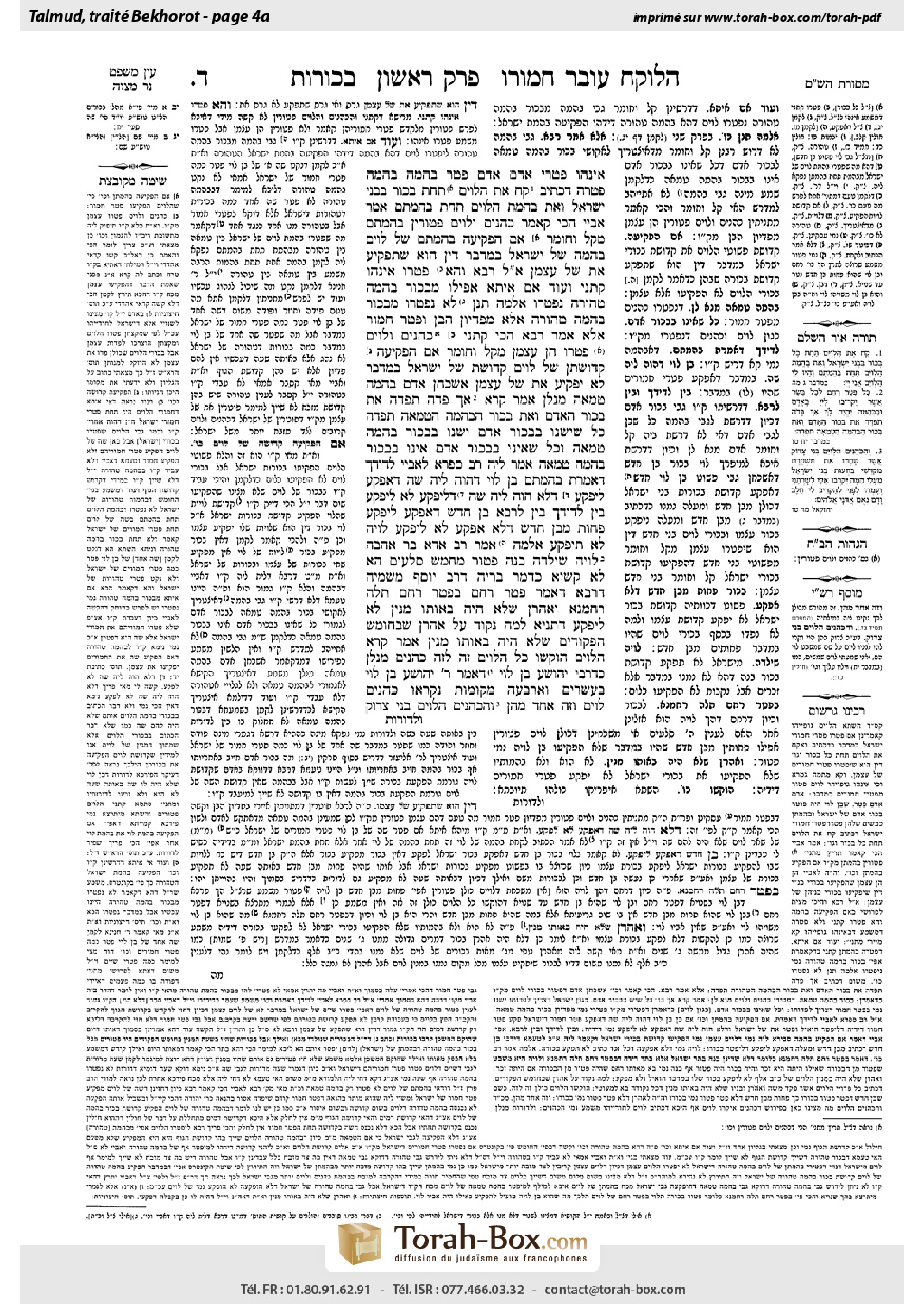
Bekhorot 4a: Talmud study for Daf Yomi
Study the Talmud for Daf Yomi with scanned pages, Hebrew text, English translations from Sefaria and AI-generated French translations.
Passage selection and English or AI-generated French translation are available where the scan has annotations. Daf Study is independent of Torah-Box and Sefaria.
Browse Bekhorot · בכורות · All tractatesBekhorot 4a text and translations
This page of Bekhorot includes the Aramaic text, an English translation and an AI-generated French translation, alongside the scan above.
בכורות ד׳ א · Aramaic and Hebrew text
גְּמָ׳ אִינְהוּ פָּטְרִי?! אָדָם — אָדָם פָּטַר, בְּהֵמָה — בְּהֵמָה פָּטְרָה, דִּכְתִיב: ״קַח אֶת הַלְוִיִּם תַּחַת בְּכוֹר בִּבְנֵי יִשְׂרָאֵל וְאֶת בֶּהֱמַת הַלְוִיִּם תַּחַת בְּהֶמְתָּם״!
אָמַר אַבָּיֵי, הָכִי קָאָמַר: כֹּהֲנִים וּלְוִיִּם פְּטוּרִין בְּהֶמְתָּם מִקַּל וְחוֹמֶר — אִם הִפְקִיעָה בְּהֶמְתָּם שֶׁל לְוִיִּם בְּהֵמָה שֶׁל יִשְׂרָאֵל בַּמִּדְבָּר, דִּין הוּא שֶׁתַּפְקִיעַ אֶת שֶׁל עַצְמָן.
אֲמַר לֵיהּ רָבָא: וְהָא ״פָּטְרוּ״ אִינְהוּ קָתָנֵי!
וְעוֹד, אִם אִיתָא, אֲפִילּוּ מִבְּכוֹר בְּהֵמָה טְהוֹרָה נִפַּטְרוּ! אַלְּמָה תְּנַן: לֹא נִפְטְרוּ מִבְּכוֹר בְּהֵמָה טְהוֹרָה, אֶלָּא מִפִּדְיוֹן הַבֵּן וּפֶטֶר חֲמוֹר?
אֶלָּא אָמַר רָבָא, הָכִי קָתָנֵי: כֹּהֲנִים וּלְוִיִּם פָּטְרוּ הֵן עַצְמָן מִקַּל וָחוֹמֶר, אִם הִפְקִיעָה קְדוּשָּׁתָן שֶׁל לְוִיִּם קְדוּשַּׁת שֶׁל יִשְׂרָאֵל בַּמִּדְבָּר, לֹא יַפְקִיעַ אֶת שֶׁל עַצְמָן?
אַשְׁכְּחַן אָדָם, בְּהֵמָה טְמֵאָה מְנָלַן? אָמַר קְרָא: ״אַךְ פָּדֹה תִפְדֶּה אֵת בְּכוֹר הָאָדָם וְאֵת בְּכוֹר הַבְּהֵמָה הַטְּמֵאָה תִּפְדֶּה״, כֹּל שֶׁיֶּשְׁנוֹ בִּבְכוֹר אָדָם — יֶשְׁנוֹ בִּבְכוֹר בְּהֵמָה טְמֵאָה, וְכֹל שֶׁאֵינוֹ בִּבְכוֹר אָדָם — אֵינוֹ בִּבְכוֹר בְּהֵמָה טְמֵאָה.
אֲמַר לֵיהּ רַב סָפְרָא לְאַבָּיֵי: לְדִידָךְ דְּאָמְרַתְּ בְּהֶמְתָּם, בֶּן לֵוִי דַּהֲוָה לֵיהּ שֶׂה דְּאַפְקַע — לַיפְקַע, דְּלָא הֲוָה לֵיהּ שֶׂה דְּלַיפְקַע — לָא לַיפְקַע!
בֵּין לְדִידָךְ, בֵּין לְרָבָא, בֶּן חֹדֶשׁ דְּאַפְקַע — לַיפְקַע, פָּחוֹת מִבֶּן חֹדֶשׁ דְּלָא אַפְקַע — לָא לַיפְקַע!
לְוִיָּה לָא תַּיפְקַע? אַלְּמָה אָמַר רַב אַדָּא בַּר אַהֲבָה: לְוִיָּה שֶׁיָּלְדָה — בְּנָהּ פָּטוּר מֵחֲמֵשׁ סְלָעִים?
הָא לָא קַשְׁיָא, כִּדְמָר בְּרֵיהּ דְּרַב יוֹסֵף מִשְּׁמֵיהּ דְּרָבָא, דְּאָמַר: ״פֶּטֶר רֶחֶם״ בְּפֶטֶר רֶחֶם תְּלָה רַחֲמָנָא.
וְאַהֲרֹן שֶׁלֹּא הָיָה בְּאוֹתוֹ מִנְיָן — לָא לַיפְקַע! דְּתַנְיָא: לָמָּה נָקוּד עַל ״אַהֲרֹן״ שֶׁבְּחוֹמֶשׁ הַפְּקוּדִים — שֶׁלֹּא הָיָה בְּאוֹתוֹ מִנְיָן.
אָמַר קְרָא: ״הַלְוִיִּם״, הוּקְשׁוּ כׇּל הַלְוִיִּם זֶה לָזֶה.
כֹּהֲנִים מְנָלַן? כִּדְרַבִּי יְהוֹשֻׁעַ בֶּן לֵוִי, דְּאָמַר רַבִּי יְהוֹשֻׁעַ בֶּן לֵוִי: בְּעֶשְׂרִים וְאַרְבָּעָה מְקוֹמוֹת נִקְרְאוּ כֹּהֲנִים ״לְוִיִּם״, וְזֶה אֶחָד מֵהֶן: ״וְהַכֹּהֲנִים הַלְוִיִּם בְּנֵי צָדוֹק״.
Bekhorot 4a · English translation
GEMARA: In stating: If the priests and Levites rendered exempt the firstborn children and donkeys of the Israelites in the wilderness from being counted firstborns, the mishna indicates that the priests and Levites themselves rendered the animals exempt. The Gemara therefore asks: Did they render the firstborn children and donkeys exempt? With regard to a person, i.e., the Israelite firstborn, the person, i.e., the priests and Levites, rendered them exempt. But with regard to an animal, i.e., the firstborn donkeys of the Israelites, the animal, i.e., the sheep of the priests and Levites, rendered them exempt, as it is written: “Take the Levites in exchange for all the firstborn among the children of Israel, and the animal of the Levites in exchange for their animals” (Numbers 3:45).
The Gemara answers: Abaye said this is what the mishna is saying: The firstborn animals of priests and Levites are exempt from firstborn status, and that is derived from an a fortiori inference: If the animals of the Levites, i.e., the sheep of the priests and Levites, rendered the firstborn status of the animals of the Israelites in the wilderness abrogated, it is only logical that the sheep of the priests and Levites should render the firstborn status of the priests’ and Levites’ own firstborn donkeys abrogated.
Rava said to him: How can you interpret the a fortiori inference in the mishna as referring to the animals of the priests and Levites? But doesn’t it teach: They, i.e., the priests and Levites, rendered the firstborn children and donkeys of the Israelites exempt? The reference is clearly to the priests and Levites themselves, not their animals.
Furthermore, if it is so that their animals are exempt due to the a fortiori inference, then the priests and Levites should be exempt even from the halakhot pertaining to a male firstborn of a kosher animal, as their firstborn kosher animals rendered the firstborn kosher animals of the Israelites exempt from firstborn status. Why did we learn in the mishna (13a): The priests and Levites were not exempted from the mitzva of the male firstborn of a kosher animal; rather, they were exempted only from redemption of the firstborn son and the firstborn donkey?
Rather, Rava said this is what the mishna is teaching: Priests and Levites rendered themselves exempt, and that is derived from an a fortiori inference: If the sanctity of the Levites abrogated the sanctity of the firstborn of the Israelites in the wilderness, should it not abrogate the sanctity of the firstborn Levites themselves?
The Gemara asks: We have found a source for the halakha that the Levites’ personal status as firstborns is abrogated; from where do we derive that their non-kosher animals, i.e., donkeys, do not have the status of firstborns? The Gemara answers that the verse states: “Yet you shall redeem the firstborn of man, and the firstborn of non-kosher animals you shall redeem” (Numbers 18:15). The status of the human firstborn is juxtaposed with that of a non-kosher animal, from which the following principle is derived: Anything that applies to a woman’s firstborn son applies to the firstborn of a non-kosher animal, and anything that does not apply to a woman’s firstborn son does not apply to a non-kosher animal. Therefore, just as firstborn status does not apply to Levites, it does not apply to their donkeys, and they do not need to be redeemed.
Rav Safra said to Abaye: According to your opinion, that you say the animals of the Levites did not have firstborn status due to the a fortiori inference, then with regard to a Levite who had a lamb, which abrogated the sanctity of the firstborn donkeys of the Israelites, let the firstborn status of his animals be abrogated. But with regard to one who did not have a lamb that would abrogate their sanctity, the status of his animals should not be abrogated.
Rav Safra asked Abaye an additional question: According to both you and Rava, since you agree that the firstborn Levites themselves were exempt from being accorded firstborn status because they rendered the sanctity of the Israelite firstborns abrogated, one should conclude that only a firstborn Levite who was at least one month old, who abrogated the sanctity of the Israelite firstborns (see Numbers 3:15), should have his own firstborn status abrogated. But those firstborn Levites who were less than one month old, who did not abrogate the sanctity of the Israelite firstborns, should not have their own firstborn status abrogated.
Furthermore, the sanctity of a firstborn son born to a female Levite who was married to an Israelite should not be abrogated, as the women were not included among the Levites who were exchanged for the Israelite firstborn. Why, then, does Rav Adda bar Ahava say: With regard to a female Levite who gave birth,her firstborn son is exempt from the obligation of giving five sela coins to the priest to be redeemed?
The Gemara answers the last question: That is not difficult, as it is in accordance with the statement of Mar, son of Rav Yosef, in the name of Rava, who says: The fact that the Torah states with regard to the sanctity of the firstborn: “Firstborn of the womb” (Exodus 13:12), indicates that the Merciful One renders the obligations of firstborn status dependent on being the firstborn of the womb, i.e., of the mother. Therefore, the mother’s status as a Levite is sufficient to exempt the child from firstborn status.
Rav Safra again challenged the opinions of Abaye and Rava: And Aaron, who was not included in that count of the Levites when they were compared to the number of Israelite firstborns and redeemed from their sanctity as firstborns, should not have his own firstborn status abrogated. As it is taught in a baraita: Why do dots appear over the word “Aaron” in the verse in the book of Numbers: “All that were numbered of the Levites, whom Moses and Aaron numbered” (Numbers 3:39)? It is in order to demonstrate that he was not included in that count of the Levites.
The Gemara answers that the verse states: “The Levites” (Numbers 3:45), to teach that all of the Levites were juxtaposed with each other. Therefore, even a firstborn Levite who did not abrogate the sanctity of the Israelite firstborns himself was still abrogated of his own firstborn sanctity.
The Gemara asks: From where do we derive that priests, including Aaron, were also subject to that halakha? The Gemara answers: It is in accordance with the statement of Rabbi Yehoshua ben Levi, as Rabbi Yehoshua ben Levi says: In twenty-four places in the Bible the priests are called Levites, and this is one of them: “But the priests the Levites, the sons of Zadok” (Ezekiel 44:15). It is derived from this verse that priests are included in the category of Levites even where they are not mentioned explicitly.
Bekhorot 4a · Traduction française (IA)
GUEMARA : En disant : Si les prêtres et les Lévites ont exempté les premiers-nés des Israélites et des ânes dans le désert de la comptabilité des premiers-nés, la mitsva indique que les prêtres et les Lévites eux-mêmes ont exempté les animaux. La Guemara demande donc : Ont-ils exempté les premiers-nés des Israélites et des ânes ? En ce qui concerne une personne, c'est-à-dire le premier-né israélite, la personne, c'est-à-dire les prêtres et les Lévites, l'ont exempté. Mais en ce qui concerne un animal, c'est-à-dire les ânes premiers-nés des Israélites, l'animal, c'est-à-dire les brebis des prêtres et des Lévites, l'ont exempté, comme il est écrit : « Prenez les Lévites en échange de tous les premiers-nés des enfants d'Israël, et l'animal des Lévites en échange de leurs animaux » (Nombres 3:45).
La Guemara répond : Abaye a dit cela : c'est ce que la mitsva dit : les animaux premiers-nés des prêtres et des Lévites sont exemptés de la statut de premier-né, et cela est déduit d'une inférence a fortiori : si les animaux des Lévites, c'est-à-dire les brebis des prêtres et des Lévites, ont annulé le statut de premier-né des animaux des Israélites dans le désert, il est logique que les brebis des prêtres et des Lévites annulent aussi le statut de premier-né des ânes premiers-nés des prêtres et des Lévites eux-mêmes.
Rava a dit à lui : comment peux-tu interpréter l'inférence a fortiori de la mitsva comme se rapportant aux animaux des prêtres et des Lévites ? Mais ne dit-il pas : ils, c'est-à-dire les prêtres et les Lévites, ont exempté les premiers-nés des Israélites et des ânes ? La référence est clairement aux prêtres et aux Lévites eux-mêmes, pas à leurs animaux.
De plus, si c'est ainsi que leurs animaux sont exemptés grâce à l'inférence a fortiori, alors les prêtres et les Lévites devraient être exemptés même des halakhot concernant un premier-né mâle d'un animal kasher, car leurs premiers-nés d'animaux kashers ont rendu les premiers-nés d'animaux kashers des Israélites exemptes du statut de premier-né. Pourquoi avons-nous appris dans la mitsva (13a) : les prêtres et les Lévites n'étaient pas exemptés de la mitsva du premier-né mâle d'un animal kasher ; plutôt, ils étaient exemptés seulement de la délivrance du premier-né fils et du premier-né âne ?
Plutôt, Rava a dit cela : c'est ce que la mitsva enseigne : les prêtres et les Lévites se sont rendus exempt, et cela est déduit d'une inférence a fortiori : si la sanctité des Lévites a annulé la sanctité des premiers-nés des Israélites dans le désert, ne devrait-elle pas annuler aussi la sanctité des premiers-nés des Lévites eux-mêmes ?
La Guemara demande : nous avons trouvé une source pour la halakha que le statut personnel des Lévites comme premiers-nés est annulé ; d'où dérivons-nous que leurs animaux non kashers, c'est-à-dire les ânes, n'ont pas le statut de premiers-nés ? La Guemara répond que le verset dit : « Vous redonneriez le premier-né de l'homme, et le premier-né de l'animal non kasher vous redonneriez » (Nombres 18:15). Le statut du premier-né humain est juxtaposé à celui de l'animal non kasher, d'où on déduit le principe suivant : tout ce qui s'applique au premier-né fils d'une femme s'applique au premier-né d'un animal non kasher, et tout ce qui ne s'applique pas au premier-né fils d'une femme ne s'applique pas à un animal non kasher. Ainsi, tout comme le statut de premier-né ne s'applique pas aux Lévites, il ne s'applique pas à leurs ânes, et ils n'ont pas besoin d'être rachetés.
Rav Safra a dit à Abaye : selon votre opinion, que vous affirmez que les animaux des Lévites n'avaient pas le statut de premier-né grâce à l'inférence a fortiori, alors concernant un Lévit qui avait un agneau, qui avait annulé la sanctité des premiers-nés d'ânes des Israélites, la sanctité des animaux de ce Lévit devrait être annulée. Mais concernant celui qui n'avait pas d'agneau qui annulerait leur sanctité, le statut de ses animaux ne devrait pas être annulé.
Rav Safra a posé une question supplémentaire à Abaye : selon les deux, vous et Rava, puisque vous convenez que les premiers-nés des Lévites eux-mêmes étaient exemptés du statut de premier-né car ils avaient annulé la sanctité des premiers-nés des Israélites, on devrait conclure que seul un premier-né Lévit d'au moins un mois, qui avait annulé la sanctité des premiers-nés des Israélites (voir Nombres 3:15), devrait avoir son propre statut de premier-né annulé. Mais ceux qui étaient moins d'un mois, qui n'avaient pas annulé la sanctité des premiers-nés des Israélites, ne devraient pas avoir leur propre statut de premier-né annulé.
De plus, la sanctité du premier-né d'une femme Lévit qui était mariée à un Israélite ne devrait pas être annulée, car les femmes n'étaient pas incluses parmi les Lévites échangés avec les premiers-nés des Israélites. Pourquoi alors Rav Adda bar Ahava dit-il : concernant une femme Lévit qui a donné naissance, son premier-né est exempt de l'obligation de lui donner cinq sela à l'homme pour être racheté ?
La Guemara répond à la dernière question : cela n'est pas difficile, car c'est selon la déclaration de Mar, fils de Rav Yosef, en nom de Rava, qui dit : le fait que la Torah mentionne la sanctité du premier-né : « premier-né du ventre » (Exode 13:12) indique que l'Éternel rend les obligations du statut de premier-né dépendantes d'être le premier-né du ventre, c'est-à-dire de la mère. Ainsi, le statut de la mère comme Lévit est suffisant pour exempter l'enfant du statut de premier-né.
Rav Safra défie à nouveau les opinions d'Abaye et de Rava : Aaron, qui n'était pas inclus dans ce compte des Lévites lorsqu'ils étaient comparés au nombre des premiers-nés israélites et rachetés de leur sanctité, ne devrait pas avoir son propre statut de premier-né annulé. Comme il est enseigné dans une baraïta : pourquoi des points apparaissent sur le mot « Aaron » dans le verset du livre de Nombres : « Tous ceux qui ont été comptés des Lévites, que Moïse et Aaron ont comptés » (Nombres 3:39) ? C'est afin de montrer qu'il n'était pas inclus dans ce compte des Lévites.
La Guemara répond que la versette dit : « Les Lévites » (Nombres 3:45), afin d'enseigner que tous les Lévites étaient juxtaposés les uns aux autres. Ainsi, même un premier-né Lévitique qui n'avait pas annulé lui-même la sanctité des premiers-nés d'Israël était encore annulé de sa propre sanctité de premier-né.
La Guemara demande : D'où dérivons-nous que les prêtres, y compris Aaron, étaient également soumis à cette halakha ? La Guemara répond : C'est selon la déclaration de Rabbi Yéhoshua ben Lévi, car Rabbi Yéhoshua ben Lévi dit : Dans vingt-quatre endroits de la Bible les prêtres sont appelés Lévites, et c'est l'un d'eux : « Mais les prêtres les Lévites, les fils de Zadok » (Ezéchiel 44:15). On en dérive de cette versette que les prêtres sont inclus dans la catégorie des Lévites même lorsqu'ils ne sont pas mentionnés explicitement.
Traduction française générée par IA à partir de l’édition anglaise de Sefaria. Vérifie toujours un passage avec le texte source.
Text from Sefaria: William Davidson Edition - Vocalized Aramaic (CC BY NC); William Davidson Edition - English (CC BY NC).