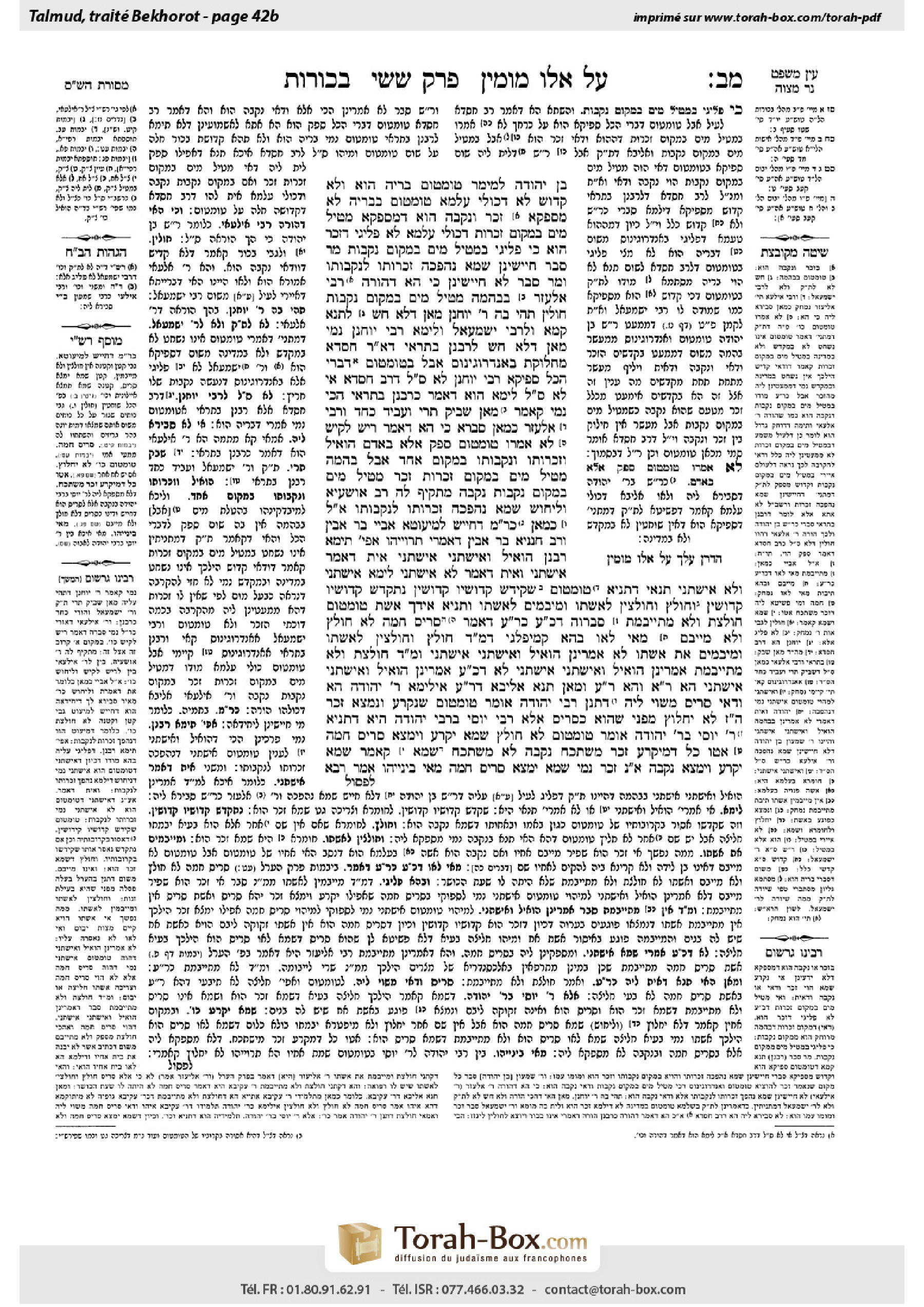
Bekhorot 42b: Talmud study for Daf Yomi
Study the Talmud for Daf Yomi with scanned pages, Hebrew text, English translations from Sefaria and AI-generated French translations.
Passage selection and English or AI-generated French translation are available where the scan has annotations. Daf Study is independent of Torah-Box and Sefaria.
Browse Bekhorot · בכורות · All tractatesBekhorot 42b text and translations
This page of Bekhorot includes the Aramaic text, an English translation and an AI-generated French translation, alongside the scan above.
בכורות מ״ב ב · Aramaic and Hebrew text
בֶּן יְהוּדָה לְמֵימַר: טוּמְטוּם בְּרִיָּה הוּא וְלֹא קָדוֹשׁ! לָא, דְּכוּלֵּי עָלְמָא טוּמְטוּם בִּבְרִיָּה לָא מְסַפְּקָא, זָכָר וּנְקֵבָה הוּא דִּמְסַפְּקָא.
מֵטִיל מַיִם בִּמְקוֹם זַכְרוּת — דְּכוּלֵּי עָלְמָא לָא פְּלִיגִי דְּזָכָר הוּא, כִּי פְּלִיגִי בְּמֵטִיל מַיִם בְּמָקוֹם נַקְבוּת: מָר סָבַר חָיְישִׁינַן שֶׁמָּא נֶהֶפְכָה זַכְרוּתוֹ לְנַקְבוּתוֹ, וּמַר סָבַר לָא חָיְישִׁינַן. כִּי הָא דְּהוֹרָה רַבִּי אֶלְעָזָר: בִּבְהֵמָה מֵטִיל מַיִם בְּמָקוֹם נַקְבוּת — חוּלִּין.
תָּהֵי בַּהּ רַבִּי יוֹחָנָן: מַאן דְּלָא חָשׁ לְתַנָּא קַמָּא וּלְרַבִּי יִשְׁמָעֵאל? וְלֵימָא רַבִּי יוֹחָנָן נָמֵי: מַאן דְּלָא חָשׁ לְרַבָּנַן בָּתְרָאֵי? דְּאָמַר רַב חִסְדָּא: מַחֲלוֹקֶת בְּאַנְדְּרוֹגִינוֹס, אֲבָל בְּטוּמְטוּם — דִּבְרֵי הַכֹּל סְפֵיקָא!
רַבִּי יוֹחָנָן לָא סְבִירָא לֵיהּ דְּרַב חִסְדָּא, אִי לָא סְבִירָא לֵיהּ, לֵימָא הוּא דְּאָמַר כְּרַבָּנַן בָּתְרָאֵי? הָכִי נָמֵי קָאָמַר: מַאן שָׁבֵיק תְּרֵי וְעָבֵיד כְּחַד!
וְרַבִּי אֶלְעָזָר כְּמַאן סָבְרַהּ? כִּי הָא דְּאָמַר רֵישׁ לָקִישׁ: לֹא אָמְרוּ טוּמְטוּם סָפֵק אֶלָּא בְּאָדָם, הוֹאִיל וְזַכְרוּתוֹ וְנַקְבוּתוֹ בְּמָקוֹם אֶחָד, אֲבָל בְּהֵמָה — מֵטִיל מַיִם בְּמָקוֹם זַכְרוּת זָכָר, מֵטִיל מַיִם בְּמָקוֹם נַקְבוּת נְקֵבָה.
מַתְקֵיף לַהּ רַב אוֹשַׁעְיָא: וְלֵיחוּשׁ שֶׁמָּא נֶהֶפְכָה זַכְרוּתוֹ לְנַקְבוּתוֹ! אֲמַר לֵיהּ: כְּמַאן? כְּרַבִּי מֵאִיר דְּחָיֵישׁ לְמִיעוּטָא?!
אַבָּיֵי בַּר אָבִין וְרַב חֲנַנְיָא בַּר אָבִין דְאָמְרִי תַּרְוַיְיהוּ: אֲפִילּוּ תֵּימָא רַבָּנַן, הוֹאִיל וְאִישְׁתַּנִּי אִישְׁתַּנִּי. אִית דְּאָמַר אִישְׁתַּנִּי, וְאִית דְּאָמַר לָא אִישְׁתַּנִּי.
לֵימָא אִישְׁתַּנִּי וְלָא אִישְׁתַּנִּי תַּנָּאֵי? דְּתַנְיָא: טוּמְטוּם שֶׁקִּידֵּשׁ — קִדּוּשָׁיו קִדּוּשִׁין, נִתְקַדֵּשׁ — קִדּוּשָׁיו קִדּוּשִׁין.
וְחוֹלֵץ, וְחוֹלְצִין לְאִשְׁתּוֹ, וּמְיַבְּמִים לְאִשְׁתּוֹ. וְתַנְיָא אִידַּךְ: אֵשֶׁת טוּמְטוּם חוֹלֶצֶת וְלֹא מִתְיַיבֶּמֶת.
סַבְרוּהָ, דְּכוּלֵּי עָלְמָא כְּרַבִּי עֲקִיבָא, דְּאָמַר: סְרִיס חַמָּה לֹא חוֹלֵץ וְלֹא מְיַיבֵּם.
מַאי לָאו בְּהָא קָמִיפַּלְגִי, דְּמַאן דְּאָמַר חוֹלֵץ, וְחוֹלְצִין לְאִשְׁתּוֹ וּמְיַבְּמִים אֶת אִשְׁתּוֹ, לָא אָמְרִינַן הוֹאִיל וְאִישְׁתַּנִּי אִישְׁתַּנִּי;
וּמַאן דְּאָמַר חוֹלֶצֶת וְלֹא מִתְיַיבֶּמֶת, אָמְרִינַן הוֹאִיל וְאִישְׁתַּנִּי אִישְׁתַּנִּי?
לָא, דְּכוּלֵּי עָלְמָא אָמְרִינַן הוֹאִיל וְאִישְׁתַּנִּי אִישְׁתַּנִּי, הָא רַבִּי אֱלִיעֶזֶר, וְהָא רַבִּי עֲקִיבָא.
וּמַאן תַּנָּא אַלִּיבָּא דְּרַבִּי עֲקִיבָא? אִילֵימָא רַבִּי יְהוּדָה — הָא וַדַּאי סָרִיס מְשַׁוֵּי לֵיהּ!
דִּתְנַן, רַבִּי יְהוּדָה אוֹמֵר: טוּמְטוּם שֶׁנִּקְרַע וְנִמְצָא זָכָר — הֲרֵי זֶה לֹא יַחְלוֹץ, מִפְּנֵי שֶׁהוּא כְּסָרִיס!
אֶלָּא רַבִּי יוֹסֵי בְּרַבִּי יְהוּדָה הִיא, דְּתַנְיָא: רַבִּי יוֹסֵי בְּרַבִּי יְהוּדָה אוֹמֵר: טוּמְטוּם לֹא חוֹלֵץ, שֶׁמָּא יִקָּרַע וְיִמָּצֵא סָרִיס חַמָּה.
אַטּוּ כֹּל דְּמִיקְּרַע זָכָר מִשְׁתְּכַח, נְקֵבָה לָא מִשְׁתְּכַח? שֶׁמָּא קָאָמַר, שֶׁמָּא יִקָּרַע וְיִמָּצֵא נְקֵבָה.
אִי נָמֵי זָכָר נָמֵי, שֶׁמָּא יִמָּצֵא סָרִיס חַמָּה. מַאי בֵּינַיְיהוּ? אָמַר רָבָא:
Bekhorot 42b · English translation
ben Yehuda comes to say: A tumtum is not of uncertain status, but a distinct entity, and it is not sacred at all. The Gemara responds: No, everyone agrees with regard to the statement that a tumtum is a distinct entity that there is no doubt that this is incorrect. Where there is doubt is with regard to whether it is a male or a female.
In addition, in a case where the tumtum urinates from the place of the male sex organ, then everyone agrees that it is a male. When they disagree is in the case of a tumtum that urinates from the place of the female sex organ. One Sage, the Rabbis, holds that we are concerned that perhaps its male sex organ was inverted toward its female sex organ; therefore, it is of uncertain status. And one Sage, Rabbi Shimon ben Yehuda, holds that we are not concerned about this possibility; rather, it is definitely a female. And Rabbi Shimon ben Yehuda maintains in accordance with that which Rabbi Elazar ruled: With regard to a firstborn animal that urinates from the place where the female sex organ is found, it is non-sacred, as it is certainly a female.
Rabbi Yoḥanan wondered about this ruling of Rabbi Elazar: Who is the Sage who is not concerned about the opinion of the first tanna in the mishna and about the opinion of Rabbi Yishmael, who maintain that a tumtum is a case of uncertainty? The Gemara asks: And let Rabbi Yoḥanan also say: Who is this who is not concerned about the opinion of the latter Rabbis in the mishna, as Rav Ḥisda says: This dispute refers to a hermaphrodite; but with regard to a tumtum, everyone agrees that it is an uncertain case.
The Gemara explains that Rabbi Yoḥanan does not hold in accordance with that statement of Rav Ḥisda; rather, he maintains that according to the latter Rabbis a tumtum is a distinct entity. The Gemara asks: If Rabbi Yoḥanan does not hold in accordance with Rav Ḥisda, why did he wonder about Rabbi Elazar’s ruling? Let him say that Rabbi Elazar said his opinion in accordance with the opinion of the latter Rabbis. The Gemara answers: That is indeed what he is saying: Who is the Sage who leaves aside the opinion of two Sages, the first tanna and Rabbi Yishmael, and acts in accordance with one opinion, the latter Rabbis?
The Gemara asks: And Rabbi Elazar, in accordance with whose opinion does he hold? The Gemara answers that he holds in accordance with that which Reish Lakish says: The Sages said that the halakhic status of a tumtum is an uncertain case only with regard to a person, since the male sex organ and the female sex organ are in one place, i.e., a man and a woman urinate from the same area of the body. Since that area is concealed in the case of a tumtum, its status is uncertain. But with regard to a tumtum animal, there is no uncertainty whether it is a male or a female, as the genitals of a male and a female are not found in the same place. Rather, if it urinates from the place of the male sex organ, it is a male; if it urinates from the place of the female sex organ, it is a female.
Rav Oshaya objects to this: And let us be concerned that perhaps its male sex organ was turned round to the place of its female sex organ. Abaye said to him: In accordance with whose opinion do you raise this objection? Is it in accordance with the opinion of Rabbi Meir, who is concerned about the minority of cases? The halakha is not in accordance with the opinion of Rabbi Meir, and therefore one should follow the majority of animals, to whom this does not occur.
Abaye bar Avin and Rav Ḥananya bar Avin both say: You may even say that Rav Oshaya’s objection is in accordance with the opinion of the Rabbis, who are not concerned about a minority. The reason is that since in this case, the animal has changed in that it is different from typical animals, as it is a tumtum, perhaps it is also changed with regard to its male sex organ being inverted toward the female sex organ. If so, the Sages disagree with regard to this principle: There are those who say that since it has changed, it has changed, and there are those who say that the claim that since it has changed, it has changed is not accepted.
The Gemara suggests: Let us say that the question of whether an animal that has changed in one respect has changed in a different respect, or whether it has not changed, is the subject of a dispute between tanna’im. As it is taught in a baraita: With regard to a tumtum who betrothed a woman, the betrothal is considered a betrothal, due to uncertainty, as the tumtum might be a male; and similarly, if the tumtum was betrothed by a man, the betrothal is deemed a betrothal due to uncertainty, as the tumtum might be a female.
The baraita continues: And if the brother of the tumtum died childless, and there is no other brother who can perform levirate marriage with the widow, the tumtum performs ḥalitza, i.e., his brother’s widow removes his shoe, as the tumtum might be a male, and she would require ḥalitza to release her from the levirate bond. And if the tumtum died, one of the brothers of the tumtum performs ḥalitza with the wife of the tumtum, or enters into levirate marriage with the wife of the tumtum, in case the tumtum was a male. And it is taught in another baraita: The wife of a tumtum performs ḥalitza and does not enter into levirate marriage.
With regard to these two baraitot, the Sages assumed that everyone holds in accordance with the opinion of Rabbi Akiva, who says: A eunuch whose condition is caused naturally, i.e., one who was entirely lacking in sexual capacity from birth, does not perform ḥalitza and does not enter into levirate marriage with his sister-in-law, as he is not included in the mitzva of levirate marriage. Likewise, if he died his brothers do not perform ḥalitza with his wife, and they may not enter into levirate marriage with her, as she is forbidden to them as a brother’s wife who does not require levirate marriage.
Based on this assumption, the Gemara suggests: What, is it not that the two baraitot disagree about this, that the one who says that a tumtum performs ḥalitza and one of the brothers performs ḥalitza with the wife of the tumtum or enters into levirate marriage with the wife of the tumtum holds that we do not say that since this tumtum has changed from an average person, he might also have changed in that he is a eunuch whose condition is caused naturally, and therefore the brothers would be prohibited from entering into levirate marriage with the wife? Rather, if the tumtum is a male, it is assumed that he is capable of fathering children, and consequently his wife requires levirate marriage.
And the one who says that the wife of a tumtum performs ḥalitza and does not enter into levirate marriage maintains that we say that since this person has changed, he has changed, i.e., the possibility that he might be a eunuch whose condition is caused naturally is considered, and therefore his wife may not enter into levirate marriage.
The Gemara responds: No; everyone agrees that we say that since this person has changed, he has changed, and there is a concern that he might be a eunuch whose condition is caused naturally. Rather, the difference between the rulings is that this baraita, which permits the wife of the tumtum to enter levirate marriage, is in accordance with the opinion of Rabbi Eliezer, who disagrees with Rabbi Akiva and maintains that levirate marriage may be performed with the wife of a eunuch whose condition is caused naturally, and that baraita, which prohibits levirate marriage, is in accordance with the opinion of Rabbi Akiva, that the brothers of a eunuch whose condition is caused naturally do not enter into levirate marriage with the wife of the tumtum.
The Gemara asks: And who is the tanna who holds in accordance with the opinion of Rabbi Akiva that the wife of a eunuch whose condition is caused naturally does not require levirate marriage, and yet he maintains that the wife of a tumtum must perform ḥalitza? If we say it is Rabbi Yehuda, this cannot be, as in his opinion even if the genitals of a tumtum were revealed and he was found to be a male, he deems him like a definite eunuch whose condition is caused naturally, and therefore his wife does not require ḥalitza at all.
As we learned in a mishna (Yevamot 81a) that Rabbi Yehuda says: With regard to a tumtum who was torn open so that his genitals were exposed, and he was found to be a male, he must not perform ḥalitza, because he is treated like a eunuch whose condition is caused naturally. Just as this tumtum does not perform ḥalitza, so too, his widow does not require ḥalitza.
Rather, it is the opinion of Rabbi Yosei, son of Rabbi Yehuda, who maintains that if a tumtum was torn open and he was found to be a male, he is considered as a matter of uncertainty to be a eunuch whose condition is caused naturally, and consequently his wife requires ḥalitza. As it is taught in a baraita that Rabbi Yosei, son of Rabbi Yehuda, says: A tumtum does not perform ḥalitza with the wife of his late, childless brother if there are other brothers to perform ḥalitza, as perhaps the skin covering his genitals will be torn open and he will be found to be a eunuch whose condition is caused naturally, and the widow would not be released from the levirate bond by his ḥalitza. According to this opinion, it is not certain that a tumtum would be found to be a eunuch whose condition is caused naturally.
With regard to the opinion of Rabbi Yosei, son of Rabbi Yehuda, the Gemara asks: Why does this individual not perform ḥalitza due only to the possibility that he will be found to be a eunuch whose condition is caused naturally? Is that to say that every tumtum whose skin was torn is found to be a male and is not found to be a female? The Gemara explains that Rabbi Yosei, son of Rabbi Yehuda, said his opinion in the formulation of: Perhaps, which includes multiple uncertainties: A tumtum must not perform ḥalitza, as perhaps he will be torn open and found to be a female, who can certainly not perform ḥalitza.
Alternatively, if he is found to be a male, he may also not perform ḥalitza, since perhaps he will be found to be a eunuch whose condition is caused naturally. The Gemara asks: Since both Rabbi Yehuda and Rabbi Yosei, son of Rabbi Yehuda, agree that a tumtum may not perform ḥalitza for his brother’s wife, what is the practical difference between their opinions? Rava said:
Bekhorot 42b · Traduction française (IA)
ben Yehuda vient dire : un tumtum n'est pas d'origine incertaine, mais une entité distincte, et il n'est pas sacré du tout. La Guemara répond : Non, tout le monde est d'accord sur la déclaration selon laquelle un tumtum est une entité distincte, et il n'y a aucun doute que cela est incorrect. Le doute existe concernant le fait qu'il soit un mâle ou une femelle.
En outre, dans le cas où le tumtum urine depuis la place de l'organe sexuel masculin, alors tout le monde est d'accord sur le fait qu'il s'agit d'un mâle. Le désaccord existe dans le cas d'un tumtum qui urine depuis la place de l'organe sexuel féminin. Un Sage, les Rabbins, estime que nous devons avoir peur que l'organe sexuel masculin ait été inversé vers l'organe sexuel féminin ; par conséquent, il est d'origine incertaine. Un autre Sage, Rabbi Shimon ben Yehuda, estime que nous ne devons pas avoir peur de cette possibilité ; plutôt, il est certainement une femelle. Et Rabbi Shimon ben Yehuda maintient selon la décision de Rabbi Elazar : concernant un animal premier-né qui urine depuis la place où l'organe sexuel féminin est trouvé, il n'est pas sacré, car il est certainement une femelle.
Rabbi Yoḥanan s'est interrogé sur cette décision de Rabbi Elazar : Qui est le Sage qui n'a pas d'attention pour l'opinion du premier tanna dans la mitsva et pour l'opinion de Rabbi Yishmael, qui maintiennent que le tumtum est un cas d'incertitude ? La Guemara demande : Et laissez Rabbi Yoḥanan dire aussi : Qui est celui qui n'a pas d'attention pour l'opinion des Rabbins ultérieurs dans la mitsva, car Rav Ḥisda dit : ce débat concerne un hermaphrodite ; mais concernant un tumtum, tout le monde est d'accord sur le fait qu'il s'agit d'un cas d'incertitude.
La Guemara explique que Rabbi Yoḥanan ne suit pas cette déclaration de Rav Ḥisda ; plutôt, il maintient que selon les Rabbins ultérieurs, un tumtum est une entité distincte. La Guemara demande : Si Rabbi Yoḥanan ne suit pas Rav Ḥisda, pourquoi s'est-il interrogé sur la décision de Rabbi Elazar ? Laisse-le dire que Rabbi Elazar a exprimé son opinion selon l'opinion des Rabbins ultérieurs. La Guemara répond : C'est exactement ce qu'il dit : Qui est le Sage qui néglige l'opinion de deux Sages, le premier tanna et Rabbi Yishmael, et agit selon une opinion, les Rabbins ultérieurs ?
La Guemara demande : Et Rabbi Elazar, selon l'opinion de qui maintient-il ? La Guemara répond que selon la déclaration de Reish Lakish : les Sages ont dit que le statut halakhique d'un tumtum est un cas d'incertitude uniquement concernant une personne, car l'organe sexuel masculin et l'organe sexuel féminin sont dans la même place, c'est-à-dire qu'un homme et une femme urinent depuis la même zone du corps. Puisque cette zone est cachée dans le cas d'un tumtum, son statut est incertain. Mais concernant un animal tumtum, il n'y a pas d'incertitude concernant le fait qu'il soit un mâle ou une femelle, car les organes sexuels masculin et féminin ne sont pas trouvés dans la même place. Plutôt, si il urine depuis la place de l'organe sexuel masculin, il est un mâle ; si il urine depuis la place de l'organe sexuel féminin, il est une femelle.
Rav Oshaya s'oppose à cela : Et laissez-nous avoir peur que l'organe sexuel masculin ait été tourné vers la place de l'organe sexuel féminin. Abaye a dit à lui : selon l'opinion de qui élevez-vous cette objection ? Est-ce selon l'opinion de Rabbi Meir, qui est préoccupé par les cas minoritaires ? La halakha ne suit pas l'opinion de Rabbi Meir, et par conséquent, on devrait suivre la majorité des animaux, auxquels cela ne se produit pas.
Abaye bar Avin et Rav Ḥananya bar Avin disent tous les deux : On peut même dire que l'objection de Rav Oshaya est selon l'opinion des Rabbins, qui ne sont pas préoccupés par les cas minoritaires. La raison est que puisque dans ce cas, l'animal a changé dans le sens où il est différent des animaux typiques, car il est un tumtum, peut-être qu'il a aussi changé concernant l'organe sexuel masculin inversé vers l'organe sexuel féminin. Si tel est le cas, les Sages s'opposent à ce principe : il y a ceux qui disent que puisqu'il a changé, il a changé, et ceux qui disent que l'affirmation que puisqu'il a changé, il a changé n'est pas acceptée.
La Guemara suggère : Disons que la question de savoir si un animal qui a changé dans un aspect a changé dans un autre aspect ou non, est la matière d'un débat entre les tannaïm. Comme il est enseigné dans une baraïta : concernant un tumtum qui a épousé une femme, l'union est considérée comme un mariage, en raison d'incertitude, car le tumtum pourrait être un mâle ; et de même, si le tumtum a été épousé par un homme, l'union est considérée comme un mariage en raison d'incertitude, car le tumtum pourrait être une femelle.
La baraïta continue : Et si le frère du tumtum est mort sans enfants, et qu'il n'y a pas d'autre frère qui puisse épouser la veuve, le tumtum pratique la ḥalitza, c'est-à-dire que la veuve du frère retire ses chaussures, car le tumtum pourrait être un mâle, et elle aurait besoin de ḥalitza pour la libérer du lien levirique. Et si le tumtum est mort, l'un des frères du tumtum pratique la ḥalitza avec la femme du tumtum, ou entre en mariage levirique avec la femme du tumtum, dans le cas où le tumtum était un mâle. Et il est enseigné dans une autre baraïta : la femme du tumtum pratique la ḥalitza et ne pratique pas le mariage levirique.
Concernant ces deux baraitot, les Sages ont supposé que tout le monde suit l'opinion de Rabbi Akiva, qui dit : un eunuque dont la condition est causée naturellement, c'est-à-dire un homme qui manque entièrement de capacité sexuelle depuis la naissance, ne pratique pas la ḥalitza et ne peut pas entrer en mariage levirique avec sa belle-sœur, car il n'est pas inclus dans la mitsva du mariage levirique. De même, si celui-ci meurt, ses frères ne pratiquent pas la ḥalitza avec sa femme, et ils ne peuvent pas entrer en mariage levirique avec elle, car elle est interdite à eux en tant que femme du frère qui ne nécessite pas le mariage levirique.
En se basant sur cette hypothèse, la Guemara suggère : Qu'est-ce que cela signifie, que les deux baraitot ne s'accordent pas sur ce point, que celui qui affirme qu'un tumtum pratique la halitza et que l'un des frères pratique la halitza avec la femme du tumtum ou entre en mariage levirat avec la femme du tumtum maintient que nous ne disons pas que puisque ce tumtum a changé d'un individu ordinaire, il pourrait aussi avoir changé en ce sens qu'il est un eunuque dont la condition est naturelle, et par conséquent les frères seraient interdits d'entrer en mariage levirat avec la femme ? Plutôt, si le tumtum est un homme, on suppose qu'il est capable d'avoir des enfants, et par conséquent sa femme a besoin de mariage levirat.
Et celui qui affirme que la femme d'un tumtum pratique la halitza et ne rentre pas en mariage levirat maintient que nous disons que puisque cette personne a changé, il a changé, c'est-à-dire la possibilité qu'il soit un eunuque dont la condition est naturelle est prise en compte, et par conséquent sa femme ne peut pas entrer en mariage levirat.
La Guemara répond : Non ; tout le monde convient que nous disons que puisque cette personne a changé, il a changé, et il y a une crainte qu'il soit un eunuque dont la condition est naturelle. Plutôt, la différence entre les décisions est que cette baraïta, qui permet à la femme du tumtum d'entrer en mariage levirat, est selon l'opinion de Rabbi Eliezer, qui s'oppose à celle de Rabbi Akiva et affirme que le mariage levirat peut être pratiqué avec la femme d'un eunuque dont la condition est naturelle, et que cette baraïta, qui interdit le mariage levirat, est selon l'opinion de Rabbi Akiva, qui affirme que les frères d'un eunuque dont la condition est naturelle ne peuvent pas entrer en mariage levirat avec la femme du tumtum.
La Guemara pose la question : Et qui est le tanna qui adopte l'opinion de Rabbi Akiva selon laquelle la femme d'un eunuque dont la condition est naturelle ne nécessite pas de mariage levirat, et pourtant maintient que la femme d'un tumtum doit pratiquer la halitza ? Si nous disons que c'est Rabbi Yéhouda, cela ne peut pas être, car selon son opinion, même si les organes génitaux d'un tumtum étaient révélés et qu'il était trouvé être un homme, il le considère comme un eunuque dont la condition est naturelle, et par conséquent sa femme ne nécessite pas de halitza du tout.
Comme nous l'avons appris dans une mitsva (Yévamot 81a) que Rabbi Yéhouda dit : En ce qui concerne un tumtum qui a été ouvert de sorte que ses organes génitaux étaient exposés, et qu'il a été trouvé être un homme, il ne doit pas pratiquer la halitza, car il est traité comme un eunuque dont la condition est naturelle. Aussi bien que ce tumtum ne pratique pas la halitza, ainsi que sa veuve ne nécessite pas de halitza.
Plutôt, c'est l'opinion de Rabbi Yosei, fils de Rabbi Yéhouda, qui affirme que si un tumtum a été ouvert et qu'il a été trouvé être un homme, il est considéré comme une incertitude quant à être un eunuque dont la condition est naturelle, et par conséquent sa femme nécessite la halitza. Comme il est enseigné dans une baraïta que Rabbi Yosei, fils de Rabbi Yéhouda, dit : Un tumtum ne pratique pas la halitza avec la femme du frère décédé et stérile s'il y a d'autres frères pour pratiquer la halitza, car peut-être la peau couvrant ses organes génitaux sera déchirée et il sera trouvé être un eunuque dont la condition est naturelle, et la veuve ne sera pas libérée du lien levirat par sa halitza. Selon cette opinion, il n'est pas certain que le tumtum soit trouvé être un eunuque dont la condition est naturelle.
En ce qui concerne l'opinion de Rabbi Yosei, fils de Rabbi Yéhuda, la Guemara pose la question : Pourquoi ce dernier ne pratique pas la halitza uniquement en raison de la possibilité qu'il soit trouvé être un eunuque dont la condition est naturelle ? Est-ce pour dire que tout tumtum dont la peau a été déchirée est trouvé être un homme et non une femme ? La Guemara explique que Rabbi Yosei, fils de Rabbi Yéhuda, a formulé son opinion ainsi : Peut-être, ce qui inclut plusieurs incertitudes : Un tumtum ne doit pas pratiquer la halitza, car peut-être il sera déchiré et trouvé être une femme, qui ne peut certainement pas pratiquer la halitza.
Alternativement, si on le trouve être un homme, il peut aussi ne pas pratiquer la halitza, car peut-être il sera trouvé être un eunuque dont la condition est naturelle. La Guemara pose la question : Puisque tant Rabbi Yéhuda que Rabbi Yosei, fils de Rabbi Yéhuda, conviennent que un tumtum ne doit pas pratiquer la halitza pour la femme de son frère décédé, quelle est la différence pratique entre leurs opinions ? Rava a dit :
Traduction française générée par IA à partir de l’édition anglaise de Sefaria. Vérifie toujours un passage avec le texte source.
Text from Sefaria: William Davidson Edition - Vocalized Aramaic (CC BY NC); William Davidson Edition - English (CC BY NC).