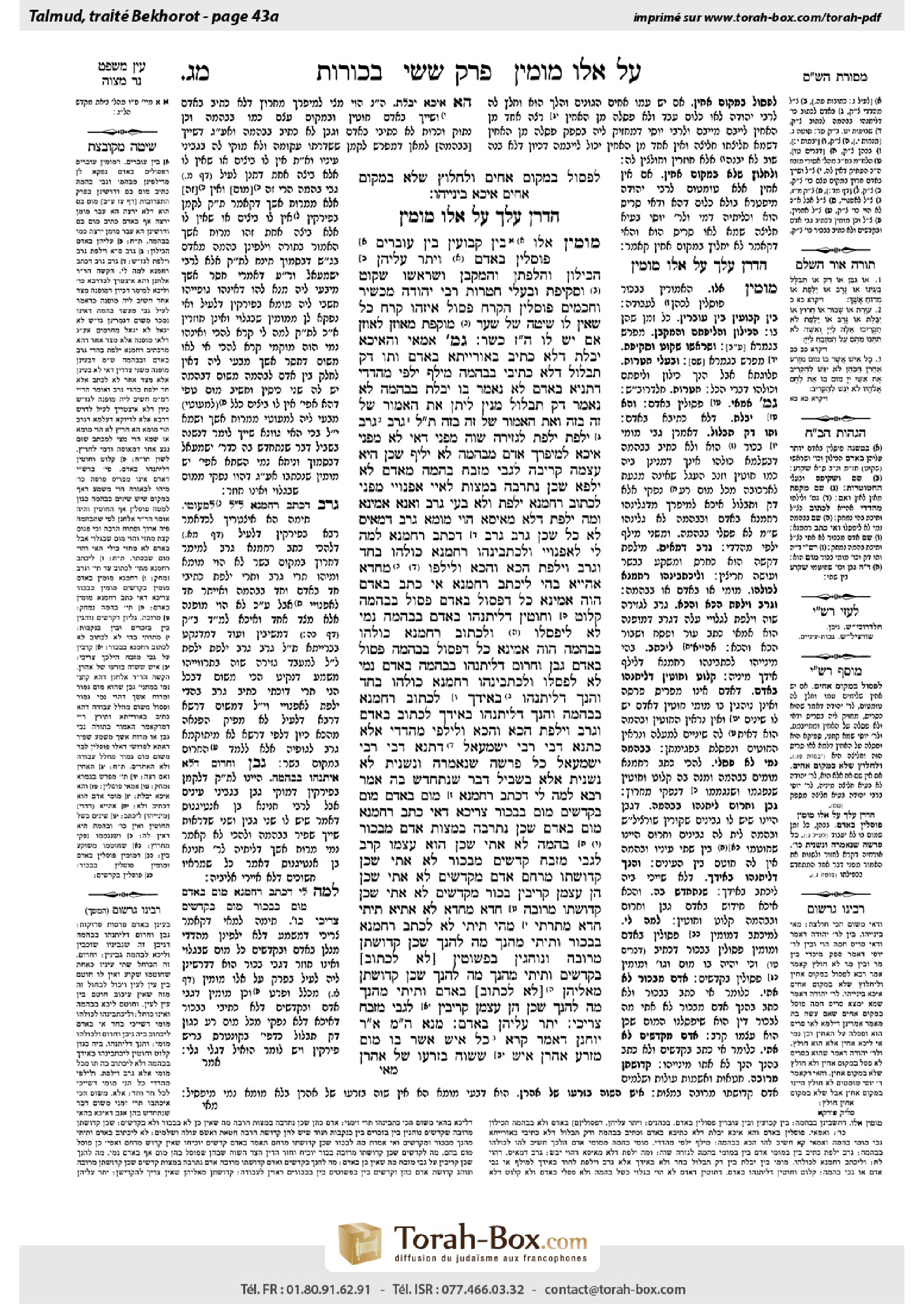
Bekhorot 43a: Talmud study for Daf Yomi
Study the Talmud for Daf Yomi with scanned pages, Hebrew text, English translations from Sefaria and AI-generated French translations.
Passage selection and English or AI-generated French translation are available where the scan has annotations. Daf Study is independent of Torah-Box and Sefaria.
Browse Bekhorot · בכורות · All tractatesBekhorot 43a text and translations
This page of Bekhorot includes the Aramaic text, an English translation and an AI-generated French translation, alongside the scan above.
בכורות מ״ג א · Aramaic and Hebrew text
לִפְסוֹל בִּמְקוֹם אַחִים,
וְלַחְלוֹץ שֶׁלֹּא בִּמְקוֹם אַחִים, אִיכָּא בֵּינַיְיהוּ.
הֲדַרַן עֲלָךְ עַל אֵלּוּ מוּמִין.
מַתְנִי׳ מוּמִין אֵלּוּ, בֵּין קְבוּעִין בֵּין עוֹבְרִים — פּוֹסְלִין בָּאָדָם, וְיָתֵר עֲלֵיהֶן: הַכִּילוֹן, וְהַלַּפְתָּן, וְהַמַּקָּבָן, וְשֶׁרֹאשׁוֹ שָׁקוּט, וּסְקִיפַת.
וּבַעֲלֵי חֲטָרוֹת — רַבִּי יְהוּדָה מַכְשִׁיר, וַחֲכָמִים פּוֹסְלִין. הַקֵּרֵחַ פָּסוּל. אֵיזֶהוּ קֵרֵחַ? כֹּל שֶׁאֵין לוֹ שִׁיטָה שֶׁל שֵׂעָר מוּקֶּפֶת מֵאוֹזֶן לְאוֹזֶן, אִם יֵשׁ לוֹ — הֲרֵי זֶה כָּשֵׁר.
גְּמָ׳ אַמַּאי? וְהָאִיכָּא יַבֶּלֶת, דְּלָא כְּתִיב בְּאוֹרָיְיתָא בְּאָדָם! וְתוּ: דַּק תְּבַלּוּל, דְּלָא כְּתִיבִי בִּבְהֵמָה!
מֵילָף יָלְפִי מֵהֲדָדֵי, דְּתַנְיָא: בָּאָדָם לֹא נֶאֱמַר בּוֹ יַבֶּלֶת, בַּבְּהֵמָה לֹא נֶאֱמַר דַּק תְּבַלּוּל, מִנַּיִן לִיתֵּן אֶת הָאָמוּר שֶׁל זֶה בָּזֶה וְאֶת הָאָמוּר שֶׁל זֶה בָּזֶה? תַּלְמוּד לוֹמַר: ״גָּרָב״ ״גָּרָב״, ״יַלֶּפֶת״ ״יַלֶּפֶת״ לִגְזֵירָה שָׁוָה.
מַפְנֵי, דְּאִי לָא מַפְנֵי, אִיכָּא לְמִיפְרַךְ: אָדָם מִבְּהֵמָה לָא יָלֵיף, שֶׁכֵּן הִיא עַצְמָהּ קְרֵיבָה לְגַבֵּי מִזְבֵּחַ; בְּהֵמָה מֵאָדָם לָא יָלְפָא, שֶׁכֵּן נִתְרַבָּה בְּמִצְוֹת.
לָאיֵי, אַפְנוֹיֵי מַפְנֵי, לִכְתּוֹב רַחֲמָנָא ״יַלֶּפֶת״ וְלָא בָּעֵי ״גָּרָב״, וַאֲנָא אָמֵינָא: וּמָה יַלֶּפֶת דְּלָא מְאִיסָא הָוֵי מוּמָא, גָּרָב דִּמְאִיס לֹא כׇּל שֶׁכֵּן? ״גָּרָב״ ״גָּרָב״ דִּכְתַב רַחֲמָנָא לְמָה לִי? לְאַפְנוֹיֵי.
וְלִכְתְּבִינְהוּ רַחֲמָנָא כּוּלְּהוּ בְּחַד, וְגָרָב וְיַלֶּפֶת הָכָא וְהָכָא, וְלֵילְפוּ מֵחֲדָא!
אַהֵיָיא בְּהֵי לִיכְתֹּב רַחֲמָנָא? אִי כְּתַב בְּאָדָם, הֲוָה אָמֵינָא: כֹּל דְּפָסוּל בְּאָדָם פָּסוּל בִּבְהֵמָה, קָלוּט וְחוּטִין דְּלֵיתַנְהוּ בְּאָדָם, בִּבְהֵמָה נָמֵי לָא לִיפַּסְלוּ.
וְלִכְתּוֹב רַחֲמָנָא כּוּלְּהוּ בִּבְהֵמָה, הָוֵה אָמֵינָא: כֹּל דְּפָסוּל בִּבְהֵמָה פָּסוּל בְּאָדָם, גִּבֵּן וְחָרוּם דְּלֵיתַנְהוּ בִּבְהֵמָה — בְּאָדָם נָמֵי לָא לִיפַּסְלוּ.
וְלִכְתְּבִינְהוּ רַחֲמָנָא כּוּלְּהוּ בְּחַד, וְהָנָךְ דְּלֵיתַנְהוּ בְּאִידַּךְ — לִכְתּוֹב רַחֲמָנָא בִּבְהֵמָה, וְהָנָךְ דְּלֵיתַנְהוּ בְּאִידַּךְ — לִכְתּוֹב בְּאָדָם, וְגָרָב וְיַלֶּפֶת — הָכָא וְהָכָא, וְלֵילְפִי מֵהֲדָדֵי.
אֶלָּא, כְּתַנָּא דְּבֵי רַבִּי יִשְׁמָעֵאל, דְּתָנָא דְּבֵי רַבִּי יִשְׁמָעֵאל: כׇּל פָּרָשָׁה שֶׁנֶּאֶמְרָה וְנִשְׁנֵית — לֹא נִשְׁנֵית אֶלָּא בִּשְׁבִיל דָּבָר שֶׁנִּתְחַדֵּשׁ בָּהּ.
אָמַר רָבָא: לְמָה לִי דִּכְתַב רַחֲמָנָא מוּם בְּאָדָם, מוּם בְּקָדָשִׁים, מוּם בִּבְכוֹר?
צְרִיכָא, דְּאִי כְּתַב רַחֲמָנָא מוּם בְּאָדָם, שֶׁכֵּן נִתְרַבָּה בְּמִצְווֹת. אָדָם מִבְּכוֹר בְּהֵמָה לָא אָתֵי, שֶׁכֵּן הוּא עַצְמוֹ קָרֵב לְגַבֵּי מִזְבֵּחַ.
קָדָשִׁים מִבְּכוֹר לָא אָתֵי, שֶׁכֵּן קְדוּשָּׁתוֹ מֵרֶחֶם.
אָדָם מִקֳּדָשִׁים לָא אָתֵי, שֶׁכֵּן הֵן עַצְמָן קְרֵיבִין. בְּכוֹר מִקֳּדָשִׁים לָא אָתֵי, שֶׁכֵּן קְדוּשָּׁתוֹ מְרוּבָּה.
חֲדָא מֵחֲדָא לָא אָתְיָא, תֵּיתֵי חֲדָא מִתַּרְתֵּי? מֵהֵי תֵּיתֵי?! לָא לִכְתֹּב רַחֲמָנָא בִּבְכוֹר, וְתֵיתֵי מֵהָנָךְ? מָה לְהָנָךְ שֶׁכֵּן קְדוּשָּׁתָן מְרוּבָּה, וְנוֹהֲגִין בִּפְשׁוּטִין.
בְּקָדָשִׁים, וְתֵיתֵי מֵהָנָךְ? מָה לְהָנָךְ שֶׁכֵּן קְדוּשָּׁתָן מֵאֲלֵיהֶן!
בְּאָדָם, וְתֵיתֵי מֵהָנָךְ? מָה לְהָנָךְ שֶׁכֵּן הֵן עַצְמָן קְרֵיבִין לְגַבֵּי מִזְבֵּחַ! צְרִיכִי.
יָתֵר עֲלֵיהֶן בְּאָדָם. מְנָא הָנֵי מִילֵּי? אָמַר רַבִּי יוֹחָנָן, דְּאָמַר קְרָא: ״כֹּל אִישׁ אֲשֶׁר בּוֹ מוּם מִזֶּרַע אַהֲרֹן״, אִישׁ שֶׁשָּׁוֶה בְּזַרְעוֹ שֶׁל אַהֲרֹן.
Bekhorot 43a · English translation
There is a practical difference with regard to disqualifying the widow, through his ḥalitza, from entering into levirate marriage in a case where there are other brothers. According to Rabbi Yehuda, who maintains that this individual is certainly a eunuch whose condition is caused naturally, his ḥalitza is of no effect whatsoever, and therefore she may enter into levirate marriage with one of the other brothers. Conversely, according to Rabbi Yosei, son of Rabbi Yehuda, since it is possible that he is not a eunuch and his ḥalitza is valid, she is forbidden to the other brothers as their brother’s wife.
And there is also a practical difference between their opinions with regard to performing ḥalitza with the widow in a case where there are no brothers other than this tumtum. According to Rabbi Yehuda, ḥalitza is not necessary in this case, as she requires ḥalitza only if her late husband had brothers who are obligated to perform levirate marriage, and this individual is definitely a eunuch whose condition is caused naturally. By contrast, Rabbi Yosei, son of Rabbi Yehuda, maintains that he must perform ḥalitza with her, in case he is a male and not a eunuch.
MISHNA: Concerning these blemishes which were taught with regard to an animal, whether they are permanent or transient, they also disqualify in the case of a person, i.e., they disqualify a priest from performing the Temple service. And in addition to those blemishes, there are other blemishes that apply only to a priest: One whose head is pointed, narrow above and wide below; and one whose head is turnip-like, wide above and narrow below; and one whose head is hammer-like, with his forehead protruding; and one whose head has an indentation; and one wherein the back of his head protrudes.
And with regard to those with humped backs, Rabbi Yehuda deems them fit for service and the Rabbis deem them disqualified. The kere’aḥ is disqualified from performing the Temple service. What is a kere’aḥ? It is anyone who does not have a row of hair encircling his head from ear to ear. If he has a row of hair from ear to ear, that person is fit for service.
GEMARA: The Gemara asks: Why does the mishna say that all the blemishes that disqualify an animal disqualify a priest as well? But there is the blemish of a wart, which is not written in the Torah with regard to a person but is written with regard to an animal (see Leviticus 22:22). And furthermore, there are also the blemishes of a cataract and a tevallul, which appear in the Torah with regard to a person but are not written in the Torah with regard to an animal (see Leviticus 21:20). Why, then, does the mishna on 38a teach that such blemishes disqualify an animal?
The Gemara responds: These blemishes are derived from one another, as it is taught in a baraita: In the case of a person, i.e., a priest, it is not stated of him that a wart disqualifies him from Temple service, and in the case of an animal, it is not stated that a cataract or a tevallul disqualify it from being sacrificed. From where is it derived that one applies that which is said of this case to that case, and that which is said of this case to that case? The verse states: “Scabbed” and “scabbed,” “scurvy” and “scurvy,” both with regard to a person and an animal (Leviticus 21:20; 22:22), which serves to draw a verbal analogy from the verses.
The Gemara notes: These verses must be free, i.e., they are superfluous and are stated only for the purpose of the verbal analogy. This means that the verbal analogy cannot be refuted by logical reasoning, whereas if the verses are not free one can refute the analogy if there is a significant difference between the two cases. As, if they are not free, the verbal analogy can be refuted as follows: One cannot derive the disqualifications of a person for performing the Temple service from those of an animal, as the case of an animal can be considered more stringent because the animal itself is sacrificed upon the altar. Similarly, one cannot derive the disqualifications of an animal from those of a person, as one can claim that the halakha with regard to a person should be more stringent, since a person was included in the performance of mitzvot.
Indeed, the terms are free. Accordingly, since these disqualifications are derived from a verbal analogy they must be accepted as though they were written explicitly in the Torah. The Gemara proves these verses are free: Let the Merciful One write that scurvy disqualifies a person and an animal, and it would be unnecessary for the Merciful One to write that a scab disqualifies them, as I would say: And if scurvy, which is not repulsive, is considered a disqualifying blemish, then in the case of a scab, which is repulsive, is it not all the more so a disqualifying blemish? If so, then with regard to “scabbed” and “scabbed,” which the Merciful One writes with regard to a person and an animal, why do I need them? Evidently, they are to be considered free for the verbal analogy.
The Gemara raises a difficulty: But if animals and priests are disqualified by the same blemishes, let the Merciful One write all the disqualifying blemishes with regard to one of them, either a person or an animal, and let the Merciful One write that a scab and scurvy disqualify both here and here, for the purpose of the verbal analogy, and let all the other blemishes be derived in one case from the other one, through the verbal analogy.
The Gemara responds: To which is this referring, i.e., in which case should the Merciful One write all the blemishes? If the Merciful One had written all of them with regard to a person then I would say: All blemishes that disqualify in the case of a person likewise disqualify in the case of an animal. If so, then with regard to closed hooves and damaged gums, which are not written with regard to a person as they are not relevant because a person has no hooves and his gums are covered with teeth, I would say: In the case of an animal as well they should not disqualify.
And if you would say: Let the Merciful One write all the blemishes with regard to an animal, I would say: All blemishes that disqualify in the case of an animal likewise disqualify in the case of a person. Accordingly, with regard to a gibben, one with blemished eyebrows, or a ḥarum, one with a sunken nose, which are not written with regard to an animal as such blemishes do not occur among animals, I would say: In the case of a person as well they should not disqualify. Therefore, the Torah delineates all the disqualifying blemishes with regard to both an animal and a person in order to state the blemishes that are unique to animals and the blemishes that are unique to people.
The Gemara asks: But even so, why is it necessary for the Torah to delineate all the common blemishes? Let the Merciful One write all of them in the verses discussing one of them, either an animal or a person, and as for those that are not relevant for the other, i.e., those blemishes that apply only in the case of an animal, let the Merciful One write with regard to an animal, and as for those that are not relevant for the other, i.e., those blemishes relevant only to a person, let the Merciful One write with regard to a person. And let the Torah write the blemishes of a scab and scurvy both here and there, for the purpose of the verbal analogy, and let the fact that their common blemishes disqualify in both cases be derived from one another.
Rather, the reason the Torah repeats their common blemishes is in accordance with that which the school of Rabbi Yishmael taught, as the school of Rabbi Yishmael taught: Every passage in the Torah that was stated and repeated was repeated only for the novel element introduced therein. It is the style of the Torah to repeat a passage even in order to teach only one additional halakha. Consequently, with regard to the blemishes of a person and an animal, their common blemishes were repeated on account of those blemishes that apply only to an animal or a person.
§ Rava says: Why do I need the Merciful One to write that a blemish causes disqualification from Temple service in the case of a person, i.e., a priest (see Leviticus 21:17–23), and that a blemish causes disqualification in the case of sacrificial animals (see Leviticus 22:20–25), and that a blemish causes disqualification for sacrifice in the case of a firstborn animal (see Deuteronomy 15:21)?
Rava answers: They are all necessary. As, had the Merciful One written only that a blemish causes disqualification in the case of a person, one might suggest that blemishes cause disqualification only in that case, since a person was included in the performance of mitzvot. Similarly, had the Merciful One written only that blemishes disqualify a firstborn animal from being sacrificed, it could be claimed that one cannot derive the disqualification of a person on account of blemishes from the disqualification of a firstborn animal, since an animal has an added aspect of stringency in that it itself is sacrificed upon the altar.
Additionally, one cannot derive the disqualifications of sacrificial animals from those of a firstborn animal, since the sanctity of a firstborn animal is from the womb, i.e., from birth, whereas the sanctity of other offerings applies only upon consecration by a person, and they are therefore of a lesser sanctity.
Furthermore, had the Merciful One written only that sacrificial animals are disqualified due to blemishes, it could be claimed that one cannot derive the disqualifications of a person from that of sacrificial animals, as the offerings themselves are sacrificed. Similarly, one cannot derive the disqualifications of a firstborn animal from those of sacrificial animals, as the sanctity of other offerings is greater than that of a firstborn animal because there are many types of other offerings, whereas a firstborn animal has only one type of sanctification. Therefore, it was necessary for the Merciful One to specify that blemishes disqualify in each case.
The Gemara raises a difficulty: Granted, the disqualification of one of these cases cannot be derived from only a single other one. But let one of them be derived from the other two. The Gemara rejects this suggestion: From which two should the other one be derived? If you will say: Let the Merciful One not write that blemishes disqualify a firstborn animal and one should derive that case from these, i.e., the disqualifications of a person and sacrificial animals, this suggestion can be rejected. What is notable about these? They are notable in that their sanctity is greater than that of a firstborn offering, as in the case of a person, he is included in the performance of mitzvot; and in the case of a sacrificial animal, there are many types of offerings. Moreover, the halakhot of these blemishes apply to regular, i.e., non-firstborn, animals and people.
Furthermore, if one will say: Let the Merciful One not write that blemishes disqualify sacrificial animals and one should derive that case from these cases, a person, i.e., a priest, and a firstborn animal, this too can be rejected: What is notable about these? They are notable in that their sanctity is automatic and requires no consecration, as a priest is a priest by virtue of being the son of a priest, and a firstborn attains its status by being the first child of its mother, while offerings are consecrated by their owners.
Finally, if one will say: Let the Merciful One not write that blemishes disqualify a person and one should derive that case from these cases, the firstborn animal and sacrificial animals, this suggestion too can be rejected: What is notable about these? They are notable in that they themselves are sacrificed upon the altar, whereas a person is not. Therefore, all three verses are necessary, to teach that blemishes disqualify in all these cases.
§ The mishna teaches that in addition to those blemishes that disqualify an animal, there are other blemishes that apply to a person despite the fact that they are not actual defects. The Gemara asks: From where are these matters derived? Rabbi Yoḥanan said: These halakhot are derived from that which the verse states: “No man among the seed of Aaron the priest who has a blemish shall come forward to sacrifice the offerings of the Lord made by fire” (Leviticus 21:21). The verse indicates that the priest must be a man who is equal among the seed of Aaron, i.e., one whose appearance is similar to the other priests.
Bekhorot 43a · Traduction française (IA)
Il existe une différence pratique concernant l'invalidation de la veuve par le moyen de la ḥalitza, en ce qui concerne l'entrée en mariage levirat avec un autre frère. Selon Rabbi Yehuda, qui affirme que cette personne est certainement un eunuque dont l'état est causé naturellement, sa ḥalitza n'a aucun effet, et par conséquent elle peut entrer en mariage levirat avec l'un des autres frères. À l'inverse, selon Rabbi Yosei, fils de Rabbi Yehuda, puisque cela est possible qu'il ne soit pas un eunuque et que sa ḥalitza soit valide, elle est interdite aux autres frères en tant que femme de son frère.
Il existe également une différence pratique entre leurs opinions concernant la pratique de la ḥalitza avec la veuve dans le cas où il n'y a pas d'autres frères que ce tumtum. Selon Rabbi Yehuda, la ḥalitza n'est pas nécessaire dans ce cas, car elle est requise uniquement si le défunt avait des frères obligés de pratiquer le mariage levirat, et cette personne est certainement un eunuque dont l'état est causé naturellement. En revanche, Rabbi Yosei, fils de Rabbi Yehuda, affirme qu'il doit pratiquer la ḥalitza avec elle, en cas où il est un homme et non un eunuque.
MICHNA : Concernant ces défauts qui ont été enseignés concernant un animal, si ces défauts sont permanents ou temporaires, ils sont également invalidants dans le cas d'une personne, c'est-à-dire qu'ils invalident un prêtre de pratiquer le service du Temple. Et en plus de ces défauts, il existe d'autres défauts qui s'appliquent uniquement au prêtre : celui dont la tête est pointue, étroite en haut et large en bas ; celui dont la tête est en forme de navet, large en haut et étroite en bas ; celui dont la tête est en forme de marteau, avec un front saillant ; celui dont la tête a une dépression ; et celui dont la partie arrière de la tête saillante.
Et concernant ceux qui ont une bosse, Rabbi Yehuda considère qu'ils sont aptes au service et les Rabbins considèrent qu'ils sont invalidés. Le kere’aḥ est invalidé pour effectuer le service du Temple. Qu'est-ce qu'un kere’aḥ ? C'est toute personne qui n'a pas une rangée de cheveux entourant sa tête de l'oreille à l'oreille. Si elle a une rangée de cheveux de l'oreille à l'oreille, cette personne est apte au service.
GUEMARA : La Guemara pose la question : Pourquoi la Michna dit que tous les défauts qui invalident un animal invalident également un prêtre ? Mais il existe le défaut de la verrue, qui n'est pas mentionné dans la Torah concernant une personne mais est mentionné concernant un animal (voir Lévitique 22:22). Et de plus, il existe également les défauts de cataracte et de tevallul, qui apparaissent dans la Torah concernant une personne mais ne sont pas mentionnés dans la Torah concernant un animal (voir Lévitique 21:20). Pourquoi, alors, la Michna sur 38a enseigne que ces défauts invalident un animal ?
La Guemara répond : Ces défauts sont dérivés les uns des autres, comme il est enseigné dans une baraïta : Dans le cas d'une personne, c'est-à-dire un prêtre, il n'est pas dit qu'une verrue l'invalidait du service du Temple, et dans le cas d'un animal, il n'est pas dit qu'un cataracte ou un tevallul l'invalidaient de l'immolation. D'où est-il dérivé que l'un s'applique à l'autre, et que l'un s'applique à l'autre ? La Sainte Écriture dit : « Poux » et « poux », « taches » et « taches », tous concernant une personne et un animal (Lévitique 21:20 ; 22:22), ce qui sert à établir une analogie verbale entre les versets.
La Guemara note : Ces versets doivent être libres, c'est-à-dire ils sont superflus et sont mentionnés uniquement à l'effet de l'analogie verbale. Cela signifie que l'analogie verbale ne peut pas être réfutée par la raison, tandis que si les versets ne sont pas libres, on peut réfuter l'analogie si il y a une différence significative entre les deux cas. En effet, si ils ne sont pas libres, l'analogie verbale peut être réfutée ainsi : On ne peut pas dériver les invalidations d'une personne pour le service du Temple à partir des invalidations d'un animal, car le cas de l'animal peut être considéré comme plus strict, car l'animal lui-même est immolé sur l'autel. De même, on ne peut pas dériver les invalidations d'un animal à partir de celles d'une personne, car on peut affirmer que la halakha concernant une personne devrait être plus strict, puisque la personne a été incluse dans la pratique des mitsvot.
En effet, les termes sont libres. Ainsi, puisque ces invalidations sont dérivées d'une analogie verbale, elles doivent être acceptées comme si elles étaient explicitement écrites dans la Torah. La Guemara prouve que ces versets sont libres : Que le Miséricordieux écrive que la tache invalidait une personne et un animal, et il serait inutile que le Miséricordieux écrive que la poux invalidait eux aussi, car je dirais : Et si la tache, qui n'est pas répugnante, est considérée comme un défaut invalidant, alors dans le cas de la poux, qui est répugnante, n'est-ce pas encore plus un défaut invalidant ? Si c'est ainsi, alors concernant « poux » et « poux », qui le Miséricordieux écrit concernant une personne et un animal, pourquoi ai-je besoin d'eux ? Évidemment, ils doivent être considérés comme libres à l'effet de l'analogie verbale.
La Guemara soulève une difficulté : Mais si les animaux et les prêtres sont invalidés par les mêmes défauts, que le Miséricordieux écrive tous les défauts invalidants concernant l'un d'eux, soit une personne soit un animal, et que le Miséricordieux écrive que la poux et la tache invalident les deux ici et là, à l'effet de l'analogie verbale, et que tous les autres défauts soient dérivés d'un cas à l'autre par l'analogie verbale.
La Guemara répond : À quel cas cela se réfère-t-il, c'est-à-dire dans quel cas le Miséricordieux devrait écrire tous les défauts ? Si le Miséricordieux avait écrit tous d'eux concernant une personne, je dirais : tous les défauts invalidants dans le cas d'une personne invalident également dans le cas d'un animal. Si c'est ainsi, alors concernant les pieds fermés et les gencives endommagées, qui ne sont pas écrits concernant une personne car ils ne sont pas pertinents, car une personne n'a pas de pieds et ses gencives sont couvertes de dents, je dirais : dans le cas d'un animal également ils ne devraient pas invalider.
Et si l'on disait : Que le Miséricordieux écrive toutes les imperfections concernant un animal, je dirais : toutes les imperfections qui rendent un animal inaptif rendent également un homme inaptif. Ainsi, concernant un gibben, un animal avec des sourcils broussailleux, ou un ḥarum, un animal avec un nez creux, qui ne sont pas mentionnés concernant un animal, car ces imperfections n'existent pas chez les animaux, je dirais : dans le cas d'un homme également, elles ne devraient pas rendre inaptif. Par conséquent, la Torah définit toutes les imperfections qui rendent inaptif, tant pour un animal que pour un homme, afin d'indiquer les imperfections propres aux animaux et celles propres aux hommes.
La Guemara demande : Mais même ainsi, pourquoi la Torah doit-elle définir toutes les imperfections communes ? Que le Miséricordieux écrive toutes ces imperfections dans les versets concernant l'un d'entre eux, soit un animal soit un homme, et quant à celles qui ne s'appliquent pas à l'autre, c'est-à-dire celles qui s'appliquent uniquement à un animal, que le Miséricordieux écrive concernant un animal, et quant à celles qui ne s'appliquent pas à l'autre, c'est-à-dire celles qui s'appliquent uniquement à un homme, que le Miséricordieux écrive concernant un homme. Et que la Torah écrive les imperfections d'une croûte et d'une maladie de la peau à la fois ici et là, à l'effet de l'analogie verbale, et que le fait que leurs imperfections communes rendent inaptif dans les deux cas soit déduit mutuellement.
Au contraire, la raison pour laquelle la Torah répète leurs imperfections communes est conforme à ce que l'école de Rabbi Yishmael a enseigné, car l'école de Rabbi Yishmael enseignait : tout passage dans la Torah qui a été dit et répété a été répété uniquement pour l'élément nouveau introduit. C'est le style de la Torah de répéter un passage même afin d'enseigner une seule halakha supplémentaire. Ainsi, concernant les imperfections d'un homme et d'un animal, leurs imperfections communes ont été répétées à cause des imperfections qui s'appliquent uniquement à un animal ou à un homme.
§ Rava dit : Pourquoi ai-je besoin que le Miséricordieux écrive que les imperfections rendent inapte au service du Temple dans le cas d'un homme, c'est-à-dire un prêtre (voir Lévitique 21:17–23), et que les imperfections rendent inapte dans le cas des animaux sacrés (voir Lévitique 22:20–25), et que les imperfections rendent inapte pour le sacrifice dans le cas d'un premier-né d'animal (voir Deutéronome 15:21) ?
Rava répond : Tous sont nécessaires. Car, si le Miséricordieux avait écrit seulement que les imperfections rendent inapte dans le cas d'un homme, on pourrait suggérer que les imperfections rendent inapte uniquement dans ce cas, puisqu'un homme est inclus dans l'accomplissement des mitsvot. De même, si le Miséricordieux avait écrit seulement que les imperfections rendent inapte un premier-né d'animal pour le sacrifice, on pourrait affirmer qu'on ne peut déduire l'inaptitude d'un homme à cause des imperfections à partir de l'inaptitude d'un premier-né d'animal, puisqu'un animal a une dimension supplémentaire de stricteur, car il est lui-même sacrifié sur l'autel.
De plus, on ne peut pas déduire l'inaptitude des animaux sacrés à partir de celle du premier-né d'animal, car la sanctité du premier-né d'animal vient de l'utérus, c'est-à-dire de la naissance, tandis que la sanctité des autres offrandes s'applique uniquement après la consécration par une personne, et elles sont donc de moindre sanctité.
En outre, si le Miséricordieux avait écrit seulement que les animaux sacrés sont inaptes à cause d'imperfections, on pourrait affirmer qu'on ne peut déduire l'inaptitude d'un homme à partir de celle des animaux sacrés, car les offrandes elles-mêmes sont sacrifiées. De même, on ne peut pas déduire l'inaptitude du premier-né d'animal à partir de celle des animaux sacrés, car la sanctité des autres offrandes est supérieure à celle du premier-né d'animal, car il y a de nombreux types d'autres offrandes, tandis que le premier-né d'animal a seulement un type de sanctification. Par conséquent, il était nécessaire que le Miséricordieux précise que les imperfections rendent inapte dans chaque cas.
Le Guemara soulève une difficulté : Admettons que l'inaptitude d'un de ces cas ne puisse pas être déduite à partir d'un seul autre cas. Mais laissez un d'entre eux être déduit à partir des deux autres. Le Guemara rejette cette suggestion : à partir de quels deux devrait-on déduire l'autre ? Si l'on dit : que le Miséricordieux ne doive pas écrire que les imperfections rendent inapte un premier-né d'animal et qu'on doive déduire ce cas à partir de ceux-ci, c'est-à-dire l'inaptitude d'un homme et des animaux sacrés, cette suggestion peut être rejetée. Qu'est-ce qui est notable à leur sujet ? Ils sont notables dans le fait que leur sanctité est supérieure à celle d'une offrande de premier-né, car dans le cas d'un homme, il est inclus dans l'accomplissement des mitsvot ; et dans le cas d'une offrande sacrée, il y a de nombreux types d'offrandes. De plus, les halakhot de ces imperfections s'appliquent aux animaux et aux hommes non premier-nés.
De plus, si l'on dit : que le Miséricordieux ne doive pas écrire que les imperfections rendent inapte une offrande sacrée et qu'on doive déduire ce cas à partir de ces cas, un homme, c'est-à-dire un prêtre, et un premier-né d'animal, cette suggestion peut également être rejetée : qu'est-ce qui est notable à leur sujet ? Ils sont notables dans le fait que leur sanctité est automatique et ne nécessite pas de consécration, car un prêtre est un prêtre par le fait d'être le fils d'un prêtre, et un premier-né acquiert son statut par être le premier enfant de sa mère, tandis que les offrandes sont consacrées par leurs propriétaires.
Enfin, si l'on dit : que le Miséricordieux ne doive pas écrire que les imperfections rendent inapte un homme et qu'on doive déduire ce cas à partir de ces cas, le premier-né d'animal et les animaux sacrés, cette suggestion peut également être rejetée : qu'est-ce qui est notable à leur sujet ? Ils sont notables dans le fait qu'ils eux-mêmes sont sacrifiés sur l'autel, tandis qu'un homme ne l'est pas. Par conséquent, tous les trois versets sont nécessaires, afin d'enseigner que les imperfections rendent inapte dans tous ces cas.
§ La Michna enseigne que, en plus des défauts qui rendent un animal inacceptable, il existe d'autres défauts applicables à une personne, même s'ils ne sont pas des défauts réels. La Guemara pose la question : d'où sont dérivés ces enseignements ? Rabbi Yochanan dit : ces halakhot sont dérivés de ce que la Paracha stipule : « Nul homme parmi la descendance d'Aaron le prêtre qui a un défaut ne doit s'avancer pour présenter les offrandes du Seigneur, offrandes faites par le feu » (Lévitique 21:21). La Paracha indique que le prêtre doit être un homme égal parmi la descendance d'Aaron, c'est-à-dire celui dont l'apparence est semblable aux autres prêtres.
Traduction française générée par IA à partir de l’édition anglaise de Sefaria. Vérifie toujours un passage avec le texte source.
Text from Sefaria: William Davidson Edition - Vocalized Aramaic (CC BY NC); William Davidson Edition - English (CC BY NC).