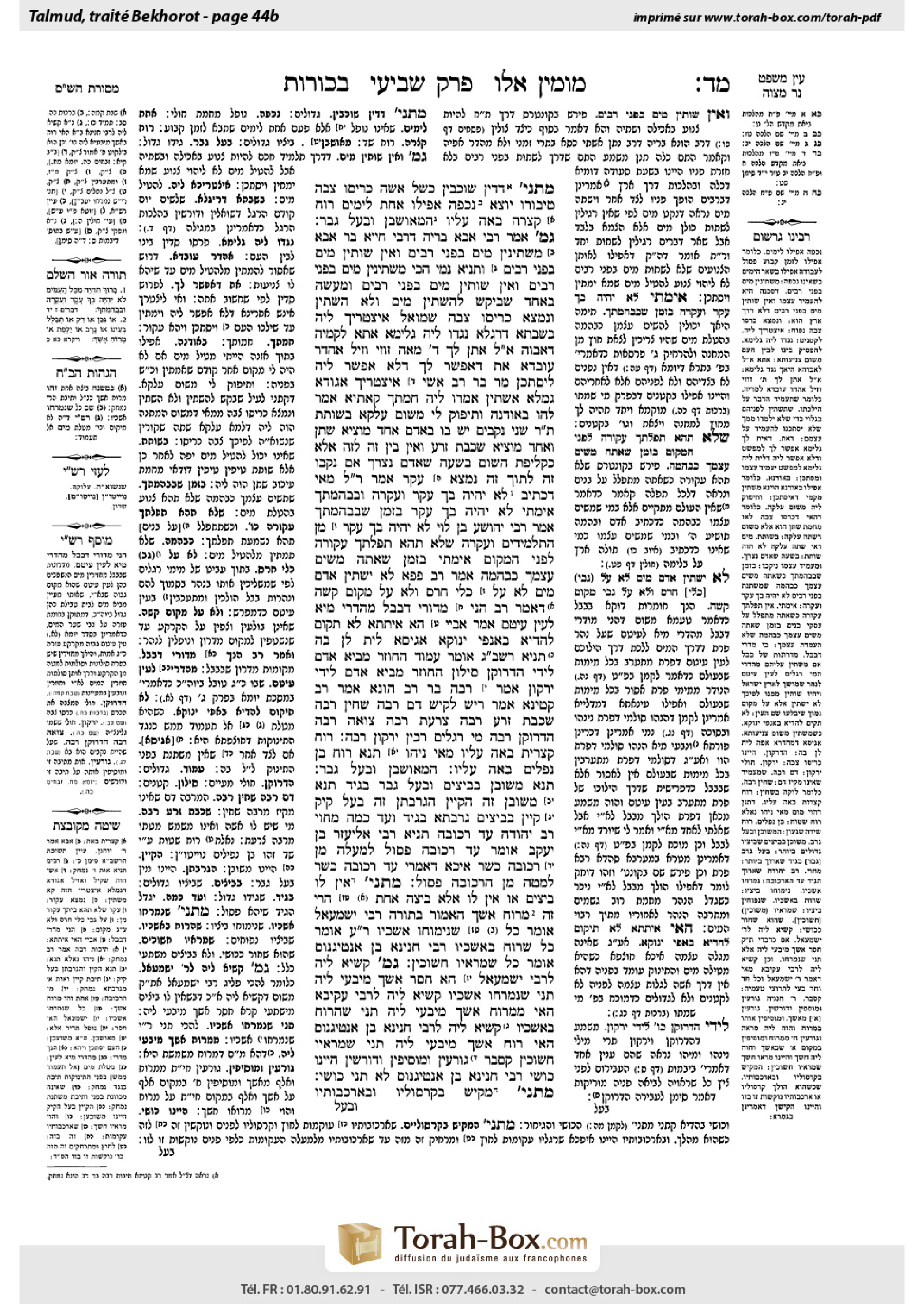
Bekhorot 44b: Talmud study for Daf Yomi
Study the Talmud for Daf Yomi with scanned pages, Hebrew text, English translations from Sefaria and AI-generated French translations.
Passage selection and English or AI-generated French translation are available where the scan has annotations. Daf Study is independent of Torah-Box and Sefaria.
Browse Bekhorot · בכורות · All tractatesBekhorot 44b text and translations
This page of Bekhorot includes the Aramaic text, an English translation and an AI-generated French translation, alongside the scan above.
בכורות מ״ד ב · Aramaic and Hebrew text
מַתְנִי׳ דַּדִּין שׁוֹכְבִין כְּשֶׁל אִשָּׁה, כְּרֵיסוֹ צָבָה, טִיבּוּרוֹ יוֹצֵא, נִכְפֶּה — אֲפִילּוּ אַחַת לְיָמִים, רוּחַ קְצָרָה בָּאָה עָלָיו, הַמְאוּשְׁבָּן, וּבַעַל גֶּבֶר.
גְּמָ׳ אָמַר רַבִּי אַבָּא בְּרֵיהּ דְּרַבִּי חִיָּיא בַּר אַבָּא: מַשְׁתִּינִין מַיִם בִּפְנֵי רַבִּים, וְאֵין שׁוֹתִין מַיִם בִּפְנֵי רַבִּים. וְתַנְיָא נָמֵי הָכִי: מַשְׁתִּינִין מַיִם בִּפְנֵי רַבִּים, וְאֵין שׁוֹתִין מַיִם בִּפְנֵי רַבִּים. וּמַעֲשֶׂה בְּאֶחָד שֶׁבִּיקֵּשׁ לְהַשְׁתִּין מַיִם וְלֹא הִשְׁתִּין, וְנִמְצָא כְּרֵיסוֹ צָבָה.
שְׁמוּאֵל אִיצְטְרִיךְ לֵיהּ בְּשַׁבְּתָא דְרִגְלָא, נְגַדוּ לֵיהּ גְּלִימָא, אֲתָא לְקַמֵּיהּ דַּאֲבוּהּ, אֲמַר לֵיהּ: אֶתֵּן לָךְ אַרְבַּע מְאָה זוּזֵי וְזִיל אַהְדַּר עוֹבָדָא. אַתְּ — דְּאֶפְשָׁר לָךְ, דְּלָא אֶפְשָׁר לֵיהּ — לִיסְתַּכַּן.
מָר בַּר רַב אָשֵׁי אִיצְטְרִיךְ אַגּוּדָּא גַּמְלָא, אַשְׁתֵּין. אֲמַרוּ לֵיהּ: חֲמָתָךְ קָאָתְיָא! אֲמַר לְהוּ: בְּאוּדְנַהּ.
וְתִיפּוֹק לִי מִשּׁוּם עַלְקָא! בְּשׁוֹתֵת.
תָּנוּ רַבָּנַן: שְׁנֵי נְקָבִים יֵשׁ בּוֹ בָּאָדָם, אֶחָד מוֹצִיא שֶׁתֶן וְאֶחָד מוֹצִיא שִׁכְבַת זֶרַע, וְאֵין בֵּין זֶה לָזֶה אֶלָּא כִּקְלִיפַּת הַשּׁוּם. בְּשָׁעָה שֶׁאָדָם נִצְרָךְ, אִם נִקְּבוּ זֶה לְתוֹךְ זֶה — נִמְצָא עָקָר.
אָמַר רֵישׁ לָקִישׁ: מַאי דִּכְתִיב ״לֹא יִהְיֶה בְךָ עָקָר וַעֲקָרָה וּבִבְהֶמְתֶּךָ״? אֵימָתַי לֹא יִהְיֶה בְךָ עָקָר? בִּזְמַן שֶׁ״בִּבְהֶמְתֶּךָ״.
אָמַר רַבִּי יְהוֹשֻׁעַ בֶּן לֵוִי: ״לֹא יִהְיֶה בְךָ עָקָר״ — מִן הַתַּלְמִידִים, ״וַעֲקָרָה״ — שֶׁלֹּא תְּהֵא תְּפִלָּתֶךָ עֲקוּרָה לִפְנֵי הַמָּקוֹם. אֵימָתַי? בִּזְמַן שֶׁאַתָּה מֵשִׂים עַצְמְךָ כִּבְהֵמָה.
אָמַר רַב פָּפָּא: לֹא יַשְׁתִּין אָדָם מַיִם לֹא עַל כְּלֵי חֶרֶס, וְלֹא עַל מְקוֹם קָשֶׁה, דְּאָמַר רַב: הָנֵי מְדוֹרֵי דְּבָבֶל מְהַדְּרִי מַיָּא לְעֵין עֵיטָם. אָמַר אַבָּיֵי: הָא אִיתְּתָא לָא תְּקוּם לְהֶדְיָא בְּאַנְפֵּי יָנוֹקָא, אַגִּיסָא לֵית לַן בַּהּ.
תַּנְיָא, רַבָּן שִׁמְעוֹן בֶּן גַּמְלִיאֵל אוֹמֵר: עַמּוּד הַחוֹזֵר מֵבִיא אָדָם לִידֵי הִדְרוֹקָן, סִילוֹן הַחוֹזֵר מֵבִיא אָדָם לִידֵי יֵרָקוֹן. אָמַר רַבָּה בַּר רַב הוּנָא, אָמַר רַב קַטִּינָא, אָמַר רֵישׁ לָקִישׁ: דָּם רָבֶה — שְׁחִין רָבֶה, שִׁכְבַת זֶרַע רָבָה — צָרַעַת רָבָה, צוֹאָה רָבָה — הִדְרוֹקָן רָבֶה, מֵי רַגְלַיִם רָבִין — יֵרָקוֹן רָבֶה.
רוּחַ קַצְרִית בָּאָה עָלָיו. מַאי נִינְהוּ? תָּנָא: רוּחַ בֶּן נְפָלִים בָּאָה עָלָיו.
הַמְאוּשְׁבָּן וּבַעַל גֶּבֶר. תָּנָא: מְשׁוּבָּן בַּבֵּיצִים, וּבַעַל גֶּבֶר בַּגִּיד. תָּנָא: מְשׁוּבָּן — זֶה הַקַּיָּין, הַגְרַבְתָּן — זֶה בַּעַל קִיק; קַיָּין — בַּבֵּיצִים, גְּרַבְתָּא — בַּגִּיד.
וְעַד כַּמָּה? מַחְוֵי רַב יְהוּדָה: עַד רְכוּבָּה. תַּנְיָא, רַבִּי אֱלִיעֶזֶר בֶּן יַעֲקֹב אוֹמֵר: עַד רְכוּבָּה — פָּסוּל, לְמַעְלָה מִן רְכוּבָּה — כָּשֵׁר. אִיכָּא דְּאָמְרִי: עַד רְכוּבָּה — כָּשֵׁר, לְמַטָּה מִן הָרְכוּבָּה — פָּסוּל.
מַתְנִי׳ אֵין לוֹ בֵּיצִים, אוֹ אֵין לוֹ אֶלָּא בֵּיצָה אַחַת — הֲרֵי זֶה ״מְרוֹחַ אָשֶׁךְ״ הָאָמוּר בְּתוֹרָה. רַבִּי יִשְׁמָעֵאל אוֹמֵר: כֹּל שֶׁנִּימּוֹחוּ אֲשָׁכָיו. רַבִּי עֲקִיבָא אוֹמֵר: כֹּל שֶׁרוּחַ בַּאֲשָׁכָיו. רַבִּי חֲנִינָא בֶּן אַנְטִיגְנוֹס אוֹמֵר: כֹּל שֶׁמַּרְאָיו חֲשׁוּכִין.
גְּמָ׳ קַשְׁיָא לֵיהּ לְרַבִּי יִשְׁמָעֵאל: הָא ״חֲסַר אָשֶׁךְ״ מִיבְּעֵי לֵיהּ! תְּנִי: שֶׁנִּמְרְחוּ אֲשָׁכָיו. קַשְׁיָא לֵיהּ לְרַבִּי עֲקִיבָא: הַאי ״מַמְרוֹחַ אָשֶׁךְ״ מִיבְּעֵי לֵיהּ! תְּנִי: שֶׁהָרוּחַ בַּאֲשָׁכָיו.
קַשְׁיָא לֵיהּ לְרַבִּי חֲנִינָא בֶּן אַנְטִיגְנוֹס: הַאי ״רוּחַ אָשֶׁךְ״ מִיבְּעֵי לֵיהּ! תְּנִי שֶׁמַּרְאָיו חֲשׁוּכִין, קָסָבַר גּוֹרְעִין וּמוֹסִיפִין וְדוֹרְשִׁין.
הַיְינוּ כּוּשִׁי! רַבִּי חֲנִינָא בֶּן אַנְטִיגְנוֹס לָא תָּנֵי ״כּוּשִׁי״.
מַתְנִי׳ מַקִּישׁ בְּקַרְסוּלָּיו, וּבְאַרְכֻבּוֹתָיו,
Bekhorot 44b · English translation
MISHNA: The mishna lists additional blemishes that disqualify a priest from performing the Temple service: One who has breasts so large that they sag like those of a woman; or if one’s belly is swollen and protrudes; or if one’s navel protrudes; or if one is an epileptic, even if he experiences seizures only once in a long while; or one who is afflicted with a melancholy temper; or one whose scrotum is unnaturally long; or one whose penis is unnaturally long is disqualified from performing the Temple service.
GEMARA: The Gemara cites a halakha involving a swollen belly. Rabbi Abba, son of Rabbi Ḥiyya bar Abba, says that Torah scholars may urinate in public and they need not be concerned with issues of modesty, because holding back from urinating causes bodily harm. But they may not drink water in public, as such conduct is unbefitting a Torah scholar. And this is also taught in a baraita: Torah scholars may urinate in public, but they may not drink water in public. And there was an incident involving one who sought to urinate, and he did not urinate, and his belly was found to be swollen.
The Gemara relates: It was necessary for Shmuel to urinate on the Shabbat when everyone came to hear halakhot relating to the impending Festival. In order to afford him privacy, they spread a sheet for him. Shmuel then came before his father, who said to him: I will give you four hundred dinars if you will go and retract this incident, i.e., if you will state publicly that one may not hold back from urinating even at the expense of one’s privacy. Since you are an important man, you can have others spread a sheet around you. But with regard to one who cannot have others spread a sheet for him, should he endanger himself by seeking privacy? You must therefore teach that one should not hold back from urinating even in public.
The Gemara further relates that it was necessary for Mar bar Rav Ashi to urinate while he was walking on the beams of a bridge, and therefore he urinated. They said to him: Your mother-in-law is coming. Mar bar Rav Ashi said to them: I would have done this even in her ear. Since holding back from urinating would place him in physical danger, he would not care that his mother-in-law was coming and might see him.
The Gemara returns to the incident cited in the baraita involving one who held back from urinating and his belly became swollen: And let me derive, i.e., can it not be said, that his belly swelled due to a leech that entered his intestines? The Gemara responds: The baraita is referring to a case where his urine would thereafter drip and no longer flowed in a healthy manner. Evidently, his health problems resulted from damage to the urinary tract.
Concerning this topic the Sages taught in a baraita: There are two orifices in a man. One of them expels urine and one of them expels semen, and there is only a partition about the thickness of a garlic peel between them. When a man needs to urinate and withholds the urine, if his urinary duct and seminal duct were punctured such that this duct leads into that one, he will be found to be barren, as his urine will penetrate into his seminal duct.
Reish Lakish says: What is the meaning of that which is written: “There shall not be male or female barren among you, or among your cattle” (Deuteronomy 7:14)? It means as follows: When will there not be a barren male among you? At a time that you act as among your cattle, i.e., you urinate when the need arises, without hesitation.
Rabbi Yehoshua ben Levi says, with regard to the same verse, that the phrase “There shall not be male…barren among you” means you will not be barren of students, as one who leaves behind no students is considered barren. The term “or female barren” indicates that your prayers will not be barren, i.e., unheard, before the Omnipresent, but will be heard by Him. And when will they be heard? At a time when you place yourself in prayer as an animal, with humility.
The Gemara cites additional statements of the Sages with regard to urination. Rav Pappa says: A person should urinate in Babylonia only on the dust, as it absorbs the urine. He should not urinate either on an earthenware vessel or on a hard place, as the urine will not be absorbed and will eventually flow into the underwater rivers. As Rav says: Those inclines of Babylonia return the water through underground watercourses to the Spring of Eitam in Eretz Yisrael, from which water was taken to the Temple. Additionally, Abaye says: A woman should not stand openly in front of a child when she urinates. But if she urinates while turning sideways, we have no problem with it.
It is taught in a baraita that Rabban Shimon ben Gamliel says: A mass of feces that is held back without being discharged causes a person to suffer from dropsy [hidrokan], while a stream of urine that is held back causes a person to suffer from jaundice. Rabba bar Rav Huna says that Rav Ketina says that Reish Lakish says: If one’s blood levels increase due to not undergoing bloodletting often enough, then boils will increase on him as well. If one’s semen levels increase due to not engaging in sexual intercourse often enough, then leprosy will increase on him. If one’s feces levels increase due to not relieving himself enough, dropsy will increase in him. Finally, if one’s urine levels increase due to not relieving himself enough, then jaundice will increase as well.
§ The mishna teaches that one who is afflicted with a melancholy temper is disqualified from performing the Temple service. The Gemara asks: What is this melancholy temper? A tanna taught: A fallen spirit, i.e., the spirit of a demon, has come upon him.
The mishna also teaches that one whose scrotum is unnaturally long [me’ushban] and one whose penis is unnaturally long [ba’al gever] are disqualified from performing the Temple service. The Sages taught in a baraita: A meshuban is one with exceedingly large testicles, and a ba’al gever is one with an unnaturally long penis. Similarly, it is taught in a baraita: A meshuban, this is synonymous with the kayyan. The garbetan, this is synonymous with a ba’al kik. A kayyan is one with a condition of the testicles, while a garbeta is one with a condition of the penis.
The Gemara asks: And how much is considered too long, which disqualifies the priest from performing the Temple service? Rav Yehuda pointed and said: Until the knee. It is likewise taught in a baraita that Rabbi Eliezer ben Ya’akov says: If one’s penis reaches until his knee he is disqualified from performing the Temple service. But if it reaches until just above his knee he remains fit. Some say if his penis reaches until the knee he is fit, but if it passes below the knee he is disqualified.
MISHNA: If one has no testicles, or if he has only one testicle, that is the mero’aḥ ashekh that is stated in the Torah (see Leviticus 21:20) among the blemishes that disqualify a priest from Temple service. Rabbi Yishmael says: A mero’aḥ ashekh is anyone whose testicles were crushed. Rabbi Akiva says: It is anyone that has wind in his testicles, i.e., they are swollen. Rabbi Ḥanina ben Antigonus says: Mero’aḥ ashekh does not refer to the testicles; rather, the reference is to anyone whose appearance [marav] is especially dark [ḥashukhin].
GEMARA: The Gemara explains why the tanna’im interpret mero’aḥ ashekh in different ways. It is difficult for Rabbi Yishmael: If mero’aḥ ashekh is referring to one who lacks two testicles, then the Torah should have stated: Ḥasar ashekh, lacking a testicle, rather than mero’aḥ ashekh. Therefore, he teaches that it is referring to one whose testicles were crushed. This is difficult for Rabbi Akiva: If mero’aḥ ashekh means one with crushed testicles, then the Torah should have stated: Mimro’aḥ ashekh, crushed testicles, not mero’aḥ ashekh. Therefore, he teaches that the Torah is referring to one who has wind in his testicles.
This is difficult for Rabbi Ḥanina ben Antigonus: If mero’aḥ ashekh is referring to one with wind in his testicles, then the Torah should have stated: Ruaḥ ashekh, wind in the testicles. Therefore, he teaches that the Torah is speaking of anyone whose appearance is especially dark. And how does he derive such an interpretation from the verse? He holds that the Sages subtract and add and interpret homiletically. Accordingly, the ḥet of mero’aḥ is removed along with the alef of ashekh. The ḥet is added to ashekh and the alef is added to mero’aḥ, and mero’aḥ ashekh is rearranged to state: Marav ḥashukhin, his appearance is dark.
The Gemara asks: But if so, this is identical to one whose skin is extremely black, and the mishna on 45b explicitly states that such a priest is disqualified from performing the Temple service. The Gemara responds: Rabbi Ḥanina ben Antigonus learns from the mishna only that a mero’aḥ ashekh is disqualified; he does not teach in that mishna the halakha that a person with extremely black skin is blemished.
MISHNA: The mishna lists additional blemishes that disqualify a priest from performing the Temple service: One whose legs are crooked and bend inward, causing him to knock his ankles or his knees into each other as he walks,
Bekhorot 44b · Traduction française (IA)
MICHNA : La Michna liste d'autres défauts qui rendent un prêtre inéligible à l'accomplissement des services du Temple : celui dont les seins sont si grands qu'ils s'effondrent comme ceux d'une femme ; celui dont l'abdomen est gonflé et saillant ; celui dont le nombril est saillant ; celui qui souffre d'épilepsie, même s'il a des crises seulement de temps en temps ; celui qui souffre d'un tempérament mélancolique ; celui dont le scrotum est anormalement long ; celui dont le pénis est anormalement long est disqualifié pour accomplir les services du Temple.
GUEMARA : La Guemara cite une halakha concernant un abdomen gonflé. Rabbi Abba, fils de Rabbi Ḥiyya bar Abba, dit que les savants de la Torah peuvent uriner en public et n'ont pas à craindre les problèmes de pudeur, car retenir l'urine cause un préjudice corporel. Cependant, ils ne doivent pas boire de l'eau en public, car cela est inapproprié pour un savant de la Torah. Et cela est également enseigné dans une baraïta : les savants de la Torah peuvent uriner en public, mais ils ne doivent pas boire de l'eau en public. Il y avait un incident concernant une personne qui voulait uriner, mais n'a pas réussi à uriner, et son abdomen a été trouvé gonflé.
La Guemara rapporte que Shmuel avait besoin d'uriner le sabbat, lorsque tout le monde venait écouter des halakhot concernant le festival prochain. Afin de lui offrir la discrétion, ils ont étendu une couverture pour lui. Shmuel est ensuite venu devant son père, qui lui a dit : Je te donnerai quatre cents dinars si tu vas rétracter cet incident, c'est-à-dire si tu déclares publiquement que l'on ne doit pas retenir l'urine même au détriment de sa discrétion. Comme tu es une personne importante, tu peux avoir d'autres personnes étendre une couverture autour de toi. Mais concernant celui qui ne peut pas avoir d'autres personnes étendre une couverture pour lui, devrait-il mettre en danger sa vie en cherchant la discrétion ? Tu dois donc enseigner que l'on ne doit pas retenir l'urine même en public.
La Guemara rapporte également que Mar bar Rav Ashi avait besoin d'uriner alors qu'il marchait sur les poutres d'un pont, et il a donc uriné. Ils lui dirent : Votre belle-mère arrive. Mar bar Rav Ashi répondit à ceux-ci : Je l'aurais fait même dans son oreille. En retenant l'urine, il aurait mis sa santé en danger, et il n'aurait pas pris en compte que sa belle-mère pouvait le voir.
La Guemara revient à l'incident mentionné dans la baraïta concernant celui qui a retenue l'urine et dont l'abdomen est devenu gonflé : Et permettez-moi de déduire, c'est-à-dire peut-on pas dire que son abdomen s'est gonflé à cause d'une larve qui est entrée dans ses intestins ? La Guemara répond : La baraïta fait référence à un cas où son urine aurait ensuite coulé et ne s'écoulait plus normalement. Évidemment, ses problèmes de santé résultaient d'une lésion du système urinaire.
Concernant ce sujet, les Sages ont enseigné dans une baraïta : Il y a deux orifices chez un homme. L'un expulse l'urine et l'autre expulse le sperme, et il n'y a qu'une cloison d'une épaisseur égale à celle d'une gousse d'ail entre eux. Lorsqu'un homme a besoin d'uriner et qu'il retient l'urine, si ses canaux urinaire et séminal étaient percés de sorte que ce canal mène à l'autre, il serait trouvé stérile, car son urine pénétrerait dans son canal séminal.
Reish Lakish dit : Quelle est la signification de ce qui est écrit : « Il n'y aura ni homme ni femme stériles parmi vous, ni parmi votre bétail » (Deutéronome 7:14) ? Cela signifie ceci : Quand y aura-t-il un homme stérile parmi vous ? À un moment où vous agissez comme parmi votre bétail, c'est-à-dire que vous urinez lorsque la nécessité s'impose, sans hésitation.
Rabbi Yehoshua ben Levi dit, concernant la même versette, que la phrase « Il n'y aura ni homme… stérile parmi vous » signifie que vous ne serez pas stériles en termes d'élèves, car celui qui ne laisse pas d'élèves est considéré comme stérile. Le terme « ou femme stérile » indique que vos prières ne seront pas stériles, c'est-à-dire inaudibles, devant le Tout-Puissant, mais seront entendues par Lui. Et quand seront-elles entendues ? À un moment où vous vous placez en prière comme un animal, avec la modestie.
La Guemara cite d'autres déclarations des Sages concernant l'urination. Rav Pappa dit : Une personne devrait uriner en Babylone uniquement sur la poussière, car elle absorbe l'urine. Elle ne devrait pas uriner sur un récipient en terre ou sur un lieu dur, car l'urine ne sera pas absorbée et finira par s'écouler vers les rivières souterraines. Comme dit Rav : Les pentes de Babylone renvoient l'eau par des cours d'eau souterrains vers la Source d'Eitam en Terre d'Israël, d'où l'eau était tirée pour le Temple. De plus, Abaye dit : Une femme ne devrait pas se tenir en face d'un enfant lorsqu'elle urine. Mais si elle urine en se tournant de côté, nous n'avons pas de problème.
Il est enseigné dans une baraïta que Rabban Shimon ben Gamliel dit : Une masse de crottin retenue sans être évacuée cause à une personne des œdèmes, tandis qu'un filet d'urine retenue cause des jaunisses. Rabba bar Rav Huna dit que Rav Ketina dit que Reish Lakish dit : Si les niveaux de sang d'une personne augmentent en raison de ne pas subir souvent le saignement, alors des cloques augmenteront sur lui. Si les niveaux de sperme d'une personne augmentent en raison de ne pas avoir d'intercourse sexuel fréquent, alors la lèpre augmentera sur lui. Si les niveaux de crottin d'une personne augmentent en raison de ne pas s'assouvir suffisamment, les œdèmes augmenteront en lui. Enfin, si les niveaux d'urine d'une personne augmentent en raison de ne pas s'assouvir suffisamment, la jaunisse augmentera également.
§ La Michna enseigne que celui qui souffre d'un tempérament mélancolique est disqualifié pour accomplir les services du Temple. La Guemara demande : Quel est ce tempérament mélancolique ? Un tanna a enseigné : Un esprit tombé, c'est-à-dire l'esprit d'un démon, est venu sur lui.
La Michna enseigne également que celui dont le scrotum est anormalement long [me’ushban] et celui dont le pénis est anormalement long [ba’al gever] est disqualifié pour accomplir le service du Temple. Les Sages ont enseigné dans une baraïta : Un meshuban est celui dont les testicules sont extrêmement volumineux, et un ba’al gever est celui dont le pénis est anormalement long. De même, il est enseigné dans une baraïta : Un meshuban, c’est synonyme de kayyan. Le garbetan, c’est synonyme de ba’al kik. Un kayyan est celui dont les testicules sont affectés, tandis qu’un garbeta est celui dont le pénis est affecté.
La Guemara pose la question : Et jusqu’à quel point est-ce considéré comme trop long, ce qui disqualifie le prêtre d’accomplir le service du Temple ? Rav Yehuda a indiqué et a dit : Jusqu’au genou. Il est également enseigné dans une baraïta que Rabbi Eliezer ben Ya’akov dit : Si le pénis d’une personne atteint jusqu’au genou, il est disqualifié pour accomplir le service du Temple. Mais si il atteint juste au-dessus du genou, il reste apte. Certains disent que si le pénis d’une personne atteint jusqu’au genou, il est apte, mais si il dépasse le genou, il est disqualifié.
MICHNA : Si une personne n’a pas de testicules, ou s’il en a seulement un, c’est le mero’aḥ ashekh mentionné dans la Torah (voir Lévitique 21:20) parmi les défauts qui disqualifient un prêtre du service du Temple. Rabbi Yishmael dit : Le mero’aḥ ashekh est celui dont les testicules ont été écrasés. Rabbi Akiva dit : C’est celui dont les testicules sont gonflés, c’est-à-dire qu’il y a de l’air dedans. Rabbi Ḥanina ben Antigonus dit : Le mero’aḥ ashekh ne se réfère pas aux testicules ; plutôt, il se réfère à celui dont l’apparence [marav] est particulièrement sombre [ḥashukhin].
GUEMARA : La Guemara explique pourquoi les tanna’im interprètent le mero’aḥ ashekh différemment. C’est difficile pour Rabbi Yishmael : Si le mero’aḥ ashekh se réfère à celui qui manque de deux testicules, alors la Torah aurait dû dire : Ḥasar ashekh, manquant de testicules, plutôt que mero’aḥ ashekh. Ainsi, il enseigne que cela se réfère à celui dont les testicules ont été écrasés. C’est difficile pour Rabbi Akiva : Si le mero’aḥ ashekh signifie celui dont les testicules sont écrasés, alors la Torah aurait dû dire : Mimro’aḥ ashekh, testicules écrasés, et non mero’aḥ ashekh. Ainsi, il enseigne que la Torah se réfère à celui dont les testicules sont gonflés.
C’est difficile pour Rabbi Ḥanina ben Antigonus : Si le mero’aḥ ashekh se réfère à celui dont les testicules sont gonflés, alors la Torah aurait dû dire : Ruaḥ ashekh, air dans les testicules. Ainsi, il enseigne que la Torah parle de celui dont l’apparence est particulièrement sombre. Et comment tire-t-il cette interprétation du verset ? Il considère que les Sages suppriment et ajoutent, et interprètent par allusion. Ainsi, la lettre ḥet du mero’aḥ est supprimée avec la lettre alef de ashekh. La lettre ḥet est ajoutée à ashekh et la lettre alef est ajoutée à mero’aḥ, et mero’aḥ ashekh est réarrangé pour dire : Marav ḥashukhin, son apparence est sombre.
La Guemara pose la question : Mais si c’est ainsi, cela est identique à celui dont la peau est extrêmement noire, et la Michna du 45b mentionne explicitement que ce prêtre est disqualifié pour accomplir le service du Temple. La Guemara répond : Rabbi Ḥanina ben Antigonus tire cette interprétation uniquement de la Michna, et ne parle pas dans cette Michna de la halakha selon laquelle une personne dont la peau est extrêmement noire est blemie.
MICHNA : La Michna liste d’autres défauts qui disqualifient un prêtre d’accomplir le service du Temple : celui dont les jambes sont courbées et se rapprochent, causant qu’il heurte ses chevilles ou ses genoux lorsqu’il marche,
Traduction française générée par IA à partir de l’édition anglaise de Sefaria. Vérifie toujours un passage avec le texte source.
Text from Sefaria: William Davidson Edition - Vocalized Aramaic (CC BY NC); William Davidson Edition - English (CC BY NC).