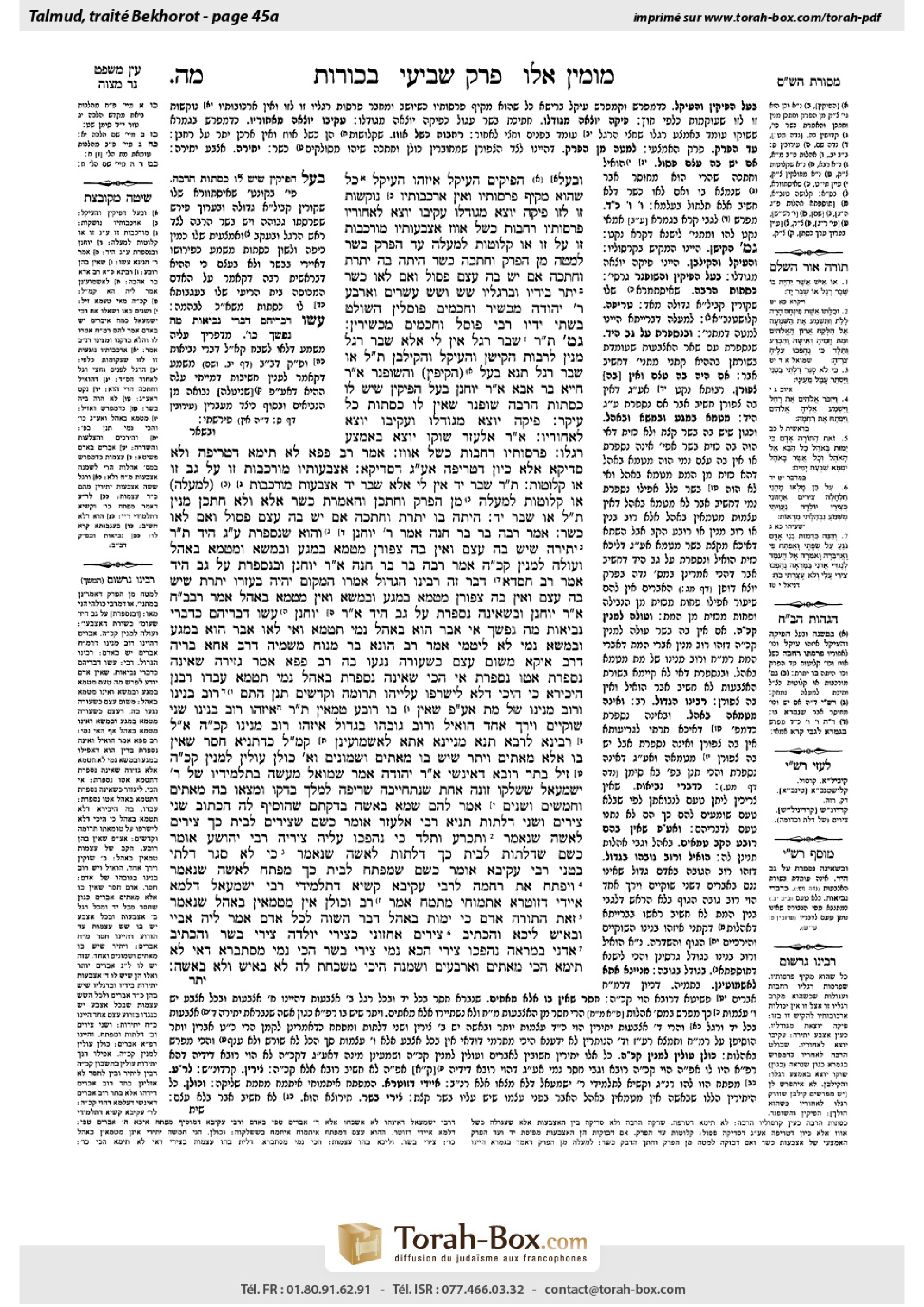
Bekhorot 45a: Talmud study for Daf Yomi
Study the Talmud for Daf Yomi with scanned pages, Hebrew text, English translations from Sefaria and AI-generated French translations.
Passage selection and English or AI-generated French translation are available where the scan has annotations. Daf Study is independent of Torah-Box and Sefaria.
Browse Bekhorot · בכורות · All tractatesBekhorot 45a text and translations
This page of Bekhorot includes the Aramaic text, an English translation and an AI-generated French translation, alongside the scan above.
בכורות מ״ה א · Aramaic and Hebrew text
וּבַעַל הַפִּיקִים, הָעִיקֵּל. אֵיזֶהוּ הָעִיקֵּל? כׇּל שֶׁהוּא מַקִּיף פַּרְסוֹתָיו וְאֵין אַרְכֻּבּוֹתָיו נוֹקְשׁוֹת זוֹ לָזוֹ. פִּיקָּה יוֹצֵא מִגּוּדָּלוֹ, עֲקֵיבוֹ יוֹצֵא לַאֲחוֹרָיו, פַּרְסוֹתָיו רְחָבוֹת כְּשֶׁל אַוָּוז.
אֶצְבְּעוֹתָיו מוּרְכָּבוֹת זוֹ עַל זוֹ, אוֹ קְלוּטוֹת לְמַעְלָה עַד הַפֶּרֶק — כָּשֵׁר, לְמַטָּה מִן הַפֶּרֶק וַחֲתָכָהּ — כָּשֵׁר, הָיְתָה בָּהּ יְתֶרֶת וַחֲתָכָהּ, אִם יֵשׁ בָּהּ עֶצֶם — פָּסוּל, וְאִם לָאו — כָּשֵׁר.
יָתֵר בְּיָדָיו וּבְרַגְלָיו, שֵׁשׁ וָשֵׁשׁ — עֶשְׂרִים וְאַרְבַּע, רַבִּי יְהוּדָה מַכְשִׁיר וַחֲכָמִים פּוֹסְלִין. הַשּׁוֹלֵט בִּשְׁתֵּי יָדָיו — רַבִּי פּוֹסֵל וַחֲכָמִים מַכְשִׁירִין.
גְּמָ׳ תָּנוּ רַבָּנַן: שֶׁבֶר רָגֶל — אֵין לִי אֶלָּא שֶׁבֶר רֶגֶל, מִנַּיִן לְרַבּוֹת הַקִּישָׁן וְהָעִיקֵּל וְהַקִּילְבָּן? תַּלְמוּד לוֹמַר: ״אוֹ שֶׁבֶר רָגֶל״. תָּנָא: בַּעַל הַקִּיפִּין וְהַשּׁוּפְנָר. אָמַר רַבִּי חִיָּיא בַּר אַבָּא אָמַר רַבִּי יוֹחָנָן: בַּעַל הַפִּיקִּין — שֶׁיֵּשׁ לוֹ כְּסָתוֹת הַרְבֵּה, שׁוּפְנָר — שֶׁאֵין לוֹ כְּסָתוֹת כׇּל עִיקָּר.
פִּיקָּה יוֹצָא מִגּוּדָּלוֹ, וַעֲקֵיבוֹ יוֹצֵא לַאֲחוֹרָיו. אָמַר רַבִּי אֶלְעָזָר: שׁוֹקוֹ יוֹצֵא בָּאֶמְצַע רַגְלוֹ. פַּרְסוֹתָיו רְחָבוֹת כְּשֶׁל אַוָּוז. אָמַר רַב פָּפָּא: לָא תֵּימָא דִּטְרִיפָה וְלָא סְדִיקָא, אֶלָּא כֵּיוָן דִּטְרִיפָה, אַף עַל גַּב דִּסְדִיקָא.
אֶצְבְּעוֹתָיו מוּרְכָּבוֹת זוֹ עַל גַּב זוֹ, אוֹ קְלוּטוֹת. תָּנוּ רַבָּנַן: ״שֶׁבֶר יָד״ — אֵין לִי אֶלָּא שֶׁבֶר יָד.
אֶצְבָּעוֹת מוּרְכָּבוֹת לְמַעְלָה אוֹ קְלוּטוֹת לְמַעְלָה מִן הַפֶּרֶק, וְהָאָמְרַתְּ כָּשֵׁר! אֶלָּא וְלֹא חֲתָכָן, מִנַּיִן? תַּלְמוּד לוֹמַר: ״אוֹ שֶׁבֶר יָד״.
הָיְתָה בּוֹ יְתֶרֶת וַחֲתָכָהּ, אִם יֵשׁ בָּהּ עֶצֶם — פָּסוּל, וְאִם לָאו — כָּשֵׁר. אָמַר רַבָּה בַּר בַּר חָנָה אָמַר רַבִּי יוֹחָנָן: וְהוּא שֶׁנִּסְפֶּרֶת עַל גַּבֵּי הַיָּד.
תָּנוּ רַבָּנַן: יְתֵירָה שֶׁיֵּשׁ בָּהּ עֶצֶם, וְאֵין בָּהּ צִפּוֹרֶן — מְטַמָּא בְּמַגָּע וּבְמַשָּׂא, וּמְטַמָּא בְּאֹהֶל, וְעוֹלָה לְמִנְיַן מֵאָה וְעֶשְׂרִים וַחֲמִשָּׁה. אָמַר רַבָּה בַּר בַּר חָנָה אָמַר רַבִּי יוֹחָנָן: וּבְנִסְפֶּרֶת עַל גַּב הַיָּד.
אָמַר רַב חִסְדָּא: דָּבָר זֶה רַבֵּינוּ הַגָּדוֹל אֲמָרוֹ, הַמָּקוֹם יִהְיֶה בְּעֶזְרוֹ: יְתֶרֶת שֶׁיֵּשׁ בָּהּ עֶצֶם וְאֵין בָּהּ צִפּוֹרֶן — מְטַמָּא בְּמַגָּע וּבְמַשָּׂא, וְאֵין מְטַמָּא בְּאֹהֶל. אָמַר רַבָּה בַּר בַּר חָנָה אָמַר רַבִּי יוֹחָנָן: וּבְשֶׁאֵינָהּ נִסְפֶּרֶת עַל גַּב הַיָּד.
אָמַר רַבִּי יוֹחָנָן: עָשׂוּ דִּבְרֵיהֶם כְּדִבְרֵי נְבִיאוּת, מָה נַפְשָׁךְ? אִי אֵבֶר הוּא — בְּאֹהֶל נָמֵי תְּטַמֵּא, וְאִי לָאו אֵבֶר הוּא — בְּמַגָּע וּבְמַשָּׂא נָמֵי לָא לִיטַמֵּי!
אָמַר רַב הוּנָא בַּר מָנוֹחַ מִשְּׁמֵיהּ דְּרַב אַחָא בְּרֵיהּ דְּרַב אִיקָא: מִשּׁוּם עֶצֶם כִּשְׂעוֹרָה נָגְעוּ בָּהּ.
רַב פָּפָּא אָמַר: גְּזֵירָה שֶׁאֵינָהּ נִסְפֶּרֶת, אַטּוּ נִסְפֶּרֶת. אִי הָכִי, שֶׁאֵינָהּ נִסְפֶּרֶת בְּאֹהֶל נָמֵי תְּטַמֵּא!
עֲבַדוּ רַבָּנַן הֶיכֵּירָא, כִּי הֵיכִי דְּלָא לִישְׂרְפוּ עֲלַיְיהוּ תְּרוּמָה וְקָדָשִׁים.
תְּנַן הָתָם: רוֹב בִּנְיָנוֹ וְרוֹב מִנְיָנוֹ שֶׁל מֵת, אַף עַל פִּי שֶׁאֵין בּוֹ רוֹבַע — טְמֵאִין. תָּנוּ רַבָּנַן: אֵיזֶהוּ רוֹב בִּנְיָנוֹ? שְׁנֵי שׁוֹקַיִים וְיָרֵךְ אֶחָד, הוֹאִיל וְרוֹב גּוֹבְהוֹ בְּגָדוֹל. אֵיזֶהוּ רוֹב מִנְיָנוֹ? מֵאָה וְעֶשְׂרִים וַחֲמִשָּׁה.
אֲמַר לֵיהּ רָבִינָא לְרָבָא: תַּנָּא מִנְיָינָא אֲתָא לְאַשְׁמוֹעִינַן? קָא מַשְׁמַע לַן כִּדְתַנְיָא: חָסֵר, שֶׁאֵין בּוֹ אֶלָּא מָאתַיִם, וְיָתֵר, שֶׁיֵּשׁ בּוֹ מָאתַיִם וּשְׁמוֹנִים וְאֶחָד — כּוּלָּן עוֹלִין לְמִנְיַן מֵאָה וְעֶשְׂרִים וַחֲמִשָּׁה, זִיל בָּתַר רוּבָּא דְאִינָשֵׁי.
אָמַר רַבִּי יְהוּדָה אָמַר שְׁמוּאֵל: מַעֲשֶׂה בְּתַלְמִידָיו שֶׁל רַבִּי יִשְׁמָעֵאל שֶׁשָּׁלְקוּ זוֹנָה אַחַת שֶׁנִּתְחַיְּיבָה שְׂרֵיפָה לַמֶּלֶךְ, בָּדְקוּ וּמָצְאוּ בָּהּ מָאתַיִם וַחֲמִשִּׁים וּשְׁנַיִם, אָמַר לָהֶם: שֶׁמָּא בְּאִשָּׁה בְּדַקְתֶּם, שֶׁהוֹסִיף לָהּ הַכָּתוּב שְׁנֵי צִירִים וּשְׁנֵי דְּלָתוֹת.
תַּנְיָא, רַבִּי אֶלְעָזָר אוֹמֵר: כְּשֵׁם שֶׁצִּירִים לַבַּיִת — כָּךְ צִירִים לָאִשָּׁה, שֶׁנֶּאֱמַר: ״וַתִּכְרַע וַתֵּלֶד כִּי נֶהֶפְכוּ עָלֶיהָ צִרֶיהָ״. רַבִּי יְהוֹשֻׁעַ אוֹמֵר: כְּשֵׁם שֶׁדְּלָתוֹת לַבַּיִת — כָּךְ דְּלָתוֹת לָאִשָּׁה, שֶׁנֶּאֱמַר: ״כִּי לֹא סָגַר דַּלְתֵי בִטְנִי״.
רַבִּי עֲקִיבָא אוֹמֵר: כְּשֵׁם שֶׁמַּפְתֵּחַ לַבַּיִת, כָּךְ מַפְתֵּחַ לָאִשָּׁה, שֶׁנֶּאֱמַר: ״וַיִּפְתַּח אֶת רַחְמָהּ״. לְרַבִּי עֲקִיבָא קַשְׁיָא דְּתַלְמִידֵי רַבִּי יִשְׁמָעֵאל! דִּלְמָא אַיְּידֵי דְּזוּטַר אִתְּמוֹחֵי מִתְּמַח.
אָמַר רַב: וְכוּלָּן אֵין מְטַמְּאִין בְּאֹהֶל, שֶׁנֶּאֱמַר: ״זֹאת הַתּוֹרָה אָדָם כִּי יָמוּת בְּאֹהֶל״, דָּבָר הַשָּׁוֶה לְכׇל אָדָם.
אֲמַר לֵיהּ אַבָּיֵי: וּבְאִישׁ לֵיכָּא? וְהָכְתִיב: ״צִירִים אֲחָזוּנִי כְּצִירֵי יוֹלֵדָה״! צִירֵי בָשָׂר. וְהָכְתִיב: ״אֲדֹנִי בַּמַּרְאָה נֶהֶפְכוּ צִירַי״! הָכָא נָמֵי צִירֵי בָשָׂר. הָכִי נָמֵי מִסְתַּבְּרָא, דְּאִי לָא תֵּימָא הָכִי, מָאתַיִם וְאַרְבָּעִים וּשְׁמֹנֶה הֵיכִי מַשְׁכַּחַתְּ לַהּ? לָא בְּאִישׁ וְלָא בְּאִשָּׁה.
Bekhorot 45a · English translation
and a ba’al happikim, and the ikkel. What is the ikkel? It is anyone who places his feet together and his knees do not knock into each other, i.e., he is bowlegged. A priest with a protuberance emerging alongside the thumb of his hand or the big toe of his foot,or one whose heel emerges and protrudes back from his foot, or one whose feet are wide like those of a goose are all disqualified from performing the Temple service.
A priest whose fingers or toes are configured one upon the other, or one whose fingers or toes are attached, is likewise disqualified. But if they were attached from above the palm of the hand or the bottom of the foot only until the middle joint, he is fit. If they were attached below the joint, higher up on the finger or toe, and he cut to separate them, he is fit. In a case where there was an extra finger or toe on his hand or foot and he cut it, if that extra appendage contains a bone, the priest is disqualified even after it was cut, and if there is no bone the priest is fit.
If there was an extra appendage on his hands and on his feet, six on each for a total of twenty-four, Rabbi Yehuda deems the priest fit and the Rabbis deem him disqualified. With regard to one who is ambidextrous and has control of both of his hands, Rabbi Yehuda HaNasi deems the priest disqualified, as his halakhic status is like that of one who is left-handed, and the Rabbis deem him fit.
GEMARA: The Sages taught in a baraita: From the verse that states: “Broken-footed” (Leviticus 21:19), I have derived only that a broken leg disqualifies a priest from performing the Temple service. From where do I derive to include that the kishan, i.e., one who knocks his ankles or his knees together; the ikkel; and the kilvan are disqualified as well? The same verse states: “Or broken-footed.” The term “or” serves to include all blemishes of the leg. It was also taught in a baraita: A ba’al hakippin and the shufnar are blemished. Rabbi Ḥiyya bar Abba says that Rabbi Yoḥanan says: A ba’al happikin is one who has large protuberances on his leg, while a shufnar is one who has no protuberances at all.
The mishna teaches that one with a protuberance emerging alongside the thumb of his hand or the big toe of his foot, and one whose heel emerges and protrudes back from his foot are disqualified. Rabbi Elazar says: The description: One whose heel emerges and protrudes back from his foot, means his calf, i.e., his lower leg, emerges from the middle of his foot. The mishna also teaches that one whose feet are wide like those of a goose is disqualified. Rav Pappa says: Do not say that this is referring only to one whose feet are entirely like those of a goose, i.e., his feet are flat and his toes are not split. Rather, once one’s feet are flat he is considered blemished, even though his toes are split.
The mishna further teaches that a priest whose fingers or toes are configured one upon the other, or whose fingers or toes are attached, is likewise disqualified from performing the Temple service. But if they were attached from the hand or foot from above the palm of the hand or the bottom of the foot until the middle joint, or if they were attached below the joint, higher up on the finger or toe, and he cut to separate them, he is fit. The Sages taught in a baraita: The verse states: “Broken-handed” (Leviticus 21:19). I have derived only that a broken hand disqualifies a priest.
From where do I derive that if his fingers or toes are configured one upon the other, or if they are attached from the hand or foot above the middle joint and he cut them to separate them, that he is disqualified? The Gemara interrupts its citation of the baraita to ask: But didn’t you say in the mishna that if he separates his fingers he is fit? Rather, the baraita is referring to a priest whose fingers or toes are attached above the middle joint and he did not cut them. From where is it derived that he is disqualified? The verse states: “Or broken-handed.”
§ The mishna teaches: In a case where there was an extra finger or toe on his hand or foot and he cut it, if that extra appendage contains a bone, the priest is disqualified even after it was cut, as he is considered to be missing a limb, and if not, the priest is fit. Rabba bar bar Ḥana says that Rabbi Yoḥanan says: And this is the halakha only in a case where it can be counted along the back of the hand or foot, i.e., the extra digit is situated in a row with his other fingers or toes. Only in such a situation is an additional appendage considered a distinct limb to the extent that if it contains a bone he is disqualified even after it has been cut away.
With regard to extra appendages the Sages taught: In the case of an extra appendage that was cut from a corpse, which contains a bone, then even if it does not have a nail it imparts ritual impurity both through contact and by carrying it, and it imparts impurity in a tent,as is the halakha with regard to the limb of a corpse. And if the extra appendage has no flesh surrounding the bone and therefore does not impart the impurity of a limb from a corpse, it is included in the count of 125 bones, which constitute a majority of the number of bones in a human being. A majority of bones imparts impurity in a tent, even if there is no flesh on any of them. Rabba bar bar Ḥana says that Rabbi Yoḥanan says: And it is considered a limb only when it can be counted along the back of the hand or foot.
Rav Ḥisda says: This matter was stated by our great rabbi, Rav, may the Omnipresent come to his assistance. An extra appendage that contains a bone and does not have a nail imparts ritual impurity through contact and by carrying, but it does not impart impurity in a tent. Rabba bar bar Ḥana says that Rabbi Yoḥanan says: And it does not impart impurity in a tent only when it is not counted along the back of the hand or foot.
Rabbi Yoḥanan says: The Sages rendered their statements in this case like statements of prophecy, i.e., there is no rationale for this halakha, as whichever way you look at it there is a difficulty: If a digit that is not counted with the other digits is considered a limb, it should impart impurity in a tent as well; and if it is not a limb, it also should not impart impurity through contact or by carrying.
Rav Huna bar Manoaḥ said in the name of Rav Aḥa, son of Rav Ika: This appendage imparts impurity through contact and by carrying because the Sages touched upon it, i.e., issued a ruling concerning it, and determined that the halakhot of a bone the volume of a barley grain apply to it, i.e., it is considered a bone fragment and not a limb. Accordingly, it does not impart impurity in a tent.
Rav Pappa said: It is a rabbinic decree that an appendage that is not counted with the other digits imparts impurity through contact and carrying, due to a case where the appendage is counted with the other digits,in which case it is considered a limb and imparts impurity in a tent. The Gemara raises a difficulty: If so, then an appendage that is not counted should impart impurity in a tent as well.
The Gemara explains: The Sages implemented a distinction by decreeing this appendage imparts impurity only through contact and carrying, in order that people will know that this impurity applies by rabbinic law and not by Torah law. And therefore they will not come to burn teruma, i.e., the portion of produce designated for the priest, or consecrated items that have been rendered impure on account of this type of impurity, as by Torah law they are ritually pure and may not be burned.
§ With regard to impurity imparted by extra appendages, we learned in a mishna there (Oholot 2:1): A majority of the skeletal structure or a majority of the number of bones in the corpse of a dead person, even when there is not a quarter of a kav of bones among them, are impure. Concerning the ruling of this mishna, the Sages taught in a baraita: What is considered a majority of the skeletal structure of a corpse? It is two calves and one thigh, since this constitutes a majority of the height of an adult. What is considered a majority of the number of bones? One hundred and twenty-five bones.
Ravina said to Rava: Is the tanna coming to teach us a number? It is obvious that as there are 248 bones in the human body, 125 of them constitute a majority. Rava responded: The tanna teaches us that the halakha is as it is taught in a baraita: With regard to a corpse that lacks some bones and has only 200 bones, or one that has extra and has 281 bones, all of them are included in the count of 125. In other words, whether the number of 125 is in a majority or minority of that particular corpse, this number of bones imparts impurity, as one follows the majority of people, and most people have 248 bones.
With regard to the number of limbs or bones in the human body, Rabbi Yehuda says that Shmuel says: There was an incident involving the students of Rabbi Yishmael, who boiled the corpse of a prostitute who was sentenced by the king to death by burning, in order to separate her flesh from her bones. They examined and found she had 252 limbs. They were puzzled by their finding, as the Sages say that the human body has only 248 limbs. Shmuel said to them: Perhaps you examined the corpse of a woman, as the verse added to her two hinges and two doors, for a total of 252 limbs.
It is taught in a baraita that Rabbi Elazar says: Just as a house has hinges [tzirim], so too, a woman has hinges, as it is stated: “And she bowed herself and brought forth, for her pains [tzireha] came suddenly upon her” (I Samuel 4:19). Rabbi Yehoshua says: Just as a house has doors, so too, a woman has doors, as it is stated: “Because it did not shut the doors of my womb” (Job 3:10).
Rabbi Akiva says: Just as there is a key to a house, so too, there is a key to a woman, as it is stated: “And He opened her womb” (Genesis 30:22). The Gemara challenges: The incident involving the students of Rabbi Yishmael, who found that the woman had only four additional limbs rather than five, i.e., there was no key, poses a difficulty for Rabbi Akiva. The Gemara responds: Perhaps since it is small, it dissolved in the water when they boiled the corpse.
Rav says: And all of them, i.e., all the limbs found only in a woman, do not impart impurity in a tent, as it is stated: “This is the law: When a person dies in a tent” (Numbers 19:14), indicating that only an item that is equal for all people, male and female, imparts impurity in a tent.
Abaye said to him: And are there no hinges in a man? But isn’t it written: “Pangs [tzirim] have taken hold upon me, as the pangs of a woman in travail” (Isaiah 21:3)? The Gemara responds: The verse is referring specifically to hinges of flesh, which are not considered limbs, as they contain no bones. The Gemara persists: But isn’t it written: “My lord, by reason of the vision my pains [tzirai] come” (Daniel 10:16)? The Gemara responds: Here too, the verse is referring to hinges of flesh. The Gemara notes: So too, it is reasonable that the hinges of a male are only of flesh, as if you do not say so, then as far as the 248 limbs that the Sages stated constitute a human body, how can you find them? Neither in a man nor in a woman.
Bekhorot 45a · Traduction française (IA)
et un ba’al happikim, et l’ikkel. Qu’est-ce que l’ikkel ? C’est toute personne qui met ses pieds ensemble et dont les genoux ne se heurtent pas, c’est-à-dire qu’il est à jambes écartées. Un prêtre dont une bosse sort du pouce de sa main ou du gros orteil de son pied, ou dont le talon sort et saillit en arrière de son pied, ou dont les pieds sont larges comme ceux d’un canard sont tous disqualifiés pour l’accomplissement du service du Temple.
Un prêtre dont les doigts ou les orteils sont superposés, ou dont les doigts ou les orteils sont joints, est également disqualifié. Mais s’ils étaient joints au-dessus de la paume de la main ou du bas du pied jusqu’au milieu du doigt, il est propre. S’ils étaient joints en dessous du joint, plus haut sur le doigt ou l’orteil, et s’il les a coupés pour les séparer, il est propre. Dans le cas où il y avait un doigt ou un orteil supplémentaire sur sa main ou son pied et qu’il l’a coupé, si cet appendice supplémentaire contient un os, le prêtre est disqualifié même après qu’il ait été coupé, et si celui-ci n’a pas d’os, le prêtre est propre.
Si un appendice supplémentaire était présent sur ses mains et sur ses pieds, six sur chaque main pour un total de vingt-quatre, Rabbi Yehuda considère le prêtre comme propre et les Rabbins le considèrent comme disqualifié. En ce qui concerne celui qui est ambidextre et qui a le contrôle des deux mains, Rabbi Yehuda HaNasi considère le prêtre comme disqualifié, car son statut halakhique est comme celui d’une personne gauchère, et les Rabbins le considèrent comme propre.
GUEMARA : Les Sages ont enseigné dans une baraïta : À partir de la versette qui dit : « Écrasé de pied » (Lévitique 21:19), j’ai dérivé seulement que le pied cassé disqualifie un prêtre de l’accomplissement du service du Temple. D’où dérive-t-on que l’on inclut également le kishan, c’est-à-dire celui qui frappe ses chevilles ou ses genoux ensemble ; l’ikkel ; et le kilvan comme disqualifiés ? Le même verset dit : « Ou écrasé de pied ». Le terme « ou » sert à inclure toutes les imperfections du pied. Il a également été enseigné dans une baraïta : Un ba’al hakippin et le shufnar sont blemis. Rabbi Ḥiyya bar Abba dit que Rabbi Yoḥanan dit : Un ba’al happikin est celui qui a des bosses importantes sur sa jambe, tandis que le shufnar est celui qui n’a aucune bosse du tout.
La mitsva enseigne que celui qui a une bosse sortant du pouce de sa main ou du gros orteil de son pied est disqualifié. Rabbi Elazar dit : La description : Celui dont le talon sort et saillit en arrière de son pied, signifie sa cheville, c’est-à-dire son tibia, sort de la moitié de son pied. La mitsva enseigne également que celui dont les pieds sont larges comme ceux d’un canard est disqualifié. Rav Pappa dit : Ne dis pas que cela se réfère uniquement à celui dont les pieds sont entièrement comme ceux d’un canard, c’est-à-dire dont les pieds sont plats et dont les orteils ne sont pas séparés. Plutôt, dès que les pieds sont plats, on considère qu’il est blemi, même si ses orteils sont séparés.
La mitsna enseigne également que le prêtre dont les doigts ou les orteils sont superposés, ou dont les doigts ou les orteils sont joints, est également disqualifié pour l’accomplissement du service du Temple. Mais s’ils étaient joints du main ou du pied au-dessus de la paume de la main ou du bas du pied jusqu’au milieu du doigt, ou s’ils étaient joints en dessous du joint, plus haut sur le doigt ou l’orteil, et s’il les a coupés pour les séparer, il est propre. Les Sages ont enseigné dans une baraïta : Le verset dit : « Écrasé de main » (Lévitique 21:19). J’ai dérivé seulement que la main cassée disqualifie un prêtre.
D’où dérive-t-on que s’il a des doigts ou des orteils superposés, ou s’ils sont joints du main ou du pied au-dessus du milieu du doigt et qu’il les a coupés pour les séparer, il est disqualifié ? La Guemara interrompt sa citation de la baraïta pour poser la question : Mais n’avez-vous pas dit dans la mitsva que s’il sépare ses doigts il est propre ? Plutôt, la baraïta se réfère à un prêtre dont les doigts ou les orteils sont joints au-dessus du milieu du doigt et qu’il n’a pas coupé. D’où dérive-t-on qu’il est disqualifié ? Le verset dit : « Ou écrasé de main ».
§ La mitsna enseigne : Dans le cas où il y avait un doigt ou un orteil supplémentaire sur sa main ou son pied et qu’il l’a coupé, si cet appendice supplémentaire contient un os, le prêtre est disqualifié même après qu’il ait été coupé, car il est considéré comme manquant d’un membre, et si non, le prêtre est propre. Rabba bar bar Ḥana dit que Rabbi Yoḥanan dit : Et c’est la halakha uniquement dans le cas où il peut être compté sur le dos de la main ou du pied, c’est-à-dire que l’appendice supplémentaire est situé en rang avec ses autres doigts ou orteils. Seulement dans ce cas un appendice supplémentaire est considéré comme un membre distinct à tel point que s’il contient un os, il est disqualifié même après qu’il ait été coupé.
En ce qui concerne les appendices supplémentaires, les Sages ont enseigné : Dans le cas d’un appendice supplémentaire qui a été coupé d’un cadavre, qui contient un os, alors même s’il n’a pas d’ongle, il transmet la souillure rituelle par contact et par portée, et il transmet la souillure dans une tente, comme c’est la halakha concernant le membre d’un cadavre. Et si l’appendice supplémentaire n’a pas de chair autour de l’os et donc ne transmet pas la souillure d’un membre d’un cadavre, il est inclus dans le compte des 125 os, qui constituent la majorité du nombre d’os d’un être humain. Une majorité d’os transmet la souillure dans une tente, même s’il n’y a pas de chair sur aucun d’entre eux. Rabba bar bar Ḥana dit que Rabbi Yoḥanan dit : Et il est considéré comme un membre uniquement lorsqu’il peut être compté sur le dos de la main ou du pied.
Rav Ḥisda dit : Cette matière a été énoncée par notre grand rabbi, Rav, que l’Éternel vienne en aide à lui. Un appendice supplémentaire qui contient un os et n’a pas d’ongle transmet la souillure rituelle par contact et par portée, mais ne transmet pas la souillure dans une tente. Rabba bar bar Ḥana dit que Rabbi Yoḥanan dit : Et il ne transmet la souillure dans une tente que lorsqu’il n’est pas compté sur le dos de la main ou du pied.
Rabbi Yoḥanan dit : Les Sages ont formulé leurs déclarations dans ce cas comme des déclarations prophétiques, c'est-à-dire qu'il n'y a pas de raisonnement pour cette halakha, car quel que soit le point de vue, il y a une difficulté : si un doigt qui n'est pas compté avec les autres doigts est considéré comme un membre, il devrait transmettre l'impureté dans une tente également ; et si ce n'est pas un membre, il ne devrait pas non plus transmettre l'impureté par contact ou par portée.
Rav Huna bar Manoaḥ a dit en nom de Rav Aḥa, fils de Rav Ika : Cette appendice transmet l'impureté par contact et par portée, car les Sages ont touché à cela, c'est-à-dire ont rendu un jugement concernant cela, et ont déterminé que les halakhot d'un os de la taille d'une mesure de céréale s'appliquent à cela, c'est-à-dire qu'il est considéré comme un fragment d'os et non comme un membre. Ainsi, il ne transmet pas l'impureté dans une tente.
Rav Pappa dit : C'est un décret rabbinique qui stipule qu'une appendice qui n'est pas compté avec les autres doigts transmet l'impureté par contact et par portée, en raison d'un cas où l'appendice est compté avec les autres doigts, dans lequel cas il est considéré comme un membre et transmet l'impureté dans une tente. La Guemara soulève une difficulté : Si c'est ainsi, alors une appendice qui n'est pas compté devrait transmettre l'impureté dans une tente également.
La Guemara explique : Les Sages ont institué une distinction par décret en stipulant que cette appendice transmet l'impureté uniquement par contact et par portée, afin que les gens sachent que cette impureté s'applique par la loi rabbinique et non par la loi de la Torah. Ainsi, ils ne viendront pas à brûler la terouma, c'est-à-dire la portion de récolte destinée au prêtre, ou les objets consacrés qui ont été rendus impurs en raison de cette forme d'impureté, car, selon la loi de la Torah, ils sont rituellement purs et ne peuvent pas être brûlés.
§ En ce qui concerne l'impureté transmise par des appendices supplémentaires, nous avons appris dans une mitsva là (Oholot 2:1) : Une majorité de la structure squelettique ou une majorité du nombre d'os dans le corps d'un mort, même s'il n'y a pas un quart de kav d'os parmi eux, sont impurs. En ce qui concerne la décision de cette mitsva, les Sages ont enseigné dans une baraïta : Qu'est-ce qui constitue une majorité de la structure squelettique d'un corps ? C'est deux taureaux et une cuisse, car cela constitue une majorité de la hauteur d'un adulte. Qu'est-ce qui constitue une majorité du nombre d'os ? Cent vingt-cinq os.
Ravina dit à Rava : Le tanna vient-il nous enseigner un nombre ? C'est évident que comme le corps humain compte 248 os, 125 d'entre eux constituent une majorité. Rava répondit : Le tanna nous enseigne que la halakha est telle que l'on l'a apprise dans une baraïta : En ce qui concerne un corps manquant d'os et possédant seulement 200 os, ou un corps ayant des os supplémentaires et possédant 281 os, tous sont inclus dans le compte de 125. En d'autres termes, que le nombre de 125 soit une majorité ou une minorité dans ce corps particulier, ce nombre d'os transmet l'impureté, car on suit la majorité des gens, et la plupart des gens ont 248 os.
En ce qui concerne le nombre de membres ou d'os dans le corps humain, Rabbi Yehuda dit que Shmuel dit : Il y avait un incident concernant les élèves de Rabbi Yishmael, qui ont fait bouillir le corps d'une prostituée condamnée par le roi à la peine de brûlement, afin de séparer sa chair de ses os. Ils ont examiné et trouvé qu'elle avait 252 membres. Ils étaient perplexes à ce sujet, car les Sages disent que le corps humain n'a que 248 membres. Shmuel a dit à eux : Peut-être avez-vous examiné le corps d'une femme, car la Parabole a ajouté à elle deux gonds et deux portes, pour un total de 252 membres.
Il est enseigné dans une baraïta que Rabbi Elazar dit : Comme une maison a des gonds [tzirim], ainsi une femme a des gonds, comme il est dit : « Et elle s'inclina et enfanta, car ses douleurs [tzireha] vinrent soudainement sur elle » (I Samuel 4:19). Rabbi Yehoshua dit : Comme une maison a des portes, ainsi une femme a des portes, comme il est dit : « Parce qu'elle n'avait pas fermé les portes de mon ventre » (Job 3:10).
Rabbi Akiva dit : Comme il y a une clé pour une maison, ainsi il y a une clé pour une femme, comme il est dit : « Et Il ouvrit son ventre » (Genèse 30:22). La Guemara soulève un défi : L'incident concernant les élèves de Rabbi Yishmael, qui ont trouvé que la femme avait seulement quatre membres supplémentaires plutôt que cinq, c'est-à-dire qu'il n'y avait pas de clé, pose une difficulté pour Rabbi Akiva. La Guemara répond : Peut-être que c'est parce qu'elle est petite, qu'elle a dissous dans l'eau lorsqu'ils ont fait bouillir le corps.
Rav dit : Et tous ceux-ci, c'est-à-dire tous les membres trouvés seulement chez une femme, ne transmettent pas l'impureté dans une tente, car il est dit : « C'est la loi : Quand un homme meurt dans une tente » (Nombres 19:14), indiquant que seul un objet égal pour tous les gens, hommes et femmes, transmet l'impureté dans une tente.
Abaye dit à lui : Et n'y a-t-il pas de gonds chez un homme ? Mais n'est-il pas écrit : « Des douleurs [tzirim] m'ont saisi, comme les douleurs d'une femme en travail » (Yahvé 21:3) ? La Guemara répond : La parabole fait référence spécifiquement aux gonds de chair, qui ne sont pas considérés comme des membres, car ils ne contiennent pas d'os. La Guemara persiste : Mais n'est-il pas écrit : « Mon seigneur, à cause de la vision mes douleurs [tzirai] sont venues » (Daniel 10:16) ? La Guemara répond : Ici aussi, la parabole fait référence aux gonds de chair. La Guemara note : De même, il est raisonnable que les gonds d'un homme soient seulement de chair, car si vous ne dites pas cela, comment pouvez-vous trouver les 248 membres que les Sages ont déclarés constituer un corps humain ? Ni chez un homme ni chez une femme.
Traduction française générée par IA à partir de l’édition anglaise de Sefaria. Vérifie toujours un passage avec le texte source.
Text from Sefaria: William Davidson Edition - Vocalized Aramaic (CC BY NC); William Davidson Edition - English (CC BY NC).