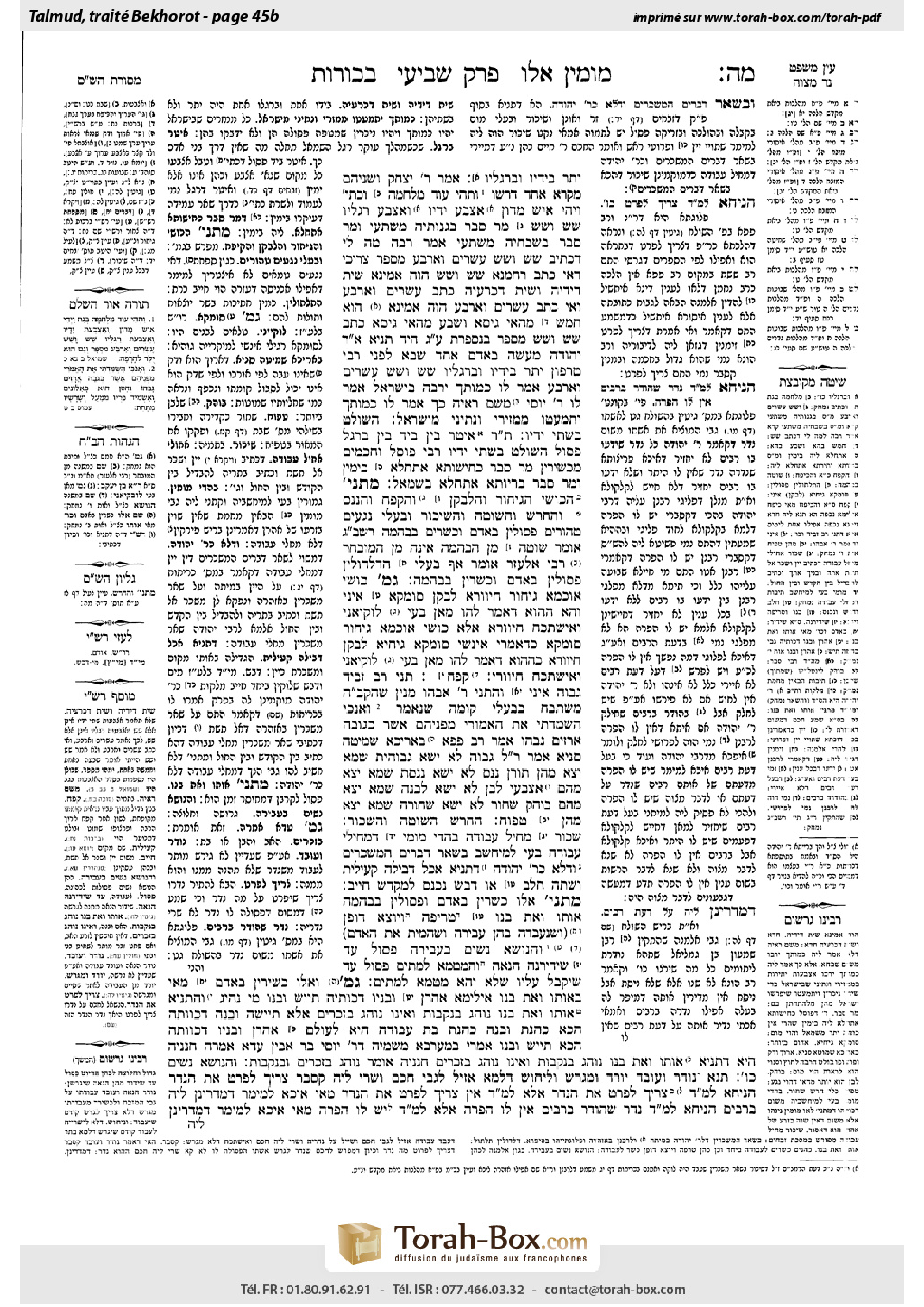
Bekhorot 45b: Talmud study for Daf Yomi
Study the Talmud for Daf Yomi with scanned pages, Hebrew text, English translations from Sefaria and AI-generated French translations.
Passage selection and English or AI-generated French translation are available where the scan has annotations. Daf Study is independent of Torah-Box and Sefaria.
Browse Bekhorot · בכורות · All tractatesBekhorot 45b text and translations
This page of Bekhorot includes the Aramaic text, an English translation and an AI-generated French translation, alongside the scan above.
בכורות מ״ה ב · Aramaic and Hebrew text
יָתֵר בְּיָדָיו וּבְרַגְלָיו. אָמַר רַבִּי יִצְחָק: וּשְׁנֵיהֶם מִקְרָא אֶחָד דָּרְשׁוּ, וַתְּהִי עוֹד מִלְחָמָה, וּכְתִיב: ״וַיְהִי אִישׁ מָדוֹן אֶצְבַּע יָדָיו וְאֶצְבַּע רַגְלָיו שֵׁשׁ וָשֵׁשׁ״, מָר סָבַר בִּגְנוּתֵיהּ מִשְׁתַּעֵי, וּמָר סָבַר בִּשְׁבָחֵיהּ מִשְׁתַּעֵי.
אָמַר רַבָּה: מָה לִי דִּכְתִיב ״שֵׁשׁ וָשֵׁשׁ עֶשְׂרִים וְאַרְבַּע מִסְפָּר״? צְרִיכִי, דְּאִי כְּתַב רַחֲמָנָא ״שֵׁשׁ וָשֵׁשׁ״ הֲוָה אָמֵינָא: שֵׁית דִּידֵיהּ וְשֵׁית דְּכַרְעֵיהּ, כְּתַב ״עֶשְׂרִים וְאַרְבַּע״. וְאִי כְּתַב ״עֶשְׂרִים וְאַרְבַּע״ הֲוָה אָמֵינָא: הוּא חֲמֵשׁ מֵהַאי גִּיסָא וּשְׁבַע מֵהַאי גִּיסָא, כְּתַב ״שֵׁשׁ וָשֵׁשׁ״. ״מִסְפָּר״ — בְּנִסְפֶּרֶת עַל גַּבֵּי הַיָּד.
תַּנְיָא, אָמַר רַבִּי יְהוּדָה: מַעֲשֶׂה בְּאָדָם אֶחָד שֶׁבָּא לִפְנֵי רַבִּי טַרְפוֹן, יָתֵר בְּיָדָיו וּבְרַגְלָיו שֵׁשׁ וָשֵׁשׁ עֶשְׂרִים וְאַרְבַּע. אָמַר לוֹ: כְּמוֹתְךָ יִרְבּוּ בְּיִשְׂרָאֵל! אָמַר לוֹ רַבִּי יוֹסֵי: מִשָּׁם רְאָיָה? כָּךְ אָמַר לוֹ: כְּמוֹתְךָ יִתְמַעֲטוּ מַמְזֵירֵי וּנְתִינֵי מִיִּשְׂרָאֵל!
הַשּׁוֹלֵט בִּשְׁתֵּי יָדָיו. תָּנוּ רַבָּנַן — אִיטֵּר, בֵּין בַּיָּד בֵּין בָּרֶגֶל — פָּסוּל. הַשּׁוֹלֵט בִּשְׁתֵּי יָדָיו — רַבִּי פּוֹסֵל וַחֲכָמִים מַכְשִׁירִין. מָר סָבַר — כְּחִישׁוּתָא אַתְחִלָא בְּיָמִין, וּמָר סָבַר — בְּרִיּוּתָא אַתְחִלָא בִּשְׂמֹאל.
מַתְנִי׳ הַכּוּשִׁי, הַגִּיחוֹר, וְהַלַּבְקָן, וְהַקִּפֵּחַ, וְהַנַּנָּס, וְהַחֵרֵשׁ, וְהַשּׁוֹטֶה, וְהַשִּׁיכּוֹר, וּבַעֲלֵי נְגָעִים טְהוֹרִים — פְּסוּלִין בְּאָדָם וּכְשֵׁרִים בַּבְּהֵמָה. רַבָּן שִׁמְעוֹן בֶּן גַּמְלִיאֵל אוֹמֵר: שׁוֹטָה מִן הַבְּהֵמָה אֵינָהּ מִן הַמּוּבְחָר. רַבִּי אֶלְעָזָר אוֹמֵר: אַף בַּעֲלֵי הַדִּלְדּוּלִין פְּסוּלִין בָּאָדָם וּכְשֵׁרִין בַּבְּהֵמָה.
גְּמָ׳ כּוּשִׁי — אוּכָּמָא, גִּיחוֹר — חִיוָּורָא, לַבְקָן — סוּמָּקָא. אִינִי? וְהָא הָהוּא דַּאֲמַר לְהוּ ״מַאן בָּעֵי לוּקְיָאנֵי״, וְאִישְׁתְּכַח חִיוָּורָא! אֶלָּא: כּוּשִׁי — אוּכָּמָא, גִּיחוֹר — סוּמָּקָא, כִּדְאָמְרִי אִינָשֵׁי: ״סוּמָּקָא גִּיחְיָא״, לַבְקָן — חִיוָּורָא, כְּהָהוּא דַּאֲמַר לְהוּ ״מַאן בָּעֵי לוּקְיָאנֵי״, וְאִישְׁתְּכַח חִיוָּורֵי.
קִפֵּחַ. תָּנֵי רַב זְבִיד: גָּבוֹהַּ. אִינִי? וְהָתָנֵי רַבִּי אֲבָהוּ: מִנַּיִן שֶׁהַקָּדוֹשׁ בָּרוּךְ הוּא מִשְׁתַּבֵּחַ בְּבַעֲלֵי קוֹמָה, שֶׁנֶּאֱמַר: ״וְאָנֹכִי הִשְׁמַדְתִּי אֶת הָאֱמֹרִי מִפְּנֵיהֶם אֲשֶׁר כְּגֹבַהּ אֲרָזִים גׇּבְהוֹ״. אָמַר רַב פָּפָּא: בַּאֲרִיכָא שְׁמִיטָה סַנְיָא.
אָמַר רֵישׁ לָקִישׁ: גָּבוֹהַּ לֹא יִשָּׂא גְּבוֹהִית — שֶׁמָּא יֵצֵא מֵהֶן תּוֹרֶן, נַנָּס לֹא יִשָּׂא נַנֶּסֶת — שֶׁמָּא יֵצֵא מֵהֶם אֶצְבָּעִי, לָבָן לֹא יִשָּׂא לְבָנָה — שֶׁמָּא יֵצֵא מֵהֶם בּוֹהֵק, שָׁחוֹר לֹא יִשָּׂא שְׁחוֹרָה — שֶׁמָּא יֵצֵא מֵהֶן טָפוּחַ.
הַחֵרֵשׁ, הַשּׁוֹטֶה, וְהַשִּׁכּוֹר. שִׁכּוֹר מַחֵיל עֲבוֹדָה, בַּהֲדֵי מוּמֵי דְּמַחֲילִי עֲבוֹדָה בָּעֵי לְמִיחְשַׁב!
בִּשְׁאָר דְּבָרִים הַמְשַׁכְּרִים. וּדְלָא כְּרַבִּי יְהוּדָה, דְּתַנְיָא: אָכַל דְּבֵילָה קְעִילִית, וְשָׁתָה חָלָב אוֹ דְּבַשׁ, נִכְנַס לַמִּקְדָּשׁ — חַיָּיב.
מַתְנִי׳ אֵלּוּ כְּשֵׁרִין בָּאָדָם וּפְסוּלִין בַּבְּהֵמָה: אוֹתוֹ וְאֶת בְּנוֹ, טְרֵיפָה, וְיוֹצֵא דּוֹפֶן, וְשֶׁנֶּעֶבְדָה בָּהֶן עֲבֵירָה, וְשֶׁהֵמִית אֶת הָאָדָם.
וְהַנּוֹשֵׂא נָשִׁים בַּעֲבֵירָה — פָּסוּל עַד שֶׁיַּדִּירֶנָּה הֲנָאָה, וְהַמִּטַּמֵּא לְמֵתִים — פָּסוּל עַד שֶׁיְּקַבֵּל עָלָיו שֶׁלֹּא יְהֵא מִטַּמֵּא לְמֵתִים.
גְּמָ׳ וְאֵלּוּ כְּשֵׁירִין בָּאָדָם, מַאי (באותו) [״אוֹתוֹ] וְאֶת בְּנוֹ״?
אִילֵּימָא אַהֲרֹן וּבָנָיו, דִּכְוָתֵיהּ תַּיִישׁ וּבְנוֹ, מִי נָהֵיג? וְהָתַנְיָא: ״אוֹתוֹ וְאֶת בְּנוֹ״ נוֹהֵג בִּנְקֵבוֹת, וְאֵינוֹ נוֹהֵג בִּזְכָרִים! אֶלָּא תְּיָישָׁה וּבְנָהּ, דִּכְוָותַהּ הָכָא כֹּהֶנֶת וּבְנָהּ, כֹּהֶנֶת בַּת עֲבוֹדָה הִיא?
לְעוֹלָם אַהֲרֹן וּבָנָיו, דִּכְוָותַהּ הָכָא תַּיִישׁ וּבְנוֹ. אָמְרִי בְּמַעְרְבָא מִשְּׁמֵיהּ דְּרַבִּי יוֹסֵי בַּר אָבִין: עֲדָא אָמְרָה חֲנַנְיָה הִיא, דְּתַנְיָא: ״אוֹתוֹ וְאֶת בְּנוֹ״ נוֹהֵג בִּנְקֵבוֹת וְאֵינוֹ נוֹהֵג בִּזְכָרִים, חֲנַנְיָה אוֹמֵר: נוֹהֵג בִּזְכָרִים וּבִנְקֵבוֹת.
וְהַנּוֹשֵׂא נָשִׁים כּוּ׳. תָּנָא: נוֹדֵר וְעוֹבֵד, יוֹרֵד וּמְגָרֵשׁ.
וְלֵיחוּשׁ דִּלְמָא אָזֵיל לְגַבֵּי חָכָם וְשָׁרֵי לֵיהּ! קָסָבַר: צָרִיךְ לְפָרֵט אֶת הַנֶּדֶר.
הָנִיחָא לְמַאן דְּאָמַר צָרִיךְ לְפָרֵט אֶת הַנֶּדֶר, אֶלָּא לְמַאן דְּאָמַר אֵין צָרִיךְ לְפָרֵט אֶת הַנֶּדֶר, מַאי אִיכָּא לְמֵימַר? דְּמַדְּרִינַן לֵיהּ בְּרַבִּים.
הָנִיחָא לְמַאן דְּאָמַר נֶדֶר שֶׁהוּדַּר בְּרַבִּים אֵין לוֹ הֲפָרָה, אֶלָּא לְמַאן דְּאָמַר יֵשׁ לוֹ הֲפָרָה, מַאי אִיכָּא לְמֵימַר? דְּמַדְּרִינַן
Bekhorot 45b · English translation
§ The mishna teaches that if one has an extra appendage on his hands and on his feet, six on each for a total of twenty-four, Rabbi Yehuda deems him fit while the Rabbis disqualify him. Rabbi Yitzḥak says: And both derived their opinions from one verse, as it is stated with regard to David’s war against the Philistines: “And there was again war at Gath” (II Samuel 21:20), and it is also written in that same verse: “And there was a champion, who had on every hand six fingers, and on every foot six toes, twenty-four in number.” One Sage, i.e., the Rabbis, holds that the verse speaks of negative qualities of the champion, and therefore it may be derived from here that extra appendages are blemishes; and one Sage, Rabbi Yehuda, holds that the verse speaks in his praise, which means that extra appendages are not blemishes at all.
With regard to that verse, Rabba says: Why do I need that which is written in the verse: “On every hand six fingers, and on every foot six toes, twenty-four in number”? Isn’t it obvious that one who has six appendages on each limb will have twenty-four in total? Rabba explains: All of these details are necessary, as, had the Merciful One written only six and six, I would say there were six of his hand and six of his foot, i.e., he had only twelve appendages. Therefore, the Merciful One wrote “twenty-four.” And had the Merciful One written only “twenty-four,” I would say he had five fingers on this side and seven fingers on that side. Therefore, the verse wrote six and six. The verse concludes with the term “in number” to indicate that these fingers were counted in a single row on the back of the hand.
With regard to the dispute concerning whether or not extra appendages are a blemish, it is taught in a baraita that Rabbi Yehuda says: There was an incident involving one man who came before Rabbi Tarfon, and he had extra appendages on his hands and on his feet, six and six, for a total of twenty-four appendages. Rabbi Tarfon said to him: There should increase among the Jewish people those that are like you, i.e., strong men. Clearly, extra appendages are not a blemish but a praiseworthy condition. Rabbi Yosei said to Rabbi Yehuda: You seek to bring a proof from there? This is what Rabbi Tarfon actually said to him: All mamzerim and Gibeonites should be like you, i.e., physically weak, so that they should decrease from the Jewish people.
§ The mishna teaches that in the case of a priest who has control of both of his hands, i.e., he is ambidextrous, Rabbi Yehuda HaNasi deems him disqualified and the Rabbis deem him fit. With regard to this dispute the Sages taught in a baraita: One whose left side is dominant, whether his left hand or his left foot, is disqualified from performing the Temple service. Furthermore, in the case of one who has control of both of his hands, Rabbi Yehuda HaNasi deems him disqualified and the Rabbis deem him fit. The Gemara explains this dispute: One Sage, Rabbi Yehuda HaNasi, holds that he learned to control his left hand because a weakness began in his right hand. He is therefore disqualified, as his right hand is weak. And one Sage, i.e., the Rabbis, holds that a strength began in his left hand that allowed him to control both hands. Nevertheless, his right hand remains strong.
MISHNA: Concerning the kushi, the giḥor, the lavkan, the kipe’aḥ, the dwarf, the deaf-mute, the imbecile, the drunk, and those with ritually pure marks, their conditions disqualify a person from performing the Temple service and are valid, i.e., they do not disqualify with regard to being sacrificed, in the case of an animal. Rabban Shimon ben Gamliel says: An imbecile among animals is not optimal for sacrifice. Rabbi Elazar says: Even with regard to those with flesh or skin that hangs from their body, that blemish disqualifies in the case of a person and is valid in the case of an animal.
GEMARA: The mishna teaches that a kushi, a giḥor, and a lavkan are disqualified. The Gemara explains: A kushi is one whose skin is extremely black, a giḥor is one whose skin is extremely white, and a lavkan is one whose skin is extremely red. The Gemara asks: Is that so? But there was a certain person who said to others: Who wants a lukiyani lamb, and the lamb was found to be white. Rather, a kushi is one whose skin is extremely black; a giḥor is one whose skin is extremely red, as people say about one whose skin is extremely red: Giḥia red; and a lavkan is one whose skin is extremely white, as in the case of that person who said: Who wants a lukiyani, and it was found to be white.
§ The mishna teaches that a kipe’aḥ is disqualified. Rav Zevid taught that this is referring to one who is extremely tall. The Gemara asks: Is that so, that one who is tall is considered blemished? But didn’t Rabbi Abbahu teach: From where is it derived that the Holy One, Blessed be He, is praised through His destruction of those of stature? As it is stated: “Yet I destroyed the Amorite before them, whose height was like the height of the cedars” (Amos 2:9). Rav Pappa said in response: The mishna is not referring to one who is tall and has a healthy build, but to one who is long, emaciated, and ugly.
Reish Lakish says: A man who is tall should not marry a woman who is also tall, lest there emerge from them a child who is extremely tall. Similarly, a man who is a dwarf should not marry a woman who is also a dwarf, lest there emerge from them a child who is exceptionally short. A man whose skin is pale should not marry a woman whose skin is also pale, lest there emerge from them a child who is extremely pale. Likewise, a man whose skin is dark should not marry a woman whose skin is also dark, lest there emerge from them a child who is extremely dark.
§ The mishna teaches that the deaf-mute, the imbecile, and the drunk are disqualified. The Gemara challenges: Since one who is drunk profanes the Temple service, the blemish of drunkenness should have been counted in the previous chapter together with those who have blemishes that profane the service. By contrast, those listed in this mishna are disqualified only because they are not equal among the seed of Aaron, and the halakha is that rites performed by priests with such blemishes are not profaned after the fact (see 43b).
The Gemara responds: The mishna is referring to a case where one became drunk through other intoxicating agents, not through wine. In such a case, the rites are not profaned. And this is not in accordance with the opinion of Rabbi Yehuda, who holds that even in such a case the rites are profaned, as it is taught in a baraita: Rabbi Yehuda says that a priest who ate pressed figs from Ke’ila or drank milk or honey, thereby becoming intoxicated, and entered the Sanctuary to serve, is liable to receive lashes. This is because he transgressed the prohibition: “Drink no wine nor strong drink, you, nor your sons with you, when you go into the Tent of Meeting” (Leviticus 10:9). He understands that “strong drink” means any intoxicating agent. The verse indicates that one who performs the Temple service while drunk profanes the service, as it states immediately afterward: “And that you may put difference between the holy and the common.”
MISHNA: These flaws do not disqualify a person from performing the Temple service, but they do disqualify an animal from being sacrificed: An animal whose mother or offspring were slaughtered that day, as slaughtering it would violate the prohibition against slaughtering the animal itself and its offspring on the same day; a tereifa; one born by caesarean section; one with which a transgression of bestiality was performed; and one that killed a person.
And a priest who marries women by a transgression, e.g., a divorcée or a woman who underwent ḥalitza, is disqualified from performing the Temple service until he vows not to derive benefit from her. The vow ensures that he will divorce her promptly. And a priest who becomes impure through exposure to corpses is disqualified from performing the Temple service until he accepts upon himself a commitment that he will no longer become impure through exposure to corpses.
GEMARA: The mishna teaches about these flaws that do not disqualify a person from performing the Temple service but do disqualify an animal from being sacrificed, one of which is: Itself and its offspring. The Gemara asks: To what possible case involving people is the mishna referring when it differentiates between people and animals with regard to the flaw of: Itself and its offspring?
If we say this is referring to Aaron and his sons, and it means that they may serve in the Temple on the same day, then in the corresponding situation the mishna must be referring to a male goat and its offspring. And does such a prohibition apply? But isn’t it taught in a baraita: The prohibition against slaughtering an animal itself and its offspring on the same day applies to female animals, i.e., a mother and its offspring, but it does not apply to males, i.e., a father and its offspring. Rather, the mishna is referring to a female goat and its offspring, that they may not be slaughtered on the same day. If so, in the corresponding situation here, with regard to the priesthood, the mishna must be referring to a female priest and her son. But is a female priest fit for performing the Temple service at all? Clearly not.
The Gemara explains: Actually, the mishna is referring to Aaron and his sons, and in the corresponding situation here, it is referring to a male goat and its offspring. And as for the difficulty that the prohibition of: Itself and its offspring, applies only to the mother, they said in the West, Eretz Yisrael, in the name of Rabbi Yosei bar Avin: That is to say, the mishna is in accordance with the opinion of Ḥananya, as it is taught in a baraita: The prohibition against slaughtering an animal itself and its offspring on the same day applies to female animals but it does not apply to male animals. Ḥananya says: It applies to both male and female animals.
§ The mishna teaches that a priest who marries women by a transgression is disqualified from performing the Temple service until he vows not to derive benefit from her. It is taught in a baraita: If a priest was performing a sacrificial rite and it was discovered that he married a woman who was forbidden to him, he does not stop performing the rite. Rather, he vows not to derive benefit from her and then continues to perform the rite. Once he has finished, he descends from the altar and divorces his wife.
The Gemara asks: How can he be permitted to perform the Temple service before actually divorcing his wife? But let us be concerned that perhaps he will go before a Sage who will dissolve his vow. The Gemara responds: The tanna holds that when one seeks to dissolve a vow, he must delineate the conditions of the vow to the Sage. Accordingly, when the Sage hears that he uttered this vow because he married a woman who was forbidden to him, the Sage will not dissolve it.
The Gemara asks: This works out well according to the one who says one must delineate the conditions of the vow. But according to the one who says he does not need to delineate the conditions of the vow, what can be said? The Gemara responds that we administer the vow to the priest in public. Such a vow cannot be dissolved.
The Gemara persists: This works out well according to the one who says that a vow that was taken in public has no option of nullification by a halakhic authority, but according to the one who says it has the option of nullification, what can be said? The Gemara responds that we administer the vow
Bekhorot 45b · Traduction française (IA)
§ La mitsva enseigne que si une personne a un appendice supplémentaire sur ses mains et sur ses pieds, six sur chaque membre pour un total de vingt-quatre, Rabbi Yehuda considère qu'il est digne, tandis que les Sages le déclarent inapte. Rabbi Yitzḥak dit : Et les deux ont tiré leurs opinions d'un seul verset, comme il est dit concernant la guerre de David contre les Philistins : « Et il y eut à nouveau une guerre à Gath » (II Samuel 21:20), et il est également écrit dans ce même verset : « Et il y avait un champion, qui avait sur chaque main six doigts, et sur chaque pied six orteils, vingt-quatre en tout. » Un Sage, c'est-à-dire les Sages, considère que le verset parle des qualités négatives du champion, et donc on peut en déduire ici que les appendices supplémentaires sont des défauts ; et un autre Sage, Rabbi Yehuda, considère que le verset parle en son éloge, ce qui signifie que les appendices supplémentaires ne sont pas des défauts du tout.
Concernant ce verset, Rabba dit : Pourquoi ai-je besoin de ce qui est écrit dans le verset : « Sur chaque main six doigts, et sur chaque pied six orteils, vingt-quatre en tout » ? N'est-ce pas évident que celui qui a six appendices sur chaque membre aura vingt-quatre en total ? Rabba explique : Tous ces détails sont nécessaires, car, si le Merciieux avait écrit seulement six et six, je dirais qu'il avait six doigts sur sa main et six sur son pied, c'est-à-dire qu'il avait seulement douze appendices. Par conséquent, le Merciieux a écrit « vingt-quatre ». Et si le Merciieux avait écrit seulement « vingt-quatre », je dirais qu'il avait cinq doigts d'un côté et sept de l'autre. Par conséquent, le verset a écrit six et six. Le verset conclut avec le terme « en nombre » pour indiquer que ces doigts étaient comptés en une seule rangée sur le dos de la main.
Concernant le débat sur le fait que les appendices supplémentaires constituent un défaut ou non, il est enseigné dans une baraïta que Rabbi Yehuda dit : Il y avait un homme qui s'est présenté devant Rabbi Tarfon, et il avait des appendices supplémentaires sur ses mains et sur ses pieds, six et six, pour un total de vingt-quatre appendices. Rabbi Tarfon lui a dit : Il devrait y avoir une augmentation parmi le peuple juif de ceux qui sont comme vous, c'est-à-dire des hommes forts. Évidemment, les appendices supplémentaires ne sont pas un défaut mais une condition louable. Rabbi Yosei a dit à Rabbi Yehuda : Vous cherchez à établir une preuve à partir de cela ? C'est ce que Rabbi Tarfon a réellement dit à lui : Tous les mamzerim et les Gibeonites devraient être comme vous, c'est-à-dire physiquement faibles, afin qu'ils diminuent du peuple juif.
§ La mitsva enseigne que dans le cas d'un prêtre qui a le contrôle des deux mains, c'est-à-dire qu'il est ambidextre, Rabbi Yehuda HaNasi le considère comme inapte, tandis que les Sages le considèrent comme digne. Concernant ce débat, les Sages ont enseigné dans une baraïta : Celui dont le côté gauche est dominant, que ce soit sa main ou son pied, est disqualifié pour effectuer le service du Temple. De plus, dans le cas d'une personne qui a le contrôle des deux mains, Rabbi Yehuda HaNasi le considère comme inapte, tandis que les Sages le considèrent comme digne. La Guemara explique ce débat : Un Sage, Rabbi Yehuda HaNasi, considère qu'il a appris à contrôler sa main gauche parce qu'une faiblesse a commencé dans sa main droite. Il est donc disqualifié, car sa main droite est faible. Et un autre Sage, c'est-à-dire les Sages, considère qu'une force a commencé dans sa main gauche, permettant ainsi de contrôler les deux mains. Cependant, sa main droite reste forte.
MICHNA: Concernant le kushi, le giḥor, le lavkan, le kipe’aḥ, le nain, le sourd-muet, l'imbécile, l'alcoolique et ceux qui ont des marques rituellement pures, leurs conditions disqualifient une personne d'effectuer le service du Temple et sont valides, c'est-à-dire qu'ils ne disqualifient pas concernant la sacrifice, dans le cas d'un animal. Rabban Shimon ben Gamliel dit : Un imbécile parmi les animaux n'est pas optimal pour le sacrifice. Rabbi Elazar dit : Même concernant ceux qui ont de la chair ou de la peau qui pend de leur corps, ce défaut disqualifie dans le cas d'une personne et est valide dans le cas d'un animal.
GUEMARA: La mitsva enseigne que le kushi, le giḥor et le lavkan sont disqualifiés. La Guemara explique : Un kushi est celui dont la peau est extrêmement noire, un giḥor est celui dont la peau est extrêmement rouge, et un lavkan est celui dont la peau est extrêmement blanche. La Guemara pose la question : Est-ce ainsi ? Mais il y avait un certain homme qui a dit à d'autres : Qui veut un agneau lukiyani, et l'agneau a été trouvé être blanc. Plutôt, un kushi est celui dont la peau est extrêmement noire ; un giḥor est celui dont la peau est extrêmement rouge, comme on dit à propos de celui dont la peau est extrêmement rouge : Giḥia rouge ; et un lavkan est celui dont la peau est extrêmement blanche, comme dans le cas de cet homme qui a dit : Qui veut un lukiyani, et il a été trouvé être blanc.
§ La mitsva enseigne que le kipe’aḥ est disqualifié. Rav Zevid enseignait que cela fait référence à celui qui est extrêmement grand. La Guemara pose la question : Est-ce ainsi, que celui qui est grand est considéré comme déficient ? Mais n'avait-il pas Rabbi Abbahu enseigné : D'où est-il dérivé que le Saint, le Très Haut, est loué par la destruction de ceux qui sont de grande stature ? Comme il est dit : « Et je détruisis les Amorites devant eux, dont la hauteur était comme la hauteur des cèdres » (Amos 2:9). Rav Pappa a répondu : La mitsva ne fait pas référence à celui qui est grand et a une constitution saine, mais à celui qui est long, maigre et laid.
Reish Lakish dit : Un homme qui est grand ne devrait pas épouser une femme qui est également grande, de peur qu'ils aient un enfant extrêmement grand. De même, un homme qui est un nain ne devrait pas épouser une femme qui est également un nain, de peur qu'ils aient un enfant extrêmement petit. Un homme dont la peau est pâle ne devrait pas épouser une femme dont la peau est également pâle, de peur qu'ils aient un enfant extrêmement pâle. De même, un homme dont la peau est sombre ne devrait pas épouser une femme dont la peau est également sombre, de peur qu'ils aient un enfant extrêmement sombre.
§ La mitsva enseigne que le sourd-muet, l'imbécile et l'alcoolique sont disqualifiés. La Guemara conteste : Puisque celui qui est ivre profane le service du Temple, le défaut de l'ivresse devrait avoir été compté dans le chapitre précédent, ensemble avec ceux qui ont des défauts qui profanent le service. À l'inverse, ceux listés dans cette mitsva sont disqualifiés uniquement parce qu'ils ne sont pas égaux parmi la descendance d'Aaron, et la halakha est que les rites effectués par des prêtres avec de tels défauts ne sont pas profanés après coup (voir 43b).
La Guemara répond : La Michna fait référence à un cas où une personne s'est saoulée grâce à d'autres agents ivrognes, pas grâce au vin. Dans ce cas, les rites ne sont pas profanés. Et cela n'est pas conforme à l'opinion du Rabbi Yéhuda, qui considère que même dans ce cas les rites sont profanés, comme il est enseigné dans une baraïta : Le Rabbi Yéhuda dit qu'un prêtre qui a mangé des figues pressées de Kéïla ou bu du lait ou du miel, s'étant ainsi saoulé, et ayant pénétré dans le Sanctuaire pour servir, est puni de coups de fouet. Cela est dû à la transgression de l'interdiction : « Ne buvez pas de vin ni de boisson forte, vous ni vos fils, lorsque vous entrerez dans le Tabernacle » (Lévitique 10:9). Il comprend que « boisson forte » signifie tout agent ivrogne. La Sainte Écriture indique que celui qui effectue les services du Temple en état de ivresse profane le service, comme il est dit immédiatement après : « Et afin que vous distinguiez le saint du commun. »
MICHNA : Ces défauts ne disqualifient pas une personne de servir dans le Temple, mais ils disqualifient un animal d'être sacrifié : Un animal dont la mère ou l'enfant a été tué ce jour-là, car tuer cet animal violerait l'interdiction de tuer l'animal lui-même et son enfant le même jour ; un téréifa ; un animal né par césarienne ; un animal avec lequel un péché de bestialité a été commis ; et un animal qui a tué une personne.
Et un prêtre qui épouse des femmes par un péché, par exemple une divorcée ou une femme ayant subi la ḥalitza, est disqualifié de servir dans le Temple jusqu'à ce qu'il jure de ne plus en tirer profit. Ce serment garantit qu'il divorcera rapidement. Et un prêtre qui devient impur par contact avec des cadavres est disqualifié de servir dans le Temple jusqu'à ce qu'il s'engage à ne plus devenir impur par contact avec des cadavres.
GUEMARA : La Michna enseigne sur ces défauts qui ne disqualifient pas une personne de servir dans le Temple mais qui disqualifient un animal d'être sacrifié, l'un d'entre eux étant : Lui-même et son descendant. La Guemara demande : À quel cas possible concernant les personnes la Michna fait-elle référence lorsqu'elle distingue entre les personnes et les animaux en ce qui concerne le défaut de : Lui-même et son descendant ?
Si nous disons que cela fait référence à Aaron et à ses fils, et qu'il signifie qu'ils peuvent servir dans le Temple le même jour, alors dans le cas correspondant la Michna doit faire référence à un bouc mâle et à son descendant. Et cette interdiction s'applique-t-elle ? Mais n'est-il pas enseigné dans une baraïta : L'interdiction de tuer un animal lui-même et son descendant le même jour s'applique aux animaux femelles, c'est-à-dire une mère et son descendant, mais pas aux animaux mâles, c'est-à-dire un père et son descendant. En réalité, la Michna fait référence à une chèvre femelle et à son descendant, qu'ils ne peuvent pas être sacrifiés le même jour. Si tel est le cas, dans le cas correspondant ici concernant la prêtrise, la Michna doit faire référence à une prêtre femelle et à son fils. Mais une prêtre femelle est-elle digne de servir dans le Temple ? Évidemment pas.
La Guemara explique : En réalité, la Michna fait référence à Aaron et à ses fils, et dans le cas correspondant ici, elle fait référence à un bouc mâle et à son descendant. Et concernant la difficulté que l'interdiction de : Lui-même et son descendant, s'applique uniquement à la mère, ils ont dit à l'Ouest, en Terre d'Israël, en nom de Rabbi Yosei bar Avin : Cela signifie que la Michna suit l'opinion de Hananya, comme il est enseigné dans une baraïta : L'interdiction de tuer un animal lui-même et son descendant le même jour s'applique aux animaux femelles mais pas aux animaux mâles. Hananya dit : Elle s'applique aux deux sexes.
§ La Michna enseigne que le prêtre qui épouse des femmes en transgressant la loi est disqualifié de servir dans le Temple jusqu'à ce qu'il jure de ne plus en tirer profit. Il est enseigné dans une baraïta : Si un prêtre effectuait un rite sacrificiel et on découvrait qu'il avait épousé une femme interdite à lui, il ne cesse pas de continuer le rite. Il jure de ne plus en tirer profit et continue alors le rite. Une fois qu'il a terminé, il descend de l'autel et divorce de sa femme.
La Guemara demande : Comment peut-il être autorisé à servir dans le Temple avant d'avoir réellement divorcé de sa femme ? Mais peut-être devons-nous crainre qu'il aille devant un Sage qui annulera son serment. La Guemara répond : Le tanna considère que lorsqu'on cherche à annuler un serment, on doit détailler les conditions du serment devant le Sage. Ainsi, lorsque le Sage entend qu'il a prononcé ce serment en raison de son mariage avec une femme interdite, il ne l'annulera pas.
La Guemara demande : Cela fonctionne bien selon celui qui dit qu'il faut détailler les conditions du serment. Mais selon celui qui dit qu'il n'est pas nécessaire de détailler les conditions du serment, que peut-on dire ? La Guemara répond que nous administrons le serment au prêtre en public. Un tel serment ne peut être annulé.
La Guemara persiste : Cela fonctionne bien selon celui qui dit qu'un serment prononcé en public ne peut être annulé par une autorité halakhique, mais selon celui qui dit qu'il peut être annulé, que peut-on dire ? La Guemara répond que nous appliquons le serment
Traduction française générée par IA à partir de l’édition anglaise de Sefaria. Vérifie toujours un passage avec le texte source.
Text from Sefaria: William Davidson Edition - Vocalized Aramaic (CC BY NC); William Davidson Edition - English (CC BY NC).