Bekhorot 46a: Talmud study for Daf Yomi
Study the Talmud for Daf Yomi with scanned pages, Hebrew text, English translations from Sefaria and AI-generated French translations.
Passage selection and English or AI-generated French translation are available where the scan has annotations. Daf Study is independent of Torah-Box and Sefaria.
Browse Bekhorot · בכורות · All tractatesBekhorot 46a text and translations
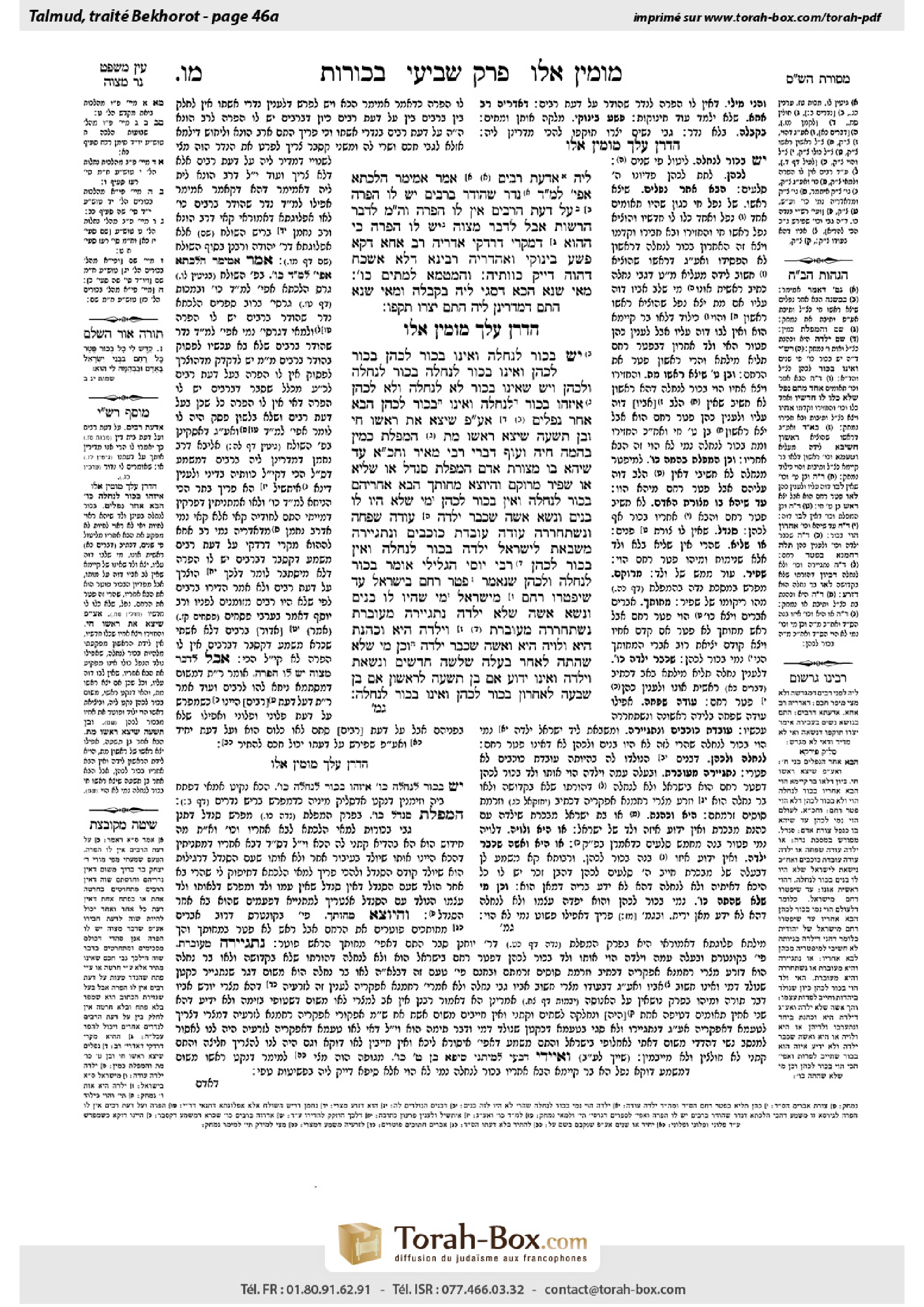
This page of Bekhorot includes the Aramaic text, an English translation and an AI-generated French translation, alongside the scan above.
בכורות מ״ו א · Aramaic and Hebrew text
לֵיהּ אַדַּעַת רַבִּים.
אָמַר אַמֵּימָר: הִלְכְתָא, אֲפִילּוּ לְמַאן דְּאָמַר נֶדֶר שֶׁהוּדַּר בָּרַבִּים יֵשׁ לוֹ הֲפָרָה, עַל דַּעַת הָרַבִּים אֵין לוֹ הֲפָרָה. וְהָנֵי מִילֵּי לִדְבַר הָרְשׁוּת, אֲבָל לִדְבַר מִצְוָה יֵשׁ לוֹ הֲפָרָה. כִּי הָהוּא דְּמַקְרֵי דַרְדְּקֵי, אַדְּרֵיהּ רַב אַחָא דְּקָא פָשַׁע בְּיָנוֹקֵי, וְאַהְדְּרֵיהּ רָבִינָא, דְּלָא אַשְׁכַּח דַּהֲוָה דָּיֵיק כְּוָותֵיהּ.
וְהַמִּטַּמֵּא לְמֵתִים כּוּ׳. מַאי שְׁנָא הָכָא דְּסַגִּי לֵיהּ בְּקַבָּלָה, וּמַאי שְׁנָא הָתָם דְּמַדְּרִינַן לֵיהּ? הָתָם יִצְרוֹ תְּקָפוֹ.
הֲדַרַן עֲלָךְ מוּמִין אֵלּוּ.
מַתְנִי׳ יֵשׁ בְּכוֹר לַנַּחֲלָה, וְאֵינוֹ בְּכוֹר לַכֹּהֵן; בְּכוֹר לִכְהֵן, וְאֵינוֹ בְּכוֹר לַנַּחֲלָה; בְּכוֹר לַנַּחֲלָה וְלַכֹּהֵן, וְיֵשׁ שֶׁאֵינוֹ בְּכוֹר לֹא לַנַּחֲלָה וְלֹא לַכֹּהֵן.
אֵיזֶהוּ בְּכוֹר לַנַּחֲלָה וְאֵינוֹ בְּכוֹר לַכֹּהֵן? הַבָּא אַחַר נְפָלִים, אַף עַל פִּי שֶׁיָּצָא אֶת רֹאשׁוֹ חַי, וּבֶן תִּשְׁעָה שֶׁיָּצָא רֹאשׁוֹ מֵת, הַמַּפֶּלֶת כְּמִין בְּהֵמָה חַיָּה וָעוֹף — דִּבְרֵי רַבִּי מֵאִיר.
וַחֲכָמִים אוֹמְרִים: עַד שֶׁיְּהֵא בּוֹ מִצּוּרַת אָדָם. הַמַּפֶּלֶת סַנְדָּל, אוֹ שִׁלְיָא, אוֹ שַׁפִּיר מְרוּקָּם, וְהַיּוֹצֵא מְחוּתָּךְ — הַבָּא אַחֲרֵיהֶם בְּכוֹר לַנַּחֲלָה, וְאֵין בְּכוֹר לַכֹּהֵן.
מִי שֶׁלֹּא הָיוּ לוֹ בָּנִים, וְנָשָׂא אִשָּׁה שֶׁכְּבָר יָלְדָה, עוֹדָהּ שִׁפְחָה וְנִשְׁתַּחְרְרָה, עוֹדָהּ נׇכְרִית וְנִתְגַּיְּירָה, מִשֶּׁבָּאת לְיִשְׂרָאֵל יָלְדָה — בְּכוֹר לַנַּחֲלָה וְאֵין בְּכוֹר לַכֹּהֵן.
רַבִּי יוֹסֵי הַגְּלִילִי אוֹמֵר: בְּכוֹר לַנַּחֲלָה וְלַכֹּהֵן, שֶׁנֶּאֱמַר: ״פֶּטֶר רֶחֶם בְּיִשְׂרָאֵל״ — עַד שֶׁיִּפְטְרוּ רֶחֶם מִיִּשְׂרָאֵל.
מִי שֶׁהָיוּ לוֹ בָּנִים וְנָשָׂא אִשָּׁה שֶׁלֹּא יָלְדָה, נִתְגַּיְּירָה מְעוּבֶּרֶת, נִשְׁתַּחְרְרָה מְעוּבֶּרֶת.
וְיָלְדָה הִיא וְכֹהֶנֶת הִיא, וּלְוִיָּה הִיא, וְאִשָּׁה שֶׁכְּבָר יָלְדָה, וְכֵן מִי שֶׁלֹּא שָׁהֲתָה לְאַחַר בַּעְלָהּ שְׁלֹשָׁה חֳדָשִׁים וְנִשֵּׂאת וְיָלְדָה, וְאֵינוֹ יָדוּעַ אִם בֶּן תִּשְׁעָה לָרִאשׁוֹן אִם בִּן שִׁבְעָה לָאַחֲרוֹן — בְּכוֹר לַכֹּהֵן וְאֵינוֹ בְּכוֹר לַנַּחֲלָה.
Bekhorot 46a · English translation
to the priest based on the consent of the public, making it a type of vow that cannot be dissolved without their consent.
Ameimar says: The halakha is as follows: Even according to the one who says a vow that was taken in public has the option of nullification, if it was taken based on the consent of the public it has no option of nullification. The Gemara comments: And this matter applies only to when the nullification of a vow is in order to enable one to perform an optional matter, but to enable one to perform a matter of a mitzva it has the option of nullification. As in the incident involving a certain teacher of children,upon whom Rav Aḥa administered a vow to cease teaching based on the consent of the public, as he was negligent with regard to the children by hitting them too much; and Ravina had his vow nullified and reinstated him, as they did not find another teacher who was as meticulous as he was.
§ The mishna teaches that a priest who becomes impure through exposure to corpses is disqualified from performing the Temple service until he accepts upon himself that he will no longer become impure in that manner. The Gemara asks: What is different here that it is sufficient for him merely to accept upon himself a commitment in order to continue serving in the Temple, and what is different there, where the priest marries by a transgression, that we administer a vow to him? The Gemara responds: There his desire seizes him, and it is therefore necessary for the priest to take a vow.
MISHNA: There is a son who is a firstborn with regard to inheritance but is not a firstborn with regard to the requirement of redemption from a priest. There is another who is a firstborn with regard to redemption from a priest but is not a firstborn with regard to inheritance. There is another who is a firstborn with regard to inheritance and with regard to redemption from a priest. And there is another who is not a firstborn at all, neither with regard to inheritance nor with regard to redemption from a priest.
Which is the son who is a firstborn with regard to inheritance but is not a firstborn with regard to redemption from a priest? It is a son who came after miscarriage of an underdeveloped fetus, even where the head of the underdeveloped fetus emerged alive; or after a fully developed nine-month-old fetus whose head emerged dead. The same applies to a son born to a woman who had previously miscarried a fetus that had the appearance of a type of domesticated animal, undomesticated animal, or bird, as that is considered the opening of the womb. This is the statement of Rabbi Meir.
And the Rabbis say: The son is not exempted from the requirement of redemption from a priest unless his birth follows the birth of an animal that takes the form of a person. In the case of a woman who miscarries a fetus in the form of a sandal fish or from whom an afterbirth or a gestational sac in which tissue developed emerged, or who delivered a fetus that emerged in pieces, the son who follows these is a firstborn with regard to inheritance but is not a firstborn with regard to redemption from a priest.
In the case of a son born to one who did not have sons and he married a woman who had already given birth; or if he married a woman who gave birth when she was still a Canaanite maidservant and she was then emancipated; or one who gave birth when she was still a gentile and she then converted, and when the maidservant or the gentile came to join the Jewish people she gave birth to a male, that son is a firstborn with regard to inheritance but is not a firstborn with regard to redemption from a priest.
Rabbi Yosei HaGelili says: That son is a firstborn with regard to inheritance and with regard to redemption from a priest, as it is stated: “Whatever opens the womb among the children of Israel” (Exodus 13:2). This indicates that the halakhic status of a child born to the mother is not that of one who opens the womb unless it opens the womb of a woman from the Jewish people.
In the case of one who had sons and married a woman who had not given birth; or if he married a woman who converted while she was pregnant, or a Canaanite maidservant who was emancipated while she was pregnant and she gave birth to a son, he is a firstborn with regard to redemption from a priest, as he opened his mother’s womb, but he is not a firstborn with regard to inheritance, because he is not the firstborn of his father or because halakhically he has no father.
And likewise, if an Israelite woman and the daughter or wife of a priest, neither of whom had given birth yet, or an Israelite woman and the daughter or wife of a Levite, or an Israelite woman and a woman who had already given birth, all women whose sons do not require redemption from the priest, gave birth in the same place and it is uncertain which son was born to which mother; and likewise a woman who did not wait three months after the death of her husband and she married and gave birth, and it is unknown whether the child was born after a pregnancy of nine months and is the son of the first husband, or whether he was born after a pregnancy of seven months and is the son of the latter husband, in all these cases the child is a firstborn with regard to redemption from a priest but is not a firstborn with regard to inheritance. Due to the uncertainty, he is unable to prove he is the firstborn of either father, and therefore he is not entitled to the double portion of the firstborn.
Bekhorot 46a · Traduction française (IA)
à l'officier religieux selon le consentement du public, ce qui en fait un type de vœu qui ne peut être annulé sans leur consentement.
Ameimar dit : La halakha est la suivante : Même selon celui qui affirme qu'un vœu prononcé en public peut être annulé, si ce vœu a été prononcé selon le consentement du public, il ne peut pas être annulé. La Guemara commente : Et cette affaire s'applique uniquement lorsqu'il s'agit d'annuler un vœu afin de permettre à quelqu'un de réaliser une action facultative, mais lorsqu'il s'agit d'annuler un vœu afin de permettre à quelqu'un de réaliser une obligation, il peut être annulé. Comme dans l'incident concernant un certain maître d'enfants, sur lequel Rav Aḥa administra un vœu pour cesser d'enseigner selon le consentement du public, car il était négligent envers les enfants en les frappant trop fort ; et Ravina annula son vœu et le rétablit, car ils n'ont pas trouvé d'autre enseignant aussi minutieux que lui.
§ La mitsna enseigne que le prêtre qui devient impur en raison de la proximité des cadavres est disqualifié pour l'accomplissement du service du Temple jusqu'à ce qu'il s'engage à ne plus devenir impur de cette manière. La Guemara pose la question : Qu'est-ce qui diffère ici pour que suffise à lui simplement d'accepter une promesse afin de continuer à servir dans le Temple, et qu'est-ce qui diffère dans le cas où le prêtre épouse en transgression, où nous administrons un vœu à lui ? La Guemara répond : Dans ce cas, son désir le saisit, et c'est donc nécessaire que le prêtre prenne un vœu.
MICHNA : Il existe un fils qui est un premier-né en ce qui concerne l'héritage mais n'est pas un premier-né en ce qui concerne l'obligation de rachat par un prêtre. Il existe un autre qui est un premier-né en ce qui concerne le rachat par un prêtre mais n'est pas un premier-né en ce qui concerne l'héritage. Il existe un autre qui est un premier-né en ce qui concerne l'héritage et en ce qui concerne le rachat par un prêtre. Et il existe un autre qui n'est pas un premier-né du tout, ni en ce qui concerne l'héritage ni en ce qui concerne le rachat par un prêtre.
Quel est le fils qui est un premier-né en ce qui concerne l'héritage mais n'est pas un premier-né en ce qui concerne le rachat par un prêtre ? Il s'agit d'un fils né après un avortement d'un fœtus sous-développé, même si la tête du fœtus sous-développé est sortie vivante ; ou après un fœtus pleinement développé de neuf mois dont la tête est sortie morte. La même chose s'applique à un fils né d'une femme qui avait précédemment avorté un fœtus ayant l'apparence d'un animal domestique, d'un animal sauvage ou d'un oiseau, car cela est considéré comme l'ouverture du ventre. C'est la déclaration de Rabbi Meir.
Et les Rabbins disent : Le fils n'est pas exempté de l'obligation de rachat par un prêtre à moins que sa naissance suive la naissance d'un animal qui prend la forme d'un être humain. Dans le cas d'une femme qui avorte un fœtus ayant la forme d'un poisson de sable ou dont un après-vie ou un sac gestationnel dans lequel des tissus se sont développés est sorti, ou qui accouche d'un fœtus sorti en morceaux, le fils qui suit ces cas est un premier-né en ce qui concerne l'héritage mais n'est pas un premier-né en ce qui concerne le rachat par un prêtre.
Dans le cas d'un fils né d'une personne qui n'avait pas de fils et qui a épousé une femme qui avait déjà donné naissance ; ou s'il a épousé une femme qui a donné naissance alors qu'elle était encore une servante cananéenne et qui a ensuite été libérée ; ou un homme qui a donné naissance alors qu'elle était encore païenne et qui a ensuite converti, et lorsque la servante ou la païenne est venue rejoindre le peuple juif, elle a donné naissance à un fils, ce fils est un premier-né en ce qui concerne l'héritage mais n'est pas un premier-né en ce qui concerne le rachat par un prêtre.
Rabbi Yosei HaGelili dit : Ce fils est un premier-né en ce qui concerne l'héritage et en ce qui concerne le rachat par un prêtre, car il est dit : « Tout ce qui ouvre le ventre parmi les enfants d'Israël » (Exode 13:2). Cela indique que le statut halakhique d'un enfant né de la mère n'est pas celui d'un qui ouvre le ventre à moins qu'il ouvre le ventre d'une femme du peuple d'Israël.
Dans le cas d'une personne qui avait des fils et qui a épousé une femme qui n'avait pas donné naissance ; ou s'il a épousé une femme qui s'est convertie pendant sa grossesse, ou une servante cananéenne qui s'est libérée pendant sa grossesse et qui a donné naissance à un fils, il est un premier-né en ce qui concerne le rachat par un prêtre, car il a ouvert le ventre de sa mère, mais il n'est pas un premier-né en ce qui concerne l'héritage, car il n'est pas le premier-né de son père ou bien il n'a pas de père halakhiquement.
De même, si une femme israélite et la fille ou la femme d'un prêtre, ni l'une ni l'autre n'avait encore donné naissance, ou une femme israélite et la fille ou la femme d'un lévite, ou une femme israélite et une femme qui avait déjà donné naissance, toutes ces femmes dont les fils n'ont pas besoin de rachat par un prêtre, ont donné naissance au même endroit et il est incertain de savoir à quelle mère appartient quel fils ; et de même une femme qui n'a pas attendu trois mois après la mort de son mari et qui s'est mariée et a donné naissance, et il est incertain si l'enfant est né après une grossesse de neuf mois et est le fils du premier mari, ou s'il est né après une grossesse de sept mois et est le fils du second mari, dans tous ces cas l'enfant est un premier-né en ce qui concerne le rachat par un prêtre mais n'est pas un premier-né en ce qui concerne l'héritage. En raison de l'incertitude, il ne peut pas prouver qu'il est le premier-né de l'un ou de l'autre père, et par conséquent il n'a pas droit à la double portion du premier-né.
Traduction française générée par IA à partir de l’édition anglaise de Sefaria. Vérifie toujours un passage avec le texte source.
Text from Sefaria: William Davidson Edition - Vocalized Aramaic (CC BY NC); William Davidson Edition - English (CC BY NC).