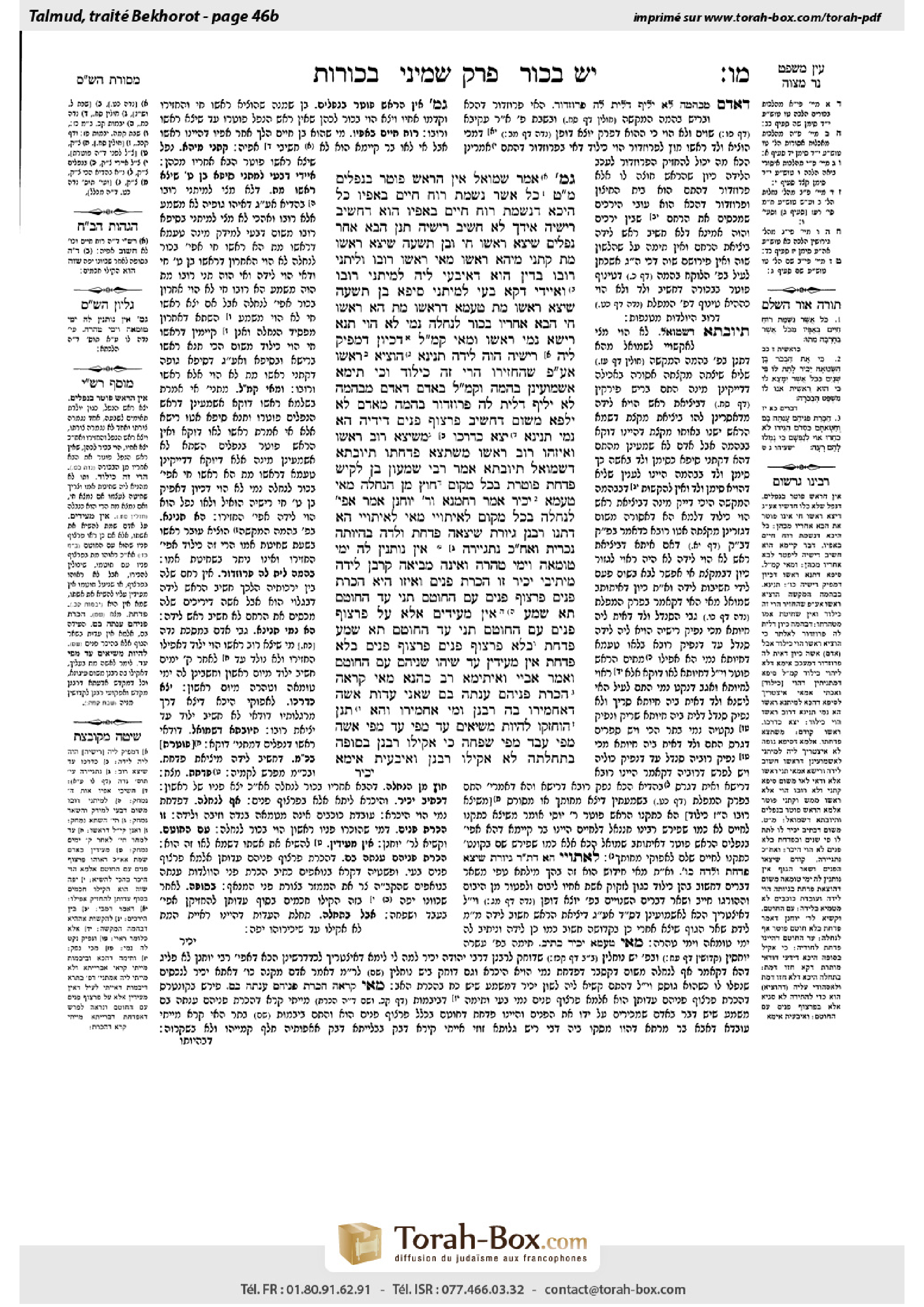
Bekhorot 46b: Talmud study for Daf Yomi
Study the Talmud for Daf Yomi with scanned pages, Hebrew text, English translations from Sefaria and AI-generated French translations.
Passage selection and English or AI-generated French translation are available where the scan has annotations. Daf Study is independent of Torah-Box and Sefaria.
Browse Bekhorot · בכורות · All tractatesBekhorot 46b text and translations
This page of Bekhorot includes the Aramaic text, an English translation and an AI-generated French translation, alongside the scan above.
בכורות מ״ו ב · Aramaic and Hebrew text
גְּמָ׳ אָמַר שְׁמוּאֵל: אֵין הָרֹאשׁ פּוֹטֵר בִּנְפָלִים.
מַאי טַעְמָא? ״כֹּל אֲשֶׁר נִשְׁמַת רוּחַ חַיִּים בְּאַפָּיו״ — כֹּל הֵיכָא דְּנִשְׁמַת רוּחַ חַיִּים בְּאַפָּיו הוּא דַּחֲשִׁיב רֵישֵׁיהּ, אִידַּךְ לָא חֲשִׁיב רֵישֵׁיהּ.
תְּנַן: הַבָּא אַחַר נְפָלִים, שֶׁיָּצָא רֹאשׁוֹ חַי, וּבֶן תִּשְׁעָה שֶׁיָּצָא רֹאשׁוֹ מֵת. קָתָנֵי מִיהָא ״רֹאשׁוֹ!״ מַאי ״רֹאשׁוֹ?״ רוּבּוֹ.
וְלִיתְנֵי ״רוּבּוֹ״! בְּדִין הוּא דְּאִיבְּעִי לֵיהּ לְמִיתְנֵי רוּבּוֹ, וְאַיְּידֵי דְּקָא בָעֵי לְמִיתְנֵי סֵיפָא בֶּן תִּשְׁעָה שֶׁיָּצָא רֹאשׁוֹ מֵת — טַעְמָא דְּרֹאשׁוֹ מֵת, הָא רֹאשׁוֹ חַי — הַבָּא אַחֲרָיו בְּכוֹר לַנַּחֲלָה נָמֵי לָא הָוֵי, תְּנָא רֵישָׁא נָמֵי רֹאשׁוֹ.
וּמַאי קָא מַשְׁמַע לַן, דְּכֵיוָן דְּמַפֵּיק לֵיהּ רֵישֵׁיהּ הָוֵה [לֵיהּ] לֵידָה? תְּנֵינָא: הוֹצִיא רֹאשׁוֹ, אַף עַל פִּי שֶׁהֶחְזִירוֹ — הֲרֵי זֶה כְּיָלוּד!
וְכִי תֵּימָא: אַשְׁמוֹעִינַן בְּהֵמָה, וְקָא מַשְׁמַע לַן בְּאָדָם, דְּאָדָם מִבְּהֵמָה לָא יָלֵיף — דְּלֵית לַהּ פְּרוֹזְדוֹר.
בְּהֵמָה מֵאָדָם לָא יָלְפָא — מִשּׁוּם דַּחֲשִׁיב פַּרְצוּף פָּנִים דִּידֵיהּ.
הָא נָמֵי תְּנֵינָא: יָצָא כְּדַרְכּוֹ — מִשֶּׁיָּצָא רוֹב רֹאשׁוֹ, וְאֵיזֶהוּ רוֹב רֹאשׁוֹ? מִשֶּׁתֵּצֵא פַּדַּחְתּוֹ. תְּיוּבְתָּא דִשְׁמוּאֵל, תְּיוּבְתָּא!
אָמַר רַבִּי שִׁמְעוֹן בֶּן לָקִישׁ: פַּדַּחַת פּוֹטֶרֶת בְּכׇל מָקוֹם, חוּץ מִן הַנַּחֲלָה. מַאי טַעְמָא? ״יַכִּיר״ אָמַר רַחֲמָנָא, וְרַבִּי יוֹחָנָן אָמַר: אֲפִילּוּ לַנַּחֲלָה.
בְּכׇל מָקוֹם, לְאֵיתוֹיֵי מַאי? לְאֵיתוֹיֵי הָא דְּתָנוּ רַבָּנַן: גִּיּוֹרֶת שֶׁיָּצְאָה פַּדַּחַת וְלָדָהּ בְּגַיּוּתָהּ, וְאַחַר כָּךְ נִתְגַּיְּירָה — אֵין נוֹתְנִין לָהּ יְמֵי טוּמְאָה וִימֵי טׇהֳרָה, וְאֵינָהּ מְבִיאָה קׇרְבַּן לֵידָה.
מֵיתִיבִי: ״יַכִּיר״ — זוֹ הַכָּרַת פָּנִים, וְאֵיזוֹ הִיא הַכָּרַת פָּנִים? פַּרְצוּף פָּנִים עִם הַחוֹטֶם. תָּנֵי: ״עַד הַחוֹטֶם״. תָּא שְׁמַע: אֵין מְעִידִים אֶלָּא עַל פַּרְצוּף פָּנִים עִם הַחוֹטֶם. תְּנִי: ״עַד הַחוֹטֶם״.
תָּא שְׁמַע: פַּדַּחַת בְּלֹא פַּרְצוּף פָּנִים, פַּרְצוּף פָּנִים בְּלֹא פַּדַּחַת — אֵין מְעִידִין עַד שֶׁיְּהוּ שְׁנֵיהֶם עִם הַחוֹטֶם. וְאָמַר אַבָּיֵי, וְאִיתֵּימָא רַב כָּהֲנָא: מַאי קְרָאָה? ״הַכָּרַת פְּנֵיהֶם עָנְתָה בָּם״! שָׁאנֵי עֵדוּת אִשָּׁה, דְּאַחְמִירוּ בַּהּ רַבָּנַן.
וּמִי אַחְמִירוּ? וְהָא תְּנַן: הוּחְזְקוּ לִהְיוֹת מַשִּׂיאִים עֵד מִפִּי עֵד, מִפִּי אִשָּׁה, מִפִּי עֶבֶד, מִפִּי שִׁפְחָה! כִּי אַקִּילוּ רַבָּנַן בְּסוֹפָהּ, בִּתְחִלָּתָהּ לָא אַקִּילוּ רַבָּנַן.
וְאִיבָּעֵית אֵימָא:
Bekhorot 46b · English translation
GEMARA: Shmuel says: In a case where the head of a fetus emerged and then went back into the womb, the offspring is not considered to have been born and does not exempt the next fetus from the obligation of redemption of the firstborn, e.g., if its twin brother was born first. Shmuel says this halakha specifically in a case of miscarriage, i.e., where the fetus whose head emerged was a stillborn and the one that was eventually born first is a viable offspring. But in a case where both are viable offspring, the emergence of the head is considered birth.
The Gemara asks: What is the reason for Shmuel’s ruling? The verse states: “All in whose nostrils was the breath of the spirit of life” (Genesis 7:22), from which it is derived: Anywhere that one has the breath of the spirit of life, i.e., if it is viable, one goes by its nostrils, i.e., its head is considered significant. But with regard to another offspring, one that is not viable, its head is not considered significant.
The Gemara raises a difficulty: We learned in the mishna: What is a firstborn with regard to inheritance but not with regard to redemption from a priest? It is a son who came after the miscarriage of an underdeveloped fetus, even where the head of the underdeveloped fetus emerged alive; and a fully developed nine-month-old fetus whose head emerged dead. Although the mishna addresses a nine-month-old fetus as well, in any event it teaches with regard to a miscarriage that its head exempts the offspring born after it. The Gemara responds: What is the meaning of the term: Its head? It means its head and most of the body.
The Gemara asks: But if so, let the mishna teach: Most of it. The Gemara answers: By right, the mishna should have taught: Most of it, but it did not do so, since in the latter clause of the mishna it needs to teach: A fully developed nine-month-old fetus whose head emerged dead. It is inferred from there that the reason the subsequent son is the firstborn with regard to inheritance is that the head of this fetus emerged dead, but if it was a nine-month-old fetus whose head emerged alive, then the fetus that comes after it is not a firstborn with regard to inheritance either. Therefore, the tanna of the mishna taught in the first clause also that the head of a miscarriage exempts the subsequent son, to maintain stylistic uniformity.
The Gemara asks: And according to this interpretation, what is the mishna teaching us? Is it that once the offspring reached out its head from the womb it is considered a birth? We learn this in a mishna with regard to the fetus of an animal (Ḥullin 68a): If a fetus reached out its head, although it returned the head, the halakhic status of that fetus is like that of a newborn, whose consumption is permitted only by its own slaughter.
And if you would say that the mishna there teaches us this halakha with regard to animals, and the mishna here teaches us that the same halakha applies to a human, this does not resolve the difficulty. The Gemara first explains why two rulings might be necessary with regard to people and animals: The reason is that the halakha of a human cannot be derived from that of an animal, as the animal has no concealed opening, i.e., the opening of an animal’s womb is not hidden. Consequently, one might have thought that only in the case of an animal is the emergence of the head considered a birth. By contrast, in humans, where the woman’s thighs conceal the opening of the womb and the emergence of the head alone is not noticeable, perhaps the emergence of the head is not considered a full-fledged birth.
Conversely, had this ruling been taught only with regard to humans, one would have said that the halakha of animals cannot be derived from that of a human because the countenance of a person’s face is significant, as people are created in the image of God. This is not so with regard to animals.
After clarifying why both rulings are necessary, the Gemara explains why this does not resolve the difficulty: We learn that ruling with regard to people also, in a mishna (Nidda 28a): If the fetus emerged in the usual manner, head first, it is considered born only when most of its head emerges. And what is considered most of its head? It is from when its forehead emerges. Accordingly, there was no need for the mishna here to state the halakha with regard to the head of a nine-month-old fetus, and the mention of a head with regard to a miscarriage contradicts the opinion of Shmuel. The Gemara comments: The refutation of the opinion of Shmuel is indeed a conclusive refutation.
§ Concerning this matter, Rabbi Shimon ben Lakish says: The emergence of a forehead alone in the case of a person exempts, i.e., is considered a birth, in all cases, except with regard to inheritance. If a son reached out his head alone and then brought it back, after which his twin brother was born, the second brother is the firstborn with regard to inheritance. What is the reason? The Merciful One states: “For he shall recognize the firstborn, the son of the hated, by giving him a double portion of all that he has” (Deuteronomy 21:17), and recognition is not attained by emergence of the forehead alone. And Rabbi Yoḥanan says: Even with regard to inheritance the emergence of a forehead is sufficient.
The Gemara asks: When Rabbi Shimon ben Lakish says the emergence of a forehead alone in the case of a person exempts in all cases, what does this comprehensive phrase serve to include? The Gemara answers that it serves to include that which the Sages taught: With regard to a female convert whose offspring reached out its forehead alone in her gentile state, and then she converted and gave birth to the entire child, one does not assign to her the days of ritual impurity and the days of ritual purity of a Jewish woman who gave birth. And likewise she does not bring the offering that a woman is obligated to sacrifice after giving birth, as the child is considered to have been born while the mother was still a gentile.
The Gemara raises an objection to the opinion of Rabbi Yoḥanan from a baraita: When the verse states: “He shall recognize” (Deuteronomy 21:17), this is referring to the recognition of the face. And what exactly is the recognition of the face? It is recognizing the countenance of the face with the nose. This indicates that the forehead alone is insufficient. The Gemara answers: Teach the baraita as saying: Up to, but not including, the nose. The Gemara suggests: Come and hear a mishna (Yevamot 120a): One can testify that a man died, in order to permit his wife to remarry, only if he can attest to seeing the countenance of the face with the nose, as this allows one to identify the individual definitively. Once again, the Gemara answers that one should teach: Up to, but not including, the nose.
The Gemara suggests: Come and hear another proof: If people saw the forehead of a dead person without the countenance of the face, or the countenance of the face without the forehead, they cannot testify that he died and render his wife permitted to remarry until they see both the countenance of the face and the forehead, with the nose. And Abaye says, and some say it was Rav Kahana who says: What is the verse from which it is derived? “The recognition of their countenance does witness against them” (Isaiah 3:9), and there is no recognition of a face without the nose. The Gemara answers: Testimony enabling a woman to remarry is different, as the Sages were stringent with regard to it. Therefore, they required greater proof than with regard to the halakhot of a firstborn.
The Gemara asks: And were the Sages stringent with regard to this testimony? But didn’t we learn in a mishna (Yevamot 122a): The Sages established that they would allow a woman to marry again based on testimony that is generally not accepted, such as testimony based on hearsay, i.e., the testimony of one man which was heard from another man who saw her husband die, from a woman’s testimony, from a Canaanite slave’s testimony, or from a Canaanite maidservant’s testimony? The Gemara answers that when the Sages were lenient it was with regard to the end of the testimony, i.e., to accept testimony that a husband had died even from individuals just mentioned. But the Sages were not lenient with regard to its beginning, i.e., the basic clarification of whether the witnesses properly identified the dead person when they saw him.
And if you wish, say instead that Rabbi Yoḥanan can resolve the difficulty as follows:
Bekhorot 46b · Traduction française (IA)
GUEMARA : Shmuel dit : Dans un cas où la tête d'un fœtus est sortie et est revenue dans l'utérus, l'enfant n'est pas considéré comme né et ne dispense pas le fœtus suivant de l'obligation de rachat du premier-né, par exemple, si son frère jumeau est né en premier. Shmuel formule cette halakha spécifiquement dans le cas d'un avortement, c'est-à-dire lorsque le fœtus dont la tête est sortie était un mort-né et que celui qui est finalement né en premier est un enfant viable. Mais dans le cas où les deux sont viables, l'émergence de la tête est considérée comme un accouchement.
La Guemara pose la question : Quelle est la raison de la décision de Shmuel ? La Paracha dit : « Tous ceux dont les narines avaient le souffle de l'esprit de vie » (Genèse 7:22), d'où on déduit : Partout où l'on a le souffle de l'esprit de vie, c'est-à-dire si c'est viable, on suit ses narines, c'est-à-dire que sa tête est considérée comme importante. Mais concernant un autre fœtus, celui qui n'est pas viable, sa tête n'est pas considérée comme importante.
La Guemara soulève une difficulté : Nous avons appris dans la mitsva : Quel est le premier-né concernant l'héritage mais pas concernant le rachat par un prêtre ? C'est un fils qui est né après l'avortement d'un fœtus sous-développé, même si la tête du fœtus sous-développé est sortie vivante ; et un fœtus bien développé de neuf mois dont la tête est sortie morte. Bien que la mitsva aborde également un fœtus de neuf mois, dans tous les cas elle enseigne concernant un avortement que sa tête dispense l'enfant né après lui. La Guemara répond : Qu'entend-on par le terme : Sa tête ? Cela signifie sa tête et la plus grande partie du corps.
La Guemara pose la question : Mais si c'est ainsi, pourquoi la mitsna ne dit-elle pas : La plus grande partie ? La Guemara répond : D'un point de vue logique, la mitsna aurait dû enseigner : La plus grande partie, mais elle ne l'a pas fait, car dans la seconde partie de la mitsna il faut enseigner : Un fœtus bien développé de neuf mois dont la tête est sortie morte. On en déduit là que la raison pour laquelle le fils suivant est considéré comme premier-né concernant l'héritage est que la tête de ce fœtus est sortie morte, mais si c'était un fœtus de neuf mois dont la tête est sortie vivante, alors le fœtus qui vient après ne serait pas non plus considéré comme premier-né concernant l'héritage. Ainsi, le tanna de la mitsna a enseigné dans la première partie également que la tête d'un avortement dispense le fils suivant, afin de maintenir une uniformité stylistique.
La Guemara pose la question : Et selon cette interprétation, que nous enseigne la mitsna ? Est-ce que dès que l'enfant tendait sa tête hors de l'utérus, on le considérait comme né ? Nous apprenons cela dans une mitsna concernant le fœtus d'un animal (Ḥullin 68a) : Si un fœtus tendait sa tête, même s'il la revenait, le statut halakhique de ce fœtus est celui d'un nouveau-né, dont la consommation est permise uniquement par son propre sacrifice.
Et si vous disiez que la mitsva là enseigne cette halakha concernant les animaux, et que la mitsva ici enseigne que la même halakha s'applique à l'humain, cela ne résout pas la difficulté. La Guemara explique d'abord pourquoi deux jugements pourraient être nécessaires concernant les humains et les animaux : La raison est que la halakha concernant l'humain ne peut pas être dérivée de celle concernant l'animal, car l'animal n'a pas d'ouverture cachée, c'est-à-dire que l'ouverture de l'utérus de l'animal n'est pas cachée. Ainsi, on pourrait penser que seul dans le cas d'un animal l'émergence de la tête est considérée comme un accouchement. À l'inverse, chez l'human, où les cuisses de la femme cachent l'ouverture de l'utérus et l'émergence de la tête seule n'est pas visible, peut-être l'émergence de la tête n'est pas considérée comme un accouchement complet.
Inversement, si ce jugement avait été enseigné uniquement concernant les humains, on aurait dit que la halakha concernant les animaux ne peut pas être dérivée de celle concernant l'humain, car le visage d'une personne est important, car les humains sont créés à l'image de Dieu. Ce n'est pas le cas concernant les animaux.
Après avoir clarifié pourquoi les deux jugements sont nécessaires, la Guemara explique pourquoi cela ne résout pas la difficulté : Nous apprenons que ce jugement concernant les humains aussi, dans une mitsva (Nidda 28a) : Si le fœtus est sorti de l'utérus de la manière habituelle, tête en premier, il est considéré comme né seulement quand la plus grande partie de sa tête est sortie. Et que signifie la plus grande partie de sa tête ? C'est quand sa frontière est sortie. Ainsi, il n'avait pas besoin que la mitsva ici énonce cette halakha concernant la tête d'un fœtus de neuf mois, et la mention de la tête concernant un avortement contredit l'opinion de Shmuel. La Guemara commente : La réfutation de l'opinion de Shmuel est effectivement une réfutation concluante.
§ Concernant cette question, Rabbi Shimon ben Lakish dit : L'émergence du front seul dans le cas d'une personne dispense, c'est-à-dire est considérée comme un accouchement, dans tous les cas, sauf concernant l'héritage. Si un fils tendait seul sa tête et la ramenait ensuite, après quoi son frère jumeau était né, le second frère est le premier-né concernant l'héritage. Quelle est la raison ? L'Éternel dit : « Car il reconnaîtra le premier-né, le fils du détesté, en lui donnant une double portion de tout ce qu'il possède » (Deutéronome 21:17), et la reconnaissance n'est pas obtenue par l'émergence du front seul. Et Rabbi Yoḥanan dit : Même concernant l'héritage, l'émergence du front est suffisante.
La Guemara pose la question : Quand Rabbi Shimon ben Lakish dit que l'émergence du front seul dans le cas d'une personne dispense dans tous les cas, à quoi sert cette phrase générale ? La Guemara répond que cela sert à inclure ce que les Sages ont enseigné : Concernant une femme convertie dont l'enfant avait tendu seul son front dans son état païen, puis elle s'est convertie et a donné naissance à l'enfant entier, on ne lui attribue pas les jours de souillure rituelle et les jours de pureté rituelle d'une femme juive qui a donné naissance. De même, elle ne sacrifie pas l'offrande que la femme est obligée de sacrifier après avoir donné naissance, car l'enfant est considéré comme né alors que la mère était encore païenne.
La Guemara soulève une objection contre l'opinion du Rabbi Yoḥanan, à partir d'une baraïta : Lorsque la Bible dit : « Il reconnaîtra » (Deutéronome 21:17), cela fait référence à la reconnaissance du visage. Et que signifie exactement la reconnaissance du visage ? C'est reconnaître le visage avec le nez. Cela indique que seul le front n'est pas suffisant. La Guemara répond : Enseigne la baraïta en disant : Jusqu'au nez, mais sans inclure le nez. La Guemara suggère : Viens écouter une mitsna (Yevamot 120a) : On peut témoigner que l'homme est mort, afin de permettre à sa femme de se remarier, uniquement si l'on peut attester avoir vu le visage avec le nez, car cela permet d'identifier l'individu de manière définitive. À nouveau, la Guemara répond que l'on devrait enseigner : Jusqu'au nez, mais sans inclure le nez.
La Guemara suggère : Viens écouter une autre preuve : Si les gens ont vu le front d'une personne morte sans le visage, ou le visage sans le front, ils ne peuvent pas témoigner qu'il est mort et rendre sa femme permise à remariage jusqu'à ce qu'ils voient à la fois le visage et le front, avec le nez. Et Abaye dit, et certains disent que c'était Rav Kahana qui a dit : De quelle verset cela est-il déduit ? « La reconnaissance de leur visage témoigne contre eux » (Yachin 3:9), et il n'y a pas de reconnaissance du visage sans le nez. La Guemara répond : Le témoignage permettant à une femme de se remarier est différent, car les Sages étaient stricts à cet égard. Par conséquent, ils exigeaient une preuve plus solide par rapport aux halakhot du premier-né.
La Guemara pose la question : Et les Sages étaient-ils stricts à cet égard ? Mais n'avons-nous pas appris dans une mitsna (Yevamot 122a) : Les Sages ont établi qu'ils permettraient à une femme de se remarier sur la base d'un témoignage généralement non accepté, tel que le témoignage par ouïe, c'est-à-dire le témoignage d'un homme qui a entendu d'un autre homme avoir vu son mari mourir, d'une femme, d'un esclave cananéen ou d'une servante cananéenne ? La Guemara répond que lorsque les Sages étaient indulgents, c'était concernant la fin du témoignage, c'est-à-dire accepter le témoignage que l'homme était mort même provenant de ces individus mentionnés. Mais les Sages n'étaient pas indulgents concernant son début, c'est-à-dire la clarification de base de savoir si les témoins ont correctement identifié la personne décédée lorsqu'ils l'ont vue.
Et si tu veux, dis plutôt que le Rabbi Yoḥanan peut résoudre la difficulté comme suit :
Traduction française générée par IA à partir de l’édition anglaise de Sefaria. Vérifie toujours un passage avec le texte source.
Text from Sefaria: William Davidson Edition - Vocalized Aramaic (CC BY NC); William Davidson Edition - English (CC BY NC).