Bekhorot 47a: Talmud study for Daf Yomi
Study the Talmud for Daf Yomi with scanned pages, Hebrew text, English translations from Sefaria and AI-generated French translations.
Passage selection and English or AI-generated French translation are available where the scan has annotations. Daf Study is independent of Torah-Box and Sefaria.
Browse Bekhorot · בכורות · All tractatesBekhorot 47a text and translations
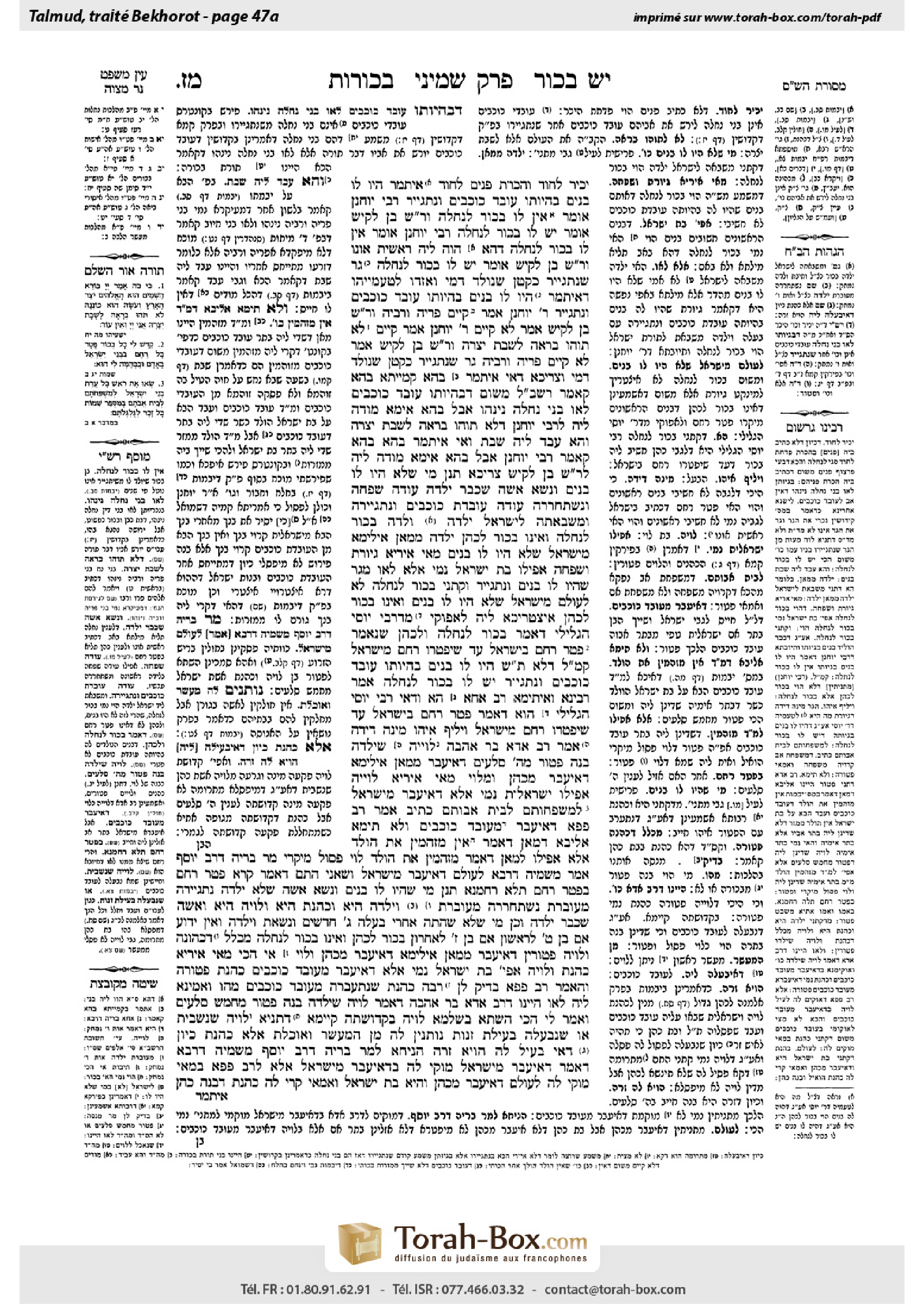
This page of Bekhorot includes the Aramaic text, an English translation and an AI-generated French translation, alongside the scan above.
בכורות מ״ז א · Aramaic and Hebrew text
״יַכִּיר״ לְחוּד, וְהַכָּרַת פָּנִים לְחוּד.
אִיתְּמַר: הָיוּ לוֹ בָּנִים בְּגַיּוּתוֹ וְנִתְגַּיֵּיר — רַבִּי יוֹחָנָן אוֹמֵר: אֵין לוֹ בְּכוֹר לַנַּחֲלָה, וְרַבִּי שִׁמְעוֹן בֶּן לָקִישׁ אוֹמֵר: יֵשׁ לוֹ בְּכוֹר לַנַּחֲלָה. רַבִּי יוֹחָנָן אוֹמֵר: אֵין לוֹ בְּכוֹר לַנַּחֲלָה — דְּהָא הֲוָה לֵיהּ ״רֵאשִׁית אוֹנוֹ״, וְרַבִּי שִׁמְעוֹן בֶּן לָקִישׁ אוֹמֵר: יֵשׁ לוֹ בְּכוֹר לַנַּחֲלָה — גֵּר שֶׁנִּתְגַּיֵּיר כְּקָטָן שֶׁנּוֹלַד דָּמֵי.
וְאָזְדוּ לְטַעְמַיְיהוּ, דְּאִיתְּמַר: הָיוּ לוֹ בָּנִים בְּגַיּוּתוֹ וְנִתְגַּיֵּיר — רַבִּי יוֹחָנָן אָמַר: קִיֵּים פְּרִיָּה וּרְבִיָּה, וְרַבִּי שִׁמְעוֹן בֶּן לָקִישׁ אָמַר: לֹא קִיֵּים. רַבִּי יוֹחָנָן אָמַר: קִיֵּים — ״לֹא תֹהוּ בְרָאָהּ לָשֶׁבֶת יְצָרָהּ״, וְרַבִּי שִׁמְעוֹן בֶּן לָקִישׁ אָמַר: לֹא קִיֵּים פְּרִיָּה וּרְבִיָּה — גֵּר שֶׁנִּתְגַּיֵּיר כְּקָטָן שֶׁנּוֹלַד דָּמֵי.
וּצְרִיכָא, דְּאִי אִיתְּמַר בְּהָא קַמַּיְיתָא, בְּהָא קָאָמַר רַבִּי שִׁמְעוֹן בֶּן לָקִישׁ, מִשּׁוּם דִּבְגַיּוּתָן לָאו בְּנֵי נַחֲלָה נִינְהוּ, אֲבָל בְּהָא אֵימָא מוֹדֶה לֵיהּ לְרַבִּי יוֹחָנָן, דְּ״לֹא תֹהוּ בְּרָאָהּ לָשֶׁבֶת יְצָרָהּ״, וְהָא עֲבַד לֵיהּ שֶׁבֶת.
וְאִי אִיתְּמַר בְּהָא, בְּהָא קָאָמַר רַבִּי יוֹחָנָן, אֲבָל בְּהָא אֵימָא מוֹדֶה לֵיהּ לְרַבִּי שִׁמְעוֹן בֶּן לָקִישׁ, צְרִיכָא.
תְּנַן: מִי שֶׁלֹּא הָיוּ לוֹ בָּנִים, וְנָשָׂא אִשָּׁה שֶׁכְּבָר יָלְדָה, עוֹדָהּ שִׁפְחָה וְנִשְׁתַּחְרְרָה, עוֹדָהּ גּוֹיָה וְנִתְגַּיְּירָה, וּמִשֶּׁבָּאתָה לְיִשְׂרָאֵל יָלָדָה — וְלָדָהּ בְּכוֹר לַנַּחֲלָה וְאֵינוֹ בְּכוֹר לַכֹּהֵן.
יָלְדָה מִמַּאן? אִילֵימָא מִיִּשְׂרָאֵל שֶׁלֹּא הָיוּ לוֹ בָּנִים — מַאי אִירְיָא גִּיּוֹרֶת וְשִׁפְחָה? אֲפִילּוּ בַּת יִשְׂרָאֵל נָמֵי!
אֶלָּא לָאו מִגֵּר שֶׁהָיוּ לוֹ בָּנִים וְנִתְגַּיֵּיר, וְקָתָנֵי בְּכוֹר לַנַּחֲלָה!
לָא, לְעוֹלָם מִיִּשְׂרָאֵל שֶׁלֹּא הָיוּ לוֹ בָּנִים, וְ״אֵינוֹ בְּכוֹר לַכֹּהֵן״ אִיצְטְרִיכָא לֵיהּ.
לְאַפּוֹקֵי מִדְּרַבִּי יוֹסֵי הַגְּלִילִי, דְּאָמַר: בְּכוֹר לַנַּחֲלָה וְלַכֹּהֵן, שֶׁנֶּאֱמַר: ״פֶּטֶר רֶחֶם בְּיִשְׂרָאֵל״ — עַד שֶׁיִּפְטְרוּ רֶחֶם מִיִּשְׂרָאֵל, קָא מַשְׁמַע לַן דְּלָא.
תָּא שְׁמַע: הָיוּ לוֹ בָּנִים בְּגַיּוּתוֹ וְנִתְגַּיֵּיר, יֵשׁ לוֹ בְּכוֹר לַנַּחֲלָה! אָמַר רָבִינָא, וְאִיתֵּימָא רַב אַחָא: הָא וַדַּאי רַבִּי יוֹסֵי הַגְּלִילִי הִוא, דְּאָמַר ״פֶּטֶר רֶחֶם בְּיִשְׂרָאֵל״ — עַד שֶׁיִּפְטְרוּ רֶחֶם מִיִּשְׂרָאֵל, וְיָלֵיף אִיהוּ מִינַּהּ דִּידַהּ.
אָמַר רַב אַדָּא בַּר אַהֲבָה: לְוִיָּיה שֶׁיָּלְדָה — בְּנָהּ פָּטוּר מֵחֲמֵשׁ סְלָעִים. דְּאִיעַבַּר מִמַּאן? אִילֵימָא דְּאִיעַבַּר מִכֹּהֵן וּמִלֵּוִי, מַאי אִירְיָא לְוִיָּיה? אֲפִילּוּ יִשְׂרְאֵלִית נָמֵי!
אֶלָּא דְּאִיעַבַּר מִיִּשְׂרָאֵל, ״לְמִשְׁפְּחֹתָם לְבֵית אֲבֹתָם״ כְּתִיב!
אָמַר רַב פָּפָּא: דְּאִיעַבַּר מִגּוֹי. וְלָא תֵּימָא אַלִּיבָּא דְּמַאן דְּאָמַר אֵין מְזַהֲמִין אֶת הַוָּלָד, אֶלָּא אֲפִילּוּ לְמַאן דְּאָמַר מְזַהֲמִין אֶת הַוָּלָד, לֵוִי פָּסוּל מִיקְּרֵי.
מָר בְּרֵיהּ דְּרַב יוֹסֵף אָמַר מִשְּׁמֵיהּ דְּרָבָא: לְעוֹלָם דְּאִיעַבַּר מִיִּשְׂרָאֵל, וְשָׁאנֵי הָתָם, דְּאָמַר קְרָא ״פֶּטֶר רֶחֶם״ — בְּפֶטֶר רֶחֶם תְּלָא רַחְמָנָא.
תְּנַן: מִי שֶׁהָיוּ לוֹ בָּנִים וְנָשָׂא אִשָּׁה שֶׁלֹּא יָלָדָה, נִתְגַּיְּירָה מְעוּבֶּרֶת, נִשְׁתַּחְרְרָה מְעוּבֶּרֶת.
וְיָלְדָה הִיא וְכֹהֶנֶת הִיא, וּלְוִיָּה הִיא, וְאִשָּׁה שֶׁכְּבָר יָלָדָה. וְכֵן מִי שֶׁלֹּא שָׁהֲתָה אַחֲרֵי בַּעְלָהּ שְׁלֹשָׁה חֳדָשִׁים וְנִשֵּׂאת וְיָלָדָה, וְאֵין יָדוּעַ אִם בֶּן תִּשְׁעָה לָרִאשׁוֹן אִם בֶּן שִׁבְעָה לָאַחֲרוֹן — בְּכוֹר לַכֹּהֵן וְאֵינוֹ בְּכוֹר לַנַּחֲלָה.
מִכְּלָל (דִּכְהוּנָּה) [דְּכֹהֶנֶת] וּלְוִיָּה פְּטוּרִין, דְּאִיעַבַּר מִמַּאן? אִילֵימָא דְּאִיעַבַּר מִכֹּהֵן וְלֵוִי — אִי הָכִי מַאי אִירְיָא כֹּהֶנֶת וּלְוִיָּה? אֲפִילּוּ בַּת יִשְׂרָאֵל נָמֵי!
אֶלָּא דְּאִיעַבַּר מִגּוֹי — כֹּהֶנֶת פְּטוּרָה? וְהָאָמַר רַב פָּפָּא: בָּדֵיק לַן רַבָּה, כֹּהֶנֶת שֶׁנִּתְעַבְּרָה מִגּוֹי מַהוּ? וְאָמֵינָא לֵיהּ: לָאו הַיְינוּ דְּרַב אַדָּא בַּר אַהֲבָה, דְּאָמַר: לְוִיָּה שֶׁיָּלְדָה בְּנָהּ פָּטוּר מֵחָמֵשׁ סְלָעִים?
וַאֲמַר לִי: הָכִי הַשְׁתָּא?! בִּשְׁלָמָא לְוִיָּה בִּקְדוּשְׁתַּהּ קָיְימָא, דְּתַנְיָא: לְוִיָּה שֶׁנִּשְׁבֵּית אוֹ שֶׁנִּבְעֲלָה בְּעִילַת זְנוּת — נוֹתְנִין לָהּ מִן הַמַּעֲשֵׂר וְאוֹכֶלֶת.
אֶלָּא כֹּהֶנֶת, כֵּיוָן דְּאִי בָּעֵיל לַהּ, הָוְיָא זָרָה!
הָנִיחָא לְמָר בְּרֵיהּ דְּרַב יוֹסֵף מִשְּׁמֵיהּ דְּרָבָא, דְּאָמַר דְּאִיעַבַּר מִיִּשְׂרָאֵל, מוֹקֵי לַהּ בִּדְאִיעַבַּר מִיִּשְׂרָאֵל, אֶלָּא לְרַב פָּפָּא בְּמַאי מוֹקֵי לָהּ?
לְעוֹלָם דְּאִיעַבַּר מִכֹּהֵן, וְהִיא בַּת יִשְׂרָאֵל, וְאַמַּאי קָרֵי לַהּ ״כֹּהֶנֶת״? דִּבְנָה כֹּהֵן.
Bekhorot 47a · English translation
The requirement of “He shall recognize” with regard to a firstborn for inheritance, and the recognition of a husband’s face, are discrete matters.
§ It was stated that amora’im engaged in a dispute concerning the case of a man who had children when he was a gentile and he subsequently converted: Rabbi Yoḥanan says he does not have a firstborn with regard to inheritance, i.e., a son who is his firstborn after his conversion does not inherit a double portion; and Rabbi Shimon ben Lakish says: He does have a firstborn with regard to inheritance. The Gemara elaborates: Rabbi Yoḥanan says: He does not have a firstborn with regard to inheritance, as this man already had “the first of his strength” (Deuteronomy 21:17), the Torah’s description of the firstborn in this context, before he converted. And Rabbi Shimon ben Lakish says: He does have a firstborn with regard to inheritance, as the halakhic status of a convert who just converted is like that of a child just born.
The Gemara comments: And these amora’im follow their regular line of reasoning, as it was stated: If a man had children when he was a gentile and he subsequently converted, Rabbi Yoḥanan says: He has already fulfilled the mitzva to be fruitful and multiply, and Rabbi Shimon ben Lakish says: He has not fulfilled the mitzva to be fruitful and multiply. The Gemara clarifies: Rabbi Yoḥanan says he has fulfilled the aspect of the mitzva to be fruitful and multiply expressed in the command: “He did not create it to be a waste; He formed it to be inhabited” (Isaiah 45:18), i.e., to increase the inhabitation of the world. And Rabbi Shimon ben Lakish says he has not fulfilled the mitzva to be fruitful and multiply, as the halakhic status of a convert who just converted is like that of a child just born, and it is considered as though he did not have children.
The Gemara adds: And it is necessary to state their opinions in both cases. As, if it were stated only in that first case with regard to inheritance, perhaps it is only in that case that Rabbi Shimon ben Lakish says his opinion that the first son born after conversion inherits a double portion, because in their gentile state they are not subject to the halakhot of inheritance. But with regard to that case, the mitzva to be fruitful and multiply, say he concedes to Rabbi Yoḥanan that since the verse states: “He did not create it to be a waste; He formed it to be inhabited,” and he has indeed performed an action that enables the world to be further inhabited, he has therefore fulfilled the mitzva.
And conversely, if their dispute were stated only with regard to this mitzva to be fruitful and multiply, perhaps it is only in this case that Rabbi Yoḥanan says his opinion, due to the verse: “He formed it to be inhabited.” But with regard to that case of inheritance, say he concedes to Rabbi Shimon ben Lakish that sons born when one was a gentile are disregarded. Consequently, it is necessary to teach their opinions in both disputes.
The Gemara raises a difficulty concerning the opinion of Rabbi Yoḥanan: We learned in the mishna: One who did not have sons and he married a woman who had already given birth; or if he married a woman who gave birth when she was still a Canaanite maidservant and she was then emancipated; or one who gave birth when she was still a gentile and she then converted, and when the maidservant or the gentile came to join the Jewish people she gave birth to a male, that offspring is a firstborn with regard to inheritance but is not a firstborn with regard to redemption from a priest.
The Gemara analyzes the mishna: This maidservant or convert, whose child that was born when she came to join the Jewish people is a firstborn for inheritance, from whom, i.e., from what type of father, did she bear him? If we say she bore him from a Jew who did not previously have sons, the initial subject of this clause of the mishna, why does it make reference specifically to a gentile or a maidservant, indicating that this son is a firstborn for inheritance because the ones born when she was not Jewish are disregarded? The halakha would be the same even with regard to a Jewish woman who had already given birth.
Rather, is the mishna not referring to two distinct cases? The first concerns a man who already had children before converting, and then marries a Jew who has already given birth to children, while the second involves a woman who had children when she was a maidservant or a gentile, and when she became Jewish she bore a child from one like her, a convert who had sons when he was a gentile and then converted. And the mishna teaches that this son is a firstborn with regard to inheritance, which apparently contradicts the opinion of Rabbi Yoḥanan.
The Gemara answers: No; actually, her child was born from a Jew who did not have sons, and the reason the mishna makes reference specifically to a gentile or a maidservant is not due to the case of inheritance. Rather, it was necessary for the clause: But is not a firstborn with regard to redemption from a priest.
This statement serves to exclude the opinion of Rabbi Yosei HaGelili, who says: That son is a firstborn with regard to inheritance and with regard to redemption from a priest, as it is stated: “Whatever opens the womb among the children of Israel” (Exodus 13:2), i.e., one is not considered a firstborn unless he opens the womb of a woman from the Jewish people, and therefore the children that she bore before she converted are not considered to have opened her womb. Therefore, the first tanna of the mishna teaches us that he is not a firstborn with regard to redemption, as his mother’s womb was already opened when she was a gentile.
The Gemara suggests: Come and hear a proof against Rabbi Yoḥanan from a baraita: If a man had sons when he was a gentile and he converted, and then fathered more sons, he has a firstborn with regard to inheritance. Ravina says, and some say it is Rav Aḥa who says: This ruling is certainly in accordance with the opinion of Rabbi Yosei HaGelili, who says that the phrase in the verse “whatever opens the womb among the children of Israel” means it is not a firstborn unless it opens the womb of a woman from the Jewish people. And he derives his halakha, that of a gentile who converted, from her halakha, that of a female convert, that one does not take into account the children born before they converted. Rabbi Yoḥanan may hold in accordance with the opinion of the Rabbis, who disagree with Rabbi Yosei HaGelili.
§ Rav Adda bar Ahava says: With regard to the daughter of a Levite who gave birth to a firstborn boy, her son is exempt from the obligation to give five sela coins to the priest for his redemption, as the child is considered to be the son of a Levite and Levites are exempt from this obligation. The Gemara asks: From whom did she become pregnant? If we say that she became pregnant from a priest or a Levite, why does Rav Adda bar Ahava refer specifically to the daughter of a Levite? The halakha would be the same even for an Israelite woman who became pregnant from a priest or a Levite.
Rather, Rav Adda bar Ahava must be referring to a case where the daughter of a Levite became pregnant from an Israelite. But if so, why is the son’s status determined by his mother’s status in this instance? After all, it is written: “By their families, by their fathers’ houses” (Numbers 1:2), which indicates that the lineage of a Jewish family follows the father rather than the mother.
Rav Pappa says: This is referring to the daughter of a Levite who became pregnant from a gentile. In such a case, the son’s status is determined by that of the mother, and therefore the son is exempt from the redemption of the firstborn. And do not say this is the halakha only according to the one who says that in such a situation one does not disqualify the child at all due to his gentile father, and he is of fit lineage. Rather, even according to the one who says that one does disqualify the child due to the gentile father, nevertheless, one also follows the mother and he is therefore called a Levite of flawed lineage, and is exempt from redemption.
Mar, son of Rav Yosef, says a different explanation, in the name of Rava: Actually, Rav Adda bar Ahava is referring to a case where the daughter of a Levite became pregnant from an Israelite. And although the son’s status is usually determined by that of the father, there, with regard to the redemption of the firstborn, it is different, as the verse states: “Whatever opens the womb among the children of Israel” (Exodus 13:2). This teaches that the Merciful One renders the obligation dependent upon the opening of the womb, and since this firstborn came from the womb of a daughter of a Levite, and not a Levite, the obligation of redemption does not apply.
The Gemara raises a difficulty concerning the opinion of Rav Pappa: We learned in the mishna: One who had sons and married a woman who had not given birth; or a woman who converted while she was pregnant, or a Canaanite maidservant who was emancipated while she was pregnant and she gave birth to a son, he is a firstborn with regard to redemption from a priest but he is not a firstborn with regard to inheritance.
And likewise, if an Israelite woman and the daughter or wife of a priest, neither of whom had given birth yet, or an Israelite woman and the daughter or wife of a Levite, or an Israelite woman and a woman who had already given birth, gave birth, and it is uncertain which son was born to which mother; and likewise a woman who did not wait three months after the death of her husband and she married and gave birth, and it is unknown whether the child was born after nine months and is the son of the first husband, or whether he was born after seven months and is the son of the latter husband, in all these cases the child is a firstborn with regard to redemption from a priest but is not a firstborn with regard to inheritance.
The Gemara explains the difficulty: From the ruling in the case of one whose child became confused with that of a daughter of a priest or a Levite, by inference one can derive that the daughter of a priest and the daughter of a Levite are exempt from redemption.Now, from whom did she become pregnant? If we say that she became pregnant from a priest or a Levite, if so, why specifically mention the daughter of a priest and the daughter of a Levite? The same halakha would apply even in the case of an Israelite woman who became pregnant from a priest or a Levite, as the son is exempt from redemption because he is also a priest or a Levite.
Rather, if the case is where the daughter of a priest or the daughter of a Levite became pregnant from a gentile, then is the son of the daughter of a priest exempt? But didn’t Rav Pappa say: Rabba tested us on the following matter: With regard to the daughter of a priest who became pregnant from a gentile, what is the halakha? And we said to him: Isn’t this the case discussed by Rav Adda bar Ahava, who says: With regard to the daughter of a Levite who gave birth to a firstborn boy, her son is exempt from the obligation to give five sela coins? This ruling was interpreted as referring to one who became pregnant from a gentile.
Rav Pappa continues: And Rabba said to me: How can these cases be compared? Granted, if the daughter of a Levite has a child from a gentile, he is considered a Levite with regard to redemption since his mother retains her sanctity. As it is taught in a baraita: In the case of a Levite woman who was captured, leading to a concern that one of her captors might have engaged in sexual intercourse with her, or even if a Levite woman definitely engaged in licentious sexual intercourse, one nevertheless gives her first tithe and she may eat it.
But with regard to the daughter of a priest, since if a gentile engages in intercourse with her she becomes like a non-priest and may no longer partake of teruma, her son from a gentile should be considered like an Israelite and be obligated in the redemption of a firstborn. If so, in what case does the mishna exempt the son of a daughter of a priest or a daughter of a Levite from redemption?
The Gemara notes: This works out well according to the opinion of Mar, son of Rav Yosef, citing in the name of Rava, who says that Rav Adda bar Ahava, who deems the son of a Levite woman exempt from the obligation of redemption, was referring to a case where she became pregnant from an Israelite. This is because he can interpret the mishna as referring to the daughter of a priest or the daughter of a Levite who became pregnant from an Israelite. But according to the opinion of Rav Pappa, who maintains that the son of a priest’s or Levite’s daughter who became pregnant from an Israelite is subject to the obligation of redemption from a priest, with regard to what case does he interpret the mishna?
The Gemara answers: Actually, the mishna is not referring to the daughter of a priest but to a woman who became pregnant from a priest. Therefore, her son is exempt from redemption, and yet she herself is an Israelite woman. And why does the mishna call her the daughter of a priest [kohenet]? Because her son is a priest.
Bekhorot 47a · Traduction française (IA)
La exigence de « Il reconnaîtra » concernant le premier-né en matière d'héritage, et la reconnaissance du visage du mari, sont des affaires distinctes.
§ Il a été dit que les amoraïm ont eu un débat concernant le cas d'un homme qui avait des enfants lorsqu'il était païen et qui s'est ensuite converti : Rabbi Yoḥanan dit qu'il n'a pas de premier-né en matière d'héritage, c'est-à-dire qu'un fils qui est son premier-né après sa conversion ne reçoit pas une part double ; et Rabbi Shimon ben Lakish dit : Il a un premier-né en matière d'héritage. La Guemara développe : Rabbi Yoḥanan dit : Il n'a pas de premier-né en matière d'héritage, car cet homme avait déjà « le premier de sa force » (Deutéronome 21:17), la description de la Torah concernant le premier-né dans ce contexte, avant sa conversion. Et Rabbi Shimon ben Lakish dit : Il a un premier-né en matière d'héritage, car le statut halakhique d'un converti qui vient de se convertir est comme celui d'un enfant né récemment.
La Guemara commente : Et ces amoraïm suivent leur raisonnement habituel, car il a été dit : Si un homme avait des enfants lorsqu'il était païen et s'est ensuite converti, Rabbi Yoḥanan dit : Il a déjà accompli la mitsva de procréer et de multiplier, et Rabbi Shimon ben Lakish dit : Il n'a pas accompli la mitsva de procréer et de multiplier. La Guemara précise : Rabbi Yoḥanan dit qu'il a accompli l'aspect de la mitsva de procréer et de multiplier exprimé dans la commande : « Il n'a pas créé cela pour être un désert ; Il l'a formé pour être habité » (Isaïe 45:18), c'est-à-dire pour augmenter l'habitation du monde. Et Rabbi Shimon ben Lakish dit qu'il n'a pas accompli la mitsva de procréer et de multiplier, car le statut halakhique d'un converti qui vient de se convertir est comme celui d'un enfant né récemment, et on le considère comme s'il n'avait pas d'enfants.
La Guemara ajoute : Il est nécessaire d'énoncer leurs opinions dans les deux cas. Car, si on avait dit seulement dans ce premier cas concernant l'héritage, peut-être est-ce seulement dans ce cas que Rabbi Shimon ben Lakish dit son opinion selon laquelle le premier fils né après la conversion hérite d'une part double, car lorsqu'ils étaient païens, ils ne sont pas soumis aux halakhot de l'héritage. Mais concernant ce cas, la mitsva de procréer et de multiplier, dit-il qu'il concède à Rabbi Yoḥanan que puisque la verset dit : « Il n'a pas créé cela pour être un désert ; Il l'a formé pour être habité », et qu'il a effectivement accompli une action qui permet à la monde d'être davantage habité, il a donc accompli la mitsva.
Et inversement, si leur débat avait été énoncé seulement concernant cette mitsva de procréer et de multiplier, peut-être est-ce seulement dans ce cas que Rabbi Yoḥanan exprime son opinion, en raison de la parole : « Il l'a formé pour être habité ». Mais concernant ce cas d'héritage, il dit qu'il reconnaît la position de Rabbi Shimon ben Lakish selon laquelle les fils nés lorsqu'on était païen sont exclus. Ainsi, il est nécessaire d'enseigner leurs opinions dans les deux cas de débat.
La Guemara soulève une difficulté concernant l'opinion de Rabbi Yoḥanan : Nous avons appris dans la Michna : Celui qui n'avait pas d'enfants et qui a épousé une femme qui avait déjà donné naissance ; ou si l'on a épousé une femme qui avait donné naissance alors qu'elle était encore une servante cananéenne et qu'elle a ensuite été libérée ; ou celui qui avait donné naissance alors qu'elle était encore païenne et qu'elle s'est ensuite convertie, et lorsque la servante ou le païen est venu rejoindre le peuple juif, elle a donné naissance à un mâle, cet enfant est un premier-né concernant l'héritage mais n'est pas un premier-né concernant la délivrance d'un prêtre.
La Guemara analyse la mishna : Cette servante ou ce converti, dont l'enfant né lorsqu'elle est venue rejoindre le peuple juif est un premier-né concernant l'héritage, de qui, c'est-à-dire de quel type de père, a-t-elle porté cet enfant ? Si nous disons qu'elle l'a porté d'un Juif qui n'avait pas encore d'enfants, le sujet initial de cette clause de la mishna, pourquoi fait-elle référence spécifiquement à un païen ou à une servante, indiquant que cet enfant est un premier-né concernant l'héritage car les enfants nés lorsqu'elle n'était pas juive sont ignorés ? La halakha serait la même même concernant une femme juive qui avait déjà donné naissance.
Plutôt, la mishna ne ne pas-elle pas faire référence à deux cas distincts ? Le premier concerne un homme qui avait déjà des enfants avant de se convertir, et qui épouse une Juive qui a déjà donné naissance à des enfants, tandis que le second concerne une femme qui avait des enfants lorsqu'elle était une servante ou un païen, et lorsqu'elle est devenue juive, elle a porté un enfant à un homme comme elle, un converti qui avait des enfants lorsqu'il était païen et s'est ensuite converti. Et la mishna enseigne que cet enfant est un premier-né concernant l'héritage, ce qui semble contredire l'opinion de Rabbi Yoḥanan.
La Guemara répond : Non ; en réalité, son enfant était né d'un Juif qui n'avait pas d'enfants, et la raison pour laquelle la mishna fait référence spécifiquement à un païen ou à une servante n'est pas due au cas d'héritage. Plutôt, il était nécessaire pour la clause : Mais n'est-ce pas un premier-né concernant la délivrance d'un prêtre ?
Cette déclaration sert à écarter l'opinion de Rabbi Yosei HaGelili, qui dit : Cet enfant est un premier-né concernant l'héritage et concernant la délivrance d'un prêtre, car il est dit : « Tout ce qui ouvre le ventre parmi les enfants d'Israël » (Exode 13:2), c'est-à-dire qu'on ne considère pas un enfant comme un premier-né à moins qu'il ne soit celui qui ouvre le ventre d'une femme du peuple juif, et donc les enfants qu'elle a portés avant sa conversion ne sont pas considérés comme ayant ouvert son ventre. Ainsi, le premier tanna de la mishna nous enseigne qu'il n'est pas un premier-né concernant la délivrance, car le ventre de sa mère avait déjà été ouvert lorsqu'elle était païenne.
La Guemara suggère : Viens écouter une preuve contre Rabbi Yoḥanan tirée d'une baraïta : Si un homme a des fils lorsqu'il était païen et qu'il s'est converti, puis a eu d'autres fils, il a un aîné en matière d'héritage. Ravina dit, et certains disent que c'est Rav Aḥa qui dit : Cette décision est certainement conforme à l'opinion de Rabbi Yosei HaGelili, qui affirme que la phrase du verset « tout ce qui ouvre le ventre parmi les enfants d'Israël » signifie qu'il n'est pas considéré comme un aîné à moins qu'il ne soit né d'une femme du peuple juif. Et il dérive sa halakha concernant un païen converti à partir de la halakha concernant une femme convertie, à savoir qu'on ne tient pas compte des enfants nés avant leur conversion. Rabbi Yoḥanan pourrait adopter l'opinion des Rabbins, qui s'opposent à Rabbi Yosei HaGelili.
§ Rav Adda bar Ahava dit : En ce qui concerne la fille d'un Lévite qui a donné naissance à un premier-né masculin, son fils est dispensé de l'obligation de donner cinq sela au prêtre pour son rachat, car l'enfant est considéré comme le fils d'un Lévite et les Lévitiques sont dispensés de cette obligation. La Guemara pose une question : D'où cette femme est-elle enceinte ? Si nous disons qu'elle est enceinte d'un prêtre ou d'un Lévite, pourquoi Rav Adda bar Ahava mentionne-t-il spécifiquement la fille d'un Lévite ? La halakha serait la même même pour une femme israélite enceinte d'un prêtre ou d'un Lévite.
Au contraire, Rav Adda bar Ahava doit certainement parler d’un cas où la fille d’un Lévite est enceinte d’un Israélite. Mais si c’est le cas, pourquoi le statut de l’enfant est-il déterminé par celui de sa mère dans ce cas précis ? Après tout, il est écrit : « Par leurs familles, par leurs maisons paternelles » (Nombres 1:2), ce qui indique que la lignée d’une famille juive suit le père plutôt que la mère.
Rav Pappa dit : Il s'agit de la fille d'un Lévite enceinte d'un païen. Dans ce cas, le statut de l'enfant est déterminé par celui de la mère, et par conséquent l'enfant est dispensé du rachat du premier-né. Et ne dis pas que cette halakha est valable uniquement selon celui qui affirme que dans ce cas-là on ne disqualifie pas l'enfant du tout en raison de son père païen, et qu'il est de bonne lignée. Au contraire, même selon celui qui affirme qu'on disqualifie l'enfant en raison du père païen, on suit tout de même la mère et il est donc appelé un Lévite de lignée défectueuse, et est dispensé du rachat.
Mar, fils de Rav Yosef, dit une autre explication, en nom de Rava : En réalité, Rav Adda bar Ahava parle d'un cas où la fille d'un Lévite est enceinte d'un Israélite. Et bien que le statut de l'enfant soit normalement déterminé par celui du père, là, concernant le rachat du premier-né, c'est différent, car le verset dit : « Tout ce qui ouvre le ventre parmi les enfants d'Israël » (Exode 13:2). Cela enseigne que l'Éternel rend l'obligation dépendante de l'ouverture du ventre, et puisque ce premier-né est né du ventre d'une fille d'un Lévite, et non d'un Lévite, l'obligation de rachat ne s'applique pas.
La Guemara soulève une difficulté concernant l'opinion de Rav Pappa : Nous avons appris dans la mishna : Celui qui a des fils et a épousé une femme qui n'avait pas encore donné naissance ; ou une femme qui s'est convertie pendant qu'elle était enceinte, ou une servante cananéenne qui s'est fait libérer pendant qu'elle était enceinte et a donné naissance à un fils, il est un premier-né concernant le rachat auprès d'un prêtre mais il n'est pas un premier-né concernant l'héritage.
Et de même, si une femme israélite et la fille ou la femme d'un prêtre, ni l'une ni l'autre n'avait encore donné naissance, ou une femme israélite et la fille ou la femme d'un Lévite, ou une femme israélite et une femme qui avait déjà donné naissance, ont donné naissance, et il est incertain quel fils est né de quelle mère ; et de même une femme qui n'a pas attendu trois mois après la mort de son mari et qui s'est mariée et a donné naissance, et il est inconnu si l'enfant est né après neuf mois et est le fils du premier mari, ou s'il est né après sept mois et est le fils du second mari, dans tous ces cas l'enfant est un premier-né concernant le rachat auprès d'un prêtre mais n'est pas un premier-né concernant l'héritage.
La Guemara explique la difficulté : À partir de la décision dans le cas où un enfant est confondu avec celui d'une fille de prêtre ou d'un Lévite, on peut déduire que les filles de prêtre et de Lévite sont dispensées du rachat. Maintenant, d'où cette femme est-elle enceinte ? Si nous disons qu'elle est enceinte d'un prêtre ou d'un Lévite, pourquoi mentionne-t-on spécifiquement la fille de prêtre et la fille de Lévite ? La même halakha s'appliquerait même dans le cas d'une femme israélite enceinte d'un prêtre ou d'un Lévite, car l'enfant est dispensé du rachat car il est également un prêtre ou un Lévite.
Au contraire, si le cas est celui où la fille d'un prêtre ou la fille d'un Lévite est enceinte d'un païen, alors l'enfant de la fille du prêtre est-il dispensé ? Mais n'a-t-on pas dit que Rav Pappa a dit : Rabba nous a soumis la question suivante : En ce qui concerne la fille d'un prêtre enceinte d'un païen, quelle est la halakha ? Et nous avons dit à lui : N'est-ce pas le cas discuté par Rav Adda bar Ahava, qui dit : En ce qui concerne la fille d'un Lévite qui a donné naissance à un premier-né masculin, son fils est dispensé de l'obligation de donner cinq sela ? Cette décision a été interprétée comme se référant à celui qui est enceinte d'un païen.
Rav Pappa continue : Et Rabba a dit à moi : Comment peuvent ces cas être comparés ? Cela est vrai, si la fille d'un Lévite a un enfant d'un païen, il est considéré comme un Lévite concernant le rachat, car sa mère conserve sa sanctité. Comme il est enseigné dans une baraïta : Dans le cas d'une femme Lévite capturée, ce qui entraîne une crainte qu'un de ses captifs ait eu des relations sexuelles avec elle, ou même si une femme Lévite a certainement eu des relations sexuelles licencieuses, on lui donne toutefois le dixième premier et elle peut le manger.
Mais concernant la fille d’un prêtre, puisque si un non-Juif a des relations sexuelles avec elle, elle devient comme un non-prêtre et ne peut plus consommer la terouma, son fils né d’un non-Juif devrait être considéré comme un Israélite et être tenu obligé à la délivrance du premier-né. Si c’est ainsi, dans quel cas la mitsva exempt le fils d’une fille de prêtre ou d’une fille de Lévi de la délivrance du premier-né ?
La Guemara note : Cela s’aligne bien selon l’opinion de Mar, fils de Rav Yosef, citant en nom de Rava, qui dit que Rav Adda bar Ahava, qui considère le fils d’une femme lévi comme exempt de l’obligation de délivrance, parlait d’un cas où elle a été enceinte d’un Israélite. Cela est dû au fait qu’il peut interpréter la mitsva comme se référant à la fille d’un prêtre ou à la fille d’un Lévi qui a été enceinte d’un Israélite. Mais selon l’opinion de Rav Pappa, qui maintient que le fils d’une fille de prêtre ou d’un Lévi qui a été enceinte d’un Israélite est soumis à l’obligation de délivrance d’un prêtre, concernant quel cas interprète-t-il la mitsva ?
La Guemara répond : En réalité, la mitsva ne se réfère pas à la fille d’un prêtre mais à une femme qui a été enceinte d’un prêtre. Ainsi, son fils est exempt de délivrance, et pourtant elle-même est une femme israélite. Et pourquoi la mitsva l’appelle-t-elle la fille d’un prêtre [kohenet] ? Parce que son fils est un prêtre.
Traduction française générée par IA à partir de l’édition anglaise de Sefaria. Vérifie toujours un passage avec le texte source.
Text from Sefaria: William Davidson Edition - Vocalized Aramaic (CC BY NC); William Davidson Edition - English (CC BY NC).