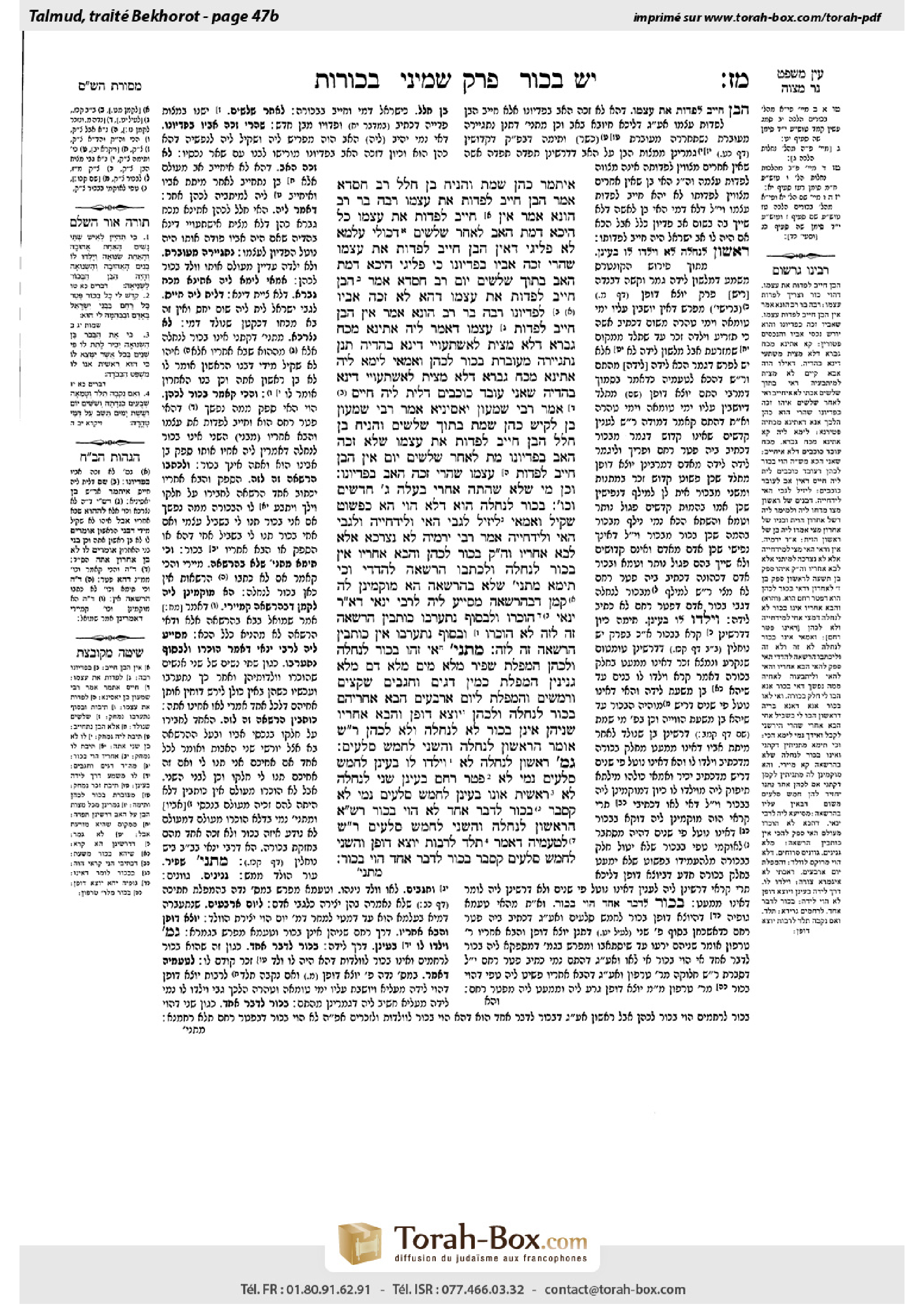
Bekhorot 47b: Talmud study for Daf Yomi
Study the Talmud for Daf Yomi with scanned pages, Hebrew text, English translations from Sefaria and AI-generated French translations.
Passage selection and English or AI-generated French translation are available where the scan has annotations. Daf Study is independent of Torah-Box and Sefaria.
Browse Bekhorot · בכורות · All tractatesBekhorot 47b text and translations
This page of Bekhorot includes the Aramaic text, an English translation and an AI-generated French translation, alongside the scan above.
בכורות מ״ז ב · Aramaic and Hebrew text
אִיתְּמַר: כֹּהֵן שֶׁמֵּת וְהִנִּיחַ בֵּן חָלָל — רַב חִסְדָּא אָמַר: הַבֵּן חַיָּיב לִפְדּוֹת אֶת עַצְמוֹ, רַבָּה בַּר רַב הוּנָא אָמַר: אֵין חַיָּיב לִפְדּוֹת אֶת עַצְמוֹ. כֹּל הֵיכָא דְּמֵת הָאָב לְאַחַר שְׁלֹשִׁים, דְּכוּלֵּי עָלְמָא לָא פְּלִיגִי דְּאֵין הַבֵּן חַיָּיב לִפְדּוֹת אֶת עַצְמוֹ, שֶׁהֲרֵי זָכָה אָבִיו בְּפִדְיוֹנוֹ.
כִּי פְּלִיגִי הֵיכָא דְּמֵת הָאָב בְּתוֹךְ שְׁלֹשִׁים יוֹם, רַב חִסְדָּא אָמַר: הַבֵּן חַיָּיב לִפְדּוֹת אֶת עַצְמוֹ, דְּהָא לֹא זָכָה אָבִיו (לְפִדְיוֹנוֹ) [בְּפִדְיוֹנוֹ]. רַבָּה בַּר רַב הוּנָא אָמַר: אֵין הַבֵּן חַיָּיב לִפְדּוֹת עַצְמוֹ, דַּאֲמַר לֵיהּ: אָתֵינָא מִכֹּחַ גַּבְרָא דְּלָא מָצֵית לְאִשְׁתַּעוֹיֵי דִּינָא בַּהֲדֵיהּ.
תְּנַן: נִתְגַּיְּירָה מְעוּבֶּרֶת — בְּכוֹר לַכֹּהֵן, וְאַמַּאי? לֵימָא לֵיהּ: אָתֵינָא מִכֹּחַ גַּבְרָא דְּלָא מָצֵית לְאִשְׁתַּעוֹיֵי דִּינָא בַּהֲדֵיהּ! שָׁאנֵי גּוֹי דְּלֵית לֵיהּ חַיִיס.
אָמַר רַבִּי שִׁמְעוֹן יָאסִינְיָא, אָמַר רַבִּי שִׁמְעוֹן בֶּן לָקִישׁ: כֹּהֵן שֶׁמֵּת בְּתוֹךְ שְׁלֹשִׁים וְהִנִּיחַ בֵּן חָלָל — הַבֵּן חַיָּיב לִפְדּוֹת אֶת עַצְמוֹ, שֶׁלֹּא זָכָה הָאָב בְּפִדְיוֹנוֹ. מֵת לְאַחַר שְׁלֹשִׁים יוֹם — אֵין הַבֵּן חַיָּיב לִפְדּוֹת עַצְמוֹ, שֶׁהֲרֵי זָכָה הָאָב בְּפִדְיוֹנוֹ.
וְכֵן מִי שֶׁלֹּא שָׁהֲתָה אַחֲרֵי בַּעְלָהּ שְׁלֹשָׁה חֳדָשִׁים וְכוּ׳.
בְּכוֹר לַנַּחֲלָה הוּא דְּלָא הָוֵי, הָא כְּפָשׁוּט שָׁקֵיל. וְאַמַּאי? לֵיזִיל לְגַבַּי הַאי וְלִידְחֲיֵיהּ, וּלְגַבַּי הַאי וְלִידְחֲיֵיהּ!
אָמַר רַבִּי יִרְמְיָה: לֹא נִצְרְכָא אֶלָּא לַבָּא אַחֲרָיו, וְהָכִי קָאָמַר: בְּכוֹר לַכֹּהֵן, וְהַבָּא אַחֲרָיו אֵין בְּכוֹר לַנַּחֲלָה.
וְלִכְתְּבוּ הַרְשָׁאָה לַהֲדָדֵי! וְכִי תֵּימָא: מַתְנִיתִין שֶׁלֹּא בְּהַרְשָׁאָה — הָא מוֹקְמִינַן לַהּ קַמַּן דִּבְהַרְשָׁאָה!
מְסַיַּיע לֵיהּ לְרַבִּי יַנַּאי, דְּאָמַר רַבִּי יַנַּאי: הוּכְּרוּ וּלְבַסּוֹף נִתְעָרְבוּ — כּוֹתְבִין הַרְשָׁאָה זֶה לָזֶה,
לֹא הוּכְּרוּ וּבְסוֹף נִתְעָרְבוּ — אֵין כּוֹתְבִין הַרְשָׁאָה זֶה לָזֶה.
מַתְנִי׳ אֵי זֶהוּ בְּכוֹר לַנַּחֲלָה וְלַכֹּהֵן? הַמַּפֶּלֶת שַׁפִּיר מָלֵא מַיִם, מָלֵא דָּם, מְלֵא גְּנִינִין, הַמַּפֶּלֶת כְּמִין דָּגִים וַחֲגָבִים שְׁקָצִים וּרְמָשִׂים, וְהַמַּפֶּלֶת לְיוֹם אַרְבָּעִים — הַבָּא אַחֲרֵיהֶם בְּכוֹר לַנַּחֲלָה וּלְכֹהֵן.
יוֹצֵא דּוֹפֶן, וְהַבָּא אַחֲרָיו — שְׁנֵיהֶן אֵינָן בְּכוֹר, לֹא לַנַּחֲלָה וְלֹא לַכֹּהֵן. רַבִּי שִׁמְעוֹן אוֹמֵר: הָרִאשׁוֹן לַנַּחֲלָה, וְהַשֵּׁנִי לְחָמֵשׁ סְלָעִים.
גְּמָ׳ רִאשׁוֹן לַנַּחֲלָה לֹא — ״וְיָלְדוּ לוֹ״ בָּעֵינַן, לְחָמֵשׁ סְלָעִים נָמֵי לָא — ״פָּטַר רֶחֶם״ בָּעֵינַן.
שֵׁנִי לַנַּחֲלָה לֹא — ״רֵאשִׁית אוֹנוֹ״ בָּעֵינַן, לְחָמֵשׁ סְלָעִים נָמֵי לָא — קָסָבַר: בְּכוֹר לְדָבָר אֶחָד לָא הָוֵי בְּכוֹר.
רַבִּי שִׁמְעוֹן אוֹמֵר: הָרִאשׁוֹן לַנַּחֲלָה, וְהַשֵּׁנִי לְחָמֵשׁ סְלָעִים. רַבִּי שִׁמְעוֹן לְטַעְמֵיהּ, דְּאָמַר: ״תֵּלֵד״ לְרַבּוֹת יוֹצֵא דּוֹפֶן.
וְהַשֵּׁנִי לְחָמֵשׁ סְלָעִים, קָסָבַר: בְּכוֹר לְדָבָר אֶחָד הָוֵי בְּכוֹר.
Bekhorot 47b · English translation
§ It was stated that in the case of a priest who married a divorcée and then died and left a son who was a priest disqualified due to flawed lineage [ḥalal] and has the status of a non-priest, Rav Ḥisda says: The son is obligated to redeem himself. Rabba bar Rav Huna says: He is not obligated to redeem himself. The Gemara explains: In any case that the father died after thirty days following the birth of the son, at which point the father was already obligated in his redemption, everyone agrees that the son is not obligated to redeem himself, as his father acquired his redemption money, i.e., it is as though he separated five sela coins and took the money for himself, since he is a priest.
They disagree when the father died within thirty days of the birth of the son, before the obligation of redemption had taken effect. Rav Ḥisda says the son is obligated to redeem himself, as his father did not acquire his redemption money. Rabba bar Rav Huna says the son is not obligated to redeem himself, as he can say to a priest who demands the redemption money from him: I come due to the strength of a man with whom you cannot enter into judgment, i.e., if my father were alive he would have separated five sela coins and taken the money for himself, and I inherit his claim.
The Gemara raises a challenge to the opinion of Rabba bar Rav Huna: We learned in the mishna: If one married a woman who converted while she was pregnant, having been impregnated by a gentile, the child is a firstborn with regard to redemption from a priest and must redeem himself. But why is this the halakha? Let this son say to the priest: I come due to the strength of a man with whom you cannot enter into judgment, as his father is a gentile, from whom the redemption money cannot be claimed. The Gemara responds: The case of a gentile is different, as he has no lineage [ḥayis], i.e., this man is not considered his father’s son at all.
On this matter, the Gemara notes that Rabbi Shimon Yasinia says that Rabbi Shimon ben Lakish says, in accordance with the opinion of Rav Ḥisda: With regard to a priest who died within thirty days of the birth of his son and left a son who was a ḥalal, the son is obligated to redeem himself, as the father did not acquire his redemption money. If the father died after thirty days following the birth of the son, the son is not obligated to redeem himself, as his father already acquired his redemption money.
§ The mishna teaches: And likewise a woman who did not wait three months after the death of her husband and she married and gave birth and it is unknown whether the son was born after a pregnancy of nine months and is the son of the first husband, or after seven months and is the son of the second husband, the son is a firstborn with regard to redemption from a priest but is not a firstborn with regard to inheritance.
The Gemara infers: This son is not a firstborn with regard to inheritance, but he takes a share of the inheritance like an ordinary son. But why is he entitled to any inheritance? Let him go to that son of the first husband and he will reject him, by demanding proof that he is from his family, and likewise let him go to that son of the second husband and he will reject him in the same manner.
Rabbi Yirmeya says: This ruling that he is not a firstborn with regard to inheritance is necessary only with regard to the son who follows him, born to the second husband, to teach that he is not a firstborn with regard to inheritance, as this son of uncertain status might be his firstborn brother. And when the mishna states: The child is a firstborn with regard to redemption from a priest but is not a firstborn with regard to inheritance, this is what it is saying: This son of uncertain status is a firstborn with regard to redemption from a priest, and the son who follows him, born to the second husband, is not a firstborn with regard to inheritance.
The Gemara suggests: And let the son with uncertain status and the son who follows him write an authorization to one another, by which each grants the other the right to claim his own share. In this manner they can claim the double portion together, as one of them is certainly the firstborn. And if you would say that the mishna is dealing with a case where there was no authorization, we interpret it later on (see 49a) as referring to a situation where there was an authorization.
The Gemara answers: The mishna, which indicates that there is no firstborn with regard to inheritance here, supports the opinion of Rabbi Yannai, as Rabbi Yannai says: In a case where two sons of two men became confused and it is unknown who is the father of whom, if the two sons were initially recognized and were ultimately intermingled, each writes an authorization to the other, and the other sons in each family cannot claim that these sons are not their brother.
If they were not initially recognized and were ultimately intermingled, each does not write an authorization to the other, as even initially neither of them had any certain right to their father’s inheritance. Likewise, in the case of the uncertain son and the one who follows him in the mishna, neither one was ever recognized as his father’s firstborn. Therefore, writing an authorization is ineffective in claiming any inheritance.
MISHNA: Which is the offspring that is a firstborn both with regard to inheritance and with regard to redemption from a priest? In the case of a woman who miscarried a gestational sac full of water, or one full of blood, or one full of pieces of flesh; or one who miscarries a mass resembling a fish, or grasshoppers, or repugnant creatures, or creeping animals, or one who miscarries on the fortieth day after conception, the son who follows any of them is a firstborn with regard to inheritance and with regard to redemption from a priest.
In the case of a boy born by caesarean section and the son who follows him, both of them are not firstborn, neither with regard to inheritance nor with regard to redemption from a priest. Rabbi Shimon says: The first son is a firstborn with regard to inheritance if he is his father’s first son, and the second son is a firstborn with regard to redemption from a priest for five sela coins, because he is the first to emerge from the womb and he emerged in the usual way.
GEMARA: The mishna teaches that neither a son born by caesarean section nor the son who follows him are firstborn, neither with regard to inheritance nor with regard to redemption from a priest. The Gemara explains: The first son, born by caesarean section, is not considered the firstborn with regard to inheritance, as we require fulfillment of the verse: “And they have borne him children” (Deuteronomy 21:15), written in the context of inheritance, and a caesarean section is not called a birth. Likewise, with regard to the redemption with five sela coins, this son is also not considered the firstborn, as we require fulfillment of the verse: “Whatever opens the womb” (Exodus 13:2), and he did not open his mother’s womb.
Similarly, the second son who follows him is not considered the firstborn with regard to inheritance, as we require fulfillment of the verse: “For he is the first of his strength, the right of the firstborn is his” (Deuteronomy 21:17), and this son is not the first. In addition, he is also not considered the firstborn with regard to the redemption of five sela coins, as the tanna of the mishna holds: A firstborn for only one matter, i.e., he opened his mother’s womb but is not her first child, is not considered a firstborn with regard to redemption.
§ The mishna teaches that Rabbi Shimon says: The first son is a firstborn with regard to inheritance if he is his father’s first son, and the second son is a firstborn with regard to redemption from a priest for five sela coins. The Gemara explains: The verse states: “And they have borne him children,” and a caesarean section is not called a birth. Rabbi Shimon conforms to his standard line of reasoning, as he says with regard to a verse that deals with the ritual impurity of a woman after childbirth: “But if she bears a girl” (Leviticus 12:5), that the apparently superfluous term “she bears” serves to include a child born by caesarean section, and the same applies with regard to a firstborn for inheritance.
And Rabbi Shimon also rules that the second son is a firstborn with regard to redemption from a priest for five sela coins, as he maintains: A firstborn for only one matter, i.e., one who opened his mother’s womb but is not her first child, is considered a firstborn with regard to the redemption of the firstborn, despite the fact that he is not his mother’s first child.
Bekhorot 47b · Traduction française (IA)
§ Il a été dit que dans le cas d’un kohen qui a épousé une femme divorcée et est ensuite décédé, laissant un fils qui était un kohen disqualifié en raison d’une lignée défectueuse [ḥalal] et qui a le statut d’un non-kohen, Rav Ḥisda dit : Le fils est tenu de s’acheter la liberté. Rabba bar Rav Huna dit : Il n’est pas tenu de s’acheter la liberté. La Guemara explique : Dans tout cas où le père est décédé après trente jours suivant la naissance du fils, moment où le père était déjà tenu de s’acheter la liberté, tout le monde convient que le fils n’est pas tenu de s’acheter la liberté, car son père a acquis l’argent de sa liberté, c’est-à-dire qu’il est comme s’il avait séparé cinq sela et pris l’argent pour lui-même, puisqu’il est un kohen.
Ils divergent lorsqu'un père est mort dans les trente jours suivant la naissance du fils, avant que l'obligation de rachat ne soit entrée en vigueur. Rav Ḥisda dit que le fils est tenu de racheter sa propre liberté, car son père n'avait pas acquis l'argent de rachat. Rabba bar Rav Huna dit que le fils n'est pas tenu de racheter sa propre liberté, car il peut dire à un kohen qui exige l'argent de rachat de lui : Je viens avec la force d'un homme avec lequel tu ne peux pas entrer en jugement, c'est-à-dire si mon père était vivant, il aurait séparé cinq sela et pris l'argent pour lui-même, et je hérite de son droit.
La Guemara soulève un défi contre l'opinion de Rabba bar Rav Huna : Nous avons appris dans la Michna : Si l'on a épousé une femme qui s'est convertie pendant sa grossesse, ayant été impregnée par un non-Juif, l'enfant est un premier-né concernant le rachat auprès d'un kohen et doit se racheter lui-même. Mais pourquoi cette halakha ? Que ce fils dise au kohen : Je viens avec la force d'un homme avec lequel tu ne peux pas entrer en jugement, car son père est un non-Juif, d'où l'argent de rachat ne peut être réclamé. La Guemara répond : Le cas d'un non-Juif est différent, car il n'a pas de lignage [ḥayis], c'est-à-dire que cet homme n'est pas considéré comme le fils de son père du tout.
Sur ce point, la Guemara note que Rabbi Shimon Yasinia dit que Rabbi Shimon ben Lakish dit, selon l'opinion de Rav Ḥisda : En ce qui concerne un kohen qui est mort dans les trente jours suivant la naissance de son fils et qui a laissé un fils qui était un ḥalal, ce fils est tenu de s'acheter lui-même, car le père n'avait pas acquis l'argent de sa propre rachat. Si le père est mort après trente jours suivant la naissance du fils, le fils n'est pas tenu de s'acheter lui-même, car son père avait déjà acquis l'argent de sa propre rachat.
§ La Michna enseigne : De même, une femme qui n'a pas attendu trois mois après la mort de son mari et qui s'est mariée à nouveau et a donné naissance à un enfant, et il est incertain si l'enfant est né après une grossesse de neuf mois et est le fils du premier mari, ou après sept mois et est le fils du second mari, l'enfant est un premier-né concernant le rachat par un kohen, mais n'est pas un premier-né concernant l'héritage.
La Guemara déduit : Cet enfant n'est pas un premier-né concernant l'héritage, mais il prend une part de l'héritage comme un enfant ordinaire. Mais pourquoi est-il dû à l'héritage ? Faites-le aller à ce fils du premier mari et il le rejettera, en exigeant une preuve qu'il est de sa famille, et de même faites-le aller à ce fils du second mari et il le rejettera de la même manière.
Rabbi Yirmeya dit : Cette décision selon laquelle il n'est pas un premier-né en ce qui concerne l'héritage est nécessaire uniquement en ce qui concerne le fils qui le suit, né du second époux, afin d'enseigner qu'il n'est pas un premier-né en ce qui concerne l'héritage, car ce fils de statut incertain pourrait être son frère aîné. Et lorsque la mitsva dit : L'enfant est un premier-né en ce qui concerne la libération par un kohen mais n'est pas un premier-né en ce qui concerne l'héritage, cela signifie : ce fils de statut incertain est un premier-né en ce qui concerne la libération par un kohen, et le fils qui le suit, né du second époux, n'est pas un premier-né en ce qui concerne l'héritage.
La Guemara suggère : Et que le fils dont l'état est incertain et le fils qui le suit écrivent l'un à l'autre une autorisation, par laquelle chacun accorde à l'autre le droit de revendiquer sa propre part. Ainsi, ils peuvent revendiquer ensemble la double portion, car l'un d'eux est certainement le premier-né. Et si l'on dit que la Michna traite d'un cas où il n'y avait pas d'autorisation, nous l'interprétons plus tard (voir 49a) comme faisant référence à un cas où il y avait une autorisation.
La Guemara répond : La Michna, qui indique qu'il n'y a pas de premier-né concernant l'héritage ici, soutient l'opinion de Rabbi Yannai, car Rabbi Yannai dit : Dans un cas où deux fils de deux hommes se sont confondus et il est inconnu qui est le père de qui, si les deux fils ont été initialement reconnus et ont finalement été mélangés, chacun écrit une autorisation à l'autre, et les autres fils de chaque famille ne peuvent pas revendiquer que ces fils ne sont pas leurs frères.
Si elles n'étaient pas initialement reconnues et finalement mélangées, aucun ne rédige une autorisation à l'autre, car même initialement aucun d'eux n'avait un droit certain à l'héritage de leur père. De même, dans le cas du fils incertain et de celui qui le suit dans la Michna, aucun n'a jamais été reconnu comme premier-né de leur père. Par conséquent, rédiger une autorisation est inefficace pour revendiquer tout héritage.
MICHNA : Quel est l'offspring qui est considéré comme premier-né à la fois en matière d'héritage et en matière de rachat par un kohen ? Dans le cas d'une femme qui a eu un avortement d'un sac gestationnel plein d'eau, ou plein de sang, ou plein de morceaux de chair ; ou d'une femme qui a eu un avortement d'une masse ressemblant à un poisson, ou aux grillons, ou aux créatures repoussantes, ou aux animaux rampants, ou d'une femme qui a eu un avortement le quarantième jour après la conception, le fils qui suit l'un d'eux est considéré comme premier-né en matière d'héritage et en matière de rachat par un kohen.
Dans le cas d’un garçon né par césarienne et du fils qui le suit, aucun des deux n’est premier fils, ni en ce qui concerne l’héritage ni en ce qui concerne la délivrance d’un prêtre. Rabbi Shimon dit : Le premier fils est considéré comme premier fils en ce qui concerne l’héritage s’il est le premier fils de son père, et le second fils est considéré comme premier fils en ce qui concerne la délivrance d’un prêtre pour cinq sela, car il est le premier à sortir du ventre et il est né de la manière habituelle.
GUEMARA : La mitsva enseigne que ni le fils né par césarienne ni le fils qui le suit ne sont considérés comme premier fils, ni en ce qui concerne l’héritage ni en ce qui concerne la délivrance d’un prêtre. La Guemara explique : Le premier fils, né par césarienne, n’est pas considéré comme premier fils en ce qui concerne l’héritage, car nous exigeons la réalisation de la parole : « Et ils ont enfanté pour lui » (Deutéronome 21:15), écrite dans le contexte de l’héritage, et la césarienne n’est pas considérée comme un accouchement. De même, en ce qui concerne la délivrance avec cinq sela, ce fils n’est pas considéré comme premier fils, car nous exigeons la réalisation de la parole : « Tout ce qui ouvre le ventre » (Exode 13:2), et il n’a pas ouvert le ventre de sa mère.
De même, le second fils qui le suit n’est pas considéré comme premier fils en ce qui concerne l’héritage, car nous exigeons la réalisation de la parole : « Car il est le premier de sa force, le droit du premier fils est le sien » (Deutéronome 21:17), et ce fils n’est pas le premier. En outre, il n’est pas considéré comme premier fils en ce qui concerne la délivrance des cinq sela, car le tanna de la mitsva affirme : Un premier fils pour une seule matière, c’est-à-dire celui qui a ouvert le ventre de sa mère mais n’est pas son premier enfant, n’est pas considéré comme premier fils en ce qui concerne la délivrance.
§ La mitsna enseigne que Rabbi Shimon dit : Le premier fils est considéré comme premier fils en ce qui concerne l’héritage s’il est le premier fils de son père, et le second fils est considéré comme premier fils en ce qui concerne la délivrance d’un prêtre pour cinq sela. La Guemara explique : La parole dit : « Et ils ont enfanté pour lui », et la césarienne n’est pas considérée comme un accouchement. Rabbi Shimon suit sa ligne de raisonnement habituelle, car il dit, en ce qui concerne une parole qui traite de l’impureté rituelle d’une femme après l’accouchement : « Mais si elle enfante une fille » (Lévitique 12:5), que le terme apparemment superflu « elle enfante » sert à inclure un enfant né par césarienne, et c’est pareil en ce qui concerne un premier fils pour l’héritage.
Et Rabbi Shimon règle également que le second fils est considéré comme premier fils en ce qui concerne la délivrance d’un prêtre pour cinq sela, car il maintient : Un premier fils pour une seule matière, c’est-à-dire celui qui a ouvert le ventre de sa mère mais n’est pas son premier enfant, est considéré comme premier fils en ce qui concerne la délivrance du premier fils, malgré le fait qu’il n’est pas le premier enfant de sa mère.
Traduction française générée par IA à partir de l’édition anglaise de Sefaria. Vérifie toujours un passage avec le texte source.
Text from Sefaria: William Davidson Edition - Vocalized Aramaic (CC BY NC); William Davidson Edition - English (CC BY NC).