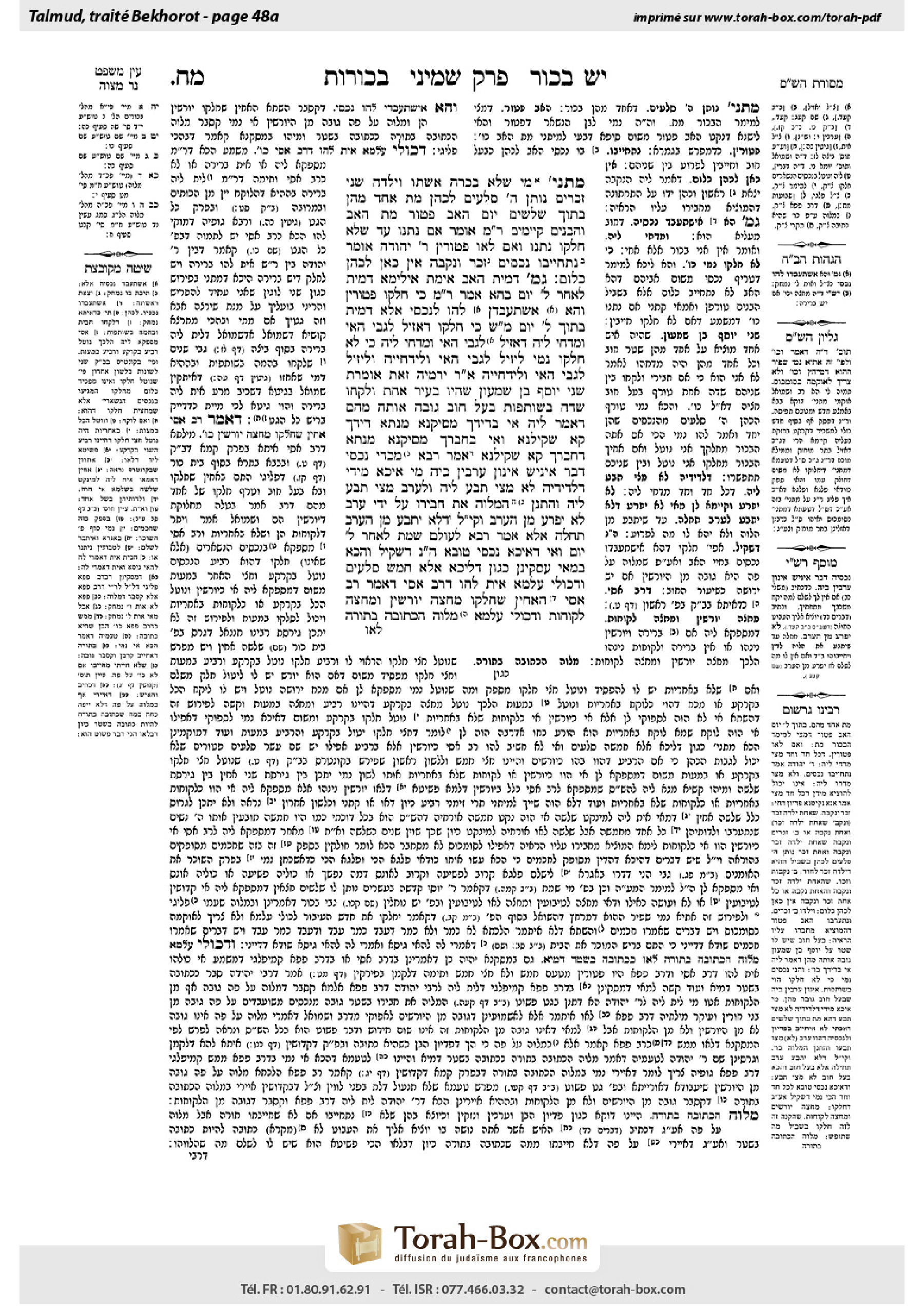
Bekhorot 48a: Talmud study for Daf Yomi
Study the Talmud for Daf Yomi with scanned pages, Hebrew text, English translations from Sefaria and AI-generated French translations.
Passage selection and English or AI-generated French translation are available where the scan has annotations. Daf Study is independent of Torah-Box and Sefaria.
Browse Bekhorot · בכורות · All tractatesBekhorot 48a text and translations
This page of Bekhorot includes the Aramaic text, an English translation and an AI-generated French translation, alongside the scan above.
בכורות מ״ח א · Aramaic and Hebrew text
מַתְנִי׳ מִי שֶׁלֹּא בִּכְּרָה אִשְׁתּוֹ וְיָלְדָה שְׁנֵי זְכָרִים — נוֹתֵן חָמֵשׁ סְלָעִים לְכֹהֵן. מֵת אֶחָד מֵהֶן בְּתוֹךְ שְׁלֹשִׁים יוֹם — הָאָב פָּטוּר.
מֵת הָאָב וְהַבָּנִים קַיָּימִים, רַבִּי מֵאִיר אוֹמֵר: אִם נָתְנוּ עַד שֶׁלֹּא חָלְקוּ — נָתָנוּ, וְאִם לָאו — פְּטוּרִין. רַבִּי יְהוּדָה אוֹמֵר: נִתְחַיְּיבוּ נְכָסִים. זָכָר וּנְקֵבָה — אֵין כָּאן לַכֹּהֵן כְּלוּם.
גְּמָ׳ דְּמִית הָאָב אֵימַת? אִילֵּימָא דְּמִית לְאַחַר שְׁלֹשִׁים יוֹם — בְּהָא אָמַר רַבִּי מֵאִיר כִּי חָלְקוּ פְּטוּרִין? וְהָא אִשְׁתַּעְבַּדוּ לְהוּ (לנכסי) [נִכְסֵי]!
אֶלָּא, דְּמִית בְּתוֹךְ שְׁלֹשִׁים יוֹם, מַאי שְׁנָא כִּי חָלְקוּ — דְּאָזֵיל לְגַבֵּי הַאי וּמְדַחֵי לֵיהּ, דְּאָזֵיל לְגַבֵּי הַאי וּמְדַחֵי לֵיהּ; כִּי לֹא חָלְקוּ נָמֵי — לֵיזִיל לְגַבֵּי הַאי וְלִידַחֲיֵיהּ, וְלֵיזִיל לְגַבֵּי הַאי וְלִידַחֲיֵיהּ!
אָמַר רַבִּי יִרְמְיָה: זֹאת אוֹמֶרֶת, שְׁנֵי יוֹסֵף בֶּן שִׁמְעוֹן שֶׁהָיוּ בְּעִיר אַחַת, וְלָקְחוּ שָׂדֶה בְּשׁוּתָּפוּת — בַּעַל חוֹב גּוֹבֶה אוֹתָהּ מֵהֶם, דְּאָמַר לֵיהּ: אִי בְּדִידָךְ מַסֵּיקְנָא — מְנָתָא דִּידָךְ קָא שָׁקֵילְנָא, וְאִי בְּחַבְרָךְ מַסֵּיקְנָא — מְנָתָא דְּחַבְרָךְ קָא שָׁקֵילְנָא.
אָמַר רָבָא: מִכְּדֵי נִכְסֵי דְּבַר אִינִישׁ אִינּוּן עָרְבִין בֵּיהּ, מִי אִיכָּא מִידֵּי דִּלְדִידֵיהּ לָא מָצֵי תָּבַע לֵיהּ, וּלְעָרֵב מָצֵי תָּבַע לֵיהּ? וְהָתְנַן: הַמַּלְוֶה אֶת חֲבֵירוֹ עַל יְדֵי עָרֵב — לֹא יִפָּרַע מִן הֶעָרֵב, וְקַיְימָא לַן דְּלֹא יִתְבַּע מִן הֶעָרֵב תְּחִלָּה!
אֶלָּא אָמַר רָבָא: לְעוֹלָם שֶׁמֵּת לְאַחַר שְׁלֹשִׁים יוֹם, וְאִי דְּאִיכָּא נִכְסֵי טוּבָא — הָכִי נָמֵי דְּשָׁקֵיל, וְהָכָא בְּמַאי עָסְקִינַן? כְּגוֹן דְּלֵיכָּא אֶלָּא חָמֵשׁ סְלָעִים.
וּדְכוּלֵּי עָלְמָא אִית לְהוּ דְּרַב אַסִּי, דְּאָמַר רַב אַסִּי: הָאַחִין שֶׁחָלְקוּ — מֶחֱצָה יוֹרְשִׁין וּמֶחֱצָה לָקוֹחוֹת, וּדְכוּלֵּי עָלְמָא מִלְוֶה הַכְּתוּבָה בַּתּוֹרָה
Bekhorot 48a · English translation
MISHNA: With regard to one whose wife had not previously given birth and then gave birth to two males, i.e., twin males, and it is unknown which is the firstborn, he gives five sela coins to the priest after thirty days have passed. If one of them dies within thirty days of birth, before the obligation to redeem the firstborn takes effect, the father is exempt from the payment due to uncertainty, as perhaps it was the firstborn who died.
In a case where the father died and the sons are alive, Rabbi Meir says: If they gave the five sela coins to the priest before they divided their father’s property between them, they gave it, and it remains in the possession of the priest. But if not, they are exempt from giving the redemption money to the priest. Rabbi Yehuda says: The obligation to redeem the firstborn already took effect on the property of the father; therefore, in either case the sons, his heirs, are required to pay the priest. If the wife gave birth to a male and a female and it is not known which was born first, the priest has nothing here, as it is possible that the female was born first.
GEMARA: The mishna teaches that in a case where the father died and the sons are alive, Rabbi Meir says: If they gave the five sela coins to the priest before they divided their father’s property, they gave it; but if not, they are exempt from giving the redemption money. The Gemara asks: When did the father die? If we say that he died after the thirty days following the birth of his sons, does Rabbi Meir say in this case that if they divided their father’s property they are exempt from giving the redemption money to the priest? But the property is already on lien for the mitzva of redemption.
Rather, it is referring to a case where the father died within thirty days of the birth of his sons, and the obligation of redemption applies to the firstborn himself, whose identity is unknown, but not to the father’s property. If so, what is different about a case where they already divided the property between them, that Rabbi Meir deems them exempt? The reason must be that the priest will go to this son, and the son will reject him by demanding that the priest prove he is the firstborn; and likewise he will go to that other son, and he too will reject him in the same manner. The Gemara challenges this explanation: The same should apply even in a case where they did not divide the property: Let the priest go to this son and he will reject him, and let him go to that son and he too will reject him.
Rabbi Yirmeya says: That is to say, i.e., it can be inferred from here, that in a case involving two people named Yosef ben Shimon who were residents of one city, and they acquired a field in partnership, a creditor of one of them can collect payment of his debt from either of them, despite the fact that he does not know which of them owes him the money. The reason is that he can say to each of them: If I have a claim against you, I am taking the one hundred dinars that is your share in the joint field, and if I have a claim against the other Yosef ben Shimon, I am taking the one hundred dinars that is his share in the field. This is similar to the case in the mishna, as the brothers who have yet to divide their father’s property are considered partners, and therefore the priest can claim his debt from that property.
Rava said in response: Now consider the principle that a person’s property is a guarantee for him, i.e., it serves as a guarantee for the loan if the debtor does not repay it. Is there any case where one cannot claim repayment from the debtor himself, and yet he can claim from a guarantor? But didn’t we learn in a mishna (Bava Batra 173a): In the case of one who lends money to another with the assurance of a guarantor, he cannot claim payment of the debt from the guarantor? And we maintain in this regard that he cannot claim payment of the debt from the guarantor at the outset, before first claiming the debt from the debtor. How, then, may the priest not claim the redemption money from either brother, and yet he can take it from their property?
Rather, Rava says: Actually, the mishna is referring to a case where the father died after thirty days following the birth of his sons and the property is already on lien for the mitzva of redemption. And if this is a case where there is a lot of property, so too, the halakha is that the priest takes the five sela coins from that property, even after the sons have divided it, as they are obligated to pay their father’s debt from their inheritance. And what are we dealing with here? With a case where there is only the five sela coins received from their father. That was the entire estate.
Rava continues: And everyone accepts the opinion of Rav Asi, as Rav Asi says: In the case of brothers who divided property they received as an inheritance, with regard to half of it they are considered heirs and with regard to the other half they are considered purchasers from each other. And furthermore, everyone agrees that a loan written in the Torah, i.e., a financial obligation by Torah law, such as the redemption of the firstborn,
Bekhorot 48a · Traduction française (IA)
MICHNA : Concernant un homme dont la femme n'avait pas encore donné naissance à un enfant et qu'elle a ensuite donné naissance à deux garçons, c'est-à-dire des jumeaux, et dont on ne sait pas lequel est le premier-né, il verse cinq sela au prêtre après trente jours. Si l'un d'eux meurt dans les treise jours suivant la naissance, avant que l'obligation de racheter le premier-né ne s'applique, le père est exempt de ce paiement en raison de l'incertitude, car peut-être c'était le premier-né qui est mort.
Dans le cas où le père est mort et que les fils sont vivants, Rabbi Meir dit : Si ils ont versé les cinq sela au prêtre avant de diviser la propriété de leur père entre eux, ils l'ont fait, et cela reste en possession du prêtre. Mais si ce n'est pas le cas, ils sont exempt de payer l'argent de rachat au prêtre. Rabbi Yéhuda dit : L'obligation de racheter le premier-né s'est déjà appliquée à la propriété du père ; par conséquent, dans tous les cas, les fils, héritiers du père, doivent payer au prêtre. Si la femme a donné naissance à un garçon et à une fille et qu'on ne sait pas lequel est né en premier, le prêtre n'a rien ici, car il est possible que la fille soit née en premier.
GUEMARA : La mésna enseigne que dans le cas où le père est mort et que les fils sont vivants, Rabbi Meir dit : Si ils ont versé les cinq sela au prêtre avant de diviser la propriété de leur père, ils l'ont fait ; mais si ce n'est pas le cas, ils sont exempt de payer l'argent de rachat. La Guemara pose la question : Quand est-ce que le père est mort ? Si on dit qu'il est mort après les trente jours suivant la naissance de ses fils, Rabbi Meir dit-il dans ce cas que s'ils ont divisé la propriété de leur père, ils sont exempt de payer l'argent de rachat au prêtre ? Mais la propriété est déjà hypothéquée pour la mitsva de rachat.
Plutôt, il s'agit d'un cas où le père est mort dans les trente jours suivant la naissance de ses fils, et l'obligation de rachat s'applique au premier-né lui-même, dont l'identité est inconnue, mais pas à la propriété du père. Si c'est le cas, qu'y a-t-il de différent dans le cas où ils ont déjà divisé la propriété entre eux, que Rabbi Meir considère qu'ils sont exempt ? La raison doit être que le prêtre ira vers ce fils, et ce fils le rejettera en exigeant que le prêtre prouve qu'il est le premier-né ; de même, il ira vers l'autre fils, et lui aussi le rejettera de la même manière. La Guemara conteste cette explication : La même chose devrait s'appliquer même dans le cas où ils n'ont pas divisé la propriété : Le prêtre ira vers ce fils et il le rejettera, et le prêtre ira vers l'autre fils et lui aussi le rejettera.
Rabbi Yirmeya dit : Cela signifie, c'est-à-dire on peut en déduire ici, que dans le cas de deux personnes nommées Yosèf ben Shim'on qui étaient des habitants d'une même ville, et qui ont acquis un champ en partage, un créancier d'un d'entre eux peut exiger le paiement de sa dette auprès de l'un ou l'autre, malgré le fait qu'il ne sache pas lequel des deux lui doit l'argent. La raison est qu'il peut dire à chacun d'eux : Si j'ai une réclamation contre toi, je prends les cent dinars qui sont ta part dans le champ partagé, et si j'ai une réclamation contre l'autre Yosèf ben Shim'on, je prends les cent dinars qui sont sa part dans le champ. C'est semblable au cas de la mésna, car les frères qui n'ont pas encore divisé la propriété de leur père sont considérés comme des associés, et par conséquent le prêtre peut réclamer son créance à partir de cette propriété.
Rava a répondu : Considérons maintenant le principe que la propriété d'une personne est une garantie pour lui, c'est-à-dire qu'elle sert de garantie pour le prêt si le débiteur ne rembourse pas. Y a-t-il un cas où l'on ne peut pas réclamer le remboursement auprès du débiteur lui-même, et pourtant l'on peut le réclamer auprès d'un garant ? Mais n'avons-nous pas appris dans une mésna (Bava Batra 173a) : Dans le cas où l'on prête de l'argent à un autre avec la garantie d'un garant, on ne peut pas réclamer le paiement de la dette auprès du garant ? Et nous maintenons à ce sujet que l'on ne peut pas réclamer le paiement de la dette auprès du garant au début, avant d'avoir d'abord réclamé la dette auprès du débiteur. Comment, alors, le prêtre ne peut-il pas réclamer l'argent de rachat auprès de l'un ou l'autre des frères, et pourtant il peut le prendre à partir de leur propriété ?
Plutôt, Rava dit : En réalité, la mésna s'adresse à un cas où le père est mort après trente jours suivant la naissance de ses fils et la propriété est déjà hypothéquée pour la mitsva de rachat. Et si c'est un cas où il y a beaucoup de propriété, de même, la halakha est que l'ancien prend les cinq sela de cette propriété, même après que les fils l'ont divisée, car ils sont obligés de payer la dette de leur père à partir de leur héritage. Et de quoi s'agit-il ici ? D'un cas où il n'y a que les cinq sela reçus de leur père. C'était l'ensemble de l'héritage.
Rava continue : Et tout le monde accepte l'opinion de Rav Asi, car Rav Asi dit : Dans le cas de frères qui ont divisé la propriété qu'ils ont reçue en héritage, concernant la moitié d'elle ils sont considérés comme des héritiers et concernant l'autre moitié ils sont considérés comme des acheteurs les uns des autres. Et de plus, tout le monde convient qu'un prêt écrit dans la Torah, c'est-à-dire une obligation financière par la loi divine, comme le rachat du premier-né,
Traduction française générée par IA à partir de l’édition anglaise de Sefaria. Vérifie toujours un passage avec le texte source.
Text from Sefaria: William Davidson Edition - Vocalized Aramaic (CC BY NC); William Davidson Edition - English (CC BY NC).