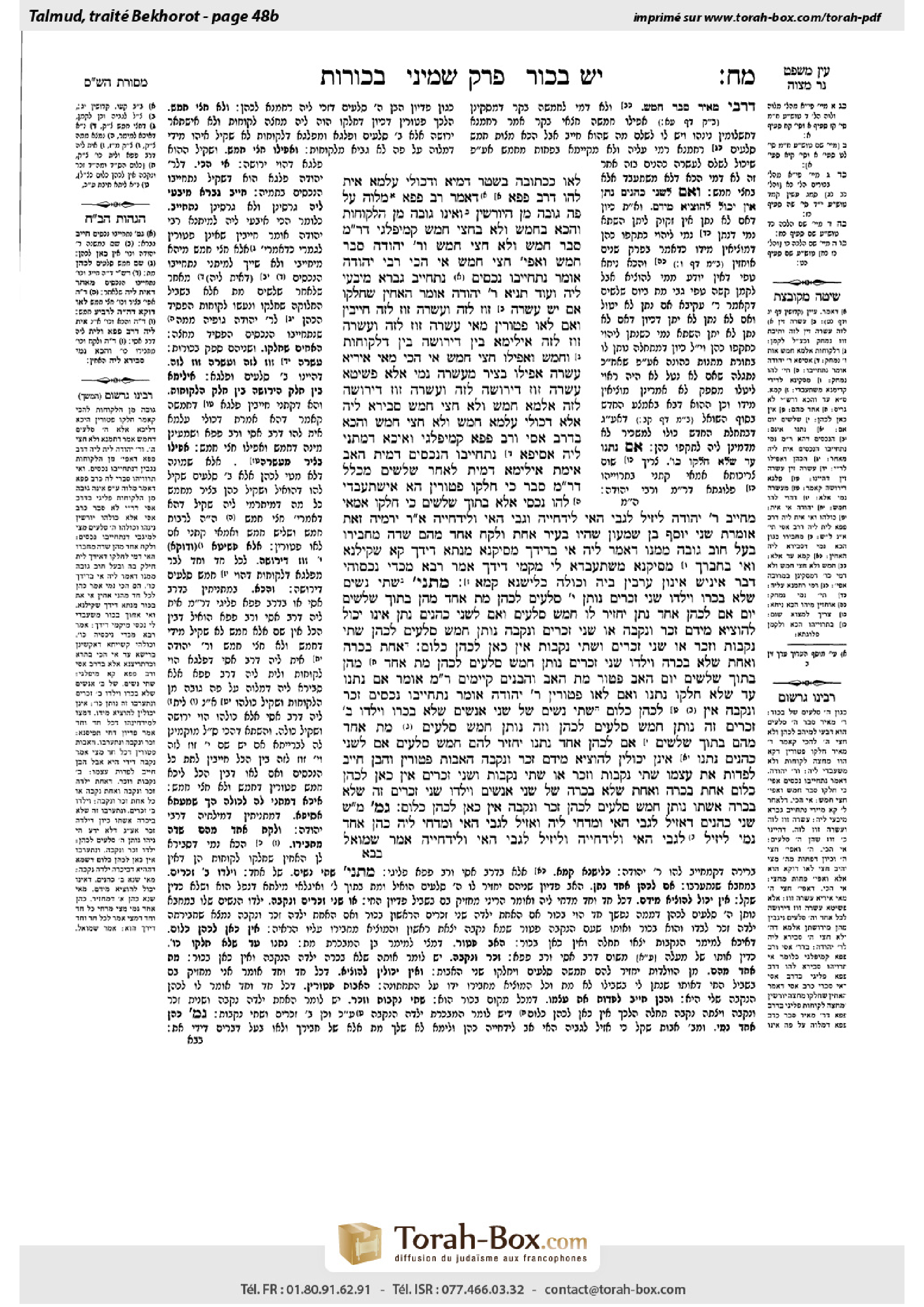
Bekhorot 48b: Talmud study for Daf Yomi
Study the Talmud for Daf Yomi with scanned pages, Hebrew text, English translations from Sefaria and AI-generated French translations.
Passage selection and English or AI-generated French translation are available where the scan has annotations. Daf Study is independent of Torah-Box and Sefaria.
Browse Bekhorot · בכורות · All tractatesBekhorot 48b text and translations
This page of Bekhorot includes the Aramaic text, an English translation and an AI-generated French translation, alongside the scan above.
בכורות מ״ח ב · Aramaic and Hebrew text
לָאו כִּכְתוּבָה בִּשְׁטָר דָּמְיָא, וּדְכוּלֵּי עָלְמָא אִית לְהוּ דְּרַב פָּפָּא, דְּאָמַר רַב פָּפָּא: מִלְוָה עַל פֶּה גּוֹבֶה מִן הַיּוֹרְשִׁין וְאֵינוֹ גּוֹבֶה מִן הַלָּקוֹחוֹת.
וְהָכָא בְּחָמֵשׁ וְלֹא בַּחֲצִי חָמֵשׁ קָמִיפַּלְגִי, דְּרַבִּי מֵאִיר סָבַר: חָמֵשׁ וְלֹא חֲצִי חָמֵשׁ, וְרַבִּי יְהוּדָה סָבַר: חָמֵשׁ וַאֲפִילּוּ חֲצִי חָמֵשׁ.
אִי הָכִי, רַבִּי יְהוּדָה אוֹמֵר נִתְחַיְּיבוּ נְכָסִים, נִתְחַיֵּיב גַּבְרָא מִיבְּעֵי לֵיהּ! וְעוֹד, תַּנְיָא: רַבִּי יְהוּדָה אוֹמֵר: הָאַחִין שֶׁחָלְקוּ, אִם יֵשׁ עֲשָׂרָה זוּז לָזֶה וַעֲשָׂרָה זוּז לָזֶה — חַיָּיבִין, וְאִם לָאו — פְּטוּרִין.
מַאי עֲשָׂרָה זוּז לָזֶה וַעֲשָׂרָה זוּז לָזֶה? אִילֵּימָא בֵּין דִּירוּשָּׁה בֵּין דְּלָקוֹחוֹת, וְחָמֵשׁ וַאֲפִילּוּ חֲצִי חָמֵשׁ — אִי הָכִי, מַאי אִירְיָא עֲשָׂרָה? אֲפִילּוּ בְּצִיר מֵעֲשָׂרָה נָמֵי!
אֶלָּא פְּשִׁיטָא, עֲשָׂרָה זוּז דִּירוּשָּׁה לָזֶה, וַעֲשָׂרָה זוּז דִּירוּשָּׁה לָזֶה, אַלְמָא: חָמֵשׁ וְלֹא חֲצִי חָמֵשׁ סְבִירָא לֵיהּ!
אֶלָּא, דְּכוּלֵּי עָלְמָא חָמֵשׁ וְלֹא חֲצִי חָמֵשׁ, וְהָכָא בִּדְרַב אַסִּי וְרַב פָּפָּא קָמִיפַּלְגִי.
וְאִיכָּא דְּמַתְנֵי לֵיהּ אַסֵּיפָא, נִתְחַיְּיבוּ הַנְּכָסִים, דְּמִית הָאָב אֵימַת? אִילֵּימָא דְּמִית לְאַחַר שְׁלֹשִׁים, מִכְּלָל דְּרַבִּי מֵאִיר סָבַר כִּי חָלְקוּ פְּטוּרִין? הָא אִישְׁתַּעְבַּדוּ לְהוּ נִכְסֵי!
אֶלָּא בְּתוֹךְ שְׁלֹשִׁים, כִּי חָלְקוּ, אַמַּאי מְחַיֵּיב רַבִּי יְהוּדָה? לֵיזִיל לְגַבֵּי הַאי לִידַחֲיֵיהּ, וְגַבֵּי הַאי וְלִידְחֲיֵיהּ!
אָמַר רַבִּי יִרְמְיָה: זֹאת אוֹמֶרֶת, שְׁנֵי יוֹסֵף בֶּן שִׁמְעוֹן שֶׁהָיוּ בְּעִיר אַחַת, וְלָקַח אֶחָד מֵהֶם שָׂדֶה מֵחֲבֵירוֹ — בַּעַל חוֹב גּוֹבֶה מִמֶּנּוּ, דַּאֲמַר לֵיהּ: אִי בְּדִידָךְ מַסֵּיקְנָא — מְנָתָא דִּידָךְ קָא שָׁקֵילְנָא, וְאִי בְּחַבְרָךְ מַסֵּיקְנָא — מִשְׁתַּעְבְּדָא לִי מִקַּמֵּי דִּידָךְ.
אָמַר רָבָא: מִכְּדֵי נִכְסוֹהִי דְּבַר אִינִישׁ אִינּוּן עָרְבִין בֵּיהּ, וְכוּלַּהּ כְּלִישָּׁנָא קַמָּא.
מַתְנִי׳ שְׁתֵּי נָשִׁים שֶׁלֹּא בִּכֵּרוּ וְיָלְדוּ שְׁנֵי זְכָרִים — נוֹתֵן עֲשָׂרָה סְלָעִים לַכֹּהֵן. מֵת אֶחָד מֵהֶן בְּתוֹךְ שְׁלֹשִׁים יוֹם, אִם לְכֹהֵן אֶחָד נָתַן — יַחֲזִיר לוֹ חָמֵשׁ סְלָעִים, וְאִם לִשְׁנֵי כֹּהֲנִים נָתַן — אֵינוֹ יָכוֹל לְהוֹצִיא מִיָּדָם.
זָכָר וּנְקֵבָה, אוֹ שְׁנֵי זְכָרִים וּנְקֵבָה — נוֹתֵן חָמֵשׁ סְלָעִים לַכֹּהֵן; שְׁתֵּי נְקֵבוֹת וְזָכָר, אוֹ שְׁנֵי זְכָרִים וּשְׁתֵּי נְקֵבוֹת — אֵין כָּאן לַכֹּהֵן כְּלוּם.
אַחַת בִּכֵּרָה וְאַחַת שֶׁלֹּא בִּכֵּרָה, וְיָלְדוּ שְׁנֵי זְכָרִים — נוֹתֵן חָמֵשׁ סְלָעִים לַכֹּהֵן, מֵת אֶחָד מֵהֶן בְּתוֹךְ שְׁלֹשִׁים יוֹם — הָאָב פָּטוּר.
מֵת הָאָב וְהַבָּנִים קַיָּימִים, רַבִּי מֵאִיר אוֹמֵר: אִם נָתְנוּ עַד שֶׁלֹּא חָלְקוּ נָתְנוּ, וְאִם לָאו פְּטוּרִין. רַבִּי יְהוּדָה אוֹמֵר: נִתְחַיְּיבוּ נְכָסִים, זָכָר וּנְקֵבָה אֵין לַכֹּהֵן כְּלוּם.
שְׁתֵּי נָשִׁים שֶׁל שְׁנֵי אֲנָשִׁים שֶׁלֹּא בִּכֵּרוּ, וְיָלְדוּ שְׁנֵי זְכָרִים — זֶה נוֹתֵן חָמֵשׁ סְלָעִים לַכֹּהֵן וְזֶה נוֹתֵן חָמֵשׁ סְלָעִים. מֵת אֶחָד מֵהֶם בְּתוֹךְ שְׁלֹשִׁים — אִם לַכֹּהֵן אֶחָד נָתָנוּ, יַחֲזִיר לָהֶם חָמֵשׁ סְלָעִים. אִם לִשְׁנֵי כֹּהֲנִים נָתָנוּ — אֵינָן יְכוֹלִין לְהוֹצִיא מִיָּדָם.
זָכָר וּנְקֵבָה — הָאָבוֹת פְּטוּרִין, וְהַבֵּן חַיָּיב לִפְדּוֹת אֶת עַצְמוֹ; שְׁתֵּי נְקֵבוֹת וְזָכָר, אוֹ שְׁתֵּי נְקֵבוֹת וּשְׁנֵי זְכָרִים — אֵין כָּאן לַכֹּהֵן כְּלוּם.
אַחַת בִּכֵּרָה וְאַחַת שֶׁלֹּא בִּכֵּרָה, שֶׁל שְׁנֵי אֲנָשִׁים, וְיָלְדוּ שְׁנֵי זְכָרִים — זֶה שֶׁלֹּא בִּכְּרָה אִשְׁתּוֹ נוֹתֵן חָמֵשׁ סְלָעִים לַכֹּהֵן; זָכָר וּנְקֵבָה — אֵין כָּאן לַכֹּהֵן כְּלוּם.
גְּמָ׳ מַאי שְׁנָא שְׁנֵי כֹּהֲנִים, דְּאָזֵיל לְגַבֵּי הַאי וּמְדַחֵי לֵיהּ, וְאָזֵיל לְגַבֵּי הַאי וּמְדַחֵי לֵיהּ?
כֹּהֵן אֶחָד נָמֵי לֵיזִיל לְגַבֵּי הַאי וְלִידַחֲיֵיהּ, וְלֵיזִיל לְגַבֵּי הַאי וְלִידַחֲיֵיהּ! אָמַר שְׁמוּאֵל:
Bekhorot 48b · English translation
is not like one written in a document, but like an oral loan. And everyone accepts the opinion of Rav Pappa, as Rav Pappa says: When a creditor gives a loan by oral agreement, he can collect the debt from the heirs of the debtor after his death but he cannot collect the debt from the purchasers of the debtor’s property. Consequently, the priest can collect the redemption money only from the half of the property with regard to which the sons are considered heirs, and since the entire property is worth only five sela coins he would be able to take only two and a half sela coins.
And here Rabbi Meir and Rabbi Yehuda disagree with regard to the issue of: Five, but not with half of five. As Rabbi Meir holds that the Torah requires giving specifically five sela coins, but not half or part of five; therefore, the brothers are exempt from giving a priest those two and a half sela coins. And Rabbi Yehuda maintains that the Torah requires giving five sela coins, and even half or part of five. Therefore, he rules that the priest takes those two and a half sela coins from the property with regard to which the sons are considered heirs.
The Gemara asks: If so, when Rabbi Yehuda says: The obligation to redeem the firstborn already took effect on the property of the father, he should have said that the obligation to redeem the firstborn took effect on the man, i.e., the brothers who are obligated to pay the sum, as Rabbi Yehuda agrees that the priest forfeits the half of the obligation that applies to the property. And furthermore, it is taught in a baraita that Rabbi Yehuda says: In a case where the identity of the firstborn is unknown, and the brothers divided their father’s property, if there are ten dinars, which equals two and a half sela coins, for this brother, and ten dinars for that brother, they are obligated to pay the priest; and if not, they are exempt.
The Gemara clarifies the difficulty by analyzing the baraita: What is the meaning of the clause: Ten dinars for this brother and ten dinars for that brother? If we say each has ten dinars from the father’s property, which is the total sum of both the half of the inheritance and the half with regard to which they are purchasers together, which equals two and a half sela coins, and Rabbi Yehuda says they are obligated to pay the priest because he maintains that there is a mitzva to give five sela coins and even half or part of five, this is difficult. If so, why specifically state that they are obligated only when there are ten dinars? The same halakha would apply even to fewer than ten dinars, as the priest is entitled to whatever is available.
Rather, it is obvious that in this case there are ten dinars of inheritance for this brother and ten dinars of inheritance for that brother, which totals five sela coins. According to Rabbi Yehuda, it is only in this case that they are obligated to pay the priest. Evidently, Rabbi Yehuda maintains that there is a mitzva to give specifically five sela coins, but not half or part of five, which contradicts the suggested explanation of the dispute.
Rather, the mishna is referring to a case where the father’s property is worth five sela coins, and everyone, both Rabbi Meir and Rabbi Yehuda, agree that the Torah requires giving five sela coins, but not half of five. And here they disagree with regard to the statements of Rav Asi and Rav Pappa that the portion of the inheritance includes only two and a half sela, which the priest is not entitled to collect. Rabbi Meir holds in accordance with their opinion, while Rabbi Yehuda disagrees and holds that all five sela coins are available for the redemption.
§ The Gemara notes: And there are those who teach this discussion with regard to the latter clause of the mishna: If one had two sons and it is unknown which is the firstborn, and the father died, Rabbi Yehuda says the obligation to redeem the firstborn already took effect on the property of the father. Therefore, even if the father’s property has been divided, the sons are required to pay the priest. The Gemara asks: When did the father die? If we say that he died after thirty days following the birth of his sons, should one conclude by inference that Rabbi Meir maintains that if they divided their father’s property they are exempt from giving the redemption payment to the priest? But the property is already on lien for the mitzva of redemption.
Rather, it is referring to a case where the father died within thirty days of the birth of his sons and the obligation of redemption applies to the firstborn himself, though it is unknown which is the firstborn. If so, why does Rabbi Yehuda obligate them even when the brothers had already divided their father’s property between them? Let the priest go to this son, and he will reject him, by claiming that he is not the firstborn, and let him go to that son and he too will reject him on the same grounds.
Rabbi Yirmeya says: That is to say: In a case involving two people named Yosef ben Shimon, who were residents of one city, and one of them purchased a field from the other, an earlier creditor can collect payment of his debt from that field. This is because he can say to the buyer: If you are indebted to me I am taking the one hundred dinars that is your share in the field, and if the other Yosef ben Shimon is indebted to me, then this field was on lien to me before you acquired it.
Rava said: Now consider, a person’s property is a guarantee for him, so why can the creditor not claim his debt from the debtor himself but can claim it from the guarantor, i.e., his property? The Gemara comments: And from here onward, all the rest of the discussion is the same as in the first version of the passage, as cited earlier.
MISHNA: With regard to two wives of one man, both of whom had not previously given birth, and they gave birth to two males, i.e., each bore one male, and the sons were intermingled, the father gives ten sela coins to the priest even if it is unknown which son was born first, because it is certain that each is firstborn of his mother. In a case where one of them dies within thirty days of birth, if he gave all ten sela coins to one priest, the priest must return five sela to him, because the father was not obligated to redeem the son who then died. And if he gave the redemption payment to two different priests, he cannot reclaim the money from the possession of either priest, as each could claim that the money that he received was for the living child.
If one mother gave birth to a male and one gave birth to a female, or if between them they gave birth to two males and one female, and the children were intermingled, the father gives five sela coins to the priest: In the first case because the male might have preceded the female and in the second case because one of the males is certainly firstborn. If the children were two females and a male, or two males and two females, the priest has nothing here, as it is possible the female was born first to each mother.
If one of his wives had previously given birth and one had not previously given birth and they gave birth to two males who became intermingled, the father gives five sela coins to the priest, as it is certain that one of them was born to the mother who had not yet given birth. If one of them dies within thirty days of birth the father is exempt from that payment, as it is possible that the one who died was born to the mother who had not yet given birth.
In a case of intermingling where the father died and the sons are alive, Rabbi Meir says: If they gave the five sela coins to the priest before they divided their father’s property between them, they gave it, and it remains in the possession of the priest. But if not, they are exempt from giving the redemption payment to the priest. Rabbi Yehuda says: The obligation to redeem the firstborn already took effect on the property of the father. If the wives gave birth to a male and a female the priest has nothing here, as perhaps the female was born to the mother who had not yet given birth.
With regard to two women who had not previously given birth, who were married to two different men, and they gave birth to two males and the sons were intermingled, this father gives five sela coins to a priest and that father gives five sela coins to a priest, as each is certainly firstborn to his mother. In a case where one of them dies within thirty days of birth, if the fathers gave all ten sela coins to one priest, the priest must return five sela coins to them. But if they gave the redemption payment to two different priests they cannot reclaim the money from the possession of either priest, as each could claim that the money that he received was for the living child.
If the women gave birth to a male and a female and the children became intermingled, the fathers are exempt, as each could claim that he is the father of the female, but the son is obligated to redeem himself, as he is certainly a firstborn. If two females and a male were born, or two females and two males, the priest has nothing here, as it is possible the female was born first to each mother.
If one woman had previously given birth and one had not previously given birth, and they were married to two men and they gave birth to two males, who then became intermingled, this one whose wife had not previously given birth gives five sela coins to the priest. If the women gave birth to a male and a female the priest has nothing here, as it is possible the female was born to the mother who had not yet given birth.
GEMARA: The mishna teaches with regard to two wives of two husbands whose firstborns were intermingled, that if the fathers gave their redemption money to two different priests and one of the firstborns died, they cannot reclaim the money from the possession of either priest. The Gemara asks: What is different about a case where the fathers gave the redemption money to two different priests, and one of the firstborns subsequently died, that they cannot reclaim the money? The reason is that one father will go to this priest and he will reject him, by claiming that he took the redemption money for the surviving firstborn, and likewise he will go to that other priest and he too will reject him in the same manner.
The same is also true in a case where they gave their redemption money to one priest: This father will go to the priest and the priest will reject him, by claiming that his son is still alive, and that father will go to the priest and he will reject him too, on the same grounds. Shmuel says:
Bekhorot 48b · Traduction française (IA)
Ce n'est pas comme un document écrit, mais comme un prêt oral. Et tout le monde accepte l'opinion de Rav Pappa, car Rav Pappa dit : Lorsqu'un créancier prête de l'argent par un accord oral, il peut récupérer le montant dû auprès des héritiers du débiteur après sa mort, mais il ne peut pas le récupérer auprès des acheteurs des biens du débiteur. Ainsi, le prêtre peut récupérer l'argent de rachat uniquement sur la moitié des biens concernant laquelle les fils sont considérés comme héritiers, et puisque la valeur totale des biens est de seulement cinq sela, il ne pourra récupérer que deux et demi sela.
Et ici, Rabbi Meïr et Rabbi Yéhuda s'opposent sur la question de : cinq, mais pas sur la moitié de cinq. Rabbi Meïr considère que la Torah exige de donner spécifiquement cinq sela, mais pas la moitié ou une partie de cinq ; donc les frères sont exemptés de donner deux et demi sela au prêtre. Rabbi Yéhuda affirme que la Torah exige de donner cinq sela, et même la moitié ou une partie de cinq. Ainsi, il déclare que le prêtre récupère ces deux et demi sela auprès des biens concernant lesquels les fils sont considérés comme héritiers.
La Guemara pose une question : Si c'est ainsi, lorsque Rabbi Yéhuda dit : L'obligation de racheter le premier-né a déjà pris effet sur les biens du père, il devrait avoir dit que l'obligation de racheter le premier-né a pris effet sur l'homme lui-même, c'est-à-dire sur les frères qui sont obligés de payer la somme, car Rabbi Yéhuda accepte que le prêtre perde la moitié de l'obligation qui concerne les biens. De plus, il est enseigné dans une baraïta que Rabbi Yéhuda dit : Dans un cas où l'identité du premier-né est inconnue, et les frères ont divisé les biens de leur père, si il y a dix dinars, c'est-à-dire deux et demi sela, pour ce frère, et dix dinars pour cet autre frère, ils sont obligés de payer le prêtre ; et si ce n'est pas le cas, ils sont exemptés.
La Guemara clarifie cette difficulté en analysant la baraïta : Quelle est la signification de la clause : Dix dinars pour ce frère et dix dinars pour cet autre frère ? Si nous disons que chacun a dix dinars provenant des biens du père, ce qui correspond à la somme totale des deux moitiés, soit deux et demi sela, et Rabbi Yéhuda dit qu'ils sont obligés de payer le prêtre car il considère qu'il y a une mitsva de donner cinq sela et même la moitié ou une partie de cinq, cela est difficile. Si c'est ainsi, pourquoi spécifiquement mentionner qu'ils sont obligés seulement lorsqu'il y a dix dinars ? La même halakha s'appliquerait même avec moins de dix dinars, car le prêtre est autorisé à récupérer ce qui est disponible.
Au contraire, il est évident que dans ce cas, il y a dix dinars d'héritage pour ce frère et dix dinars d'héritage pour cet autre frère, ce qui totalise cinq sela. Selon Rabbi Yéhuda, c'est seulement dans ce cas qu'ils sont obligés de payer le prêtre. Évidemment, Rabbi Yéhuda considère qu'il y a une mitsva de donner spécifiquement cinq sela, mais pas la moitié ou une partie de cinq, ce qui contredit l'explication suggérée de la dispute.
Au contraire, la mitsna fait référence à un cas où les biens du père valent cinq sela, et tout le monde, à la fois Rabbi Meïr et Rabbi Yéhuda, s'accordent sur le fait que la Torah exige de donner cinq sela, mais pas la moitié de cinq. Et ici, ils s'opposent concernant les déclarations de Rav Asi et de Rav Pappa selon lesquelles la part de l'héritage inclut seulement deux et demi sela, que le prêtre n'est pas autorisé à récupérer. Rabbi Meïr suit leur opinion, tandis que Rabbi Yéhuda s'oppose et considère que les cinq sela sont disponibles pour le rachat.
§ La Guemara note : Et il y a ceux qui enseignent cette discussion concernant la dernière clause de la mitsna : Si l'on a deux fils et que l'identité du premier-né est inconnue, et que le père est décédé, Rabbi Yéhuda dit que l'obligation de racheter le premier-né a déjà pris effet sur les biens du père. Ainsi, même si les biens du père ont été divisés, les fils sont tenus de payer le prêtre. La Guemara pose une question : Quand est-ce que le père est décédé ? Si nous disons qu'il est décédé après trente jours suivant la naissance de ses fils, devons-nous conclure par l'inférence que Rabbi Meïr considère que s'ils ont divisé les biens de leur père, ils sont exemptés de payer la somme de rachat au prêtre ? Mais les biens sont déjà sous hypothèque pour la mitsva de rachat.
Au contraire, il s'agit d'un cas où le père est décédé dans les trente jours suivant la naissance de ses fils et l'obligation de rachat s'applique au premier-né lui-même, bien que son identité soit inconnue. Si c'est ainsi, pourquoi Rabbi Yéhuda oblige-t-il les frères même lorsque les frères ont déjà divisé les biens de leur père ? Fassez que le prêtre aille à ce fils, et il le rejettera en disant qu'il n'est pas le premier-né, et fassez qu'il aille à cet autre fils et il le rejettera pour la même raison.
Rabbi Yirmeya dit : Cela signifie : Dans un cas impliquant deux personnes nommées Yosef ben Shimon, résidents d'une même ville, et l'un d'eux achète un champ à l'autre, un créancier antérieur peut récupérer le paiement de sa dette à partir de ce champ. Cela est dû au fait qu'il peut dire à l'acheteur : Si tu me dois de l'argent, je prends les cent dinars qui sont ta part dans le champ, et si Yosef ben Shimon est également en dette envers moi, alors ce champ était sous hypothèque pour moi avant que tu ne l'achètes.
Rava dit : Considérons maintenant que les biens d'une personne constituent une garantie pour lui, donc pourquoi un créancier ne peut-il pas réclamer sa dette directement auprès du débiteur, mais peut le faire auprès du garant, c'est-à-dire ses biens ? La Guemara commente : À partir de là, toute la discussion suivante est identique à celle de la première version du passage, comme mentionné précédemment.
MICHNA : Concernant deux épouses d’un même homme, toutes deux n’ayant pas encore eu d’enfants, et ayant donné naissance à deux garçons, c’est-à-dire que chacune a eu un garçon, et les fils étant mélangés, le père verse dix sela au prêtre, même si on ne sait pas quel fils est né en premier, car il est certain que chacun est le premier-né de sa mère. Dans le cas où l’un d’eux meurt dans les trente jours suivant la naissance, si le père a versé les dix sela à un seul prêtre, ce prêtre doit lui rendre cinq sela, car le père n’était pas tenu de racheter le fils qui est ensuite mort. Et si le père a versé le prix de rachat à deux prêtres différents, il ne peut récupérer l’argent auprès de l’un ou l’autre, car chacun peut affirmer que l’argent qu’il a reçu était pour l’enfant vivant.
Si une mère a donné naissance à un garçon et l’autre à une fille, ou si entre elles elles ont donné naissance à deux garçons et une fille, et les enfants sont mélangés, le père verse cinq sela au prêtre : dans le premier cas, car le garçon pourrait avoir précédé la fille, et dans le second cas, car l’un des garçons est certainement le premier-né. Si les enfants sont deux filles et un garçon, ou deux garçons et deux filles, le prêtre n’a rien ici, car il est possible que la fille soit née en premier pour chaque mère.
Si l’une de ses épouses avait déjà eu des enfants et l’autre n’avait pas encore eu d’enfants, et qu’elles ont donné naissance à deux garçons qui sont devenus mélangés, le père verse cinq sela au prêtre, car il est certain que l’un d’eux est né de la mère qui n’avait pas encore eu d’enfants. Si l’un d’eux meurt dans les trente jours suivant la naissance, le père est exempt de ce paiement, car il est possible que celui qui est mort soit né de la mère qui n’avait pas encore eu d’enfants.
Dans un cas de mélange où le père est mort et les fils sont vivants, Rabbi Meïr dit : Si ils ont donné les cinq sela au prêtre avant de diviser la propriété du père entre eux, ils l'ont fait, et cela reste en possession du prêtre. Mais s'ils ne l'ont pas fait, ils sont exempt de verser le prix de rachat au prêtre. Rabbi Yéhuda dit : L'obligation de racheter le premier-né était déjà en vigueur sur la propriété du père. Si les épouses ont donné naissance à un garçon et à une fille, le prêtre n'a rien ici, car peut-être la fille est née de la mère qui n'avait pas encore eu d'enfants.
Concernant deux femmes qui n'avaient pas encore eu d'enfants, mariées à deux hommes différents, et ayant donné naissance à deux garçons dont les fils sont mélangés, ce père verse cinq sela à un prêtre et celui-ci verse cinq sela à un prêtre, car chacun est certainement le premier-né de sa mère. Dans le cas où l'un d'eux meurt dans les trente jours suivant la naissance, si les pères ont versé les dix sela à un seul prêtre, le prêtre doit leur rendre cinq sela. Mais si les pères ont versé le prix de rachat à deux prêtres différents, ils ne peuvent récupérer l'argent auprès de l'un ou l'autre, car chacun peut affirmer que l'argent qu'il a reçu était pour l'enfant vivant.
Si les femmes ont donné naissance à un garçon et à une fille et les enfants sont devenus mélangés, les pères sont exemptés, car chacun peut affirmer qu'il est le père de la fille, mais le fils est tenu de racheter lui-même, car il est certainement le premier-né. Si deux filles et un garçon sont nés, ou deux filles et deux garçons, le prêtre n'a rien ici, car il est possible que la fille soit née en premier pour chaque mère.
Si l’une des femmes avait déjà eu des enfants et l’autre n’avait pas encore eu d’enfants, et qu’elles étaient mariées à deux hommes et qu’elles ont donné naissance à deux garçons, qui sont ensuite devenus mélangés, celle dont la femme n’avait pas encore eu d’enfants verse cinq sela au prêtre. Si les femmes ont donné naissance à un garçon et à une fille, le prêtre n’a rien ici, car il est possible que la fille soit née de la mère qui n’avait pas encore eu d’enfants.
GUEMARA : La mishna enseigne concernant deux épouses de deux maris dont les premiers-nés sont mélangés, que si les pères ont versé leur argent de rachat à deux prêtres différents et qu’un des premiers-nés est ensuite mort, ils ne peuvent récupérer l’argent auprès de la possession de l’un ou l’autre prêtre. La Guemara pose la question : Qu’est-ce qui diffère dans le cas où les pères ont versé l’argent de rachat à deux prêtres différents et qu’un des premiers-nés meurt ensuite, ce qui les empêche de récupérer l’argent ? La raison est que l’un des pères ira vers ce prêtre et celui-ci le rejettera, en affirmant qu’il a reçu l’argent pour le premier-né vivant, et de même il ira vers l’autre prêtre et celui-ci le rejettera également de la même manière.
C’est également vrai dans le cas où ils ont versé leur argent de rachat à un seul prêtre : ce père ira vers le prêtre et le prêtre le rejettera, en affirmant que son fils est encore vivant, et ce père ira vers le prêtre et celui-ci le rejettera également pour la même raison. Shmuel dit :
Traduction française générée par IA à partir de l’édition anglaise de Sefaria. Vérifie toujours un passage avec le texte source.
Text from Sefaria: William Davidson Edition - Vocalized Aramaic (CC BY NC); William Davidson Edition - English (CC BY NC).