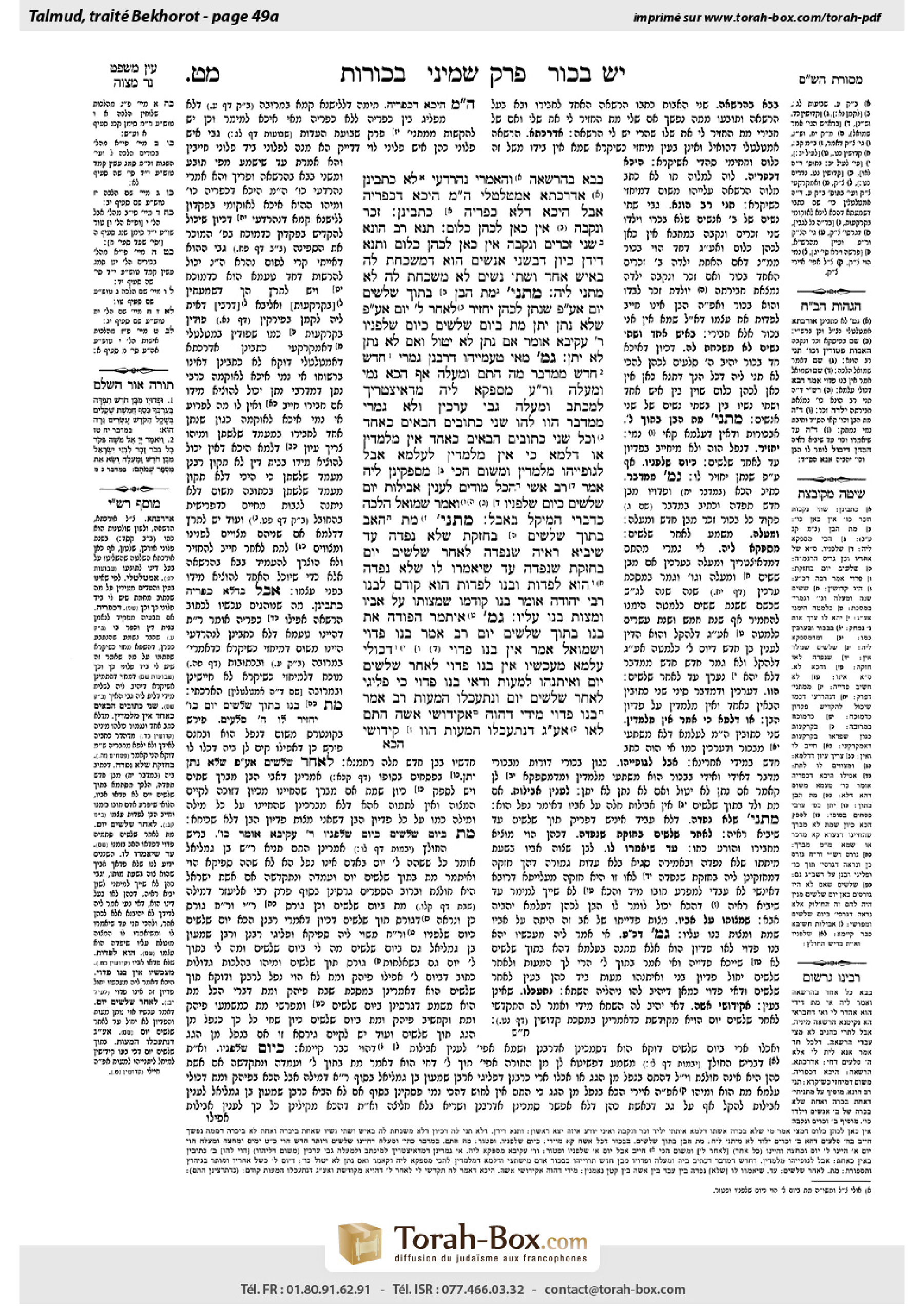
Bekhorot 49a: Talmud study for Daf Yomi
Study the Talmud for Daf Yomi with scanned pages, Hebrew text, English translations from Sefaria and AI-generated French translations.
Passage selection and English or AI-generated French translation are available where the scan has annotations. Daf Study is independent of Torah-Box and Sefaria.
Browse Bekhorot · בכורות · All tractatesBekhorot 49a text and translations
This page of Bekhorot includes the Aramaic text, an English translation and an AI-generated French translation, alongside the scan above.
בכורות מ״ט א · Aramaic and Hebrew text
בְּבָא בְּהַרְשָׁאָה.
וְהָאָמְרִי נְהַרְדָּעֵי: לָא כָּתְבִינַן אַדְרַכְתָּא אַמִּטַּלְטְלִי! הָנֵי מִילֵּי הֵיכָא דְּכַפְרֵיהּ, אֲבָל הֵיכָא דְּלָא כַּפְרֵיהּ — כָּתְבִינַן.
זָכָר וּנְקֵבָה — אֵין כָּאן לַכֹּהֵן כְּלוּם. תָּנָא רַב הוּנָא: שְׁנֵי זְכָרִים וּנְקֵבָה — אֵין כָּאן לַכֹּהֵן כְּלוּם.
וְתַנָּא דִּידַן, כֵּיוָן דְּבִשְׁנֵי אֲנָשִׁים הוּא דְּמַשְׁכַּחַתְּ לַהּ, בְּאִישׁ אֶחָד וּשְׁתֵּי נָשִׁים לָא מַשְׁכַּחַתְּ לַהּ — לָא מִתְּנֵי לֵיהּ.
מַתְנִי׳ מֵת הַבֵּן בְּתוֹךְ שְׁלֹשִׁים יוֹם, אַף עַל פִּי שֶׁנָּתַן לַכֹּהֵן — יַחְזִיר. לְאַחַר שְׁלֹשִׁים יוֹם, אַף עַל פִּי שֶׁלֹּא נָתַן — יִתֵּן. מֵת בְּיוֹם שְׁלֹשִׁים — כְּיוֹם שֶׁלְּפָנָיו. רַבִּי עֲקִיבָא אוֹמֵר: אִם נָתַן — לֹא יִטּוֹל, וְאִם לֹא נָתַן — לֹא יִתֵּן.
גְּמָ׳ מַאי טַעְמַיְיהוּ דְּרַבָּנַן? גָּמְרִי ״חֹדֶשׁ״ ״חֹדֶשׁ״ מִמִּדְבָּר, מָה הָתָם ״וָמַעְלָה״ אַף הָכָא נָמֵי וָמַעְלָה.
וְרַבִּי עֲקִיבָא מְסַפְּקָא לֵיהּ, מִדְּאִיצְטְרִיךְ לְמִכְתַּב ״וָמַעְלָה״ גַּבֵּי עֲרָכִין, וְלָא גָּמְרִי מִמִּדְבָּר — הָווּ לְהוּ שְׁנֵי כְּתוּבִים הַבָּאִים כְּאֶחָד,
וְכׇל שְׁנֵי כְּתוּבִים הַבָּאִים כְּאֶחָד — אֵין מְלַמְּדִין.
אוֹ דִלְמָא: כִּי אֵין מְלַמְּדִין — לְעָלְמָא, אֲבָל לְגוּפַיְיהוּ — מְלַמְּדִין, וּמִשּׁוּם הָכִי מְסַפְּקָא לֵיהּ.
אָמַר רַב אָשֵׁי: הַכֹּל מוֹדִים לְעִנְיַן אֲבֵילוּת, יוֹם שְׁלֹשִׁים כְּיוֹם שֶׁלְּפָנָיו. וְאָמַר שְׁמוּאֵל: הֲלָכָה כְּדִבְרֵי הַמֵּיקֵל בְּאֵבֶל.
מַתְנִי׳ מֵת הָאָב בְּתוֹךְ שְׁלֹשִׁים — בְּחֶזְקַת שֶׁלֹּא נִפְדָּה, עַד שֶׁיָּבִיא רְאָיָה שֶׁנִּפְדָּה; לְאַחַר שְׁלֹשִׁים יוֹם — בְּחֶזְקַת שֶׁנִּפְדָּה, עַד שֶׁיֹּאמְרוּ לוֹ שֶׁלֹּא נִפְדָּה. הוּא לִפְדּוֹת וּבְנוֹ לִפְדּוֹת — הוּא קוֹדֵם לִבְנוֹ; רַבִּי יְהוּדָה אוֹמֵר: בְּנוֹ קוֹדְמוֹ, שֶׁמִּצְוָתוֹ עַל אָבִיו וּמִצְוַת בְּנוֹ עָלָיו.
גְּמָ׳ אִיתְּמַר: הַפּוֹדֶה אֶת בְּנוֹ בְּתוֹךְ שְׁלֹשִׁים יוֹם, רַב אָמַר: בְּנוֹ פָּדוּי, וּשְׁמוּאֵל אָמַר: אֵין בְּנוֹ פָּדוּי. דְּכוּלֵּי עָלְמָא ״מֵעַכְשָׁיו״ — אֵין בְּנוֹ פָּדוּי, לְאַחַר שְׁלֹשִׁים יוֹם וְאִיתַנְהוּ לְמָעוֹת — וַדַּאי בְּנוֹ פָּדוּי.
כִּי פְּלִיגִי לְאַחַר שְׁלֹשִׁים יוֹם, וְנִתְעַכְּלוּ הַמָּעוֹת, רַב אָמַר: בְּנוֹ פָּדוּי, מִידֵּי דְּהָוֵה אַקִּידּוּשֵׁי אִשָּׁה, הָתָם לָאו אַף עַל גַּב דְּנִתְעַכְּלוּ הַמָּעוֹת — הָווּ קִידּוּשֵׁי,
Bekhorot 49a · English translation
This is referring to a case where one of the fathers comes with authorization to act on behalf of the other father to state his claim for him, and therefore the priest cannot reject his claim. But if they gave the money to two different priests an authorization is of no effect, as each priest can claim the other took the redemption money of the son who died.
The Gemara asks: But didn’t the Sages of Neharde’a say: We do not write an authorization document [adrakhta] concerning movable property? Therefore, in the case of redemption, where money, which has the status of movable property, is demanded from the priest, an authorization document may not be used. The Gemara answers: This statement, that one does not write authorization for movable property, applies only when the respondent, in this case the priest, already denied the claim against him. But in a case where the respondent did not yet deny the claim against him we write authorization even for movable property. In the case of redemption, although the priest claims the one issuing the claim against him is not the father of the son who died, he does not deny that he received the money.
§ The mishna teaches: With regard to two women who had not previously given birth who were married to two men, and gave birth to a male and a female who then became intermingled, the fathers are exempt from the mitzva of redemption but the son is obligated to redeem himself, as he certainly has firstborn status. If the offspring were two females and a male, or two males and two females, all of whom became intermingled, the priest has nothing here. Concerning this case Rav Huna teaches: If they gave birth to two males and a female the priest has nothing here, despite the fact that one of them is definitely a firstborn, as each father can claim that his firstborn is the female. In addition, the sons are exempt as well, since each can claim that the female was his sister and born first.
The Gemara asks: And with regard to the tanna of our mishna, why does he not state this case? The Gemara answers: Since you find this ruling that they are entirely exempt in a case where the women are married to two men, but you do not find it in a case of one man and two of his wives, as a firstborn was definitely born to that man and he must give five sela coins to a priest, the tanna does not teach the case of two women and two men either. The reason is that stylistically, the tanna prefers to teach the ruling: The priest has nothing here, only when the halakha is identical in a case of two wives of two men and a case of two wives of one man.
MISHNA: If the firstborn son dies within thirty days of birth, although the father gave five sela to the priest, the priest must return it. If the firstborn son dies after thirty days have passed, even if the father did not give five sela coins to the priest he must give it then. If the firstborn dies on the thirtieth day, that day’s halakhic status is like that of the day that preceded it, as the obligation takes effect only after thirty days have elapsed. Rabbi Akiva says: If the firstborn dies on the thirtieth day it is a case of uncertainty; therefore, if the father already gave the redemption payment to the priest he cannot take it back, but if he did not yet give payment he does not need to give it.
GEMARA: The Gemara asks: What is the reason of the Rabbis, i.e., the first tanna, who hold that the mitzva of redemption applies only after thirty days have elapsed? The Gemara explains that they derive the meaning of the term “month” stated in this context by means of a verbal analogy from the meaning of the term “month” stated in the context of the redemption of the Israelite firstborn in the wilderness via the Levites. Just as there, with regard to the redemption through the Levites, it is stated: “Number all the firstborn males of the children of Israel from a month old and upward” (Numbers 3:40), i.e., after thirty days, so too here, with regard to the mitzva of redemption for future generations, where it states: “From a month old you shall redeem” (Numbers 18:16), the requirement: And upward, applies as well, i.e., only after thirty days.
And Rabbi Akiva is uncertain in this regard, as one could claim: From the fact that it was necessary for the verse to write “and upward” with regard to the mitzva of valuations: “And if it be from sixty years old and upward” (Leviticus 27:7), and it is not derived from the redemption of the Israelite firstborns in the wilderness that the phrase “from…years old” means “and upward,” one can conclude the following: The redemption of the firstborn in the wilderness and valuations are two verses that come as one, i.e., to teach the same matter.
And there is a principle that any two verses that come as one do not teach their common halakha to other cases. If so, the halakha with regard to the mitzva of redeeming the firstborn for future generations would be that the thirtieth day is like the following day, which is not in accordance with the opinion of the Rabbis.
Or perhaps one could say: When do two verses that come as one not teach their common halakha? That is with regard to general halakhot, i.e., entirely different areas of halakha. But with regard to themselves, i.e., similar cases, they do teach. If so, one should derive permanent halakha of redemption of firstborns from the redemption of the firstborn in the wilderness. And it is due to that reason that Rabbi Akiva is uncertain concerning a firstborn on his thirtieth day.
Rav Ashi says: All concede with regard to mourning that the thirtieth day is like the preceding day, i.e., if the son died on the thirtieth day it is considered as though he died on the day before and he has the status of a stillborn, and the rites of mourning are not observed. And the reason is as Shmuel says: The halakha is in accordance with the statement of the more lenient authority in matters relating to mourning.
MISHNA: If the father of the firstborn dies within thirty days of birth the presumptive status of the son is that he was not redeemed, until the son will bring proof that he was redeemed. If the father dies after thirty days have passed the presumptive status of the son is that he was redeemed, until people will tell him that he was not redeemed. If one had both himself to redeem and his son to redeem, his own redemption takes precedence over that of his son. Rabbi Yehuda says: The redemption of his son takes precedence, as the mitzva to redeem the father is incumbent upon his own father, and the mitzva to redeem his son is incumbent upon him.
GEMARA: It was stated: In the case of one who redeems his firstborn son within thirty days of his birth by giving a priest five sela coins, Rav says his son is redeemed and Shmuel says his son is not redeemed. The Gemara explains: Everyone agrees that if the father said: He is redeemed from now, that his son is not redeemed, as the obligation to redeem the son is not yet in effect. Likewise, if the father says the redemption should take effect after thirty days, and the money is still there, in the possession of the priest, after thirty days, his son is certainly redeemed, as the money is in the priest’s possession when the obligation of redemption comes into effect.
They disagree in a situation where the father says the redemption should take effect after thirty days but the money was squandered away in the meantime. Rav says his son is redeemed, just as is the halakha with regard to the betrothal of a woman on the condition that it takes effect after thirty days. In that case there, is it not correct that even though the money was squandered away during the thirty days it is a valid betrothal?
Bekhorot 49a · Traduction française (IA)
Cela fait référence à un cas où l'un des pères vient avec l'autorisation d'agir au nom de l'autre père pour déclarer sa revendication, et par conséquent le prêtre ne peut pas rejeter cette revendication. Mais si l'argent a été donné à deux prêtres différents, l'autorisation est inopérante, car chaque prêtre peut revendiquer que l'autre a pris l'argent de rachat du fils décédé.
La Guemara demande : Mais n'ont pas dit les Sages de Neharde’a : Nous ne rédigeons pas un document d'autorisation [adrakhta] concernant les biens mobiliers ? Ainsi, dans le cas du rachat, où l'argent, qui a le statut de bien mobilier, est demandé au prêtre, un document d'autorisation ne peut pas être utilisé. La Guemara répond : Cette déclaration, selon laquelle on ne rédige pas d'autorisation pour les biens mobiliers, s'applique uniquement lorsque le répondant, dans ce cas le prêtre, a déjà rejeté la revendication contre lui. Mais dans un cas où le répondant n'a pas encore rejeté la revendication contre lui, on rédige un document d'autorisation même pour les biens mobiliers. Dans le cas du rachat, bien que le prêtre affirme que celui qui formule la revendication contre lui n'est pas le père du fils décédé, il ne nie pas avoir reçu l'argent.
§ La mitsva enseigne : Concernant deux femmes qui n'avaient pas encore eu d'enfants et qui se sont mariées à deux hommes, et qui ont donné naissance à un mâle et à une femelle qui se sont ensuite mêlés, les pères sont exemptés de la mitsva de rachat mais l'enfant est tenu de se racheter lui-même, car il a certainement le statut de premier-né. Si les descendants étaient deux femelles et un mâle, ou deux mâles et deux femelles, tous ayant été mêlés, le prêtre n'a rien ici. Concernant ce cas, Rav Huna enseigne : Si elles ont donné naissance à deux mâles et à une femelle, le prêtre n'a rien ici, malgré le fait qu'un d'entre eux est certainement un premier-né, car chaque père peut affirmer que son premier-né est la femelle. De plus, les fils sont également exemptés, car chacun peut affirmer que la femelle était sa sœur et née en premier.
La Guemara demande : Et concernant le tanna de notre mitsva, pourquoi ne mentionne-t-il pas ce cas ? La Guemara répond : Puisque vous trouvez cette décision selon laquelle ils sont entièrement exemptés dans un cas où les femmes sont mariées à deux hommes, mais vous ne trouvez pas cela dans un cas d'un seul homme et de deux de ses épouses, car un premier-né a certainement été né à cet homme et il doit donner cinq sela à un prêtre, le tanna ne transmet pas non plus le cas de deux femmes et deux hommes. La raison est que stylistiquement, le tanna préfère enseigner la décision : Le prêtre n'a rien ici, uniquement lorsque la halakha est identique dans un cas de deux épouses de deux hommes et dans un cas de deux épouses d'un seul homme.
MITSVA : Si le fils premier-né meurt dans les trente jours suivant sa naissance, bien que le père ait donné cinq sela au prêtre, le prêtre doit le lui rendre. Si le fils premier-né meurt après que les trente jours se soient écoulés, même si le père n'a pas donné cinq sela au prêtre, il doit le faire alors. Si le fils meurt le trentième jour, le statut halakhique de ce jour est comme celui du jour précédent, car l'obligation prend effet uniquement après que trente jours aient passé. Rabbi Akiva dit : Si le fils meurt le trentième jour, c'est un cas d'incertitude ; par conséquent, si le père a déjà donné le paiement de rachat au prêtre, il ne peut pas le récupérer, mais si le père n'a pas encore effectué le paiement, il n'a pas besoin de le faire.
GUEMARA : La Guemara demande : Quel est le fondement des Rabbins, c'est-à-dire du premier tanna, qui affirme que l'obligation de rachat s'applique uniquement après trente jours ? La Guemara explique qu'ils dérivent le sens du terme « mois » mentionné dans ce contexte par analogie verbale du sens du terme « mois » mentionné dans le contexte du rachat des premiers-nés israélites dans le désert via les Lévites. Tout comme là, concernant le rachat via les Lévites, il est dit : « Compte tous les premiers-nés masculins des enfants d'Israël à partir d'un mois et au-delà » (Nombres 3:40), c'est-à-dire après trente jours, de même ici, concernant l'obligation de rachat pour les générations futures, où il est dit : « À partir d'un mois tu dois racheter » (Nombres 18:16), la mention « et au-delà » s'applique également, c'est-à-dire uniquement après trente jours.
Et Rabbi Akiva est incertain à ce sujet, car on pourrait dire : D'après le fait que la Bible a dû écrire « et au-delà » concernant l'obligation de valuation : « Et si c'est à partir de soixante ans et au-delà » (Lévitique 27:7), et non pas à partir du rachat des premiers-nés israélites dans le désert, on peut conclure ce qui suit : Le rachat des premiers-nés dans le désert et les valuations sont deux versets qui viennent ensemble, c'est-à-dire pour enseigner la même chose.
Et il y a un principe selon lequel toute paire de versets qui viennent ensemble ne transmet pas leur halakha commune à d'autres cas. Si c'est ainsi, la halakha concernant l'obligation de rachat des premiers-nés pour les générations futures serait que le trentième jour est comme le jour suivant, ce qui n'est pas conforme à l'opinion des Rabbins.
Ou peut-être pourrait-on dire : Quand deux versets qui viennent ensemble ne transmettent-ils pas leur halakha commune ? C'est à propos des halakhot générales, c'est-à-dire des domaines entièrement différents de halakha. Mais à propos d'eux-mêmes, c'est-à-dire des cas semblables, ils transmettent. Si c'est ainsi, on devrait déduire la halakha permanente du rachat des premiers-nés à partir du rachat des premiers-nés dans le désert. Et c'est pour cette raison que Rabbi Akiva est incertain concernant un premier-né à son trentième jour.
Rav Ashi dit : Tout le monde reconnaît à propos du deuil que le trentième jour est comme le jour précédent, c'est-à-dire si le fils est décédé le trentième jour, il est considéré comme s'il était décédé le jour précédent et il a le statut d'un né mort, et les rites de deuil ne sont pas observés. Et la raison est telle que dit Shmuel : La halakha suit l'opinion du plus accommodant concernant les questions de deuil.
MICHNA : Si le père du premier-né meurt dans les trente jours suivant la naissance, le statut présomptif du fils est qu'il n'a pas été racheté, jusqu'à ce que le fils apporte la preuve qu'il a été racheté. Si le père meurt après que les trente jours se soient écoulés, le statut présomptif du fils est qu'il a été racheté, jusqu'à ce que les gens lui disent qu'il n'a pas été racheté. Si l'on doit racheter à la fois soi-même et son fils, le rachat de soi-même a priorité sur celui de son fils. Rabbi Yéhuda dit : Le rachat de son fils a priorité, car la mitsva de racheter le père incombe à son propre père, et la mitsva de racheter son fils incombe à lui-même.
GUEMARA : Il a été dit : Dans le cas d'un homme qui rachète son premier-né dans les trente jours suivant sa naissance en donnant à un prêtre cinq sela, Rav dit que son fils est racheté et Shmuel dit que son fils n'est pas racheté. La Guemara explique : Tout le monde convient que si le père dit : Il est racheté à partir de maintenant, alors son fils n'est pas racheté, car l'obligation de racheter le fils n'est pas encore en vigueur. De même, si le père dit que le rachat doit prendre effet après trente jours, et que l'argent est toujours là, en possession du prêtre, après trente jours, son fils est certainement racheté, car l'argent est en possession du prêtre lorsque l'obligation de rachat commence.
Ils divergent dans un cas où le père dit que le rachat doit prendre effet après trente jours mais l'argent a été gaspillé pendant ce temps. Rav dit que son fils est racheté, tout comme c'est le cas concernant le mariage d'une femme sur la condition que le mariage prenne effet après trente jours. Dans ce cas-là, n'est-ce pas correct que même si l'argent a été gaspillé pendant les trente jours, le mariage est valide ?
Traduction française générée par IA à partir de l’édition anglaise de Sefaria. Vérifie toujours un passage avec le texte source.
Text from Sefaria: William Davidson Edition - Vocalized Aramaic (CC BY NC); William Davidson Edition - English (CC BY NC).