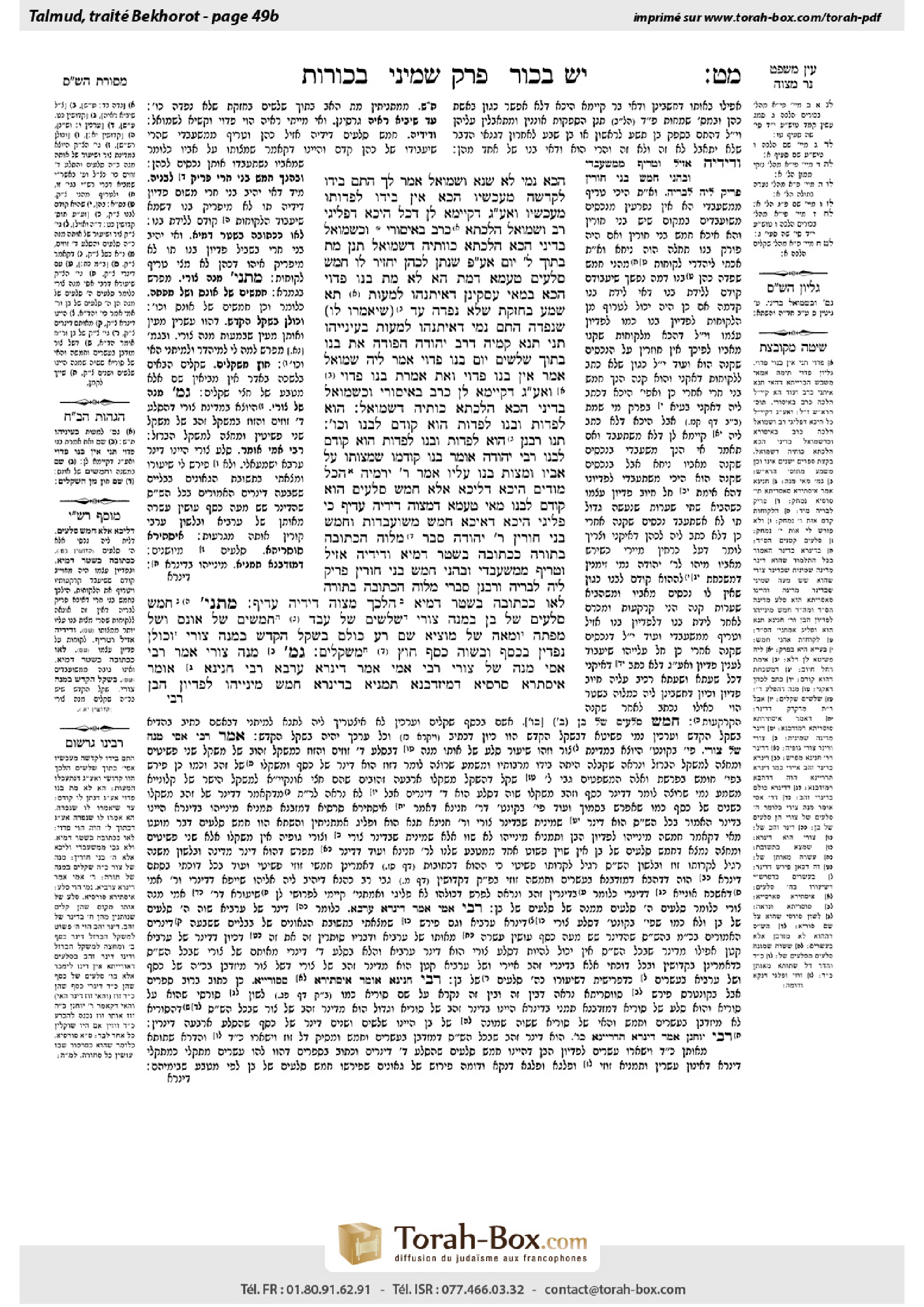
Bekhorot 49b: Talmud study for Daf Yomi
Study the Talmud for Daf Yomi with scanned pages, Hebrew text, English translations from Sefaria and AI-generated French translations.
Passage selection and English or AI-generated French translation are available where the scan has annotations. Daf Study is independent of Torah-Box and Sefaria.
Browse Bekhorot · בכורות · All tractatesBekhorot 49b text and translations
This page of Bekhorot includes the Aramaic text, an English translation and an AI-generated French translation, alongside the scan above.
בכורות מ״ט ב · Aramaic and Hebrew text
הָכָא נָמֵי לָא שְׁנָא.
וּשְׁמוּאֵל אָמַר לָךְ: הָתָם — בְּיָדוֹ לְקַדְּשָׁהּ מֵעַכְשָׁיו, הָכָא — אֵין בְּיָדוֹ לִפְדּוֹתוֹ מֵעַכְשָׁיו. וְאַף עַל גַּב דְּקַיְימָא לַן, דְּכֹל הֵיכָא דִּפְלִיגִי רַב וּשְׁמוּאֵל — הִלְכְתָא כְּרַב בְּאִיסּוּרֵי וְכִשְׁמוּאֵל בְּדִינֵי, הָכָא הִלְכְתָא כְּוָותֵיהּ דִּשְׁמוּאֵל.
תְּנַן: מֵת בְּתוֹךְ שְׁלֹשִׁים יוֹם, אַף עַל פִּי שֶׁנָּתַן לַכֹּהֵן — יַחְזִיר לוֹ חָמֵשׁ סְלָעִים. טַעְמָא דְּמֵת, הָא לֹא מֵת — בְּנוֹ פָּדוּי! הָכָא בְּמַאי עָסְקִינַן? דְּאִיתַנְהוּ לְמָעוֹת.
תָּא שְׁמַע: בְּחֶזְקַת שֶׁלֹּא נִפְדָּה עַד שֶׁיֹּאמְרוּ לוֹ שֶׁנִּפְדָּה! הָתָם נָמֵי דְּאִיתַנְהוּ לְמָעוֹת בְּעֵינַיְיהוּ.
תָּנֵי תַּנָּא קַמֵּיהּ דְּרַב יְהוּדָה: הַפּוֹדֶה אֶת בְּנוֹ בְּתוֹךְ שְׁלֹשִׁים יוֹם — בְּנוֹ פָּדוּי. אֲמַר לֵיהּ: שְׁמוּאֵל אָמַר אֵין בְּנוֹ פָּדוּי, וְאַתְּ אָמְרַתְּ בְּנוֹ פָּדוּי?! וְאַף עַל גַּב דְּקַיְימָא לַן כְּרַב בְּאִיסּוּרֵי וְכִשְׁמוּאֵל בְּדִינֵי, הָכָא הִלְכְתָא כְּוָתֵיהּ דִּשְׁמוּאֵל.
הוּא לִפְדּוֹת וּבְנוֹ לִפְדּוֹת — הוּא קוֹדֵם לִבְנוֹ וְכוּ׳. תָּנוּ רַבָּנַן: הוּא לִפְדּוֹת וּבְנוֹ לִפְדּוֹת — הוּא קוֹדֵם לִבְנוֹ. רַבִּי יְהוּדָה אוֹמֵר: בְּנוֹ קוֹדְמוֹ, שֶׁמִּצְוָתוֹ עַל אָבִיו, וּמִצְוַת בְּנוֹ עָלָיו.
אָמַר רַבִּי יִרְמְיָה: הַכֹּל מוֹדִים הֵיכָא דְּלֵיכָּא אֶלָּא חָמֵשׁ סְלָעִים — הוּא קוֹדֵם לִבְנוֹ, מַאי טַעְמָא? דְּמִצְוָה דִּידֵיהּ עֲדִיף. כִּי פְּלִיגִי הֵיכָא דְּאִיכָּא חָמֵשׁ מְשׁוּעְבָּדוֹת וְחָמֵשׁ בְּנֵי חוֹרִין.
רַבִּי יְהוּדָה סָבַר: מִלְוָה הַכְּתוּבָה בַּתּוֹרָה — כִּכְתוּבָה בִּשְׁטָר דָּמְיָא, וְדִידֵיהּ אָזֵיל וְטָרֵיף מִמְּשַׁעְבְּדִי, וּבְהָנֵי חָמֵשׁ בְּנֵי חוֹרִין — פָּרֵיק לֵיהּ לִבְרֵיהּ.
וְרַבָּנַן סָבְרִי: מִלְוָה הַכְּתוּבָה בַּתּוֹרָה — לָאו כִּכְתוּבָה בִּשְׁטָר דָּמְיָא, הִלְכָּךְ מִצְוָה דִּידֵיהּ עָדִיף.
מַתְנִי׳ חָמֵשׁ סְלָעִים שֶׁל בֵּן — בְּמָנֶה צוֹרִי.
שְׁלֹשִׁים שֶׁל עֶבֶד, חֲמִשִּׁים שֶׁל אוֹנֵס וְשֶׁל מְפַתֶּה, וּמֵאָה שֶׁל מוֹצִיא שֵׁם רַע — כּוּלָּם בְּשֶׁקֶל הַקֹּדֶשׁ, בְּמָנֶה צוֹרִי. וְכוּלָּן נִפְדִּין בְּכֶסֶף וּבְשָׁוֵה כֶּסֶף, חוּץ מִשְּׁקָלִים.
גְּמָ׳ מָנֶה צוֹרִי. אָמַר רַבִּי אַסִּי: מָנֶה שֶׁל צוֹר. רַבִּי אַמֵּי אָמַר: דִּינָרָא (ערבא) [עַרְבָיָא]. רַבִּי חֲנִינָא אוֹמֵר: אִיסְתֵּרָא סֻרְסְיָא דְּמִיזְדַּבְּנָא תְּמָנְיָא בְּדִינָרָא, חֲמֵשׁ מִינַּיְיהוּ לְפִדְיוֹן הַבֵּן.
Bekhorot 49b · English translation
Here, too, the halakha is no different.
And Shmuel could say to you: There, with regard to betrothal, it is in his power to betroth her from now, when he gave her the coins, and therefore it is irrelevant that the money was spent. Conversely, here, in the case of redemption, it is not in his power to redeem his son from now. With regard to the practical halakha in this dispute the Gemara comments: And even though we maintain as a principle that wherever Rav and Shmuel disagree the halakha is in accordance with the opinion of Rav in ritual matters and in accordance with the opinion of Shmuel in monetary matters, here the halakha is in accordance with the opinion of Shmuel, who holds that if one redeems his son within thirty days he is not redeemed.
The Gemara raises a difficulty: We learned in the mishna on the previous amud: If the firstborn son dies within thirty days of birth, although the father gave five sela coins to the priest, the priest must return the five sela coins to him. The Gemara infers: The reason he must return the money is that the son died. But if he did not die within thirty days his son is redeemed despite the fact that the father gave the priest the money prior to the proper time. This inference contradicts the opinion of Shmuel. The Gemara answers: Here we are dealing with a case where the money is still extant, i.e., in the priest’s possession.
The Gemara comments: Come and hear another difficulty from the mishna: If the father of the firstborn son dies within thirty days of the birth the presumptive status of the son is that he is not redeemed, until people will tell him that he is redeemed. But if people tell him he is redeemed then the redemption is effective, in contradiction to the opinion of Shmuel. The Gemara answers: There too, it is referring to a case where the money is still extant, i.e., in the priest’s possession.
The Gemara relates that a tanna taught a baraita in the presence of Rav Yehuda: In the case of one who redeems his firstborn son within thirty days of his birth, his son is redeemed. Rav Yehuda said to him: Shmuel said his son is not redeemed, and yet you say his son is redeemed? The Gemara comments: And even though we maintain that the halakha is in accordance with the opinion of Rav in ritual matters and in accordance with the opinion of Shmuel in monetary matters, here the halakha is in accordance with the opinion of Shmuel.
§ The mishna teaches that if one had both himself to redeem and his son to redeem, his own redemption takes precedence over that of his son. The Sages taught in a baraita: If one had both himself to redeem and his son to redeem, his own redemption takes precedence over that of his son. Rabbi Yehuda says: The redemption of his son takes precedence, as the mitzva to redeem the father is incumbent upon his own father, and the mitzva to redeem his son is incumbent upon him. Consequently, he should first fulfill the mitzva that is incumbent upon him by redeeming his son.
Rabbi Yirmeya says: Everyone concedes that in a case where there are only five sela coins available and one has to redeem both himself and his son, his own redemption takes precedence over that of his son, despite the indication to the contrary from the mishna. What is the reason? The reason is that his own mitzva is preferable to one he performs on behalf of others. Where they disagree is in a case where there is both land worth five sela coins that is liened property that had been previously sold to others and land worth five sela coins that is unsold property.
The Gemara explains the reasoning behind the dispute: Rabbi Yehuda maintains that a loan that is written in the Torah, i.e., a financial obligation by Torah law, such as redemption of the firstborn son with five sela coins, is considered as though it is written in a document, and it can therefore be collected from liened property, as can any loan recorded in a document. Therefore, the five sela coins that are liened property are available for one’s own redemption but not for that of one’s son, as the sale of the property presumably occurred before the birth of his firstborn. And therefore the priest goes and repossesses the land worth five sela that is liened property for his own redemption, like any debt written in a document; and with those five sela of unsold property he redeems his son. In this manner, one can fulfill both mitzvot.
And the Rabbis maintain: A loan that is written in the Torah is not considered as though it is written in a document, since buyers will not know to guard against repossession if it is not written in a document. Therefore, the five sela coins that are liened property are not available for redemption, and consequently his own mitzva is preferable. He accordingly redeems himself with the land that is not liened.
MISHNA: The five sela coins of the redemption of the firstborn son, with regard to which it is written: “Five shekels of silver, after the shekel of the Sanctuary” (Numbers 18:16), are calculated using a Tyrian maneh. The silver content of the Tyrian coinage is significantly higher than that of provincial coinage, which is worth one-eighth its value.
With regard to the thirty shekels paid to the owner of a Canaanite slave who is killed by an ox (see Exodus 21:32), and the fifty shekels paid by a rapist (see Deuteronomy 22:29) and by a seducer (see Exodus 22:16) of a young virgin woman, and the one hundred shekels paid by the defamer of his bride with the claim that she is not a virgin (see Deuteronomy 22:19), all of them, even those cases where the word shekel is not explicitly written, are paid in the shekel of the Sanctuary, whose value is twenty gera (see Numbers 18:16) and that is calculated using a Tyrian maneh. And all monetary obligations are redeemed, i.e., paid, with coins or with items of the equivalent value of money, except for the half-shekels that are donated to the Temple each year, which must be given specifically as coins.
GEMARA: The mishna stated that the five sela coins of the redemption of the son are calculated using a Tyrian maneh. In explanation of this, Rabbi Asi says: One must give five sela of the maneh used in Tyre. Rabbi Ami says: The five sela coins are equal to a golden Arabian dinar. Rabbi Ḥanina says: There is a Syrian sela [istera], eight of which are sold for a large golden dinar. One must give five of these for the redemption of the son.
Bekhorot 49b · Traduction française (IA)
Ici aussi, la halakha est identique.
Et Shmuel pourrait te dire : Là, concernant le mariage, il a le pouvoir de marier la femme dès maintenant, lorsqu'il lui a donné les pièces, et donc il n'est pas pertinent que l'argent ait été dépensé. À l'inverse, ici, dans le cas de la rachat, il n'a pas le pouvoir de racheter son fils dès maintenant. Concernant la halakha pratique dans ce débat, la Guemara commente : Et même si nous maintenons comme principe que là où Rav et Shmuel divergent, la halakha suit l'opinion de Rav dans les questions rituelles et celle de Shmuel dans les questions monétaires, ici la halakha suit l'opinion de Shmuel, qui affirme que si l'on rachète son fils dans les trente jours, il n'est pas racheté.
La Guemara soulève une difficulté : Nous avons appris dans la mitsva sur l'amud précédent : Si le premier-né meurt dans les trente jours suivant sa naissance, bien que le père ait donné cinq sela à l'ancien, l'ancien doit rendre les cinq sela au père. La Guemara déduit : La raison pour laquelle il doit rendre l'argent est que le fils est mort. Mais si le fils n'est pas mort dans les trente jours, il est racheté malgré le fait que le père ait donné l'argent à l'ancien avant le moment approprié. Cette déduction contredit l'opinion de Shmuel. La Guemara répond : Ici, nous parlons d'un cas où l'argent est encore présent, c'est-à-dire en possession de l'ancien.
La Guemara commente : Viens écouter une autre difficulté tirée de la Michna : Si le père du premier-né meurt dans les trente jours suivant la naissance, le statut présomptif du fils est qu'il n'est pas racheté, jusqu'à ce que les gens lui disent qu'il est racheté. Mais si les gens lui disent qu'il est racheté, alors le rachat est efficace, ce qui contredit l'opinion de Shmuel. La Guemara répond : Là aussi, il s'agit d'un cas où l'argent est encore présent, c'est-à-dire en possession du prêtre.
La Guemara rapporte que un tanna a enseigné une baraïta en présence de Rav Yehuda : Dans le cas d'une personne qui rachète son premier-né dans les trente jours suivant sa naissance, son fils est racheté. Rav Yehuda dit à lui : Shmuel dit que son fils n'est pas racheté, et pourtant tu dis que son fils est racheté ? La Guemara commente : Et même si nous maintenons que la halakha suit l'opinion de Rav dans les questions rituelles et celle de Shmuel dans les questions monétaires, ici la halakha suit l'opinion de Shmuel.
§ La Michna enseigne que si l'on doit racheter soi-même et son fils, le rachat de soi-même a priorité sur celui de son fils. Les Sages ont enseigné dans une baraïta : Si l'on doit racheter soi-même et son fils, le rachat de soi-même a priorité sur celui de son fils. Rabbi Yehuda dit : Le rachat de son fils a priorité, car la mitsva de racheter le père incombe à son propre père, et la mitsva de racheter son fils incombe à lui. Ainsi, il devrait d'abord accomplir la mitsva qui incombe à lui en rachetant son fils.
Rabbi Yirmeya dit : Tout le monde reconnaît que dans le cas où il n'y a que cinq sela disponibles et qu'on doit racheter soi-même et son fils, le rachat de soi-même a priorité sur celui de son fils, malgré l'indication contraire de la mitsna. Quelle est la raison ? La raison est que sa propre mitsva est préférable à celle qu'il accomplit pour autrui. Le point de désaccord est dans le cas où il y a à la fois une terre valant cinq sela liée à un prêt et une terre valant cinq sela non vendue.
La Guemara explique la raison du débat : Rabbi Yehuda maintient qu'un prêt écrit dans la Torah, c'est-à-dire une obligation financière par la loi divine, comme le rachat du premier-né avec cinq sela, est considéré comme s'il était écrit dans un document, et peut donc être récupéré à partir d'une propriété liée, comme tout prêt inscrit dans un document. Ainsi, les cinq sela liés à la propriété sont disponibles pour son propre rachat mais pas pour celui de son fils, car la vente de la propriété a probablement eu lieu avant la naissance de son premier-né. Et donc le prêtre va récupérer la terre valant cinq sela liée pour son propre rachat, comme toute dette écrite dans un document ; et avec ces cinq sela de propriété non liée il rachète son fils. Ainsi, on peut accomplir les deux mitsvot.
Et les Rabbins maintiennent : Un prêt écrit dans la Torah n'est pas considéré comme s'il était écrit dans un document, car les acheteurs ne sauront pas garder la propriété en cas de récupération si ce n'est pas écrit dans un document. Ainsi, les cinq sela liés à la propriété ne sont pas disponibles pour le rachat, et par conséquent sa propre mitsva est préférable. Il rachète donc lui-même avec la terre non liée.
MICHNA : Les cinq sela du rachat du premier-né, concernant lesquels il est écrit : « Cinq shekels d'argent, après le shekel du Sanctuaire » (Nombres 18:16), sont calculés à l'aide d'un maneh tyrien. La teneur en argent de la monnaie tyrienne est nettement supérieure à celle de la monnaie provinciale, qui vaut un huitième de sa valeur.
Concernant les trente shekels payés à l'propriétaire d'un esclave canané qui est tué par un bœuf (voir Exode 21:32), et les cinquante shekels payés par un violateur (voir Deutéronome 22:29) et par un séducteur (voir Exode 22:16) d'une jeune vierge, et les cent shekels payés par le calomniateur de sa fiancée avec la déclaration qu'elle n'est pas vierge (voir Deutéronome 22:19), tous ceux-ci, même dans les cas où le mot shekel n'est pas explicitement écrit, sont payés en shekel du Sanctuaire, dont la valeur est vingt gera (voir Nombres 18:16) et qui est calculé à l'aide d'un maneh tyrien. Et toutes les obligations monétaires sont payées, c'est-à-dire exécutées, avec des pièces ou avec des objets équivalents en valeur monétaire, sauf les demi-shekels qui sont donnés au Temple chaque année, qui doivent être donnés spécifiquement en pièces.
GUEMARA : La mitsva a dit que les cinq sela de la rançon du fils sont calculés à l’aide d’un maneh de Tyr. En explication de cela, Rabbi Asi dit : On doit donner cinq sela du maneh utilisé à Tyr. Rabbi Ami dit : Les cinq sela sont égaux à un dinar d’Arabie en or. Rabbi Ḥanina dit : Il y a un sela syrien [istera], huit d’entre eux sont vendus pour un grand dinar d’or. On doit donner cinq de ces sela pour la rançon du fils.
Traduction française générée par IA à partir de l’édition anglaise de Sefaria. Vérifie toujours un passage avec le texte source.
Text from Sefaria: William Davidson Edition - Vocalized Aramaic (CC BY NC); William Davidson Edition - English (CC BY NC).