Bekhorot 50a: Talmud study for Daf Yomi
Study the Talmud for Daf Yomi with scanned pages, Hebrew text, English translations from Sefaria and AI-generated French translations.
Passage selection and English or AI-generated French translation are available where the scan has annotations. Daf Study is independent of Torah-Box and Sefaria.
Browse Bekhorot · בכורות · All tractatesBekhorot 50a text and translations
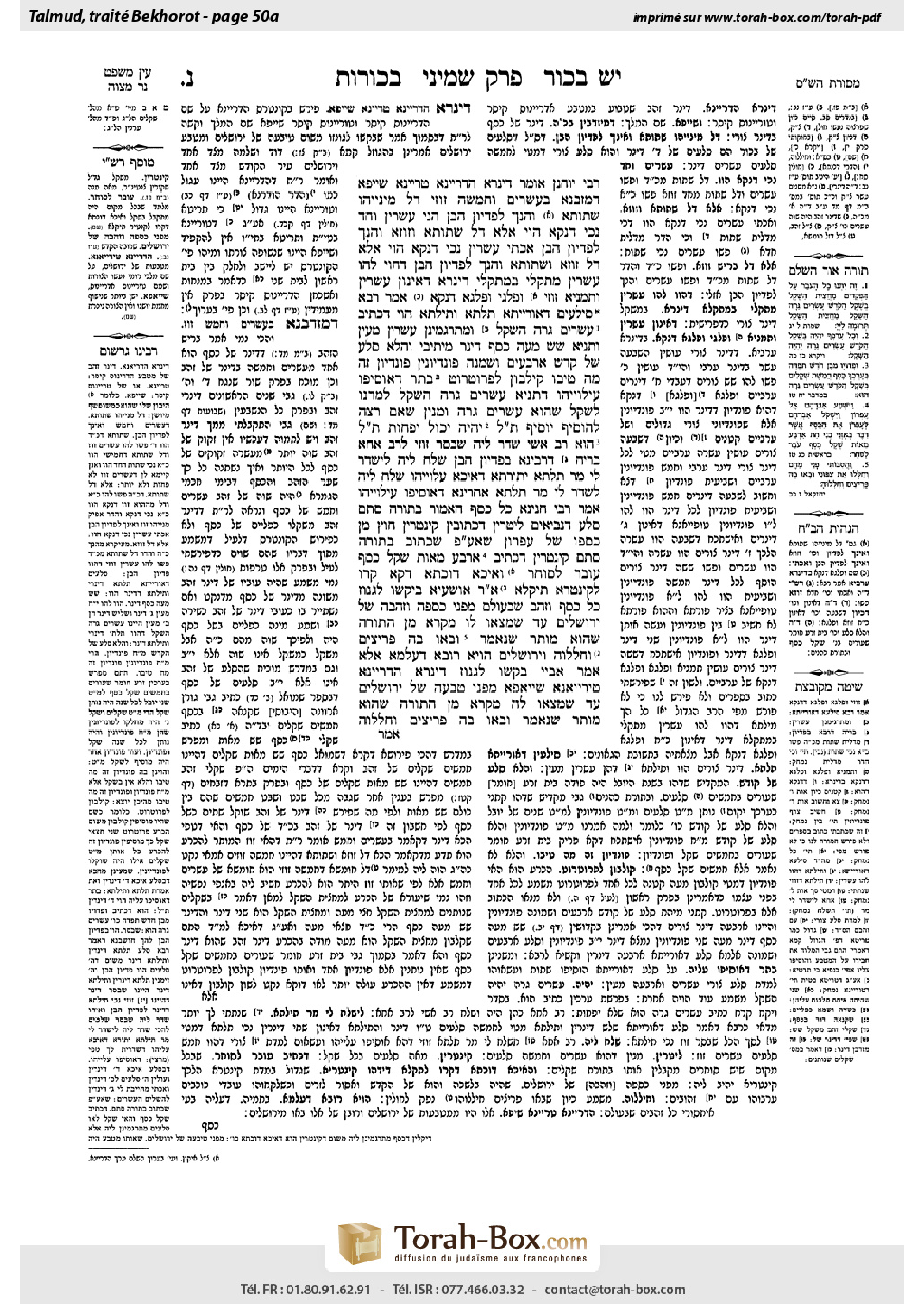
This page of Bekhorot includes the Aramaic text, an English translation and an AI-generated French translation, alongside the scan above.
בכורות נ׳ א · Aramaic and Hebrew text
רַבִּי יוֹחָנָן אוֹמֵר: דִּינָרָא הַדְרִיָּינָא טִרְיָינָא שְׁיָיפָא דִּמְזַבְּנָא בְּעֶשְׂרִים וְחַמְשָׁה זוּזֵי, דַּל מִינַּיְיהוּ שְׁתוּתָא וְהָנָךְ לְפִדְיוֹן הַבֵּן. הָנֵי עֶשְׂרִין וְחַד נְכֵי דַּנְקָא הָוֵי!
אֶלָּא, דַּל שְׁתוּתָא וְזוּזָא, וְהָנָךְ לְפִדְיוֹן הַבֵּן. אַכַּתִּי עֶשְׂרִין נְכֵי דַּנְקָא הָוֵי! אֶלָּא, דַּל זוּזָא וּשְׁתוּתָא, וְהָנָךְ לְפִדְיוֹן הַבֵּן, דְּהָוֵי לְהוּ עֶשְׂרִין מַתְקָלֵי בְּמַתְקָלֵי דִּינָרָא, דְּאִינּוּן עֶשְׂרִין וּתְמָנְיָא זוּזֵי וּפַלְגֵי וּפַלְגָא דַּנְקָא.
אָמַר רָבָא: סִילְעִים דְּאוֹרָיְיתָא תְּלָתָא וְתִילְתָּא הָוֵי, דִּכְתִיב: ״עֶשְׂרִים גֵּרָה הַשֶּׁקֶל״, וּמְתַרְגְּמִינַן: ״עֶשְׂרִין מָעִין״, וְתַנְיָא: שֵׁשׁ מָעָה כֶּסֶף דִּינָר.
מֵיתִיבִי: וַהֲלֹא סֶלַע שֶׁל קֹדֶשׁ אַרְבָּעִים וּשְׁמֹנֶה פּוּנְדְּיוֹנִין.
פּוּנְדְּיוֹן זֶה מָה טִיבוֹ? קִילְבּוֹן לַפְּרוֹטְרוֹט!
בָּתַר דְּאוֹסִיפוּ עִילָּוַיְיהוּ, דְּתַנְיָא: ״עֶשְׂרִים גֵּרָה הַשֶּׁקֶל״ — לָמַדְנוּ לַשֶּׁקֶל שֶׁהוּא עֶשְׂרִים גֵּרָה, וּמִנַּיִן שֶׁאִם רָצָה לְהוֹסִיף יוֹסִיף? תַּלְמוּד לוֹמַר: ״יִהְיֶה״, יָכוֹל יִפְחוֹת? תַּלְמוּד לוֹמַר: ״הוּא״.
רַב אָשֵׁי שַׁדַּר לֵיהּ שִׁבְסַר זוּזֵי לְרַב אַחָא בְּרֵיהּ דְּרָבִינָא בְּפִדְיוֹן הַבֵּן, שְׁלַח לֵיהּ: לִישַׁדַּר לִי מָר תִּלְתָּא יַתִּירְתָּא דְּאִיכָּא עִלָּוַיְיהוּ. שְׁלַח לֵיהּ: לְשַׁדַּר לִי מָר תְּלָתָא אַחֲרִינָא דְּאוֹסִיפוּ עִילָּוַיְיהוּ!
אָמַר רַבִּי חֲנִינָא: כׇּל כֶּסֶף הָאָמוּר בַּתּוֹרָה סְתָם — סֶלַע, דִּנְבִיאִים — לִיטְרִין, דִּכְתוּבִין — קִינְטְרִין, חוּץ מִן כַּסְפּוֹ שֶׁל עֶפְרוֹן, שֶׁאַף עַל פִּי שֶׁכָּתוּב בַּתּוֹרָה סְתָם — קִינְטָרִין, דִּכְתִיב ״אַרְבַּע מֵאוֹת שֶׁקֶל כֶּסֶף עוֹבֵר לַסֹּחֵר״, וְאִיכָּא דּוּכְתָּא דְּקָא קָרוּ לְקִינְטָרָא ״תִּיקְלָא״.
אָמַר רַבִּי אוֹשַׁעְיָא: בִּיקְּשׁוּ לִגְנוֹז כׇּל כֶּסֶף וְזָהָב שֶׁבָּעוֹלָם מִפְּנֵי כַּסְפָּהּ וּזְהָבָהּ שֶׁל יְרוּשָׁלַיִם, עַד שֶׁמָּצְאוּ לוֹ מִקְרָא מִן הַתּוֹרָה שֶׁהוּא מוּתָּר, שֶׁנֶּאֱמַר: ״וּבָאוּ בָהּ פָּרִיצִים וְחִלְּלוּהָ״.
וִירוּשָׁלַיִם הָוְיָא רוּבָּא דְּעָלְמָא? אֶלָּא אָמַר אַבָּיֵי: בִּקְּשׁוּ לִגְנוֹז דִּינָרָא הַדְרִיָּינָא טִירְיָיאנָא שְׁיָיאפָא, מִפְּנֵי טִבְעָהּ שֶׁל יְרוּשָׁלַיִם, עַד שֶׁמָּצְאוּ לָהּ מִקְרָא מִן הַתּוֹרָה שֶׁהוּא מוּתָּר, שֶׁנֶּאֱמַר: ״וּבָאוּ בָהּ פָּרִיצִים וְחִלְּלוּהָ״.
Bekhorot 50a · English translation
Rabbi Yoḥanan says: If one wishes to know how much to give for the redemption of the firstborn son, take the worn-out gold dinars of Hadrian and Trajan, which are sold at twenty-five dinars, and deduct from them one-sixth. And these that remain are the five sela that one must give for the redemption of the firstborn son, i.e., twenty dinars, as there are four dinars in a sela. The Gemara challenges: After deducting one- sixth from twenty-five, one is not left with twenty dinars, but twenty-one dinars less one-sixth [danka] of a dinar.
Rather, deduct one-sixth and another dinar, and these that are left are for the redemption of the firstborn son. The Gemara challenges: But the calculation is still inexact, as this sum is twenty dinars less one-sixth of a dinar. Rather, first deduct one dinar, and from the remainder, i.e., twenty-four dinars, deduct one-sixth, and these that are left are the five sela coins that one must give for the redemption of the son. The Gemara notes that these are a weight of twenty matkalei of the small golden dinars known as matkalei, which are worth twenty-eight and a half dinars, and half of a sixth of a dinar, in Arabian silver dinars.
§ Rava says: The biblical sela coins, i.e., the shekels that must be given for the redemption of the firstborn son, are each three and one-third dinars in weight, not four dinars. As it is written: “The shekel is twenty gera” (Exodus 30:13), and we translate “twenty gera” as twenty ma’a. And it is taught in a baraita: Six silver ma’a equal a dinar. If so, twenty ma’a, which is equal to the sela of the Torah, is worth three and one-third dinars.
The Gemara raises an objection from a baraita, which discusses the halakha of one who redeems an ancestral field from the Temple treasury. The Torah states that one who consecrates his field in the Jubilee year gives as its redemption, for each of the upcoming forty-nine years, fifty sela for each area fit for the sowing of a kor of barley seed. In this regard, the Sages have said that one gives a sela and a pundeyon, which is half a ma’a, per year. The baraita notes a discrepancy here: But in the sela coins of the Sanctuary there are forty-eight pundeyon, which means that according to the statement of the Sages, the redemption for forty-nine years amounts to forty-nine sela and forty-nine pundeyon, i.e., fifty sela and a pundeyon, one pundeyon more than the sum required by the Torah.
The baraita explains: This pundeyon, what is its function? It is a premium [kilbon] for exchanging the sela into pundeyon. In any case, this baraita teaches that there are forty-eight pundeyon in the sela of the Torah, which is twenty-four ma’a. This contradicts the statement of Rava, who said that the sela of the Torah is worth only twenty ma’a.
The Gemara answers that the baraita is referring to the period after the Sages added one-sixth to the coins, i.e., four ma’a to each sela. As it is taught in a baraita, with regard to the verse: “Twenty gera shall be the shekel” (Leviticus 27:25): We learn from here with regard to the shekel mentioned in the Torah that it is twenty gera. And from where is it derived that if one wants to add to the number of ma’a in the shekel he may add? The verse states: “Twenty gera shall be the shekel,” whereby the term “shall be” denotes an increase. One might have thought that one may reduce the number of ma’a in the shekel to fewer than twenty. Therefore, the verse states: “The same is twenty gera” (Numbers 18:16), i.e., it may not be fewer than that.
The Gemara relates that Rav Ashi sent seventeen dinars to Rav Aḥa, son of Ravina, a priest, for the redemption of the firstborn son. Along with the money, Rav Ashi sent him the following message: Let the Master send me back the extra one-third of a dinar that is included in the sum. Since according to Rava the sela of the Torah is worth three and one-third dinars, five sela amount to sixteen dinars and two-thirds, which is one-third less than the seventeen dinars he sent. Rav Aḥa sent him in response: Let the Master send me the other three dinars that the Sages added to them, since after the Sages added to the sela of the Torah, five sela are equal to twenty dinars, three more than the seventeen Rav Ashi sent.
§ The Gemara continues to discuss the value of coins. Rabbi Ḥanina says: Any silver shekel that is stated in the Torah but which is unspecified is referring to one sela. Additionally, any unspecified silver shekel mentioned in the Prophets is a silver litra, weighing twenty-five sela, and any unspecified silver shekel mentioned in the Writings is in centenaria [kintarin], silver weighing one hundred sela. This is the case throughout the Bible except for the silver of Ephron, where even though it is written in the Torah: “Shekels of silver,” without specification, it is in centenaria, as it is written: “Four hundred shekels of silver, current money with the merchant” (Genesis 23:16). This means that the silver was acceptable as shekels everywhere, and there is a place where they call a centenarius a shekel.
With regard to the worn-out dinars of Hadrian and Trajan mentioned earlier, Rabbi Oshaya says: The Sages wished to sequester all the silver and gold in the world because of the silver and gold of Jerusalem, i.e., that which was kept in the Temple treasury and was appropriated by gentiles and mixed with other silver and gold. They did not permit its use until they found a verse in the Torah indicating that it is permitted, as it is stated: “And robbers shall enter into it, and profane it” (Ezekiel 7:22). This verse teaches that once robbers plundered the silver and gold it is profaned and does not retain its sanctity.
The Gemara asks: And is Jerusalem the majority of the world such that that all of the silver and gold of the world should be prohibited due to a concern that it comes from Jerusalem? Rather, Abaye said: The Sages wished to sequester all the worn-out dinars of Hadrian and Trajan because of the coins of Jerusalem, as these coins contained a large quantity of the Temple treasury’s gold and silver, until they found a verse in the Torah indicating that it is permitted, as it is stated: “And robbers shall enter into it, and profane it.”
Bekhorot 50a · Traduction française (IA)
Rabbi Yoḥanan dit : Si l'on veut savoir combien donner pour l'achat de l'ainé, on prend les dinars d'or usagés de Hadrien et de Trajan, qui sont vendus à vingt-cinq dinars, et on en déduit un sixième. Ce qui reste sont cinq sela que l'on doit donner pour l'achat de l'ainé, c'est-à-dire vingt dinars, car il y a quatre dinars dans un sela. La Guemara conteste : Après avoir déduit un sixième de vingt-cinq, on ne reste pas avec vingt dinars, mais vingt-cinq dinars moins un sixième [danka] de dinar.
Plutôt, on déduit un sixième et un dinar supplémentaire, et ce qui reste est pour l'achat de l'ainé. La Guemara conteste : Mais le calcul reste imprecis, car cette somme est vingt dinars moins un sixième de dinar. Plutôt, on déduit d'abord un dinar, et à partir du reste, c'est-à-dire vingt-quatre dinars, on déduit un sixième, et ce qui reste sont les cinq sela qui doivent être donnés pour l'achat de l'ainé. La Guemara note que ces sela pèsent vingt matkalei des dinars d'or petits connus sous le nom de matkalei, qui valent vingt-huit et demi dinars, et la moitié d'un sixième de dinar, en dinars d'argent arabes.
§ Rava dit : Les sela de la Torah, c'est-à-dire les shekels qui doivent être donnés pour l'achat de l'ainé, pèsent chacun trois et un tiers dinars, pas quatre dinars. Car il est écrit : « Le shekel est vingt gera » (Lévitique 30:13), et nous traduisons « vingt gera » comme vingt ma’a. Et il est enseigné dans une baraïta : Six ma’a d'argent égalent un dinar. Si tel est le cas, vingt ma’a, qui égalent le sela de la Torah, valent trois et un tiers dinars.
La Guemara soulève une objection à partir d'une baraïta, qui discute de la halakha d'une personne qui rachète un champ ancestral du trésor du Temple. La Torah stipule que celui qui consacre son champ à l'année du Jubilé donne, pour chaque année suivante, cinquante sela par unité adaptée à la semence d'un kor de blé. À cet égard, les Sages ont dit qu'on donne un sela et un pundeyon, c'est-à-dire la moitié d'un ma’a, par année. La baraïta note une incohérence ici : Mais dans les sela du Sanctuaire, il y a quarante-huit pundeyon, ce qui signifie que selon l'avis des Sages, le rachat pour quarante-neuf ans s'élève à quarante-neuf sela et quarante-neuf pundeyon, c'est-à-dire cinquante sela et un pundeyon, un pundeyon de plus que la somme requise par la Torah.
La baraïta explique : Ce pundeyon, à quoi sert-il ? C'est un prime [kilbon] pour échanger le sela en pundeyon. En tout cas, cette baraïta enseigne qu'il y a quarante-huit pundeyon dans le sela de la Torah, qui est vingt-quatre ma’a. Cela contredit l'avis de Rava, qui disait que le sela de la Torah ne valait que vingt ma’a.
La Guemara répond que la baraïta fait référence à la période après que les Sages ont ajouté un sixième aux pièces, c'est-à-dire quatre ma’a à chaque sela. Comme il est enseigné dans une baraïta, concernant la versette : « Vingt gera sera le shekel » (Lévitique 27:25) : Nous en déduisons ici concernant le shekel mentionné dans la Torah qu'il est vingt gera. Et d'où déduit-on que si l'on veut ajouter au nombre de ma’a dans le shekel, on peut l'ajouter ? La versette dit : « Vingt gera sera le shekel », ce qui signifie un accroissement. On aurait pu penser qu'on pouvait réduire le nombre de ma’a dans le shekel à moins de vingt. Par conséquent, la versette dit : « Le même est vingt gera » (Nombres 18:16), c'est-à-dire qu'il ne peut pas être inférieur à cela.
La Guemara rapporte que Rav Ashi a envoyé dix-sept dinars à Rav Aḥa, fils de Ravina, un prêtre, pour l'achat de l'ainé. Avec l'argent, Rav Ashi a envoyé à Rav Aḥa le message suivant : Faites-moi renvoyer le tiers supplémentaire de dinar qui est inclus dans la somme. Selon Rava, la valeur du sela de la Torah est de trois et un tiers dinars, donc cinq sela équivalent à seize dinars et deux tiers, ce qui est un tiers de moins que les dix-sept dinars qu'il a envoyés. Rav Aḥa a répondu en envoyant : Faites-moi renvoyer les trois dinars supplémentaires que les Sages ont ajoutés, car après que les Sages ont ajouté au sela de la Torah, cinq sela équivalent à vingt dinars, trois de plus que les dix-sept que Rav Ashi a envoyés.
§ La Guemara continue à discuter de la valeur des pièces. Rabbi Ḥanina dit : Tout shekel d'argent mentionné dans la Torah mais non spécifié fait référence à un sela. De plus, tout shekel d'argent non spécifié mentionné dans les Prophètes est un litra d'argent, pesant vingt-cinq sela, et tout shekel d'argent non spécifié mentionné dans les Ecritures est un centenaire [kintarin], argent pesant cent sela. C'est le cas dans toute la Bible, sauf pour l'argent d'Ephron, où même si il est écrit dans la Torah : « Shekels d'argent », sans spécification, il est un centenaire, car il est écrit : « Quatre cents shekels d'argent, monnaie courante avec le marchand » (Genèse 23:16). Cela signifie que l'argent était acceptable partout comme shekels, et il y a un endroit où on appelle un centenaire un shekel.
Concernant les dinars usagés de Hadrien et de Trajan mentionnés plus tôt, Rabbi Oshaya dit : Les Sages souhaitaient séquestrer toute l'argent et l'or du monde à cause de l'argent et l'or de Jérusalem, c'est-à-dire celui qui était conservé dans le trésor du Temple et qui avait été approprié par les païens et mélangé avec d'autres argent et or. Ils n'ont pas permis leur utilisation jusqu'à ce qu'ils trouvent un verset dans la Torah indiquant qu'il est permis, car il est dit : « Et les voleurs entreront en lui, et le profaneront » (Ezechiel 7:22). Ce verset enseigne que dès que les voleurs ont pillé l'argent et l'or, il est profané et ne conserve plus sa sainteté.
La Guemara demande : Et Jérusalem est-elle la majorité du monde tel que toute l'argent et l'or du monde devrait être interdit à cause de la crainte qu'ils proviennent de Jérusalem ? Plutôt, Abaye dit : Les Sages souhaitaient séquestrer tous les dinars usagés de Hadrien et de Trajan à cause des pièces de Jérusalem, car ces pièces contenaient une grande quantité d'or et d'argent du trésor du Temple, jusqu'à ce qu'ils trouvent une versette dans la Torah indiquant qu'il est permis, car il est dit : « Et les voleurs entreront en lui, et le profaneront. »
Traduction française générée par IA à partir de l’édition anglaise de Sefaria. Vérifie toujours un passage avec le texte source.
Text from Sefaria: William Davidson Edition - Vocalized Aramaic (CC BY NC); William Davidson Edition - English (CC BY NC).