Bekhorot 4b: Talmud study for Daf Yomi
Study the Talmud for Daf Yomi with scanned pages, Hebrew text, English translations from Sefaria and AI-generated French translations.
Passage selection and English or AI-generated French translation are available where the scan has annotations. Daf Study is independent of Torah-Box and Sefaria.
Browse Bekhorot · בכורות · All tractatesBekhorot 4b text and translations
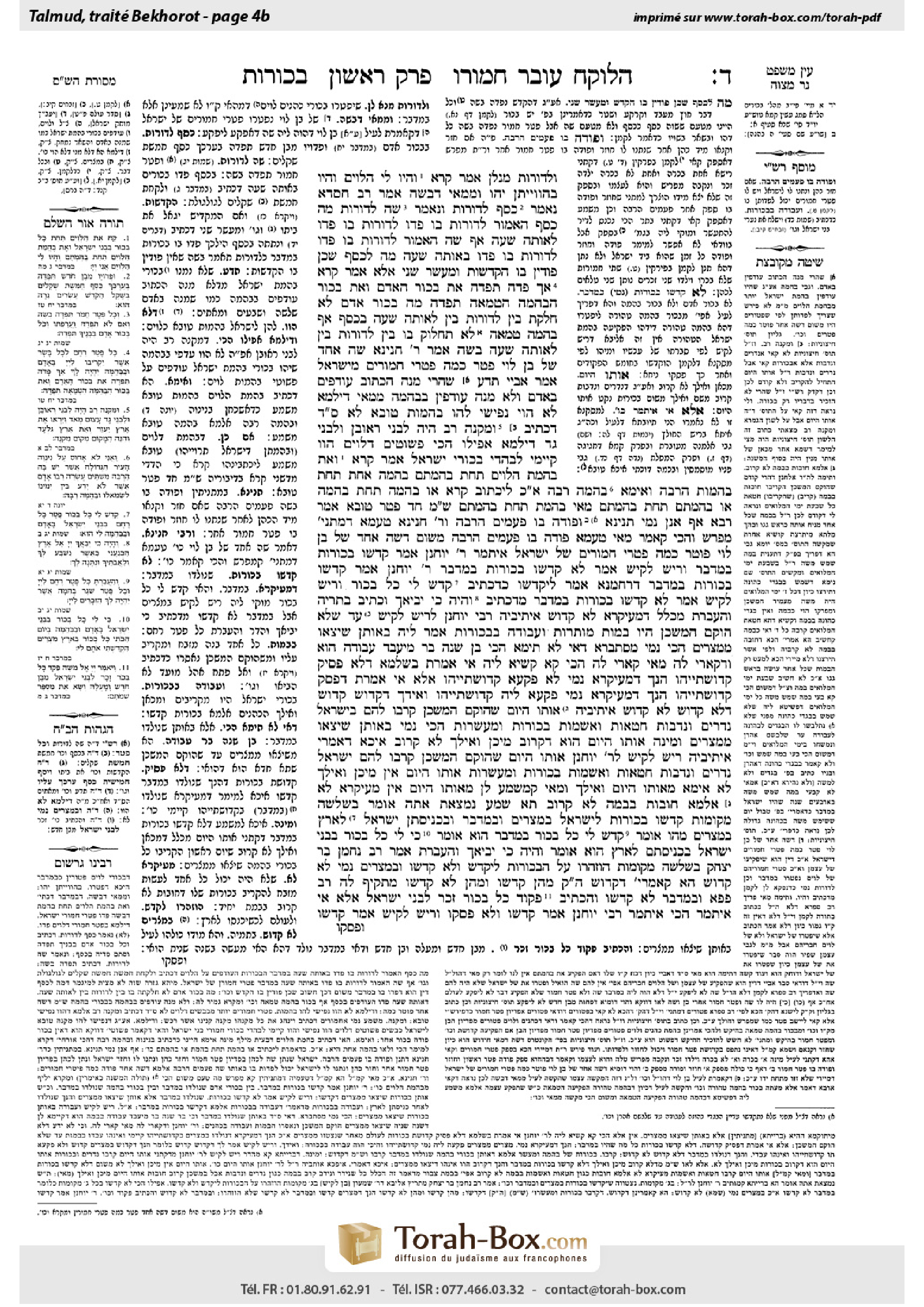
This page of Bekhorot includes the Aramaic text, an English translation and an AI-generated French translation, alongside the scan above.
בכורות ד׳ ב · Aramaic and Hebrew text
וּלְדוֹרוֹת מְנָלַן? אָמַר קְרָא: ״וְהָיוּ לִי הַלְוִיִּם״, ״וְהָיוּ״ — בַּהֲוָויָיתָן יְהוּ.
וּמִמַּאי דִּבְשֶׂה? אָמַר רַב חִסְדָּא: נֶאֱמַר כֶּסֶף לְדוֹרוֹת, וְנֶאֱמַר שֶׂה לְדוֹרוֹת.
מָה כֶּסֶף הָאָמוּר לְדוֹרוֹת — בּוֹ פָּדוּ לְדוֹרוֹת, בּוֹ פָּדוּ לְאוֹתָהּ שָׁעָה, אַף שֶׂה הָאָמוּר לְדוֹרוֹת — בּוֹ פָּדוּ לְדוֹרוֹת, בּוֹ פָּדוּ בְּאוֹתָהּ שָׁעָה.
מָה לְכֶסֶף — שָׁכֵן פּוֹדִין בּוֹ הֶקְדֵּשׁוֹת וּמַעֲשֵׂר שֵׁנִי!
אֶלָּא, אָמַר קְרָא: ״אַךְ פָּדֹה תִפְדֶּה אֶת בְּכוֹר הָאָדָם וְאֵת בְּכוֹר הַבְּהֵמָה הַטְּמֵאָה תִּפְדֶּה״, מָה בְּכוֹר אָדָם לֹא חִלַּקְתָּ בֵּין לְדוֹרוֹת בֵּין לְאוֹתָהּ שָׁעָה — בְּכֶסֶף, אַף בְּהֵמָה טְמֵאָה לֹא תַּחְלוֹק בּוֹ בֵּין לְדוֹרוֹת בֵּין לְאוֹתָהּ שָׁעָה — בְּשֶׂה.
אָמַר רַבִּי חֲנִינָא: שֶׂה אֶחָד שֶׁל בֶּן לֵוִי פָּטַר כַּמָּה פִּטְרֵי חֲמוֹרִים מִיִּשְׂרָאֵל. אָמַר אַבָּיֵי: תֵּדַע, שֶׁהֲרֵי מָנָה הַכָּתוּב עוֹדְפִים בְּאָדָם, וְלֹא מָנָה עוֹדְפִין בִּבְהֵמָה.
מִמַּאי? דִּילְמָא לָא הָוֵי נְפִישִׁי לְהוּ בְּהֵמוֹת טוּבָא? לָא סָלְקָא דַּעְתָּךְ! דִּכְתִיב: ״וּמִקְנֶה רַב הָיָה לִבְנֵי רְאוּבֵן וְלִבְנֵי גָד״.
דִּילְמָא אֲפִילּוּ הָכִי, פְּשׁוּטִים דִּלְוִיִּם הֲווֹ קָיְימִי לְבַהֲדֵי בְּכוֹרֵי יִשְׂרָאֵל! אָמַר קְרָא: ״וְאֶת בֶּהֱמַת הַלְוִיִּם תַּחַת בְּהֶמְתָּם״, בְּהֵמָה אַחַת תַּחַת בְּהֵמוֹת הַרְבֵּה.
וְאֵימָא בְּהֵמָה רַבָּה? אִם כֵּן, לִיכְתּוֹב קְרָא אוֹ ״בְּהֵמָה תַּחַת בְּהֵמָה״ אוֹ ״בְּהֶמְתָּם תַּחַת בְּהֶמְתָּם״! מַאי ״בֶּהֱמַת... תֵּחַת בְּהֶמְתָּם״? שְׁמַע מִינַּהּ חַד פָּטַר טוּבָא.
אָמַר רָבָא, אַף אֲנַן נָמֵי תְּנֵינָא: וּפוֹדֶה בּוֹ פְּעָמִים הַרְבֵּה. וְרַבִּי חֲנִינָא טַעְמָא דְמַתְנִיתִין מְפָרֵשׁ, וְהָכִי קָאָמַר: מַאי טַעְמָא פּוֹדֶה בּוֹ פְּעָמִים הַרְבֵּה? מִשּׁוּם דְּשֶׂה אֶחָד שֶׁל בֶּן לֵוִי פּוֹטֵר כַּמָּה פִּטְרֵי חֲמוֹרִים שֶׁל יִשְׂרָאֵל.
אִיתְּמַר, רַבִּי יוֹחָנָן אָמַר: קָדְשׁוּ בְּכוֹרוֹת בַּמִּדְבָּר, וְרֵישׁ לָקִישׁ אָמַר: לֹא קָדְשׁוּ בְּכוֹרוֹת בַּמִּדְבָּר.
רַבִּי יוֹחָנָן אָמַר: קָדְשׁוּ בְּכוֹרוֹת בַּמִּדְבָּר, דְּרַחֲמָנָא אָמַר לִיקְדְּשׁוּ, דִּכְתִיב: ״קַדֶּשׁ לִי כׇל בְּכוֹר״.
וְרֵישׁ לָקִישׁ אָמַר: לֹא קָדְשׁוּ בְּכוֹרוֹת בַּמִּדְבָּר, מִדִּכְתִיב: ״וְהָיָה כִּי יְבִיאֲךָ״, וּכְתִיב בָּתְרֵיהּ: ״וְהַעֲבַרְתָּ״, מִכְּלָל דְּמֵעִיקָּרָא לָא קְדוּשׁ.
אֵיתִיבֵיהּ רַבִּי יוֹחָנָן לְרֵישׁ לָקִישׁ: עַד שֶׁלֹּא הוּקַם הַמִּשְׁכָּן הָיוּ בָּמוֹת מוּתָּרוֹת וַעֲבוֹדָה בִּבְכוֹרוֹת! אֲמַר לֵיהּ: בְּאוֹתָן שֶׁיָּצְאוּ מִמִּצְרָיִם.
הָכִי נָמֵי מִסְתַּבְּרָא, דְּאִי לָא תֵּימָא הָכִי, בֶּן שָׁנָה בַּר מֶיעְבַּד עֲבוֹדָה הוּא?
וּדְקָאָרֵי לַהּ, מַאי קָאָרֵי לַהּ?
הָכִי קָא קַשְׁיָא לֵיהּ: אִי אָמְרַתְּ בִּשְׁלָמָא דְּלָא פָּסֵיק קְדוּשְׁתַּיְיהוּ — הָנָךְ דְּמֵעִיקָּרָא נָמֵי לָא פָּקְעָא קְדוּשְׁתַּיְיהוּ, אֶלָּא אִי אָמְרַתְּ דְּפָסֵק קְדוּשְׁתַּיְיהוּ — הָנָךְ דְּמֵעִיקָּרָא נָמֵי פָּקְעָא לֵיהּ קְדוּשְׁתַּיְיהוּ.
וְאִידַּךְ: דִּקְדוּשׁ — קְדוּשׁ, דְּלָא קְדוּשׁ — לָא קְדוּשׁ.
אֵיתִיבֵיהּ: אוֹתוֹ הַיּוֹם שֶׁהוּקַם הַמִּשְׁכָּן, קָרְבוּ בּוֹ לָהֶם בְּיִשְׂרָאֵל נְדָרִים וּנְדָבוֹת, חַטָּאוֹת וַאֲשָׁמוֹת, בְּכוֹרוֹת וּמַעַשְׂרוֹת. הָכִי נָמֵי — בְּאוֹתָן שֶׁיָּצְאוּ מִמִּצְרָיִם. וּמִינַּהּ: אוֹתוֹ הַיּוֹם הוּא דִּקְרוּב, מִיכָּן וְאֵילָךְ לָא קְרוּב!
אִיכָּא דְּאָמְרִי: אֵיתִיבֵיהּ רֵישׁ לָקִישׁ לְרַבִּי יוֹחָנָן: אוֹתוֹ הַיּוֹם שֶׁהוּקַם הַמִּשְׁכָּן קָרְבוּ לָהֶם יִשְׂרָאֵל נְדָרִים וּנְדָבוֹת חַטָּאוֹת וַאֲשָׁמוֹת בְּכוֹרוֹת וּמַעַשְׂרוֹת. אוֹתוֹ הַיּוֹם — אִין, מִיכָּן וְאֵילָךְ — לָא! אֵימָא: מֵאוֹתוֹ הַיּוֹם וְאֵילָךְ.
וּמַאי קָמַשְׁמַע לַן? מֵאוֹתוֹ הַיּוֹם — אִין, מֵעִיקָּרָא — לָא. אַלְמָא חוֹבוֹת בְּבָמָה לָא קְרוּב.
תָּא שְׁמַע, נִמְצֵאתָ אַתָּה אוֹמֵר: בִּשְׁלֹשָׁה מְקוֹמוֹת קָדְשׁוּ בְּכוֹרוֹת לְיִשְׂרָאֵל — בְּמִצְרַיִם, וּבַמִּדְבָּר, וּבִכְנִיסָתָן יִשְׂרָאֵל לְאֶרֶץ. בְּמִצְרַיִם מַהוּ אוֹמֵר? ״קַדֶּשׁ לִי כׇל בְּכוֹר״. בַּמִּדְבָּר הוּא אוֹמֵר: ״כִּי לִי כׇל בְּכוֹר בִּבְנֵי יִשְׂרָאֵל״. בִּכְנִיסָתָם לָאָרֶץ הוּא אוֹמֵר: ״וְהָיָה כִּי יְבִיאֲךָ... וְהַעֲבַרְתָּ״.
אָמַר רַב נַחְמָן בַּר יִצְחָק: בִּשְׁלֹשָׁה מְקוֹמוֹת הוּזְהֲרוּ עַל הַבְּכוֹרוֹת לִיקְדַּשׁ, וְלֹא קָדְשׁוּ. וּבְמִצְרַיִם נָמֵי לָא קְדוּשׁ? הָא קָאָמְרִינַן דִּקְדוּשׁ! הָכִי אָמַר: מֵהֶן קָדְשׁוּ, וּמֵהֶן לֹא קָדְשׁוּ.
מַתְקֵיף לַהּ רַב פָּפָּא: וּבַמִּדְבָּר לֹא קָדְשׁוּ? וְהָכְתִיב: ״פְּקֹד כׇּל בְּכֹר זָכָר לִבְנֵי יִשְׂרָאֵל״! אֶלָּא, אִי אִיתְּמַר הָכִי אִיתְּמַר: רַבִּי יוֹחָנָן אָמַר: קָדְשׁוּ וְלֹא פָּסְקוּ, וְרֵישׁ לָקִישׁ אָמַר: קָדְשׁוּ
Bekhorot 4b · English translation
The Gemara asks: And from where do we derive that the priests and Levites are exempt from their offspring being counted a firstborn for all generations? The Gemara answers that the verse states: “And the Levites shall be Mine” (Numbers 3:12). The term “shall be” indicates that they shall be, i.e., shall remain, in their current state of sanctity. Just as firstborn status did not apply to the priests or the Levites in the wilderness, it does not apply to priests or Levites in subsequent generations.
§ Rav Safra (4a) referred to the fact that the sanctity of the firstborn donkeys of the Israelites was abrogated by the lambs of the Levites. The Gemara asks: From where is it derived that this abrogation was accomplished with a lamb? Rav Ḥisda says: The word “silver” is stated with regard to the redemption of a woman’s firstborn son for later generations in the verse: “And their redemption money…shall be, according to your valuation, five shekels of silver” (Numbers 18:16). And in addition, the word “lamb” is stated with regard to the redemption of a firstborn donkey for later generations in the verse: “And every firstborn donkey you shall redeem with a lamb” (Exodus 13:13).
Therefore, one can derive that just as concerning silver, which was mentioned with regard to later generations, the Israelites redeemed with it in later generations and they also redeemed with it at that time, as the surplus firstborn in the wilderness were redeemed with five shekels (see Numbers 3:47), so too concerning the lamb, which was mentioned with regard to later generations, they redeemed with it in later generations, and they redeemed with it at that time.
The Gemara rejects the comparison: What is notable about silver? It is notable in that it is also used for redemption in other cases, as one can redeem consecrated property and second-tithe produce with it, which is not the halakha with regard to lambs.
Rather, it can be derived from the fact that the verse states: “Yet you shall redeem the firstborn of man, and the firstborn of non-kosher animals you shall redeem” (Numbers 18:15). The juxtaposition of the two cases demonstrates that just as with regard to a woman’s firstborn son you have not distinguished between the halakha for later generations and the halakha for that time, as the redemption is performed with silver in both cases, so too, with regard to the redemption of a non-kosher animal, you should not distinguish between the halakha for later generations and for that time, as it must be performed with a lamb in both situations.
§ The Gemara resumes its discussion of the procedure for the redemption of the firstborn donkeys in the wilderness: Rabbi Ḥanina says that one lamb of a Levite in the wilderness rendered several firstborn donkeys of the Israelites exempt from the obligations of firstborn status. Abaye says: Know that this is so, as the verse enumerates the surplus of firstborn humans when it says that there were 273 more firstborn Israelites than Levites who needed to be redeemed with silver (see Numbers 3:46); but the verse does not enumerate any surplus of Israelite animals.
The Gemara asks: From where is this proven? Perhaps the Israelites did not have many animals, and their firstborn donkeys did not outnumber the lambs of the Levites. The Gemara answers: Do not let this possibility enter your mind, as it is written: “Now the children of Reuben and the children of Gad had a very great multitude of livestock” (Numbers 32:1).
The Gemara challenges: Perhaps even so, the number of ordinary animals of the Levites that were not firstborn corresponded to the number of firstborn animals belonging to the Israelites. The Gemara explains that the verse states: “Take the Levites in exchange for all the firstborn among the children of Israel, and the animal of [behemat] the Levites in exchange for their animals [behemtam]” (Numbers 3:45). The use of the word behemat in the singular indicates that the transaction involved one animal of the Levites in exchange for many animals of the Israelites.
The Gemara asks: And say the word behemat is referring to many animals, as in the phrase: “And many animals [uvhema rabba]” (Jonah 4:11). The Gemara answers: If so, let the verse write either: Behema of the Levites in exchange for behema, or: Behemtam in exchange for behemtam. What is the significance of the phrase “behemat the Levites in exchange for behemtam”? Learn from it that one lamb of a Levite rendered many donkeys of Israelites exempt.
Rava said: We learn in a mishna (9a), as well, a support for Rabbi Ḥanina’s statement: And if the priest returns the lamb to him, he may redeem firstborn donkeys with it many times if he repurchases the lamb from the priest each time upon redeeming a donkey. And actually, Rabbi Ḥanina is not offering his own opinion, but is rather explaining the reasoning of the mishna, and this is what he is saying: What is the reason that the owner may redeem firstborn donkeys with the same lamb many times? It is because one lamb of a Levite renders exempt several firstborn donkeys belonging to an Israelite.
§ It was stated with regard to the sanctity of the firstborn in the wilderness: Rabbi Yoḥanan says that both firstborn animals and firstborn sons born in the wilderness were sanctified, and Reish Lakish says: The firstborn that were born in the wilderness were not sanctified.
The Gemara explains the reason for each opinion: Rabbi Yoḥanan says that the firstborn that were born in the wilderness were sanctified, since the Merciful One states they should be sanctified, as it is written prior to the Jews leaving Egypt: “Sanctify to Me all the firstborn” (Exodus 13:2).
And Reish Lakish says: Although the firstborn in Egypt were sanctified, the firstborn that were born in the wilderness were not sanctified, as it is written: “And it shall be when the Lord shall bring you into the land of the Canaanites” (Exodus 13:11), and it is written afterward: “And you shall set apart all firstborn of the womb to the Lord” (Exodus 13:12). By inference, it can be derived that initially, before the Jewish people entered Eretz Yisrael, those that were born in the wilderness were not sanctified.
Rabbi Yoḥanan raised an objection to the opinion of Reish Lakish from a mishna (Zevaḥim 112b): Until the Tabernacle was established, private altars were permitted and the sacrificial service was performed by the firstborn. Clearly, then, the firstborn in the wilderness were sanctified. Reish Lakish said to him: That mishna is referring to those firstborn who left Egypt, who performed the sacrificial service, and not to the ones born in the wilderness.
The Gemara comments: This too stands to reason, as if you do not say so, is an infant in its first year capable of performing the sacrificial service? Since the Tabernacle was established only a year after the Jewish people left Egypt, clearly the firstborn who performed the sacrificial service at that time were born in Egypt.
The Gemara asks: And he who asked it, why did he ask it? Isn’t it obvious that the firstborn born in Egypt performed the sacrificial service in the first years of the Tabernacle?
The Gemara answers: This was his difficulty: Granted, if you say that the sanctity of the firstborn did not cease from the time that the mitzva of: “Sanctify to Me all the firstborn” (Exodus 13:2), was given in Egypt, and those born in the wilderness were also sanctified, then with regard to these firstborn who were originally in Egypt, their sanctity also did not lapse. Therefore, they could perform the sacrificial service in the first years of the Tabernacle. But if you say that the sanctity of the firstborn ceased and the firstborn born in the wilderness were not sanctified, then with regard to these firstborn that were originally born in Egypt, their sanctity also lapsed.
And the other amora, Reish Lakish, responded: No proof may be derived from here, as those who were sanctified in Egypt were sanctified and did not then lose their sanctity in the wilderness, while those who were not sanctified in Egypt were not sanctified in the wilderness.
Rabbi Yoḥanan raised an objection to the opinion of Reish Lakish from a baraita: On the same day that the Tabernacle was established, many types of offerings were sacrificed by the Jewish people, including vow offerings and gift offerings, sin offerings and guilt offerings, kosher firstborn animal offerings and animal tithe offerings. If firstborn animal offerings were sacrificed in the wilderness, then evidently the firstborn animals were sanctified in the wilderness. Reish Lakish answered him: This is referring also to those firstborn animals that left Egypt and were already sanctified there. The Gemara comments: And it may be understood from the baraita itself that the opinion of Reish Lakish is correct, as one can infer from it: That day is when the firstborn were sacrificed, but beyond that they were not sacrificed.
There are those who say the discussion proceeded as follows: Reish Lakish raised an objection to the opinion of Rabbi Yoḥanan: On the same day that the Tabernacle was established, many types of offerings were sacrificed by the Jewish people, including vow offerings and gift offerings, sin offerings and guilt offerings, kosher firstborn animal offerings and animal tithe offerings. It may be inferred that on that day, yes, the firstborn animals were sacrificed, but beyond that the firstborn animals were not sacrificed, indicating that the male firstborn animals in the wilderness were not sanctified. The Gemara responds: One can say that the baraita means that from that day onward, all of those offerings were sacrificed.
The Gemara asks: And what, then, is the baraita teaching us? The Gemara answers: It is teaching that from that day onward, yes, the Jewish people brought those offerings, but initially, prior to the establishment of the Tabernacle, they were not brought. Evidently, obligatory offerings such as these were not sacrificed on a private altar; only voluntary offerings were sacrificed on such altars.
The Gemara suggests: Come and hear a proof for the opinion of Rabbi Yoḥanan from a baraita: You are found to be saying that the firstborn of the Jewish people were sanctified in three locations: In Egypt, and in the wilderness, and upon the entry of the Jewish people into Eretz Yisrael. In Egypt, what does the verse state? “Sanctify to Me all the firstborn” (Exodus 13:2). In the wilderness, the verse states: “For all the firstborn among the children of Israel are Mine” (Numbers 8:17). With regard to their entry into Eretz Yisrael, the verse states: “And it shall be when the Lord shall bring you into the land of the Canaanites…and you shall set apart all firstborn of the womb to the Lord” (Exodus 13:11–12). This baraita indicates that the firstborn born in the wilderness were sanctified.
The Gemara rejects this proof. Rav Naḥman bar Yitzḥak said: The baraita means that the Jewish people were commanded in three locations with regard to the firstborn, that is, to sanctify them, but they did not sanctify them in practice. The Gemara asks: But according to this, were they not sanctified in Egypt either? Didn’t we say that they were sanctified even according to Reish Lakish? The Gemara answers: This is what the tanna is saying: They were commanded in three locations to sanctify the firstborn. In some of those cases, i.e., in Egypt and in Eretz Yisrael, they sanctified them, and in some of them, i.e., in the wilderness, they did not sanctify them.
Rav Pappa objects to this: And did they not sanctify them in the wilderness? But isn’t it written: “Count all the firstborn males of the children of Israel from a month old and upward” (Numbers 3:40), a commandment that was fulfilled (see Numbers 3:42)? The firstborn referred to certainly include those born in the wilderness, as this counting occurred in the second year after the exodus from Egypt. Rather, if a dispute between Rabbi Yoḥanan and Reish Lakish was stated with regard to this matter, it was stated like this: Rabbi Yoḥanan says the firstborn that were born in the wilderness were sanctified and their sanctity did not cease, and Reish Lakish says they were sanctified only until the time of the counting referred to above,
Bekhorot 4b · Traduction française (IA)
La Guemara pose la question : D'où dérive-t-on que les prêtres et les Lévites sont exemptés de ce que leurs descendants soient comptés comme premiers-nés pour toutes les générations ? La Guemara répond que la Parashah dit : « Et les Lévites seront à moi » (Nombres 3:12). Le terme « seront » indique qu'ils resteront, c'est-à-dire dans leur état actuel de sanctité. Tout comme le statut de premier-né ne s'appliquait pas aux prêtres ou aux Lévites dans le désert, il ne s'applique pas aux prêtres ou aux Lévites dans les générations futures.
§ Rav Safra (4a) faisait référence au fait que la sanctité des premiers-nés de bœufs israélites fut abrogée par les agneaux des Lévites. La Guemara pose la question : D'où dérive-t-on que cette abrogation a été accomplie avec un agneau ? Rav Ḥisda dit : Le mot « argent » est mentionné concernant la délivrance d'un fils premier-né d'une femme pour les générations futures dans la Parashah : « Et leur prix de délivrance… sera, selon votre estimation, cinq sicles d'argent » (Nombres 18:16). Et en outre, le mot « agneau » est mentionné concernant la délivrance d'un premier-né de bœuf pour les générations futures dans la Parashah : « Et tout premier-né de bœuf que tu auras, tu le délivreras avec un agneau » (Exode 13:13).
Par conséquent, on peut déduire que tout comme concernant l'argent, qui a été mentionné concernant les générations futures, les Israélites l'ont utilisé pour la délivrance dans les générations futures et ils l'ont également utilisé à l'époque, comme les premiers-nés en excédent dans le désert ont été délivrés avec cinq sicles (voir Nombres 3:47), de même concernant l'agneau, qui a été mentionné concernant les générations futures, ils l'ont utilisé pour la délivrance dans les générations futures, et ils l'ont utilisé à l'époque.
La Guemara rejette cette comparaison : Qu'est-ce qui est notable à propos de l'argent ? C'est qu'il est aussi utilisé pour la délivrance dans d'autres cas, comme l'on peut délivrer des biens consacrés et des dixièmes de deuxième catégorie avec lui, ce qui n'est pas le cas concernant les agneaux.
Plutôt, on peut déduire du fait que la Parashah dit : « Et tu délivreras le premier-né d'un homme, et le premier-né d'un animal non-kosher tu le délivreras » (Nombres 18:15). La juxtaposition des deux cas montre que tout comme concernant le fils premier-né d'une femme, on n'a pas distingué entre la halakha pour les générations futures et celle pour l'époque, car la délivrance est faite avec de l'argent dans les deux cas, de même, concernant la délivrance d'un animal non-kosher, on ne doit pas distinguer entre la halakha pour les générations futures et celle pour l'époque, car elle doit être faite avec un agneau dans les deux cas.
§ La Guemara reprend sa discussion sur la procédure de délivrance des premiers-nés de bœufs dans le désert : Rabbi Ḥanina dit qu'un agneau d'un Lévi dans le désert a rendu plusieurs premiers-nés de bœufs des Israélites exemptés de l'obligation de premier-né. Abaye dit : Sache que c'est ainsi, car la Parashah énumère l'excédent des premiers-nés humains lorsqu'elle dit qu'il y avait 273 premiers-nés israélites de plus que les Lévites qui devaient être délivrés avec de l'argent (voir Nombres 3:46) ; mais la Parashah ne mentionne pas d'excédent d'animaux israélites.
La Guemara pose la question : D'où cette démonstration ? Peut-être les Israélites n'avaient pas beaucoup d'animaux, et leurs premiers-nés de bœufs n'excédaient pas le nombre d'agneaux des Lévites. La Guemara répond : Ne laisse pas cette possibilité entrer dans ton esprit, car il est écrit : « Maintenant les enfants de Rouben et les enfants de Gad avaient une multitude très grande de bétail » (Nombres 32:1).
La Guemara conteste : Peut-être même ainsi, le nombre d'animaux ordinaires des Lévites qui n'étaient pas des premiers-nés correspondait au nombre d'animaux premiers-nés appartenant aux Israélites. La Guemara explique que la Parashah dit : « Prends les Lévites en échange de tous les premiers-nés parmi les enfants d'Israël, et l'animal du Lévi en échange de leurs animaux » (Nombres 3:45). L'emploi du mot behemat au singulier indique que la transaction impliquait un seul animal du Lévi en échange de plusieurs animaux des Israélites.
La Guemara pose la question : Et le mot behemat fait référence à de nombreux animaux, comme dans la phrase : « Et beaucoup d'animaux [uvhema rabba] » (Jonah 4:11). La Guemara répond : Si c'est ainsi, que la Parashah écrive soit : Behema des Lévites en échange de behema, ou : Behemtam en échange de behemtam. Quel est le sens de la phrase « behemat des Lévites en échange de behemtam » ? Apprends-en que l'agneau d'un Lévi a rendu exempt plusieurs bœufs des Israélites.
Rava dit : Nous apprenons également dans une mitsva (9a), comme support pour l'affirmation de Rabbi Ḥanina : Et si le prêtre rend l'agneau à son propriétaire, il peut délivrer les premiers-nés de bœufs avec lui plusieurs fois s'il rachète l'agneau du prêtre chaque fois qu'il délivre un bœuf. Et en réalité, Rabbi Ḥanina ne propose pas son propre avis, mais explique la raison de la mitsva, et c'est ce qu'il dit : Quelle est la raison pour laquelle le propriétaire peut délivrer les premiers-nés de bœufs avec le même agneau plusieurs fois ? C'est parce qu'un agneau d'un Lévi rend exempt plusieurs premiers-nés de bœufs appartenant à un Israélite.
§ Il a été dit concernant la sanctité des premiers-nés dans le désert : Rabbi Yoḥanan dit que les animaux premiers-nés et les fils premiers-nés nés dans le désert furent sanctifiés, et Reish Lakish dit : Les premiers-nés nés dans le désert ne furent pas sanctifiés.
La Guemara explique la raison de chaque opinion : Rabbi Yoḥanan dit que les premiers-nés nés dans le désert furent sanctifiés, car l'Éternel dit qu'ils doivent être sanctifiés, comme il est écrit avant que les Israélites ne sortent d'Égypte : « Sanctifie-moi tous les premiers-nés » (Exode 13:2).
Et Reish Lakish dit : Bien que les premiers-nés d'Égypte aient été sanctifiés, ceux qui étaient nés dans le désert n'étaient pas sanctifiés, comme il est écrit : « Et il arrivera quand l'Éternel aura conduit le peuple dans la terre des Cananéens » (Exode 13:11), et ensuite : « Et tu sanctifieras tous les premiers-nés du sein à l'Éternel » (Exode 13:12). Par conséquent, on peut déduire que, d'abord, avant que le peuple juif n'entre en Terre d'Israël, ceux qui étaient nés dans le désert n'étaient pas sanctifiés.
Rabbi Yoḥanan a soulevé une objection contre l'opinion de Reish Lakish, à partir d'une mitsva (Zevaḥim 112b) : Jusqu'à ce que le Tabernacle fût établi, les autels privés étaient permis et le service sacrificiel était accompli par les premiers-nés. Il est donc clair que les premiers-nés du désert étaient sanctifiés. Reish Lakish a répondu à lui : Cette mitsva fait référence à ceux des premiers-nés qui sont sortis d'Égypte, qui ont accompli le service sacrificiel, et non à ceux nés dans le désert.
Le Guemara commente : Cela aussi est logique, car si l'on ne le disait pas, un enfant de moins d'un an pouvait-il accomplir le service sacrificiel ? Puisque le Tabernacle a été établi seulement un an après que le peuple juif était sorti d'Égypte, il est clair que les premiers-nés qui ont accompli le service sacrificiel à cette époque étaient nés en Égypte.
Le Guemara demande : Et celui qui a posé cette question, pourquoi l'a-t-il posée ? N'est-ce pas évident que les premiers-nés nés en Égypte ont accompli le service sacrificiel aux premiers temps du Tabernacle ?
Le Guemara répond : C'était sa difficulté : Admettons que vous disiez que la sanctité des premiers-nés n'avait pas cessé depuis que la mitsva : « Sanctifie-moi tous les premiers-nés » (Exode 13:2) avait été donnée en Égypte, et que ceux nés dans le désert étaient également sanctifiés, alors, concernant ces premiers-nés qui étaient originellement en Égypte, leur sanctité n'avait pas non plus cessé. Ainsi, ils pouvaient accomplir le service sacrificiel aux premiers temps du Tabernacle. Mais si vous disiez que la sanctité des premiers-nés avait cessé et que ceux nés dans le désert n'étaient pas sanctifiés, alors, concernant ces premiers-nés qui étaient originellement nés en Égypte, leur sanctité avait également cessé.
Et l'autre amora, Reish Lakish, répondit : On ne peut pas en tirer une preuve, car ceux qui avaient été sanctifiés en Égypte étaient sanctifiés et n'avaient pas perdu leur sanctité dans le désert, tandis que ceux qui n'étaient pas sanctifiés en Égypte ne l'étaient pas non plus dans le désert.
Rabbi Yoḥanan a soulevé une objection contre l'opinion de Reish Lakish à partir d'une baraïta : Le même jour que le Tabernacle a été établi, le peuple juif a sacrifié divers types d'offrandes, notamment des offrandes de vœu et d'offrandes de don, des offrandes de péché et d'offrandes de culpabilité, des offrandes de premiers-nés animaux et d'offrandes de dîme animale. Si les offrandes de premiers-nés animaux ont été sacrifiées dans le désert, alors évidemment les animaux premiers-nés étaient sanctifiés dans le désert. Reish Lakish a répondu à lui : Cela fait référence aussi à ces animaux premiers-nés qui sont sortis d'Égypte et qui étaient déjà sanctifiés là-bas. La Guemara commente : Et on peut en déduire de la baraïta elle-même que l'opinion de Reish Lakish est correcte, car on peut en déduire : Ce jour-là, les premiers-nés ont été sacrifiés, mais au-delà de cela, ils n'ont pas été sacrifiés.
Certains disent que la discussion s'est déroulée ainsi : Reish Lakish a soulevé une objection contre l'opinion de Rabbi Yoḥanan : Le même jour que le Tabernacle a été établi, le peuple juif a sacrifié divers types d'offrandes, notamment des offrandes de vœu et d'offrandes de don, des offrandes de péché et d'offrandes de culpabilité, des offrandes de premiers-nés animaux et d'offrandes de dîme animale. On peut en déduire que ce jour-là, oui, les animaux premiers-nés ont été sacrifiés, mais au-delà de cela, les animaux premiers-nés n'ont pas été sacrifiés, indiquant que les animaux premiers-nés du désert n'étaient pas sanctifiés. La Guemara répond : On peut dire que la baraïta signifie que à partir de ce jour, toutes ces offrandes ont été sacrifiées.
La Guemara demande : Et alors, que nous enseigne la baraïta ? La Guemara répond : Elle enseigne que à partir de ce jour, oui, le peuple juif a apporté ces offrandes, mais avant l'établissement du Tabernacle, elles n'étaient pas apportées. Il est évident que les offrandes obligatoires telles que celles-ci n'étaient pas sacrifiées sur un autel privé ; seules les offrandes volontaires étaient sacrifiées sur de tels autels.
Le Guemara suggère : Viens entendre une preuve pour l'opinion de Rabbi Yoḥanan à partir d'une baraïta : Tu dis que les premiers-nés du peuple juif ont été sanctifiés dans trois lieux : en Égypte, dans le désert, et à l'entrée du peuple juif en Terre d'Israël. En Égypte, quelle est la parole de la Torah ? « Sanctifie-moi tous les premiers-nés » (Exode 13:2). Dans le désert, la parole de la Torah dit : « Car tous les premiers-nés des enfants d'Israël sont à moi » (Nombres 8:17). Concernant leur entrée en Terre d'Israël, la parole de la Torah dit : « Et il arrivera quand l'Éternel aura conduit le peuple dans la terre des Cananéens… et tu sanctifieras tous les premiers-nés du sein à l'Éternel » (Exode 13:11–12). Cette baraïta indique que les premiers-nés nés dans le désert étaient sanctifiés.
Le Guemara rejette cette preuve. Rav Naḥman bar Yitzḥak dit : La baraïta signifie que le peuple juif a été commandé à trois endroits concernant les premiers-nés, c'est-à-dire de les sanctifier, mais ils n'ont pas sanctifié les premiers-nés en pratique. Le Guemara demande : Mais selon cela, n'étaient-ils pas sanctifiés en Égypte aussi ? N'avons-nous pas dit que oui, selon Reish Lakish ? Le Guemara répond : C'est ce que dit le tanna : Ils ont été commandés à trois endroits de sanctifier les premiers-nés. Dans certains de ces cas, c'est-à-dire en Égypte et en Terre d'Israël, ils les ont sanctifiés, et dans certains d'entre eux, c'est-à-dire dans le désert, ils n'ont pas sanctifié les premiers-nés.
Rav Pappa s'oppose à cela : N'ont-ils pas sanctifié ceux-ci dans le désert ? Mais n'est-il pas écrit : « Compte tous les premiers-nés masculins des enfants d'Israël, depuis un mois et plus » (Nombres 3:40), une commandement qui a été accompli (voir Nombres 3:42) ? Les premiers-nés mentionnés y compris certainement ceux nés dans le désert, puisque ce recensement s'est produit à la deuxième année après l'exode d'Égypte. Plutôt, si un débat entre Rabbi Yoḥanan et Reish Lakish a été évoqué à propos de cette question, il a été énoncé ainsi : Rabbi Yoḥanan dit que les premiers-nés nés dans le désert étaient sanctifiés et leur sanctité n'a pas cessé, et Reish Lakish dit qu'ils étaient sanctifiés uniquement jusqu'au moment du recensement mentionné ci-dessus,
Traduction française générée par IA à partir de l’édition anglaise de Sefaria. Vérifie toujours un passage avec le texte source.
Text from Sefaria: William Davidson Edition - Vocalized Aramaic (CC BY NC); William Davidson Edition - English (CC BY NC).