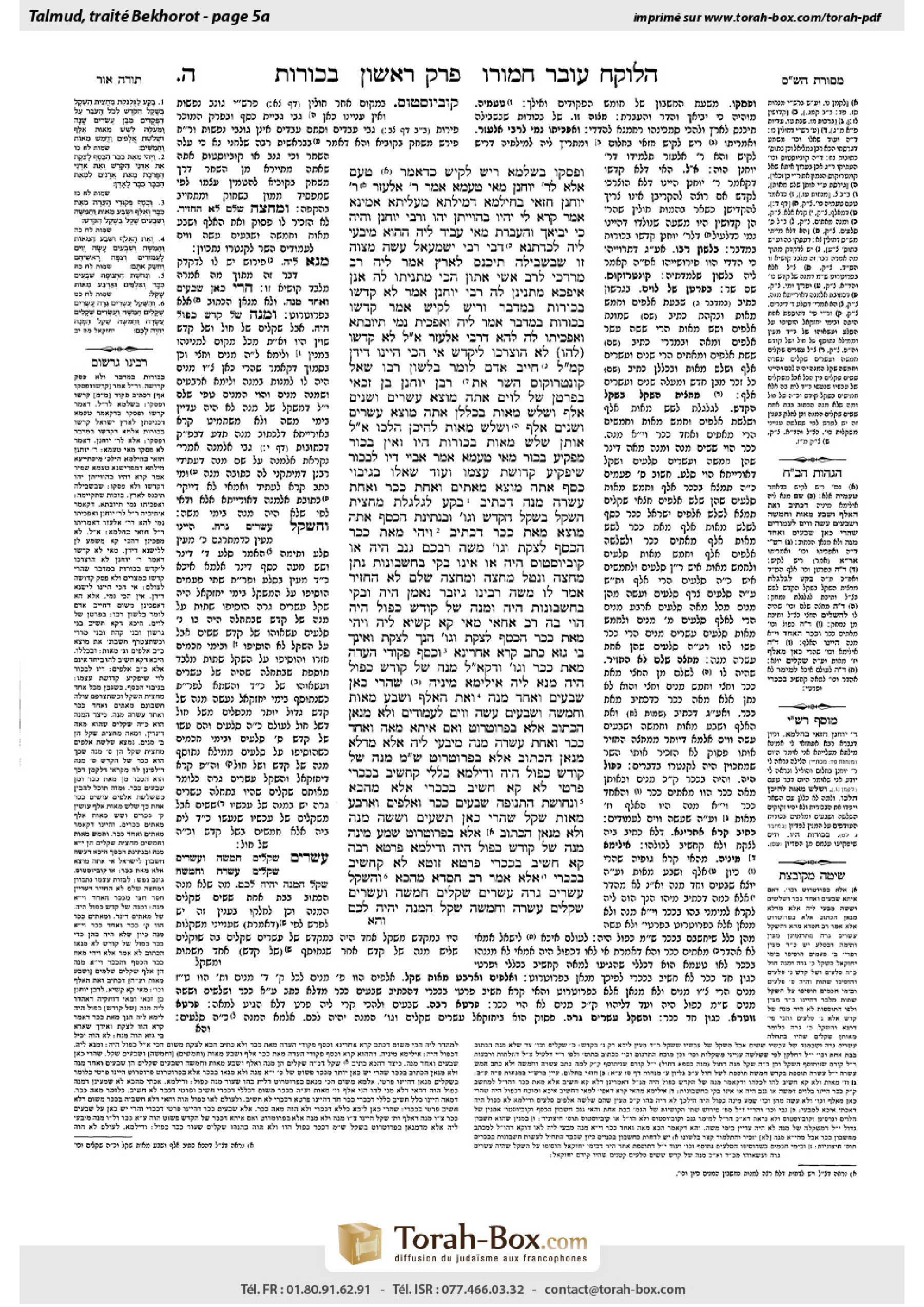
Bekhorot 5a: Talmud study for Daf Yomi
Study the Talmud for Daf Yomi with scanned pages, Hebrew text, English translations from Sefaria and AI-generated French translations.
Passage selection and English or AI-generated French translation are available where the scan has annotations. Daf Study is independent of Torah-Box and Sefaria.
Browse Bekhorot · בכורות · All tractatesBekhorot 5a text and translations
This page of Bekhorot includes the Aramaic text, an English translation and an AI-generated French translation, alongside the scan above.
בכורות ה׳ א · Aramaic and Hebrew text
וּפָסְקוּ.
בִּשְׁלָמָא רֵישׁ לָקִישׁ, כִּדְאָמַר טַעַם, אֶלָּא לְרַבִּי יוֹחָנָן — מַאי טַעְמָא?
אָמַר רַבִּי אֶלְעָזָר: רַבִּי יוֹחָנָן חֲזַאי בְּחֶילְמָא דְּמִילְּתָא מְעַלַּיְתָא אָמֵינָא, אָמַר קְרָא ״לִי יִהְיוּ״ — בַּהֲוָיָיתָן יְהוּ.
וְרַבִּי יוֹחָנָן, ״וְהָיָה כִּי יְבִיאֲךָ... וְהַעֲבַרְתָּ״ מַאי עָבֵיד לֵיהּ? הַהוּא מִיבְּעֵי לֵיהּ לְכִדְתָנָא דְּבֵי רַבִּי יִשְׁמָעֵאל: עֲשֵׂה מִצְוָה זוֹ שֶׁבִּשְׁבִילָהּ תִּיכָּנֵס לָאָרֶץ.
אֲמַר לֵיהּ רַב מָרְדֳּכַי לְרַב אָשֵׁי: אַתּוּן הָכִי מַתְנִיתוּ לַהּ, אֲנַן אִיפְּכָא מַתְנִינַן לַהּ, רַבִּי יוֹחָנָן אָמַר: לֹא קָדְשׁוּ בְּכוֹרוֹת בַּמִּדְבָּר, וְרֵישׁ לָקִישׁ אָמַר: קָדְשׁוּ בְּכוֹרוֹת בַּמִּדְבָּר.
אֲמַר לֵיהּ: וְאָפְכִית נָמֵי תְּיוּבָתָא, וְאָפְכִיתוּ לַהּ לְהָא דְּרַבִּי אֶלְעָזָר? אֲמַר לֵיהּ: לֹא קָדְשׁוּ לְהוּ — לֹא הוּצְרְכוּ לִיקְדַּשׁ.
אִי הָכִי, הַיְינוּ דִּידַן! קָא מַשְׁמַע לַן: חַיָּיב אָדָם לוֹמַר בִּלְשׁוֹן רַבּוֹ.
שָׁאַל קוּנְטְרוּקוּס הַשַּׂר אֶת רַבָּן יוֹחָנָן בֶּן זַכַּאי: בִּפְרָטָן שֶׁל לְוִיִּם אַתָּה מוֹצֵא עֶשְׂרִים וּשְׁנַיִם אֶלֶף וּשְׁלֹשׁ מֵאוֹת, בִּכְלָלָן אַתָּה מוֹצֵא עֶשְׂרִים וּשְׁנַיִם אֶלֶף, וּשְׁלֹשׁ מֵאוֹת לְהֵיכָן הָלְכוּ?
אָמַר לוֹ: אוֹתָן שְׁלֹשׁ מֵאוֹת בְּכוֹרוֹת הָיוּ, וְאֵין בְּכוֹר מַפְקִיעַ בְּכוֹר. מַאי טַעְמָא? אָמַר אַבָּיֵי: דַּיּוֹ לַבְּכוֹר שֶׁיַּפְקִיעַ קְדוּשַּׁת עַצְמוֹ.
וְעוֹד שְׁאָלוֹ: בְּגִיבּוּי כֶּסֶף אַתָּה מוֹצֵא מָאתַיִם וְאַחַת כִּכָּר וְאַחַת עֶשְׂרֵה מָנֶה, דִּכְתִיב: ״בֶּקַע לַגֻּלְגֹּלֶת מַחֲצִית הַשֶּׁקֶל בְּשֶׁקֶל הַקֹּדֶשׁ וְגוֹ׳״,
וּבִנְתִינַת הַכֶּסֶף אַתָּה מוֹצֵא מְאַת כִּכָּר, דִּכְתִיב: ״וַיְהִי מְאַת כִּכַּר הַכֶּסֶף לָצֶקֶת וְגוֹ׳״. מֹשֶׁה רַבְּכֶם גַּנָּב הָיָה, אוֹ קוּבְיוּסְטוּס הָיָה, אוֹ אֵינוֹ בָּקִי בְּחֶשְׁבּוֹנוֹת? נָתַן מֶחֱצָה וְנָטַל מֶחֱצָה, וּמֶחֱצָה שָׁלֵם לֹא הֶחֱזִיר.
אָמַר לוֹ: מֹשֶׁה רַבֵּינוּ גִּיזְבָּר נֶאֱמָן הָיָה, וּבָקִי בְּחֶשְׁבּוֹנוֹת הָיָה, וּמָנֶה שֶׁל קוֹדֶשׁ כָּפוּל הָיָה.
הָוֵי בַּהּ רַב אַחַאי: מַאי קָא קַשְׁיָא לֵיהּ, ״וַיְהִי מְאַת כִּכַּר הַכֶּסֶף לָצֶקֶת וְגוֹ׳״? הָנָךְ לָצֶקֶת, וְאִינָךְ בֵּי גַזָּא! כְּתַב קְרָא אַחֲרִינָא: ״וְכֶסֶף פְּקוּדֵי הָעֵדָה מְאַת כִּכָּר וְגוֹ׳״.
וּדְקָאָמַר לֵיהּ: מָנֶה שֶׁל קוֹדֶשׁ כָּפוּל הָיָה, מְנָא לֵיהּ?
אִילֵימָא מִינֵּיהּ, שֶׁהֲרֵי כָּאן שִׁבְעִים וְאֶחָד מָנֶה — ״וְאֶת הָאָלֶף וּשְׁבַע מֵאוֹת וַחֲמִשָּׁה וְשִׁבְעִים עָשָׂה וָוִים לָעַמּוּדִים״, וְלֹא מְנָאָן הַכָּתוּב אֶלָּא בִּפְרוֹטְרוֹט, וְאִם אִיתָא — מֵאָה וְאֶחָד כִּכָּר וְאַחַת עֶשְׂרֵה מָנֶה מִיבְּעֵי לֵיהּ!
אֶלָּא, מִדְּלֹא מְנָאָן הַכָּתוּב אֶלָּא בִּפְרוֹטְרוֹט, שְׁמַע מִינַּהּ: מָנֶה שֶׁל קוֹדֶשׁ כָּפוּל הָיָה.
וְדִילְמָא כְּלָלֵי קָחָשֵׁיב בְּכַכְּרֵי, פְּרָטִי לָא קָא חָשֵׁיב בְּכַכְּרֵי!
אֶלָּא מֵהָכָא: ״וּנְחֹשֶׁת הַתְּנוּפָה שִׁבְעִים כִּכָּר וְאַלְפַּיִם וְאַרְבַּע מֵאוֹת שָׁקֶל״, שֶׁהֲרֵי כָּאן תִּשְׁעִים וְשִׁשָּׁה מָנֶה, וְלֹא מְנָאָן הַכָּתוּב אֶלָּא בִּפְרוֹטְרוֹט, שְׁמַע מִינַּהּ: מָנֶה שֶׁל קוֹדֶשׁ כָּפוּל הָיָה.
וְדִילְמָא פְּרָטָא רַבָּה קָא חָשֵׁיב בְּכַכְּרֵי, פְּרָטָא זוּטָא לָא קָחָשֵׁיב בְּכַכְּרֵי!
אֶלָּא אָמַר רַב חִסְדָּא: מֵהָכָא, ״וְהַשֶּׁקֶל עֶשְׂרִים גֵּרָה עֶשְׂרִים שְׁקָלִים חֲמִשָּׁה וְעֶשְׂרִים שְׁקָלִים עֲשָׂרָה וַחֲמִשָּׁה שֶׁקֶל הַמָּנֶה יִהְיֶה לָכֶם״.
Bekhorot 5a · English translation
and then their sanctity ceased following the census.
The Gemara asks: Granted, according to Reish Lakish, who holds the firstborn were not sanctified following the census until they entered Eretz Yisrael, the reason is as he said, that it is written: “And it shall be when the Lord shall bring you into the land of the Canaanites…and you shall set apart all firstborn of the womb to the Lord” (Exodus 13:11–12). But according to Rabbi Yoḥanan, who holds that the firstborn continued to be sanctified following the census, what is the reason, i.e., the source, for his opinion?
Rabbi Elazar said: I saw Rabbi Yoḥanan in a dream, which is a sign that I am saying a proper matter in explaining his opinion. The verse states: “For all the firstborn are Mine: On the day that I smote all the firstborn in the land of Egypt I sanctified to Me all the firstborn in Israel, both man and animal, Mine they shall be: I am the Lord” (Numbers 3:13). The additional phrase “Mine they shall be” indicates that they shall be, i.e., shall remain, in their current state of sanctity.
The Gemara asks: And as for Rabbi Yoḥanan, with regard to the verse “And it shall be when the Lord shall bring you…and you shall set apart,” what does he do with it? The Gemara answers: That expression is necessary to teach that which the tanna of the school of Rabbi Yishmael taught: Perform this mitzva on account of which you will be privilged to enter into Eretz Yisrael.
Rav Mordekhai said to Rav Ashi: You teach the dispute between Rabbi Yoḥanan and Reish Lakish in this manner, whereas we teach it in the opposite manner: Rabbi Yoḥanan says the firstborn were not sanctified in the wilderness, and Reish Lakish says the firstborn were sanctified in the wilderness.
Rav Ashi said to him: And do you also reverse the objections raised by one against the other, and do you also reverse that which Rabbi Elazar said, that he saw Rabbi Yoḥanan in a dream and interpreted his opinion to be referring to Reish Lakish instead? Rav Mordekhai said to him: According to my tradition, when Rabbi Yoḥanan stated that the firstborn in the wilderness were not sanctified he meant that they did not need to be consecrated, i.e., one who wished to sacrifice a firstborn lamb did not need to consecrate it, as they were already sanctified as firstborns. And Reish Lakish disagreed.
The Gemara asks: If so, that is the same as our tradition, that in Rabbi Yoḥanan’s opinion the firstborn that were born in the wilderness were sanctified, and in Reish Lakish’s opinion they were not. For what purpose, then, did Rav Mordekhai inform Rav Ashi of his alternative version of the dispute? The Gemara answers that it teaches us that a person must say what he was taught in the precise language employed by his teacher.
§ With regard to the abrogation of the sanctity of the firstborn in the wilderness by the Levites, the Gemara relates that Kontrokos the officer asked Rabban Yoḥanan ben Zakkai: In the individual count of each family of Levites you find that there were 22,300 (see Numbers 3:22–34). But in the collective count of the entire tribe you find a total of 22,000, as it is stated: “All the males from a month old and upward, were 22,000” (Numbers 3:39). Where, then, did the other three hundred Levites go?
Rabban Yoḥanan ben Zakkai said to him: The total sum includes only those Levites who redeemed the Israelite firstborn. Those additional three hundred Levites were themselves firstborns, and a firstborn Levite cannot abrogate the sanctity of a firstborn Israelite. The Gemara asks: What is the reason? Abaye says: It is sufficient for a Levite firstborn to abrogate his own firstborn sanctity.
Additionally, Kontrokos asked Rabban Yoḥanan ben Zakkai: With regard to the collection of silver by Moses for the Tabernacle, you find that the total amount is 201 talents and eleven maneh, as it is written that they amassed: “A beka a head, that is, half a shekel, of the shekel of the Sanctuary…for 603,550 men” (Exodus 38:26), which totals 301,775 shekels. This sum equals 201 talents and eleven maneh, as each talent contains 1,500 shekels, or sixty maneh, and each maneh contains twenty-five shekels.
But with regard to the giving of the silver to the Tabernacle you find only one hundred talents, as it is written: “And the hundred talents of silver were for casting” (Exodus 38:27). Now, was Moses your teacher a thief, or was he a gambler [kuveyustus], or was he not expert in accounting? He gave half of the money for the Tabernacle and took half for himself, and he did not return even a complete half to the Tabernacle.
Rabban Yoḥanan ben Zakkai said to him: Moses, our teacher, was a trustworthy treasurer and was expert in accounting, but a maneh of the Sanctuary, which was used to measure the one hundred talents used for the sockets, was double the value of a standard maneh, i.e., fifty shekels instead of twenty-five shekels. Therefore, the one hundred talents given by Moses were equivalent to the two hundred talents that he collected from the Jewish people.
Rav Aḥai discusses it: What posed a difficulty for Rabban Yoḥanan ben Zakkai that forced him to offer this answer? Was it the verse: “And the hundred talents of silver were for casting the sockets of the Sanctuary” (Exodus 38:27)? If so, one can explain that these one hundred talents were designated for casting the sockets, and the other one hundred talents that are not mentioned here were placed in the treasury. The Gemara answers that another verse is written that discusses the total sum collected, and only one hundred talents are mentioned: “And the silver of those that were numbered of the congregation was a hundred talents” (Exodus 38:25).
The Gemara asks: And with regard to that which Rabban Yoḥanan ben Zakkai said to Kontrokos, that a maneh of the Sanctuary was double the value of a standard maneh, from where does he derive this?
If we say that it is derived from the verse itself that Kontrokos mentioned (Exodus 38:27), then the derivation would be as follows: In addition to the one hundred talents, additional silver coins are mentioned here that equal seventy-one maneh, as it is stated: “And of the 1,775 shekels he made hooks for the pillars” (Exodus 38:28), which is equal to one talent, or sixty maneh, plus an additional eleven maneh, and the verse counted them only using the value of small coins, i.e., shekels, and not in talents. And if it is so that a maneh of the Sanctuary was of equal value to a common maneh, then the verse should have expressed this value using larger coins, writing: 101 talents and eleven maneh.
Rather, since the verse counts this value only using the value of small coins, learn from it that a maneh of the Sanctuary was double the value of a standard maneh and equaled fifty shekels. Therefore, the 1,775 shekels mentioned are worth only 35½ maneh, which is less than a full talent, or sixty maneh.
The Gemara rejects this proof: But perhaps the total amount of shekels does equal the amount of a talent, but the verse calculates the general amounts, i.e., the hundreds of talents, in talents, and the verse does not calculate the details, i.e., any amount less than one hundred talents, in talents, but in shekels.
Rather, the principle that a maneh of the Sanctuary is double the value of a common maneh is derived from here: “And the brass of the offering was seventy talents and 2,400 shekels” (Exodus 38:29). The Gemara explains: Aside from the seventy talents mentioned, there are an additional ninety-six maneh here, which is equivalent to one talent and an additional thirty-six maneh, and the verse counts them only using the value of small coins. Learn from it that a maneh of the Sanctuary was double the amount of a standard maneh, and that is why the number of shekels mentioned did not equal a full talent.
The Gemara rejects this proof as well: But perhaps the verse is referring to a standard maneh, and the verse calculates a large unit, i.e., tens of talents, in talents, while the verse does not calculate a small unit, i.e., any amount less than ten talents, in talents.
Rather, Rav Ḥisda says the claim that a maneh of the Sanctuary was double the size of a standard maneh is derived from here: “And the shekel shall be twenty gera; twenty shekels, twenty-five shekels, ten, and five shekels, shall be your maneh” (Ezekiel 45:12). In this verse, Ezekiel defines the various weights used in the Temple and states that each silver shekel consists of twenty gera. In addition, the combination of twenty, twenty-five, ten, and five shekels yields a total sum of sixty shekels, which is the value of a maneh. A maneh, in turn, is equivalent to one hundred dinars.
Bekhorot 5a · Traduction française (IA)
et leur sanctité cessa après le recensement.
La Guemara demande : Cela est évident selon Reish Lakish, qui considère que les premiers-nés n'étaient pas sanctifiés après le recensement jusqu'à leur entrée en Eretz Yisrael, la raison est celle qu'il a donnée, à savoir que cela est écrit : « Et il arrivera quand le Seigneur aura ramené le peuple vers la terre des Cananéens… et tu sanctifieras tous les premiers-nés de la chair au Seigneur » (Exode 13:11–12). Mais selon Rabbi Yoḥanan, qui considère que les premiers-nés continuaient d'être sanctifiés après le recensement, quelle est la raison, c'est-à-dire la source, de son opinion ?
Rabbi Elazar dit : J'ai vu Rabbi Yoḥanan en rêve, ce qui est un signe que je dis une bonne chose en expliquant son opinion. La Bible dit : « Car tous les premiers-nés sont à moi : le jour où je fis périr tous les premiers-nés dans la terre d'Egypte, j'ai sanctifié à moi tous les premiers-nés d'Israël, hommes et bêtes, ils sont à moi : je suis le Seigneur » (Nombres 3:13). La phrase supplémentaire « ils sont à moi » indique qu'ils resteront dans leur état actuel de sanctité.
La Guemara demande : Et concernant Rabbi Yoḥanan, à propos de la parole « Et il arrivera quand le Seigneur aura ramené le peuple… et tu sanctifieras », que fait-il avec cela ? La Guemara répond : Cette expression est nécessaire pour enseigner ce que le tanna de la maison de Rabbi Yishmael a enseigné : accomplir cette mitsva pour laquelle tu seras privilégié d'entrer en Eretz Yisrael.
Rav Mordekhai dit à Rav Ashi : Tu enseignes le débat entre Rabbi Yoḥanan et Reish Lakish de cette manière, alors que nous l'enseignons de manière opposée : Rabbi Yoḥanan dit que les premiers-nés n'étaient pas sanctifiés dans le désert, et Reish Lakish dit qu'ils étaient sanctifiés dans le désert.
Rav Ashi dit à lui : Et tu inverses aussi les objections que l'un oppose à l'autre, et tu inverses aussi ce que Rabbi Elazar a dit, qu'il a vu Rabbi Yoḥanan en rêve et a interprété son opinion comme faisant référence à Reish Lakish au lieu de cela ? Rav Mordekhai dit à lui : Selon ma tradition, lorsque Rabbi Yoḥanan a dit que les premiers-nés dans le désert n'étaient pas sanctifiés, il voulait dire qu'ils n'avaient pas besoin d'être consacrés, c'est-à-dire qu'une personne qui voulait sacrifier un agneau premier-né n'avait pas besoin de le consacrer, car ils étaient déjà sanctifiés comme premiers-nés. Et Reish Lakish s'est opposé à cela.
La Guemara demande : Si c'est ainsi, cela correspond à notre tradition, selon laquelle, selon l'opinion de Rabbi Yoḥanan, les premiers-nés nés dans le désert étaient sanctifiés, tandis que selon celle de Reish Lakish, ils ne l'étaient pas. Pour quelle raison, alors, Rav Mordekhai a-t-il informé Rav Ashi de sa version alternative du débat ? La Guemara répond que cela nous enseigne qu'une personne doit dire exactement ce qu'elle a appris, dans la langue exacte employée par son maître.
§ Concernant l'abrogation de la sanctité des premiers-nés dans le désert par les Lévites, la Guemara rapporte que Kontrokos l'officier a demandé à Rabban Yoḥanan ben Zakkai : Dans le recensement individuel de chaque famille des Lévites, vous trouvez que le nombre était de 22 300 (voir Nombres 3:22–34). Mais dans le recensement collectif de toute la tribu, vous trouvez un total de 22 000, comme il est écrit : « Tous les hommes d'un mois et plus, étaient 22 000 » (Nombres 3:39). Où, alors, les trois cents Lévites supplémentaires sont-ils passés ?
Rabban Yoḥanan ben Zakkai répondit à lui : La somme totale inclut uniquement les Lévites qui ont racheté les premiers-nés d'Israël. Ces trois cents Lévites supplémentaires étaient eux-mêmes des premiers-nés, et un Lévitique premier-né ne peut pas abroger la sanctité d'un premier-né israélite. La Guemara demande : Quelle est la raison ? Abaye dit : Il suffit à un Lévitique premier-né d'abroger sa propre sanctité de premier-né.
De plus, Kontrokos a demandé à Rabban Yoḥanan ben Zakkai : Concernant la collecte d'argent par Moïse pour le Tabernacle, vous trouvez que le total est de 201 talents et onze manna, comme il est écrit que l'on a amassé : « Un beka par tête, c'est-à-dire la moitié d'un shekel, de la shekel du Sanctuaire… pour 603 550 hommes » (Exode 38:26), ce qui totalise 301 775 shekels. Cette somme équivaut à 201 talents et onze manna, comme chaque talent contient 1 500 shekels, soit soixante manna, et chaque manna contient vingt-cinq shekels.
Mais concernant la distribution de l'argent au Tabernacle, vous trouvez seulement cent talents, comme il est écrit : « Et les cent talents d'argent furent pour couler les socles du Sanctuaire » (Exode 38:27). Maintenant, Moïse, votre maître, était-il un voleur, ou un joueur de hasard [kuveyustus], ou n'était-il pas expert en comptabilité ? Il a donné la moitié de l'argent au Tabernacle et a gardé la moitié pour lui-même, et il n'a même pas rendu une moitié complète au Tabernacle.
Rabban Yoḥanan ben Zakkai dit à lui : Moïse, notre maître, était un trésorier de confiance et expert en comptabilité, mais un manna du Sanctuaire, utilisé pour mesurer les cent talents utilisés pour les socles, était double en valeur par rapport à un manna standard, c'est-à-dire cinquante shekels au lieu de vingt-cinq shekels. Ainsi, les cent talents donnés par Moïse étaient équivalents aux deux cents talents qu'il avait collectés du peuple juif.
Rav Aḥai discute cela : Quel était le problème qui a forcé Rabban Yoḥanan ben Zakkai à donner cette réponse ? Était-ce la versette : « Et les cent talents d'argent furent pour couler les socles du Sanctuaire » (Exode 38:27) ? Si c'est le cas, on peut expliquer que ces cent talents étaient destinés à couler les socles, et les autres cent talents qui ne sont pas mentionnés ici furent placés dans le trésor. La Guemara répond que l'on écrit une autre versette qui discute de la somme totale collectée, et seulement cent talents sont mentionnés : « Et l'argent des comptes du peuple fut cent talents » (Exode 38:25).
La Guemara demande : Et concernant ce que Rabban Yoḥanan ben Zakkai a dit à Kontrokos, que le manna du Sanctuaire était double en valeur par rapport au manna standard, d'où tire-t-il cela ?
Si nous disons que cela découle directement du texte mentionné par Kontrokos (Exode 38:27), alors la dérivation serait la suivante : En plus des cent talents, des monnaies d'argent supplémentaires sont mentionnées ici égales à soixante-et-onze maneh, comme il est dit : « Et de 1 775 shekels il fit des crochets pour les colonnes » (Exode 38:28), ce qui équivaut à un talent, ou soixante maneh, plus onze maneh supplémentaires, et la parole compte uniquement la valeur des petites monnaies, c'est-à-dire des shekels, et non en talents. Et si c'est ainsi que le maneh du Sanctuaire était équivalent au maneh ordinaire, alors la parole aurait dû exprimer cette valeur en utilisant des grandes monnaies, en écrivant : 101 talents et onze maneh.
Au contraire, puisque la parole compte cette valeur uniquement en utilisant la valeur des petites monnaies, apprenons-en que le maneh du Sanctuaire était double du maneh ordinaire et équivalait à cinquante shekels. Ainsi, les 1 775 shekels mentionnés valent seulement 35½ maneh, ce qui est inférieur à un talent, ou soixante maneh.
La Guemara rejette cette démonstration : Mais peut-être la somme totale des shekels équivaut bien à celle d'un talent, mais la parole calcule les montants généraux, c'est-à-dire les centaines de talents, en talents, et ne calcule pas les détails, c'est-à-dire tout montant inférieur à une centaine de talents, en talents, mais en shekels.
Au contraire, le principe selon lequel un maneh du Sanctuaire est double en valeur par rapport à un maneh ordinaire est tiré de là : « Et l'or du don était soixante-dix talents et deux mille quatre cents shekels » (Exode 38:29). La Guemara explique : En dehors des soixante-dix talents mentionnés, il y a ici une addition de quatre-vingt-seize maneh, ce qui équivaut à un talent et trente-six maneh supplémentaires, et la parole compte uniquement la valeur des petites monnaies. Apprenons-en que le maneh du Sanctuaire était double du maneh ordinaire, et c'est pourquoi la somme des shekels mentionnés n'équivalait pas à un talent complet.
La Guemara rejette cette démonstration également : Mais peut-être la parole fait référence à un maneh ordinaire, et la parole calcule une unité grande, c'est-à-dire des dizaines de talents, en talents, tandis que la parole ne calcule pas une unité petite, c'est-à-dire tout montant inférieur à dix talents, en talents.
Au contraire, Rav Ḥisda dit que l'affirmation selon laquelle un maneh du Sanctuaire était double en valeur par rapport à un maneh ordinaire est tirée de là : « Et le shekel sera vingt gera ; vingt shekels, vingt-cinq shekels, dix, et cinq shekels, seront votre maneh » (Ezechiel 45:12). Dans cette parole, Ezéchiel définit les divers poids utilisés dans le Temple et indique que chaque shekel d'argent est composé de vingt gera. De plus, la combinaison de vingt, vingt-cinq, dix et cinq shekels donne une somme totale de soixante shekels, ce qui est la valeur d'un maneh. Un maneh, à son tour, équivaut à cent dinars.
Traduction française générée par IA à partir de l’édition anglaise de Sefaria. Vérifie toujours un passage avec le texte source.
Text from Sefaria: William Davidson Edition - Vocalized Aramaic (CC BY NC); William Davidson Edition - English (CC BY NC).