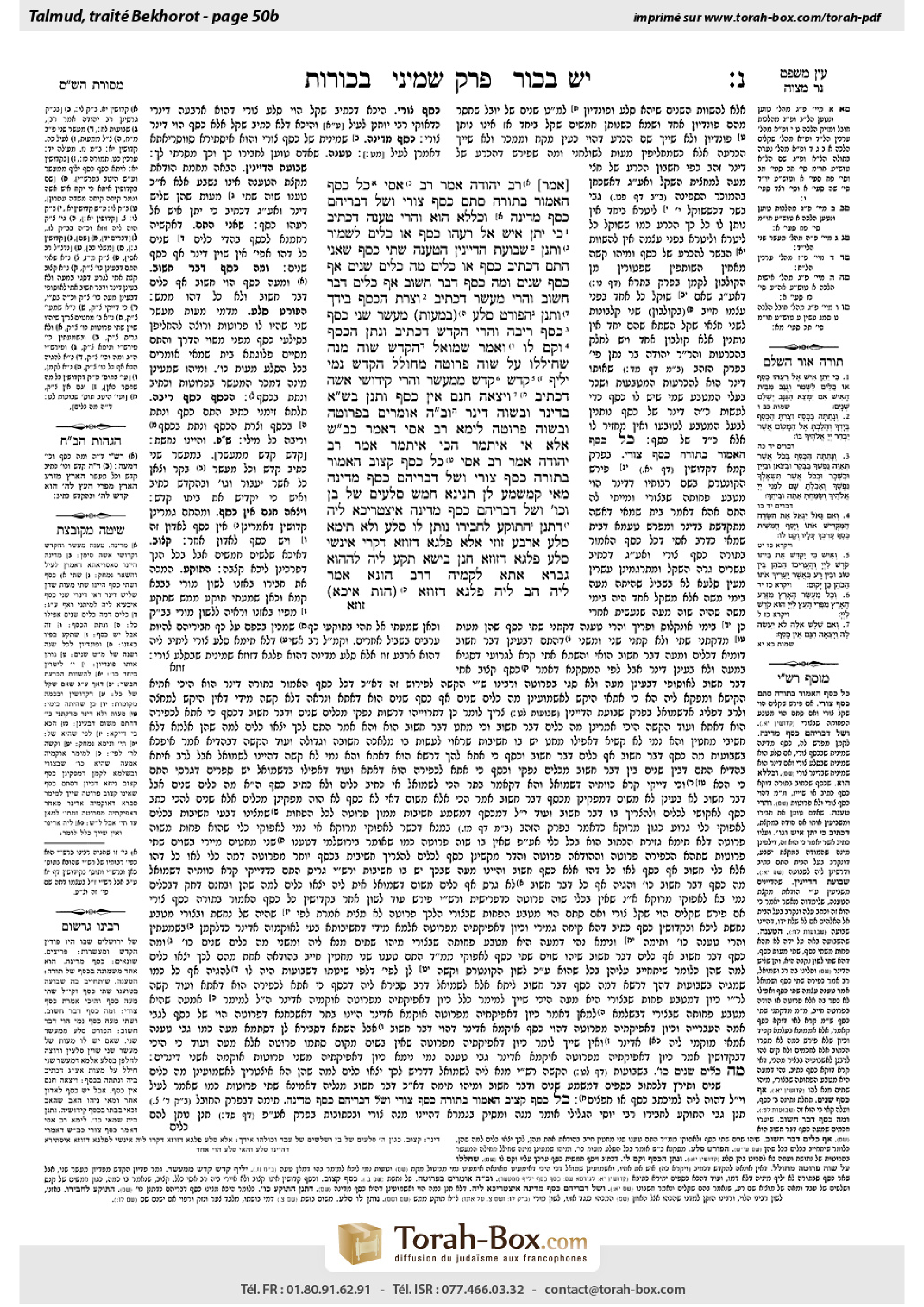
Bekhorot 50b: Talmud study for Daf Yomi
Study the Talmud for Daf Yomi with scanned pages, Hebrew text, English translations from Sefaria and AI-generated French translations.
Passage selection and English or AI-generated French translation are available where the scan has annotations. Daf Study is independent of Torah-Box and Sefaria.
Browse Bekhorot · בכורות · All tractatesBekhorot 50b text and translations
This page of Bekhorot includes the Aramaic text, an English translation and an AI-generated French translation, alongside the scan above.
בכורות נ׳ ב · Aramaic and Hebrew text
רַב יְהוּדָה אָמַר רַב אַסִּי: כׇּל ״כֶּסֶף״ הָאָמוּר בַּתּוֹרָה סְתָם — כֶּסֶף צוֹרִי, וְשֶׁל דִּבְרֵיהֶם — כֶּסֶף מְדִינָה.
וּכְלָלָא הוּא? וַהֲרֵי טַעֲנָה, דִּכְתִיב: ״כִּי יִתֵּן אִישׁ אֶל רֵעֵהוּ כֶּסֶף אוֹ כֵלִים לִשְׁמוֹר״,
וּתְנַן: שְׁבוּעַת הַדַּיָּינִין — הַטַּעֲנָה שְׁתֵּי כֶסֶף!
שָׁאנֵי הָתָם, דִּכְתִיב: ״כֶּסֶף אוֹ כֵלִים״, מָה כֵּלִים שְׁנַיִם — אַף כֶּסֶף שְׁנַיִם, וּמָה כֶּסֶף דָּבָר חָשׁוּב — אַף כֵּלִים דָּבָר חָשׁוּב.
וַהֲרֵי מַעֲשֵׂר, דִּכְתִיב: ״וְצַרְתָּ הַכֶּסֶף בְּיָדְךָ״, וּתְנַן: הַפּוֹרֵט סֶלַע בִּמְעוֹת מַעֲשֵׂר שֵׁנִי! ״כֶּסֶף״ ״כֶּסֶף״ רִיבָּה.
וַהֲרֵי הֶקְדֵּשׁ, דִּכְתִיב ״וְנָתַן הַכֶּסֶף וְקָם לוֹ״, וְאָמַר שְׁמוּאֵל: הֶקְדֵּשׁ שָׁוֶה מָנֶה שֶׁחִילְּלוֹ עַל שָׁוֶה פְּרוּטָה מְחוּלָּל! הֶקְדֵּשׁ נָמֵי יָלֵיף ״קֹדֶשׁ״ ״קֹדֶשׁ״ מִמַּעֲשֵׂר.
וַהֲרֵי קִידּוּשֵׁי אִשָּׁה, דִּכְתִיב: ״וְיָצְאָה חִנָּם אֵין כָּסֶף״, וּתְנַן: בֵּית שַׁמַּאי אוֹמְרִים: בְּדִינָר וּבְשָׁוֶה דִּינָר, וּבֵית הִלֵּל אוֹמְרִים: בִּפְרוּטָה וּבְשָׁוֶה פְּרוּטָה, לֵימָא רַב אַסִּי דְּאָמַר כְּבֵית שַׁמַּאי?
אֶלָּא, אִי אִיתְּמַר הָכִי אִיתְּמַר, אָמַר רַב יְהוּדָה אָמַר רַב אַסִּי: כׇּל כֶּסֶף קָצוּב הָאָמוּר בַּתּוֹרָה — כֶּסֶף צוֹרִי, וְשֶׁל דִּבְרֵיהֶם — כֶּסֶף מְדִינָה.
מַאי קָמַשְׁמַע לַן? תְּנֵינָא: חָמֵשׁ סְלָעִים שֶׁל בֵּן וְכוּ׳!
וְשֶׁל דִּבְרֵיהֶם כֶּסֶף מְדִינָה אִיצְטְרִיכָא לֵיהּ, דִּתְנַן: הַתּוֹקֵעַ לַחֲבֵירוֹ נוֹתֵן לוֹ סֶלַע, וְלָא תֵּימָא סֶלַע אַרְבַּע זוּזֵי, אֶלָּא פַּלְגָא דְּזוּזָא, דְּקָרוּ אִינָשֵׁי ״סֶלַע״ פַּלְגָא דְּזוּזָא.
חָנָן בִּישָׁא תְּקַע לֵיהּ לְהָהוּא גַּבְרָא, אֲתָא לְקַמֵּיהּ דְּרַב הוּנָא, אֲמַר לֵיהּ: הַב לֵיהּ פַּלְגָא דְּזוּזָא. הֲוָה אִיכָּא
Bekhorot 50b · English translation
§ Rav Yehuda says that Rav Asi says: Every sum of money stated in the Torah without specifying that it is in shekels is referring to silver dinars of Tyrian coinage, which have a high value. And every mention of coins in statements of the Sages is referring to provincial coinage, which was worth roughly one-eighth of Tyrian coinage.
The Gemara challenges: And is it an established principle that all money mentioned in the Torah is a silver dinar of Tyrian coinage? But there is the case of one who admits to part of a claim that he has not returned a deposit or loan, where it is written: “If a man deliver to his neighbor money or vessels to guard and it is stolen out of the man’s house…the cause of both parties shall come before the judges” (Exodus 22:6–8). This teaches that the case is brought to a court, where the defendant must take an oath.
And we learned in a mishna with regard to one who admits to part of a claim (Shevuot 38b): The oath administered by the judges to one who admits to part of a claim is administered only when the claim is for at least two silver ma’a, and the defendant’s admission is to at least the value of one peruta. If every sum of money mentioned in the Torah is referring to Tyrian coinage, how did the Sages arrive at the amount of two ma’a in this case?
The Gemara explains: There, the halakha is derived from a juxtaposition, as the “money” mentioned in the verse is similar to “vessels”: Just as the word “vessels” indicates at least two, so too, “money” is referring to at least two coins. And just as money is a significant item, i.e., silver ma’a, so too, the vessels must be a significant item. Rav Asi, by contrast, is referring to a mention of money where there is no juxtaposition.
The Gemara challenges: But there is the case of the redemption of second tithe, as it is written: “And bind up the money in your hand” (Deuteronomy 14:25). And yet we learned in a mishna (Ma’aser Sheni 2:8): With regard to one who exchanges copper coins of second-tithe money for a sela, Beit Shammai say: He may exchange the copper coins for the entire silver sela. This mishna indicates that second-tithe money, mentioned in the Torah, can be in the form of copper coins, and is not required to be in the form of silver coins. The Gemara explains that the verse states: “Money,” “money,” using the term more than once. This serves as an amplification. In other words, this addition teaches that second-tithe money can be in any coinage, including copper coins.
The Gemara challenges: But there is the case of consecrated property, as it is written: “And he will give the money and it will be assured to him” (see Leviticus 27:19). And Shmuel says: With regard to consecrated property worth one hundred dinars, which was redeemed for an item worth one peruta, it is redeemed. Although the word “money” is stated in the Torah, a copper peruta may be used. The Gemara answers: There too, there is a reason for this unusual halakha, as he derives this ruling from a verbal analogy using the term “holy” mentioned here and “holy” from second tithe (see Leviticus 27:14, 30). Consequently, one may use any type of coin in this case as well.
The Gemara challenges: But there is the case of the betrothal of a woman, as it is written: “Then shall she go out for nothing, without money” (Exodus 21:11). And yet we learned in a mishna (Kiddushin 2a) that Beit Shammai say that one can betroth her with one dinar or with an item that is worth one dinar, and Beit Hillel say one can betroth a woman with one peruta or with any item that is worth one peruta. If so, shall we say that Rav Asi, who claims that all sums of money mentioned in the Torah are in Tyrian coinage, stated his opinion in accordance with the opinion of Beit Shammai, even though the halakha is in accordance with the opinion of Beit Hillel?
The Gemara suggests an alternative explanation: Rather, if this was stated, it was stated like this: Rav Yehuda says that Rav Asi says: Every set amount of money stated in the Torah, i.e., when a specific amount is mentioned, such as the fifty shekels paid by a rapist (Deuteronomy 22:29), is referring to Tyrian coinage, and any amount of money set by rabbinic law is in provincial coinage.
The Gemara asks: If so, what is Rav Asi teaching us? We already learn all of these halakhot explicitly in the mishna: The payment of five sela for the redemption of a firstborn son, the thirty for a Canaanite slave killed by an ox, the fifty of a rapist and of a seducer, and the one hundred of the slanderer are all paid in the shekel of the Sanctuary, which is determined based on Tyrian coinage.
The Gemara answers: It was necessary for Rav Asi to clarify that payments mentioned in statements of the Sages are referring to provincial coinage, as that halakha was not taught in the mishna. As we learned in a mishna (Bava Kamma 90a): The Sages established that one who strikes another as an act of disrespect must give him a sela as a fine for striking him. And Rav Asi teaches: Do not say that this sela is a Tyrian sela worth four dinars. Rather, it is the sela of provincial coinage, which is worth one-half a dinar, as people commonly call a one-half dinar by the name sela.
The Gemara relates that Ḥanan the wicked struck a certain man. He came before Rav Huna for judgment, and Rav Huna said to him: Go give him half a dinar, which is the fine imposed for such an action. Ḥanan had
Bekhorot 50b · Traduction française (IA)
§ Rav Yehuda dit que Rav Asi dit : Toute somme d'argent mentionnée dans la Torah sans préciser qu'il s'agit de sicles est un dinar d'argent tyrien, qui a une grande valeur. Et toute mention de monnaie dans les déclarations des Sages fait référence à la monnaie provinciale, qui valait approximativement un huitième de la monnaie tyrienne.
La Guemara soulève un défi : Et est-ce un principe établi que toute somme d'argent mentionnée dans la Torah est un dinar d'argent tyrien ? Mais il y a le cas d'une personne qui admet une partie d'une réclamation qu'elle n'a pas rendue, où il est écrit : « Si un homme donne à son voisin de l'argent ou des objets pour les garder et qu'ils sont volés de la maison de l'homme, la cause des deux parties viendra devant les juges » (Exode 22 : 6-8). Cela enseigne que le cas est porté devant un tribunal, où le défendeur doit prendre un serment.
Et nous avons appris dans une mitsva concernant une personne qui admet une partie d'une réclamation (Shevuot 38b) : Le serment administré par les juges à une personne qui admet une partie d'une réclamation est administré uniquement lorsque la réclamation est d'au moins deux ma'ot d'argent, et l'admission du défendeur est d'au moins la valeur d'un peruta. Si toute somme d'argent mentionnée dans la Torah fait référence à la monnaie tyrienne, comment les Sages sont-ils parvenus à l'amount de deux ma'ot dans ce cas ?
La Guemara explique : Là, la halakha est dérivée d'une juxtaposition, car la « monnaie » mentionnée dans la versette est similaire à « objets » : Tout comme le mot « objets » indique au moins deux, de même, « monnaie » fait référence à au moins deux pièces. Et tout comme la monnaie est un objet important, c'est-à-dire un ma'ot d'argent, de même, les objets doivent être un objet important. Rav Asi, en revanche, fait référence à une mention de monnaie où il n'y a pas de juxtaposition.
La Guemara soulève un défi : Mais il y a le cas du rachat de la dîme secondaire, comme il est écrit : « Et tu enlieras l'argent dans ta main » (Deutéronome 14 : 25). Et pourtant nous avons appris dans une mitsva (Ma'aser Sheni 2 : 8) que concernant une personne qui échange des pièces de cuivre de l'argent de la dîme secondaire contre un sela, Beit Shammai disent : Il peut échanger les pièces de cuivre contre l'ensemble du sela d'argent. Cette mitsva indique que l'argent de la dîme secondaire, mentionné dans la Torah, peut être sous forme de pièces de cuivre, et n'est pas requis d'être sous forme d'argent. La Guemara explique que la versette dit : « argent », « argent », en utilisant le terme plus d'une fois. Cela sert d'élargissement. En d'autres termes, cette addition enseigne que l'argent de la dîme secondaire peut être sous n'importe quelle monnaie, y compris les pièces de cuivre.
La Guemara soulève un défi : Mais il y a le cas des biens consacrés, comme il est écrit : « Et il donnera l'argent et cela sera assuré à lui » (voir Lévitique 27 : 19). Et Shmuel dit : Concernant des biens consacrés valant cent dinars, qui ont été rachetés par un objet valant un peruta, il est racheté. Bien que le mot « argent » soit mentionné dans la Torah, un peruta en cuivre peut être utilisé. La Guemara répond : Là aussi, il y a une raison pour cette halakha inhabituelle, car il dérive cette décision d'une analogie verbale utilisant le terme « saint » mentionné ici et « saint » de la dîme secondaire (voir Lévitique 27 : 14, 30). Par conséquent, on peut utiliser n'importe quel type de monnaie dans ce cas également.
La Guemara soulève un défi : Mais il y a le cas du mariage d'une femme, comme il est écrit : « Alors elle sortira pour rien, sans argent » (Exode 21 : 11). Et pourtant nous avons appris dans une Michna (Kiddushin 2a) que Beit Shammai disent que l'on peut marier une femme avec un dinar ou avec un objet valant un dinar, et Beit Hillel disent qu'on peut marier une femme avec un peruta ou avec n'importe quel objet valant un peruta. Si c'est ainsi, devons-nous dire que Rav Asi, qui affirme que toutes les sommes d'argent mentionnées dans la Torah sont en monnaie tyrienne, a exprimé son opinion conformément à l'opinion de Beit Shammai, même si la halakha suit l'opinion de Beit Hillel ?
La Guemara suggère une autre explication : Plutôt, si cela a été dit, cela a été dit ainsi : Rav Yehuda dit que Rav Asi dit : Toute somme d'argent fixée dans la Torah, c'est-à-dire lorsque la quantité est mentionnée, comme les cinquante sicles payés par un violateur (Deutéronome 22 : 29), fait référence à la monnaie tyrienne, et toute somme d'argent fixée par la loi rabbinique fait référence à la monnaie provinciale.
La Guemara demande : Si c'est ainsi, que nous apprend donc Rav Asi ? Nous apprenons déjà toutes ces halakhot explicitement dans la Michna : Le paiement de cinq sela pour le rachat d'un premier-né, trente pour un esclave cananéen tué par un bœuf, cinquante du violateur et du séducteur, et cent du calomniateur sont tous payés en sicle du Sanctuaire, qui est déterminé en fonction de la monnaie tyrienne.
La Guemara répond : Il était nécessaire que Rav Asi clarifie que les paiements mentionnés dans les déclarations des Sages font référence à la monnaie provinciale, car cette halakha n'était pas enseignée dans la mitsna. Comme nous avons appris dans une mitsna (Bava Kamma 90a) : Les Sages ont établi que celui qui frappe un autre comme un acte de mépris doit lui donner un sela comme amendement pour avoir frappé. Et Rav Asi enseigne : Ne dis pas que ce sela est un sela tyrien valant quatre dinars. Mais c'est le sela de la monnaie provinciale, qui vaut demi-dinar, comme les gens l'appellent sela.
La Guemara rapporte que Hanan le méchant a frappé un certain homme. Il est venu devant Rav Huna pour être jugé, et Rav Huna lui a dit : Va lui donner demi-dinar, qui est la sanction imposée pour un tel acte. Hanan avait
Traduction française générée par IA à partir de l’édition anglaise de Sefaria. Vérifie toujours un passage avec le texte source.
Text from Sefaria: William Davidson Edition - Vocalized Aramaic (CC BY NC); William Davidson Edition - English (CC BY NC).