Bekhorot 51a: Talmud study for Daf Yomi
Study the Talmud for Daf Yomi with scanned pages, Hebrew text, English translations from Sefaria and AI-generated French translations.
Passage selection and English or AI-generated French translation are available where the scan has annotations. Daf Study is independent of Torah-Box and Sefaria.
Browse Bekhorot · בכורות · All tractatesBekhorot 51a text and translations
This page of Bekhorot includes the Aramaic text, an English translation and an AI-generated French translation, alongside the scan above.
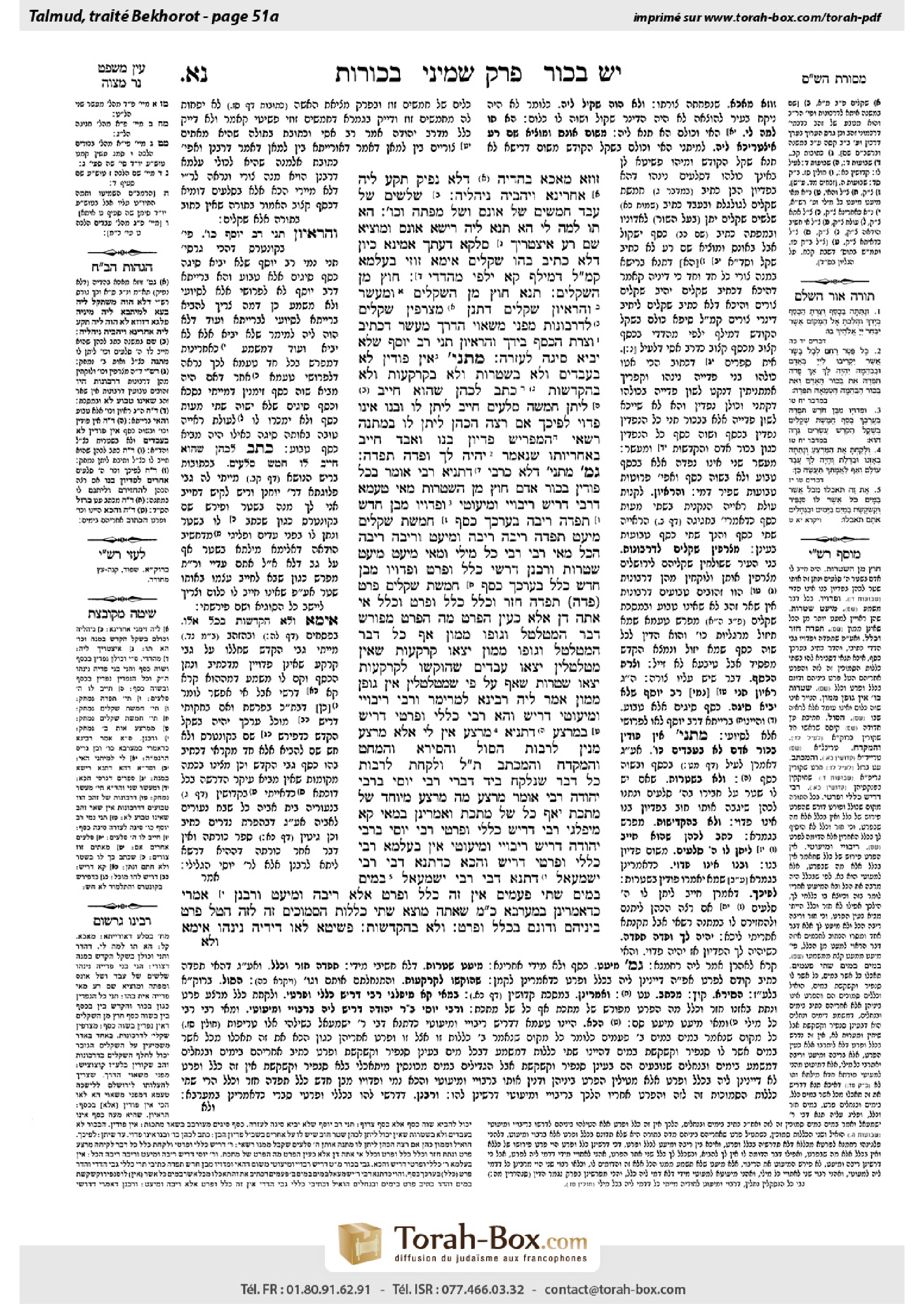
בכורות נ״א א · Aramaic and Hebrew text
זוּזָא מָאכָא בַּהֲדֵיהּ דְּלָא נָפֵיק, תְּקַע לֵיהּ אַחֲרִינָא וְיַהֲבֵיהּ נִיהֲלֵיהּ.
שְׁלֹשִׁים שֶׁל עֶבֶד, חֲמִשִּׁים שֶׁל אוֹנֵס וְשֶׁל מְפַתֶּה וְכוּ׳. הָא תּוּ לְמָה לִי? הָא תְּנָא לֵיהּ רֵישָׁא!
אוֹנֵס וּמוֹצִיא שֵׁם רַע אִיצְטְרִיךְ, סָלְקָא דַּעְתָּךְ אָמֵינָא: כֵּיוָן דְּלָא כְּתִיב בְּהוּ ״שְׁקָלִים״, אֵימָא זוּזֵי בְּעָלְמָא, קָא מַשְׁמַע לַן דְּמֵילָף קָא יָלְפִי מֵהֲדָדֵי.
חוּץ מִן הַשְּׁקָלִים. תָּנָא: חוּץ מִן הַשְּׁקָלִים, וּמַעֲשֵׂר, וְהָרֵאָיוֹן.
שְׁקָלִים — דִּתְנַן: מְצָרְפִין שְׁקָלִים לְדַרְבּוֹנוֹת, מִפְּנֵי מַשּׂאוֹי הַדֶּרֶךְ.
מַעֲשֵׂר — דִּכְתִיב: ״וְצַרְתָּ הַכֶּסֶף בְּיָדְךָ״, וְהָרֵאָיוֹן — תָּנֵי רַב יוֹסֵף: שֶׁלֹּא יָבִיא סִיגָה לָעֲזָרָה.
מַתְנִי׳ אֵין פּוֹדִין לֹא בַּעֲבָדִים, וְלֹא בִּשְׁטָרוֹת, וְלֹא בְּקַרְקָעוֹת, וְלֹא בְּהֶקְדֵּשׁוֹת. כָּתַב לְכֹהֵן שֶׁהוּא חַיָּיב לִיתֵּן חֲמִשָּׁה סְלָעִים — חַיָּיב לִיתֵּן לוֹ, וּבְנוֹ אֵינוֹ פָּדוּי. לְפִיכָךְ, אִם רָצָה הַכֹּהֵן לִיתֵּן לוֹ בְּמַתָּנָה — רַשַּׁאי.
הַמַּפְרִישׁ פִּדְיוֹן בְּנוֹ, וְאָבַד — חַיָּיב בְּאַחְרָיוּתוֹ, שֶׁנֶּאֱמַר: ״יִהְיֶה לָּךְ״ וּ״פָדֹה תִפְדֶּה״.
גּמ׳ מַתְנִיתִין דְּלָא כְּרַבִּי, דְּתַנְיָא: רַבִּי אוֹמֵר: בַּכֹּל פּוֹדִין בְּכוֹר אָדָם, חוּץ מִן הַשְּׁטָרוֹת. מַאי טַעְמָא דְּרַבִּי?
דָּרֵישׁ רִיבּוּיֵי וּמִיעוּטֵי, ״וּפְדוּיָו מִבֶּן חֹדֶשׁ תִּפְדֶּה״ — רִיבָּה, ״בְּעֶרְכְּךָ כֶּסֶף חֲמֵשֶׁת שְׁקָלִים״ — מִיעֵט, ״תִּפְדֶּה״ — רִיבָּה.
רִיבָּה וּמִיעֵט וְרִיבָּה, רִיבָּה הַכֹּל. מַאי רַבִּי? רַבִּי כֹּל מִילֵּי, וּמַאי מַיעֵט? מַיעֵט שְׁטָרוֹת.
וְרַבָּנַן דָּרְשִׁי כְּלָל וּפְרָט: ״ופְדוּיָו מִבֶּן חֹדֶשׁ״ — כָּלַל, ״בְּעֶרְכְּךָ כֶּסֶף חֲמֵשֶׁת שְׁקָלִים״ — פָּרַט, (פדה) ״תִּפְדֶּה״ — חָזַר וְכָלַל.
כְּלָל וּפְרָט וּכְלָל, אִי אַתָּה דָן אֶלָּא כְּעֵין הַפְּרָט. מָה הַפְּרָט מְפוֹרָשׁ — דָּבָר הַמִּטַּלְטֵל וְגוּפוֹ מָמוֹן, אַף כׇּל דָּבָר הַמִּטַּלְטֵל וְגוּפוֹ מָמוֹן. יָצְאוּ קַרְקָעוֹת — שֶׁאֵין מִטַּלְטְלִין, יָצְאוּ עֲבָדִים — שֶׁהוּקְּשׁוּ לְקַרְקָעוֹת, יָצְאוּ שְׁטָרוֹת — שֶׁאַף עַל פִּי שֶׁמִּטַּלְטְלִין, אֵין גּוּפָן מָמוֹן.
אֲמַר לֵיהּ רָבִינָא לְמָרִימָר: וְרַבִּי, רִיבּוּיֵי וּמִיעוּטֵי דָּרֵישׁ? וְהָא רַבִּי כְּלָלֵי וּפְרָטֵי דָּרֵישׁ בְּמַרְצֵעַ!
דְּתַנְיָא: ״מַרְצֵעַ״ — אֵין לִי אֶלָּא מַרְצֵעַ, מִנַּיִן לְרַבּוֹת הַסּוֹל וְהַסִּירָא וְהַמַּחַט וְהַמַּקְדֵּחַ וְהַמַּכְתֵּב? תַּלְמוּד לוֹמַר ״וְלָקַחְתָּ״ — לְרַבּוֹת כׇּל דָּבָר שֶׁנִּלְקָח בַּיָּד, דִּבְרֵי רַבִּי יוֹסֵי בְּרַבִּי יְהוּדָה. רַבִּי אוֹמֵר: ״מַרְצֵעַ״ — מָה מַרְצֵעַ מְיוּחָד שֶׁל מַתֶּכֶת, אַף כֹּל שֶׁל מַתֶּכֶת.
וְאָמְרִינַן: בְּמַאי קָא מִיפַּלְגִי? רַבִּי דָּרֵישׁ כְּלָלֵי וּפְרָטֵי, ורבי יוֹסֵי בְּרַבִּי יְהוּדָה דָּרֵישׁ רִיבּוּיֵי וּמִיעוּטֵי.
אִין בְּעָלְמָא רַבִּי כְּלָלֵי וּפְרָטֵי דָּרֵישׁ, וְהָכָא כִּדְתָנָא דְּבֵי רַבִּי יִשְׁמָעֵאל.
דְּתָנָא דְּבֵי רַבִּי יִשְׁמָעֵאל: ״בְּמַיִם״ ״בַּמַּיִם״ שְׁתֵּי פְעָמִים, אֵין זֶה כְּלָל וּפְרָט, אֶלָּא רִיבָּה וּמִיעֵט.
וְרַבָּנַן אָמְרִי: כִּדְאָמְרִינַן בְּמַעְרְבָא, כׇּל מָקוֹם שֶׁאַתָּה מוֹצֵא שְׁתֵּי כְלָלוֹת הַסְּמוּכִים זֶה לָזֶה — הַטֵּל פְּרָט בֵּינֵיהֶם, וְדוּנֵם בִּכְלָל וּפְרָט.
וְלֹא בְּהֶקְדֵּשׁוֹת. פְּשִׁיטָא, לָאו דִּידֵיהּ נִינְהוּ! אֵימָא:
Bekhorot 51a · English translation
an impaired dinar with him, which was not in circulation, and his victim did not want to accept it from him. Ḥanan the wicked then struck him another time, rendering himself liable to pay an additional fine of one-half a dinar, and gave him the full dinar as payment for both strikes.
§ The mishna teaches: The thirty shekels paid to the owner of a Canaanite slave who is killed by an ox, and the fifty shekels paid by a rapist and by a seducer, and the one hundred shekels paid by the defamer are all paid in the shekel of the Sanctuary, which is calculated based on one hundred Tyrian dinars. The Gemara asks: Why do I need this additional mention of: All are paid in the shekel of the Sanctuary, which is calculated based on one hundred Tyrian dinars? The tanna of the mishna already taught this in the first clause.
The Gemara explains: It was necessary to state the cases of the rapist and the defamer, as it might enter your mind to say: Since the term shekels is not written with regard to them, but only “money,” say that one pays merely dinars, and not shekels, which are worth four dinars. Therefore, the tanna teaches us that the halakhot of all these cases are derived from one another, and in all of them, the payment is in the shekel of the Sanctuary.
§ The mishna further teaches: And all monetary obligations are redeemed, i.e., paid, with coins or with items of the equivalent value of money, except for the half-shekels that are donated to the Temple each year, which must be given specifically as coins. The Gemara notes that it is taught in a baraita: All monetary obligations are redeemed with coins or with their equivalent value, except for the half-shekels, and second tithe, and the money for appearance, i.e., the two silver ma’a that every man must bring to the Temple to purchase burnt offerings of appearance on the pilgrimage Festivals, all of which must be given as coins.
The Gemara elaborates: The halakha that the half-shekel payment dues to the Temple cannot be paid using items of equivalent value is as we learned in a mishna (Shekalim 2:1): When people who live far from Jerusalem wish to send to Jerusalem the shekels that have been levied from their community, they may combine their shekels and exchange them for darics [darbonot], which are large gold coins, due to the hardship of carrying on the journey. Instead of carrying large amounts of shekels, the agents who deliver the funds will bring a much lighter burden of gold coins with them. They may exchange them only for coins, not for items of equivalent value.
Second tithe may not be redeemed with items of equivalent value, as it is written: “And bind up [vetzarta] the money in your hand” (Deuteronomy 14:25), which the Sages interpreted as referring to money that has a form [tzura] engraved on it, i.e., a coin. And with regard to the money for appearance, this is as Rav Yosef teaches, that one may not bring a lump of silver full of base metals to the Temple courtyard.
MISHNA: One may not redeem his firstborn son, neither with Canaanite slaves, nor with promissory notes, nor with land, nor with consecrated items. If the father wrote a promissory note to the priest that he is obligated to give him five sela coins, the father is obligated to give them to him but his son is not redeemed. Therefore, if the priest wished to give back the five sela coins to him as a gift he is permitted to do so.
With regard to one who designates five sela coins for redemption of his firstborn son and he lost the coins before he gave them to the priest, the father bears financial responsibility for their loss, as it is stated to Aaron the priest: “Everything that opens the womb in man and animal shall be yours”; and only afterward it says: “You shall redeem the firstborn of man” (Numbers 18:15). This indicates that only after the money shall be in the possession of the priest is the son redeemed.
GEMARA: The Gemara comments: The mishna is not in accordance with the opinion of Rabbi Yehuda HaNasi. As it is taught in a baraita that Rabbi Yehuda HaNasi says: One can redeem a woman’s firstborn son with anything worth five shekels except for promissory notes. This is different from the mishna, which also excludes Canaanite slaves and land. The Gemara asks: What is the reason for Rabbi Yehuda HaNasi’s opinion?
The Gemara answers that he interprets verses using the method of amplifications and restrictions, and this is how he interprets the verse: “And its redemption from one month you shall redeem, according to the valuation of five silver shekels by the shekel of the Sanctuary” (Numbers 18:16). Concerning the phrase “and its redemption from one month,” since it does not specify that only certain items can be used for the redemption, the verse amplified the category of items that can be used to redeem the firstborn, intimating that many different items can be used. Then, with the phrase “according to the valuation of five silver shekels,” the verse restricted the category to items that are similar to silver shekels. Then, with the phrase “You shall redeem,” the verse again amplified the category.
According to the hermeneutical principle that when a verse amplified and then restricted and then amplified, it amplified the relevant category to include everything except the specific matter excluded in the restriction. The Gemara elaborates: What has it amplified? Almost everything. And what has it restricted? It restricted only promissory notes, which are the most fundamentally dissimilar to silver shekels.
The Gemara explains the reasoning of the Rabbis: And the Rabbis expound verses through the method of a generalization and a detail. They expound the verse as follows: The phrase “and its redemption from one month” is a generalization which suggests that many different items can be used to redeem the firstborn. Then, the phrase “according to the valuation of five silver shekels” is a detail, which suggests that only items that are similar to silver shekels can be used. Then, with the phrase: “You shall redeem,” the verse again makes a generalization.
Based on this exegetical method, whenever a verse has a generalization and then a detail and then a generalization, the principle is that you may deduce that the verse is referring only to items that are similar to the detail. In this case, just as the detail, i.e., silver shekels, is explicitly something that is movable and has intrinsic monetary value, so too, anything that is movable and has intrinsic monetary value can be used. This excludes land, which is not movable property; it excludes Canaanite slaves, who are halakhically compared to land; and it excludes promissory notes, because even though they are movable property they do not have intrinsic monetary value.
Ravina said to Ameimar: Does Rabbi Yehuda HaNasi really expound verses through the method of amplifications and restrictions? But doesn’t Rabbi Yehuda HaNasi expound verses through the method of generalizations and details with regard to an awl?
This is as it is taught in a baraita: The Torah provides the process by which a Hebrew slave who has already completed his six years of servitude may continue on as a slave of his master: “And you shall take the awl and put it through his ear and in the door” (Deuteronomy 15:17). From this verse, I have derived only that an awl can be used; from where do I know to include the thorn of a palm, and a thorn, a needle, and a gimlet, and a stylus for writing on wax, as valid tools for piercing his ear? The verse states: “And you shall take,” which indicates that anything that can be taken by hand is a valid tool. This is the statement of Rabbi Yosei, son of Rabbi Yehuda. Rabbi Yehuda HaNasi says: Not all these items can be used. Rather, since the verse specifies an “awl,” only items similar to an awl can be used; just as an awl is distinct in that it is fashioned of metal, so too, anything fashioned of metal can be used.
And we say with regard to this dispute: About what do they disagree? Rabbi Yehuda HaNasi expounds verses using the method of generalizations and details, and Rabbi Yosei, son of Rabbi Yehuda, expounds verses using the method of amplifications and restrictions.
Ameimar answers: Yes, generally Rabbi Yehuda HaNasi expounds verses using the method of generalizations and details, but here, with regard to the redemption of the firstborn, this is the reason he expounds the verses using the method of amplifications and restrictions: He holds in accordance with that which the school of Rabbi Yishmael taught.
As the school of Rabbi Yishmael taught: When defining which fish it is permitted to eat, the verse states: “This you may eat, from whatever is in the water, anything that has fins and scales in the water, in the seas and in the streams” (Leviticus 11:9). The verse first states the general term “in the water,” “in the water,” mentioning it twice, and only afterward mentions the details, i.e., “in the seas and in the streams.” When the general and detailed phrases are ordered in this way, they are not expounded as a generalization and a detail, but rather the verse amplified and restricted. Similarly, although Rabbi Yehuda HaNasi generally expounds verses using the method of generalizations and details, with regard to the redemption of the firstborn, since the verse mentions the two general terms first and mentions the specific detail only afterward, he expounds it using the method of amplifications and restrictions.
The Gemara asks: And with regard to the Rabbis, why do they expound the verse about the redemption of a firstborn as a generalization and a detail? The Sages say: This is like they say in the West, Eretz Yisrael: Wherever you find two generalizations juxtaposed to each other, followed by a specific detail, place the detail between the two generalizations and thereby expound them as a generalization and a detail followed by another generalization.
§ The mishna teaches: And one may not redeem a firstborn with consecrated items. The Gemara asks: Isn’t it obvious? Consecrated items are not his. The Gemara answers: Say that
Bekhorot 51a · Traduction française (IA)
un dinar défectueux avec lui, qui n'était pas en circulation, et sa victime ne voulait pas l'accepter de lui. Hanneh le méchant frappa alors à nouveau, ce qui le rendait dû à une amende supplémentaire de demi-dinar, et lui donna le dinar complet en paiement pour les deux coups.
§ La mitsva enseigne : Les trente sicles payés à l'propriétaire d'un esclave cananéen tué par un bœuf, et les cinquante sicles payés par un violateur et par un séducteur, et les cent sicles payés par un calomniateur sont tous payés en sicle du Sanctuaire, qui est calculé sur cent dinars tyriens. La Guemara demande : Pourquoi ai-je besoin de cette mention supplémentaire : Tous sont payés en sicle du Sanctuaire, qui est calculé sur cent dinars tyriens ? Le tanna de la mitsva l'avait déjà enseigné dans la première clause.
La Guemara explique : Il était nécessaire d'évoquer les cas du violateur et du calomniateur, car cela pourrait entrer dans votre esprit de dire : Puisque le terme sicles n'est pas écrit concernant eux, mais seulement « argent », disons que l'on paie simplement des dinars, et non des sicles, qui valent quatre dinars. Ainsi, le tanna nous enseigne que les halakhot de tous ces cas sont dérivées les uns des autres, et dans tous ces cas, le paiement est en sicle du Sanctuaire.
§ La mitsna enseigne encore : Et toutes les obligations monétaires sont rachetées, c'est-à-dire payées, avec des pièces ou avec des objets équivalents en valeur monétaire, sauf les demi-sicles que l'on donne chaque année à l'Autel, qui doivent être donnés spécifiquement sous forme de pièces. La Guemara note que cela est enseigné dans une baraïta : Toutes les obligations monétaires sont rachetées avec des pièces ou avec leur valeur équivalente, sauf les demi-sicles, et la deuxième dîme, et l'argent pour l'offrande, c'est-à-dire les deux ma'ot d'argent que chaque homme doit apporter à l'Autel pour acheter des offrandes brûlées lors des fêtes de pèlerinage, toutes ces choses doivent être données sous forme de pièces.
La Guemara développe : La halakha selon laquelle le paiement des demi-sicles versés à l'Autel ne peut être effectué avec des objets équivalents en valeur monétaire est comme nous l'avons appris dans une mitsna (Shekalim 2:1) : Lorsque les gens vivant loin de Jérusalem souhaitent envoyer à Jérusalem les sicles imposés à leur communauté, ils peuvent combiner leurs sicles et les échanger contre des darics [darbonot], des pièces d'or, en raison de la difficulté de transporter sur la route. Au lieu de transporter de grandes quantités de sicles, les agents qui livrent les fonds apporteront un fardeau beaucoup plus léger en pièces d'or. Ils peuvent les échanger uniquement contre des pièces, pas contre des objets équivalents en valeur.
La deuxième dîme ne peut pas être rachetée avec des objets équivalents en valeur monétaire, car il est écrit : « Et tu enroules [vetzarta] l'argent dans ta main » (Deutéronome 14:25), que les Sages ont interprété comme faisant référence à de l'argent ayant une forme [tzura] gravée dessus, c'est-à-dire une pièce. Et concernant l'argent pour l'offrande, cela est comme Rav Yosef enseigne, que l'on ne peut pas apporter un bloc d'argent plein de métaux base au jardin du Temple.
MICHNA : On ne peut pas racheter son premier-né ni avec des esclaves cananéens, ni avec des promesses de paiement, ni avec la terre, ni avec des objets consacrés. Si le père a écrit une promesse de paiement au prêtre qu'il est tenu de lui donner cinq sela, le père est tenu de les lui donner, mais son fils n'est pas racheté. Ainsi, si le prêtre souhaitait lui rendre les cinq sela comme cadeau, il est autorisé à le faire.
Concernant celui qui a désigné cinq sela pour le rachat de son premier-né et qui a perdu les pièces avant de les donner au prêtre, le père assume la responsabilité financière de leur perte, car il est dit à Aaron le prêtre : « Tout ce qui naît dans l'homme et l'animal sera à toi » ; et ensuite il dit : « Tu rachèteras le premier-né de l'homme » (Lévitique 18:15). Cela indique que seul après que l'argent soit en possession du prêtre est le fils racheté.
GUEMARA : La Guemara commente : La mitsva ne suit pas l'opinion de Rabbi Yehuda HaNasi. Comme il est enseigné dans une baraïta que Rabbi Yehuda HaNasi dit : On peut racheter le premier-né d'une femme avec n'importe quoi valant cinq sicles, sauf les promesses de paiement. Cela diffère de la mitsva, qui exclut également les esclaves cananéens et la terre. La Guemara demande : Quelle est la raison de l'opinion de Rabbi Yehuda HaNasi ?
La Guemara répond qu'il interprète les versets selon la méthode d'amplifications et de restrictions, et c'est ainsi qu'il interprète le verset : « Et sa rédemption à partir d'un mois tu rachèteras, selon la valeur de cinq sicles d'argent par le sicle du Sanctuaire » (Nombres 18:16). Concernant la phrase « et sa rédemption à partir d'un mois », puisque cela ne spécifie pas que seul certains objets peuvent être utilisés pour la rédemption, le verset a amplifié la catégorie des objets pouvant être utilisés pour racheter le premier-né, suggérant que de nombreux objets différents peuvent être utilisés. Ensuite, avec la phrase « selon la valeur de cinq sicles d'argent », le verset a restreint la catégorie aux objets semblables aux sicles d'argent. Ensuite, avec la phrase « tu rachèteras », le verset a à nouveau amplifié la catégorie.
Selon le principe herméneutique selon lequel lorsqu'un verset amplifie, puis restreint, puis amplifie à nouveau, il amplifie la catégorie pertinente pour inclure tout sauf la matière spécifique exclue dans la restriction. La Guemara développe : Qu'a-t-il amplifié ? Presque tout. Et qu'a-t-il restreint ? Il a restreint uniquement les promesses de paiement, qui sont le plus fondamentalement différents des sicles d'argent.
La Guemara explique la raison de la déduction des Rabbins : Et les Rabbins interprètent les versets par la méthode d'une généralisation et d'un détail. Ils interprètent le verset comme suit : La phrase « et sa rançon d'un mois » est une généralisation qui suggère que divers objets peuvent être utilisés pour racheter le premier-né. Ensuite, la phrase « selon la valeur de cinq sicres d'argent » est un détail, qui suggère que seul les objets semblables aux sicres d'argent peuvent être utilisés. Ensuite, avec la phrase : « Tu rachèteras », le verset fait à nouveau une généralisation.
Selon cette méthode exégétique, chaque fois qu'un verset contient une généralisation, puis un détail, puis une généralisation, le principe est que l'on peut déduire que le verset fait référence uniquement aux objets semblables au détail. Dans ce cas, puisque le détail, c'est-à-dire les sicres d'argent, est explicitement quelque chose qui est un bien mobilier et qui a une valeur monétaire intrinsèque, ainsi tout ce qui est un bien mobilier et qui a une valeur monétaire intrinsèque peut être utilisé. Cela exclut la terre, qui n'est pas un bien mobilier ; il exclut les esclaves cananéens, qui sont halachiquement comparés à la terre ; et il exclut les billets de change, car même s'ils sont des biens mobilier, ils n'ont pas de valeur monétaire intrinsèque.
Ravina dit à Ameimar : Le Rabbi Yéhuda HaNasi explose-t-il vraiment les versets par la méthode d'amplifications et de restrictions ? N'est-ce pas plutôt qu'il explose les versets par la méthode de généralisations et de détails concernant un foret ?
C'est ce qui est enseigné dans une baraïta : La Torah donne le processus par lequel un serviteur hébreu qui a déjà accompli ses six années de servitude peut continuer à être un esclave de son maître : « Et tu prendras le foret et le passeras par son oreille et dans la porte » (Deutéronome 15:17). À partir de ce verset, j'ai déduit seulement que le foret peut être utilisé ; d'où sais-je inclure la piquette de palmier, la piquette, l'aiguille, le foret et le stylet pour écrire sur la cire, comme des outils valides pour percer son oreille ? Le verset dit : « Et tu prendras », ce qui indique que tout ce qui peut être tenu dans la main est un outil valide. C'est la déclaration du Rabbi Yosei, fils du Rabbi Yéhuda. Le Rabbi Yéhuda HaNasi dit : Non, tous ces objets ne peuvent pas être utilisés. Plutôt, puisque le verset spécifie un « foret », seul les objets semblables au foret peuvent être utilisés ; tout comme le foret est distinct dans le fait qu'il est en métal, ainsi tout ce qui est en métal peut être utilisé.
Et nous disons concernant ce débat : À propos de quoi s'entretiennent-ils ? Le Rabbi Yéhuda HaNasi interprète les versets par la méthode des généralisations et des détails, et le Rabbi Yosei, fils du Rabbi Yéhuda, interprète les versets par la méthode des amplifications et des restrictions.
Ameimar répond : Oui, généralement le Rabbi Yéhuda HaNasi interprète les versets par la méthode des généralisations et des détails, mais ici, concernant le rachat du premier-né, c'est la raison pour laquelle il interprète les versets par la méthode des amplifications et des restrictions : il suit ce que l'école du Rabbi Yishmael a enseigné.
Comme l'école du Rabbi Yishmael a enseigné : Lorsqu'on définit quels poissons sont permis à manger, le verset dit : « Cela tu mangeras, de tout ce qui est dans l'eau, tout ce qui a des nageoires et des écailles dans l'eau, dans les mers et dans les rivières » (Lévitique 11:9). Le verset commence par le terme général « dans l'eau », « dans l'eau », le mentionnant deux fois, et seulement ensuite mentionne les détails, c'est-à-dire « dans les mers et dans les rivières ». Lorsque les termes général et détaillé sont ordonnés ainsi, ils ne sont pas interprétés comme une généralisation et un détail, mais plutôt comme un amplification et une restriction. De même, bien que le Rabbi Yéhuda HaNasi généralement explose les versets par la méthode de généralisations et de détails, concernant le rachat du premier-né, puisque le verset mentionne d'abord les deux termes généraux et mentionne seulement ensuite le détail spécifique, il l'explose par la méthode d'amplifications et de restrictions.
La Guemara pose la question : Et concernant les Rabbins, pourquoi expoundent-ils le verset sur le rachat du premier-né comme une généralisation et un détail ? Les Sages disent : C'est comme ils disent dans l'Ouest, Eretz Yisraël : Lorsque vous trouvez deux généralisations juxtaposées l'une à l'autre, suivies d'un détail spécifique, placez le détail entre les deux généralisations et ainsi interprétez-les comme une généralisation et un détail suivis d'une autre généralisation.
§ La mitsva enseigne : On ne peut pas racheter un premier-né avec des objets consacrés. La Guemara pose la question : N'est-ce pas évident ? Les objets consacrés ne sont pas à lui. La Guemara répond : Dites que
Traduction française générée par IA à partir de l’édition anglaise de Sefaria. Vérifie toujours un passage avec le texte source.
Text from Sefaria: William Davidson Edition - Vocalized Aramaic (CC BY NC); William Davidson Edition - English (CC BY NC).