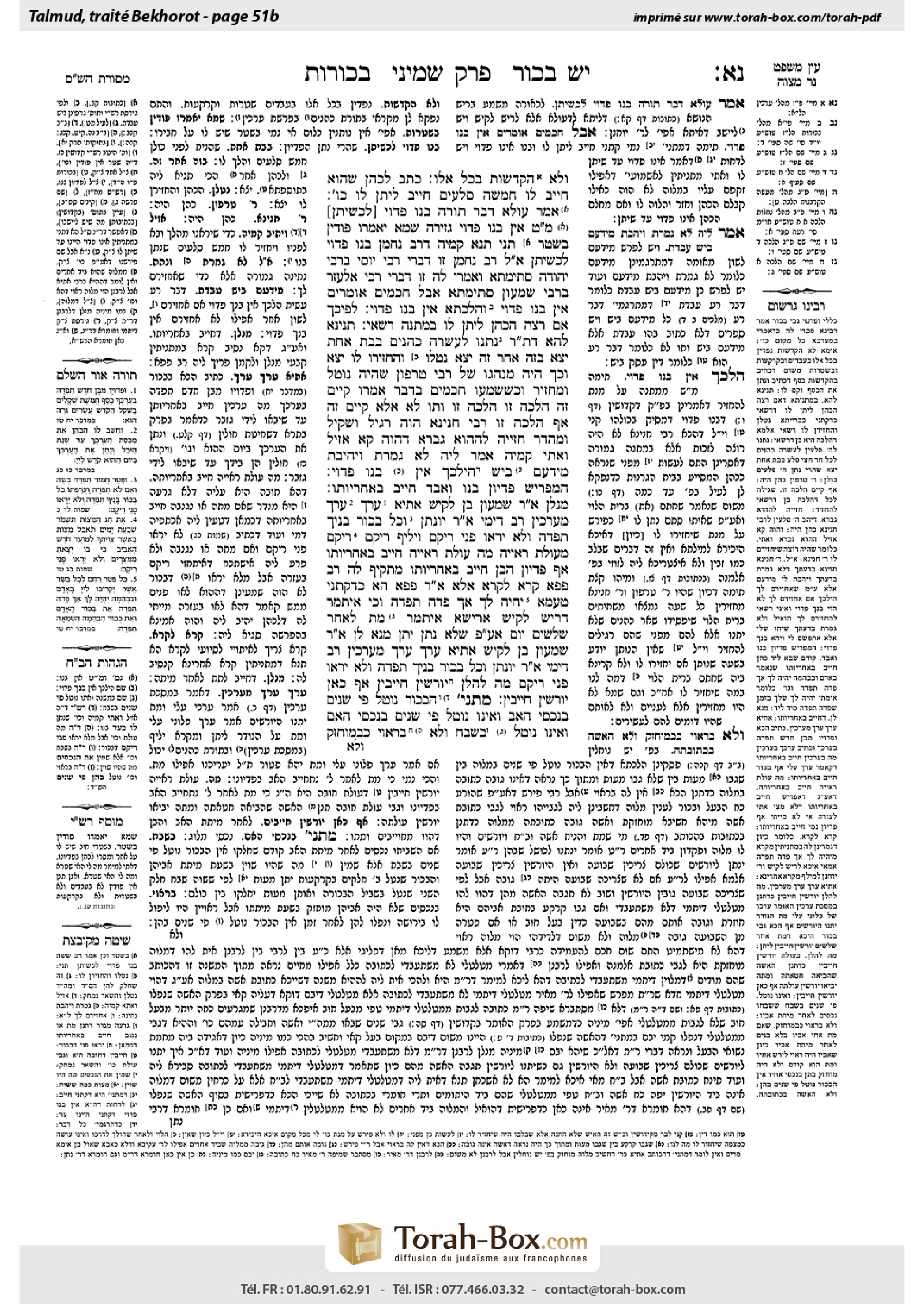
Bekhorot 51b: Talmud study for Daf Yomi
Study the Talmud for Daf Yomi with scanned pages, Hebrew text, English translations from Sefaria and AI-generated French translations.
Passage selection and English or AI-generated French translation are available where the scan has annotations. Daf Study is independent of Torah-Box and Sefaria.
Browse Bekhorot · בכורות · All tractatesBekhorot 51b text and translations
This page of Bekhorot includes the Aramaic text, an English translation and an AI-generated French translation, alongside the scan above.
בכורות נ״א ב · Aramaic and Hebrew text
וְלֹא הֶקְדֵּשׁוֹת בְּכׇל אֵלּוּ.
כָּתַב לְכֹהֵן שֶׁהוּא חַיָּיב לוֹ חֲמִשָּׁה סְלָעִים חַיָּיב לִיתֵּן לוֹ כּוּ׳. אָמַר עוּלָּא: דְּבַר תּוֹרָה בְּנוֹ פָּדוּי, מַאי טַעְמָא אֵין בְּנוֹ פָּדוּי? גְּזֵירָה שֶׁמָּא יֹאמְרוּ פּוֹדִין בִּשְׁטָר.
תָּנֵי תַּנָּא קַמֵּיהּ דְּרַב נַחְמָן: בְּנוֹ פָּדוּי לִכְשֶׁיִּתֵּן. אֲמַר לֵיהּ רַב נַחְמָן: זוֹ דִּבְרֵי רַבִּי יוֹסֵי בְּרַבִּי יְהוּדָה (סתימתא) [סְתִימְתָּאָה], וְאָמְרִי לַהּ: זוֹ דִּבְרֵי רַבִּי אֶלְעָזָר בְּרַבִּי שִׁמְעוֹן סְתִימְתָּאָה, אֲבָל חֲכָמִים אוֹמְרִים: אֵין בְּנוֹ פָּדוּי. וְהִלְכְתָא: אֵין בְּנוֹ פָּדוּי.
לְפִיכָךְ אִם רָצָה הַכֹּהֵן לִיתֵּן לוֹ בְּמַתָּנָה — רַשַּׁאי. תְּנֵינָא לְהָא דְּתָנוּ רַבָּנַן: נְתָנוֹ לַעֲשָׂרָה כֹּהֲנִים בְּבַת אַחַת — יָצָא, בְּזֶה אַחַר זֶה — יָצָא, נְטָלוֹ וְהֶחְזִירוֹ לוֹ — יָצָא.
וְכָךְ הָיָה מִנְהָגוֹ שֶׁל רַבִּי טַרְפוֹן, שֶׁהָיָה נוֹטֵל וּמַחְזִיר. וּכְשֶׁשָּׁמְעוּ חֲכָמִים בַּדָּבָר אָמְרוּ: קִיֵּים זֶה הֲלָכָה זוֹ. הֲלָכָה זוֹ וְתוּ לָא? אֶלָּא, קִיֵּים זֶה אַף הֲלָכָה זוֹ.
רַבִּי חֲנִינָא הֲוָה רְגִיל (ושקיל) [דְּשָׁקֵיל] וּמַהְדַּר, חַזְיֵיהּ לְהָהוּא גַּבְרָא דַּהֲוָה קָא אָזֵיל וְאָתֵי קַמֵּיהּ, אֲמַר לֵיהּ: לָא גְּמַרְתְּ וִיהֵיבְתְּ — מִידַּעַם בִּישׁ, הִילְכָּךְ אֵין בְּנוֹ פָּדוּי.
הַמַּפְרִישׁ פִּדְיוֹן בְּנוֹ וְאָבַד — חַיָּיב בְּאַחְרָיוּתוֹ. מְנָלַן? אָמַר רַבִּי שִׁמְעוֹן בֶּן לָקִישׁ: אָתְיָא ״עֵרֶךְ״ ״עֵרֶךְ״ מֵעֲרָכִין.
רַב דִּימִי אָמַר רַבִּי יוֹנָתָן: ״וְכֹל בְּכוֹר בָּנֶיךָ תִּפְדֶּה וְלֹא יֵרָאוּ פָנַי רֵיקָם״, וְיָלֵיף ״רֵיקָם״ ״רֵיקָם״ מֵעוֹלַת רְאִיָּיה, מָה עוֹלַת רְאִיָּיה חַיָּיב בְּאַחְרָיוּתוֹ, אַף פִּדְיוֹן הַבֵּן חַיָּיב בְּאַחְרָיוּתוֹ.
מַתְקֵיף לַהּ רַב פָּפָּא: קְרָא לִקְרָא? אֶלָּא אָמַר רַב פָּפָּא: הָא כִּדְקָתָנֵי טַעְמָא — ״יִהְיֶה לָּךְ... אַךְ פָּדֹה תִפְדֶּה״.
וְכִי אִיתְּמַר דְּרֵישׁ לָקִישׁ — אַרֵישָׁא אִיתְּמַר: מֵת לְאַחַר שְׁלֹשִׁים יוֹם, אַף עַל פִּי שֶׁלֹּא נָתַן — יִתֵּן. מְנָא לַן? אָמַר רַבִּי שִׁמְעוֹן בֶּן לָקִישׁ: אָתְיָא ״עֵרֶךְ״ ״עֵרֶךְ״ מֵעֲרָכִין.
רַב דִּימִי אָמַר רַבִּי יוֹנָתָן: ״וְכֹל בְּכוֹר בָּנֶיךָ תִּפְדֶּה וְלֹא יֵרָאוּ פָנַי רֵיקָם״, מָה לְהַלָּן יוֹרְשִׁין חַיָּיבִין, אַף כָּאן יוֹרְשִׁין חַיָּיבִין.
מַתְנִי׳ הַבְּכוֹר נוֹטֵל פִּי שְׁנַיִם בְּנִכְסֵי הָאָב, וְאֵינוֹ נוֹטֵל פִּי שְׁנַיִם בְּנִכְסֵי הָאֵם, וְאֵינוֹ נוֹטֵל בַּשֶּׁבַח, וְלֹא בְּרָאוּי כִּבְמוּחְזָק.
Bekhorot 51b · English translation
the mishna means: Nor may consecrated items be redeemed with any of these items mentioned above, i.e., Canaanite slaves, documents, and land.
§ The mishna teaches: If the father of a firstborn son wrote a promissory note to the priest that he is obligated to give him five sela coins, the father is obligated to give them to him but his son is not redeemed. Ulla says: By Torah law, his son is redeemed when the father gives the money to the priest. If so, what is the reason the Sages said his son is not redeemed? It is a rabbinic decree that was enacted, lest people say that one may redeem a firstborn son with a promissory note that enables the priest to collect a debt from a third party. This is not effective, as the Torah requires redemption with actual money.
A tanna taught a baraita in the presence of Rav Naḥman: His son is redeemed when the father gives the money. Rav Naḥman said to him: This baraita is the statement of Rabbi Yosei, son of Rabbi Yehuda, which was recorded as unattributed. And some say: This baraita is the statement of Rabbi Elazar, son of Rabbi Shimon, which was recorded as unattributed. But the Rabbis say his son is not redeemed. The Gemara concludes: And the halakha is that his son is not redeemed.
§ The mishna further teaches: Therefore, if the priest wished to give back the five sela coins to him as a gift he is permitted to do so. The Gemara comments: We learn in the mishna that which the Sages taught explicitly in a baraita: If the father gave the redemption money for his son to ten priests all at once, i.e., he placed five sela coins in front of a group of ten priests, he has fulfilled his obligation. If he gave it to them one after the other, he has fulfilled his obligation. If a priest took the redemption money and returned it to the father, the father has fulfilled his obligation.
And this was the practice of Rabbi Tarfon, as he would take the redemption money and return it. And when the Sages heard of this matter they said: This individual has fulfilled this halakha. The Gemara asks: Has he fulfilled only this halakha and nothing more? Certainly, Rabbi Tarfon fulfilled many halakhot. Rather, they meant: This individual fulfilled even this halakha.
The Gemara relates that Rabbi Ḥanina, a priest, was accustomed to take the redemption money and return it. On one occasion, he saw that a certain man from whom he had received the redemption money for his son was passing to and fro before him, to hint to Rabbi Ḥanina that he should return the money. Rabbi Ḥanina said to him: Evidently, you did not conclusively resolve to give the money. This is a bad matter, and therefore his son is not redeemed.
§ The mishna teaches: With regard to one who designates five sela coins for redemption of his son and he lost the money before he gave it to the priest, the father bears financial responsibility for its loss. The Gemara asks: From where do we derive this? Rabbi Shimon ben Lakish says: It is derived by means of a verbal analogy between “valuation” and “valuation,” from the passage discussing valuations. With regard to a firstborn son it states: “From a month old you shall redeem, according to your valuation” (Numbers 18:16), and it is written with regard to valuations: “And he shall give your valuation on that day” (Leviticus 27:23). Just as one bears financial responsibility to pay for valuations, the same applies to redemption money.
Rav Dimi says that Rabbi Yonatan says: The verse states concerning the redemption of the firstborn: “And every firstborn of your sons you shall redeem, and none shall appear before Me empty” (Exodus 34:20). And therefore this halakha is derived through a verbal analogy between “empty” and “empty,” from the passage discussing the burnt offering of appearance, which every pilgrim must bring on a Festival. With regard to the burnt offering of appearance it states: “And none shall appear before Me empty” (Exodus 23:15). Just as in the case of the burnt offering of appearance one bears financial responsibility for the loss of the offering, so too, with regard to the redemption of the firstborn one bears financial responsibility for its loss as well.
Rav Pappa objects to this: Is it necessary here to cite one verse in support of another verse? The mishna itself cites the verse that is the source of the halakha that the father bears financial responsibility for the redemption money. Rather, Rav Pappa says: The reason for this halakha is the reason that the mishna itself teaches: “Everything that opens the womb in man and animal shall be yours; yet you shall redeem the firstborn of man” (Numbers 18:15).
And when the comment of Reish Lakish was stated, it was stated with regard to the first clause of the mishna (49a), which teaches: If the firstborn son dies after thirty days have passed, even if the father did not yet give five sela coins to the priest he must give them then. From where do we derive this? Rabbi Shimon ben Lakish says: It is derived by means of a verbal analogy between “valuation” and “valuation,” from the passage discussing valuations. Just as in a case where one says: It is incumbent upon me to donate so-and-so’s valuation, he must do so even if that individual dies, so too, concerning the redemption of the firstborn the father must pay even though his son died.
Rav Dimi says that Rabbi Yonatan says: It is written with regard to the redemption of the firstborn: “And all the firstborn of your sons you shall redeem, and none shall appear before Me empty” (Exodus 34:20), and it likewise states with regard to the burnt offering of appearance: “And none shall appear before Me empty” (Exodus 23:15). Just as there, in the case of the burnt offering of appearance, if one died after becoming obligated to bring the offering the heirs are obligated to bring his offering, so too here, with regard to the redemption of the firstborn, if the obligation already took effect, and the son and the father then died, the heirs are obligated to give five sela coins to a priest.
MISHNA: The firstborn son takes a double portion, i.e., twice the portion taken by the other sons, when inheriting the property of the father, but he does not take twice the portion when inheriting the property of the mother. And neither does he take twice the portion in any enhancement of the value of the property after the death of the father, nor does he take twice the portion in property due the father, as he does in property the father possessed.
Bekhorot 51b · Traduction française (IA)
la michna signifie : les objets consacrés ne peuvent pas être rachetés avec aucun des objets mentionnés ci-dessus, c'est-à-dire les esclaves cananéens, les documents et la terre.
§ La michna enseigne : si le père d'un premier-né a écrit une promesse de paiement au prêtre qu'il est tenu de lui donner cinq sela, le père est tenu de lui donner l'argent, mais son fils n'est pas racheté. Ulla dit : selon la loi divine, son fils est racheté lorsque le père donne l'argent au prêtre. Si c'est ainsi, pourquoi les Sages ont-ils dit que son fils n'est pas racheté ? C'est un décret rabbinique qui a été institué, afin que les gens ne disent pas qu'on peut racheter un premier-né avec une promesse de paiement qui permet au prêtre de réclamer un créance auprès d'un tiers. Cela n'est pas efficace, car la Torah exige le rachat avec de l'argent réel.
Un tanna a enseigné une baraïta en présence de Rav Naḥman : son fils est racheté lorsque le père donne l'argent. Rav Naḥman a dit à lui : cette baraïta est la déclaration de Rabbi Yosei, fils de Rabbi Yehuda, qui a été enregistrée sans attribution. Et certains disent : cette baraïta est la déclaration de Rabbi Elazar, fils de Rabbi Shimon, qui a été enregistrée sans attribution. Mais les Rabbins disent que son fils n'est pas racheté. La Guemara conclut : et la halakha est que son fils n'est pas racheté.
§ La michna enseigne davantage : donc, si le prêtre souhaitait rendre les cinq sela à lui en tant que cadeau, il est autorisé à le faire. La Guemara commente : nous apprenons dans la michna ce que les Sages ont explicitement enseigné dans une baraïta : si le père donnait l'argent de rachat pour son fils à dix prêtres en même temps, c'est-à-dire qu'il plaçait cinq sela devant un groupe de dix prêtres, il remplissait son obligation. Si il les donnait les uns après les autres, il remplissait son obligation. Si un prêtre prenait l'argent de rachat et le rendait au père, le père remplissait son obligation.
Et c'était la pratique de Rabbi Tarfon, car il prenait l'argent de rachat et le rendait. Et lorsqu'on a entendu cela, les Sages ont dit : cette personne a accompli cette halakha. La Guemara demande : a-t-il accompli seulement cette halakha et rien d'autre ? Certainement, Rabbi Tarfon a accompli beaucoup de halakhot. Plutôt, ils voulaient dire : cette personne a accompli même cette halakha.
La Guemara rapporte que Rabbi Ḥanina, un prêtre, était habitué à prendre l'argent de rachat et à le rendre. Une fois, il a vu un certain homme, duquel il avait reçu l'argent de rachat pour son fils, passer devant lui, pour lui faire comprendre que Rabbi Ḥanina devrait rendre l'argent. Rabbi Ḥanina a dit à lui : évidemment, vous n'avez pas résolu de manière définitive de donner l'argent. C'est une mauvaise affaire, et donc son fils n'est pas racheté.
§ La michna enseigne : concernant celui qui désigne cinq sela pour le rachat de son fils et qui perd l'argent avant de le donner au prêtre, le père assume la responsabilité financière de sa perte. La Guemara demande : d'où tirons-nous cela ? Rabbi Shimon ben Lakish dit : cela est tiré par analogie verbale entre « valuation » et « valuation », du passage concernant les valuations. Concernant un premier-né, il est écrit : « De un mois, tu rachèteras, selon ta valuation » (Nombres 18:16), et il est écrit concernant les valuations : « Et il donnera ta valuation ce jour-là » (Lévitique 27:23). Aussi longtemps qu'on assume la responsabilité financière pour les valuations, de même on assume la responsabilité financière pour l'argent de rachat.
Rav Dimi dit que Rabbi Yonatan dit : le verset parle du rachat du premier-né : « Et tout premier-né de vos fils, vous le rachèterez, et aucun ne devra paraître devant moi vide » (Exode 34:20). Et donc cette halakha est tirée par analogie verbale entre « vide » et « vide », du passage concernant l'holocauste de présentation, que chaque pèlerin doit apporter lors d'un festival. Concernant l'holocauste de présentation, il est écrit : « Et aucun ne devra paraître devant moi vide » (Exode 23:15). Aussi longtemps qu'on assume la responsabilité financière pour la perte de l'offrande, de même on assume la responsabilité financière pour la perte du rachat du premier-né.
Rav Pappa s'oppose à cela : est-ce nécessaire ici de citer un verset en faveur d'un autre verset ? La michna elle-même cite le verset qui est la source de la halakha que le père assume la responsabilité financière pour l'argent de rachat. Plutôt, Rav Pappa dit : la raison de cette halakha est la raison que la michna elle-même enseigne : « Tout ce qui sort du ventre d'un homme et d'un animal sera à toi ; cependant, tu rachèteras le premier-né d'un homme » (Nombres 18:15).
Et lors que la remarque de Reish Lakish a été émise, elle a été émise concernant la première clause de la michna (49a), qui enseigne : si le premier-né meurt après trente jours, même si le père n'a pas encore donné cinq sela au prêtre, il doit les donner alors. D'où tirons-nous cela ? Rabbi Shimon ben Lakish dit : cela est tiré par analogie verbale entre « valuation » et « valuation », du passage concernant les valuations. Aussi longtemps qu'on dit : il est tenu de donner la valuation de tel ou tel, il doit le faire même si cette personne meurt, de même concernant le rachat du premier-né, le père doit payer même si son fils est mort.
Rav Dimi dit que Rabbi Yonatan dit : il est écrit concernant le rachat du premier-né : « Et tous les premiers-nés de vos fils, vous les rachèterez, et aucun ne devra paraître devant moi vide » (Exode 34:20), et il est également écrit concernant l'holocauste de présentation : « Et aucun ne devra paraître devant moi vide » (Exode 23:15). Aussi longtemps qu'il est dit là, concernant l'holocauste de présentation, si l'on meurt après avoir été tenu de présenter l'offrande, les héritiers sont tenus de présenter son offrande, de même ici, concernant le rachat du premier-né, si l'obligation a déjà pris effet, et que le fils et le père meurent alors, les héritiers sont tenus de donner cinq sela à un prêtre.
MICHNA : Le premier fils reçoit une part double, c'est-à-dire deux fois la part reçue par les autres fils, lors de l'héritage des biens du père, mais il ne reçoit pas une part double lors de l'héritage des biens de la mère. Il ne reçoit pas non plus une part double en cas d'augmentation de la valeur des biens après la mort du père, ni en ce qui concerne les biens dus au père, comme il en est pour les biens possédés par le père.
Traduction française générée par IA à partir de l’édition anglaise de Sefaria. Vérifie toujours un passage avec le texte source.
Text from Sefaria: William Davidson Edition - Vocalized Aramaic (CC BY NC); William Davidson Edition - English (CC BY NC).