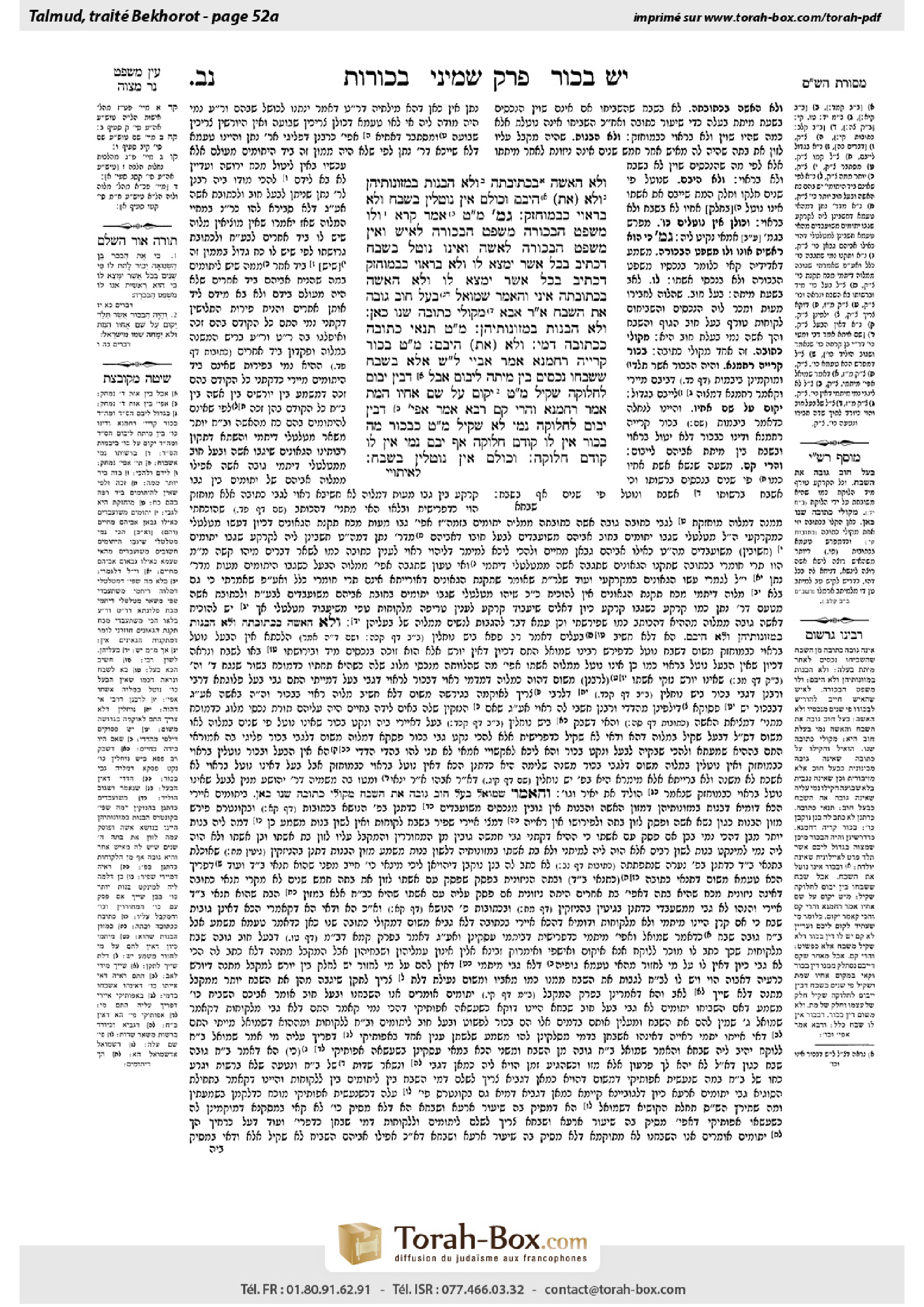
Bekhorot 52a: Talmud study for Daf Yomi
Study the Talmud for Daf Yomi with scanned pages, Hebrew text, English translations from Sefaria and AI-generated French translations.
Passage selection and English or AI-generated French translation are available where the scan has annotations. Daf Study is independent of Torah-Box and Sefaria.
Browse Bekhorot · בכורות · All tractatesBekhorot 52a text and translations
This page of Bekhorot includes the Aramaic text, an English translation and an AI-generated French translation, alongside the scan above.
בכורות נ״ב א · Aramaic and Hebrew text
וְלֹא הָאִשָּׁה בִּכְתוּבָּתָהּ, וְלֹא הַבָּנוֹת בִּמְזוֹנוֹתֵיהֶן, וְלֹא אֶת הַיָּבָם, וְכוּלָּם אֵין נוֹטְלִין בַּשֶּׁבַח וְלֹא בָּרָאוּי כְּבַמּוּחְזָק.
גְּמָ׳ מַאי טַעְמָא? אָמַר קְרָא: ״וְלוֹ מִשְׁפַּט הַבְּכוֹרָה״ — מִשְׁפַּט הַבְּכוֹרָה לָאִישׁ, וְאֵין מִשְׁפַּט הַבְּכוֹרָה לָאִשָּׁה.
וְאֵינוֹ נוֹטֵל בַּשֶּׁבַח. דִּכְתִיב: ״בְּכֹל אֲשֶׁר יִמָּצֵא לוֹ״, וְלֹא בָּרָאוּי כְּבַמּוּחְזָק, דִּכְתִיב: ״בְּכֹל אֲשֶׁר יִמָּצֵא לוֹ״.
וְלֹא הָאִשָּׁה בִּכְתוּבָּתָהּ. אִינִי? וְהָאָמַר שְׁמוּאֵל: בַּעַל חוֹב גּוֹבֶה אֶת הַשֶּׁבַח! אָמַר רַבִּי אַבָּא: מִקּוּלֵּי כְתוּבָּה שָׁנוּ כָּאן.
וְלֹא הַבָּנוֹת בִּמְזוֹנוֹתֵיהֶן. מַאי טַעְמָא? תְּנַאי כְּתוּבָּה כִּכְתוּבָּה דָּמֵי.
וְלֹא (אֶת) הַיָּבָם. מַאי טַעְמָא? ״בְּכוֹר״ קַרְיֵיהּ רַחֲמָנָא. אָמַר אַבָּיֵי: לֹא שָׁנוּ אֶלָּא בְּשֶׁבַח שֶׁשָּׁבְחוּ נְכָסִים בֵּין מִיתָה לְיִבּוּם, אֲבָל דְּבֵין יִבּוּם לַחֲלוּקָּה — שָׁקֵיל. מַאי טַעְמָא? ״יָקוּם עַל שֵׁם אָחִיו הַמֵּת״ אָמַר רַחֲמָנָא, וַהֲרֵי קָם.
רָבָא אָמַר: אֲפִילּוּ דְּבֵין יִבּוּם לַחֲלוּקָּה נָמֵי לָא שָׁקֵיל, מַאי טַעְמָא? כִּבְכוֹר, מָה בְּכוֹר אֵין לוֹ קוֹדֶם חֲלוּקָּה, אַף יָבָם נָמֵי אֵין לוֹ קוֹדֶם חֲלוּקָּה.
וְכוּלָּם אֵין נוֹטְלִין בַּשֶּׁבַח,
Bekhorot 52a · English translation
And neither does a woman take these portions, i.e., any enhancement of the value of the property or the property due the husband, from her husband’s property for payment of her marriage contract upon her divorce or her husband’s death; nor do the daughters take this share of the property for their sustenance, to which they are entitled from their late father’s possessions. Nor does a man whose married brother died childless [yavam] receive these portions, even though he acquires his brother’s portion of their shared father’s inheritance after performing levirate marriage with his brother’s wife. The mishna summarizes: And all of them do not take a portion in any enhancement of the value of the property after the death of the owner, nor do they take a portion in property due the deceased, as they do in property in his possession.
GEMARA: The mishna teaches that the firstborn son does not receive a double portion when inheriting the property of his mother. The Gemara asks: What is the reason? The Gemara explains that the verse states: “The law of primogeniture is his” (Deuteronomy 21:17); this is understood to mean that there is a law of primogeniture for a man, i.e., a duty to bequeath a double portion to his firstborn son, and there is no law of primogeniture for a woman.
The mishna teaches further: And neither does he take twice the portion in any enhancement of the value of the property after the death of his father. The Gemara explains that this is because it is written: “A double portion of all that he has” (Deuteronomy 21:17), and this enhancement was not in his father’s possession at the time of his death. The mishna also teaches: Nor does he take twice the portion in property due the father, as he does in the property in possession of the father. The Gemara explains that this too is because it is written: “Of all that he has” (Deuteronomy 21:17), and property due the father is not in his possession.
§ The mishna teaches: And neither does a woman take any enhancement of the value of the property or the property due the husband, from her husband’s property for payment of her marriage contract. The Gemara asks: Is that so? But doesn’t Shmuel say a creditor collects the value of the enhancement of the field of a borrower after the latter’s death? Since a wife’s marriage contract is like a promissory note, she is considered a creditor. Rabbi Abba says: The Sages taught here one of the leniencies for the husband that apply to a marriage contract: That a woman does not collect the value of the enhancement despite the fact that she is a creditor.
The mishna teaches: Nor do the daughters take this share of the property for their sustenance, to which they are entitled from their late father’s possessions. The Gemara asks: What is the reason for this? The Gemara explains that a stipulation in the marriage contract, such as that the daughters are entitled to sustenance from the father’s property after his death, is comparable to the marriage contract itself, and therefore they cannot claim that which cannot be claimed from a marriage contract, i.e., an enhancement to the father’s property.
The mishna teaches: Nor does the yavam receive these portions. The Gemara asks: What is the reason for this? The Gemara answers that the Merciful One calls the yavam a firstborn, in the verse: “And it shall be, the firstborn” (Deuteronomy 25:6). Abaye says: The Sages taught this halakha only with regard to an enhancement by which the property was enhanced between the death of the brother and the levirate marriage. But concerning the enhancement that occurs between the levirate marriage and the distribution of the inheritance, he does take it. What is the reason? The Merciful One states: “Shall succeed in the name of his brother who is dead” (Deuteronomy 25:6), and by that stage he has succeeded him, and the enhancement occurred at that stage.
Rava says: Even with regard to the enhancement that occurs between the levirate marriage and the distribution of the inheritance, the yavam does not take it. What is the reason? He is compared to a firstborn: Just as a firstborn does not have any special right to the inheritance before its distribution, so too, a yavam does not have any right to the inheritance before its distribution.
The mishna teaches: And all of them do not take a portion in any enhancement.
Bekhorot 52a · Traduction française (IA)
Et la femme ne prend pas ces parts, c'est-à-dire toute augmentation de valeur du bien ou le bien qui revient au mari, du bien du mari pour payer son contrat de mariage en cas de divorce ou de décès de son mari ; ni les filles ne prennent cette part du bien pour leur subsistance, à laquelle elles ont droit dans les biens de leur père décédé. Ni un homme dont son frère marié est mort sans enfants [yavam] ne reçoit ces parts, même s'il acquiert la part de son frère dans l'héritage de leur père commun après avoir épousé la veuve de son frère. La mitsna résume : Et tous ne prennent pas une part dans toute augmentation de valeur du bien après le décès du propriétaire, ni ne prennent-ils une part dans le bien qui revient au défunt, comme ils le font dans le bien qui était en son possession.
GUEMARA : La mitsna enseigne que le premier-né ne reçoit pas une double part lors de l'héritage des biens de sa mère. La Guemara demande : Quel est le motif ? La Guemara explique que le verset dit : « La loi du premier-né est à lui » (Deutéronome 21:17) ; cela signifie qu'il y a une loi du premier-né pour un homme, c'est-à-dire une obligation de transmettre une double part à son premier-né, et qu'il n'y a pas de loi du premier-né pour une femme.
La mitsna enseigne davantage : Et il ne prend pas double part dans toute augmentation de valeur du bien après le décès de son père. La Guemara explique que cela est parce que cela est écrit : « Une double part de tout ce qu'il a » (Deutéronome 21:17), et cette augmentation n'était pas en possession de son père au moment de son décès. La mitsna enseigne aussi : Ni ne prend-il double part dans le bien qui revient au père, comme il le fait dans le bien en possession du père. La Guemara explique que cela est aussi parce que cela est écrit : « De tout ce qu'il a » (Deutéronome 21:17), et le bien qui revient au père n'est pas en possession de celui-ci.
§ La mitsna enseigne : Et la femme ne prend pas d'augmentation de valeur du bien ou le bien qui revient au mari, du bien du mari pour payer son contrat de mariage. La Guemara demande : Est-ce ainsi ? Mais ne dit pas Shmuel qu'un créancier récupère la valeur de l'augmentation du champ d'un emprunteur après le décès de ce dernier ? Puisque le contrat de mariage de la femme est comme un billet de change, elle est considérée comme une créancière. Rabbi Abba dit : Les Sages ont enseigné ici l'une des facilités pour le mari qui s'applique au contrat de mariage : que la femme ne récupère pas la valeur de l'augmentation malgré le fait qu'elle est une créancière.
La mitsna enseigne : Ni les filles ne prennent cette part du bien pour leur subsistance, à laquelle elles ont droit dans les biens de leur père décédé. La Guemara demande : Quel est le motif de cela ? La Guemara explique que la stipulation du contrat de mariage, telle que les filles aient droit à la subsistance des biens du père après son décès, est comparable au contrat de mariage lui-même, et par conséquent elles ne peuvent revendiquer ce qui ne peut être revendiqué d'un contrat de mariage, c'est-à-dire une augmentation des biens du père.
La mitsna enseigne : Ni le yavam ne reçoit ces parts. La Guemara demande : Quel est le motif de cela ? La Guemara répond que l'Éternel appelle le yavam un premier-né, dans le verset : « Et il sera, le premier-né » (Deutéronome 25:6). Abaye dit : Les Sages ont enseigné cette halakha uniquement concernant une augmentation par laquelle le bien a été amélioré entre la mort du frère et le mariage levirat. Concernant l'augmentation qui a lieu entre le mariage levirat et la distribution de l'héritage, il la prend. Quel est le motif ? L'Éternel dit : « Il succédera au nom de son frère décédé » (Deutéronome 25:6), et à ce stade il a succédé à son frère, et l'augmentation a eu lieu à ce stade.
Rava dit : Même en ce qui concerne l'augmentation qui a lieu entre le mariage levirat et la distribution de l'héritage, le yavam ne la prend pas. Quel est le motif ? Il est comparé à un premier-né : Tout comme le premier-né n'a pas de droit particulier à l'héritage avant sa distribution, de même le yavam n'a pas de droit à l'héritage avant sa distribution.
La mitsna enseigne : Et aucun d'entre eux ne prend une part à toute augmentation.
Traduction française générée par IA à partir de l’édition anglaise de Sefaria. Vérifie toujours un passage avec le texte source.
Text from Sefaria: William Davidson Edition - Vocalized Aramaic (CC BY NC); William Davidson Edition - English (CC BY NC).