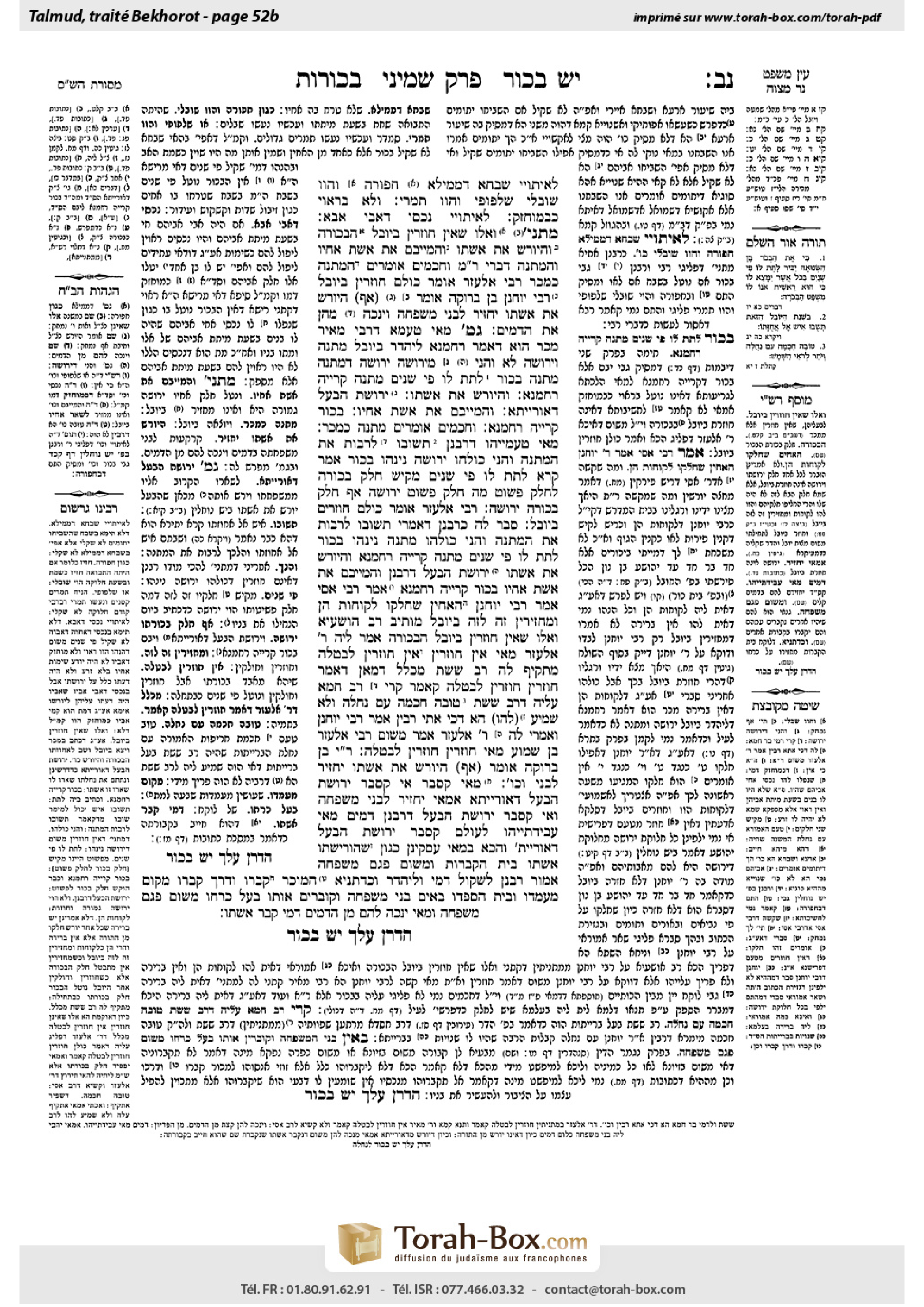
Bekhorot 52b: Talmud study for Daf Yomi
Study the Talmud for Daf Yomi with scanned pages, Hebrew text, English translations from Sefaria and AI-generated French translations.
Passage selection and English or AI-generated French translation are available where the scan has annotations. Daf Study is independent of Torah-Box and Sefaria.
Browse Bekhorot · בכורות · All tractatesBekhorot 52b text and translations
This page of Bekhorot includes the Aramaic text, an English translation and an AI-generated French translation, alongside the scan above.
בכורות נ״ב ב · Aramaic and Hebrew text
לְאֵיתוֹיֵי שְׁבָחָא דְּמִמֵּילָא: חֲפוּרָה וַהֲווֹ שׁוּבְלֵי, שַׁלְפּוּפֵי וַהֲווֹ תַּמְרֵי.
וְלֹא בָּרָאוּי כְּבַמּוּחְזָק, לְאֵיתוֹיֵי נִכְסֵי דַּאֲבִי אַבָּא.
מַתְנִי׳ וְאֵלּוּ שֶׁאֵין חוֹזְרִין בַּיּוֹבֵל — הַבְּכוֹרָה, וְהַיּוֹרֵשׁ אֶת אִשְׁתּוֹ, וְהַמְיַיבֵּם אֶת אֵשֶׁת אָחִיו.
וְהַמַּתָּנָה — דִּבְרֵי רַבִּי מֵאִיר, וַחֲכָמִים אוֹמְרִים: הַמַּתָּנָה כַּמֶּכֶר, רַבִּי אֶלְעָזָר אוֹמֵר: כּוּלָּם חוֹזְרִין בַּיּוֹבֵל, רַבִּי יוֹחָנָן בֶּן בְּרוֹקָה אוֹמֵר: אַף הַיּוֹרֵשׁ אֶת אִשְׁתּוֹ יַחְזִיר לִבְנֵי מִשְׁפָּחָה, וִינַכֶּה מֵהֶן אֶת הַדָּמִים.
גְּמָ׳ מַאי טַעְמָא דְּרַבִּי מֵאִיר? מֶכֶר הוּא דְּאָמַר רַחֲמָנָא לֶיהְדַּר בַּיּוֹבֵל, מַתָּנָה וִירוּשָּׁה לָא. וְהָנֵי מִיְּרוּשָּׁה — יְרוּשָּׁה, דְּמַתָּנָה — מַתָּנָה. בְּכוֹר — ״לָתֶת לוֹ פִּי שְׁנַיִם״, מַתָּנָה קַרְיֵיהּ רַחֲמָנָא.
וְהַיּוֹרֵשׁ אֶת אִשְׁתּוֹ, יְרוּשַּׁת הַבַּעַל דְּאוֹרָיְיתָא, וְהַמְיַיבֵּם אֶת אֵשֶׁת אָחִיו — ״בְּכוֹר״ קַרְיֵיהּ רַחֲמָנָא.
וַחֲכָמִים אוֹמְרִים: מַתָּנָה כְּמֶכֶר. מַאי טַעְמַיְיהוּ דְּרַבָּנַן? ״תָּשׁוּבוּ״ — לְרַבּוֹת אֶת הַמַּתָּנָה.
וְהָנֵי כּוּלְּהוּ יְרוּשָּׁה נִינְהוּ.
בְּכוֹר אָמַר קְרָא: ״לָתֶת לוֹ פִּי שְׁנַיִם״, מַקִּישׁ חֵלֶק בְּכוֹרָה לְחֵלֶק פָּשׁוּט — מָה חֵלֶק פָּשׁוּט יְרוּשָּׁה, אַף חֵלֶק בְּכוֹרָה יְרוּשָּׁה.
רַבִּי אֶלְעָזָר אוֹמֵר: כּוּלָּם חוֹזְרִים בַּיּוֹבֵל. סָבַר לַהּ כְּרַבָּנַן דְּאָמְרִי: ״תָּשׁוּבוּ״ לְרַבּוֹת אֶת הַמַּתָּנָה, וְהָנֵי כּוּלְּהוּ מַתָּנָה נִינְהוּ. בְּכוֹר — ״לָתֶת לוֹ פִּי שְׁנַיִם״, מַתָּנָה קַרְיֵיהּ רַחֲמָנָא.
וְהַיּוֹרֵשׁ אֶת אִשְׁתּוֹ — יְרוּשַּׁת הַבַּעַל דְּרַבָּנַן, וְהַמְיַיבֵּם אֶת אֵשֶׁת אָחִיו — ״בְּכוֹר״ קַרְיֵיהּ רַחֲמָנָא.
אָמַר רַבִּי אַסִּי אָמַר רַבִּי יוֹחָנָן: הָאַחִין שֶׁחָלְקוּ לָקוֹחוֹת הֵן, וּמַחְזִירִין זֶה לָזֶה בַּיּוֹבֵל. מוֹתֵיב רַב הוֹשַׁעְיָא: וְאֵלּוּ שֶׁאֵין חוֹזְרִין בַּיּוֹבֵל — הַבְּכוֹרָה!
אֲמַר לֵיהּ רַבִּי אֶלְעָזָר: מַאי ״אֵין חוֹזְרִין״ — אֵין חוֹזְרִין לְבַטָּלָה. מַתְקֵיף לַהּ רַב שֵׁשֶׁת: מִכְּלָל דְּמַאן דְּאָמַר ״חוֹזְרִין״ — חוֹזְרִין לְבַטָּלָה קָאָמַר?
קָרֵי רַב חָמָא עֲלֵיהּ דְּרַב שֵׁשֶׁת: ״טוֹבָה חׇכְמָה עִם נַחֲלָה״, וְלָא שְׁמִיעַ לְהוּ הָא דְּכִי אָתֵי רָבִין אָמַר רַבִּי יוֹחָנָן, וְאָמְרִי לַהּ רַבִּי אֶלְעָזָר אָמַר מִשּׁוּם רַבִּי אֶלְעָזָר בֶּן שַׁמּוּעַ: מַאי ״חוֹזְרִין״ — חוֹזְרִין לְבַטָּלָה.
רַבִּי יוֹחָנָן בֶּן בְּרוֹקָה אוֹמֵר: אַף הַיּוֹרֵשׁ אֶת אִשְׁתּוֹ יַחְזִיר לִבְנֵי וְכוּ׳. מַאי קָסָבַר? אִי קָסָבַר יְרוּשַּׁת הַבַּעַל דְּאוֹרָיְיתָא — אַמַּאי יַחְזִיר לִבְנֵי מִשְׁפָּחָה? וְאִי קָסָבַר יְרוּשַּׁת הַבַּעַל דְּרַבָּנַן — דָּמִים מַאי עֲבִידְתַּיְיהוּ?
לְעוֹלָם קָסָבַר יְרוּשַּׁת הַבַּעַל דְּאוֹרָיְיתָא, וְהָכָא בְּמַאי עָסְקִינַן? כְּגוֹן שֶׁהוֹרִישַׁתּוּ אִשְׁתּוֹ בֵּית הַקְּבָרוֹת, וּמִשּׁוּם פְּגַם מִשְׁפָּחָה אֲמוּר רַבָּנַן: לִשְׁקוֹל דְּמֵי וְלַיהְדַּר.
וְכִדְתַנְיָא: הַמּוֹכֵר קִבְרוֹ, וְדֶרֶךְ קִבְרוֹ, מְקוֹם מַעֲמָדוֹ, וּבֵית הֶסְפֵּדוֹ — בָּאִים בְּנֵי מִשְׁפָּחָה וְקוֹבְרִים אוֹתוֹ בְּעַל כׇּרְחוֹ, מִשּׁוּם פְּגַם מִשְׁפָּחָה. וּמַאי ״יְנַכֶּה לָהֶם מִן הַדָּמִים״? דְּמֵי קֶבֶר אִשְׁתּוֹ.
הֲדַרַן עֲלָךְ יֵשׁ בְּכוֹר.
Bekhorot 52b · English translation
The Gemara explains that this halakha is repeated in order to include an enhancement that occurs by itself after the death of the father or husband, for instance in a case when fodder [ḥafura], i.e., produce that has grown stalks but is not yet ripe, becomes full ears, or when date flowers [shalpufei] become fully developed dates. Despite the fact that in such cases the property became enhanced by itself, without any effort on the part of the other brothers, the firstborn may not claim his double portion from that enhancement, and the same applies in the other cases mentioned in the mishna.
With regard to the repetition of the statement: Nor does he take twice the portion in property due the father as he does in property in his possession, this serves to include property of the father’s father, in a case where the father died before his own father. The firstborn does not receive his portion in such property, despite the fact that it will certainly come into the father’s possession, as this too is considered property that is due the father, not property in his possession. The same halakha applies also in the case of property due the wife, the daughters, or a yavam.
MISHNA: And these are the people whose properties, unlike an ancestral field, do not return to their original owners in the Jubilee Year: The firstborn who inherited his father’s property by the right of primogeniture need not return the extra portion for redistribution among the brothers; and one who inherits his wife’s property need not return it to her family; and one who consummates the levirate marriage with the wife of his brother and gains the right to his brother’s property need not return it for redistribution among the brothers.
And likewise, a gift of land need not be returned to the original owners in the Jubilee Year; this is the statement of Rabbi Meir. And the Rabbis say: The halakhic status of a gift is like that of a sale, and it must be returned. Rabbi Elazar says: All these lands return in the Jubilee Year. Rabbi Yoḥanan ben Beroka says: Even one who inherits his wife’s property must return the land to the members of her father’s family and should deduct from them the monetary value of the land, as the Gemara will explain.
GEMARA: The Gemara asks: What is the reason of Rabbi Meir, who holds that none of these items return in the Jubilee Year? The Gemara answers: It is with regard to land acquired specifically by means of a sale that the Merciful One states that it should be returned during the Jubilee Year (see Leviticus 25:28), whereas a gift and an inheritance are not returned. And these cases listed in the mishna that are derived from the halakha of an inheritance have the status of an inheritance, and those that are derived from a gift have the status of a gift. The Gemara elaborates: With regard to a firstborn, it is stated: “By giving him a double portion” (Deuteronomy 21:17); here the Merciful One calls the portion of a firstborn a gift, an item that is given.
And one who inherits his wife’s property need not return it to her family in the Jubilee Year, as Rabbi Meir maintains that the inheritance of a husband is by Torah law, not a rabbinic enactment, and land acquired through inheritance is not returned. And likewise, one who consummates the levirate marriage with the wife of his brother need not return the brother’s property for redistribution among the brothers. This is because the Merciful One calls the yavam a firstborn, in the verse: “And it shall be, the firstborn” (Deuteronomy 25:6), and Rabbi Meir holds that the portion of the firstborn is not returned in the Jubilee Year, as explained earlier.
The mishna further teaches: And the Rabbis say: The halakhic status of a gift is like that of a sale, and must be returned. The Gemara asks: What is the reason of the Rabbis? The Gemara answers that the term “you shall return” in the verse: “In the Jubilee Year you shall return every man to his possession” (Leviticus 25:13), is superfluous, as it is already stated: “It shall be a Jubilee for you, and you shall return every man to his possession” (Leviticus 25:10). Therefore, this term serves to include a gift, which is also returned in the Jubilee Year.
And these other cases listed in the mishna are all considered as an inheritance, and consequently they are not returned in the Jubilee Year. With regard to the husband’s inheritance of his wife’s property, the Rabbis, like Rabbi Meir, maintain that it applies by Torah law, and they agree that the yavam is considered like a firstborn with respect to his portion.
As for a firstborn, the verse states: “By giving him a double portion” (Deuteronomy 21:17), and the Rabbis disagree with Rabbi Meir, who derives from this verse that the portion of the firstborn has the status of a gift. Rather, they maintain that the verse juxtaposes the extra portion of the firstborn to the portion he receives as an ordinary brother: Just as the portion of an ordinary brother is not redistributed among the brothers in the Jubilee Year, but rather is an inheritance, as it is stated: “On the day that he causes his sons to inherit” (Deuteronomy 21:16), so too the portion of the firstborn is an inheritance, and is not returned in the Jubilee Year.
The mishna further teaches that Rabbi Elazar says: All these lands return in the Jubilee Year. The Gemara explains that Rabbi Elazar holds in accordance with the opinion of the Rabbis, who say that the term “you shall return” serves to include a gift, and he further maintains that these cases listed in the mishna are all considered gifts. The Gemara elaborates: With regard to a firstborn it is stated: “By giving him a double portion.” Through the use of the term “giving,” the Merciful One calls his portion a gift.
And with regard to one who inherits his wife’s property, Rabbi Elazar maintains that the inheritance of a husband is by rabbinic law, and therefore it does not have the status of an inheritance that does not return in the Jubilee Year. And finally, one who consummates the levirate marriage with the wife of his brother returns the property for redistribution among the brothers, as the Merciful One calls him a firstborn, and Rabbi Elazar rules that the portion of the firstborn is returned in the Jubilee Year.
§ Rabbi Asi says that Rabbi Yoḥanan says: Brothers who divided property received as an inheritance are considered purchasers from each other, i.e., one does not say they each received the exact inheritance to which they were entitled. And as purchasers of land, they must return the portions to each other in the Jubilee Year, at which point they redistribute the property. Rav Hoshaya raises an objection from the mishna: And these are the people whose properties do not return to their original owners in the Jubilee Year: The firstborn who inherited his father’s property by the right of primogeniture.
Rabbi Elazar said to Rav Hoshaya: What is the meaning of the clause: They do not return? It means that they do not return for naught, i.e., the firstborn does not forfeit the double portion; rather, when they redistribute the property he again receives a double portion. Rav Sheshet objects to this: By inference from this answer, should one conclude that the one who says the portion of the firstborn returns in the Jubilee Year is saying that it returns for naught? Why should the firstborn lose his double portion?
Rav Ḥama read the verse about Rav Sheshet: “Wisdom is good with an inheritance” (Ecclesiastes 7:11), i.e., it is not enough to inherit knowledge of baraitot, as does Rav Sheshet; rather, one must also be expert in the wisdom of amora’im. Rav Ḥama explained: Didn’t Rav Sheshet hear this matter, that when Ravin came from Eretz Yisrael to Babylonia, he said that Rabbi Yoḥanan says, and some say that Rabbi Elazar said it in the name of Rabbi Elazar ben Shammua, who is the tanna Rabbi Elazar in the mishna: What is the meaning of the clause: They return in the Jubilee Year? It means that they return for naught, and they forfeit that which they received.
§ The mishna teaches that Rabbi Yoḥanan ben Beroka says: Even one who inherits his wife’s property must return the land to the members of her father’s family and should deduct from them the monetary value of the land. The Gemara asks: What does Rabbi Yoḥanan ben Beroka hold? If he holds that the inheritance of a husband is by Torah law, why must he return the property to the members of his wife’s family? An inheritance by Torah law is not given back in the Jubilee Year. And if he holds that the inheritance of a husband is by rabbinic law, what is the purpose of the money he receives from his wife’s relatives? Since the property belongs to them, they should not have to pay him anything.
The Gemara answers: Actually, Rabbi Yoḥanan ben Beroka holds that the inheritance of a husband is by Torah law, and what are we dealing with here? We are dealing with a case where his wife bequeathed to him her family’s graveyard. And due to the need to avoid a family flaw, i.e., harm to the family name, if the wife’s family would be buried in plots belonging to others, the Sages said he should take money from them and return the graveyard.
And this is as it is taught in a baraita discussing halakhot connected with burial that serve to uphold family honor: In the case of one who sells his grave, or the path to his grave, or the place where visitors would stand to comfort the mourners, or the place of his eulogies, the members of his family may come and bury him in his ancestral plot against the purchaser’s wishes, due to the need to avoid a family flaw, i.e., harm to the family name. And what is the meaning of the clause: And deduct for them part of the monetary value of the property? It means that he must deduct the monetary value of his wife’s grave from the value of the field, as a husband is obligated to pay for his wife’s burial (see Ketubot 47b).
Bekhorot 52b · Traduction française (IA)
La Guemara explique que cette halakha est répétée afin d'inclure une amélioration qui se produit d'elle-même après la mort du père ou du mari, par exemple dans le cas où des épis [ḥafura], c'est-à-dire des produits qui ont des tiges mais ne sont pas encore mûrs, deviennent des épis complets, ou lorsque les fleurs de datte [shalpufei] deviennent des datte pleinement développées. Malgré le fait que dans de tels cas la propriété s'est améliorée d'elle-même, sans aucun effort de la part des autres frères, le premier-né ne peut pas revendiquer sa double part de cette amélioration, et cela s'applique de la même manière aux autres cas mentionnés dans la michna.
Concernant la répétition de la déclaration : « Il ne prend pas double portion en propriété due au père comme il le fait en propriété qu'il possède », cela sert à inclure la propriété du père du père, dans le cas où le père est mort avant son propre père. Le premier-né ne reçoit pas sa part de cette propriété, malgré le fait qu'elle entrera certainement en possession du père, car cela est considéré comme une propriété due au père, pas une propriété qu'il possède. La même halakha s'applique également au cas de la propriété due à la femme, aux filles ou à un yavam.
MICHNA : Et ces sont les personnes dont les propriétés, contrairement à un champ ancestral, ne reviennent pas à leurs propriétaires originels lors de l'année sabbatique : le premier-né qui a hérité de la propriété de son père par le droit de primogeniture n'a pas besoin de rendre la part supplémentaire pour la redistribuer parmi les frères ; et celui qui hérite de la propriété de sa femme n'a pas besoin de la rendre à sa famille ; et celui qui consomme le mariage leviratique avec la femme de son frère et obtient le droit à la propriété de son frère n'a pas besoin de la rendre pour la redistribuer parmi les frères.
Et de même, un don de terre n'a pas besoin d'être rendu aux propriétaires originaux lors de l'année sabbatique ; c'est l'opinion de Rabbi Meir. Et les Rabbins disent : le statut halakhique d'un don est comme celui d'une vente, et il doit être rendu. Rabbi Elazar dit : toutes ces terres reviennent lors de l'année sabbatique. Rabbi Yoḥanan ben Beroka dit : même celui qui hérite de la propriété de sa femme doit rendre la terre aux membres de la famille de son père et doit déduire de leur valeur monétaire, comme l'explique la Guemara.
GUEMARA : La Guemara demande : quelle est la raison de Rabbi Meir, qui affirme que rien de ces choses ne revient lors de l'année sabbatique ? La Guemara répond : c'est concernant la terre acquise spécifiquement par une vente que l'Éternel dit qu'elle doit être rendue lors de l'année sabbatique (cf. Lévitique 25:28), alors que les dons et les héritages ne sont pas rendus. Et ces cas listés dans la michna, dérivés de la halakha de l'héritage, ont le statut d'héritage, et ceux dérivés d'un don ont le statut de don. La Guemara développe : concernant le premier-né, il est dit : « En lui donnant une double portion » (Deutéronome 21:17) ; ici l'Éternel appelle la portion du premier-né un don, un objet donné.
Et celui qui hérite de la propriété de sa femme n'a pas besoin de la rendre à sa famille lors de l'année sabbatique, selon Rabbi Meir, qui maintient que l'héritage du mari est selon la loi de la Torah, pas un édict rabbinique, et la terre acquise par héritage n'est pas rendue. De même, celui qui consomme le mariage leviratique avec la femme de son frère n'a pas besoin de rendre la propriété de son frère pour la redistribuer parmi les frères. Cela est dû au fait que l'Éternel appelle le yavam un premier-né, dans la verset : « Et il sera, le premier-né » (Deutéronome 25:6), et Rabbi Meir maintient que la portion du premier-né n'est pas rendue lors de l'année sabbatique, comme expliqué précédemment.
La Michna enseigne davantage : les Rabbins disent que le statut halakhique d'un don est comme celui d'une vente, et doit être rendu. La Guemara demande : quelle est la raison des Rabbins ? La Guemara répond que le terme « vous rendrez » dans la versette : « Dans l'année sabbatique, vous rendrez à chacun son possession » (Lévitique 25:13) est superflu, car il est déjà dit : « Il sera un sabbat pour vous, et vous rendrez à chacun son possession » (Lévitique 25:10). Ainsi, ce terme sert à inclure un don, qui est aussi rendu lors de l'année sabbatique.
Et ces autres cas mentionnés dans la Michna sont tous considérés comme un héritage, et par conséquent ils ne sont pas rendus lors de l'année sabbatique. Concernant l'héritage du mari de la propriété de sa femme, les Rabbins, comme Rabbi Meir, maintiennent qu'il s'applique selon la loi de la Torah, et ils s'accordent sur le fait que le yavam est considéré comme un premier-né concernant sa part.
Concernant le premier-né, la versette dit : « En lui donnant une double portion » (Deutéronome 21:17), et les Rabbins s'opposent à Rabbi Meir, qui dérive de cette versette que la portion du premier-né a le statut d'un don. Plutôt, ils maintiennent que la versette juxtapose la portion supplémentaire du premier-né à la portion qu'il reçoit comme frère ordinaire : tout comme la portion d'un frère ordinaire n'est pas redistribuée parmi les frères lors de l'année sabbatique, mais plutôt est un héritage, comme il est dit : « Le jour où il fera hériter ses fils » (Deutéronome 21:16), ainsi la portion du premier-né est un héritage, et n'est pas rendue lors de l'année sabbatique.
La Michna enseigne davantage que Rabbi Elazar dit : toutes ces terres reviennent lors de l'année sabbatique. La Guemara explique que Rabbi Elazar suit l'opinion des Rabbins, qui disent que le terme « vous rendrez » sert à inclure un don, et il affirme davantage que ces cas listés dans la Michna sont tous considérés comme des dons. La Guemara développe : concernant le premier-né, il est dit : « En lui donnant une double portion ». À travers l'utilisation du terme « donnant », l'Éternel appelle sa portion un don.
Et concernant celui qui hérite de la propriété de sa femme, le maître Eléazar affirme que l'héritage du mari est réglementé par la loi rabbinique, et par conséquent il ne possède pas le statut d'héritage qui ne revient pas à la Jubilé. Et enfin, celui qui consomme le mariage leviratique avec la femme de son frère restitue la propriété pour la redistribution parmi les frères, car l'Éternel l'appelle premier-né, et le maître Eléazar déclare que la part du premier-né est restituée à la Jubilé.
§ Le maître Asi dit que le maître Yochanan dit : Les frères qui ont divisé la propriété reçue en héritage sont considérés comme des acheteurs les uns des autres, c'est-à-dire qu'on ne dit pas qu'ils ont chacun reçu l'héritage exact auquel ils avaient droit. Et comme acheteurs de terre, ils doivent restituer les portions les unes aux autres à la Jubilé, à ce moment-là ils redistribuent la propriété. Le maître Hoshaya oppose un argument tiré de la mitsva : Et ces sont les gens dont les propriétés ne reviennent pas à leurs propriétaires originels à la Jubilé : le premier-né qui a hérité de la propriété de son père par le droit de primogeniture.
Le maître Eléazar dit au maître Hoshaya : Quel est le sens de la clause : Ils ne reviennent pas ? Cela signifie qu'ils ne reviennent pas à vide, c'est-à-dire que le premier-né ne perd pas la double portion ; plutôt, lorsqu'ils redistribuent la propriété, il reçoit à nouveau une double portion. Le maître Sheshet s'oppose à cela : Par l'inférence de cette réponse, devrait-on conclure que celui qui dit que la part du premier-né revient à la Jubilé dit qu'elle revient à vide ? Pourquoi le premier-né perdrait-il sa double portion ?
Le maître Chamâ lit la parole concernant le maître Sheshet : « La sagesse est bonne avec une héritage » (Ecclésiaste 7:11), c'est-à-dire qu'il n'est pas suffisant d'hériter de la connaissance des baraitot, comme le fait le maître Sheshet ; il faut aussi être expert dans la sagesse des amoraim. Le maître Chamâ explique : N'a-t-il pas entendu cette affaire, que lorsque Ravin est venu d'Israël en Babylone, il a dit que le maître Yochanan dit, et certains disent que le maître Eléazar l'a dit au nom du maître Eléazar ben Shammua, qui est le tanna Eléazar de la mitsna : Quel est le sens de la clause : Ils reviennent à la année du Jubilé ? Cela signifie qu'ils reviennent à vide, et ils perdent ce qu'ils ont reçu.
§ La mitsna enseigne que le maître Yochanan ben Beroka dit : Même celui qui hérite de la propriété de sa femme doit restituer la terre aux membres de la famille de sa femme et doit déduire de leur valeur monétaire la valeur de la terre. La Guemara demande : Quel est l'opinion du maître Yochanan ben Beroka ? S'il considère que l'héritage du mari est réglementé par la loi divine, pourquoi doit-il restituer la propriété aux membres de la famille de sa femme ? Un héritage réglementé par la loi divine n'est pas restitué à la Journee du Jubilé. Et s'il considère que l'héritage du mari est réglementé par la loi rabbinique, à quoi sert l'argent qu'il reçoit des parents de sa femme ? Puisque la propriété appartient à eux, ils ne devraient pas avoir à lui payer quoi que ce soit.
La Guemara répond : En réalité, le maître Yochanan ben Beroka considère que l'héritage du mari est réglementé par la loi divine, et à quoi sommes-nous en train de faire référence ? Nous faisons référence à un cas où sa femme a légué à lui sa tombe familiale. Et en raison du besoin d'éviter une faute familiale, c'est-à-dire un préjudice au nom de la famille, si la famille de la femme serait enterrée dans des parcelles appartenant à d'autres, les Sages ont dit qu'il devrait prendre de l'argent d'eux et restituer la tombe.
Et cela est comme il est enseigné dans une baraïta discutant des halakhot liées à l'enterrement qui servent à préserver l'honneur familial : Dans le cas d'un homme qui vend sa tombe, ou le chemin menant à sa tombe, ou la place où les visiteurs se tiennent pour consoler les veuves, ou la place de ses funérailles, les membres de sa famille peuvent venir l'enterrer dans sa tombe familiale contre la volonté de l'acheteur, en raison du besoin d'éviter une faute familiale, c'est-à-dire un préjudice au nom de la famille. Et quel est le sens de la clause : Et déduire une part de la valeur monétaire de la propriété ? Cela signifie qu'il doit déduire la valeur monétaire de la tombe de sa femme de la valeur du champ, car le mari est tenu de payer pour l'enterrement de sa femme (voir Ketubot 47b).
Traduction française générée par IA à partir de l’édition anglaise de Sefaria. Vérifie toujours un passage avec le texte source.
Text from Sefaria: William Davidson Edition - Vocalized Aramaic (CC BY NC); William Davidson Edition - English (CC BY NC).