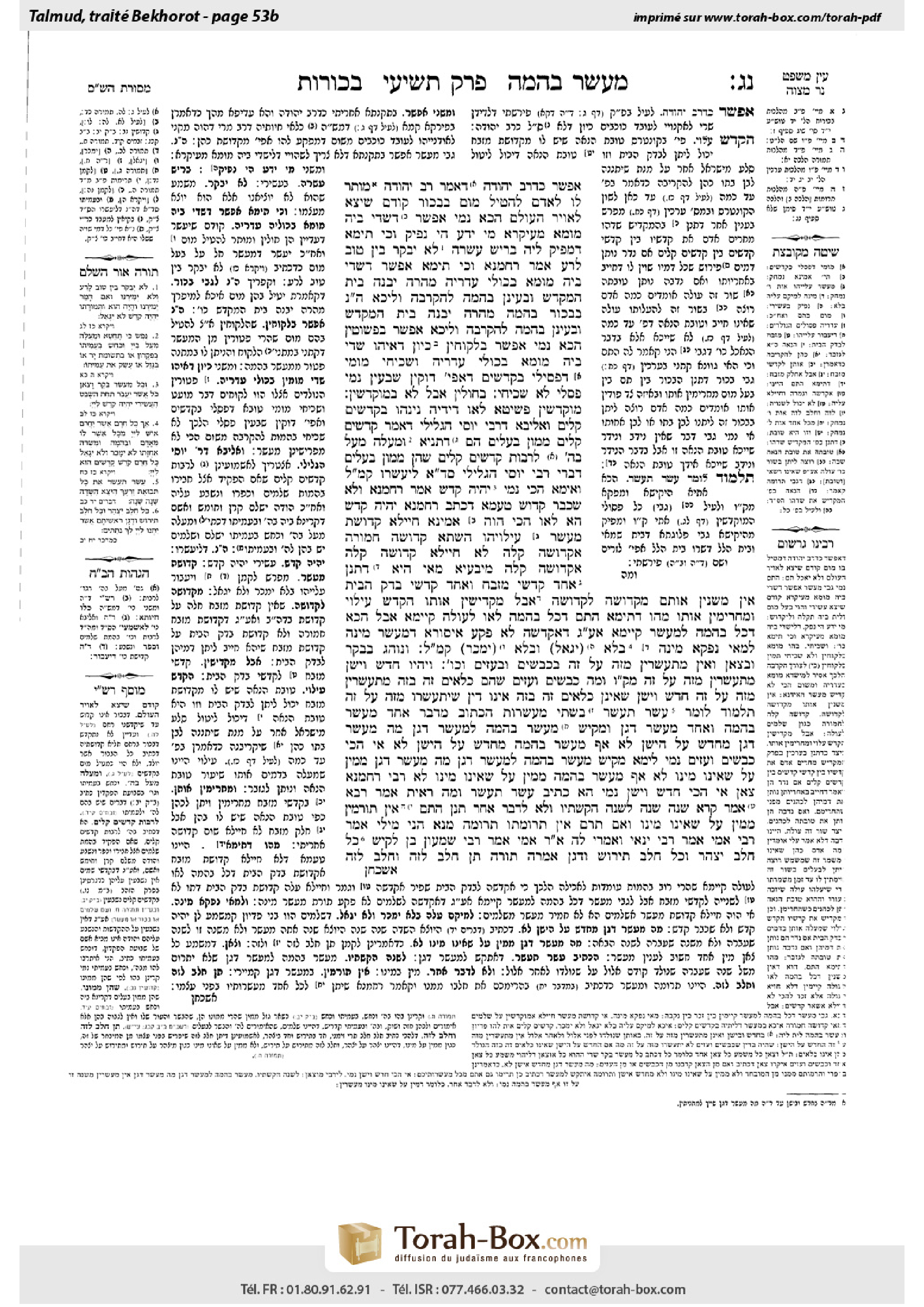
Bekhorot 53b: Talmud study for Daf Yomi
Study the Talmud for Daf Yomi with scanned pages, Hebrew text, English translations from Sefaria and AI-generated French translations.
Passage selection and English or AI-generated French translation are available where the scan has annotations. Daf Study is independent of Torah-Box and Sefaria.
Browse Bekhorot · בכורות · All tractatesBekhorot 53b text and translations
This page of Bekhorot includes the Aramaic text, an English translation and an AI-generated French translation, alongside the scan above.
בכורות נ״ג ב · Aramaic and Hebrew text
אֶפְשָׁר כִּדְרַב יְהוּדָה, דְּאָמַר רַב יְהוּדָה: מוּתָּר לוֹ לָאָדָם לְהַטִּיל מוּם בִּבְכוֹר קוֹדֶם שֶׁיָּצָא לַאֲוִיר הָעוֹלָם. הָכָא נָמֵי, אֶפְשָׁר דְּשָׁדֵי בֵּיהּ מוּמָא מֵעִיקָּרָא!
מִי יָדַע הֵי נָפֵיק? וְכִי תֵּימָא דְּמַפֵּיק לֵיהּ בְּרֵישׁ עַשְׂרָה — ״לֹא יְבַקֵּר בֵּין טוֹב לָרַע״ אָמַר רַחֲמָנָא.
וְכִי תֵּימָא: אֶפְשָׁר דְּשָׁדֵי בֵּיהּ מוּמָא בְּכוּלֵּיהּ עֶדְרֵיהּ — מְהֵרָה יִבָּנֶה בֵּית הַמִּקְדָּשׁ, וּבָעֵינַן בְּהֵמָה לְהַקְרָבָה וְלֵיכָּא.
הָכִי נָמֵי בִּבְכוֹר בְּהֵמָה, מְהֵרָה יִבָּנֶה בֵּית הַמִּקְדָּשׁ, וּבָעֵינַן בְּהֵמָה לְהַקְרָבָה וְלֵיכָּא! אֶפְשָׁר בִּפְשׁוּטִין.
הָכָא נָמֵי, אֶפְשָׁר בִּלְקוּחִין! כֵּיוָן דְּאִיהוּ שָׁדֵי בֵּיהּ מוּמָא בְּכוּלֵּיהּ עֶדְרֵיהּ, וּשְׁכִיחִי מוּמֵי דְּפָסְילִי בְּקָדָשִׁים, דַּאֲפִילּוּ דּוּקִּין שֶׁבָּעַיִן נָמֵי פָּסְלִי — לָא שְׁכִיחִי.
בַּחוּלִּין אֲבָל לֹא בַּמּוּקְדָּשִׁין. מוּקְדָּשִׁין — פְּשִׁיטָא, לָאו דִּידֵיהּ נִינְהוּ!
בְּקָדָשִׁים קַלִּים, וְאַלִּיבָּא דְּרַבִּי יוֹסֵי הַגְּלִילִי, דְּאָמַר: קָדָשִׁים קַלִּים מָמוֹן בְּעָלִים הֵם. דְּתַנְיָא: ״וּמָעֲלָה מַעַל בַּה׳״ — לְרַבּוֹת קֳדָשִׁים קַלִּים שֶׁהֵן מָמוֹן בְּעָלִים, דִּבְרֵי רַבִּי יוֹסֵי הַגְּלִילִי. סָלְקָא דַּעְתָּךְ אָמֵינָא לִיעַשְּׂרוּ, קָא מַשְׁמַע לַן.
וְאֵימָא הָכִי נָמֵי! ״יִהְיֶה קֹּדֶשׁ״ אָמַר רַחֲמָנָא, וְלֹא שֶׁכְּבָר קָדוֹשׁ.
טַעְמָא דִּכְתַב רַחֲמָנָא ״יִהְיֶה קֹּדֶשׁ״, הָא לָאו הָכִי הֲוָה אָמֵינָא חָיְילָא קְדוּשַּׁת מַעֲשֵׂר עִילָּוַיְהוּ? הַשְׁתָּא קְדוּשָּׁה חֲמוּרָה אַקְּדוּשָּׁה קַלָּה לָא חָיְילָא, קְדוּשָּׁה קַלָּה אַקְּדוּשָּׁה קַלָּה מִיבַּעְיָא?!
מַאי הִיא? דִּתְנַן: אֶחָד קׇדְשֵׁי מִזְבֵּחַ וְאֶחָד קׇדְשֵׁי בֶּדֶק הַבַּיִת, אֵין מְשַׁנִּין אוֹתָם מִקְּדוּשָּׁה לִקְדוּשָּׁה, אֲבָל מַקְדִּישִׁין אוֹתָן הֶקְדֵּשׁ עִילּוּי, וּמַחְרִימִין אוֹתָן.
מַהוּ דְּתֵימָא: הָתָם, דְּכׇל בְּהֵמָה לָאו לְעוֹלָה קָיְימָא, אֲבָל הָכָא, דְּכׇל בְּהֵמָה לְמַעֲשֵׂר קָיְימָא, אַף עַל גַּב דְּאַקְדְּשַׁהּ — לָא פָּקַע אִיסּוּרָא דְּמַעֲשֵׂר מִינַּהּ.
לְמַאי נָפְקָא מִינַּהּ? בְּ״לֹא יִגָּאֵל״ וּבְ״לֹא יִמָּכֵר״ קָא מַשְׁמַע לַן.
וְנוֹהֵג בַּבָּקָר וּבַצֹּאן, וְאֵין מִתְעַשְּׂרִין מִזֶּה עַל זֶה, בַּכְּבָשִׂים וּבָעִזִּים וְכוּ׳. וְיִהְיוּ חָדָשׁ וְיָשָׁן מִתְעַשְּׂרִין מִזֶּה עַל זֶה מִקַּל וְחוֹמֶר: וּמָה כְּבָשִׂים וְעִזִּים שֶׁהֵם כִּלְאַיִם זֶה בָּזֶה — מִתְעַשְּׂרִין מִזֶּה עַל זֶה, חָדָשׁ וְיָשָׁן שֶׁאֵינָן כִּלְאַיִם זֶה בָּזֶה — אֵינוֹ דִּין שֶׁיִּתְעַשְּׂרוּ מִזֶּה עַל זֶה?
תַּלְמוּד לוֹמַר: ״עַשֵּׂר תְּעַשֵּׂר״ בִּשְׁתֵּי מַעַשְׂרוֹת הַכָּתוּב מְדַבֵּר, אֶחָד מַעְשַׂר בְּהֵמָה וְאֶחָד מַעְשַׂר דָּגָן, וּמַקִּישׁ מַעְשַׂר בְּהֵמָה לְמַעֲשֵׂר דָּגָן: מָה מַעְשַׂר דָּגָן מֵחָדָשׁ עַל הַיָּשָׁן לֹא, אַף מַעְשַׂר בְּהֵמָה מֵחָדָשׁ עַל הַיָּשָׁן לֹא.
אִי הָכִי, כְּבָשִׂים וְעִזִּים נָמֵי לֵימָא: מַקִּישׁ מַעְשַׂר בְּהֵמָה לְמַעֲשֵׂר דָּגָן — מָה מַעְשַׂר דָּגָן מִמִּין עַל שֶׁאֵינוֹ מִינוֹ לֹא, אַף מַעְשַׂר בְּהֵמָה מִמִּין עַל שֶׁאֵינוֹ מִינוֹ לֹא? רַבִּי רַחֲמָנָא ״צֹאן״.
אִי הָכִי, חָדָשׁ וְיָשָׁן נָמֵי! הָא כְּתִיב ״עַשֵּׂר תְּעַשֵּׂר״. וּמָה רָאִיתָ? אָמַר רָבָא: אָמַר קְרָא ״שָׁנָה שָׁנָה״ — לְשָׁנָה הִקַּשְׁתִּיו, וְלֹא לְדָבָר אַחֵר.
תְּנַן הָתָם: אֵין תּוֹרְמִין מִמִּין עַל שֶׁאֵינוֹ מִינוֹ, וְאִם תָּרַם — אֵין תְּרוּמָתוֹ תְּרוּמָה. מְנָא הָנֵי מִילֵּי? אָמַר רַבִּי אַמֵּי אָמַר רַבִּי יַנַּאי, וְאָמְרִי לַהּ אָמַר רַבִּי אַמֵּי אָמַר רַבִּי שִׁמְעוֹן בֶּן לָקִישׁ: ״כׇּל חֵלֶב יִצְהָר וְכׇל חֵלֶב תִּירוֹשׁ וְדָגָן״ — אָמְרָה תּוֹרָה: תֵּן חֵלֶב לָזֶה וְחֵלֶב לָזֶה.
Bekhorot 53b · English translation
The Gemara explains that it is possible to act in a different manner, so that the priest does not lose out on his rights to the firstborn animal. One can act in accordance with the opinion of Rabbi Yehuda, as Rabbi Yehuda says: It is permitted for a person to inflict a blemish upon a firstborn animal fetus before it emerges into the air of the world. The Gemara challenges: If so, here too, it is possible for one to inflict a blemish from the outset, before the animal becomes consecrated as the tithed animal.
The Gemara answers: How can one know which animal will emerge as the tenth? Since it is impossible to know this, one cannot inflict a blemish on the animal before it becomes consecrated. And if you would say that one should bring out the animal upon which he has inflicted the blemish at the head of the ten animals to ensure that it will be the tithed animal, this is not a valid option, as the Merciful One states: “He shall not inquire whether it be good or bad” (Leviticus 27:33). This means one may not plan in advance which animal will be the tenth.
And if you would say it is possible to inflict a blemish on the entire herd of animals and thereby ensure the tenth one will be blemished, that is also undesirable. The reason is that soon the Temple will be rebuilt and we will require animals for offerings, and there will be none remaining without a blemish.
The Gemara asks: But here too, with regard to a firstborn animal, why not also say that soon the Temple will be rebuilt and we will require animals for offerings and there will be none remaining without a blemish? The Gemara answers: It is possible to bring the offerings from ordinary animals that are not firstborns.
The Gemara challenges: Here too, with regard to the animal tithe, it is possible to bring the offerings from animals purchased from another person, which are exempt from animal tithe, as taught in the mishna on 55b. The Gemara answers: Since anyone who has animals inflicts a blemish on all of the animals in his herd to avoid consecrating the tithe, there will be very few unblemished animals available for purchase. And furthermore, blemishes that disqualify sacrificial animals are common, as even if the blemish is small, e.g., on the animal’s eyelid, it disqualifies the animal from being used for sacrifice. Therefore, it will not be common to find animals fit to be used as offerings. For this reason the Sages decreed that one should not tithe his animals in the present time.
§ The mishna teaches that the mitzva of animal tithe is in effect with regard to non-sacred animals but not with regard to sacrificial animals. The Gemara raises a difficulty: It is obvious that the mitzva to tithe is not in effect with regard to sacrificial animals, as they are not his. Since sacrificial animals have been dedicated to the Temple, of course the owner cannot subsequently consecrate them.
The Gemara answers: The mishna is referring to offerings of lesser sanctity, e.g., peace offerings, and it is in accordance with the opinion of Rabbi Yosei HaGelili, who says: Offerings of lesser sanctity are the monetary property of their owners, and therefore the owner can consecrate them. As it is taught in a baraita with regard to the guilt offering of a robber who takes a false oath, that the verse: “And he commits a trespass against the Lord” (Leviticus 5:21), serves to include one who takes a false oath with regard to offerings of lesser sanctity belonging to another, which are the property of their owners. This is the statement of Rabbi Yosei HaGelili. Accordingly, it might enter your mind to say that such animals should be tithed. Therefore, the mishna teaches us that the mitzva of animal tithe is not in effect with regard to sacrificial animals at all.
The Gemara suggests: But one can say it is indeed so, i.e., perhaps offerings of lesser sanctity can indeed be tithed. The Gemara responds that the Merciful One states: “And all the tithe of the herd or the flock, whatever passes under the rod, the tenth shall be sacred to the Lord” (Leviticus 27:32). This teaches that this mitzva applies only to an animal that can become sacred in the future but not to an animal that is already sanctified, e.g., that has been set aside as an offering of lesser sanctity.
The Gemara raises a difficulty: The reason that offerings of lesser sanctity cannot be tithed is that the Merciful One writes: “The tenth shall be sacred to the Lord,” from which it can be inferred that were that not the case, I would say that the sanctity of the animal tithe does take effect on the animal. This claim is difficult, as now that consecration of stringent sanctity does not take effect with regard to offerings of lesser sanctity, as will be explained, is it necessary to teach that a consecration of lesser sanctity does not take effect with regard to offerings of lesser sanctity?
The Gemara clarifies: What is this halakha that consecration of stringent sanctity does not take effect with regard to offerings of lesser sanctity? As we learned in a mishna (Temura 32a): Both concerning animals consecrated for the altar and items consecrated for Temple maintenance, one cannot alter their designation from one form of sanctity to another form of sanctity. But one can consecrate an animal already consecrated for the altar by consecration of its value, and that value is donated to the Temple treasury for maintenance, in addition to the sacrificing of the animal. And one can dedicate that value for the purpose of giving it to the priests. This mishna teaches that one may not consecrate an animal that has already been consecrated for Temple maintenance as an offering for the altar, despite the fact that an offering has more stringent sanctity, and if so, then the sanctity of the animal tithe certainly does not take effect with regard to offerings of lesser sanctity.
The Gemara answers: Even so, it is necessary for the mishna to teach that tithes do not take effect on offerings of lesser sanctity, lest you say that there, in the mishna in Temura, the reason is that not every animal stands to potentially become a burnt offering, i.e., an offering of more stringent sanctity, from the time it is born. For this reason the greater sanctity cannot take effect once the animal has been consecrated as an offering of lesser sanctity. But in the mishna here, where every animal stands to potentially become an animal tithe offering, one might have thought that even though it is consecrated as an offering of lesser sanctity, nevertheless the initial potential prohibition, i.e., status, of animal tithe is not abrogated from it.
The Gemara clarifies: What difference is there if an animal that has been consecrated as a peace offering is also sanctified as an animal tithe offering? The Gemara explains that if it is sanctified as an animal tithe offering, the prohibition of: “It shall not be redeemed” (Leviticus 27:33), and the prohibition of: It shall not be sold (see 32b), take effect. A peace offering can be redeemed, whereas it is prohibited to redeem or sell animal tithe even after its slaughter. Therefore, the mishna teaches us that the sanctity of animal tithe does not take effect on animals that have been consecrated as offerings of lesser sanctity.
§ The mishna teaches: And the animal tithe is in effect with regard to the herd and the flock, but they are not tithed from one for the other; and it is in effect with regard to sheep and goats, and they are tithed from one for the other. In this regard the Gemara cites a baraita: Let it be proven that the animals from the new flock and the animals from the old flock can be tithed from one for the other, by an a fortiori inference: And if sheep and goats, which are prohibited for interbreeding with each other due to the prohibition of diverse kinds, are nevertheless tithed from one for the other, with regard to animals from the new flock and the old flock, which are not prohibited for interbreeding with each other as diverse kinds, is it not logical that they should be tithed from one for the other?
The baraita continues: Therefore, the verse states: “You shall tithe a tithe from all the increase of your seed that the field brings forth year by year. And you shall eat before the Lord your God, in the place that He shall choose to place His name there, the tithe of your grain, of your wine, and of your oil, and the firstborn of your herds and of your flocks; that you may learn to fear the Lord your God always” (Deuteronomy 14:22–23). Here, the verse is speaking of two tithes; one is the animal tithe and the other one is the grain tithe. And the verse juxtaposes the animal tithe to the grain tithe, teaching that just as the grain tithe is not taken from the new grain for the old grain, so too, the animal tithe is not taken from the new flock for the old flock.
The Gemara asks: If so, let us say with regard to sheep and goats that they too are not tithed for each other, by the same reasoning, i.e., that the verse juxtaposes the animal tithe to the grain tithe: Just as grain tithe is not separated from one type of grain for another grain that is not its type, so too, animal tithe is not separated from one type of animal for another species of animal that is not its type. The Gemara answers that with regard to animal tithe the Merciful One has amplified the halakha by stating “flock” (Leviticus 27:32). This teaches that all species referred to with the term flock, i.e., sheep and goats, are tithed together.
The Gemara suggests: If so, let us also say that new flocks are tithed together with old flocks, based on that amplification of the verse. The Gemara answers that it is written: “You shall tithe a tithe” (Deuteronomy 14:22), to teach that old and new flocks are not tithed together. The Gemara asks: And what did you see that led you to use the juxtaposition to prohibit tithing old and new flocks together but not to prohibit tithing sheep and goats together? Rava said the verse states: “Year by year” (Deuteronomy 14:22), which teaches that I have juxtaposed the flocks with regard to the year in which they were born, i.e., to prohibit tithing old and new flocks together, but not with regard to another matter.
§ We learned in a mishna there (Terumot 2:4): One may not separate the portion of the produce designated for the priest [teruma] from one type of produce to exempt another type of produce that is not its type, and if one did separate teruma in that manner, his teruma is not teruma. The Gemara asks: From where is this matter derived? Rabbi Ami says that Rabbi Yannai says, and some say that Rabbi Ami says that Rabbi Shimon ben Lakish says, that the verse states with regard to teruma: “All the best of the oil, and all the best of the wine, and of the grain, the first part of them, which they give to the Lord, to you have I given them” (Numbers 18:12). The Torah says: Give the best, i.e., teruma and tithes, of this, the oil, and the best of that, the wine, separately, i.e., one may not give teruma or tithes from one for the other. This mitzva also applies to tithes, as it too is called: “The best” (Numbers 18:30).
Bekhorot 53b · Traduction française (IA)
La Guemara explique que l'on peut agir différemment, de sorte que le prêtre ne perde pas ses droits sur l'animal premier. On peut agir selon l'opinion de Rabbi Yéhuda, car Rabbi Yéhuda dit : Il est permis à une personne d'infliger une imperfection à un fœtus d'animal premier avant qu'il ne sorte dans l'air du monde. La Guemara conteste : Si c'est ainsi, ici aussi, on peut infliger une imperfection dès le départ, avant que l'animal ne soit consacré comme l'animal titré.
La Guemara répond : Comment peut-on savoir quel animal sortira en dixième ? Puisque cela est impossible à savoir, on ne peut pas infliger une imperfection à l'animal avant qu'il ne soit consacré. Et si l'on disait qu'on devrait sortir l'animal sur lequel on a infligé l'imperfection en tête des dix animaux pour s'assurer qu'il sera l'animal titré, cela n'est pas une option valable, car le Très Haut dit : « Il ne demandera pas s'il est bon ou mauvais » (Lévitique 27:33). Cela signifie qu'on ne peut pas planifier à l'avance quel animal sera le dixième.
Et si l'on disait qu'on peut infliger une imperfection à toute la troupe d'animaux et ainsi s'assurer que le dixième sera imperfectionné, cela est aussi indésirable. La raison est que bientôt le Temple sera reconstruit et nous aurons besoin d'animaux pour les offrandes, et il n'en restera plus aucun sans imperfection.
La Guemara demande : Mais ici aussi, concernant l'animal premier, pourquoi ne pas dire que, avec la reconstruction du Temple, nous aurons besoin d'animaux pour les offrandes et il n'en restera plus aucun sans imperfection ? La Guemara répond : On peut utiliser des offrandes provenant d'animaux ordinaires qui ne sont pas des premiers.
La Guemara conteste : Ici aussi, concernant l'animal titré, on peut utiliser des offrandes provenant d'animaux achetés chez un autre, qui sont exemptés de la tithe animale, comme enseigné dans la mitsva sur 55b. La Guemara répond : Puisque tout propriétaire d'animaux inflige une imperfection à tous ses animaux pour éviter de consacrer la tithe, il restera très peu d'animaux sans imperfection disponibles à l'achat. De plus, les imperfections qui rendent les animaux incompatibles avec les sacrifices sont courantes, car même une imperfection mineure, par exemple sur le cil de l'animal, rend l'animal inutilisable pour le sacrifice. Par conséquent, il ne sera pas courant de trouver des animaux adaptés aux offrandes. Pour cette raison, les Sages ont décrété qu'on ne devrait pas titrer ses animaux aujourd'hui.
§ La mitsva enseigne que la mitsva de tithe animale est en vigueur concernant les animaux non sacrés mais pas concernant les animaux sacrés. La Guemara soulève une difficulté : Il est évident que la mitsva de tithe n'est pas en vigueur concernant les animaux sacrés, car ils ne sont pas à l'owner. Puisque les animaux sacrés ont été dédiés au Temple, l'owner ne peut évidemment pas les consacrer ultérieurement.
La Guemara répond : La mitsva fait référence aux offrandes de moindre sanctité, par exemple, aux offrandes de paix, et elle suit l'opinion de Rabbi Yosei HaGelili, qui dit : Les offrandes de moindre sanctité sont la propriété monétaire de leurs propriétaires, et par conséquent, le propriétaire peut les consacrer. Comme il est enseigné dans une baraïta concernant l'offrande de culpabilité du voleur qui jure faux, que la versette : « Et il commet un péché contre l'Éternel » (Lévitique 5:21), sert à inclure celui qui jure faux concernant les offrandes de moindre sanctité appartenant à un autre, qui sont la propriété de leurs propriétaires. C'est l'opinion de Rabbi Yosei HaGelili. Ainsi, il pourrait entrer en vous l'idée que tels animaux devraient être tithés. Par conséquent, la mitsva nous enseigne que la mitsva de tithe animale n'est pas en vigueur concernant les animaux sacrés du tout.
La Guemara suggère : Mais on peut dire qu'il en est ainsi, c'est-à-dire peut-être que les offrandes de moindre sanctité peuvent effectivement être tithées. La Guemara répond que l'Éternel dit : « Et toute la tithe du troupeau ou de la basse-cour, tout ce qui passe sous le bâton, le dixième sera sacré à l'Éternel » (Lévitique 27:32). Cela enseigne que cette mitsva s'applique uniquement à un animal qui peut devenir sacré à l'avenir, mais pas à un animal déjà sanctifié, par exemple, celui qui a été désigné comme offrande de moindre sanctité.
La Guemara soulève une difficulté : La raison pour laquelle les offrandes de moindre sanctité ne peuvent pas être tithées est que l'Éternel écrit : « Le dixième sera sacré à l'Éternel », d'où on peut déduire que si ce n'était pas le cas, je dirais que la sanctité de la tithe s'applique à l'animal. Cette affirmation est difficile, car maintenant que la sanctification stricte ne s'applique pas aux offrandes de moindre sanctité, comme on le verra, est-il nécessaire d'enseigner que la sanctification de moindre sanctité ne s'applique pas aux offrandes de moindre sanctité ?
La Guemara clarifie : Quelle est cette halakha que la sanctification stricte ne s'applique pas aux offrandes de moindre sanctité ? Comme nous l'avons appris dans une mitsva (Temura 32a) : Concernant les animaux consacrés pour l'autel et les objets consacrés pour la maintenance du Temple, on ne peut pas changer leur désignation d'une forme de sanctité à une autre. Mais on peut consacrer un animal déjà consacré pour l'autel par la consécration de sa valeur, et cette valeur est donnée au trésor du Temple pour la maintenance, en plus de la sacrifice de l'animal. Et on peut dédier cette valeur à l'effet de la donner aux prêtres. Cette mitsva enseigne que l'on ne peut pas consacrer un animal déjà consacré pour la maintenance du Temple comme offrande pour l'autel, malgré le fait qu'une offrande a une sanctité plus stricte, et si c'est ainsi, alors la sanctité de la tithe animale ne s'applique certainement pas aux offrandes de moindre sanctité.
La Guemara répond : Même ainsi, il est nécessaire que la Michna enseigne que les dîmes ne s'appliquent pas aux offrandes de moindre sanctité, afin que l'on ne dise pas que là, dans la Michna de Temura, la raison est que non chaque animal peut potentiellement devenir une offrande brûlée, c'est-à-dire une offrande de plus grande sanctité, dès qu'il est né. Pour cette raison, la plus grande sanctité ne peut pas s'appliquer une fois que l'animal a été consacré comme une offrande de moindre sanctité. Mais dans la Michna ici, où chaque animal peut potentiellement devenir une offrande de dîme animale, on pourrait penser que même s'il est consacré comme une offrande de moindre sanctité, néanmoins le premier interdiction, c'est-à-dire le statut, de la dîme animale n'est pas annulé.
La Guemara clarifie : Quelle différence y a-t-il si un animal qui a été consacré comme une offrande de paix est aussi sanctifié comme une dîme animale ? La Guemara explique que si elle est sanctifiée comme une dîme animale, l'interdiction de : « Il ne sera pas racheté » (Lévitique 27:33), et l'interdiction de : « Il ne sera pas vendu » (voir 32b), s'appliquent. Une offrande de paix peut être rachetée, tandis que l'on ne peut pas racheter ou vendre une dîme animale même après son sacrifice. Ainsi, la Michna nous enseigne que la sanctité de la dîme animale ne s'applique pas aux animaux qui ont été consacrés comme des offrandes de moindre sanctité.
§ La Michna enseigne : Et la dîme animale est en vigueur concernant le troupeau et le bétail, mais elle n'est pas tithée l'une pour l'autre ; et elle est en vigueur concernant les moutons et les chèvres, et elle est tithée l'une pour l'autre. À ce sujet, la Guemara cite une baraïta : Faites-le savoir que les animaux du troupeau nouveau et les animaux du troupeau ancien peuvent être tithés l'un pour l'autre, par une déduction a fortiori : Et si les moutons et les chèvres, qui sont interdits d'intercroissance entre eux en raison de l'interdiction des espèces différentes, sont toutefois tithés l'un pour l'autre, concernant les animaux du troupeau nouveau et du troupeau ancien, qui ne sont pas interdits d'intercroissance entre eux comme des espèces différentes, n'est-il pas logique qu'ils soient tithés l'un pour l'autre ?
La baraïta continue : Ainsi, le verset dit : « Tu titherais une dîme de toute l'augmentation de ta descendance que le champ produit chaque année. Et tu mangeras devant l'Éternel ton Dieu, dans le lieu qu'Il aura choisi pour y placer Son nom, la dîme de ton blé, de ton vin et de ton huile, et le premier-né de ton troupeau et de ton bétail ; afin que tu apprennes à craindre l'Éternel ton Dieu toujours » (Dt 14:22-23). Ici, le verset parle de deux dîmes ; l'une est la dîme animale et l'autre est la dîme de céréales. Et le verset juxtapose la dîme animale à la dîme de céréales, enseignant que tout comme la dîme de céréales n'est pas prise d'une espèce pour une autre espèce, de même la dîme animale n'est pas prise d'un troupeau pour un autre troupeau.
La Guemara demande : Si c'est ainsi, disons aussi concernant les moutons et les chèvres qu'ils ne sont pas tithés l'un pour l'autre, par le même raisonnement, c'est-à-dire que le verset juxtapose la dîme animale à la dîme de céréales : Tout comme la dîme de céréales n'est pas séparée d'une espèce de céréale pour une autre espèce de céréale, de même la dîme animale n'est pas séparée d'une espèce d'animal pour une autre espèce d'animal. La Guemara répond que concernant la dîme animale, le Misna a amplifié la halakha en disant « troupeau » (Lévitique 27:32). Cela enseigne que toutes les espèces désignées par le terme « troupeau », c'est-à-dire les moutons et les chèvres, sont tithées ensemble.
La Guemara suggère : Si c'est ainsi, disons aussi que les troupeaux nouveaux sont tithés ensemble avec les troupeaux anciens, en se basant sur cette amplification du verset. La Guemara répond qu'il est écrit : « Tu titherais une dîme » (Dt 14:22), pour enseigner que les troupeaux nouveaux et anciens ne sont pas tithés ensemble. La Guemara demande : Et qu'as-tu vu qui t'a conduit à utiliser la juxtaposition pour interdire de tithé les troupeaux nouveaux et anciens ensemble mais pas pour interdire de tithé les moutons et les chèvres ensemble ? Rav a dit que le verset dit : « Annuellement » (Dt 14:22), ce qui enseigne que j'ai juxtaposé les troupeaux concernant l'année où ils ont été nés, c'est-à-dire pour interdire de tithé les troupeaux nouveaux et anciens ensemble, mais pas concernant une autre matière.
§ Nous avons appris dans une Michna là (Terouma 2:4) : On ne peut pas séparer la part des produits désignés pour le prêtre [terouma] d'un type de produit afin d'exempter un autre type de produit qui n'est pas de son type, et si l'on a séparé la terouma ainsi, sa terouma n'est pas terouma. La Guemara demande : D'où cette matière est-elle dérivée ? Rabbi Ami dit que Rabbi Yannai dit, et certains disent que Rabbi Ami dit que Rabbi Shimon ben Lakish dit, que le verset dit concernant la terouma : « Tous les meilleurs de l'huile, et tous les meilleurs du vin, et de la céréale, la première partie d'entre eux, que vous donnez à l'Éternel, à vous ai-je donné » (Nb 18:12). La Torah dit : Donnez le meilleur, c'est-à-dire la terouma et les dîmes, de cela, l'huile, et le meilleur de cela, le vin, séparément, c'est-à-dire qu'on ne peut pas donner la terouma ou les dîmes d'un pour l'autre. Cette mitsva s'applique aussi aux dîmes, car elle est aussi appelée : « Le meilleur » (Nb 18:30).
Traduction française générée par IA à partir de l’édition anglaise de Sefaria. Vérifie toujours un passage avec le texte source.
Text from Sefaria: William Davidson Edition - Vocalized Aramaic (CC BY NC); William Davidson Edition - English (CC BY NC).