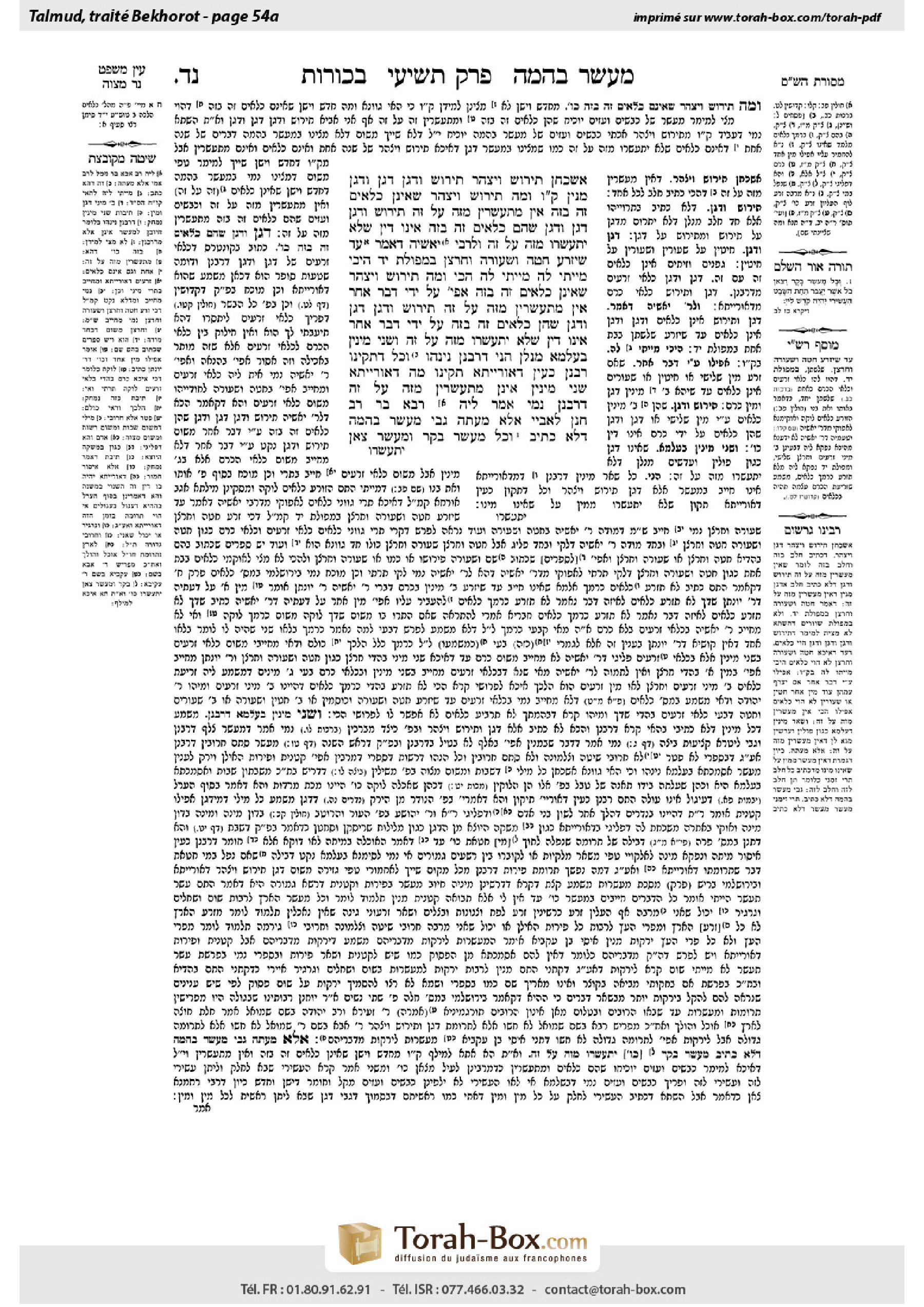
Bekhorot 54a: Talmud study for Daf Yomi
Study the Talmud for Daf Yomi with scanned pages, Hebrew text, English translations from Sefaria and AI-generated French translations.
Passage selection and English or AI-generated French translation are available where the scan has annotations. Daf Study is independent of Torah-Box and Sefaria.
Browse Bekhorot · בכורות · All tractatesBekhorot 54a text and translations
This page of Bekhorot includes the Aramaic text, an English translation and an AI-generated French translation, alongside the scan above.
בכורות נ״ד א · Aramaic and Hebrew text
אַשְׁכְּחַן תִּירוֹשׁ וְיִצְהָר, תִּירוֹשׁ וְדָגָן דָּגָן וְדָגָן מִנַּיִן? קַל וָחוֹמֶר: וּמָה תִּירוֹשׁ וְיִצְהָר שֶׁאֵינָן כִּלְאַיִם זֶה בָּזֶה — אֵין מִתְעַשְּׂרִין מִזֶּה עַל זֶה, תִּירוֹשׁ וְדָגָן דָּגָן וְדָגָן שֶׁהֵם כִּלְאַיִם זֶה בָּזֶה — אֵינוֹ דִּין שֶׁלֹּא יִתְעַשְּׂרוּ מִזֶּה עַל זֶה?
וּלְרַבִּי יֹאשִׁיָּה, דְּאָמַר: עַד שֶׁיִּזְרַע חִטָּה וּשְׂעוֹרָה וְחַרְצָן בְּמַפּוֹלֶת יָד, הֵיכִי מַיְיתֵי לַהּ?
מַיְיתֵי לַהּ הָכִי: וּמָה תִּירוֹשׁ וְיִצְהָר, שֶׁאֵינָן כִּלְאַיִם זֶה בָּזֶה אֲפִילּוּ עַל יְדֵי דָּבָר אַחֵר — אֵין מִתְעַשְּׂרִין מִזֶּה עַל זֶה. תִּירוֹשׁ וְדָגָן דָּגָן וְדָגָן, שֶׁהֵן כִּלְאַיִם זֶה בָּזֶה עַל יְדֵי דָּבָר אַחֵר — אֵינוֹ דִּין שֶׁלֹּא יִתְעַשְּׂרוּ מִזֶּה עַל זֶה?
וּשְׁנֵי מִינִין בְּעָלְמָא, מְנָלַן? הָנֵי דְּרַבָּנַן נִינְהוּ, וְכֹל דְּתַקִּינוּ רַבָּנַן כְּעֵין דְּאוֹרָיְיתָא תַּקִּינוּ: מָה דְּאוֹרָיְיתָא שְׁנֵי מִינִין אֵינָן מִתְעַשְּׂרִין מִזֶּה עַל זֶה, דְּרַבָּנַן נָמֵי.
אֲמַר לֵיהּ רָבָא בַּר רַב חָנָן לְאַבָּיֵי: אֶלָּא מֵעַתָּה, גַּבֵּי מַעֲשַׂר בְּהֵמָה, דְּלָא כְּתִיב ״וְכׇל מַעְשַׂר בָּקָר וּמַעֲשֵׂר צֹאן״,
Bekhorot 54a · English translation
The Gemara asks: We found a source for the halakha that one may not separate teruma from wine and oil together; from where is it derived that one may not separate teruma from wine and grain together, or from grain of one kind and grain of a different kind together? The Gemara answers that this can be derived by an a fortiori inference: And if wine and oil, which are not prohibited due to the prohibition of diverse kinds if they are planted with each other, nevertheless may not be tithed from one for the other, then with regard to wine and grain or grain and grain, which are subject to the prohibition of diverse kinds when planted with each other, is it not logical that they may not be tithed from one for the other?
The Gemara challenges: But this derivation is problematic according to the opinion of Rabbi Yoshiya, who says that the verse: “You shall not sow your vineyard with diverse kinds” (Deuteronomy 22:9), means that one who sows diverse kinds is not liable by Torah law until he sows wheat and barley and a grape seed with a single hand motion. According to this opinion, the above a fortiori inference is not valid; consequently, how does he derive the halakha that one may not tithe grain for wine or grain for grain?
The Gemara answers that he derives it in this manner: And if wine and oil, which are not prohibited as diverse kinds with each other even by means of something else, i.e., even if one planted a different kind of grain seed with them, do not become prohibited, and yet they may not be tithed from one for the other, then with regard to wine and grain or grain and grain, which are prohibited as diverse kinds with something else, i.e., if they are planted with another type of seed, is it not logical that they may not be tithed from one for the other?
The Gemara asks: It can be derived in this manner that one may not separate teruma or tithes from wine for grain or vice versa; but from where do we derive the prohibition against separating teruma or tithes from two species in general that are not grain, e.g., lentils and beans, one for the other? The Gemara answers that the obligation to separate tithes from these other species, which are not mentioned in the Torah, applies by rabbinic law, and concerning all ordinances that the Sages instituted, they instituted them parallel to Torah law. Therefore, just as by Torah law two species may not be tithed from one for the other, so too, those mixtures that are prohibited by rabbinic law may not be tithed one for another.
Rava bar Rav Ḥanan said to Abaye: If that is so, then with regard to animal tithe, where it is not written in the Torah: And all the tithe of the herd or the tithe of the flock, with the word “tithe” mentioned twice, once in reference to the herd and once in reference to the flock, but rather the verse states: “And all the tithe of the herd or the flock, whatever passes under the rod, the tenth shall be sacred to the Lord” (Leviticus 27:32),
Bekhorot 54a · Traduction française (IA)
La Guemara pose la question : Nous avons trouvé une source pour la halakha selon laquelle on ne peut pas séparer la terouma du vin et de l'huile ensemble ; d'où tire-t-on que l'on ne peut pas séparer la terouma du vin et du grain ensemble, ou du grain d'une espèce et du grain d'une autre espèce ensemble ? La Guemara répond que cela peut être déduit par une inférence a fortiori : Et si le vin et l'huile, qui ne sont pas interdits en raison de l'interdiction des espèces diverses si ils sont plantés ensemble, ne peuvent toutefois pas être tithés l'un pour l'autre, alors concernant le vin et le grain ou le grain et le grain, qui sont soumis à l'interdiction des espèces diverses lorsqu'ils sont plantés ensemble, n'est-il pas logique qu'ils ne puissent pas être tithés l'un pour l'autre ?
La Guemara conteste : Mais cette déduction est problématique selon l'opinion de Rabbi Yosséya, qui dit que la parole : « Tu ne semeras pas ton vigne avec des espèces diverses » (Deutéronome 22:9), signifie que celui qui sème des espèces diverses n'est pas puni par la loi divine jusqu'à ce qu'il sème du blé et du seigle et une graine de raisin avec une seule main. Selon cette opinion, l'inférence a fortiori ci-dessus n'est pas valable ; par conséquent, comment déduit-il la halakha selon laquelle l'on ne peut pas tither le grain pour le vin ou le grain pour le grain ?
La Guemara répond qu'il le déduit ainsi : Et si le vin et l'huile, qui ne sont pas interdits comme espèces diverses l'un envers l'autre même par l'intermédiaire d'une autre chose, c'est-à-dire même si l'on plante une graine d'une espèce différente avec eux, ne deviennent pas interdits, et pourtant ils ne peuvent pas être tithés l'un pour l'autre, alors concernant le vin et le grain ou le grain et le grain, qui sont interdits comme espèces diverses avec une autre chose, c'est-à-dire si l'on les plante avec une autre graine, n'est-il pas logique qu'ils ne puissent pas être tithés l'un pour l'autre ?
La Guemara pose la question : On peut en déduire que l'on ne peut pas séparer la terouma ou les dîmes du vin pour le grain ou inversement ; mais d'où tire-t-on l'interdiction de séparer la terouma ou les dîmes de deux espèces en général qui ne sont pas du grain, par exemple les lentilles et les haricots, l'un pour l'autre ? La Guemara répond que l'obligation de séparer les dîmes de ces autres espèces, qui ne sont pas mentionnés dans la Torah, s'applique selon la loi rabbinique, et concernant toutes les ordonnances que les Sages ont instituées, ils les ont instituées parallèlement à la loi divine. Par conséquent, tout comme deux espèces ne peuvent pas être tithés l'un pour l'autre selon la loi divine, de même ces mélanges interdits selon la loi rabbinique ne peuvent pas être tithés l'un pour l'autre.
Rava bar Rav Hanan dit à Abaye : Si c'est ainsi, alors concernant la dîme des animaux, où il n'est pas écrit dans la Torah : « Et toute la dîme du bétail ou la dîme du troupeau, avec le mot « dîme » mentionné deux fois, une fois en référence au bétail et une fois en référence au troupeau », mais plutôt la parole dit : « Et toute la dîme du bétail ou du troupeau, tout ce qui passe sous le bâton, la dixième sera sainte au Seigneur » (Lévitique 27:32),
Traduction française générée par IA à partir de l’édition anglaise de Sefaria. Vérifie toujours un passage avec le texte source.
Text from Sefaria: William Davidson Edition - Vocalized Aramaic (CC BY NC); William Davidson Edition - English (CC BY NC).