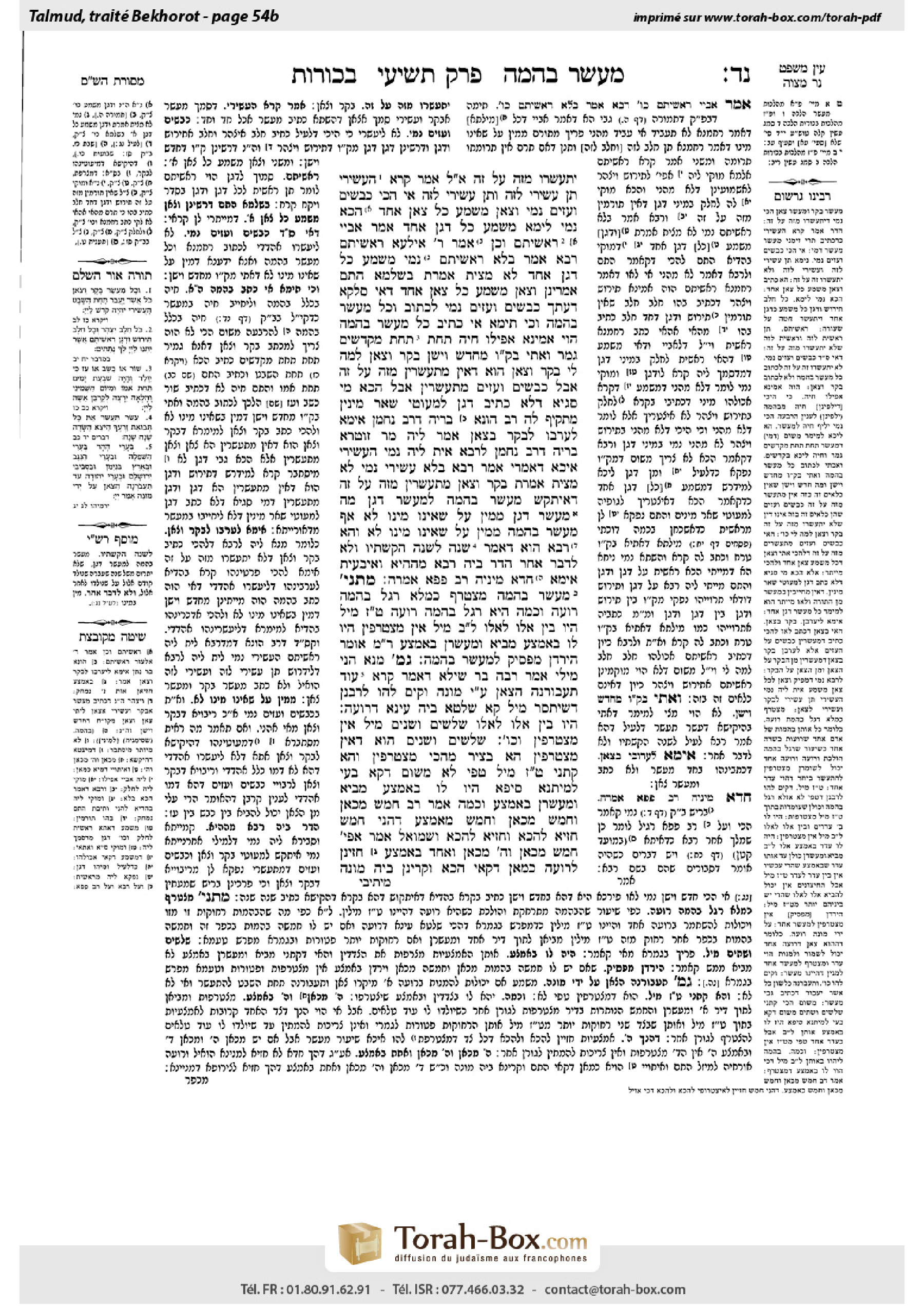
Bekhorot 54b: Talmud study for Daf Yomi
Study the Talmud for Daf Yomi with scanned pages, Hebrew text, English translations from Sefaria and AI-generated French translations.
Passage selection and English or AI-generated French translation are available where the scan has annotations. Daf Study is independent of Torah-Box and Sefaria.
Browse Bekhorot · בכורות · All tractatesBekhorot 54b text and translations
This page of Bekhorot includes the Aramaic text, an English translation and an AI-generated French translation, alongside the scan above.
בכורות נ״ד ב · Aramaic and Hebrew text
יִתְעַשְּׂרוּ מִזֶּה עַל זֶה! אֲמַר לֵיהּ: אָמַר קְרָא ״הָעֲשִׂירִי״, תֵּן עֲשִׂירִי לָזֶה וְתֵן עֲשִׂירִי לָזֶה. אִי הָכִי, כְּבָשִׂים וְעִזִּים נָמֵי? ״וָצֹאן״ מַשְׁמַע כׇּל צֹאן אֶחָד.
הָכָא נָמֵי לֵימָא מַשְׁמַע כׇּל דָּגָן אֶחָד! אָמַר אַבָּיֵי: ״רֵאשִׁיתָם״, וְכֵן אָמַר רַבִּי אִילְעָא: ״רֵאשִׁיתָם״.
רָבָא אָמַר: בְּלָא ״רֵאשִׁיתָם״ נָמֵי מַשְׁמַע כׇּל דָּגָן אֶחָד — לָא מָצֵית אָמְרַתְּ. בִּשְׁלָמָא הָתָם אָמְרִינַן: ״וָצֹאן״ מַשְׁמַע כׇּל צֹאן אֶחָד, דְּאִי סָלְקָא דַעְתָּךְ כְּבָשִׂים וְעִזִּים נָמֵי — לִכְתּוֹב ״וְכׇל מַעְשַׂר בְּהֵמָה״.
וְכִי תֵּימָא: אִי כְּתִיב ״כׇּל מַעְשַׂר בְּהֵמָה״, הֲוֵי אָמֵינָא אֲפִילּוּ חַיָּה — ״תַּחַת״ ״תַּחַת״ מִקֳּדָשִׁים גָּמַר.
וְאָתֵי בְּקַל וָחוֹמֶר מֵחָדָשׁ וְיָשָׁן, ״בָּקָר וָצֹאן״ לְמָה לִי? בָּקָר וָצֹאן הוּא דְּאֵין מִתְעַשְּׂרִין מִזֶּה עַל זֶה, אֲבָל כְּבָשִׂים וְעִזִּים מִתְעַשְּׂרִין.
אֲבָל הָכָא, מִי סַגִּיא דְּלָא כְּתִיב ״דָּגָן״? לְמַעוֹטֵי שְׁאָר מִינִין.
מַתְקֵיף לַהּ רַב הוּנָא בְּרֵיהּ דְּרַב נַחְמָן: אֵימָא לְעָרְבוּ לְבָקָר בְּצֹאן! אֲמַר לֵיהּ מָר זוּטְרָא בְּרֵיהּ דְּרַב נַחְמָן לְרָבָא: אִית לֵיהּ נָמֵי ״הָעֲשִׂירִי״.
אִיכָּא דְּאָמְרִי, אָמַר רָבָא: בְּלֹא ״עֲשִׂירִי״ נָמֵי לָא מָצֵית אָמְרַתְּ בָּקָר וָצֹאן מִתְעַשְּׂרִין מִזֶּה עַל זֶה, דְּאִיתַּקַּשׁ מַעְשַׂר בְּהֵמָה לְמַעֲשֵׂר דָּגָן — מָה מַעְשַׂר דָּגָן מִמִּין עַל שֶׁאֵינוֹ מִינוֹ לָא, אַף מַעְשַׂר בְּהֵמָה מִמִּין עַל שֶׁאֵינוֹ מִינוֹ לָא.
וְהָא רָבָא הוּא דְּאָמַר: ״שָׁנָה״ לְשָׁנָה הִקַּשְׁתִּיו, וְלֹא לְדָבָר אַחֵר! הֲדַר בֵּיהּ רָבָא מֵהַהִיא. וְאִיבָּעֵית אֵימָא: חֲדָא (מיניה) [מִינַיְהִי] רַב פָּפָּא אַמְרַהּ.
מַתְנִי׳ מַעְשַׂר בְּהֵמָה מִצְטָרֵף כִּמְלֹא רֶגֶל בְּהֵמָה רוֹעָה, וְכַמָּה הִיא רֶגֶל בְּהֵמָה רוֹעָה? שִׁשָּׁה עָשָׂר מִיל. הָיוּ בֵּין אֵלּוּ לְאֵלּוּ שְׁלֹשִׁים וּשְׁנַיִם מִיל — אֵין מִצְטָרְפִין. הָיוּ לוֹ בָּאֶמְצַע — מֵבִיא וּמְעַשְּׂרָן בָּאֶמְצַע. רַבִּי מֵאִיר אוֹמֵר: הַיַּרְדֵּן מַפְסִיק לְמַעְשַׂר בְּהֵמָה.
גְּמָ׳ מְנָא הָנֵי מִילֵּי?
אָמַר רַבָּה בַּר שֵׁילָא: דְּאָמַר קְרָא ״עוֹד תַּעֲבֹרְנָה הַצֹּאן עַל יְדֵי מוֹנֶה״, וְקִים לְהוּ לְרַבָּנַן דְּשִׁיתְּסַר מִיל קָא שָׁלְטָא בֵּיהּ עֵינָא דְּרוֹעֶה.
הָיוּ בֵּין אֵלּוּ לְאֵלּוּ שְׁלֹשִׁים וּשְׁנַיִם מִיל אֵין מִצְטָרְפִין וְכוּ׳. שְׁלֹשִׁים וּשְׁנַיִם הוּא דְּאֵין מִצְטָרְפִין, הָא בְּצִיר מֵהָכִי מִצְטָרְפִין? וְהָא קָתָנֵי: שִׁשָּׁה עָשָׂר מִיל, טְפֵי לָא! מִשּׁוּם דְּקָא בָעֵי לְמִיתְנֵא סֵיפָא: הָיוּ לוֹ בָּאֶמְצַע — מֵבִיא וּמְעַשְּׂרָן בָּאֶמְצַע.
וְכַמָּה? אָמַר רַב: חָמֵשׁ מִכָּאן וְחָמֵשׁ מִכָּאן וְחָמֵשׁ מֵאֶמְצַע, דְּהָנֵי חָמֵשׁ חַזְיָא לְהָכָא וְחַזְיָא לְהָכָא.
וּשְׁמוּאֵל אָמַר: אֲפִילּוּ חָמֵשׁ מִכָּאן וְחָמֵשׁ מִכָּאן וְאֶחָד בָּאֶמְצַע, חָזֵינַן לְרוֹעֶה כְּמַאן דְּקָאֵי הָכָא, וְקָרֵינַן בֵּיהּ ״מוֹנֶה״.
Bekhorot 54b · English translation
let them be tithed from one for the other. Abaye said to him that the verse states: “The tenth shall be sacred to the Lord” (Leviticus 27:32). This indicates that one must give the tenth animal from this, the flock, and give the tenth animal from that, the herd, with each counted and given separately. The Gemara raises a difficulty: If so, sheep and goats should also have to be tithed separately. The Gemara answers that the verse states: “Or the flock,” which means that all the goats and sheep are one flock and may be tithed together.
The Gemara raises a further difficulty: Here too, with regard to teruma and tithes, let us say that the term “grain” (Numbers 18:12) means that all the different types of grain are considered one grain, and may be tithed together. Abaye said in response that there it is different, as the verse states: “The first part of them” (Numbers 18:12), in the plural, which teaches that one must give the first part for each type of produce separately. And Rabbi Ile’a says likewise that “the first part of them” teaches that one must give the first part for each type of produce separately.
Rava said that there is an alternative answer: Even without the term “the first part of them” there is also no difficulty, as you cannot say the term “grain” means that all the different types of grain are considered one grain. Rava explains: Granted, there, with regard to sheep and goats, we say that the term “or the flock” means that all goats and sheep are one flock. Because if it enters your mind that sheep and goats may also not be tithed one for the other, like the herd and the flock, let the verse write: And all the animal tithe, without distinguishing between herds and flocks.
And if you would say that if the verse had written: All the animal tithe, I would say that the requirement to tithe animals applies even to undomesticated animals, this is not so. The reason is that one derives the halakha of the animal tithe from sacrificial animals, via a verbal analogy of the terms “under” and “under.” With regard to sacrificial animals it states: “When a bull, or a sheep, or a goat is brought forth, then it shall be seven days under its mother, but from the eighth day onward it may be accepted for an offering made by fire to the Lord” (Leviticus 22:27), and with regard to animal tithe it states: “And all the tithe of the herd or the flock, whatever passes under the rod, the tenth shall be sacred to the Lord” (Leviticus 27:32). It is derived through this verbal analogy that just as an undomesticated animal cannot be consecrated as an offering, so too, it cannot be tithed.
Rava continues his explanation: And as one would not have thought that undomesticated animals are included in the animal tithe the verse could have stated: And all the animal tithe, and one would derive that one species may not be tithed for another by an a fortiori inference from new grain and old grain, as specified earlier: If the grain tithe may not be taken from the new grain for the old grain despite the fact that the prohibition of diverse kinds does not apply, all the more so with regard to different species of animal, which are prohibited as diverse kinds; the animal tithe may not be taken from one for another. If so, why do I need the verse to state: “The herds or the flock”? This teaches that herds of cattle and flocks of sheep or goats may not be tithed from one for the other, but sheep and goats, which are both called flocks, may be tithed from one for the other.
Rava concludes: But here, in the case of grain, would it suffice if the Torah had not written: “Grain,” to exclude other types of foods from the obligation of tithes by Torah law? In other words, the term “grain” must be serving to exclude other types of food, as one cannot claim they could have been excluded in some other manner.
Rav Huna, son of Rav Naḥman, objects to this claim of Rava in which it is derived from the words “herd” and “flock” that cattle and sheep may not be tithed together. One can say instead that this teaches that one should intermingle the cattle in the herd with the sheep in the flock and tithe them all together. Mar Zutra, son of Rav Naḥman, said to Rav Huna, son of Rav Naḥman: Rava also accepts the opinion of Abaye that the verse “The tenth shall be sacred to the Lord” teaches that cattle and sheep must be tithed separately, and therefore he does not entertain that derivation.
There are those who say that Rava said: Even without the verse “The tenth shall be sacred to the Lord” you also cannot say that a herd and a flock should be tithed from one for the other, as animal tithe is juxtaposed to grain tithe: Just as grain tithe may not be separated from one type of grain for another grain that is not its type, so too, animal tithe may not be separated from one type of animal for another species of animal that is not its type.
The Gemara asks: But isn’t it Rava himself who said that the term: “Year by year” (Deuteronomy 14:22), teaches that I have juxtaposed the two types of tithe with regard to the year in which they were born, teaching that one may not tithe old and new flocks together, but not with regard to another matter, i.e., there is no prohibition against tithing two types together? The Gemara answers: Rava retracted that first opinion, and maintains that the juxtaposition applies even to the tithing of two types together. And if you wish, say instead that one of those opinions was said by Rav Pappa, not by Rava. Since Rav Pappa was Rava’s closest student and took over as head of the academy after Rava’s death, his statements were occasionally mistaken for those of Rava himself.
MISHNA: Animals subject to the obligation of animal tithe join together if the distance between them is no greater than the distance that a grazing animal can walk and still be tended by one shepherd. And how much is the distance that a grazing animal walks? It is sixteen mil. If the distance between these animals and those animals was thirty-two mil they do not join together. If he also had animals in the middle of that distance of thirty-two mil, he brings all three flocks to a pen and tithes them in the middle. Rabbi Meir says: The Jordan River divides between animals on two sides of the river with regard to animal tithe, even if the distance between them is minimal.
GEMARA: The mishna teaches that animals join together for the purposes of tithing if the distance between them is no greater than the distance a grazing animal can walk and still be tended by one shepherd. The Gemara asks: From where are these matters derived? What is the source that this is the maximum distance at which they can be tithed together?
Rabba bar Sheila said that the verse states: “So says the Lord of hosts: Yet again shall there be in this place, which is desolate, without man and without animal, and in all its cities, a habitation of shepherds causing their flocks to lie down. In the cities of the hill country, in the cities of the lowland, and in the cities of the south, and in the land of Benjamin, and in the places about Jerusalem, and in the cities of Judah, the flock shall again pass under the hands of him who counts them, says the Lord” (Jeremiah 33:12–13). It is derived from here that animals that can pass under the hands of one shepherd are called one flock and can be counted together for the animal tithe. And the Sages have an accepted tradition that the eye of the shepherd can see up to a distance of sixteen mil.
§ The mishna teaches that if the distance between these animals and those animals was thirty-two mil they do not join together. The Gemara infers: It is only if the distance between them is thirty-two mil that they do not join together, from which it can be inferred that if the distance between them is less than this they do join together. But the mishna earlier teaches: Sixteen mil, which indicates: And no more. The Gemara answers: One cannot infer that if the distance is less than thirty-two mil the animals join together. The mishna mentions thirty-two mil only because it wants to teach in the latter clause: If he also had animals in the middle of that distance of thirty-two mil, he brings them all to a pen and tithes them in the middle.
The Gemara asks: And how many animals must he have on the two sides and in the middle in order to tithe them as one group? Rav says: Five from here and five from there and five in the middle. The reason is that these five in the middle are fit to combine with the animals here and are likewise fit to combine with the animals there, to amount to a total of ten, to which the obligation of animal tithe applies. For this reason all three flocks are considered as one flock.
And Shmuel says: Even if there are five from here and five from there and only one in the middle they may be tithed together. The reason is that we see the shepherd as one who stands here in the middle and we apply the verse: “Who counts them” (Jeremiah 33:13), to him. Since he can see and count both sides from his vantage point in the middle, they are all considered one flock.
Bekhorot 54b · Traduction française (IA)
ils doivent être tithés l'un pour l'autre. Abaye dit à celui-ci que la Parashah dit : « Le dixième sera sacré au Seigneur » (Lévitique 27:32). Cela indique qu'on doit donner le dixième animal de ce troupeau et le dixième animal de ce bétail, en comptant et en donnant séparément chaque animal. La Guemara soulève un problème : Si c'est ainsi, les brebis et les chèvres devraient aussi être tithés séparément. La Guemara répond que la Parashah dit : « ou le troupeau », ce qui signifie que toutes les chèvres et brebis sont un seul troupeau et peuvent être tithés ensemble.
La Guemara soulève une difficulté supplémentaire : ici aussi, concernant la terouma et les dixièmes, disons que le terme « céréale » (Nb 18:12) signifie que toutes les différentes céréales sont considérées comme une seule céréale et peuvent être tithés ensemble. Abaye répond que cela est différent, car la Parashah dit : « la première partie d'entre elles » (Nb 18:12), au pluriel, ce qui enseigne qu'on doit donner la première partie pour chaque type de produit séparément. Et Rabbi Ile’a dit de même que « la première partie d'entre elles » enseigne qu'on doit donner la première partie pour chaque type de produit séparément.
Rava dit que l'alternative est la suivante : même sans le terme « la première partie d'entre elles », il n'y a pas de difficulté, car on ne peut pas dire que le terme « céréale » signifie que toutes les différentes céréales sont considérées comme une seule céréale. Rava explique : certes, là, concernant les brebis et les chèvres, nous disons que le terme « ou le troupeau » signifie que toutes les chèvres et brebis sont un seul troupeau. Car si l'idée vous vient que les brebis et les chèvres ne peuvent pas non plus être tithés l'une pour l'autre, comme le bétail et le troupeau, la Parashah aurait dû écrire : « et toute la tithe animale », sans distinguer entre bétail et troupeau.
Et si l'on disait que si la Parashah avait dit : « toute la tithe animale », je dirais que la tithe animale s'applique même aux animaux sauvages, cela n'est pas le cas. La raison est qu'on dérive la halakha de la tithe animale des animaux sacrés, par analogie verbale des termes « sous » et « sous ». Concernant les animaux sacrés, il est dit : « Quand un taureau, ou une brebis, ou une chèvre est née, alors elle restera sept jours sous sa mère, mais à partir du huitième jour, elle peut être acceptée comme offrande brûlée au Seigneur » (Lévitique 22:27), et concernant la tithe animale, il est dit : « Et toute la tithe du bétail ou du troupeau, tout ce qui passe sous le bâton, le dixième sera sacré au Seigneur » (Lévitique 27:32). On en dérive par cette analogie verbale que tout comme un animal sauvage ne peut pas être consacré comme offrande, ainsi non plus il ne peut être tithé.
Rava continue son explication : et comme l'on ne penserait pas que les animaux sauvages soient inclus dans la tithe animale, la Parashah aurait pu dire : « toute la tithe animale », et l'on en déduirait que l'une des espèces ne peut pas être tithée pour une autre, comme spécifié plus tôt : si la tithe de la céréale ne peut pas être prise de la céréale nouvelle pour la céréale ancienne, malgré le fait que la prohibition des espèces différentes ne s'applique pas, encore plus encore concernant les espèces différentes d'animaux, qui sont interdites comme espèces différentes ; la tithe animale ne peut pas être prise d'une espèce pour une autre. Si c'est ainsi, pourquoi la Parashah dit-elle : « le bétail ou le troupeau » ? Cela enseigne que les troupeaux de bœufs et les troupeaux de brebis ou de chèvres ne peuvent pas être tithés l'un pour l'autre, mais les brebis et les chèvres, qui sont tous deux appelés troupeaux, peuvent être tithés l'un pour l'autre.
Rava conclut : mais ici, concernant la céréale, suffirait-il que la Torah n'ait pas écrit : « céréale », pour exclure d'autres types de nourriture de l'obligation des dixièmes par la Torah ? En d'autres termes, le terme « céréale » doit servir à exclure d'autres types de nourriture, car on ne peut pas affirmer qu'ils pourraient avoir été exclus d'une autre manière.
Rav Huna, fils de Rav Naḥman, s'oppose à cette affirmation de Rava, selon laquelle on dérive de la mention des termes « bétail » et « troupeau » que les bœufs et les brebis ne peuvent pas être tithés ensemble. On pourrait dire au contraire que cela enseigne qu'on doit mélanger les bœufs du bétail avec les brebis du troupeau et tithé tous ensemble. Mar Zutra, fils de Rav Naḥman, dit à Rav Huna, fils de Rav Naḥman : Rava accepte également l'opinion d'Abaye selon laquelle la Parashah « Le dixième sera sacré au Seigneur » enseigne que les bœufs et les brebis doivent être tithés séparément, et par conséquent il ne considère pas cette dérivation.
Certains disent que Rava a dit : même sans la Parashah « Le dixième sera sacré au Seigneur », on ne peut pas dire que le bétail et le troupeau doivent être tithés l'un pour l'autre, car la tithe animale est juxtaposée à la tithe de la céréale : tout comme la tithe de la céréale ne peut pas être séparée d'une espèce de céréale pour une autre espèce de céréale, ainsi la tithe animale ne peut pas être séparée d'une espèce d'animaux pour une autre espèce d'animaux.
La Guemara demande : mais n'est-ce pas Rava lui-même qui a dit que le terme « année par année » (Dt 14:22) enseigne que l'on a juxtaposé les deux types de dîme concernant l'année où ils ont été nés, enseignant qu'on ne peut pas dîmer ensemble les troupeaux anciens et nouveaux, mais pas concernant une autre matière, c'est-à-dire qu'il n'y a pas de prohibition contre dîmer deux types ensemble ? La Guemara répond : Rava a rétracté cette première opinion, et maintient que la juxtaposition s'applique même à la dîme de deux types ensemble. Et si vous le souhaitez, dites plutôt que l'une de ces opinions a été dite par Rav Pappa, pas par Rava. Puisque Rav Pappa était l'élève le plus proche de Rava et a pris la tête de l'académie après la mort de Rava, ses déclarations ont parfois été confondues avec celles de Rava lui-même.
MICHNA : Les animaux soumis à l'obligation de dîme animale se regroupent si la distance entre eux ne dépasse pas la distance que peut parcourir un animal paissant tout en étant tenu par un seul berger. Et combien est cette distance que parcourt un animal paissant ? Elle est de seize mil. Si la distance entre ces animaux et ceux-ci était de trente-deux mil, ils ne se regroupent pas. Si l'on avait également des animaux au milieu de cette distance de trente-deux mil, on amène toutes les trois troupeaux dans un enclos et on en fait la dîme au milieu. Rabbi Meïr dit : Le fleuve Jourdain divise les animaux des deux côtés du fleuve en ce qui concerne la dîme animale, même si la distance entre eux est minimale.
GUEMARA : La mishna enseigne que les animaux se regroupent pour l'effet de la dîme animale si la distance entre eux ne dépasse pas la distance que peut parcourir un animal paissant tout en étant tenu par un seul berger. La Guemara pose la question : D'où provient cette loi ? Quel est le fondement qui indique que c'est la distance maximale à laquelle ils peuvent être tithés ensemble ?
Rabba bar Sheila a dit que la parole de l'Éternel dit : « Ainsi parle l'Éternel, le Seigneur des armées : Il y aura encore ici, dans ce lieu désert, sans homme et sans animal, et dans toutes ses villes, une habitation de bergers qui feront paître leurs troupeaux. Dans les villes des hauteurs, dans les villes des plaines, et dans les villes du sud, et dans la terre de Benjamin, et dans les lieux autour de Jérusalem, et dans les villes de Juda, le troupeau passera à nouveau sous la main de celui qui les compte, dit l'Éternel » (Jérémie 33 : 12-13). On en déduit ici que les animaux qui peuvent passer sous la main d'un seul berger sont appelés une même troupeau et peuvent être comptés ensemble pour la dîme animale. Et les Sages ont une tradition acceptée selon laquelle l'œil du berger peut voir à une distance de seize mil.
§ La mishna enseigne que si la distance entre ces animaux et ceux-ci était de trente-deux mil, ils ne se regroupent pas. La Guemara déduit : C'est seulement si la distance entre eux est de trente-deux mil que ils ne se regroupent pas, d'où on peut déduire que si la distance entre eux est inférieure à cela, ils se regroupent. Mais la mishna précédente enseigne : seize mil, ce qui indique : Et pas plus. La Guemara répond : On ne peut pas déduire que si la distance est inférieure à trente-deux mil les animaux se regroupent. La mishna mentionne trente-deux mil uniquement parce qu'elle veut enseigner dans la clause ultérieure : Si l'on avait également des animaux au milieu de cette distance de trente-deux mil, on amène tous ceux-ci dans un enclos et on en fait la dîme au milieu.
La Guemara pose la question : Et combien d'animaux doit-il avoir des deux côtés et au milieu pour les tithés ensemble ? Rav dit : Cinq d'ici et cinq d'ailleurs et cinq au milieu. La raison est que ces cinq au milieu sont aptes à se combiner avec les animaux d'ici et sont également aptes à se combiner avec les animaux d'ailleurs, pour un total de dix, à qui s'applique l'obligation de dîme animale. Pour cette raison, les trois troupeaux sont considérés comme un seul troupeau.
Et Shmuel dit : Même s'il y a cinq d'ici et cinq d'ailleurs et seulement un au milieu, ils peuvent être tithés ensemble. La raison est que nous voyons le berger comme celui qui se tient ici au milieu et nous appliquons la parole : « Qui les compte » (Jérémie 33 : 13) à lui. Puisqu'il peut voir et compter les deux côtés depuis son point de vue au milieu, ils sont tous considérés comme un seul troupeau.
Traduction française générée par IA à partir de l’édition anglaise de Sefaria. Vérifie toujours un passage avec le texte source.
Text from Sefaria: William Davidson Edition - Vocalized Aramaic (CC BY NC); William Davidson Edition - English (CC BY NC).