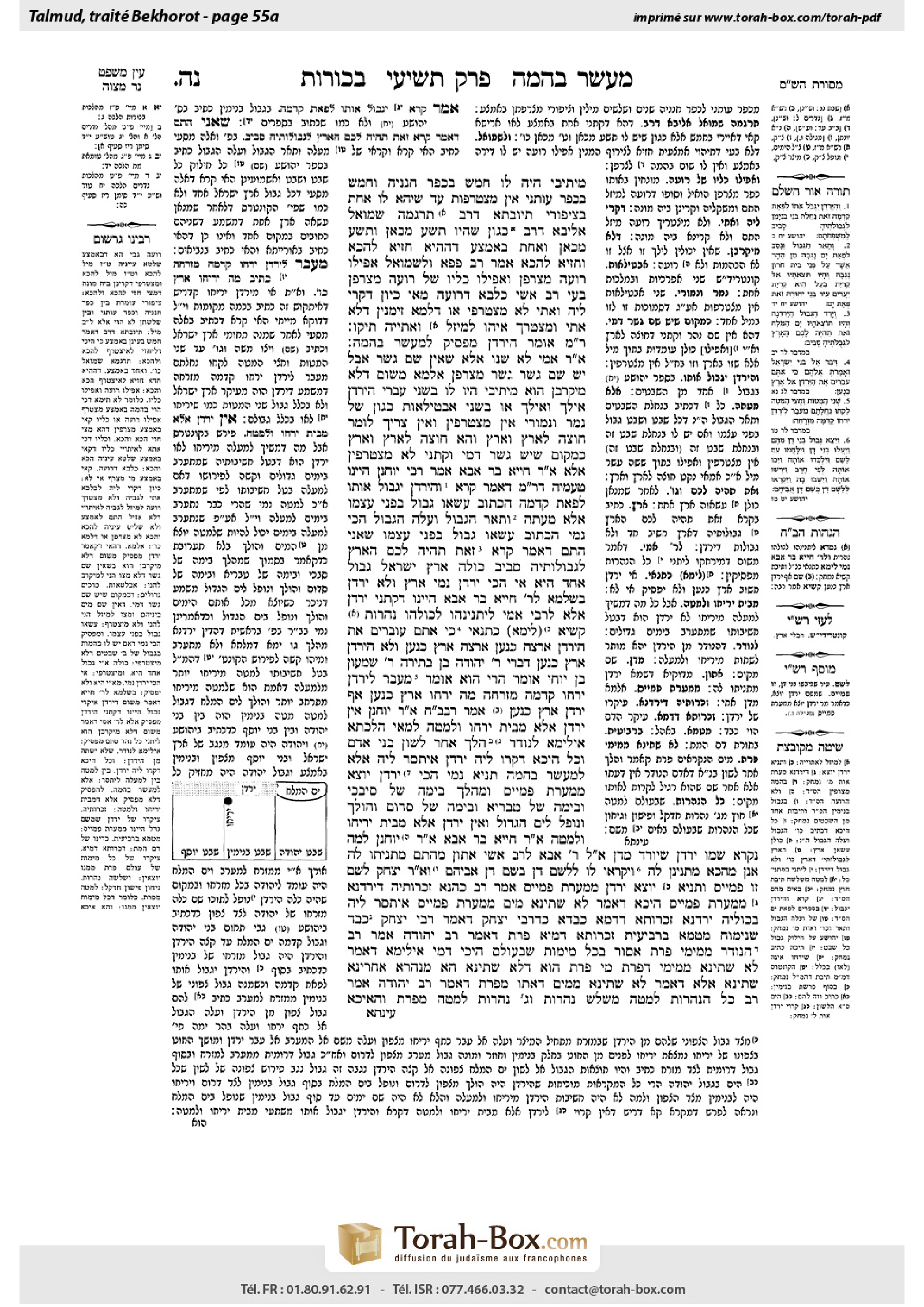
Bekhorot 55a: Talmud study for Daf Yomi
Study the Talmud for Daf Yomi with scanned pages, Hebrew text, English translations from Sefaria and AI-generated French translations.
Passage selection and English or AI-generated French translation are available where the scan has annotations. Daf Study is independent of Torah-Box and Sefaria.
Browse Bekhorot · בכורות · All tractatesBekhorot 55a text and translations
This page of Bekhorot includes the Aramaic text, an English translation and an AI-generated French translation, alongside the scan above.
בכורות נ״ה א · Aramaic and Hebrew text
מֵיתִיבִי: הָיָה לוֹ חָמֵשׁ בִּכְפַר חֲנַנְיָה וְחָמֵשׁ בִּכְפַר עוֹתְנַי — אֵין מִצְטָרְפוֹת עַד שֶׁיְּהֵא לוֹ אַחַת בְּצִיפּוֹרִי. תְּיוּבְתָּא דְּרַב!
תַּרְגְּמַהּ שְׁמוּאֵל אַלִּיבָּא דְּרַב: כְּגוֹן שֶׁהָיוּ תֵּשַׁע מִכָּאן וְתֵשַׁע מִכָּאן וְאַחַת בָּאֶמְצַע, דְּהַהִיא חַזְיָא לְהָכָא וְחַזְיָא לְהָכָא.
אָמַר רַב פָּפָּא: וְלִשְׁמוּאֵל, אֲפִילּוּ רוֹעֶה מְצָרְפָן, וַאֲפִילּוּ כִּלְיוֹ שֶׁל רוֹעֶה מְצָרְפָן.
בָּעֵי רַב אָשֵׁי: כַּלְבָּא דְּרוֹעֶה מַאי? כֵּיוָן דְּקָרֵי לֵיהּ וְאָתֵי לָא מִצְטָרְפִי, אוֹ דִלְמָא זִימְנִין דְּלָא אָתֵי, וּמִצְטָרֵךְ אִיהוּ לְמֵיזַל וְאֵתֹיֵיהּ? תֵּיקוּ.
רַבִּי מֵאִיר אוֹמֵר: הַיַּרְדֵּן מַפְסִיק לְמַעְשַׂר בְּהֵמָה. אָמַר רַבִּי אַמֵּי: לֹא שָׁנוּ אֶלָּא שֶׁאֵין שָׁם גֶּשֶׁר, אֲבָל יֵשׁ שָׁם גֶּשֶׁר — גֶּשֶׁר מְצָרְפָן.
אַלְמָא, מִשּׁוּם דְּלָא מְיקָרְבָן הוּא. מֵיתִיבִי: הָיוּ לוֹ בִּשְׁנֵי עֶבְרֵי הַיַּרְדֵּן אֵילָךְ וְאֵילָךְ, אוֹ בִּשְׁנֵי אַבְטִילָאוֹת כְּגוֹן שֶׁל נָמֵר וְנָמוֹרִי — אֵין מִצְטָרְפִין, וְאֵין צָרִיךְ לוֹמַר חוּצָה לָאָרֶץ וָאָרֶץ.
וְהָא חוּצָה לָאָרֶץ וָאָרֶץ כִּמְקוֹם שֶׁיֵּשׁ גֶּשֶׁר דָּמֵי, וְקָתָנֵי: לֹא מִצְטָרְפִין!
אֶלָּא אָמַר רַבִּי חִיָּיא בַּר אַבָּא אָמַר רַבִּי יוֹחָנָן: הַיְינוּ טַעְמֵיהּ דְּרַבִּי מֵאִיר, דְּאָמַר קְרָא: ״וְהַיַּרְדֵּן יִגְבֹּל אֹתוֹ לִפְאַת קֵדְמָה״, הַכָּתוּב עֲשָׂאוֹ גְּבוּל בִּפְנֵי עַצְמוֹ.
אֶלָּא מֵעַתָּה, ״וְתָאַר הַגְּבוּל״ ״וְעָלָה הַגְּבוּל״, הָכִי נָמֵי הַכָּתוּב עֲשָׂאוֹ גְּבוּל בִּפְנֵי עַצְמוֹ!
שָׁאנֵי הָתָם, דְּאָמַר קְרָא: ״זֹאת תִּהְיֶה לָכֶם הָאָרֶץ לִגְבֻלֹתֶיהָ סָבִיב״, כּוּלַּהּ אֶרֶץ יִשְׂרָאֵל גְּבוּל אֶחָד הִיא.
אִי הָכִי, יַרְדֵּן נָמֵי! ״אֶרֶץ״ — וְלֹא יַרְדֵּן.
בִּשְׁלָמָא לְרַבִּי חִיָּיא בַּר אַבָּא — הַיְינוּ דְּקָתָנֵי ״יַרְדֵּן״, אֶלָּא לְרַבִּי אַמֵּי — לִיתְנִינְהוּ לְכוּלְּהוּ נְהָרוֹת! קַשְׁיָא.
לֵימָא כְּתַנָּאֵי: ״כִּי אַתֶּם עֹבְרִים אֶת הַיַּרְדֵּן אַרְצָה כְּנָעַן״, ״אַרְצָה״ — אֶרֶץ כְּנַעַן, וְלֹא הַיַּרְדֵּן אֶרֶץ כְּנַעַן, דִּבְרֵי רַבִּי יְהוּדָה בֶּן בְּתִירָה.
רַבִּי שִׁמְעוֹן בֶּן יוֹחַי אוֹמֵר: הֲרֵי הוּא אוֹמֵר ״מֵעֵבֶר לְיַרְדֵּן יְרֵחוֹ קֵדְמָה מִזְרָחָה״, מָה יְרֵחוֹ אֶרֶץ כְּנַעַן, אַף יַרְדֵּן אֶרֶץ כְּנַעַן.
אָמַר רַבָּה בַּר בַּר חָנָה אָמַר רַבִּי יוֹחָנָן: אֵין ״יַרְדֵּן״ אֶלָּא מִבֵּית יְרֵחוֹ וּלְמַטָּה. לְמַאי הִלְכְתָא? אִילֵּימָא לְנוֹדֵר — הַלֵּךְ אַחַר לְשׁוֹן בְּנֵי אָדָם, וְכֹל הֵיכָא דְּקָרוּ לֵיהּ ״יַרְדֵּן״ אִיתְּסַר לֵיהּ! אֶלָּא לְמַעְשַׂר בְּהֵמָה.
תַּנְיָא נָמֵי הָכִי: יַרְדֵּן יוֹצֵא מִמְּעָרַת פַּמְיָיס, וּמְהַלֵּךְ בְּיַמָּהּ שֶׁל סִיבְכִי, וּבְיַמָּהּ שֶׁל טְבֶרְיָא, וּבְיַמָּהּ שֶׁל סְדוֹם, וְהוֹלֵךְ וְנוֹפֵל לַיָּם הַגָּדוֹל, וְאֵין ״יַרְדֵּן״ אֶלָּא מִבֵּית יְרִיחוֹ וּלְמַטָּה.
אָמַר רַבִּי חִיָּיא בַּר אַבָּא אָמַר רַבִּי יוֹחָנָן: לָמָּה נִקְרָא שְׁמוֹ ״יַרְדֵּן״? שֶׁיּוֹרֵד מִדָּן. אֲמַר לֵיהּ רַבִּי אַבָּא לְרַב אָשֵׁי: אַתּוּן מֵהָתָם מַתְנִיתוּ לַהּ, אֲנַן מֵהָכָא מַתְנֵינַן לַהּ, ״וַיִּקְרְאוּ (לוֹ) לְלֶשֶׁם דָּן בְּשֵׁם דָּן אֲבִיהֶם״. וְאָמַר רַבִּי יִצְחָק: לֶשֶׁם זוֹ פַּמְיָיס, וְתַנְיָא: יוֹצֵא יַרְדֵּן מִמְּעָרַת פַּמְיָיס.
אָמַר רַב כָּהֲנָא: זַכְרוּתֵיהּ דְּיַרְדְּנָא מִמְּעָרַת פַּמְיָיס, הֵיכָא דְּאָמַר: ״לָא שָׁתֵינָא מַיִם מִמְּעָרַת פַּמְיָיס״ — אִיתְּסַר לֵיהּ בְּכוּלֵּיהּ יַרְדְּנָא.
זַכְרוּתָא דִּדְמָא — כַּבְדָּא, כִּדְרַבִּי יִצְחָק, דְּאָמַר רַבִּי יִצְחָק: כָּבֵד שֶׁנִּימּוֹחַ — מְטַמֵּא בִּרְבִיעִית.
זַכְרוּתָא דְּמַיָּא — פְּרָת, דְּאָמַר רַב יְהוּדָה אָמַר רַב: הַנּוֹדֵר מִמֵּימֵי פְּרָת — אָסוּר בְּכׇל מֵימוֹת שֶׁבָּעוֹלָם.
הֵיכִי דָמֵי? אִילֵימָא דְּאָמַר ״לָא שָׁתֵינָא מִמֵּימֵי דִּפְרָת״ — מֵי פְרָת הוּא דְּלָא שָׁתֵינָא, הָא מִנַּהֲרָא אַחֲרִינָא שָׁתֵינָא.
אֶלָּא, דְּאָמַר: ״לָא שָׁתֵינָא מִמַּיִם דְּאָתוּ מִפְּרָת״, דְּאָמַר רַב יְהוּדָה אָמַר רַב: כׇּל הַנְּהָרוֹת לְמַטָּה מִשְּׁלֹשָׁה נְהָרוֹת, וּשְׁלֹשָׁה נְהָרוֹת לְמַטָּה מִפְּרָת. וְהָאִיכָּא
Bekhorot 55a · English translation
The Gemara raises an objection to the opinion of Rav from a baraita: If one had five sheep in the village of Ḥananya and five sheep in the village of Otnai, which is a distance of thirty-two mil from the village of Ḥananya, they do not combine, unless he also has one sheep between them, in Tzippori. This is apparently a conclusive refutation of the opinion of Rav that there must be at least five sheep in the middle.
Shmuel interpreted the baraita in accordance with the opinion of Rav. The baraita does not mean he had five sheep on either side, but rather it is referring to a case where he had nine sheep from here and nine sheep from there and one in the middle. This case is different, as that one sheep in the middle is fit to combine with the animals here and is fit to combine with the animals there, to constitute a total of ten animals on either side, to which the obligation applies.
Rav Pappa says: And according to the opinion of Shmuel that one animal in the middle is sufficient to combine the two groups on either side of it, even if the shepherd himself is in the middle without any sheep, he combines the two flocks on either side. And even if only the implements of the shepherd are in the middle, they combine the two flocks on either side into one flock. Since the shepherd must go there to collect his implements it is considered as though he is already there and therefore the two flocks are combined.
Rav Ashi raises a dilemma: What is the halakha in a case where the dog of the shepherd is in the middle? Does it combine the two flocks into one or not? Since the shepherd can call the dog and it comes, perhaps it does not combine the two flocks, as the shepherd himself has no need to go to the middle, so the dog is not like the implements of the shepherd. Or perhaps, because sometimes the dog does not come when the shepherd calls it, and in such cases the shepherd himself must go and bring it, it does combine the two flocks. The Gemara states that the dilemma shall stand unresolved.
§ The mishna teaches that Rabbi Meir says: The Jordan River divides between animals on two sides of the river with regard to animal tithe, even if the distance between them is minimal. Rabbi Ami says: They taught that the Jordan River serves as a partition only when there is no bridge there, but if there is a bridge there, the bridge combines the two flocks into one for the purposes of tithing.
The Gemara notes: Apparently, the Jordan River serves as a partition because the flock on one side is not close and is unable to join the flock on the other side due to the river between them. The Gemara raises an objection from a baraita: If one had sheep on both sides of the Jordan River, here and there; or if the flocks were in two counties [avtilaot], e.g., Namer and Namori, even if they were under the control of the same ruler, the flocks do not combine, even if there is no river between them and they are less than thirty-two mil apart. And needless to say, if one flock is outside of Eretz Yisrael and the other is inside Eretz Yisrael, they do not combine.
The Gemara clarifies its objection: But the partition between outside of Eretz Yisrael and inside Eretz Yisrael is like a place that has a bridge, as the two areas are not necessarily separated by water. And yet the baraita teaches that they do not combine.
Rather, the Gemara retracts its previous explanation. Rabbi Ḥiyya bar Abba says that Rabbi Yoḥanan says: This is the reason for the opinion of Rabbi Meir: As the verse states: “And the Jordan was to be its border on the east side. This was the inheritance of the children of Benjamin, by its borders round about, according to their families” (Joshua 18:20). Here, the verse renders the Jordan River as a border in and of itself.
The Gemara raises a difficulty: But if that is so, should one say that the demarcation of the land allotted to each tribe has the status of a border? Consider the verse: “And the border was drawn and turned about on the west side southward, from the mountain that lies before Beit Horon southward; and its goings out were at Kiriath Ba’al, which is Kiriath Jearim, a city of the children of Judah; this was the west side” (Joshua 18:14). And consider the verse: “And the border went up to the side of Jericho on the north, and went up through the hill country westward; and its goings out were at the wilderness of Beit Aven” (Joshua 18:12). Here also, the verse apparently renders each of these places a border by itself. If so, flocks on either side should not combine for purposes of tithing.
The Gemara answers: There, with regard to the demarcation of each inheritance, it is different, as the verse states: “And the border shall go down to the Jordan, and its goings out shall be at the Dead Sea; this shall be your land according to its borders round about” (Numbers 34:12). This teaches that all of Eretz Yisrael is considered to be within one border, notwithstanding the demarcations of each inheritance within.
The Gemara raises a further difficulty: If so, the Jordan River also should not be considered a border with regard to animal tithes. The Gemara explains that the verse states: “This shall be your land,” which is referring to those parts of land that are connected, but not to areas separated by the Jordan River, which is not land but water.
The Gemara asks: Granted, according to Rabbi Ḥiyya bar Abba, who maintains that the ruling of Rabbi Meir is a Torah edict, this is the reason that the tanna teaches: The Jordan River divides between animals on two sides of the river with regard to animal tithe. But according to Rabbi Ami, who holds that the Jordan River serves as a partition because the animals are unable to cross from one side to the other, let Rabbi Meir teach his principle with regard to all rivers that cannot be crossed. They should all divide flocks with regard to animal tithe. The Gemara comments: This is difficult.
The Gemara suggests: Let us say that the question of whether or not the Jordan River is part of Eretz Yisrael is the subject of a dispute between tanna’im, as it is taught in a baraita: The verse states: “Speak to the children of Israel, and say to them: When you pass over the Jordan into the land of Canaan” (Numbers 35:10). The term “into the land” indicates that the land of Canaan is considered part of Eretz Yisrael, but the Jordan River itself is not considered part of the land of Canaan; this is the statement of Rabbi Yehuda ben Beteira.
Rabbi Shimon ben Yoḥai says: The verse states with regard to the portions of the tribes of Reuben, Gad, and half of Manasseh: “The two tribes and the half tribe have received their inheritance beyond the Jordan at Jericho eastward, toward the sunrise” (Numbers 34:15). Just as Jericho is part of the land of Canaan, so too, the Jordan River is part of the land of Canaan.
§ Rabba bar bar Ḥana says that Rabbi Yoḥanan says: The river is called Jordan only from Beit Jericho and below, i.e., to the south. The Gemara asks: With regard to what halakha is this statement relevant? If we say it is relevant for one who takes a vow, e.g., that water from the Jordan River is forbidden to him, this cannot be so, as there is a principle with regard to vows that one must follow the ordinary language of people. The meaning of a vow is interpreted in accordance with the manner in which the words are used in common speech. And therefore, anywhere that most people call the river by the name Jordan, it is prohibited for him to drink from it, regardless of whether it is north or south of Beit Jericho. Rather, the Gemara explains that Rabbi Yoḥanan’s statement is relevant for animal tithe.
According to the opinion of Rabbi Meir the Jordan River acts as a partition only south of Beit Jericho, but north of that point it is not a partition. The Gemara notes: That is also taught in a baraita: The Jordan River issues forth from the Cave of Pamyas and flows via the Sea of Sivkhi, i.e., Lake Hula, and via the Sea of Tiberias, i.e., the Sea of Galilee, and via the Sea of Sodom, i.e., the Dead Sea, and continues and falls down to the Great Sea. But it is called Jordan only from Beit Jericho and below, i.e., to the south.
Rabbi Ḥiyya bar Abba says that Rabbi Yoḥanan says: Why is the river called Jordan? Because it descends [yored] from the city of Dan. Rabbi Abba said to Rav Ashi: You learned that the Jordan River emerges from the territory of Dan from there, i.e., from its name. We learn it from here: “And the border of the children of Dan went out from them; and the children of Dan went up and fought against Leshem, and took it, and smote it with the edge of the sword, and possessed it, and dwelt there, and called Leshem: Dan, after the name of Dan their father” (Joshua 19:47). And Rabbi Yitzḥak says that this Leshem is a city that was known in the talmudic period as Pamyas. And it is taught in a baraita that the Jordan River emerges from the Cave of Pamyas.
Rav Kahana says: The source of the Jordan River is from the Cave of Pamyas. Therefore, in a case where one says: I will not drink water from the Cave of Pamyas, it is prohibited for him to drink water from the entire Jordan River.
Rav Kahana also states: The source of blood is the liver. The halakhic ramification of this observation is in accordance with a statement of Rabbi Yitzḥak, as Rabbi Yitzḥak says: A liver that dissolved, i.e., a decomposed liver from a corpse, imparts ritual impurity if it has the volume of a quarter-log, which is the minimum amount of blood that imparts ritual impurity.
Rav Kahana also states: The source of all the water in the world is the Euphrates River. The halakhic ramification of this is in accordance with a statement of Rav Yehuda, as Rav Yehuda says that Rav says: With regard to one who takes a vow rendering the waters of the Euphrates River forbidden to him, it is prohibited for him to drink from any water in the world.
The Gemara asks: What are the circumstances in which it is prohibited to drink from any water in the world? If we say this is a case where he says: I will not drink from the water of the Euphrates River, it is only the waters of the Euphrates River that he may not drink, whereas he may drink water from another river, since one follows the ordinary language of people.
Rather, it is referring to a case where he says: I will not drink from any water that comes from the Euphrates River. It is prohibited for him to drink any water at all, as Rav Yehuda says that Rav says: All the rivers are below, i.e., they receive their waters from, three rivers: The Pishon, the Gihon, and the Tigris (see Genesis 2:11–14). And these three rivers are below and receive their waters from the Euphrates River. The Gemara asks: But there are
Bekhorot 55a · Traduction française (IA)
La Guemara soulève une objection contre l'opinion de Rav, à partir d'une baraïta : Si l'on avait cinq brebis dans la ville de Hananya et cinq brebis dans la ville d'Otnai, qui est à une distance de trente-deux mil de la ville de Hananya, elles ne se combinent pas, sauf s'il possède également une brebis entre elles, à Tzippori. Cela semble être une réfutation concluante de l'opinion de Rav selon laquelle il faut au moins cinq brebis au milieu.
Shmuel interprète la baraïta conformément à l'opinion de Rav. La baraïta ne signifie pas qu'il avait cinq brebis de chaque côté, mais plutôt qu'il s'agit d'un cas où il avait neuf brebis d'ici et neuf brebis d'ailleurs, avec une brebis au milieu. Ce cas est différent, car cette brebis au milieu est apte à se combiner avec les animaux d'ici et avec ceux d'ailleurs, pour constituer un total de dix animaux de chaque côté, auxquels s'applique l'obligation.
Rav Pappa dit : Et selon l'opinion de Shmuel, qui considère qu'une seule bête au milieu suffit pour combiner les deux groupes des deux côtés, même si le berger lui-même est au milieu sans avoir de brebis, il combine les deux troupeaux des deux côtés. Et même si seulement les outils du berger sont au milieu, ils combinent les deux troupeaux des deux côtés en un seul troupeau. Puisque le berger doit y aller pour récupérer ses outils, cela est considéré comme s'il était déjà là, et donc les deux troupeaux se combinent.
Rav Ashi soulève un dilemme : Quelle est la halakha dans un cas où le chien du berger est au milieu ? Ce chien combine-t-il les deux troupeaux en un ou non ? Puisque le berger peut appeler le chien et il vient, peut-être qu'il ne combine pas les deux troupeaux, car le berger n'a pas besoin d'aller au milieu, donc le chien n'est pas comme les outils du berger. Ou peut-être, car parfois le chien ne vient pas quand le berger l'appelle, et dans ces cas, le berger doit y aller et le ramener, donc il combine les deux troupeaux. La Guemara indique que ce dilemme restera sans solution.
§ La mishna enseigne que Rabbi Meir dit : Le fleuve Jourdain divise entre les animaux des deux côtés du fleuve en ce qui concerne la dîme animale, même si la distance entre eux est minimale. Rabbi Ami dit : Ils enseignent que le fleuve Jourdain sert de séparation uniquement lorsqu'il n'y a pas de pont, mais si un pont existe, ce pont combine les deux troupeaux en un pour l'effet de la dîme.
La Guemara note : Apparemment, le fleuve Jourdain sert de séparation car le troupeau d'un côté n'est pas proche et ne peut pas se joindre au troupeau de l'autre côté en raison du fleuve entre eux. La Guemara soulève une objection à partir d'une baraïta : Si l'on avait des brebis des deux côtés du fleuve Jourdain, ici et là ; ou si les troupeaux étaient dans deux comtés [avtilaot], par exemple Namer et Namori, même s'ils étaient sous le contrôle du même souverain, les troupeaux ne se combinent pas, même s'il n'y a pas de fleuve entre eux et qu'ils sont à moins de trente-deux mil. Et encore moins, si un troupeau est en dehors de la Terre d'Israël et l'autre est à l'intérieur, ils ne se combinent pas.
La Guemara clarifie son objection : Mais la séparation entre l'extérieur de la Terre d'Israël et l'intérieur de la Terre d'Israël est comme un lieu qui a un pont, car les deux zones ne sont pas nécessairement séparées par de l'eau. Et pourtant, la baraïta enseigne qu'ils ne se combinent pas.
Plutôt, la Guemara retire son explication précédente. Rabbi Ḥiyya bar Abba dit que Rabbi Yoḥanan dit : C'est la raison de l'opinion de Rabbi Meir : car la Parashah dit : « Et le Jourdain était à sa frontière côté l'orient. C'était la part des enfants de Benjamin, selon ses limites, selon leurs familles » (Josué 18:20). Ici, la Parashah rend le fleuve Jourdain une frontière en soi.
La Guemara soulève une difficulté : Mais si c'est ainsi, devrait-on dire que la délimitation de la terre attribuée à chaque tribu a le statut de frontière ? Considérons la Parashah : « Et la frontière fut tracée et tourna sur le côté occidental, vers le sud, depuis la montagne qui est devant Beit Horon vers le sud ; et ses sorties étaient à Kiriath Ba’al, qui est Kiriath Jearim, une ville des enfants de Juda ; c'était le côté occidental » (Josué 18:14). Et considérons la Parashah : « Et la frontière alla jusqu'au côté de Jéricho au nord, et alla jusqu'au pays de la montagne vers l'ouest ; et ses sorties étaient à la désert de Beit Aven » (Josué 18:12). Ici aussi, la Parashah semble rendre chacun de ces lieux une frontière en soi. Si c'est ainsi, les troupeaux des deux côtés ne devraient pas se combiner pour l'effet de la dîme.
La Guemara répond : Là, concernant la délimitation de chaque part, c'est différent, car la Parashah dit : « Et la frontière descendra jusqu'au Jourdain, et ses sorties seront à la Mer Morte ; c'est votre terre selon ses frontières autour » (Nombres 34:12). Cela enseigne que toute la Terre d'Israël est considérée comme étant dans une seule frontière, malgré les délimitations de chaque part à l'intérieur.
La Guemara soulève une difficulté supplémentaire : Si c'est ainsi, le fleuve Jourdain ne devrait pas non plus être considéré comme une frontière concernant la dîme animale. La Guemara explique que la Parashah dit : « C'est votre terre », ce qui fait référence aux parties de terre qui sont connectées, mais pas aux zones séparées par le fleuve Jourdain, qui n'est pas une terre mais de l'eau.
La Guemara demande : D'accord, selon Rabbi Ḥiyya bar Abba, qui maintient que la décision de Rabbi Meir est un enseignement de la Torah, c'est la raison pour laquelle le tanna enseigne : Le fleuve Jourdain divise entre les animaux des deux côtés du fleuve concernant la dîme animale. Mais selon Rabbi Ami, qui considère que le fleuve Jourdain sert de séparation car les animaux ne peuvent pas traverser d'un côté à l'autre, que Rabbi Meir enseigne son principe concernant tous les fleuves qui ne peuvent pas être traversés. Ils devraient tous diviser les troupeaux concernant la dîme animale. La Guemara commente : Cela est difficile.
La Guemara suggère : Disons que la question de savoir si le fleuve Jourdain fait partie de la Terre d'Israël est l'objet d'un débat entre les tannaïm, comme il est enseigné dans une baraïta : La parabole dit : « Parle aux enfants d'Israël, et dis-leur : Lorsque vous traverserez le Jourdain pour entrer dans la terre de Canaan » (Nombres 35:10). Le terme « entrer dans la terre » indique que la terre de Canaan est considérée comme faisant partie de la Terre d'Israël, mais le fleuve Jourdain lui-même n'est pas considéré comme faisant partie de la terre de Canaan ; c'est l'opinion du Rabbi Yéhuda ben Bétéira.
Le Rabbi Shimon ben Yochai dit : La parabole dit concernant les portions des tribus de Rouben, de Gad et de la moitié de Manassé : « Les deux tribus et la moitié de la tribu ont reçu leur héritage au-delà du Jourdain, à Jéricho, vers l'est, vers l'orient » (Nombres 34:15). Aussi bien que Jéricho fait partie de la terre de Canaan, ainsi le fleuve Jourdain fait-il partie de la terre de Canaan.
§ Rabba bar bar Ḥana dit que le Rabbi Yoḥanan dit : Le fleuve est appelé Jourdain seulement à partir de Beit Jéricho et au-dessous, c'est-à-dire vers le sud. La Guemara demande : À quel halakha cette déclaration est-elle pertinente ? Si nous disons qu'elle est pertinente pour celui qui prend un serment, par exemple, que l'eau du fleuve Jourdain lui est interdite, cela ne peut pas être vrai, car il y a un principe concernant les serments selon lequel on doit suivre la langue ordinaire des gens. Le sens d'un serment est interprété selon la manière dont les mots sont utilisés dans la parole courante. Et par conséquent, partout où la plupart des gens appellent le fleuve par le nom de Jourdain, il est interdit à lui de boire dedans, qu'il soit au nord ou au sud de Beit Jéricho. Plutôt, la Guemara explique que la déclaration du Rabbi Yoḥanan est pertinente pour l'offrande de l'animal.
Selon l'opinion du Rabbi Méri, le fleuve Jourdain agit comme une frontière seulement au sud de Beit Jéricho, mais au nord de ce point il ne l'est pas. La Guemara note : Cela est également enseigné dans une baraïta : Le fleuve Jourdain sort de la Caverne de Pamyas et coule via le Lac de Sivkhi, c'est-à-dire le Lac Hula, et via le Lac de Tibériade, c'est-à-dire la Mer de Galilée, et via le Lac de Sodom, c'est-à-dire la Mer Morte, et continue jusqu'à la Mer Grande. Mais il est appelé Jourdain seulement à partir de Beit Jéricho et au-dessous, c'est-à-dire vers le sud.
Le Rabbi Ḥiyya bar Abba dit que le Rabbi Yoḥanan dit : Pourquoi le fleuve est-il appelé Jourdain ? Parce qu'il descend [yored] de la ville de Dan. Le Rabbi Abba dit au Rav Ashi : Tu as appris que le fleuve Jourdain sort du territoire de Dan, c'est-à-dire de son nom. Nous l'apprenons d'ici : « Et la frontière des enfants de Dan s'étendait de leur côté ; et les enfants de Dan montèrent et combattirent contre Leshem, et le prirent, et le firent périr avec l'arme de l'épée, et l'occupèrent, et y demeurèrent, et appelèrent Leshem : Dan, après le nom de Dan leur père » (Josué 19:47). Et le Rabbi Yitzḥak dit que ce Leshem est une ville connue à l'époque talmudique sous le nom de Pamyas. Et il est enseigné dans une baraïta que le fleuve Jourdain sort de la Caverne de Pamyas.
Le Rav Kahana dit : La source du fleuve Jourdain est la Caverne de Pamyas. Par conséquent, dans un cas où l'on dit : Je ne boirai pas d'eau de la Caverne de Pamyas, il est interdit de boire de l'eau du fleuve Jourdain entier.
Rav Kahana également affirme : La source du sang est le foie. La conséquence halakhique de cette observation s'inspire d'une déclaration du Rabbi Yitzḥak, car le Rabbi Yitzḥak dit : Un foie décomposé, c'est-à-dire un foie décomposé d'un cadavre, transmet l'impureté rituelle s'il a le volume d'un quart de log, qui est la quantité minimale de sang transmettant l'impureté rituelle.
Rav Kahana également affirme : La source de toutes les eaux du monde est le fleuve Euphrate. La conséquence halakhique de cela s'inspire d'une déclaration du Rav Yéhuda, car le Rav Yéhuda dit que le Rav dit : En ce qui concerne celui qui prend un serment rendant les eaux du fleuve Euphrate lui interdites, il est interdit de boire toute eau du monde.
La Guemara demande : Quelles sont les circonstances où il est interdit de boire toute eau du monde ? Si nous disons que c'est un cas où l'on dit : Je ne boirai pas d'eau du fleuve Euphrate, il est seulement interdit de boire les eaux du fleuve Euphrate, tandis que l'on peut boire d'autres eaux, car on suit la langue ordinaire des gens.
Plutôt, il s'agit d'un cas où il dit : Je ne boirai pas d'eau qui vient du fleuve Euphrate. Il est interdit de boire toute eau, car Rav Yéhuda dit que Rav dit : Tous les fleuves sont en dessous, c'est-à-dire qu'ils reçoivent leurs eaux de trois fleuves : le Pison, le Gihon et le Tigris (voir Genèse 2:11–14). Et ces trois fleuves sont en dessous et reçoivent leurs eaux du fleuve Euphrate. La Guemara demande : Mais il y a
Traduction française générée par IA à partir de l’édition anglaise de Sefaria. Vérifie toujours un passage avec le texte source.
Text from Sefaria: William Davidson Edition - Vocalized Aramaic (CC BY NC); William Davidson Edition - English (CC BY NC).