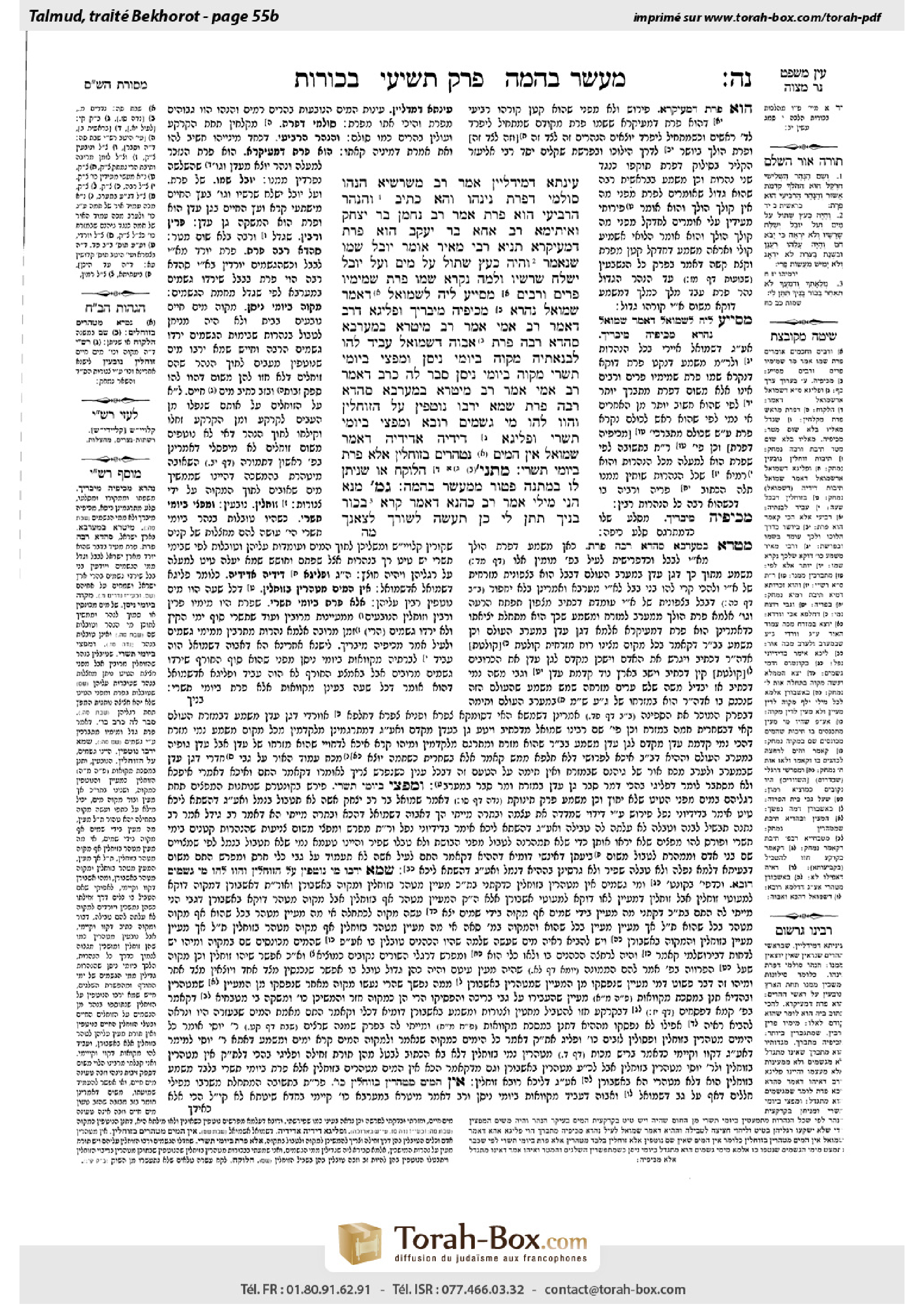
Bekhorot 55b: Talmud study for Daf Yomi
Study the Talmud for Daf Yomi with scanned pages, Hebrew text, English translations from Sefaria and AI-generated French translations.
Passage selection and English or AI-generated French translation are available where the scan has annotations. Daf Study is independent of Torah-Box and Sefaria.
Browse Bekhorot · בכורות · All tractatesBekhorot 55b text and translations
This page of Bekhorot includes the Aramaic text, an English translation and an AI-generated French translation, alongside the scan above.
בכורות נ״ה ב · Aramaic and Hebrew text
עֵינָתָא דְּמִידַּלְּיָין! אָמַר רַב מְשַׁרְשְׁיָא: הָנְהוּ סוּלָּמֵי דִּפְרָת נִינְהוּ.
וְהָא כְּתִיב: ״וְהַנָּהָר הָרְבִיעִי הוּא פְרָת״!
אָמַר רַב נַחְמָן בַּר יִצְחָק, וְאִיתֵּימָא רַב אַחָא בַּר יַעֲקֹב: הוּא פְּרָת דְּמֵעִיקָּרָא.
תַּנְיָא, רַבִּי מֵאִיר אוֹמֵר: ״יוּבַל״ שְׁמוֹ, שֶׁנֶּאֱמַר: ״וְהָיָה כְּעֵץ שָׁתוּל עַל מַיִם וְעַל יוּבַל יְשַׁלַּח שׇׁרָשָׁיו״, וְלָמָּה נִקְרָא שְׁמוֹ ״פְּרָת״? שֶׁמֵּימָיו פָּרִים וְרָבִים.
מְסַיַּיע לֵיהּ לִשְׁמוּאֵל, דְּאָמַר שְׁמוּאֵל: נַהְרָא מִכֵּיפֵיהּ מִיבְּרִיךְ. וּפְלִיגָא דְּרַב, דְּאָמַר רַב אַמֵּי אָמַר רַב: מִיטְרָא בְּמַעְרְבָא סָהֲדָא רַבָּה פְּרָת.
אֲבוּהּ דִּשְׁמוּאֵל עָבֵיד לְהוּ לִבְנָאתֵיהּ מִקְוֶה בְּיוֹמֵי נִיסָן, וּמַפָּצֵי בְּיוֹמֵי תִשְׁרֵי. מִקְוֶה בְּיוֹמֵי נִיסָן — סָבַר לַהּ כְּרַב, דְּאָמַר רַב אַמֵּי אָמַר רַב: מִיטְרָא בְּמַעְרְבָא סָהֲדָא רַבָּה פְּרָת, שֶׁמָּא יִרְבּוּ נוֹטְפִין עַל הַזּוֹחֲלִין, וְהָווּ לְהוּ מֵי גְשָׁמִים רוּבָּא.
וּמַפָּצֵי בְּיוֹמֵי תִשְׁרֵי.
וּפְלִיגָא דִּידֵיהּ אַדִּידֵיהּ, דְּאָמַר שְׁמוּאֵל: אֵין הַמַּיִם נִטְהָרִים בְּזוֹחֲלִין אֶלָּא פְּרָת בְּיוֹמֵי תִשְׁרֵי.
מַתְנִי׳ הַלּוֹקֵחַ, אוֹ שֶׁנִּיתַּן לוֹ בְּמַתָּנָה — פָּטוּר מִמַּעְשַׂר בְּהֵמָה.
גְּמָ׳ מְנָא הָנֵי מִילֵּי? אָמַר רַב כָּהֲנָא: דְּאָמַר קְרָא ״בְּכוֹר בָּנֶיךָ תִּתֶּן לִּי כֵּן תַּעֲשֶׂה לְשֹׁרְךָ לְצֹאנֶךָ״,
Bekhorot 55b · English translation
springs that are higher in the mountains than the Euphrates; how can their water come from the Euphrates? Rav Mesharshiyya said: These are ladders of the Euphrates, i.e., the waters of the Euphrates seep through the ground and are drawn upward to emerge from these springs.
The Gemara asks: But isn’t it written: “And a river went out of Eden to water the garden; and from there it was separated, and became four heads…And the name of the third river is Tigris; that is the one that goes toward the east of Ashur. And the fourth river is the Euphrates” (Genesis 2:10, 14)? This indicates that the Euphrates, which is mentioned last, is the least of the four rivers, not the source of the other three.
Rav Naḥman bar Yitzḥak said, and some say it was Rav Aḥa bar Ya’akov who said: It is the Euphrates that the verse mentions initially as the river that went out of Eden, which divided into all the other rivers. After the other three branched out from it, the Euphrates continued to flow.
It is taught in a baraita that Rabbi Meir says: Yuval is the name of the Euphrates River where it emerges from Eden, as it is stated: “For he shall be as a tree planted by the waters, and that spreads out its roots by the river [yuval], and shall not see when heat comes, but its foliage shall be luxuriant; and shall not be anxious in the year of drought, neither shall cease from yielding fruit” (Jeremiah 17:8). And why is it named Euphrates [perat]? Because its waters are fruitful [parim] and multiply without the need for rainfall.
The Gemara adds that this supports the opinion of Shmuel, as Shmuel says: The river is blessed from its riverbed; the additional water in the river is not from rainfall but rather from subterranean sources. And this statement disagrees with the opinion of Rav, as Rav Ami says that Rav says: When rain falls in the West, Eretz Yisrael, the great witness attesting to that fact is the Euphrates, as the water flow in the Euphrates increases after the rainy season.
The Gemara relates that Shmuel’s father fashioned a ritual bath for his daughters during the days of Nisan, and placed mats in the Euphrates River during the days of Tishrei when his daughters immersed in the river. He fashioned a ritual bath during the days of Nisan, because he holds in accordance with the opinion of Rav, as Rav Ami says that Rav says: When rain falls in the West, the great witness attesting to that fact is the Euphrates. Shmuel’s father was concerned that perhaps the rainwater and snow water that fell and accumulated in the river would exceed the amount of naturally flowing spring water that originated in the river’s sources, and the flowing rainwater would be the majority. Rainwater purifies only when it is collected; it does not purify when it is flowing. Therefore, Shmuel’s father fashioned ritual baths of standing water for his daughters.
And he placed mats during the days of Tishrei, when his daughters immersed in the river itself, to give them privacy. During Tishrei the waters of the Euphrates do not come from rainwater; rather, the waters are from the river itself, and therefore immersion is valid even when that water is flowing.
The Gemara notes: And this statement of Shmuel’s, that the additional water in the Euphrates is not from rainfall but from subterranean sources, disagrees with another ruling that he himself issued. As Shmuel says: Waters purify when flowing, i.e., when they are not collected into a ritual bath, only in the Euphrates during the days of Tishrei. Since rain does not fall in the summer, only after the summer, in Tishrei, is it clear that the water one is immersing in is in fact river water.
MISHNA: One who purchases an animal or has an animal that was given to him as a gift is exempt from separating animal tithe.
GEMARA: The Gemara asks: From where is this matter derived? Rav Kahana says that the verse states: “You shall not delay to offer of the fullness of your harvest, and of the outflow of your presses. The firstborn of your sons you shall give to Me. So you shall do with your oxen, and with your sheep: Seven days it shall be with its mother; on the eighth day you shall give it to Me” (Exodus 22:28–29).
Bekhorot 55b · Traduction française (IA)
Des sources qui sont plus élevées dans les montagnes que l'Euphrate ; comment peuvent-elles avoir leur eau provenant de l'Euphrate ? Rav Mesharshiyya a dit : Ce sont des échelons de l'Euphrate, c'est-à-dire que les eaux de l'Euphrate s'infiltrent dans le sol et sont tirées vers le haut pour émerger de ces sources.
La Guemara pose la question : Mais n'est-il pas écrit : « Et un fleuve sortit d'Éden pour arroser le jardin ; et d'ici il fut séparé, et devint quatre sources… Et le nom du troisième fleuve est Tigris ; c'est celui qui va vers l'est d'Assour. Et la quatrième fleuve est l'Euphrate » (Genèse 2:10, 14) ? Cela indique que l'Euphrate, qui est mentionné en dernier, est le moins important des quatre fleuves, et non la source des trois autres.
Rav Naḥman bar Yitzḥak a dit, et certains disent que c'était Rav Aḥa bar Ya’akov qui a dit : C'est l'Euphrate dont la parabole mentionne initialement le fleuve sortant d'Éden, qui s'est divisé en tous les autres fleuves. Après que les trois autres se sont séparés de lui, l'Euphrate a continué à couler.
Il est enseigné dans une baraïta que Rabbi Meir dit : Yuval est le nom du fleuve Euphrate où il sort d'Éden, comme il est dit : « Car il sera comme un arbre planté près des eaux, et qui étend ses racines par le fleuve [yuval], et ne verra pas quand viendra la chaleur, mais ses feuillages seront luxurieux ; et ne sera pas inquiet en l'année de sécheresse, ni cesser de produire des fruits » (Jérémie 17:8). Et pourquoi est-il nommé Euphrate [perat] ? Parce que ses eaux sont fécondes [parim] et se multiplient sans avoir besoin de la pluie.
La Guemara ajoute que cela soutient l'opinion de Shmuel, car Shmuel dit : Le fleuve est béni à partir de son lit ; l'eau supplémentaire dans le fleuve ne vient pas de la pluie, mais plutôt des sources souterraines. Et cette déclaration contredit l'opinion de Rav, car Rav Ami dit que Rav dit : Quand la pluie tombe dans le West, Eretz Yisrael, le grand témoin attestant de cela est l'Euphrate, car le débit de l'Euphrate augmente après la saison des pluies.
La Guemara rapporte que le père de Shmuel a construit un mikvé pour ses filles pendant les jours de Nisan, et a placé des tapis dans le fleuve Euphrate pendant les jours de Tishrei quand ses filles se sont immergées dans le fleuve. Il a construit un mikvé pendant les jours de Nisan, car il suit l'opinion de Rav, comme Rav Ami dit que Rav dit : Quand la pluie tombe dans le West, Eretz Yisrael, le grand témoin attestant de cela est l'Euphrate. Le père de Shmuel avait peur que peut-être l'eau de pluie et l'eau de neige qui sont tombés et s'accumulés dans le fleuve dépassent la quantité d'eau naturellement coulant provenant des sources du fleuve, et que l'eau de pluie serait la majorité. L'eau de pluie ne purifie que lorsqu'elle est collectée ; elle ne purifie pas lorsqu'elle est en cours d'écoulement. Par conséquent, le père de Shmuel a construit des mikvé d'eau statique pour ses filles.
Et il a disposé des tapis pendant les jours de Tishrei, quand ses filles s'immergeaient dans le fleuve lui-même, pour leur offrir de la discrétion. Pendant Tishrei, les eaux de l'Euphrate ne proviennent pas de la pluie ; plutôt, les eaux proviennent du fleuve lui-même, et donc l'immersion est valide même quand cette eau est en cours d'écoulement.
La Guemara note : Et cette déclaration de Shmuel, que l'eau supplémentaire dans l'Euphrate ne vient pas de la pluie mais des sources souterraines, contredit une autre décision qu'il a lui-même rendue. Car Shmuel dit : L'eau purifie lorsqu'elle est en cours d'écoulement, c'est-à-dire lorsqu'elle n'est pas collectée dans un mikvé, seulement dans l'Euphrate pendant les jours de Tishrei. Puisque la pluie ne tombe pas en été, seulement après l'été, en Tishrei, il est clair que l'eau dans laquelle l'on s'immerge est en effet de l'eau du fleuve.
MICHNA : Celui qui achète un animal ou qui possède un animal donné à lui en cadeau est exempt de séparer la dîme animale.
GUEMARA : La Guemara pose la question : D'où cette matière est-elle dérivée ? Rav Kahana dit que la versette stipule : « Vous ne retarderez pas à offrir de la pleine récolte de vos fruits, et de l'écoulement de vos pressoirs. Le premier-né de vos fils vous donnerez à Moi. Ainsi vous ferez avec vos bœufs et vos brebis : Sept jours il restera avec sa mère ; le huitième jour vous donnerez à Moi » (Exode 22:28–29).
Traduction française générée par IA à partir de l’édition anglaise de Sefaria. Vérifie toujours un passage avec le texte source.
Text from Sefaria: William Davidson Edition - Vocalized Aramaic (CC BY NC); William Davidson Edition - English (CC BY NC).