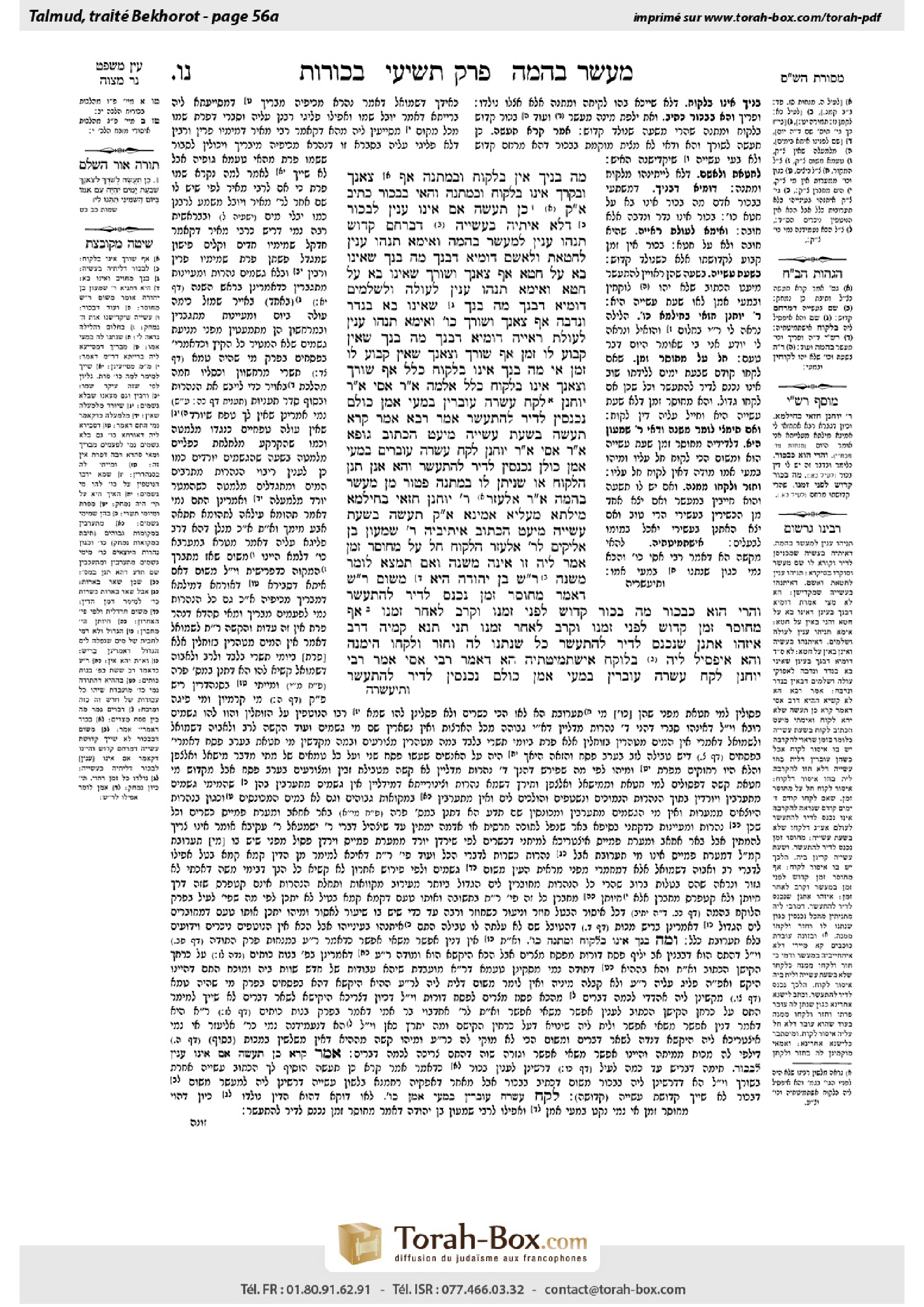
Bekhorot 56a: Talmud study for Daf Yomi
Study the Talmud for Daf Yomi with scanned pages, Hebrew text, English translations from Sefaria and AI-generated French translations.
Passage selection and English or AI-generated French translation are available where the scan has annotations. Daf Study is independent of Torah-Box and Sefaria.
Browse Bekhorot · בכורות · All tractatesBekhorot 56a text and translations
This page of Bekhorot includes the Aramaic text, an English translation and an AI-generated French translation, alongside the scan above.
בכורות נ״ו א · Aramaic and Hebrew text
מָה בָּנֶיךָ — אֵין בְּלָקוּחַ וּבְמַתָּנָה, אַף צֹאנְךָ וּבְקָרְךָ — אֵינוֹ בְּלָקוּחַ וּבְמַתָּנָה.
וְהַאי בִּבְכוֹר כְּתִיב! אָמַר קְרָא: ״כֵּן תַּעֲשֶׂה״, אִם אֵינוֹ עִנְיָן לִבְכוֹר, דְּלָא אִיתֵיהּ בַּעֲשִׂיָּיה, דִּבְרֶחֶם קָדוֹשׁ — תְּנֵהוּ עִנְיָן לְמַעְשַׂר בְּהֵמָה.
וְאֵימָא: תְּנֵהוּ עִנְיָן לְחַטָּאת וּלְאָשָׁם! דּוּמְיָא דְּבִנְךָ — מָה בִּנְךָ שֶׁאֵינוֹ בָּא עַל חֵטְא, אַף צֹאנְךָ וְשׁוֹרְךָ שֶׁאֵינוֹ בָּא עַל חֵטְא.
וְאֵימָא: תְּנֵהוּ עִנְיָן לְעוֹלָה וְלִשְׁלָמִים! דּוּמְיָא דְּבִנְךָ — מָה בִּנְךָ שֶׁאֵינוֹ בָּא בְּנֶדֶר וּנְדָבָה, אַף צֹאנְךָ וְשׁוֹרְךָ כּוּ׳.
וְאֵימָא: תְּנֵהוּ עִנְיָן לְעוֹלַת רְאִיָּיה! דּוּמְיָא דְּבִנְךָ — מָה בִּנְךָ שֶׁאֵין קָבוּעַ לוֹ זְמַן, אַף שׁוֹרְךָ וְצֹאנְךָ שֶׁאֵין קָבוּעַ לוֹ זְמַן.
אִי מָה בִּנְךָ אֵינוֹ בְּלָקוּחַ כְּלָל, אַף שׁוֹרְךָ וְצֹאנְךָ אֵינוֹ בְּלָקוּחַ כְּלָל, אַלְּמָה אָמַר רַבִּי אַסִּי אָמַר רַבִּי יוֹחָנָן: לָקַח עֲשָׂרָה עוּבָּרִין בִּמְעֵי אִמָּן — כּוּלָּם נִכְנָסִין לַדִּיר לְהִתְעַשֵּׂר?
אָמַר רָבָא, אָמַר קְרָא: ״תַּעֲשֶׂה״ — בִּשְׁעַת עֲשִׂיָּיה מִיעֵט הַכָּתוּב.
גּוּפָא, אָמַר רַבִּי אַסִּי אָמַר רַבִּי יוֹחָנָן: לָקַח עֲשָׂרָה עוּבָּרִים בִּמְעֵי אִמָּן — כּוּלָּן נִכְנָסִין לַדִּיר לְהִתְעַשֵּׂר. וְהָא אֲנַן תְּנַן: הַלּוֹקֵחַ אוֹ שֶׁנִּיתַּן לוֹ בְּמַתָּנָה פָּטוּר מִן מַעְשַׂר בְּהֵמָה!
אָמַר רַבִּי אֶלְעָזָר: רַבִּי יוֹחָנָן חֲזַאי בְּחֶילְמָא, מִילְּתָא מְעַלְּיָא אָמֵינָא. אָמַר קְרָא ״תַּעֲשֶׂה״, בִּשְׁעַת עֲשִׂיָּיה מִיעֵט הַכָּתוּב. אֵיתִיבֵיהּ רַבִּי שִׁמְעוֹן בֶּן אֶלְיָקִים לְרַבִּי אֶלְעָזָר: הַלָּקוּחַ חָל עַל מְחוּסַּר זְמַן!
אֲמַר לֵיהּ: זוֹ אֵינָהּ מִשְׁנָה, וְאִם תִּמְצָא לוֹמַר מִשְׁנָה — רַבִּי שִׁמְעוֹן בֶּן יְהוּדָה הִיא מִשּׁוּם רַבִּי שִׁמְעוֹן, דְּאָמַר: מְחוּסַּר זְמַן נִכְנָס לַדִּיר לְהִתְעַשֵּׂר, וַהֲרֵי הוּא כִּבְכוֹר, מָה בְּכוֹר קָדוֹשׁ לִפְנֵי זְמַנּוֹ וְקָרֵב לְאַחַר זְמַנּוֹ — אַף מְחוּסַּר זְמַן קָדוֹשׁ לִפְנֵי זְמַנּוֹ וְקָרֵב לְאַחַר זְמַנּוֹ.
תָּנֵי תַּנָּא קַמֵּיהּ דְּרַב: אֵיזֶהוּ אֶתְנַן שֶׁנִּכְנָס לַדִּיר לְהִתְעַשֵּׂר? כֹּל שֶׁנְּתָנוֹ לָהּ וְחָזַר וּלְקָחוֹ הֵימֶנָּה. וְהָא אִיפְּסִיל לֵיהּ בְּלוֹקֵחַ!
אִישְׁתְּמִיטְתֵּיהּ הָא דְּאָמַר רַבִּי אַסִּי אָמַר רַבִּי יוֹחָנָן: לָקַח עֲשָׂרָה עוּבָּרִין בִּמְעֵי אִמָּן — כּוּלָּם נִכְנָסִין לַדִּיר לְהִתְעַשֵּׂר.
Bekhorot 56a · English translation
Just as the redemption of your firstborn son does not apply to a child who was purchased or received as a gift, i.e., the mitzva applies only to one’s own son, so too, the mitzva of separating tithe from your flock and your herd does not apply to animals that were purchased or received as a gift.
The Gemara raises a difficulty: But this verse, which juxtaposes the firstborn son to an animal, is written with regard to redemption of a firstborn, not with regard to animal tithe. The Gemara explains that the verse states: “So you shall do with your oxen, and with your sheep: Seven days it shall be with its mother; on the eighth day you shall give it to Me” (Exodus 22:29). If this is not needed for the matter of firstborn animals, which do not require any action to sanctify them as the animal is already consecrated when it leaves the womb, apply it to the matter of animal tithe, where an animal is sanctified only when the owner counts it as the tenth animal.
The Gemara suggests: But instead one can say to apply this phrase: “So you shall do,” to the matter of a sin offering and a guilt offering rather than animal tithe, i.e., one should derive that these offerings are sanctified only if they originally belonged to the individual who is attempting to sanctify them, not if they are purchased or received as a gift. The Gemara explains that one expounds the phrase as referring to animal tithe because that case is similar to the case of: Your son. Just as your son does not come to be redeemed to atone for a sin, so too, the phrase: Your sheep and your oxen, discussed in the verse, is referring to animal tithe, which does not come to the Temple to atone for a sin. Sin offerings and guilt offerings are brought only if one commits a sin.
The Gemara suggests: But instead one can say to apply this phrase to the matter of a burnt offering and a peace offering, which can be brought even if one has not sinned, like the animal tithe. The Gemara explains that one expounds the phrase as referring to animal tithe because that case is similar to the case of: Your son. Just as your son cannot come in the form of a vow or a gift, so too, the phrase: Your sheep and your oxen, discussed in the verse, is referring to animal tithe, which cannot be brought as a vow or as a gift. It is not referring to a burnt offering or a peace offering, both of which can be brought as a vow or as a gift.
The Gemara suggests: But one can say instead that one should apply this phrase to the matter of a burnt offering of appearance, which one brings when he ascends to Jerusalem on one of the three pilgrimage Festivals. This offering is not brought for a sin, nor as a vow or a gift, as it is obligatory. The Gemara explains that one expounds the phrase as referring to animal tithe because that case is similar to the case of: Your son. Just as your son does not have a fixed time of year to be redeemed, but is redeemed after the thirtieth day from his birth, so too: Your oxen and your sheep, discussed in the verse, is referring to animal tithe, which does not have a fixed time to be brought. By contrast, the burnt offering of appearance is brought only on the three pilgrimage Festivals.
The Gemara asks: If the halakha of the tithing of a purchased animal is derived from the juxtaposition to the mitzva of redemption of a firstborn son, then all the halakhot of one should apply to the other: Just as your firstborn son cannot be purchased at all, under any circumstances, so too, your oxen and your sheep should not be subject to animal tithe if they are purchased at all. If so, why does Rabbi Asi say that Rabbi Yoḥanan says: If one purchased ten animal fetuses while they were still in their mothers’ wombs and the animals were born once he already owned them, they all enter the pen to be tithed? If the halakha is derived from a firstborn son, there should be no concept of tithe in the case of purchased animals.
Rava said in response that the verse states: “So you shall do with your oxen, and with your sheep: Seven days it shall be with its mother; on the eighth day you shall give it to Me.” The verse excludes purchased animals from animal tithe only at the time of doing, i.e., from the time the animals are fit to be sacrificed in the Temple, not while they are still in their mothers’ wombs, as at that time they are as yet unfit to be sacrificed on the altar.
The Gemara discusses the matter itself, to cite the relevant discussion in full. Rabbi Asi says that Rabbi Yoḥanan says: If one purchased ten animal fetuses while they were still in their mothers’ wombs and the animals were born once he already owned them, they all enter the pen to be tithed. The Gemara asks: But didn’t we learn in the mishna: One who purchases an animal or has an animal that was given to him as a gift is exempt from animal tithe? If so, why isn’t the owner of these fetuses also exempt from animal tithe?
Rabbi Elazar said: I saw Rabbi Yoḥanan in a dream, which is a sign that I am saying a proper matter in explaining his opinion. The verse states: “So you shall do” (Exodus 22:29); the verse excludes purchased animals from animal tithe only at the time of doing, i.e., from the time the animals are fit to be sacrificed in the Temple. Rabbi Shimon ben Elyakim raised an objection to Rabbi Elazar from a baraita: The exemption of a purchased animal applies even to an animal whose time has not yet arrived, i.e., before it is eight days old and fit to be sacrificed in the Temple. By the same token, the exemption should also apply to a fetus, despite the fact that it is not yet fit to be sacrificed.
Rabbi Elazar said to Rabbi Shimon ben Elyakim: This baraita is not a tannaitic source that can be relied upon, as it is not accurate. And if you say this baraita is a tannaitic source that can be relied upon, it is only in accordance with the opinion of Rabbi Shimon ben Yehuda in the name of Rabbi Shimon, who says that an animal whose time has not yet arrived also enters the pen to be tithed, and in this regard it is like a firstborn animal. Just as a firstborn animal is sanctified before its time arrives to be sacrificed, but is sacrificed after its time, i.e., after it is at least eight days old, so too, an animal whose time has not yet arrived enters the pen to be tithed, and if it comes out as the tenth animal, it is sanctified before its time for sacrifice has arrived but is sacrificed only after its time, i.e., after it is at least eight days old.
A tanna taught a baraita in the presence of Rav: Which is the type of animal set aside as payment to a prostitute, about which the Sages said (see 57a) that it enters the pen to be tithed? Any animal that he gave to her as payment and subsequently purchased back from her. The tanna asked: But doesn’t it become disqualified from the status of animal tithe as a purchased animal, as he purchased it back from the prostitute?
The Gemara answers that this statement escaped that tanna: As Rabbi Asi says that Rabbi Yoḥanan says: If one purchased ten animal fetuses while they were still in their mothers’ wombs they all enter the pen to be tithed. Accordingly, the baraita can be understood as referring to an animal that was given to a prostitute as payment and purchased back from her while it was still inside its mother’s womb.
Bekhorot 56a · Traduction française (IA)
Comme la délivrance de votre premier-né ne s'applique pas à un enfant acheté ou reçu en cadeau, c'est-à-dire que la mitsva s'applique uniquement à votre propre fils, de même la mitsva de séparer la dîme de votre troupeau et de votre bétail ne s'applique pas aux animaux achetés ou reçus en cadeau.
La Guemara soulève une difficulté : Mais ce verset, qui juxtapose le premier-né à un animal, est écrit concernant la délivrance du premier-né, pas concernant la dîme animale. La Guemara explique que le verset dit : « Ainsi faites-vous avec vos bœufs et vos brebis : Sept jours il restera avec sa mère ; le huitième jour vous le donnerez à Moi » (Exode 22:29). Si cela n'est pas nécessaire pour la question des premiers-nés d'animaux, qui n'exigent aucune action pour les sanctifier car ils sont déjà consacrés lorsqu'ils sortent du ventre, appliquez-le à la question de la dîme animale, où un animal est sanctifié uniquement lorsque l'owner le compte comme le dixième animal.
La Guemara suggère : Mais on pourrait plutôt dire d'appliquer cette phrase : « Ainsi faites-vous », à la question du sacrifice expiatoire et du sacrifice de culpabilité plutôt qu'à la dîme animale, c'est-à-dire qu'on devrait déduire que ces sacrifices sont sanctifiés uniquement s'ils appartenaient initialement à la personne qui tente de les sanctifier, pas s'ils sont achetés ou reçus en cadeau. La Guemara explique qu'on interprète cette phrase comme concernant la dîme animale car ce cas est similaire à celui de : Votre fils. Comme votre fils ne vient pas se sanctifier pour expier un péché, de même la phrase : Vos bœufs et vos brebis, discutée dans le verset, fait référence à la dîme animale, qui ne vient pas au Temple pour expier un péché. Les sacrifices expiatoires et de culpabilité sont uniquement offerts si l'on commet un péché.
La Guemara suggère : Mais on pourrait plutôt dire d'appliquer cette phrase à la question du sacrifice holocauste et du sacrifice de paix, qui peuvent être offerts même si l'on n'a pas péché, comme la dîme animale. La Guemara explique qu'on interprète cette phrase comme concernant la dîme animale car ce cas est similaire à celui de : Votre fils. Comme votre fils ne peut pas venir sous la forme d'un vœu ou d'un cadeau, de même la phrase : Vos bœufs et vos brebis, discutée dans le verset, fait référence à la dîme animale, qui ne peut pas être offerte comme un vœu ou comme un cadeau. Elle ne fait pas référence au sacrifice holocauste ou au sacrifice de paix, qui peuvent être offerts comme un vœu ou comme un cadeau.
La Guemara suggère : Mais on pourrait plutôt dire d'appliquer cette phrase à la question du sacrifice holocauste de l'apparition, que l'on offre lorsqu'on monte à Jérusalem l'un des trois festivals de pèlerinage. Ce sacrifice n'est pas offert pour un péché, ni comme un vœu ou un cadeau, car il est obligatoire. La Guemara explique qu'on interprète cette phrase comme concernant la dîme animale car ce cas est similaire à celui de : Votre fils. Comme votre fils n'a pas de moment fixe de l'année pour être délivré, mais est délivré après le trentième jour de sa naissance, de même : Vos bœufs et vos brebis, discutés dans le verset, font référence à la dîme animale, qui n'a pas de moment fixe pour être offerte. À l'inverse, le sacrifice holocauste de l'apparition est offert uniquement lors des trois festivals de pèlerinage.
La Guemara pose la question : Si la halakha de la dîme d'un animal acheté est dérivée de la juxtaposition à la mitsva de la délivrance du premier-né, alors toutes les halakhot de l'un s'appliquent à l'autre : Comme votre premier-né ne peut être acheté du tout, sous aucun circonstance, de même, vos bœufs et vos brebis ne devraient pas être soumis à la dîme animale si ils sont achetés du tout. Si c'est ainsi, pourquoi Rabbi Asi dit que Rabbi Yoḥanan dit : Si l'on a acheté dix fœtus d'animaux alors qu'ils étaient encore dans le ventre de leurs mères et que les animaux sont nés une fois que l'on les possédait déjà, ils entrent tous dans l'enclos pour être tithés ? Si la halakha est dérivée du premier-né, il ne devrait pas y avoir de concept de dîme dans le cas des animaux achetés.
Rava répondit en disant que le verset dit : « Ainsi faites-vous avec vos bœufs et vos brebis : Sept jours il restera avec sa mère ; le huitième jour vous le donnerez à Moi. » Le verset exclut les animaux achetés de la dîme animale uniquement au moment de l'acte, c'est-à-dire à partir du moment où les animaux sont prêts à être sacrifiés dans le Temple, pas pendant qu'ils sont encore dans le ventre de leurs mères, car à ce moment-là ils ne sont pas encore prêts à être sacrifiés sur l'autel.
La Guemara discute la question elle-même, afin de citer la discussion pertinente en entier. Rabbi Asi dit que Rabbi Yoḥanan dit : Si l'on a acheté dix fœtus d'animaux alors qu'ils étaient encore dans le ventre de leurs mères et que les animaux sont nés une fois que l'on les possédait déjà, ils entrent tous dans l'enclos pour être tithés. La Guemara pose la question : Mais n'avons-nous pas appris dans la mishna : Celui qui achète un animal ou qui possède un animal donné en cadeau est exempt de la dîme animale ? Si c'est ainsi, pourquoi l'propriétaire de ces fœtus n'est-il pas également exempt de la dîme animale ?
Rabbi Elazar dit : J'ai vu Rabbi Yoḥanan dans un rêve, ce qui est un signe que je dis une bonne chose en expliquant son opinion. Le verset dit : « Ainsi faites-vous » (Exode 22:29) ; le verset exclut les animaux achetés de la dîme animale uniquement au moment de l'acte, c'est-à-dire à partir du moment où les animaux sont prêts à être sacrifiés dans le Temple. Rabbi Shimon ben Elyakim a soulevé une objection contre Rabbi Elazar à partir d'une baraïta : L'exemption de l'animal acheté s'applique même à un animal dont le moment n'est pas encore arrivé, c'est-à-dire avant qu'il ne soit âgé de huit jours et prêt à être sacrifié dans le Temple. Par la même logique, l'exemption devrait s'appliquer également à un fœtus, malgré le fait qu'il n'est pas encore prêt à être sacrifié.
Rabbi Elazar a dit à Rabbi Shimon ben Elyakim : Ce baraïta n'est pas une source tannaitique sur laquelle on peut compter, car elle n'est pas exacte. Et si vous dites que ce baraïta est une source tannaitique sur laquelle on peut compter, c'est uniquement selon l'opinion de Rabbi Shimon ben Yehuda, dans le nom de Rabbi Shimon, qui dit qu'un animal dont l'âge n'a pas encore atteint l'âge requis entre dans la basse cour pour être tenu à la première tithe, et dans ce cas, il est considéré comme un animal premier. Tout comme un animal premier est sanctifié avant l'âge requis pour être sacrifié, mais est sacrifié après l'âge, c'est-à-dire après qu'il ait atteint l'âge de huit jours, de même, un animal dont l'âge n'a pas encore atteint l'âge requis entre dans la basse cour pour être tenu à la première tithe, et si celui-ci sort comme le dixième animal, il est sanctifié avant l'âge requis pour être sacrifié, mais est sacrifié uniquement après l'âge, c'est-à-dire après qu'il ait atteint l'âge de huit jours.
Un tanna a enseigné un baraïta en présence de Rav : Quel est le type d'animal désigné comme paiement à une prostituée, à propos duquel les Sages ont dit (voir 57a) qu'il entre dans la basse cour pour être tenu à la première tithe ? Tout animal qu'il a donné à elle comme paiement et qu'il a ensuite acheté à nouveau d'elle. Le tanna a demandé : Mais ne devient-il pas disqualifié du statut d'animal tithe en tant qu'animal acheté, puisqu'il l'a acheté à nouveau de la prostituée ?
La Guemara répond que cette déclaration a échappé à ce tanna : Comme Rabbi Asi dit que Rabbi Yoḥanan dit : Si l'on achète dix fœtus d'animaux pendant qu'ils sont encore dans le ventre de leur mère, ils entrent tous dans la basse cour pour être tenu à la première tithe. Ainsi, ce baraïta peut être compris comme faisant référence à un animal qui a été donné à une prostituée comme paiement et acheté à nouveau d'elle alors qu'il était encore dans le ventre de sa mère.
Traduction française générée par IA à partir de l’édition anglaise de Sefaria. Vérifie toujours un passage avec le texte source.
Text from Sefaria: William Davidson Edition - Vocalized Aramaic (CC BY NC); William Davidson Edition - English (CC BY NC).