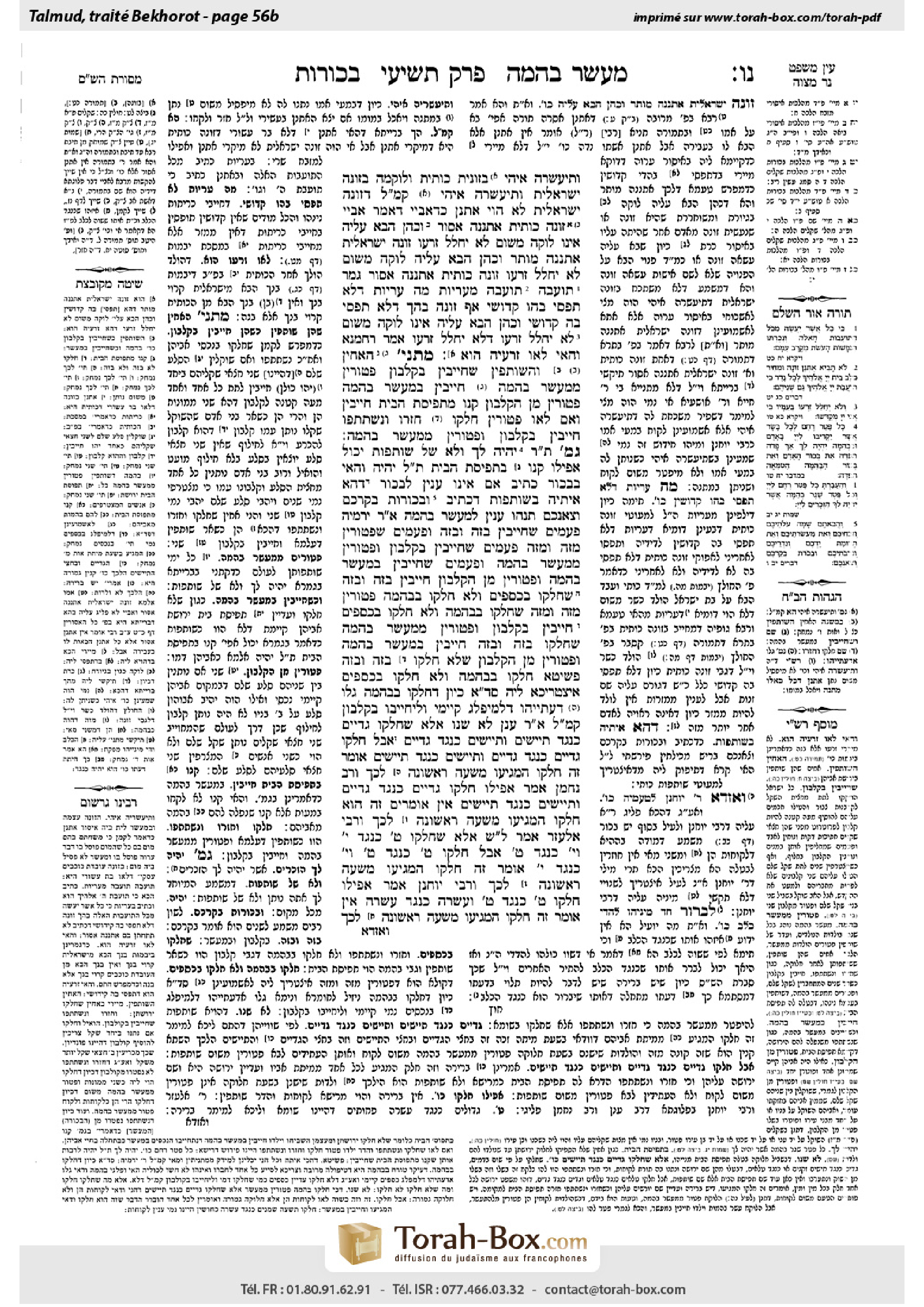
Bekhorot 56b: Talmud study for Daf Yomi
Study the Talmud for Daf Yomi with scanned pages, Hebrew text, English translations from Sefaria and AI-generated French translations.
Passage selection and English or AI-generated French translation are available where the scan has annotations. Daf Study is independent of Torah-Box and Sefaria.
Browse Bekhorot · בכורות · All tractatesBekhorot 56b text and translations
This page of Bekhorot includes the Aramaic text, an English translation and an AI-generated French translation, alongside the scan above.
בכורות נ״ו ב · Aramaic and Hebrew text
וְתִיעַשְּׂרֵהּ אִיהִי! בְּזוֹנָה גּוֹיָה.
וְלוֹקְמַהּ בְּזוֹנָה יִשְׂרְאֵלִית, וְתִיעַשְּׂרֵהּ אִיהִי! קָא מַשְׁמַע לַן דְּזוֹנָה יִשְׂרְאֵלִית לָא הָוֵי אֶתְנַן.
כִּדְאַבָּיֵי, דְּאָמַר אַבָּיֵי: זוֹנָה גּוֹיָה — אֶתְנַנָּהּ אָסוּר, וְכֹהֵן הַבָּא עָלֶיהָ אֵינוֹ לוֹקֶה מִשּׁוּם ״לֹא יְחַלֵּל זַרְעוֹ״. זוֹנָה יִשְׂרְאֵלִית — אֶתְנַנָּהּ מוּתָּר, וְכֹהֵן הַבָּא עָלֶיהָ לוֹקֶה מִשּׁוּם ״לֹא יְחַלֵּל זַרְעוֹ״.
זוֹנָה גּוֹיָה אֶתְנַנָּהּ אָסוּר — גָּמַר ״תּוֹעֵבָה״ ״תּוֹעֵבָה״ מֵעֲרָיוֹת.
מָה עֲרָיוֹת, דְּלָא תָּפְסִי בְּהוּ קִדּוּשֵׁי — אַף זוֹנָה, בְּהָךְ דְּלָא תָּפְסִי בַּהּ קִדּוּשֵׁי.
וְכֹהֵן הַבָּא עָלֶיהָ אֵינוֹ לוֹקֶה מִשּׁוּם ״לֹא יְחַלֵּל זַרְעוֹ״, דְּלֹא יְחַלֵּל זַרְעוֹ אָמַר רַחֲמָנָא, וְהַאי לָאו זַרְעֵיהּ הוּא.
מַתְנִי׳ הָאַחִין וְהַשּׁוּתָּפִין, שֶׁחַיָּיבִין בַּקָּלְבּוֹן — פְּטוּרִין מִמַּעְשַׂר בְּהֵמָה, חַיָּיבִין בְּמַעְשַׂר בְּהֵמָה — פְּטוּרִין מִן הַקָּלְבּוֹן.
קָנוּ מִתְּפִיסַת הַבַּיִת — חַיָּיבִין, וְאִם לָאו — פְּטוּרִין. חָלְקוּ, חָזְרוּ וְנִשְׁתַּתְּפוּ — חַיָּיבִין בַּקָּלְבּוֹן וּפְטוּרִין מִמַּעְשַׂר בְּהֵמָה.
גְּמָ׳ תָּנוּ רַבָּנַן: ״יִהְיֶה לְךָ״ — וְלֹא שֶׁל שׁוּתָּפוּת. יָכוֹל אֲפִילּוּ קָנוּ בִּתְפִיסַת הַבַּיִת? תַּלְמוּד לוֹמַר: ״יִהְיֶה״.
וְהַאי בִּבְכוֹר כְּתִיב! אִם אֵינוֹ עִנְיָן לִבְכוֹר, דְּהָא אִיתֵיהּ בְּשׁוּתָּפוּת, דִּכְתִיב: ״וּבְכוֹרוֹת בְּקַרְכֶם וְצֹאנְכֶם״, תְּנֵהוּ עִנְיָן לְמַעְשַׂר בְּהֵמָה.
אָמַר רַבִּי יִרְמְיָה: פְּעָמִים שֶׁחַיָּיבִין בָּזֶה וּבָזֶה, וּפְעָמִים שֶׁפְּטוּרִין מִזֶּה וּמִזֶּה, פְּעָמִים שֶׁחַיָּיבִין בַּקָּלְבּוֹן וּפְטוּרִין מִמַּעְשַׂר בְּהֵמָה, וּפְעָמִים שֶׁחַיָּיבִין בְּמַעְשַׂר בְּהֵמָה וּפְטוּרִין מִן הַקָּלְבּוֹן.
חַיָּיבִין בָּזֶה וּבָזֶה — שֶׁחָלְקוּ בַּכְּסָפִים וְלֹא חָלְקוּ בַּבְּהֵמָה, פְּטוּרִין מִזֶּה וּמִזֶּה — שֶׁחָלְקוּ בַּבְּהֵמָה וְלֹא חָלְקוּ בַּכְּסָפִים.
חַיָּיבִין בַּקָּלְבּוֹן וּפְטוּרִין מִמַּעְשַׂר בְּהֵמָה — שֶׁחָלְקוּ בָּזֶה וּבָזֶה.
חַיָּיבִין בְּמַעְשַׂר בְּהֵמָה וּפְטוּרִין מִן הַקָּלְבּוֹן — שֶׁלֹּא חָלְקוּ בְּזֶה וּבָזֶה.
פְּשִׁיטָא! חָלְקוּ בַּבְּהֵמָה וְלֹא חָלְקוּ בַּכְּסָפִים אִיצְטְרִיכָא לֵיהּ, סָלְקָא דַּעְתָּךְ אָמֵינָא: כֵּיוָן דְּחָלְקוּ בַּבְּהֵמָה, גַּלּוֹ דַּעְתַּיְיהוּ דִּלְמִיפְלַג קָיְימִי, וְלִיחַיְּיבוּ בְּקָלְבּוֹן — קָא מַשְׁמַע לַן.
אָמַר רַב עָנָן: לֹא שָׁנוּ אֶלָּא שֶׁחָלְקוּ גְּדָיִים כְּנֶגֶד תְּיָישִׁים וּתְיָישִׁים כְּנֶגֶד גְּדָיִים.
אֲבָל חָלְקוּ גְּדָיִים כְּנֶגֶד גְּדָיִים וּתְיָישִׁים כְּנֶגֶד תְּיָישִׁים — אוֹמֵר זֶה חֶלְקוֹ הַמַּגִּיעוֹ מִשָּׁעָה רִאשׁוֹנָה לְכָךְ.
וְרַב נַחְמָן אָמַר: אֲפִילּוּ חָלְקוּ גְּדָיִים כְּנֶגֶד גְּדָיִים וּתְיָישִׁים כְּנֶגֶד תְּיָישִׁים — אֵין אוֹמְרִים זֶה הוּא חֶלְקוֹ הַמַּגִּיעוֹ מִשָּׁעָה רִאשׁוֹנָה לְכָךְ.
וְרַבִּי אֶלְעָזָר אָמַר: לֹא שָׁנוּ אֶלָּא שֶׁחָלְקוּ תִּשְׁעָה כְּנֶגֶד עֲשָׂרָה, וַעֲשָׂרָה כְּנֶגֶד תִּשְׁעָה.
אֲבָל חָלְקוּ תִּשְׁעָה כְּנֶגֶד תִּשְׁעָה וַעֲשָׂרָה כְּנֶגֶד עֲשָׂרָה — אוֹמֵר זֶה חֶלְקוֹ הַמַּגִּיעוֹ מִשָּׁעָה רִאשׁוֹנָה לְכָךְ.
וְרַבִּי יוֹחָנָן אָמַר: אֲפִילּוּ חָלְקוּ תִּשְׁעָה כְּנֶגֶד תִּשְׁעָה, וַעֲשָׂרָה כְּנֶגֶד עֲשָׂרָה, אֵין אוֹמֵר זֶה חֶלְקוֹ הַמַּגִּיעוֹ מִשָּׁעָה רִאשׁוֹנָה לְכָךְ.
Bekhorot 56b · English translation
The Gemara asks: But if that is the meaning of the baraita, why is it necessary to purchase the animal back from the prostitute for it to be subject to animal tithe? Let her tithe it herself, as it is not prohibited as payment to a prostitute, since it was in the womb when he gave it to her. The Gemara answers that the baraita is referring to a gentile prostitute, to whom the mitzva of tithing animals does not apply.
The Gemara challenges: But let the baraita establish this case, of an animal set aside as payment to a prostitute that nevertheless enters the pen to be tithed, as a case involving a Jewish prostitute, and let it be referring to a case where she tithes it herself. The Gemara explains that this baraita teaches us that an animal given as payment to a Jewish prostitute does not have the halakhic status of payment to a prostitute, and is not prohibited for sacrifice.
The Gemara adds that this is in accordance with the opinion of Abaye, as Abaye says: An animal given to a gentile prostitute is considered to be payment to a prostitute, which is prohibited for sacrifice on the altar. And a priest who engages in intercourse with a gentile prostitute is not flogged due to the prohibition of: “A widow, or one divorced, or a profaned woman, or a prostitute, these shall he not take, but a virgin of his own people shall he take to wife. And he shall not profane his seed among his people, for I am the Lord who sanctifies him” (Leviticus 21:14–15). Conversely, an animal given to a Jewish prostitute is not considered payment to a prostitute and it is permitted to sacrifice it. But a priest who engages in intercourse with a Jewish prostitute is flogged due to the prohibition of: “And he shall not profane his seed among his people, for I am the Lord who sanctifies him.”
The Gemara clarifies Abaye’s opinion. An animal given to a gentile prostitute is considered payment to a prostitute, which is prohibited for sacrifice on the altar, as Abaye derives a verbal analogy from the word “abomination” stated with regard to payment to a prostitute: “You shall not bring the payment of a prostitute, or the price of a dog, into the House of the Lord your God for any vow, for both of these are an abomination to the Lord your God” (Deuteronomy 23:19), and the word “abomination” stated in the verses discussing those with whom relations are forbidden: “For whosoever shall do any of these abominations, the souls that do them shall be cut off from among their people” (Leviticus 18:29).
The Gemara elaborates: Just as the verses discussing those with whom relations are forbidden are referring specifically to those women upon whom betrothal does not take effect, so too, the prostitute referred to in the verse is one upon whom betrothal does not take effect, i.e., a gentile prostitute.
Abaye further stated: And a priest who engages in intercourse with her is not flogged due to the prohibition of: “And he shall not profane his seed among his people, for I am the Lord who sanctifies him.” The Gemara explains: The reason is that the Merciful One states that he should not profane his seed, i.e., his children, and any children born from this gentile prostitute are not considered to be his seed, as the children of a gentile mother are gentiles.
MISHNA: With regard to brothers and partners, i.e., brothers who are partners in the inheritance of their father, when they are obligated to add the premium [bakalbon] to their annual half-shekel payment to the Temple they are exempt from animal tithe. Conversely, those whose halakhic status is like that of sons who are supported by their father and are obligated to separate animal tithe are exempt from adding the premium.
The mishna clarifies: If the brothers acquired the animals through inheritance from the property in the possession of their father’s house they are obligated in animal tithe; but if not, they are exempt. How so? If they divided the inheritance between them and then reentered a partnership, they are obligated to add the premium and are exempt from animal tithe.
GEMARA: The Sages taught in a baraita: The verse states: “That you shall set apart for the Lord all that opens the womb; every firstborn male that emerges from an animal that shall be yours belongs to the Lord” (Exodus 13:12). This teaches that the obligation of animal tithe applies only to an animal that belongs to you, i.e., to one owner, but not to an animal owned by partners. One might have thought that the obligation of the tithe does not apply to the animal even if brothers acquired the animals through inheritance from the property in the possession of their father’s house. Therefore, the verse states: “Shall be,” to include animals acquired through inheritance in the obligation of animal tithe.
The Gemara asks: But this verse is not referring to animal tithe; rather, it is written with regard to firstborn animals. The Gemara answers: If it is not needed for the matter of firstborn animals, as the mitzva of sanctifying a firstborn animal does apply in a case of partnership, as it is written, in the plural form: “And you shall bring there your burnt offerings, and your offerings, and your tithes, and the offering of your hand, and your vows, and your gift offerings, and the firstborn of your herd and of your flock” (Deuteronomy 12:6), apply the verse to the matter of animal tithe, teaching that it does not apply to an animal owned by partners.
§ The mishna teaches: If the brothers divided the inheritance between them and then reentered a partnership, they are obligated to add the premium and are exempt from animal tithe. Rabbi Yirmeya says: There are times when they are obligated both in this, the premium, and in that, animal tithe. And there are times when they are exempt both from this and from that. Furthermore, there are times when they are obligated to add the premium and are exempt from animal tithe; and finally, there are times when they are obligated in animal tithe and are exempt from having to add the premium.
The Gemara elaborates: The guiding principle is that partners are exempt from animal tithe but obligated to pay the premium, whereas in the case of individual ownership one is obligated in the animal tithe but exempt from paying the premium. Therefore, the case where they are obligated both in this, the premium, and in that, animal tithe, is when they divided the money they inherited from their father but did not divide the animals they inherited. The case where they are exempt both from this and from that is when they divided the animals but did not divide the money.
The case where they are obligated to pay the premium and are exempt from animal tithe is when they divided up both this and that, the money and the animals, from the estate of their deceased father. Afterward they reestablished a partnership and are therefore partners in the normal sense, rather than co-owners of the original inherited estate, and partners are obligated to pay the premium and are exempt from the animal tithe.
Finally, the case where they are obligated in the animal tithe and are exempt from paying the premium involves brothers who have not divided this or that, the money and the animals of their father’s estate, between them at all. It is therefore considered as though their father is still the sole owner of the estate and is contributing the shekel for the pair of them. Since the estate is under individual ownership, the animal tithe must be separated from the livestock.
The Gemara asks: Isn’t it obvious? What is the novelty of Rabbi Yirmeya’s statement? The Gemara answers: It was necessary for Rabbi Yirmeya to teach the case where they divided the animals but did not divide the money. It might enter your mind to say that since they divided the animals they have thereby revealed their intent to divide the entire estate. Consequently, the estate stands to be divided, and they should be obligated to pay the premium. Therefore, Rabbi Yirmeya teaches us that they are exempt from paying the premium until they have actually divided the money.
§ Rav Anan says: The Sages taught this halakha only in a case where they divided kids for goats and goats for kids, i.e., when the two brothers inherited both kids and goats, but one took all the goats and the other all the kids. Since each originally inherited both goats and kids, this division is tantamount to one brother trading his goats for the other’s kids. When they again become partners, they are considered like strangers who join together. Consequently, they are exempt from the animal tithe.
But if they divided kids for kids and goats for goats, so that each takes some of both types, in the normal manner, one can say that this, i.e., the group of animals that each brother takes, is considered his share to which he is entitled from the outset, and no transaction between them has occurred. Consequently, when they reestablish the partnership the estate reverts to its original status as a single entity, and they are therefore obligated to separate animal tithe.
And Rav Naḥman says: Even if they divided the estate in the manner of kids for kids and goats for goats, we do not say that this, the group of animals taken by each brother, is considered his share to which he is entitled from the outset. Therefore, if they reestablish a partnership they are considered like partners and are exempt from separating animal tithe.
The Gemara notes that this matter is also the subject of a dispute between other amora’im. And Rabbi Elazar says: The Sages taught this halakha only when they divided nine large goats for ten kids, and ten kids for nine large ones. Since the nine large goats are worth the same as ten kids, this division is tantamount to one brother trading his large goats for the other’s kids. When they again become partners they are considered as strangers who join together, and therefore they are exempt from the animal tithe.
But if they divided nine large goats for nine large goats and ten kids for ten kids, so that each takes some of both types, one can say that this, the group of animals taken by each brother, is considered his share to which he is entitled from the outset, and no transaction between them has occurred. Consequently, when they reestablish the partnership the estate reverts to its original status as a single entity, which means they are obligated to separate animal tithe.
And Rabbi Yoḥanan says: Even if they divided the estate in the manner of nine large goats for nine large goats and ten kids for ten kids, one does not say that this, the group of animals taken by each brother, is considered his share to which he is entitled from the outset. Therefore, if they reestablish a partnership they are considered as partners and are exempt from separating animal tithe.
Bekhorot 56b · Traduction française (IA)
La Guemara pose la question : Mais si c'est la signification de la baraïta, pourquoi est-il nécessaire d'acheter l'animal auprès de la prostituée pour qu'il soit soumis à la dîme animale ? Que la prostituée le dote elle-même, car il n'est pas interdit de le donner en paiement à une prostituée, puisqu'il était dans le ventre lorsqu'il lui a été donné. La Guemara répond que la baraïta fait référence à une prostituée païenne, à laquelle la Mitsva de dîme animale ne s'applique pas.
La Guemara conteste : Mais que la baraïta établisse ce cas, d'un animal désigné comme paiement à une prostituée qui entre toutefois dans la cour pour être dû, comme un cas impliquant une prostituée juive, et que ce soit un cas où elle le dote elle-même. La Guemara explique que cette baraïta nous apprend que l'animal donné en paiement à une prostituée juive ne possède pas le statut halakhique de paiement à une prostituée et n'est pas interdit pour l'offrande.
La Guemara ajoute que cela correspond à l'opinion d'Abaye, car Abaye dit : Un animal donné à une prostituée païenne est considéré comme un paiement à une prostituée, ce qui est interdit pour l'offrande sur l'autel. Et un prêtre qui a relations sexuelles avec une prostituée païenne n'est pas battu en raison de l'interdiction de : « Une veuve, ou une femme divorcée, ou une femme prostituée, ou une prostituée, ces femmes il ne doit pas prendre, mais une vierge de son propre peuple il doit prendre pour épouse. Et il ne doit pas profaner sa semence parmi son peuple, car je suis le Seigneur qui le sanctifie » (Lévitique 21:14–15). À l'inverse, un animal donné à une prostituée juive n'est pas considéré comme un paiement à une prostituée et il est permis de l'offrir. Mais un prêtre qui a relations sexuelles avec une prostituée juive est battu en raison de l'interdiction de : « Et il ne doit pas profaner sa semence parmi son peuple, car je suis le Seigneur qui le sanctifie. »
La Guemara clarifie l'opinion d'Abaye. Un animal donné à une prostituée païenne est considéré comme un paiement à une prostituée, ce qui est interdit pour l'offrande sur l'autel, car Abaye tire une analogie verbale du mot « abomination » mentionné concernant le paiement à une prostituée : « Vous ne devez pas apporter le paiement d'une prostituée, ou le prix d'un chien, dans la Maison du Seigneur votre Dieu pour tout vœu, car ces deux sont des abominations au Seigneur votre Dieu » (Dt 23,19), et du mot « abomination » mentionné dans les versets concernant ceux avec qui les relations sont interdites : « Celui qui fera l'un de ces abominations, les âmes qui les feront seront coupées de leur peuple » (Lévitique 18,29).
La Guemara développe : Comme les versets concernant ceux avec qui les relations sont interdites font référence spécifiquement à celles auxquelles le mariage ne prend effet, de même, la prostituée mentionnée dans le verset est celle auxquelles le mariage ne prend effet, c'est-à-dire une prostituée païenne.
Abaye a de plus dit : Et un prêtre qui a relations sexuelles avec elle n'est pas battu en raison de l'interdiction de : « Et il ne doit pas profaner sa semence parmi son peuple, car je suis le Seigneur qui le sanctifie. » La Guemara explique : La raison est que le Miséricordieux dit qu'il ne doit pas profaner sa semence, c'est-à-dire ses enfants, et que tout enfant né de cette prostituée païenne n'est pas considéré comme sa semence, car les enfants d'une mère païenne sont des païens.
MICHNA : Concernant les frères et les partenaires, c'est-à-dire les frères qui sont partenaires dans l'héritage de leur père, lorsqu'ils sont obligés d'ajouter le supplément [bakalbon] à leur paiement annuel de moitié de shekel pour le Temple, ils sont exemptés de la dîme animale. À l'inverse, ceux dont le statut halakhique est celui des fils qui sont soutenus par leur père et sont obligés de séparer la dîme animale sont exemptés d'ajouter le supplément.
La mitsna clarifie : Si les frères ont acquis les animaux par héritage à partir de la propriété dans la possession de la maison de leur père, ils sont obligés de la dîme animale ; mais si ce n'est pas le cas, ils sont exemptés. Comment cela se passe-t-il ? Si ils ont divisé l'héritage entre eux et sont ensuite revenus à une partnership, ils sont obligés d'ajouter le supplément et sont exemptés de la dîme animale.
GUEMARA : Les Sages ont enseigné dans une baraïta : Le verset dit : « Que tu sépares pour le Seigneur tout ce qui ouvre le ventre ; tout premier-né mâle qui sort d'un animal qui est à toi appartient au Seigneur » (Exode 13,12). Cela enseigne que l'obligation de la dîme animale s'applique uniquement à un animal qui t'appartient, c'est-à-dire à un seul propriétaire, mais pas à un animal possédé par des partenaires. On pouvait penser que l'obligation de la dîme ne s'applique pas à l'animal même si les frères ont acquis les animaux par héritage à partir de la propriété dans la possession de la maison de leur père. Par conséquent, le verset dit : « Doit être », pour inclure les animaux acquis par héritage dans l'obligation de la dîme animale.
La Guemara pose la question : Mais ce verset ne fait pas référence à la dîme animale ; il est écrit concernant les premiers-nés. La Guemara répond : Si ce n'est pas nécessaire pour la matière des premiers-nés, car l'obligation de sanctifier un premier-né s'applique dans un cas de partenariat, comme il est écrit, au pluriel : « Et vous apporterez là vos offrandes brûlantes, vos offrandes, vos dîmes, et l'offrande de votre main, vos vœux, et vos offrandes de don, et les premiers-nés de votre troupeau et de votre bétail » (Dt 12,6), appliquez ce verset à la matière de la dîme animale, enseignant qu'il ne s'applique pas à un animal possédé par des partenaires.
§ La mitsna enseigne : Si les frères ont divisé l'héritage entre eux et sont ensuite revenus à une partnership, ils sont obligés d'ajouter le supplément et sont exemptés de la dîme animale. Rabbi Yirmeya dit : Il y a des moments où ils sont obligés à la fois du supplément et de la dîme animale. Et il y a des moments où ils sont exemptés à la fois du supplément et de la dîme animale. De plus, il y a des moments où ils sont obligés d'ajouter le supplément et sont exemptés de la dîme animale ; et enfin, il y a des moments où ils sont obligés de la dîme animale et sont exemptés d'ajouter le supplément.
La Guemara développe : Le principe fondamental est que les partenaires sont exemptés de l'offrande d'animal mais doivent payer le prix, tandis que dans le cas de propriété individuelle, l'on est tenu de l'offrande d'animal mais exempté de payer le prix. Ainsi, le cas où ils sont tenu de cette chose, le prix, et de celle-ci, l'offrande d'animal, est celui où ils ont divisé l'argent qu'ils ont hérité de leur père mais n'ont pas divisé les animaux qu'ils ont hérités. Le cas où ils sont exemptés de cette chose et de celle-ci est celui où ils ont divisé les animaux mais n'ont pas divisé l'argent.
Le cas où ils doivent payer le prix et sont exemptés de l'offrande d'animal est celui où ils ont divisé à la fois cette chose et celle-ci, l'argent et les animaux, du patrimoine de leur père décédé. Après cela, ils ont rétabli une partnership et sont donc des partenaires dans le sens normal, plutôt que des co-propriétaires du patrimoine hérité originel, et les partenaires doivent payer le prix et sont exemptés de l'offrande d'animal.
Enfin, le cas où ils sont tenu de l'offrande d'animal et sont exemptés de payer le prix concerne des frères qui n'ont pas divisé cette chose ou celle-ci, l'argent et les animaux du patrimoine de leur père, entre eux du tout. Il est donc considéré comme si leur père est encore le seul propriétaire du patrimoine et contribue le sela pour les deux d'entre eux. Puisque le patrimoine est sous propriété individuelle, l'offrande d'animal doit être séparée des bêtes.
La Guemara pose la question : N'est-ce pas évident ? Quel est le novum de la déclaration de Rabbi Yirmeya ? La Guemara répond : Il était nécessaire que Rabbi Yirmeya enseigne le cas où ils ont divisé les animaux mais n'ont pas divisé l'argent. Il pourrait entrer en votre esprit de dire que puisqu'ils ont divisé les animaux, ils ont ainsi révélé leur intention de diviser l'ensemble du patrimoine. Par conséquent, le patrimoine est considéré comme divisé, et ils devraient être tenus de payer le prix. Ainsi, Rabbi Yirmeya nous enseigne que jusqu'à ce qu'ils aient effectivement divisé l'argent, ils sont exemptés de payer le prix.
§ Rav Anan dit : Les Sages ont enseigné cette halakha uniquement dans un cas où ils ont divisé les agneaux pour les boucs et les boucs pour les agneaux, c'est-à-dire lorsque les deux frères ont hérité à la fois d'agneaux et de boucs, mais l'un a pris tous les boucs et l'autre tous les agneaux. Puisque chacun a originellement hérité à la fois de boucs et d'agneaux, cette division est équivalente à un frère échangeant ses boucs contre les agneaux de l'autre. Lorsqu'ils redeviennent partenaires, ils sont considérés comme des étrangers qui se joignent ensemble. Par conséquent, ils sont exemptés de l'offrande d'animal.
Mais si ils ont divisé les agneaux pour les agneaux et les boucs pour les boucs, de sorte que chacun prend une partie des deux types, dans le sens normal, on peut dire que cette chose, c'est-à-dire le groupe d'animaux que chaque frère prend, est considéré comme sa part à laquelle il a droit dès le départ, et aucun échange entre eux n'a eu lieu. Par conséquent, lorsqu'ils rétablissent la partnership, le patrimoine reprend son statut originel d'entité unique, et ils sont donc tenus de séparer l'offrande d'animal.
Et Rav Naḥman dit : Même s'ils ont divisé le patrimoine comme des agneaux pour des agneaux et des boucs pour des boucs, nous ne disons pas que ce groupe d'animaux pris par chaque frère est considéré comme sa part à laquelle il a droit dès le départ. Par conséquent, si ils rétablissent une partnership, ils sont considérés comme des partenaires et sont exemptés de séparer l'offrande d'animal.
La Guemara note que cette question est également l'objet d'un débat entre d'autres amoraïm. Et Rabbi Elazar dit : Les Sages ont enseigné cette halakha uniquement lorsqu'ils ont divisé neuf boucs grands pour dix agneaux et dix agneaux pour neuf boucs grands. Puisque les neuf boucs grands sont aussi valables que dix agneaux, cette division est équivalente à un frère échangeant ses boucs grands contre les agneaux de l'autre. Lorsqu'ils redeviennent partenaires, ils sont considérés comme des étrangers qui se joignent ensemble, et par conséquent, ils sont exemptés de l'offrande d'animal.
Mais si ils ont divisé neuf boucs grands pour neuf boucs grands et dix agneaux pour dix agneaux, de sorte que chacun prend une partie des deux types, on peut dire que ce groupe d'animaux pris par chaque frère est considéré comme sa part à laquelle il a droit dès le départ, et aucun échange entre eux n'a eu lieu. Par conséquent, lorsqu'ils rétablissent la partnership, le patrimoine reprend son statut originel d'entité unique, ce qui signifie qu'ils sont tenus de séparer l'offrande d'animal.
Et Rabbi Yoḥanan dit : Même s'ils ont divisé le patrimoine comme neuf boucs grands pour neuf boucs grands et dix agneaux pour dix agneaux, on ne dit pas que cette chose, le groupe d'animaux pris par chaque frère, est considéré comme sa part à laquelle il a droit dès le départ. Par conséquent, si ils rétablissent une partnership, ils sont considérés comme des partenaires et sont exemptés de séparer l'offrande d'animal.
Traduction française générée par IA à partir de l’édition anglaise de Sefaria. Vérifie toujours un passage avec le texte source.
Text from Sefaria: William Davidson Edition - Vocalized Aramaic (CC BY NC); William Davidson Edition - English (CC BY NC).