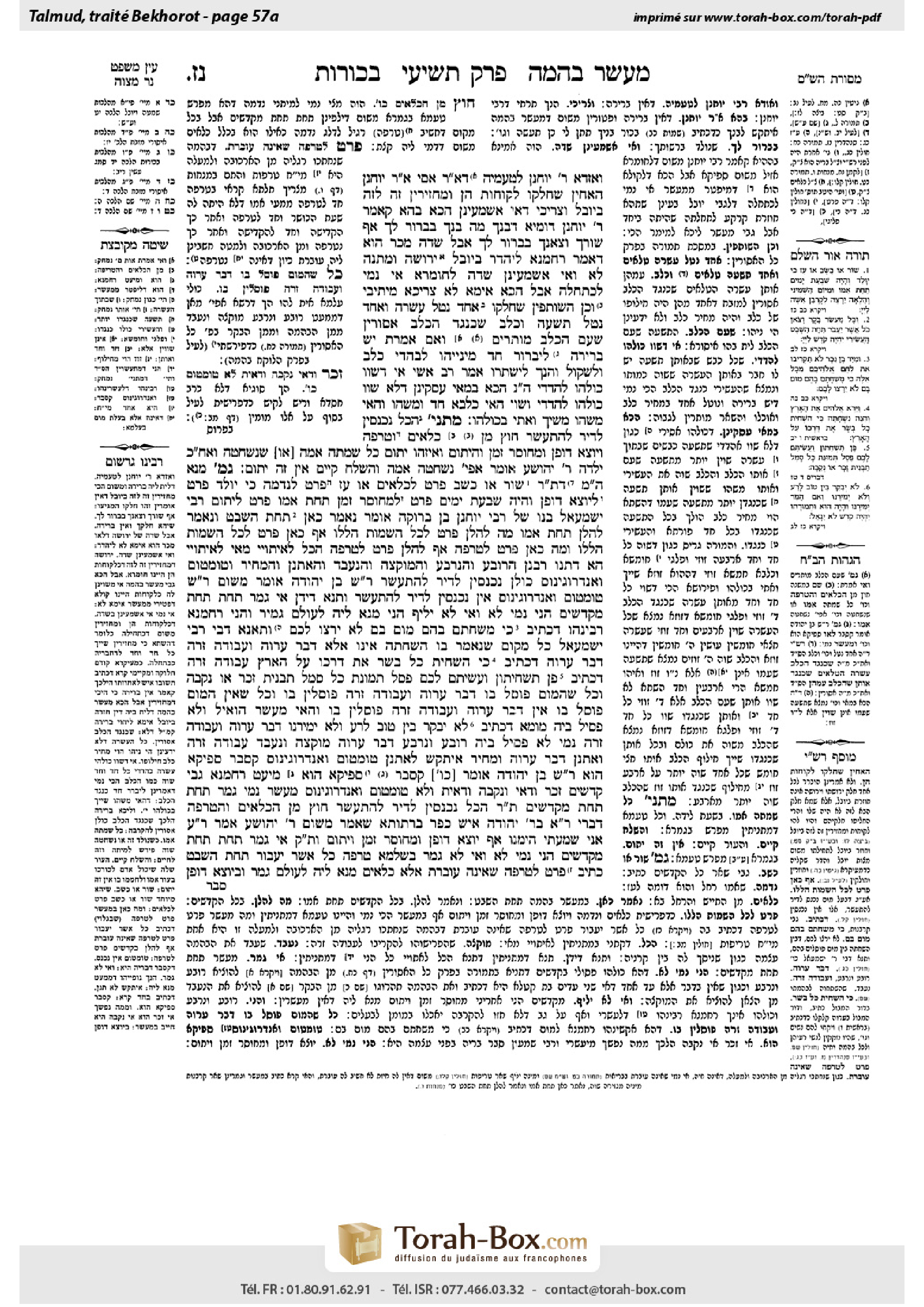
Bekhorot 57a: Talmud study for Daf Yomi
Study the Talmud for Daf Yomi with scanned pages, Hebrew text, English translations from Sefaria and AI-generated French translations.
Passage selection and English or AI-generated French translation are available where the scan has annotations. Daf Study is independent of Torah-Box and Sefaria.
Browse Bekhorot · בכורות · All tractatesBekhorot 57a text and translations
This page of Bekhorot includes the Aramaic text, an English translation and an AI-generated French translation, alongside the scan above.
בכורות נ״ז א · Aramaic and Hebrew text
וְאַזְדָּא רַבִּי יוֹחָנָן לְטַעְמֵיהּ, דְּאָמַר רַבִּי אַסִּי אָמַר רַבִּי יוֹחָנָן: הָאַחִין שֶׁחָלְקוּ — לָקוֹחוֹת הֵן, וּמַחְזִירִין זֶה לָזֶה בַּיּוֹבֵל.
וּצְרִיכִי, דְּאִי אַשְׁמְעִינַן הָכָא, בְּהָא קָאָמַר רַבִּי יוֹחָנָן דּוּמְיָא דְּבִנְךָ, מָה בִּנְךָ בְּבָרוּר לָךְ, אַף שׁוֹרְךָ וְצֹאנְךָ בְּבָרוּר לָךְ; אֲבָל שָׂדֶה מֶכֶר הוּא דְּאָמַר רַחֲמָנָא לֶיהְדַּר בְּיוֹבֵל, יְרוּשָּׁה וּמַתָּנָה לָא!
וְאִי אַשְׁמְעִינַן שָׂדֶה — לְחוּמְרָא, אִי נָמֵי לְכַתְּחִלָּה, אֲבָל הָכָא — אֵימָא לָא, צְרִיכָא.
מֵיתִיבִי: וְכֵן הַשּׁוּתָּפִין שֶׁחָלְקוּ, אֶחָד נָטַל עֲשָׂרָה וְאֶחָד נָטַל תִּשְׁעָה וָכֶלֶב — שֶׁכְּנֶגֶד הַכֶּלֶב אֲסוּרִין, שֶׁעִם הַכֶּלֶב מוּתָּרִים. וְאִם אָמְרַתְּ יֵשׁ בְּרֵירָה, לִיבְרוֹר חַד מִינַּיְיהוּ לְבַהֲדֵי כֶלֶב וְלִשְׁקוֹל, וְהָנָךְ לִישְׁתְּרוֹ!
אָמַר רַב אָשֵׁי: אִי דְּשָׁווּ כּוּלְּהוּ לַהֲדָדֵי — הָכִי נָמֵי, הָכָא בְּמַאי עָסְקִינַן? דְּלָא שָׁווּ כּוּלְּהוּ לַהֲדָדֵי, וְשָׁוֵי הַאי כַּלְבָּא חַד וּמַשֶּׁהוּ, וְהַאי מַשֶּׁהוּ מָשֵׁיךְ וְאָתֵי בְּכוּלְּהוּ.
מַתְנִי׳ הַכֹּל נִכְנָסִין לַדִּיר לְהִתְעַשֵּׂר, חוּץ מִן כִּלְאַיִם, וּטְרֵפָה, וְיוֹצֵא דּוֹפֶן, וּמְחוּסַּר זְמַן, וְהַיָּתוֹם. וְאֵיזֶהוּ יָתוֹם? כֹּל שֶׁמֵּתָה אִמָּהּ שֶׁנִּשְׁחֲטָה וְאַחַר כָּךְ יָלְדָה. רַבִּי יְהוֹשֻׁעַ אוֹמֵר: אֲפִילּוּ נִשְׁחֲטָה אִמָּהּ וְהַשֶּׁלַח קַיָּים — אֵין זֶה יָתוֹם.
גְּמָ׳ מְנָא הָנֵי מִילֵּי? דְּתָנוּ רַבָּנַן: ״שׁוֹר אוֹ כֶשֶׂב״ — פְּרָט לְכִלְאַיִם, ״אוֹ עֵז״ — פְּרָט לְנִדְמֶה, ״כִּי יִוָּלֵד״ — פְּרָט לְיוֹצֵא דוֹפֶן, ״וְהָיָה שִׁבְעַת יָמִים״ — פְּרָט לִמְחוּסַּר זְמַן, ״תַּחַת אִמּוֹ״ — פְּרָט לְיָתוֹם.
רַבִּי יִשְׁמָעֵאל בְּנוֹ שֶׁל רַבִּי יוֹחָנָן בֶּן בְּרוֹקָה אוֹמֵר: נֶאֱמַר כָּאן ״תַּחַת הַשָּׁבֶט״, וְנֶאֱמַר לְהַלָּן ״תַּחַת אִמּוֹ״. מָה לְהַלָּן — פְּרָט לְכׇל הַשֵּׁמוֹת הַלָּלוּ, אַף כָּאן — פְּרָט לְכׇל הַשֵּׁמוֹת הַלָּלוּ. וּמָה כָּאן — פְּרָט לִטְרֵפָה, אַף לְהַלָּן — פְּרָט לִטְרֵפָה.
״הַכֹּל״, לְאֵיתוֹיֵי מַאי? לְאֵיתוֹיֵי הָא דְּתָנוּ רַבָּנַן: הָרוֹבֵעַ, וְהַנִּרְבָּע, וְהַמּוּקְצֶה, וְהַנֶּעֱבָד, וְהָאֶתְנַן, וְהַמְחִיר, וְטוּמְטוּם, וְאַנְדְּרוֹגִינוֹס — כּוּלָּן נִכְנָסִין לַדִּיר לְהִתְעַשֵּׂר. רַבִּי שִׁמְעוֹן בֶּן יְהוּדָה אוֹמֵר מִשּׁוּם רַבִּי שִׁמְעוֹן: טוּמְטוּם וְאַנְדְּרוֹגִינוֹס אֵין נִכְנָסִין לַדִּיר לְהִתְעַשֵּׂר.
וְתַנָּא דִּידַן, אִי גָּמַר ״תַּחַת״ ״תַּחַת״ מִקֳּדָשִׁים — הָנֵי נָמֵי לָא, וְאִי לָא יָלֵיף — הָנֵי מְנָא לֵיהּ?
לְעוֹלָם גָּמַיר, וְהָנֵי רַחֲמָנָא רַבִּינְהוּ, דִּכְתִיב: ״כִּי מׇשְׁחָתָם בָּהֶם מוּם בָּם לֹא יֵרָצוּ לָכֶם״, וְתָאנָא דְּבֵי רַבִּי יִשְׁמָעֵאל: כׇּל מָקוֹם שֶׁנֶּאֱמַר בּוֹ הַשְׁחָתָה, אֵינוֹ אֶלָּא דְּבַר עֶרְוָה וַעֲבוֹדָה זָרָה.
דְּבַר עֶרְוָה — דִּכְתִיב: ״כִּי הִשְׁחִית כׇּל בָּשָׂר אֶת דַּרְכּוֹ עַל הָאָרֶץ״, עֲבוֹדָה זָרָה — דִּכְתִיב: ״פֶּן תַּשְׁחִיתוּן וַעֲשִׂיתֶם לָכֶם פֶּסֶל תְּמוּנַת כׇּל סָמֶל תַּבְנִית זָכָר אוֹ נְקֵבָה״.
וְכֹל שֶׁהַמּוּם פּוֹסֵל בּוֹ — דְּבַר עֶרְוָה וַעֲבוֹדָה זָרָה פּוֹסְלִין בּוֹ, וְכֹל שֶׁאֵין הַמּוּם פּוֹסֵל בּוֹ — אֵין דְּבַר עֶרְוָה וַעֲבוֹדָה זָרָה פּוֹסְלִין בּוֹ, וְהַאי מַעֲשֵׂר הוֹאִיל וְלָא פָּסֵיל בֵּיהּ מוּמָא, דִּכְתִיב: ״לֹא יְבַקֵּר בֵּין טוֹב לָרַע וְלֹא יְמִירֶנּוּ״ — דְּבַר עֶרְוָה וַעֲבוֹדָה זָרָה נָמֵי לָא פָּסֵיל בֵּיהּ.
רוֹבֵעַ וְנִרְבָּע — דְּבַר עֶרְוָה, מוּקְצֶה וְנֶעֱבָד — עֲבוֹדָה זָרָה, וְאֶתְנַן — דְּבַר עֶרְוָה, וּמְחִיר אִיתַּקַּשׁ לְאֶתְנַן,
טוּמְטוּם וְאַנְדְּרוֹגִינוֹס — קָסָבַר: סְפֵיקָא הוּא.
רַבִּי שִׁמְעוֹן בֶּן יְהוּדָה אוֹמֵר. קָסָבַר סְפֵיקָא הוּא, מִיעֵט רַחֲמָנָא גַּבֵּי קָדָשִׁים — זָכָר וַדַּאי וּנְקֵבָה וַדָּאִית, וְלֹא טוּמְטוּם וְאַנְדְּרוֹגִינוֹס. מַעֲשֵׂר נָמֵי גְּמַר ״תַּחַת״ ״תַּחַת״ מִקֳּדָשִׁים.
תָּנוּ רַבָּנַן: הַכֹּל נִכְנָסִין לַדִּיר לְהִתְעַשֵּׂר, חוּץ מִן הַכִּלְאַיִם וְהַטְּרֵפָה, דִּבְרֵי רַבִּי אֶלְעָזָר בְּרַבִּי יְהוּדָה אִישׁ כְּפַר בַּרְתּוֹתָא שֶׁאָמַר מִשּׁוּם רַבִּי יְהוֹשֻׁעַ. אָמַר רַבִּי עֲקִיבָא: אֲנִי שָׁמַעְתִּי הֵימֶנּוּ אַף יוֹצֵא דּוֹפֶן וּמְחוּסַּר זְמַן וְיָתוֹם.
וְתַנָּא קַמָּא, אִי גָּמַר ״תַּחַת״ ״תַּחַת״ מִקֳּדָשִׁים — הָנֵי נָמֵי לָא, וְאִי לָא גָּמַר, בִּשְׁלָמָא טְרֵפָה — ״כֹּל אֲשֶׁר יַעֲבֹר תַּחַת הַשָּׁבֶט״ כְּתִיב, פְּרָט לִטְרֵפָה שֶׁאֵינָהּ עוֹבֶרֶת, אֶלָּא כִּלְאַיִם מְנָא לֵיהּ?
לְעוֹלָם גָּמַר, וּבְיוֹצֵא דּוֹפֶן —
Bekhorot 57a · English translation
And Rabbi Yoḥanan follows his established line of reasoning in this regard. As Rav Asi says that Rabbi Yoḥanan says: Brothers who divided real estate received as an inheritance are considered purchasers who have purchased from each other, and as purchasers of land they must return the portions to each other in the Jubilee Year, at which point they may redistribute the property. This demonstrates that Rabbi Yoḥanan does not hold that it is retroactively established that each brother’s portion was designated for him upon their father’s death. Rather, it is considered as though all the land was joint property until the brothers traded or bought their respective portions from each other.
The Gemara notes: And both statements of Rabbi Yoḥanan are necessary. As, if he had taught this halakha to us only here, with regard to animal tithe, one might have thought that it is in this case that Rabbi Yoḥanan says each one has not received his own portion. This is because the case must be similar to the case of your firstborn son, in accordance with the juxtaposition between the two cases. Just as your firstborn son is redeemed only if it is clear to you that he is your son, not if he is purchased from another, so too, your cattle and your sheep are subject to animal tithe only if it is clear to you, i.e., if there is no aspect of acquisition at all. But in the case of a field, one might think it is only with regard to a field that is sold that the Merciful One states that the purchaser should return it in the Jubilee Year, whereas a field that is an inheritance or a gift need not be returned.
And if Rabbi Yoḥanan had taught us only the halakha that a field inherited by two brothers must be returned in the Jubilee Year, one might have thought that Rabbi Yoḥanan was uncertain and therefore ruled to be stringent. If so, he would rule stringently with regard to animal tithe as well, deeming the brothers liable. Alternatively, one might think Rabbi Yoḥanan rules in this manner with regard to returning fields in the Jubilee Year only because the field must return to how it was in the beginning. But here, in the case of animal tithe, where there is no requirement to return matters to their initial state, one might say that the brothers are not considered to be purchasers, but rather each received the animals that were retroactively designated for him and they are therefore obligated in animal tithe. For this reason it is necessary for Rabbi Yoḥanan to teach both cases.
The Gemara raises an objection from a baraita against the opinion that there is retroactive designation of the animals: And similarly in the case of two partners who divided their common property, and one took ten lambs and the other one took nine lambs and a dog, sacrificing any of the ten lambs taken in exchange for the dog is prohibited. This is because they are considered “the price of a dog,” as it states in the Torah (Deuteronomy 23:19), since they were given in exchange for it. Nevertheless, the nine lambs that were taken with the dog are permitted for sacrifice. The Gemara explains the objection: And if you say that there is retroactive designation, why are all ten lambs prohibited? Let him select one of the lambs to correspond to the dog and take it away, and all the rest of these lambs should be permitted.
Rav Ashi said: If this is referring to a case where they are all equal in value to each other, indeed one may consider only one of the lambs as corresponding to the dog. Here, we are dealing with a case where they are not all equal in value to each other, but the value of this dog is one and a small amount more than the value of each one of the ten lambs. Therefore, one cannot set aside a single lamb in exchange for the dog, and consequently one draws this extra small amount, i.e., the additional value of the dog, and divides it between all of the other nine lambs. As a result, all ten lambs are prohibited, since part of the price of a dog is included in each of them.
MISHNA: All cattle, sheep, and goats enter the pen to be tithed, except for an animal crossbred from diverse kinds, e.g., a hybrid of a goat and a sheep; a tereifa; an animal born by caesarean section; one whose time has not yet arrived, i.e., that is younger than eight days old, which is when animals become eligible for sacrifice; and an orphan. And what is an orphan? It is any animal whose mother died or was slaughtered while giving birth to it and thereafter completed giving birth to it. Rabbi Yehoshua says: Even if its mother was slaughtered but its hide exists at birth, i.e., if the mother’s hide is present after the birth, this is not an orphan.
GEMARA: The Gemara asks: From where are these matters, i.e., the fact that those animals are not included in the animal tithe, derived? The Gemara answers: As the Sages taught in a baraita that discusses offerings in general: “When a bull or a sheep or a goat is born, then it shall be seven days under its mother, but from the eighth day onward it may be accepted for an offering made by fire to the Lord” (Leviticus 22:27). The phrase “a bull or a sheep” serves to exclude an animal born from diverse kinds; “or a goat” serves to exclude an animal that resembles another, e.g., a sheep that is the offspring of two sheep but which looks like a goat, or vice versa; “when…is born” serves to exclude an animal born by caesarean section; “then it shall be seven days” serves to exclude an animal whose time has not yet arrived; “under its mother” serves to exclude an orphan.
The baraita continues: From where is it derived that these halakhot also apply to animal tithe? Rabbi Yishmael, son of Rabbi Yoḥanan ben Beroka, says it is learned by a verbal analogy from the term “under.” It is stated here, with regard to animal tithe: “Whatever passes under the rod” (Leviticus 27:32), and it is stated there, with regard to all offerings: “Under its mother” (Leviticus 22:27). Just as there, in the case of all offerings, the verse serves to exclude all these categories, so too here, with regard to animal tithe, the verse serves to exclude all these categories. And just as here, with regard to animal tithe, the verse serves to exclude a tereifa, as the verse states: “Whatever passes under the rod,” and a tereifa is unable to pass unaided, so too there, with regard to all offerings, the verse serves to exclude a tereifa.
§ The Gemara asks: What does the mishna’s expansive term: All, serve to include? The Gemara answers that it serves to include this halakha that the Sages taught in a baraita: With regard to an animal that copulated with a person, or an animal that was the object of bestiality, or an animal that was set aside for idol worship, or one that was worshipped as a deity, or one that was given as payment to a prostitute or as the price of a dog, or a tumtum, i.e., an animal whose sexual organs are indeterminate, or a hermaphrodite, i.e., an animal displaying sexual organs of both sexes, all of these enter the pen to be tithed despite the fact that they are disqualified from being brought as offerings. Rabbi Shimon ben Yehuda says in the name of Rabbi Shimon: A tumtum and a hermaphrodite do not enter the pen to be tithed.
The Gemara raises a difficulty: But as for the tanna of our mishna, if he derives the verbal analogy of: “Under” (Leviticus 27:32), and: “Under” (Leviticus 22:27), from the verse referring to sacrificial animals, then these types listed in the baraita should also not enter the pen to be tithed, as they are all disqualified from being sacrificed. And if he does not derive the verbal analogy from sacrificial animals, from where does he derive the exemption of these categories listed in the mishna, e.g., one whose time has not yet arrived and an orphan?
The Gemara answers: Actually, the tanna does derive the verbal analogy, but these categories listed in the baraita are included by the Merciful One in the animal tithe. As it is written with regard to those animals that may not be brought as offerings: “Neither from the hand of a foreigner shall you offer the bread of your God of any of these, because their corruption is in them, there is a blemish in them” (Leviticus 22:25). This verse indicates that corruption is considered a blemish, and the school of Rabbi Yishmael taught: Anywhere that the term: Corruption, is stated, it is a reference to nothing other than a matter of licentiousness and idol worship.
The baraita supports this claim: Corruption is a reference to a matter of licentiousness, as it is written with regard to the generation of the flood: “And God saw the earth, and behold, it was corrupt; for all flesh had corrupted their way upon the earth” (Genesis 6:12). And corruption is also a reference to idol worship, as it is written: “Lest you deal corruptly, and make you a graven image, the form of any figure, the likeness of male or female” (Deuteronomy 4:16).
And the juxtaposition of the word “corruption” with the word “blemish” in Leviticus 22:25 teaches that in any case where a blemish disqualifies an animal, a matter of licentiousness or a matter of idol worship also disqualifies it. And in a case where a blemish does not disqualify an animal, a matter of licentiousness or a matter of idol worship also does not disqualify it. And with regard to this animal tithe, since a blemish on an animal does not disqualify it, as it is written: “He shall not inquire whether it be good or bad, neither shall he change it” (Leviticus 27:33), a matter of licentiousness or a matter of idol worship also does not disqualify it.
The Gemara further explains that the categories listed in the baraita are either matters of licentiousness or matters of idol worship. An animal that copulated with a person and an animal that was the object of bestiality are both a matter of licentiousness. An animal that was set aside for idol worship and one that was worshipped are cases of idol worship. And an animal that was given as payment to a prostitute is a matter of licentiousness, and an animal used as the price of a dog is juxtaposed to an animal that was given as payment to a prostitute (see Deuteronomy 23:19).
Finally, with regard to an animal that is a tumtum or a hermaphrodite, the tanna holds that it is uncertain whether it is male or female, not a creature unto itself, and therefore a tumtum is also subject to the tithe.
The baraita states that Rabbi Shimon ben Yehuda says in the name of Rabbi Shimon: A tumtum and a hermaphrodite do not enter the pen to be tithed. The Gemara explains: He holds that the case of an animal that is a tumtum or a hermaphrodite involves an uncertainty, and the Merciful One excluded cases of uncertainty with regard to sacrificial animals. Only a definite male or a definite female is fit to be sacrificed on the altar, but not a tumtum or a hermaphrodite. Consequently, with regard to animal tithe too, they do not enter the pen to be tithed, as he derives the verbal analogy of “under” and “under” from sacrificial animals.
The Sages taught in a baraita: All animals enter the pen to be tithed except for an animal crossbred from diverse kinds, e.g., a hybrid of a goat and a sheep, and a tereifa; this is the statement of Rabbi Elazar, son of Rabbi Yehuda, of the village of Bartota, who said it in the name of Rabbi Yehoshua. Rabbi Akiva said: I heard from Rabbi Yehoshua that an animal born by caesarean section and an animal whose time has not yet arrived, i.e., that is less than eight days old, and an orphan animal, are also excluded from animal tithe.
The Gemara asks: And the first tanna of the baraita, what does he maintain? If he derives the verbal analogy of “under” and “under” from sacrificial animals, then these categories listed by Rabbi Akiva should also not enter the pen to be tithed. And if he does not derive the verbal analogy, granted, he rules that a tereifa does not enter the pen to be tithed, as it is written: “Whatever passes under the rod” (Leviticus 27:32), which excludes a tereifa, as it does not pass under the rod due to its physical state. But from where does he derive that an animal crossbred from diverse kinds does not enter the pen to be tithed?
The Gemara answers: Actually, he does derive the verbal analogy of “under” and “under,” and therefore he excludes a tereifa and diverse kinds from the animal tithe. But with regard to an animal born by caesarean section
Bekhorot 57a · Traduction française (IA)
Et le maître Rabbi Yoḥanan suit ici sa ligne de raisonnement établie. Comme Rav Asi dit que Rabbi Yoḥanan dit : Les frères qui ont divisé une propriété immobilière héritée sont considérés comme des acheteurs qui se sont acheté mutuellement, et comme acheteurs de terre, ils doivent rendre leurs parts à l'autre lors de l'année sabbatique, moment où ils peuvent redistribuer la propriété. Cela montre que Rabbi Yoḥanan ne considère pas que chaque portion de frère était désignée pour lui à la mort de leur père. Plutôt, on considère que toute la terre était propriété commune jusqu'à ce que les frères aient échangé ou acheté leurs portions respectives entre eux.
La Guemara note : Et les deux déclarations de Rabbi Yoḥanan sont nécessaires. Car, si on avait appris cette halakha uniquement ici, concernant l'offrande de bétail, on aurait pu penser que c'est dans ce cas précis que Rabbi Yoḥanan dit que chacun n'a pas reçu sa propre portion. Cela est dû au fait que le cas doit être semblable à celui du premier-né, conformément à la juxtaposition des deux cas. Tout comme le premier-né est racheté seulement si on est sûr qu'il est votre fils, et non s'il est acheté à un autre, de même, votre bétail et votre mouton sont soumis à l'offrande de bétail seulement si on est sûr, c'est-à-dire s'il n'y a aucun aspect d'acquisition. Mais dans le cas d'un champ, on pourrait penser qu'il s'agit uniquement d'un champ vendu que l'Éternel dit que l'acheteur doit le rendre à l'année sabbatique, alors qu'un champ hérité ou offert ne doit pas être rendu.
Et si Rabbi Yoḥanan avait enseigné uniquement la halakha selon laquelle un champ hérité par deux frères doit être rendu à l'année sabbatique, on aurait pu penser que Rabbi Yoḥanan était incertain et a donc rendu un jugement strict. Si tel est le cas, il jugerait également strictement concernant l'offrande de bétail, considérant les frères comme responsables. Alternativement, on pourrait penser que Rabbi Yoḥanan adopte ce mode de jugement uniquement concernant le retour des champs à l'année sabbatique, car le champ doit retourner à l'état initial. Mais ici, dans le cas de l'offrande de bétail, où il n'y a pas de nécessité de retourner les choses à leur état initial, on pourrait dire que les frères ne sont pas considérés comme des acheteurs, mais plutôt qu'ils ont reçu les bêtes qui étaient désignées pour eux à rebours, et qu'ils sont donc obligés d'offrir l'offrande de bétail. C'est pourquoi il est nécessaire que Rabbi Yoḥanan enseigne les deux cas.
La Guemara soulève une objection contre l'opinion selon laquelle il y a une désignation rétroactive des bêtes : Et de même, dans le cas de deux partenaires qui ont divisé leur propriété commune, et l'un a pris dix agneaux et l'autre un agneau et un chien, sacrifier n'importe quel agneau pris en échange du chien est interdit. Cela est dû au fait qu'ils sont considérés comme « le prix du chien », comme il est dit dans la Torah (Deutéronome 23:19), puisqu'ils ont été donnés en échange. Cependant, les neuf agneaux qui ont été pris avec le chien sont permis pour l'offrande. La Guemara explique l'objection : Et si vous dites qu'il y a une désignation rétroactive, pourquoi tous les dix agneaux sont-ils interdits ? Laissez-le choisir un agneau correspondant au chien et le prendre, et tous les autres agneaux devraient être permis.
Rav Ashi dit : Si cela concerne un cas où ils sont tous égaux en valeur entre eux, en effet, on peut considérer seulement un des agneaux comme correspondant au chien. Ici, nous sommes dans un cas où ils ne sont pas tous égaux en valeur entre eux, mais la valeur de ce chien est une et une petite quantité de plus que la valeur de chaque un des dix agneaux. Par conséquent, on ne peut pas désigner un seul agneau en échange du chien, et par conséquent, on retire cette petite quantité supplémentaire, c'est-à-dire la valeur supplémentaire du chien, et on la partage entre tous les autres neuf agneaux. En conséquence, tous les dix agneaux sont interdits, car une partie du prix du chien est incluse dans chacun d'eux.
MICHNA : Tous les bœufs, moutons et chèvres entrent dans la cour pour être tithés, sauf un animal croisé de diverses espèces, par exemple un hybride de chèvre et de mouton ; un tereifa ; un animal né par césarienne ; un animal dont le temps n'est pas encore arrivé, c'est-à-dire plus jeune que huit jours, l'âge où les animaux deviennent éligibles à l'offrande ; et un orphelin. Et qu'est-ce qu'un orphelin ? C'est tout animal dont la mère est morte ou a été tuée lors de l'accouchement et a ensuite terminé l'accouchement. Rabbi Yéhoshua dit : Même si sa mère a été tuée mais que sa peau existe à la naissance, c'est-à-dire si la peau de la mère existe après la naissance, cela n'est pas un orphelin.
GUEMARA : La Guemara pose la question : D'où sont dérivés ces points, c'est-à-dire le fait que ces animaux ne sont pas inclus dans l'offrande de bétail ? La Guemara répond : Comme les Sages ont enseigné dans une baraïta qui discute des offrandes généralement : « Quand un taureau ou un mouton ou une chèvre est né, il doit rester sept jours avec sa mère, mais à partir du huitième jour, il peut être accepté comme offrande faite par le feu à l'Éternel » (Lévitique 22:27). La phrase « un taureau ou un mouton » sert à exclure un animal né de diverses espèces ; « ou une chèvre » sert à exclure un animal qui ressemble à un autre, par exemple un mouton qui est l'enfant de deux moutons mais qui ressemble à une chèvre, ou inversement ; « quand… est né » sert à exclure un animal né par césarienne ; « alors il doit rester sept jours » sert à exclure un animal dont le temps n'est pas encore arrivé ; « avec sa mère » sert à exclure un orphelin.
La baraïta continue : D'où est-il dérivé que ces halakhot s'appliquent également à l'offrande de bétail ? Rabbi Yishmael, fils de Rabbi Yoḥanan ben Beroka, dit qu'il est appris par analogie verbale du terme « sous ». Il est dit ici, concernant l'offrande de bétail : « Tout ce qui passe sous le bâton » (Lévitique 27:32), et il est dit là, concernant toutes les offrandes : « sous sa mère » (Lévitique 22:27). Tout comme là, dans le cas de toutes les offrandes, la verset sert à exclure toutes ces catégories, de même ici, concernant l'offrande de bétail, le verset sert à exclure toutes ces catégories. Et tout comme ici, concernant l'offrande de bétail, le verset sert à exclure un tereifa, comme le verset dit : « Tout ce qui passe sous le bâton », et un tereifa ne peut pas passer seul, de même là, concernant toutes les offrandes, le verset sert à exclure un tereifa.
§ La Guemara pose la question : Quel est le sens du terme élargi de la Michna : Tous, qui inclut ? La Guemara répond qu'il sert à inclure cette halakha que les Sages ont enseignée dans une baraïta : Concernant un animal qui a copulé avec une personne, ou un animal qui a été l'objet de bestialité, ou un animal qui a été désigné pour l'idolâtrie, ou un animal qui a été vénéré comme un dieu, ou un animal donné en paiement à une prostituée ou comme prix d'un chien, ou un tumtum, c'est-à-dire un animal dont les organes sexuels sont indéterminés, ou un hermaphrodite, c'est-à-dire un animal présentant des organes sexuels de deux sexes, tous ces animaux entrent dans l'enclos pour être tithés malgré le fait qu'ils sont disqualifiés pour être offerts en sacrifice. Rabbi Shimon ben Yehuda dit en nom de Rabbi Shimon : Le tumtum et l'hermaphrodite ne pénètrent pas dans l'enclos pour être tithés.
La Guemara soulève une difficulté : Mais concernant le tanna de notre Michna, si celui-ci dérive l'analogie verbale de : « Sous » (Lévitique 27:32), et : « Sous » (Lévitique 22:27), à partir du verset concernant les animaux sacrés, alors ces types énumérés dans la baraïta devraient également ne pas entrer dans l'enclos pour être tithés, car ils sont tous disqualifiés pour être sacrifiés. Et si celui-ci ne dérive pas l'analogie verbale à partir des animaux sacrés, d'où dérive-t-il l'exemption de ces catégories énumérées dans la Michna, par exemple un animal dont le temps n'est pas encore arrivé et un orphelin ?
La Guemara répond : En réalité, le tanna dérive bien l'analogie verbale, mais ces catégories énumérées dans la baraïta sont incluses par la Miséricorde dans la tithe des animaux. Comme il est écrit concernant ces animaux qui ne peuvent pas être offerts en sacrifice : « Ni de la main d'un étranger ne devra-t-on offrir le pain de ton Dieu de tout cela, car leur corruption est en eux, il y a un défaut en eux » (Lévitique 22:25). Ce verset indique que la corruption est considérée comme un défaut, et l'école de Rabbi Yishmael enseignait : Partout que le terme : Corruption, est mentionné, il s'agit d'une référence à rien d'autre qu'une question de luxure et d'idolâtrie.
La baraïta soutient cette affirmation : La corruption est une référence à une question de luxure, comme il est écrit concernant la génération de la diluvion : « Et Dieu vit la terre, et voilà qu'elle était corrompue ; car toute la chair avait corrompu leur voie sur la terre » (Gn 6:12). Et la corruption est aussi une référence à l'idolâtrie, comme il est écrit : « De peur que tu agisses de manière corrompue, et que tu fasses un image gravée, la figure de toute figure, la ressemblance d'un homme ou d'une femme » (Dt 4:16).
Et la juxtaposition du mot « corruption » avec le mot « défaut » dans Lévitique 22:25 enseigne que dans tout cas où un défaut disqualifie un animal, une question de luxure ou une question d'idolâtrie le disqualifie également. Et dans un cas où un défaut ne disqualifie pas un animal, une question de luxure ou une question d'idolâtrie ne le disqualifie pas non plus. Et concernant cette tithe des animaux, puisque un défaut sur un animal ne le disqualifie pas, comme il est écrit : « Il ne devra pas demander s'il est bon ou mauvais, ni ne le changer » (Lévitique 27:33), une question de luxure ou une question d'idolâtrie ne le disqualifie pas non plus.
La Guemara explique davantage que les catégories énumérées dans la baraïta sont soit des questions de luxure soit des questions d'idolâtrie. Un animal qui a copulé avec une personne et un animal qui a été l'objet de bestialité sont tous deux des questions de luxure. Un animal désigné pour l'idolâtrie et un animal vénéré sont des cas d'idolâtrie. Et un animal donné en paiement à une prostituée est une question de luxure, et un animal utilisé comme prix d'un chien est juxtaposé à un animal donné en paiement à une prostituée (cf Dt 23:19).
Enfin, concernant un animal qui est un tumtum ou un hermaphrodite, le tanna considère qu'il s'agit d'une incertitude quant à son sexe, pas un être à part, et donc un tumtum est également soumis à la tithe.
La baraïta affirme que Rabbi Shimon ben Yehuda dit en nom de Rabbi Shimon : Un tumtum et un hermaphrodite ne pénètrent pas dans l'enclos pour être tithés. La Guemara explique : Il considère que le cas d'un animal qui est un tumtum ou un hermaphrodite implique une incertitude, et la Miséricorde a exclu les cas d'incertitude concernant les animaux sacrés. Seul un mâle ou une femelle définis est apte à être sacrifié sur l'autel, pas un tumtum ou un hermaphrodite. Par conséquent, concernant la tithe des animaux, ils ne pénètrent pas dans l'enclos pour être tithés, car il dérive l'analogie verbale de « sous » et « sous » à partir des animaux sacrés.
Les Sages ont enseigné dans une baraïta : Tous les animaux pénètrent dans l'enclos pour être tithés, sauf un animal croisé de diverses espèces, par exemple un hybride de chèvre et de mouton, et un tereifa ; c'est l'opinion de Rabbi Elazar, fils de Rabbi Yehuda, du village de Bartota, qui l'a dit en nom de Rabbi Yehoshua. Rabbi Akiva a dit : J'ai entendu de Rabbi Yehoshua que l'animal né par césarienne, et l'animal dont le temps n'est pas encore arrivé, c'est-à-dire moins de huit jours, et l'animal orphelin sont également exclus de la tithe des animaux.
La Guemara pose la question : Et le premier tanna de la baraïta, de quoi maintient-il son opinion ? Si il dérive l'analogie verbale de « sous » et « sous » à partir des animaux sacrés, alors ces catégories énumérées par Rabbi Akiva devraient également ne pas entrer dans l'enclos pour être tithés. Et si il ne dérive pas l'analogie verbale, alors il est admis qu'il considère que le tereifa ne pénètre pas dans l'enclos pour être tithé, comme il est écrit : « Tout ce qui passe sous le bâton » (Lévitique 27:32), qui exclut le tereifa, car il ne passe pas sous le bâton en raison de son état physique. Mais d'où dérive-t-il que l'animal croisé de diverses espèces ne pénètre pas dans l'enclos pour être tithé ?
La Guemara répond : En réalité, il dérive bien l'analogie verbale de « sous » et « sous », et donc il exclut le tereifa et les diverses espèces de la tithe des animaux. Mais concernant un animal né par césarienne,
Traduction française générée par IA à partir de l’édition anglaise de Sefaria. Vérifie toujours un passage avec le texte source.
Text from Sefaria: William Davidson Edition - Vocalized Aramaic (CC BY NC); William Davidson Edition - English (CC BY NC).