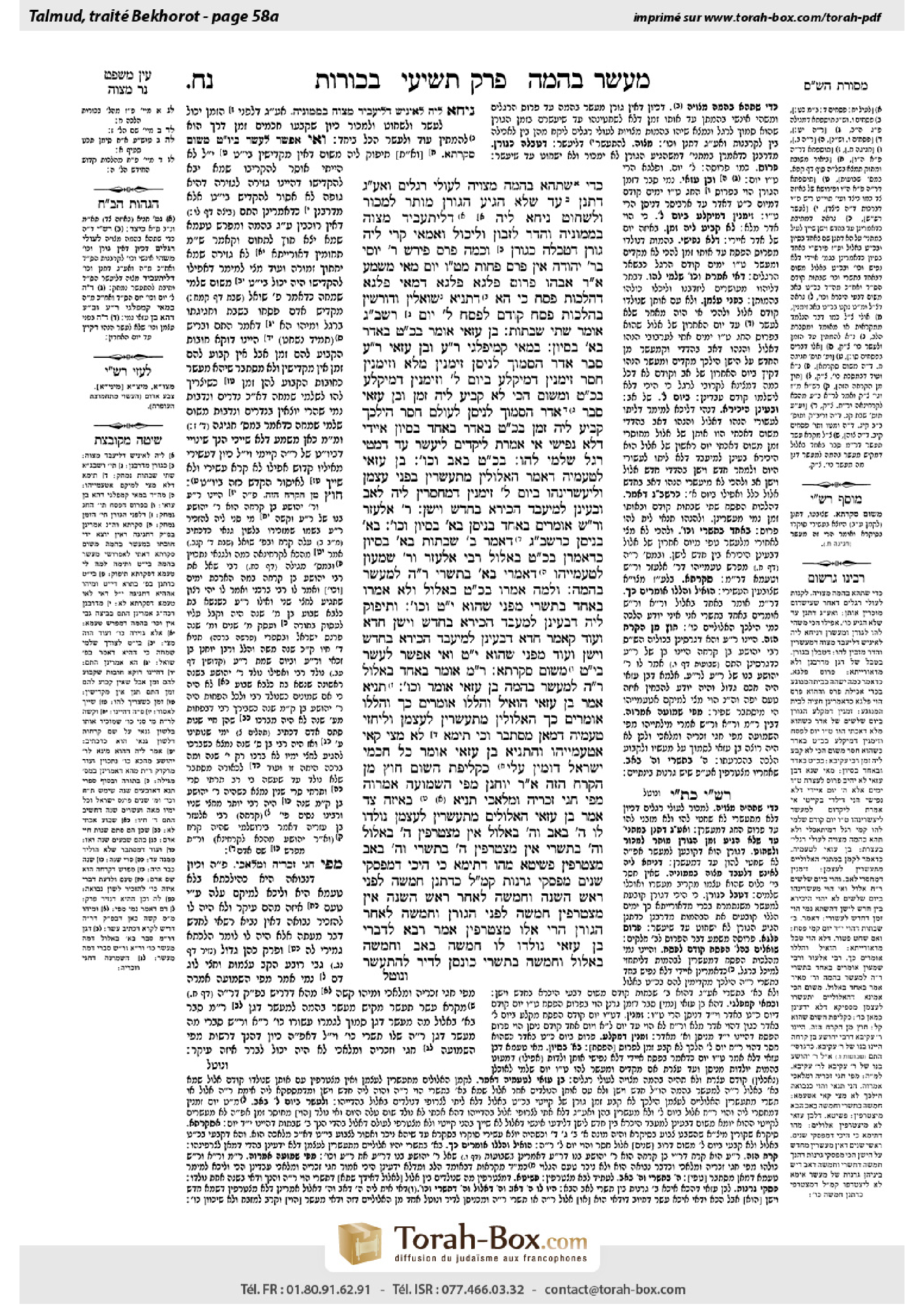
Bekhorot 58a: Talmud study for Daf Yomi
Study the Talmud for Daf Yomi with scanned pages, Hebrew text, English translations from Sefaria and AI-generated French translations.
Passage selection and English or AI-generated French translation are available where the scan has annotations. Daf Study is independent of Torah-Box and Sefaria.
Browse Bekhorot · בכורות · All tractatesBekhorot 58a text and translations
This page of Bekhorot includes the Aramaic text, an English translation and an AI-generated French translation, alongside the scan above.
בכורות נ״ח א · Aramaic and Hebrew text
כְּדֵי שֶׁתְּהֵא בְּהֵמָה מְצוּיָה לְעוֹלֵי רְגָלִים.
וְאַף עַל גַּב דִּתְנַן: עַד שֶׁלֹּא הִגִּיעַ הַגּוֹרֶן מוּתָּר לִמְכּוֹר וְלִשְׁחוֹט — נִיחָא לֵיהּ דְּלִיתְעֲבִיד מִצְוָה בְּמָמוֹנֵיהּ, וַהֲדַר לִזְבּוֹן וְלֵיכוֹל.
וְאַמַּאי קָרֵי לֵיהּ ״גּוֹרֶן״? דְּטָבְלָה כְּגוֹרֶן.
וְכַמָּה ״פְּרָס״? פֵּירֵשׁ רַבִּי יוֹסֵי בְּרַבִּי יְהוּדָה: אֵין פְּרָס פָּחוֹת מֵחֲמִשָּׁה עָשָׂר יוֹם.
מַאי מַשְׁמַע? אָמַר רַבִּי אֲבָהוּ: ״פְּרוֹס״ — פַּלְגָא. פַּלְגָא דְּמַאי? פַּלְגָא דְּהִלְכוֹת פֶּסַח, כִּי הָא דְּתַנְיָא: שׁוֹאֲלִין וְדוֹרְשִׁין בְּהִלְכוֹת פֶּסַח קוֹדֶם לְפֶסַח שְׁלֹשִׁים יוֹם. רַבָּן שִׁמְעוֹן בֶּן גַּמְלִיאֵל אוֹמֵר: שְׁתֵּי שַׁבָּתוֹת.
בֶּן עַזַּאי אוֹמֵר: בְּעֶשְׂרִים וְתִשְׁעָה בַּאֲדָר, בְּאֶחָד בְּסִיוָן. בְּמַאי קָמִיפַּלְגִי רַבִּי עֲקִיבָא וּבֶן עַזַּאי? רַבִּי עֲקִיבָא סָבַר: אֲדָר הַסָּמוּךְ לְנִיסָן זִימְנִין מָלֵא וְזִימְנִין חָסֵר, זִימְנִין דְּמִיקְּלַע בְּיוֹם שְׁלֹשִׁים וְזִימְנִין דְּמִיקְּלַע בְּעֶשְׂרִים וְתִשְׁעָה, וּמִשּׁוּם הָכִי לָא קְבִיעַ לֵיהּ זְמַן. וּבֶן עַזַּאי סָבַר: אֲדָר הַסָּמוּךְ לְנִיסָן לְעוֹלָם חָסֵר, הִילְכָּךְ קְבִיעַ לֵיהּ זְמַן בְּעֶשְׂרִים וְתִשְׁעָה בַּאֲדָר.
בְּאֶחָד בְּסִיוָן — אַיְּידֵי דְּלָא נְפִישִׁי, אִי אָמְרַתְּ לִיקַדֵּים לִיעַשַּׂר — עַד דְּמָטֵי רֶגֶל שָׁלְמִי לְהוּ.
בְּעֶשְׂרִים וְתִשְׁעָה בְּאָב וְכוּ׳. בֶּן עַזַּאי לְטַעְמֵיהּ, דְּאָמַר: הָאֱלוּלִין מִתְעַשְּׂרִין בִּפְנֵי עַצְמָן.
וְלִיעַשְּׂרִינְהוּ בְּיוֹם שְׁלֹשִׁים! זִימְנִין דִּמְחַסְּרִין לֵיהּ לְאָב, וּבָעֵינַן לְמִיעְבַּד הֶכֵּירָא בְּחָדָשׁ וְיָשָׁן.
רַבִּי אֶלְעָזָר וְרַבִּי שִׁמְעוֹן אוֹמְרִים: בְּאֶחָד בְּנִיסָן, בְּאֶחָד בְּסִיוָן וְכוּ׳. בְּאֶחָד בְּנִיסָן — כְּרַבָּן שִׁמְעוֹן בֶּן גַּמְלִיאֵל, דְּאָמַר: שְׁתֵּי שַׁבָּתוֹת. בְּאֶחָד בְּסִיוָן — כְּדַאֲמַרַן.
בְּעֶשְׂרִים וְתִשְׁעָה בֶּאֱלוּל — רַבִּי אֶלְעָזָר וְרַבִּי שִׁמְעוֹן לְטַעְמַיְיהוּ, דְּאָמְרִי: בְּאֶחָד בְּתִשְׁרִי רֹאשׁ הַשָּׁנָה לְמַעְשַׂר בְּהֵמָה.
וְלָמָה אָמְרוּ בְּעֶשְׂרִים וְתִשְׁעָה בֶּאֱלוּל, וְלֹא אָמְרוּ בְּאֶחָד בְּתִשְׁרִי? מִפְּנֵי שֶׁהוּא יוֹם טוֹב וְכוּ׳. וְתִיפּוֹק לֵיהּ, דְּבָעֵינַן לְמֶעְבַּד הֶכֵּירָא בְּחָדָשׁ וְיָשָׁן!
חֲדָא וְעוֹד קָאָמַר, חֲדָא — דְּבָעֵינַן לְמִיעְבַּד הֶכֵּירָא בְּחָדָשׁ וְיָשָׁן, וְעוֹד — מִפְּנֵי שֶׁהוּא יוֹם טוֹב, וְאִי אֶפְשָׁר לְעַשֵּׂר בְּיוֹם טוֹב מִשּׁוּם סְקַרְתָּא.
רַבִּי מֵאִיר אוֹמֵר: בְּאֶחָד בֶּאֱלוּל רֹאשׁ הַשָּׁנָה לְמַעְשַׂר בְּהֵמָה. בֶּן עַזַּאי אוֹמֵר וְכוּ׳. תַּנְיָא, אָמַר בֶּן עַזַּאי: הוֹאִיל וְהַלָּלוּ אוֹמְרִים כָּךְ, וְהַלָּלוּ אוֹמְרִים כָּךְ — הָאֱלוּלִין מִתְעַשְּׂרִין לְעַצְמָן.
וְלִיחְזֵי טַעְמֵיהּ דְּמַאן מִסְתַּבַּר! וְכִי תֵּימָא: לָא מָצֵי קָאֵי אַטַּעְמַיְיהוּ, וְהָתַנְיָא: בֶּן עַזַּאי אוֹמֵר: כׇּל חַכְמֵי יִשְׂרָאֵל דּוֹמִין עָלַי כִּקְלִיפַּת הַשּׁוּם חוּץ מִן הַקֵּרֵחַ הַזֶּה!
אָמַר רַבִּי יוֹחָנָן: מִפִּי הַשְּׁמוּעָה אֲמָרוּהָ, מִפִּי חַגַּי זְכַרְיָה וּמַלְאָכִי.
תַּנְיָא: בְּאֵיזֶה צַד אָמַר בֶּן עַזַּאי הָאֱלוּלִים מִתְעַשְּׂרִין לְעַצְמָן? נוֹלְדוּ לוֹ חֲמִשָּׁה בְּאָב וַחֲמִשָּׁה בֶּאֱלוּל — אֵין מִצְטָרְפִין, חֲמִשָּׁה בֶּאֱלוּל וַחֲמִשָּׁה בְּתִשְׁרִי — אֵין מִצְטָרְפִין, חֲמִשָּׁה בְּתִשְׁרִי וַחֲמִשָּׁה בְּאָב מִצְטָרְפִין.
פְּשִׁיטָא! מַהוּ דְּתֵימָא, כִּי הֵיכִי דְּמַפְסְקִי שָׁנִים, מַפְסְקִי גֳּרָנוֹת, קָא מַשְׁמַע לַן.
כְּדִתְנַן: חֲמִשָּׁה לִפְנֵי רֹאשׁ הַשָּׁנָה וַחֲמִשָּׁה לְאַחַר רֹאשׁ הַשָּׁנָה — אֵין מִצְטָרְפִין, חֲמִשָּׁה לִפְנֵי הַגּוֹרֶן וַחֲמִשָּׁה לְאַחַר הַגּוֹרֶן — הֲרֵי אֵלּוּ מִצְטָרְפִין.
אָמַר רָבָא: לְדִבְרֵי בֶּן עַזַּאי, נוֹלְדוּ לוֹ חֲמִשָּׁה בְּאָב וַחֲמִשָּׁה בֶּאֱלוּל וַחֲמִשָּׁה בְּתִשְׁרִי, כּוֹנְסָן לַדִּיר לְהִתְעַשֵּׂר,
Bekhorot 58a · English translation
The reason is so that animals will be readily available to those ascending to Jerusalem for the pilgrimage Festivals. The animals are tithed shortly before each of the Festivals so that their owners will refrain from selling or killing them until those times, when they gather them together to set aside the animal tithe. As a result, there are plenty of non-sacred animals ready to be sold, for food or offerings, to those on their way to Jerusalem.
And even though we learned in the mishna: Until the time designated for gathering arrives, it is permitted to sell and slaughter the animals, which means that there is no obligation to keep the animals until those dates and there is no concern that the owners will sell the animals before tithing them. This is because a person prefers to perform a mitzva with his money, by separating the animal tithe, and only afterward sell or eat those animals.
The Gemara asks: And why does the tanna call the time designated for gathering animal tithe goren, which literally means threshing floor? The Gemara explains that it is due to the fact that the arrival of this time renders the halakhic status of new animals like that of untithed produce gathered on a threshing floor, as from the time that produce is gathered on the threshing floor one becomes obligated to tithe it. Likewise, from this stage onward it is prohibited to slaughter the new animals until they have been tithed.
The mishna states that according to Rabbi Akiva the times for tithing animals are adjacent to Passover, Shavuot, and Sukkot. The Gemara asks: And how much is adjacent [peras]? Rabbi Yosei, son of Rabbi Yehuda, explained that the term adjacent means not less than fifteen days.
The Gemara asks: From where is this inferred? Rabbi Abbahu said that the term peros means half. The Gemara inquires: Half of what? The Gemara answers: Half of the time during which one must learn the halakhot of Passover, and this is like that which is taught in a baraita: One asks about and teaches the halakhot of Passover for thirty days before Passover. Rabban Shimon ben Gamliel says: One begins studying those halakhot two weeks before the Festival.
§ The mishna states that ben Azzai says the times are on the twenty-ninth of Adar, on the first of Sivan, and on the twenty-ninth of Av. The Gemara asks: With regard to what principle do Rabbi Akiva, who says fifteen days before Passover, and ben Azzai, who refers to the twenty-ninth of Adar, disagree? The Gemara answers: Rabbi Akiva holds that the month of Adar that immediately precedes Nisan is sometimes a full month of thirty days and sometimes a defective month of only twenty-nine days. Therefore, sometimes the fifteenth day before Passover occurs on the thirtieth of Adar and sometimes it occurs on the twenty-ninth of Adar. Due to that reason Rabbi Akiva does not fix a time by date, but simply states fifteen days before Passover. And ben Azzai holds that the Adar that immediately precedes Nisan is always defective. Therefore, he fixes a time in the calendar that the animals must be tithed, which is on the twenty-ninth of Adar.
With regard to the fact that ben Azzai does not require fifteen days before Shavuot but maintains that the animals must be tithed on the first of Sivan, the reason is that since there are not so many animals born between the previous time of tithing and this one, if you say that the owner should tithe earlier, then before the pilgrimage Festival arrives all the animals will already be gone, their sales having been completed. If so, there will be no animals remaining for those coming to Jerusalem for Shavuot.
The mishna teaches that ben Azzai says the last gathering time is on the twenty-ninth of Av, rather than fifteen days before Sukkot. The Gemara notes that ben Azzai conforms to his standard line of reasoning, as he said: The animals born in Elul are tithed by themselves, because it is uncertain whether the new year for animal tithes begins on the first of Tishrei or the first of Elul. Consequently, he sets the time for animal tithe before the beginning of Elul to avoid the possibility of tithing animals born in one year with animals born in the next year.
The Gemara challenges: But if so, let him require that one tithe the animals on the thirtieth day of Av, which is the last day before Elul begins. The Gemara explains: Sometimes the month of Av is defective, i.e., it has only twenty-nine days, and therefore the thirtieth day after the start of Av is the first day of Elul. And we are required to implement a distinction between the new animals born in Elul and the old animals born in Av, which is considered to be the previous year.
§ The mishna teaches that Rabbi Elazar and Rabbi Shimon say that the times are on the first of Nisan, on the first of Sivan, and on the twenty-ninth of Elul. The Gemara explains with regard to the first date: On the first of Nisan, this is in accordance with the opinion of Rabban Shimon ben Gamliel, who says one begins studying and teaching the halakhot of Passover two weeks before the Festival. And Rabbi Elazar and Rabbi Shimon hold that the second time for animal tithe is on the first of Sivan, and this is as we said with regard to the opinion of ben Azzai, so that there will be enough animals born since the previous time.
Finally, they hold that the third time for animal tithe is on the twenty-ninth of Elul, since Rabbi Elazar and Rabbi Shimon conform to their standard line of reasoning, as they say: On the first of Tishrei is the new year for animal tithe. All animals born prior to that date belong to the previous year for tithe and are tithed as a single unit, whereas those born after that date belong to the next year for tithe, and therefore there is a distinction drawn between the new animals and the old.
§ The mishna teaches: And why did Rabbi Elazar and Rabbi Shimon say the twenty-ninth of Elul and why did they not say the first of Tishrei? It is due to the fact that the first of Tishrei is the festival of Rosh HaShana and one cannot tithe on a Festival; consequently, they brought it earlier, to the twenty-ninth of Elul. The Gemara raises a difficulty: But let the mishna derive it from the fact that we require a distinction between the new animals born in Tishrei and the old animals born in Elul, which is considered to be the previous year.
The Gemara answers: The mishna states one reason and adds another. One reason is that we require a distinction between the new animals and the old animals. And another reason is because it is the festival of Rosh HaShana and one cannot tithe on a Festival, due to the sakreta, a lead-based red paint for marking every tenth animal, as explained on 58b. It is prohibited to apply paint on a Festival.
§ The mishna teaches that Rabbi Meir says: The beginning of the new year for animal tithe is on the first of Elul. Ben Azzai says: The animals born in Elul are tithed by themselves, due to the uncertainty as to whether the halakha is in accordance with the opinion of Rabbi Meir or in accordance with the opinion of Rabbi Elazar and Rabbi Shimon. The Gemara notes that it is taught in a baraita that ben Azzai said: Since these Rabbis, Rabbi Elazar and Rabbi Shimon, say this, that the first of Tishrei is the beginning of the new year for animal tithe, and those, i.e., Rabbi Meir, say that the first of Elul is the beginning of the new year for animal tithe, the animals born in Elul are tithed by themselves.
The Gemara raises a difficulty: But let ben Azzai see whose opinion is more reasonable, and decide accordingly. And if you would say that it is not possible for him to establish their reasoning, that is difficult: But it is taught in a baraita that ben Azzai says: All the Sages of Israel appear to me to be as unimpressive in their intellect as garlic peel, except for this bald one, i.e., Rabbi Akiva.
Rabbi Yoḥanan says that ben Azzai was unable to establish their reasoning in this particular case, as they said their opinions by tradition, from a chain of transmission stretching back to Haggai, Zechariah, and Malachi, the last of the prophets. Each Sage claimed his tradition concerning their ruling was the correct one. Since this dispute is based on tradition, it cannot be resolved by logical reasoning.
It is taught in a baraita: In what manner did ben Azzai say that animals born in Elul are tithed by themselves? For example, if five animals were born in Av and five were born in Elul, they do not combine to make ten animals that require tithing. Likewise, if five were born in Elul and five in Tishrei, they do not combine. But if five were born in Tishrei and five were born in the following Av, they do combine.
The Gemara asks: This is obvious; what is the novelty of the ruling of the baraita? The Gemara answers: This ruling is necessary lest you say that just as years separate between animals that may be tithed together, so too, the designated times for gathering and tithing the animals separate between those animals born before and after each one of them. If so, animals born in Tishrei and those born in the following Av would not combine. Therefore, the baraita teaches us that these designated times do not prevent animals born before and after them from being tithed together.
This is as we learned in the mishna: If five were born before Rosh HaShana and five after Rosh HaShana, those animals do not combine to be tithed; if five were born before the time designated for gathering and five after the time designated for gathering, those animals combine to be tithed.
Rava says: According to the statement of ben Azzai, if five animals were born in Av and five animals were born in Elul and five animals were born in Tishrei, the owner gathers them all in a pen to be tithed,
Bekhorot 58a · Traduction française (IA)
La raison est que les animaux soient disponibles pour ceux qui montent à Jérusalem pour les fêtes de pèlerinage. Les animaux sont tithés peu avant chaque fête, de sorte que leurs propriétaires ne vendent ni ne tuent leurs animaux avant ces moments, lorsqu'ils les rassemblent pour séparer la tithe animale. En conséquence, il y a suffisamment d'animaux non sacrés prêts à être vendus, pour de la nourriture ou des offrandes, pour ceux qui se rendent à Jérusalem.
Et même si nous avons appris dans la Michna : Jusqu'au moment désigné pour la collecte, il est permis de vendre et de sacrifier les animaux, ce qui signifie qu'il n'y a pas d'obligation de conserver les animaux jusqu'à ces dates et qu'il n'y a pas de préoccupation que les propriétaires vendent les animaux avant de les titrer. Cela est dû au fait qu'une personne préfère accomplir une mitsva avec son argent, en séparant la tithe animale, et ne vend ou ne mange ces animaux qu'après.
La Guemara pose la question : Et pourquoi le tanna appelle-t-il le moment désigné pour la collecte de la tithe animale « goren », qui signifie littéralement « séchoir » ? La Guemara explique que c'est en raison du fait que l'arrivée de ce moment rend le statut halakhique des nouveaux animaux semblable à celui des produits non titrés réunis sur un séchoir, car à partir du moment où les produits sont réunis sur un séchoir, on devient tenu de les titrer. De même, à partir de cette étape, il est interdit de sacrifier les nouveaux animaux jusqu'à ce qu'ils aient été titrés.
La mitsna stipule que selon Rabbi Akiva, les moments pour tithier les animaux sont adjacents à la Pessah, au Chavuot et à la Sucot. La Guemara pose la question : Et combien est-ce adjacent [peras] ? Rabbi Yosei, fils de Rabbi Yehuda, explique que le terme « adjacent » signifie au moins quinze jours.
La Guemara pose la question : D'où cela est-il inféré ? Rabbi Abbahu dit que le terme « peros » signifie la moitié. La Guemara interroge : La moitié de quoi ? La Guemara répond : La moitié du temps pendant lequel on doit apprendre les halakhot de la Pessah, et cela est semblable à ce qui est enseigné dans une baraïta : On pose des questions et on enseigne les halakhot de la Pessah pendant trente jours avant la Pessah. Rabban Shimon ben Gamliel dit : On commence à étudier ces halakhot deux semaines avant la fête.
§ La mitsna stipule que ben Azzai dit que les moments sont le vingt-neuf d'Adar, le premier de Sivan et le vingt-neuf d'Av. La Guemara pose la question : Sur quel principe Rabbi Akiva, qui dit quinze jours avant la Pessah, et ben Azzai, qui mentionne le vingt-neuf d'Adar, s'opposent-ils ? La Guemara répond : Rabbi Akiva considère que le mois d'Adar qui précède immédiatement le Nisan est parfois un mois complet de trente jours et parfois un mois déficient de vingt-neuf jours. Ainsi, parfois le quinzième jour avant la Pessah tombe le trentième d'Adar et parfois le vingt-neuf d'Adar. Pour cette raison, Rabbi Akiva ne fixe pas un moment par date, mais indique simplement quinze jours avant la Pessah. Et ben Azzai considère que le mois d'Adar qui précède immédiatement le Nisan est toujours déficient. Ainsi, il fixe un moment dans l'année pour la tithe animale, qui est le vingt-neuf d'Adar.
Concernant le fait que ben Azzai ne nécessite pas quinze jours avant le Shavuot mais maintient que la tithe animale doit avoir lieu le premier de Sivan, la raison est que puisque peu d'animaux sont nés entre la précédente date de tithe et celle-ci, si l'on dit que le propriétaire doit titrer plus tôt, alors avant que la fête de pèlerinage n'arrive, tous les animaux seront déjà partis, leurs ventes étant terminées. Ainsi, il n'y aura plus d'animaux pour ceux qui viennent à Jérusalem pour le Shavuot.
La Michna enseigne que ben Azzai dit que le dernier moment de collecte est le vingt-neuf d'Av, plutôt que quinze jours avant la Sucot. La Guemara note que ben Azzai suit sa ligne de raisonnement standard, car il a dit : Les animaux nés en Elul sont tithés par eux-mêmes, car il est incertain si l'année nouvelle pour la tithe animale commence le premier de Tishrei ou le premier d'Elul. Ainsi, il fixe le moment de la tithe animale avant le début d'Elul pour éviter la possibilité de tithé les animaux nés dans une année avec ceux nés dans l'année suivante.
La Guemara conteste : Mais si c'est le cas, laissez-le exiger que l'on titre les animaux le trentième jour d'Av, qui est le dernier jour avant le début d'Elul. La Guemara explique : Parfois le mois d'Av est déficient, c'est-à-dire qu'il a seulement vingt-neuf jours, et donc le trentième jour après le début d'Av est le premier jour d'Elul. Et nous devons faire la distinction entre les nouveaux animaux nés en Elul et les anciens animaux nés en Av, qui sont considérés comme appartenant à l'année précédente.
§ La mitsna enseigne que Rabbi Elazar et Rabbi Shimon disent que les moments sont le premier de Nisan, le premier de Sivan et le vingt-neuf d'Elul. La Guemara explique concernant la première date : Le premier de Nisan, cela correspond à l'opinion de Rabban Shimon ben Gamliel, qui dit qu'on commence à étudier et à enseigner les halakhot de la Pessah deux semaines avant la fête. Et Rabbi Elazar et Rabbi Shimon considèrent que le deuxième moment de tithe animale est le premier de Sivan, et cela est comme nous l'avons dit concernant l'opinion de ben Azzai, afin qu'il y ait suffisamment d'animaux nés depuis la précédente date.
Enfin, ils considèrent que le troisième moment de tithe animale est le vingt-neuf d'Elul, car Rabbi Elazar et Rabbi Shimon suivent leur ligne de raisonnement standard, car ils disent : Le premier de Tishrei est l'année nouvelle pour la tithe animale. Tous les animaux nés avant cette date appartiennent à l'année précédente pour la tithe et sont tithés en bloc, tandis que ceux nés après cette date appartiennent à l'année suivante pour la tithe, et donc on fait la distinction entre les nouveaux animaux et les anciens.
§ La Michna enseigne : Et pourquoi Rabbi Elazar et Rabbi Shimon ont-ils dit le vingt-neuvième d'Elul et pourquoi n'ont-ils pas dit le premier de Tishri ? C'est à cause du fait que le premier de Tishri est la fête de Rosh HaShana et qu'on ne peut pas faire l'offrande de dixième lors d'une fête ; par conséquent, ils ont apporté l'animal plus tôt, le vingt-neuvième d'Elul. La Guemara soulève une difficulté : Mais la Michna devrait en déduire le fait que nous exigeons une distinction entre les animaux nés en Tishri et les animaux nés en Elul, qui est considéré comme l'année précédente.
La Guemara répond : La Michna énonce une raison et ajoute une autre. Une raison est que nous exigeons une distinction entre les nouveaux animaux et les anciens animaux. Une autre raison est que c'est la fête de Rosh HaShana et qu'on ne peut pas faire l'offrande de dixième lors d'une fête, en raison du sakreta, une peinture rouge à base de plomb utilisée pour marquer chaque dixième animal, comme expliqué sur 58b. Il est interdit d'appliquer de la peinture lors d'une fête.
§ La Michna enseigne que Rabbi Meir dit : Le début de l'année nouvelle pour l'offrande de dixième est le premier d'Elul. Ben Azzai dit : Les animaux nés en Elul sont tithés par eux-mêmes, en raison de l'incertitude quant à savoir si la halakha suit l'opinion de Rabbi Meir ou celle de Rabbi Elazar et Rabbi Shimon. La Guemara note que cela est enseigné dans une baraïta que Ben Azzai dit : Puisque ces Rabbins, Rabbi Elazar et Rabbi Shimon, disent cela, que le premier de Tishri est le début de l'année nouvelle pour l'offrande de dixième, et ceux, c'est-à-dire Rabbi Meir, disent que le premier d'Elul est le début de l'année nouvelle pour l'offrande de dixième, les animaux nés en Elul sont tithés par eux-mêmes.
La Guemara soulève une difficulté : Mais laissez Ben Azzai voir qui est le plus raisonnable, et décide en conséquence. Et si vous dites que ce n'est pas possible pour lui d'établir leur raisonnement, cela est difficile : Mais il est enseigné dans une baraïta que Ben Azzai dit : Tous les Sages d'Israël me semblent aussi peu impressionnants dans leur intelligence que la peau d'ail, sauf ce chauve, c'est-à-dire Rabbi Akiva.
Rabbi Yoḥanan dit que Ben Azzai n'a pas pu établir leur raisonnement dans ce cas particulier, car ils ont dit leurs opinions par tradition, en chaîne de transmission remontant à Haggai, Zacharie et Malachie, le dernier des prophètes. Chaque Sage affirmait que sa tradition concernant leur décision était la bonne. Puisque ce débat est basé sur la tradition, il ne peut pas être résolu par la raison logique.
Il est enseigné dans une baraïta : Dans quel sens Ben Azzai a-t-il dit que les animaux nés en Elul sont tithés par eux-mêmes ? Par exemple, si cinq animaux étaient nés en Av et cinq en Elul, ils ne se combinent pas pour former dix animaux nécessitant l'offrande de dixième. De même, si cinq étaient nés en Elul et cinq en Tishri, ils ne se combinent pas. Mais si cinq étaient nés en Tishri et cinq en Av suivant, ils se combinent.
La Guemara pose une question : Cela est évident ; quelle est la nouveauté de la décision de la baraïta ? La Guemara répond : Cette décision est nécessaire pour éviter de dire que tout comme les années séparent les animaux qui peuvent être tithés ensemble, de même, les moments désignés pour la collecte et l'offrande de dixième séparent les animaux nés avant et après chacun d'eux. Si tel est le cas, les animaux nés en Tishri et ceux nés en Av suivant ne se combinent pas. Par conséquent, la baraïta nous enseigne que ces moments désignés ne bloquent pas les animaux nés avant et après d'être tithés ensemble.
C'est comme nous l'avons appris dans la Michna : Si cinq animaux étaient nés avant Rosh HaShana et cinq après Rosh HaShana, ces animaux ne se combinent pas pour être tithés ; si cinq étaient nés avant le moment désigné pour la collecte et cinq après le moment désigné pour la collecte, ces animaux se combinent pour être tithés.
Rava dit : Selon l'affirmation de Ben Azzai, si cinq animaux étaient nés en Av et cinq animaux étaient nés en Elul et cinq animaux étaient nés en Tishri, l'propriétaire les rassemble tous dans un enclos pour être tithés,
Traduction française générée par IA à partir de l’édition anglaise de Sefaria. Vérifie toujours un passage avec le texte source.
Text from Sefaria: William Davidson Edition - Vocalized Aramaic (CC BY NC); William Davidson Edition - English (CC BY NC).