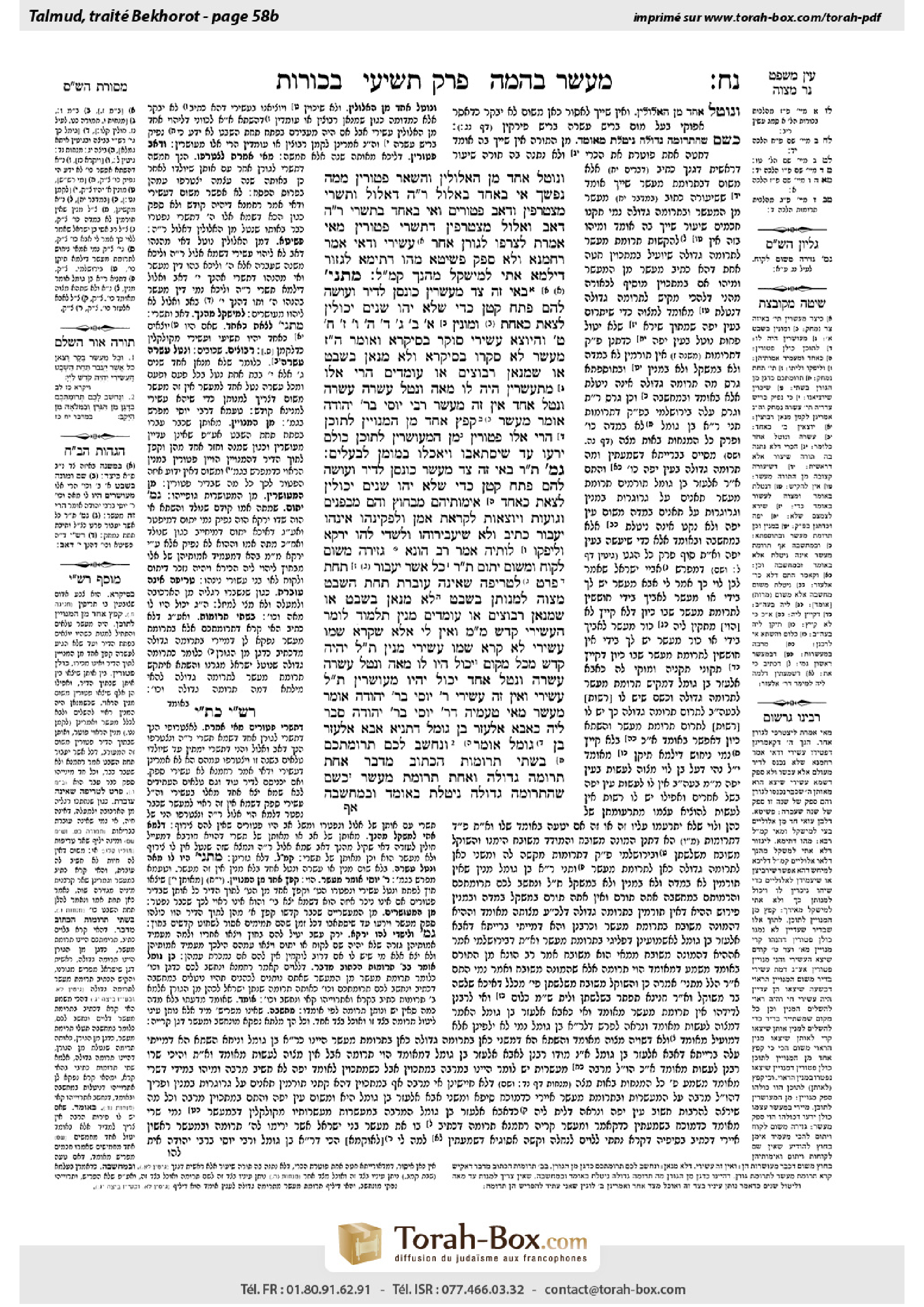
Bekhorot 58b: Talmud study for Daf Yomi
Study the Talmud for Daf Yomi with scanned pages, Hebrew text, English translations from Sefaria and AI-generated French translations.
Passage selection and English or AI-generated French translation are available where the scan has annotations. Daf Study is independent of Torah-Box and Sefaria.
Browse Bekhorot · בכורות · All tractatesBekhorot 58b text and translations
This page of Bekhorot includes the Aramaic text, an English translation and an AI-generated French translation, alongside the scan above.
בכורות נ״ח ב · Aramaic and Hebrew text
וְנוֹטֵל אֶחָד מִן הָאֱלוּלִין וְהַשְּׁאָר פְּטוּרִין, מִמָּה נַפְשָׁךְ: אִי בְּאֶחָד בֶּאֱלוּל רֹאשׁ הַשָּׁנָה — דֶּאֱלוּל וְתִשְׁרִי מִצְטָרְפִין וּדְאָב פְּטוּרִים, וְאִי בְּאֶחָד בְּתִשְׁרִי רֹאשׁ הַשָּׁנָה — דְּאָב וֶאֱלוּל מִצְטָרְפִין דְּתִשְׁרִי פְּטוּרִין.
מַאי אָמְרַתְּ: לִצְטַרְפוּ לְגוֹרֶן אַחֵר? עֲשִׂירִי וַדַּאי אָמַר רַחֲמָנָא, וְלֹא סָפֵק.
פְּשִׁיטָא! מַהוּ דְּתֵימָא לִגְזוֹר, דִּילְמָא אָתֵי לְמִישְׁקַל מֵהָנָךְ, קָא מַשְׁמַע לַן.
מַתְנִי׳ בְּאֵי זֶה צַד מְעַשְּׂרִין? כּוֹנְסָן לַדִּיר, וְעוֹשֶׂה לָהֶם פֶּתַח קָטָן כְּדֵי שֶׁלֹּא יְהוּ שְׁנַיִם יְכוֹלִין לָצֵאת כְּאֶחָת, וּמוֹנִין: אֶחָד, שְׁנַיִם, שְׁלֹשָׁה, אַרְבָּעָה, חֲמִשָּׁה, שִׁשָּׁה, שִׁבְעָה, שְׁמוֹנָה, תִּשְׁעָה, וְהַיּוֹצֵא עֲשִׂירִי סוֹקֵר בְּסִיקְרָא וְאוֹמֵר: ״הֲרֵי זֶה מַעֲשֵׂר״. לֹא סְקָרוֹ בְּסִיקְרָא, וְלֹא מְנָאָן בַּשֵּׁבֶט, אוֹ שֶׁמְּנָאָן רְבוּצִים אוֹ עוֹמְדִים — הֲרֵי אֵלּוּ מִתְעַשְּׂרִין.
הָיָה לוֹ מֵאָה וְנָטַל עֲשָׂרָה, עֲשָׂרָה וְנָטַל אֶחָד — אֵין זֶה מַעֲשֵׂר. רַבִּי יוֹסֵי בְּרַבִּי יְהוּדָה אוֹמֵר: מַעֲשֵׂר. קָפַץ אֶחָד מִן הַמְּנוּיִין לְתוֹכָן — הֲרֵי אֵלּוּ פְּטוּרִין, מִן הַמְעוּשָּׂרִין לְתוֹכָן — כּוּלָּם יִרְעוּ עַד שֶׁיִּסְתָּאֲבוּ, וְיֵאָכְלוּ בְּמוּמָן לַבְּעָלִים.
גְּמָ׳ תָּנוּ רַבָּנַן: בְּאֵי זֶה צַד מְעַשֵּׂר? כּוֹנְסָן לַדִּיר, וְעוֹשֶׂה לָהֶם פֶּתַח קָטָן כְּדֵי שֶׁלֹּא יְהוּ שְׁנַיִם יְכוֹלִין לָצֵאת כְּאֶחָד, אִימּוֹתֵיהֶם מִבַּחוּץ וְהֵם מִבִּפְנִים, וְגוֹעוֹת, וְיוֹצְאוֹת לִקְרַאת אִמָּן.
וְלַפְּקִינְהוּ אִינְהוּ! ״יַעֲבוֹר״ כְּתִיב, וְלֹא שֶׁיַּעֲבִירוּהוּ.
וְלִשְׁדֵּי לְהוּ יַרְקָא וְלִיפְּקוּ לְוָתֵיהּ! אָמַר רַב הוּנָא: גְּזֵירָה מִשּׁוּם לָקוּחַ וּמִשּׁוּם יָתוֹם.
תָּנוּ רַבָּנַן: ״כׇּל אֲשֶׁר יַעֲבֹר תַּחַת״ — פְּרָט לַטְּרֵיפָה שֶׁאֵינָהּ עוֹבֶרֶת תַּחַת הַשָּׁבֶט. מִצְוָה לִמְנוֹתָן בְּשֵׁבֶט. לֹא מְנָאָן בְּשֵׁבֶט, אוֹ שֶׁמְּנָאָן רְבוּצִים אוֹ עוֹמְדִים, מִנַּיִן? תַּלְמוּד לוֹמַר: ״הָעֲשִׂירִי קֹדֶשׁ״ — מִכׇּל מָקוֹם.
וְאֵין לִי אֶלָּא שֶׁקְּרָא שְׁמוֹ ״עֲשִׂירִי״, לֹא קְרָא שְׁמוֹ ״עֲשִׂירִי״ מִנַּיִן? תַּלְמוּד לוֹמַר ״יִהְיֶה קֹּדֶשׁ״ מִכׇּל מָקוֹם. יָכוֹל הָיוּ לוֹ מֵאָה וְנָטַל עֲשָׂרָה, עֲשָׂרָה וְנָטַל אֶחָד, יָכוֹל יִהְיוּ מְעוּשָּׂרִין? תַּלְמוּד לוֹמַר ״עֲשִׂירִי״, וְאֵין זֶה עֲשִׂירִי. רַבִּי יוֹסֵי בְּרַבִּי יְהוּדָה אוֹמֵר: מַעֲשֵׂר.
מַאי טַעְמֵיהּ דְּרַבִּי יוֹסֵי בְּרַבִּי יְהוּדָה? סָבַר לֵיהּ כְּאַבָּא אֶלְעָזָר בֶּן גּוֹמֵל, דְּתַנְיָא: אַבָּא אֶלְעָזָר בֶּן גּוֹמֵל אוֹמֵר: ״וְנֶחְשַׁב לָכֶם תְּרוּמַתְכֶם״ — בִּשְׁתֵּי תְרוּמוֹת הַכָּתוּב מְדַבֵּר, אַחַת תְּרוּמָה גְּדוֹלָה, וְאַחַת תְּרוּמַת מַעֲשֵׂר.
כְּשֵׁם שֶׁהַתְּרוּמָה גְּדוֹלָה נִיטֶּלֶת בְּאוֹמֶד וּבְמַחְשָׁבָה —
Bekhorot 58b · English translation
and he takes one of the animals born in Elul as the tithe, and the remainder are exempt, whichever way you look at it. Rava explains: If the new year for animal tithe is on the first of Elul, then the animals born in Elul and Tishrei combine to form a total of ten, and the animals born in Av are exempt, as they are from the previous year and there are less than ten of them. And if the new year is on the first of Tishrei, the animals born in Av and Elul combine to form a total of ten, whereas the animals born in Tishrei are exempt.
The Gemara raises a difficulty with regard to the opinion of Rava: What are you saying? Why are the five animals born in Tishrei exempt? Let them combine with animals at another time of gathering to form a total of ten. Rather, what is the reason one is not required to tithe these five animals born in Tishrei? It is because the Merciful One states: “And all the tithe of the herd or the flock, whatever passes under the rod, the tenth shall be sacred to the Lord” (Leviticus 27:32), from which it is derived that a definite tenth must be tithed, and not an uncertain tenth, i.e., an animal that is not definitely the tenth. If the first of Elul is the new year, then the five born in Tishrei would have combined with the five of Elul and are exempt. Therefore, the obligation in this case is uncertain.
Rava said he takes one of the animals born in Elul as the tithe. The Gemara asks: Isn’t it obvious that he must take one of those animals, as those are the only ones concerning which the obligation is definite? The Gemara answers: It is necessary for Rava to specify this lest you say the Sages should decree that one should not even take one of the animals born in Elul as a tithe, as perhaps he might come to take from those that were born in Av or Tishrei by mistake. Therefore, Rava teaches us that the Sages are not concerned about this error.
MISHNA: In what manner does one tithe the animals? He gathers them in a pen and provides them with a small, i.e., narrow, opening, so that two animals will not be able to emerge together. And he counts the animals as they emerge: One, two, three, four, five, six, seven, eight, nine; and he paints the animal that emerges tenth with red paint and declares: This is tithe. Even if he did not paint it with red paint, or if he did not count the animals with a rod in accordance with the verse: “Whatever passes under the rod, the tenth shall be sacred to the Lord” (Leviticus 27:32), or if he counted the animals when they were prone or standing in place and did not make them pass through a narrow opening, these animals are tithed after the fact.
But if he had one hundred animals and he took ten as tithe, or if he had ten animals and he simply took one as tithe, that is not tithe, as he did not count them one by one until reaching ten. Rabbi Yosei, son of Rabbi Yehuda, says: In that case too, it is tithe. If before the owner completed tithing his animals, one of those already counted jumped back into the pen among the animals that had not yet been counted, all those in the pen are exempt from being tithed, as each of them might be the animal that was already counted. If one of those animals that had been tithed, i.e., designated as the tenth, jumped back into the pen among the animals that had not yet been counted, creating uncertainty with regard to all the animals there which was the animal tithe, all the animals must graze until they become unfit for sacrifice, and each of them may be eaten in its blemished state by its owner once it develops a blemish.
GEMARA: The Sages taught in a baraita: In what manner does one tithe his animals? He gathers them in a pen and provides them with a small, i.e., narrow, opening so that two animals will not be able to emerge together. The mothers of those animals stand outside, and the newborn animals to be tithed are inside the pen. And the mothers bleat and the young ones emerge toward their mothers.
The Gemara asks: But why is it performed this way? Let the owner simply make them emerge from the pen by pushing them. The Gemara answers that it is written: “Whatever passes under the rod, the tenth shall be sacred to the Lord” (Leviticus 27:32). This means that the animal must pass under the rod of its own volition, and not that one will cause it to pass by pushing it out of the pen.
The Gemara asks: But why not simply throw the animals a vegetable outside the pen, and they will go out toward it to eat it? Rav Huna said: The use of the mothers is a rabbinic decree due to a purchased animal and due to an orphan, i.e., a baby animal whose mother died before it was born. Neither of these animals is subject to tithing. Since neither a purchased animal nor an orphaned animal will have its mother outside calling to it, these animals will remain in the pen and will not be tithed accidentally.
The Sages taught in a baraita: “Whatever passes under the rod, the tenth shall be sacred to the Lord” (Leviticus 27:32); this teaches that all animals may be sanctified as animal tithe, excluding a tereifa, as on account of its physical state it does not pass under the rod. The phrase “under the rod” teaches that it is a mitzva to count them with a rod. If one did not count them with a rod, or he counted them when they were prone or standing, from where is it derived that the tenth animal is nevertheless sanctified? The verse states: “The tenth shall be sacred,” indicating that the tenth animal is sacred in any case, even if it was not tithed correctly.
The baraita continues: And I have derived only that an animal that one explicitly called by the name of the tenth one is the animal tithe. From where do I derive that the tenth animal is sanctified even if one did not explicitly call it the tenth one? The verse states: “Shall be sacred.” This teaches that it shall be sacred in any case, even if it was not called the tenth. One might have thought with regard to one who had one hundred animals and simply took ten of them without counting them, or one who had ten animals and took one of them without counting, one might have thought that they should be considered tithed. Therefore, the verse states: “The tenth,” and this animal that he removed is not the tenth, as he did not count the animals. Rabbi Yosei, son of Rabbi Yehuda, says: Even if he simply removed one animal from ten without counting, that animal is tithe.
The Gemara asks: What is the reason of Rabbi Yosei, son of Rabbi Yehuda? The Gemara answers: He holds in accordance with the opinion of Abba Elazar ben Gomel. As it is taught in a baraita that Abba Elazar ben Gomel says with regard to the verse: “And your teruma shall be reckoned to you as though it were the grain of the threshing floor” (Numbers 18:27), that in using the plural form of the term “your,” the verse speaks about two terumot. One is standard teruma, i.e. the grain of the threshing floor, and the other one is teruma of the tithe. The verse equates these two terumot.
Abba Elazar ben Gomel explains: Just as standard teruma is taken by estimate, as there is no requirement for the amount separated to be measured precisely, and it can be taken by thought, as one is not required to physically separate it before consuming the remaining produce,
Bekhorot 58b · Traduction française (IA)
et il prend un des animaux nés en Elul comme dîme, et les autres sont exemptés, quels que soient les regards. Rava explique : Si la nouvelle année pour la dîme des animaux est le premier d'Elul, alors les animaux nés en Elul et Tishrei forment ensemble un total de dix, et les animaux nés en Av sont exemptés, car ils appartiennent à l'année précédente et leur nombre est inférieur à dix. Et si la nouvelle année est le premier de Tishrei, les animaux nés en Av et Elul forment ensemble un total de dix, tandis que les animaux nés en Tishrei sont exemptés.
La Guemara soulève une difficulté concernant l'opinion de Rava : Que veux-tu dire ? Pourquoi les cinq animaux nés en Tishrei sont-ils exemptés ? Laissons-les se combiner avec d'autres animaux à un autre moment de rassemblement pour former un total de dix. Plutôt, quelle est la raison pour laquelle on n'est pas tenu de dîmer ces cinq animaux nés en Tishrei ? C'est parce que l'Éternel dit : « Et toute la dîme du troupeau ou de l'herd, ce qui passe sous le bâton, le dixième sera consacré à l'Éternel » (Lévitique 27:32), d'où on déduit que la dîme doit être tithée de manière certaine, et non une dîme incertaine, c'est-à-dire un animal qui n'est pas certainement le dixième. Si le premier d'Elul est la nouvelle année, alors les cinq nés en Tishrei auraient combiné avec les cinq d'Elul et seraient exemptés. Par conséquent, l'obligation dans ce cas est incertaine.
Rava dit qu'il prend un des animaux nés en Elul comme dîme. La Guemara demande : N'est-ce pas évident qu'il doive prendre un de ces animaux, car ce sont les seuls concernant lesquels l'obligation est certaine ? La Guemara répond : Il est nécessaire que Rava précise cela afin que l'on ne dise pas que les Sages ont décidé que l'on ne devrait pas même prendre un des animaux nés en Elul comme dîme, car peut-être l'on pourrait prendre par erreur un des animaux nés en Av ou en Tishrei. Par conséquent, Rava nous enseigne que les Sages ne craignent pas cette erreur.
MICHNA : De quelle manière tithé-t-on les animaux ? Il les rassemble dans un enclos et lui donne une ouverture étroite, de sorte que deux animaux ne puissent pas sortir ensemble. Et il compte les animaux à mesure qu'ils sortent : Un, deux, trois, quatre, cinq, six, sept, huit, neuf ; et il peint l'animal qui sort dixième avec de la peinture rouge et déclare : Cet animal est la dîme. Même s'il n'a pas peint l'animal avec de la peinture rouge, ou s'il n'a pas compté les animaux avec un bâton selon la parole : « Ce qui passe sous le bâton, le dixième sera consacré à l'Éternel » (Lévitique 27:32), ou s'il a compté les animaux lorsqu'ils étaient allongés ou debout sans les faire passer par une ouverture étroite, ces animaux sont tithés après coup.
Mais si l'on avait cent animaux et l'on avait pris dix comme dîme, ou si l'on avait dix animaux et l'on avait simplement pris un comme dîme, cela n'est pas une dîme, car l'on n'a pas compté un par un jusqu'à dix. Rabbi Yosei, fils de Rabbi Yéhouda, dit : Dans ce cas-là aussi, c'est une dîme. Si avant que l'propriétaire n'ait terminé de tithé ses animaux, l'un de ceux déjà comptés est revenu dans l'enclos parmi les animaux non encore comptés, tous ceux dans l'enclos sont exemptés de tithé, car chacun d'eux pourrait être l'animal déjà compté. Si l'un des animaux déjà tithés, c'est-à-dire désigné comme dixième, est revenu dans l'enclos parmi les animaux non encore comptés, créant une incertitude concernant tous les animaux là qui était la dîme, tous les animaux doivent paître jusqu'à ce qu'ils deviennent inaptes à l'offrande, et chacun d'eux peut être mangé dans son état déficient par son propriétaire une fois qu'il développe une imperfection.
GUEMARA : Les Sages ont enseigné dans une baraïta : De quelle manière tithé-t-on ses animaux ? Il les rassemble dans un enclos et lui donne une ouverture étroite, de sorte que deux animaux ne puissent pas sortir ensemble. Les mères des animaux sont à l'extérieur, et les jeunes à tithé sont à l'intérieur de l'enclos. Et les mères mugissent et les jeunes sortent vers leurs mères.
La Guemara demande : Mais pourquoi est-ce fait ainsi ? L'propriétaire pourrait simplement les faire sortir de l'enclos en les poussant. La Guemara répond que cela est écrit : « Ce qui passe sous le bâton, le dixième sera consacré à l'Éternel » (Lévitique 27:32). Cela signifie que l'animal doit passer sous le bâton de son propre gré, et non qu'on le force à sortir de l'enclos en le poussant.
La Guemara demande : Mais pourquoi ne pas simplement jeter des légumes à l'extérieur de l'enclos, et les animaux sortiront vers eux pour les manger ? Rav Huna dit : L'utilisation des mères est un décret rabbinique en raison d'un animal acheté et d'un orphelin, c'est-à-dire un petit animal dont la mère est morte avant sa naissance. Ni ces animaux n'est soumis à la dîme. Puisque ni un animal acheté ni un orphelin n'aura sa mère à l'extérieur qui l'appelle, ces animaux resteront dans l'enclos et ne seront pas tithés accidentellement.
Les Sages ont enseigné dans une baraïta : « Ce qui passe sous le bâton, le dixième sera consacré à l'Éternel » (Lévitique 27:32) ; cela enseigne que tous les animaux peuvent être sanctifiés comme dîme, à l'exception d'un téréfah, car à cause de son état physique, il ne passe pas sous le bâton. La phrase « sous le bâton » enseigne que c'est un mitsva de les compter avec un bâton. Si l'on n'a pas compté avec un bâton, ou s'il a compté les animaux lorsqu'ils étaient allongés ou debout, d'où est-il déduit que le dixième animal est tout de même sanctifié ? La parole dit : « Le dixième sera consacré », indiquant que le dixième animal est consacré dans tous les cas, même s'il n'a pas été tithé correctement.
La baraïta continue : Et j'ai tiré seulement cela, qu'un animal que l'on a explicitement appelé par le nom du dixième est l'animal dîme. D'où tire-t-on que l'animal dîme est sanctifié même si l'on n'a pas explicitement appelé celui-ci le dixième ? La Sainte Écriture dit : « Doit être sacré. » Cela enseigne qu'il doit être sacré dans tous les cas, même s'il n'a pas été appelé le dixième. On pouvait penser, en ce qui concerne celui qui possède cent animaux et a simplement pris dix d'entre eux sans les compter, ou celui qui possède dix animaux et a pris l'un d'entre eux sans les compter, qu'ils devaient être considérés comme dîmes. Ainsi, la Sainte Écriture dit : « Le dixième », et cet animal qu'il a retiré n'est pas le dixième, car il n'a pas compté les animaux. Rabbi Yosei, fils de Rabbi Yéhuda, dit : Même s'il a simplement retiré un animal parmi dix sans les compter, cet animal est dîme.
Le Guemara demande : Quel est le fondement de la position de Rabbi Yosei, fils de Rabbi Yéhuda ? Le Guemara répond : Il suit l'opinion d'Abba Elazar ben Gomel. Comme il est enseigné dans une baraïta, Abba Elazar ben Gomel dit concernant la Sainte Écriture : « Et votre terouma sera comptée pour vous comme si elle était la céréale du tapis de meunier » (Nombres 18:27), que l'emploi du pluriel du terme « votre » indique qu'il s'agit de deux terumot. L'une est la terouma ordinaire, c'est-à-dire la céréale du tapis de meunier, et l'autre est la terouma de la dîme. La Sainte Écriture établit l'équivalence entre ces deux terumot.
Abba Elazar ben Gomel explique : Comme la terouma ordinaire est prise par estimation, car il n'y a pas de nécessité de mesurer précisément la quantité séparée, et qu'elle peut être prise par pensée, car l'on n'est pas tenu de séparer physiquement avant de consommer les produits restants,
Traduction française générée par IA à partir de l’édition anglaise de Sefaria. Vérifie toujours un passage avec le texte source.
Text from Sefaria: William Davidson Edition - Vocalized Aramaic (CC BY NC); William Davidson Edition - English (CC BY NC).